Feed Management Planners Certification Program to Reduce Nutrient Loads in Impaired Watersheds

Waste to Worth: Spreading science and solutions logoWaste to Worth home | More proceedings….

Why Develop a Feed Management Certification Program?

To develop a program to train ARPAS-certified (American Registry of Professional Animal Scientists) dairy and beef nutritionists on how to prepare and evaluate Feed Management plans as it relates to the NRCS Feed Management (592) practice in Pennsylvania. The objective is to compare how formulated diets match to the consumed diets. Phosphorus is monitored through manure testing and nitrogen by milk urea nitrogen and calculating milk nitrogen efficiency. Dry matter intake efficiency is also monitored as this can affect the total manure volume excreted.

What Did We Do?

In 2007, Mid-Atlantic Water Program (MAWP) scientists applied the national feed management program to meet the needs of dairy consultants to implement feed management in the Chesapeake Basin. This program certifies consultants in precision feed management, a practice that reduces nutrient loads in animal wastes by minimizing the phosphorus and nitrogen content in the feed. 

With the recent release of the US Environmental Protection Agency’s Total Maximum Daily Load for the Chesapeake Bay, the agricultural community is looking for the best practices to control nutrient pollution while minimizing impacts to profit. Over the years, the work of this project team has established precision feed management as both an economically and environmentally viable best management practice.  As such, state watershed implementation plans include precision feed management as a method to meet load allocations.

Pennsylvania currently has twenty-four NRCS qualified nutritionists to write feed management plans. In 2011, fifty-one operations received EQIP or CBWI funding through USDA-NRCS for feed management, with the majority consisting of dairy farms.  An additional 10 farms entered into contracts with NRCS in 2012.  Farms are currently in the process of being assessed on how well they implemented recommendations from the first year of quarterly reports and are working through their second year of implementation.

Additional efforts have been implemented to educate consultants about the regulations and issues affecting dairy producers. Currently, the Pennsylvania team is working with producers to monitor income over feed costs and to develop cash flow plans, which provides the opportunity to implement precision feeding practices while monitoring the economic benefits to the herd.  A study of six component fed dairy herds in Pennsylvania is also being completed to evaluate the effects of the feed, forage, and manure sampling protocols along with feeding order on fecal phosphorus levels and to update current sampling recommendations.

Funding from the MAWP was critical to providing these trainings and projects and establishing precision feed management as a best management practice that farmers can realistically utilize.  The infrastructure is in place to address the demand for more feed management plans and the MAWP will continue to meet the educational needs of this audience.

What Have We Learned?

There are a lot of opportunities on farms to improve feed management and nutrient balance. Challenges have been observed pertaining to nutrient reduction strategies that could impact overall nutrient balances in dairy and beef rations. Many of these challenges are greatly influenced by the volatility in today’s commodity pricing. Producers need to become more engaged in what they are feeding and how it affects their profitability.  It has been observed that inorganic phosphorus is still being used in grain mixtures when rations contain high phosphorus forages or inclusion of byproduct feeds. We have also observed some challenges in obtaining test analyses for complete grain and mineral mixes on a regular basis.  More education is needed for both industry professionals as well as producers.

Future Plans

As the feed management program in Pennsylvania progresses, pounds of phosphorus excreted can be tracked to monitor the effects of reducing phosphorus in dairy and beef rations. This can be used to evaluate its effect on water quality and potential phosphorus accumulations in the soil when manure is applied to crops at nitrogen-based rates. Crop rotations, inclusion of alternative forages and whole farm nutrient balance will be included in future trainings and feed management plans. The Penn State Extension Dairy team is also working on the development of a Feed Management mobile app for producers and nutritionist to be able to track and monitor their progress on nutrient reductions in their rations.

Authors

Daniel Ludwig, Natural Resources Specialist, USDA – NRCS, dan.ludwig@pa.usda.gov

Virginia Ishler, Dairy Complex Manager/Nutrient Specialist, Penn State University

Rebecca White, Program Manager-Penn State Extension Dairy Team

Additional Information

Feed Management for Producers

Pennsylvania NRCS on Feed Management


The authors are solely responsible for the content of these proceedings. The technical information does not necessarily reflect the official position of the sponsoring agencies or institutions represented by planning committee members, and inclusion and distribution herein does not constitute an endorsement of views expressed by the same. Printed materials included herein are not refereed publications. Citations should appear as follows. EXAMPLE: Authors. 2013. Title of presentation. Waste to Worth: Spreading Science and Solutions. Denver, CO. April 1-5, 2013. URL of this page. Accessed on: today’s date.
Integrating Probable Fieldwork Days into Nutrient Management Plans

Waste to Worth: Spreading science and solutions logoWaste to Worth home | More proceedings….

Abstract

Weather conditions impact land application of manure.  Wet soils hinder equipment from accessing fields.  Regulations prohibit application on frozen or snow cover soils.  Uncertain soil and atmospheric conditions can cause the best plans to fail.  Nutrient management plans that are expected to succeed might fail given any particular year’s weather. Incorporating fieldwork days information into nutrient management plans can make them more robust to uncertain weather conditions.

The USDA publishes the number of fieldwork days for different crop reporting districts within states. These data are from field reporters who provide their opinion on the number of days that were available for farmers to conduct fieldwork such as disking, planting and harvesting.  USDA Fieldwork Days data cover the growing season (approximately April to December). Estimates of fieldwork days do not exist for the non-growing season (approximately December to April).  However, certain states have agricultural weather station networks that collect soil temperature and other critical information that can be used to estimate the number of fieldwork days that exist for manure application within regulatory limits.

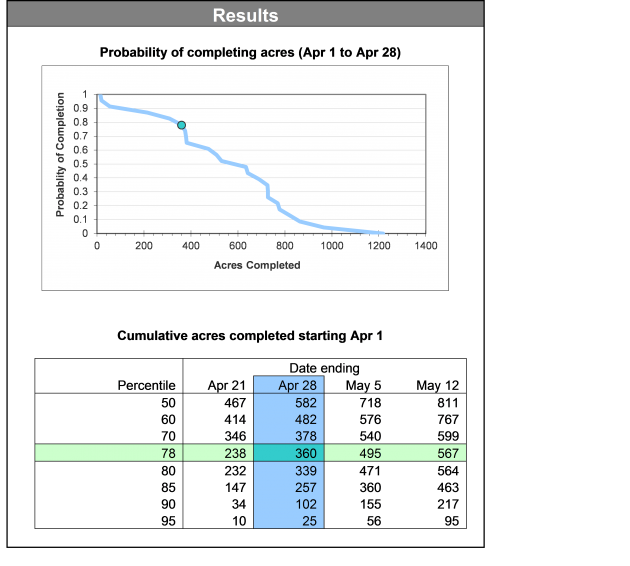
This project integrates fieldwork days from the USDA Fieldwork Days data with the Missouri Agricultural Weather Station Network winter soil temperature and precipitation data for the corresponding crop reporting district.  This compiled database gives a complete year of fieldwork day estimates.  The data are used in a model that allows nutrient management planners to incorporate climatological impacts into their land application plans.  Users specify their equipment complement and size, quantity of manure, and desired beginning and ending dates.  The model reports output in a cumulative distribution function that estimates the probability of completing fieldwork within the specified parameters and a sensitivity table of ending dates.

Why Consider Fieldwork Days for Nutrient Planning?

We currently have no mechanism to evaluate the feasibility of implementing nutrient management plans.  A plan that successfully finds sufficient fields for using nutrients in manure may fail because there is insufficient time to apply manure with the designated equipment.  Incorporating fieldwork day information into the nutrient management planning process could make plans more robust, informing the planner and farmer how likely the plan will succeed.

What Did We Do?

This project developed two spreadsheets that help nutrient management planners incorporate USDA and climatic data into their plans to estimate the likelihood of successfully completing the plan objectives.

The first spreadsheet incorporates fieldwork day data from the USDA with machinery management decisions to estimate the probability of completing manure application within a planned window.  This spreadsheet and data report the number of days in a week when fieldwork can be done in various regions of the state during the period April through November.  The second spreadsheet integrates soil temperature and precipitation data from the Missouri Agricultural Weather Station Network to estimate the probability of completing manure application within a planned window during the months of December through March period.

Users specify their equipment complement and size, quantity of acres receiving manure, desired beginning and ending dates for manure application, and hours per day and days per week they can apply manure.  The model reports output in a cumulative distribution function that estimates the probability of completing fieldwork within the specified parameters and a sensitivity table of ending dates.

Sample output of the probability of completing necessary fieldwork.

What Have We Learned?

Plans do not normally consider the feasibility of accomplishing manure application within an appropriate time frame.  Missouri fieldwork day data indicate that time available for field work varies significantly over the year and within the state at any given time.    For example, a nutrient management plan that requires 100 hours of application time in northwest MO during the month of April would be successful 78% of the time.  The same nutrient management plan needing 100 hours of fieldwork during February would be successful 40% of the time.  In April the median number of fieldwork days 11.5 days compared to 8.3 days in February.

Sample imput screen for describing the manure application parameters.

Future Plans

We will expand the tool beyond Missouri.  We are looking for funding opportunities to integrate it into our nutrient management plan document generators.

Authors

John Lory, Associate Professor of Extension, Plant Science Divsion, University of Missouri loryj@missouri.edu

Dr. Ray Massey, Professor of Extension, Agricultural Economics, University of Missouri

Pat Guinan, Assistant Professor of Extension, Soil and Environmental Systems, University of Missouri

Additional Information

The spreadsheets that incorporates fieldwork days into manure management decisions can be obtained at swine.missouri.edu/manure/ under the link names of Probable Fieldwork Days and Probable Winter Fieldwork Days.

Acknowledgements

Scott Gerlt and Brent Carpenter of the Food and Agriculture Policy Institute created the initial spreadsheet tool.


The authors are solely responsible for the content of these proceedings. The technical information does not necessarily reflect the official position of the sponsoring agencies or institutions represented by planning committee members, and inclusion and distribution herein does not constitute an endorsement of views expressed by the same. Printed materials included herein are not refereed publications. Citations should appear as follows. EXAMPLE: Authors. 2013. Title of presentation. Waste to Worth: Spreading Science and Solutions. Denver, CO. April 1-5, 2013. URL of this page. Accessed on: today’s date.

Silage Runoff Treatment

Waste to Worth: Spreading science and solutions logoWaste to Worth home | More proceedings….

Abstract

Agricultural filter strips are commonly used to treat runoff from agricultural farmstead areas.  Many filter strips have been assessed in terms of surface water quality impacts but have failed to determine the fate of pollutants once they have infiltrated the soil subsurface.  Two side-by-side filter strips plots were installed to assess the performance of and determine the fate of contaminants in a filter strip system.  One of the two plots also contained a pretreatment system to facilitate nitrogen removal in an attempt to reduce nitrate leaching.  Both plots were lined with an impermeable membrane to collect subsurface leachate as well as surface runoff.  A mass balance could then be determined for these filter strip systems to assess the fate of nutrients and the ability of a low cost pretreatment system to reduce nitrate leaching.

Filter-strip Construction

Why Is It Important to Prevent Runoff from Silage Piles from Reaching Water?

Silage runoff, or the flow of surface excess water over an area containing silage or silage leachate, contains nutrients harmful to watersheds.  A filter-strip, a long narrow buffer strip used in agriculture as a BMP, could be used to reduce nutrient concentrations within silage runoff.  A study that investigates design storm loading and seasonal operation could benefit producers and their surrounding watershed.  A pre-treatment design consisting of an aerobic and anaerobic section, is also analyzed to quantify improvements in pollutant reduction.

What Did We Do?

Before Establishment of Vegetation

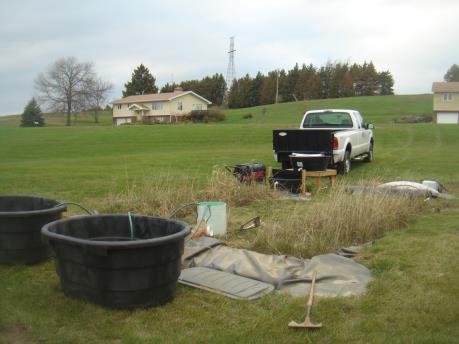
Two experimental filter-strips, one control and one pre-treatment design, were applied with silage runoff at volumes and rates corresponding to a 25 year – 24 hour and a 2 year – 24 hour design storm.  Design storm rates and volumes were determined from the runoff modeled from a 1:1 dairy bunker to filter strip area.  Three runs of each design storm were accomplished throughout the months of October, November, and early December 2012.

What Have We Learned?

The pre-treatment filter strip design distributed higher BOD5 reduction however, nitrite concentrations increased in the effluent.  Application in November and December had lower infiltration and changes in ammonia reduction were illustrated. 

Experimental Filter-strip and Sampling

Future Plans

Applications in the spring  and summer will determine further seasonal variation.  Expanding design storms applied will help determine prescriptive loading and aid in modeling.

Authors

Michael Holly, Master’s Candidate Biological System Engineering, University of Wisconsin – Madison, maholly@wisc.edu

Dr. Rebecca Larson, Assistant Professor and Extension Specialist, University of Wisconsin – Madison

Acknowledgements

Zach Zopp, Lab and Field Tech

Shayne Havlovitz, Undergraduate Research Assistant


The authors are solely responsible for the content of these proceedings. The technical information does not necessarily reflect the official position of the sponsoring agencies or institutions represented by planning committee members, and inclusion and distribution herein does not constitute an endorsement of views expressed by the same. Printed materials included herein are not refereed publications. Citations should appear as follows. EXAMPLE: Authors. 2013. Title of presentation. Waste to Worth: Spreading Science and Solutions. Denver, CO. April 1-5, 2013. URL of this page. Accessed on: today’s date.

Silage Runoff Characterization

Waste to Worth: Spreading science and solutions logoWaste to Worth home | More proceedings….

Abstract

Silage leachate is a high strength waste which contributes to surface and groundwater contamination of various pollutants from runoff, direct leaching through concrete storage structures, and infiltration of runoff. Feed storage is required for the majority of dairy operations in the country (which are expanding in size and fed storage requirements) leading to widespread potential contamination. Limited data on silage leachate quality and treatment has made management and regulation based solely on observation. This project investigated three bunker silage storage sites to assess the water quality characteristics of silage leachate and runoff from various feed sources and surrounding environmental factors. Surface samples were collected from feed storage structures and analyzed for numerous water quality parameters. Using collected hydrologic data, contaminant loading was analyzed for various storm events and assessed for first flush effects and potential to impact handling and treatment designs. Determination of first flush provides essential data for separation of waste streams (high and low strength) to ease management in terms of operation and cost, reduce loading to treatment systems, and reducing the overall environmental impact.

Why Is It Important to Characterize Silage Leachate?

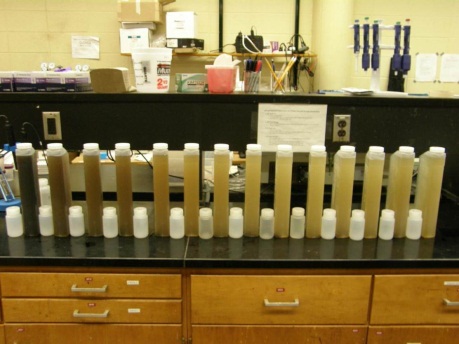
Silage Runoff Samples from an October Rain Event

Silage runoff, or the flow of surface excess water over an area containing silage or silage leachate, contains nutrients harmful to watersheds. Nutrient concentrations within silage runoff are variable and are dependent on event size, seasonality, bunker condition, and concentration of silage. Knowledge of nutrient loading thoughout a storm can benefit silage runoff storage and treatment standards.

What Did We Do?

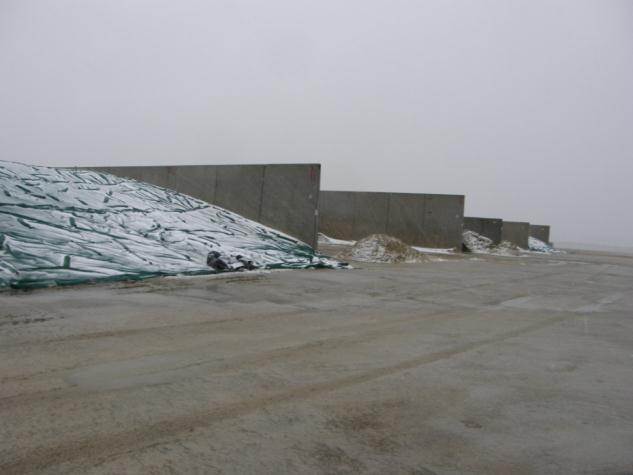
Three horizontal bunkers in south central Wisconsin were anzlyzed over the seasons of fall, spring and summer.  Two of the bunkers sampled were designed with subsurface leachate collection.  Runoff was collected using ISCO automated samplers and samples were triggered by flow rate. Water quality analysis was completed on the campus of University of Wisconsin – Madison and alkalinity, NH3, BOD5, COD, NO2, NO3, ortho-p, pH, TKN, TP and TS were analyzed. Thirty-five storms in total were analyzed ranging from 0.03 – 1.74 inches.

Horizontal Dairy Bunker During a Storm Event

What Have We Learned?

Seasonality can impact the nutrient concentrations within silage runoff.  Normalized cumulative pollution load curves illustrate moderate first flush in the fall and a moderate delayed load curve in the summer.

Future Plans

Correlating silage runoff concentrations with bunker conditions such as date, amount filled, moisture content, and amount of litter present on pad could help explain seasonal variability.  Collection of future storms could aid in explaining variances and facilitate modeling.

Authors

Michael Holly, Master’s Candidate Biological System Engineering, University of Wisconsin – Madison, maholly@wisc.edu

Dr. Rebecca Larson, Assistant Professor and Extension Specialist, University of Wisconsin – Madison

Acknowledgements

Zach Zopp, Lab and Field Tech

Shayne Havlovitz, Undergraduate Research Assistant


The authors are solely responsible for the content of these proceedings. The technical information does not necessarily reflect the official position of the sponsoring agencies or institutions represented by planning committee members, and inclusion and distribution herein does not constitute an endorsement of views expressed by the same. Printed materials included herein are not refereed publications. Citations should appear as follows. EXAMPLE: Authors. 2013. Title of presentation. Waste to Worth: Spreading Science and Solutions. Denver, CO. April 1-5, 2013. URL of this page. Accessed on: today’s date.
Waste Disposal by the Veterinary Community

Waste to Worth: Spreading science and solutions logoWaste to Worth home | More proceedings….

The American Veterinary Medical Association (AVMA) offers several resources to its members and the public regarding various disposal issues encountered by the veterinary community and animal owners.  With its veterinary medical expertise, the veterinary profession can be a valuable resource for clients, the general public, regulators, and other stakeholders on carcass and other animal waste disposal issues, especially those involving potential health risks to other animals or the public.  The purpose in developing these resources is to further increase awareness by the veterinary profession and its stakeholders of the value, potential hazards, and legal restrictions concerning disposal of animal waste and carcasses.

What Did We Do?

The AVMA has established policies related to the disposal of animal waste and carcass disposal.  Three key policies include “Appropriate Animal Carcass Disposal,” “Animal Carcass Risk in Natural Disasters,” and “Animal Agriculture Waste Management.”  All of the AVMA policies related to waste issues can be found at https://www.avma.org/PracticeManagement/Administration/Pages/AVMA-Policies-Relevant-to-Waste-Disposal.aspx.

  1. Appropriate Animal Carcass Disposal

The AVMA advocates safe and environmentally responsible disposal of animal carcasses, whether on an individual animal basis or during mass mortality events. As such, the AVMA supports increased research and education towards the development of appropriate methods and guidelines for animal carcass disposal.

  1. Animal Carcass Risk in Natural Disasters

Consistent with current scientific literature and the conclusions of the Pan American Health Organization (PAHO), the AVMA recognizes that animals that die from injuries, including massive animal deaths in cases of natural disasters, generally do not represent a health hazard for humans. The presence of dead bodies that result from a disaster, without the presence of another risk factor, is not the cause for the spread of infectious diseases. (1PAHO Manual, Ch 3, Conclusions; p. 81)

1 Management of Dead Bodies in Disaster Situations, Disaster Manuals and Guidelines Series, number 5. Pan American Health Organization, Area on Emergency Preparedness and Disaster Relief, and the World Health Organization, Department for Health Action in Crisis. Washington, DC, 2004.

  1. Animal Agriculture Waste Management

The AVMA supports the basic premises of current federal and state legislation and regulations enacted to prevent negative environmental impacts from wastes generated by terrestrial or aquatic animal productions. Veterinarians should be aware of the value, potential hazards, and legal restrictions concerning animal waste.

Therefore the AVMA supports the following:

  • Education, outreach, and extension programs to assist producers in meeting or exceeding current federal and state requirements. This includes aid in establishing and implementing nutrient management plans as well as design and construction of effective waste management facilities to prevent contamination of the environment.
  • Science based research on animal waste management systems and procedures to allow animal waste materials to be utilized as nutrient sources for sustainable agriculture systems.
  • Scientific studies of the impact of pathogens and chemicals from animal/human waste sources on the environment.

Additionally, the AVMA has developed the microsite, www.avma.org/wastedisposal.  Sections of the microsite addressing topics such as “Federal Regulations of Waste Disposal,” “State-based Waste Disposal Resources,” and “AVMA Policies Relevant to Waste Disposal,” are accessible by the general public.  Specific “Clinical Resources” pages, such as “Animal Carcass Disposal,” “Animal Waste Disposal,” “Recordkeeping,” and more are accessible only by AVMA members.  On a similar note and because of its expertise, the Association was consulted during the development of the Veterinary Compliance Assistance (VetCA) website (www.vetca.org) by the National Center for Manufacturing Sciences under the National Compliance Assistance Centers program. Funding for this latter project has been provided by the U.S. Environmental Protection Agency.

In addition to the pharmaceutical disposal information within the aforementioned resources, the AVMA has partnered with the National Sea Grant Office (NSGO), Office of Oceanic and Atmospheric Research, National Oceanic and Atmospheric Administration (NOAA), U.S. Department of Commerce to combine efforts and develop a joint outreach and educational campaign for veterinary clients regarding proper pharmaceutical disposal.  Information and products associated with the collaborative effort are available at www.avma.org/unwantedmeds.

The “Green Veterinary Practices” microsite has also been developed by the AVMA.   The web pages provide AVMA members and the public information on sustainable practices.  Not only does the site discuss what the AVMA is doing, it also provides resources for integrating eco-friendly features into veterinary practices as well as opportunities for including eco-friendly practices in facility designs.  The microsite is available at https://www.avma.org/green-veterinary-practices

In addition to policy and resource development, the AMVA is active in advocacy.  Related to waste issues, the Association has weighed in on Federal Register items such as Docket Number [EPA-HQ-OW-2011-0188], the National Pollutant Discharge Elimination System (NPDES) Concentrated Animal Feeding Operation (CAFO) Reporting Rule and Docket Number [EPA-OW-2011-0466], Draft Recreational Water Quality Criteria and Request for Scientific Views.  To see additional topics as well as the AVMA’s comments, please visit https://www.avma.org/advocacy/national-advocacy.  In 2012, the AVMA joined the Agriculture and Food Research Initiative (AFRI) Coalition urging Congress to support the $325 million for the AFRI in the President’s Fiscal year 2013 budget proposal.  To view all of the AVMA’s advocacy information, please click on “Advocacy” from the AVMA’s home page, www.avma.org.

What Have We Learned?

Integrative efforts of multiple disciplines and stakeholders are needed to better enhance the science of waste management as well as to help bridge the gaps between such science and sociopolitical opinions.

Future Plans

As stated in its policies, the AVMA will continue to advocate for safe and environmentally responsible disposal of animal carcasses as well as support:

  • Education, outreach, and extension programs to assist producers in meeting or exceeding current federal and state requirements
  • Science based research on animal waste management systems and procedures to allow animal waste materials to be utilized as nutrient sources for sustainable agriculture systems.
  • Scientific studies of the impact of pathogens and chemicals from animal/human waste sources on the environment.

Authors

Kristi Henderson, DVM, Assistant Director, Scientific Activities Division, American Veterinary Medical Association khenderson@avma.org

Additional Information

http://www.avma.org

The authors are solely responsible for the content of these proceedings. The technical information does not necessarily reflect the official position of the sponsoring agencies or institutions represented by planning committee members, and inclusion and distribution herein does not constitute an endorsement of views expressed by the same. Printed materials included herein are not refereed publications. Citations should appear as follows. EXAMPLE: Authors. 2013. Title of presentation. Waste to Worth: Spreading Science and Solutions. Denver, CO. April 1-5, 2013. URL of this page. Accessed on: today’s date.
Model of a Successful Regulatory-Industry Partnership to Address Air Emissions from Dairy Operations in Yakima, WA

Waste to Worth: Spreading science and solutions logoWaste to Worth home | More proceedings….

Why Is It Important for Industry and Regulators to Work Together?

The community in the Yakima Region of Washington State has raised concerns over the potential adverse effects of air emissions from dairy operations. To address these concerns, the Yakima Regional Clean Air Agency (YRCAA) proposed a policy process in October 2010 to control and mitigate emissions through implementation of site-specific best management practices (BMPs) on dairy operations. Absent a lack of reliable methodologies for estimating emissions from dairies, the YRCAA enrolled experts and scientists to help create tools that could be used for estimation of emissions from dairy operations. The assessment of BMPs aimed at mitigating air emissions from dairies was also included to determine their effect on the character, amount, and dispersion of specific air pollutants. This project assessed the effect of voluntary verses policy driven action on the dairy industry, community, and environmental impacts of air emissions from dairy operations.

What Did We Do?

The Yakima Regional Clean Air Agency (YRCAA) proposed a draft policy in October 2010 to control and mitigate emissions through implementation of site-specific best management practices (BMPs) on dairy operations. To validate the policy, a “Pilot Research Project” was launched in February 2011 to gather information for one year to test the feasibility of implementing and determining policy effectiveness. Twelve operations, representing ~40% of the estimated regional cow numbers, volunteered to participate.

A description of proven BMPs and a BMP selection-guide were created to help producers develop site-specific Air Quality Management Plans (AQMP). Each AQMP identified, systematically, specific BMPs to mitigate emissions from each area of the dairy system (nutrition, feed management, milk parlor, housing-drylot, housing-freestall, grazing, manure management, land application, other) based on effectiveness, practicality and economics. The pollutants addressed in each AQMP included ammonia, nitrous oxide, hydrogen sulfide, volatile organic compounds, odor, particulate matter, oxides of nitrogen, and methane. A universal score-sheet was created to assess implementation of BMPs at each dairy. The YRCAA inspectors were trained to evaluate, score, and record BMP implementation. A whole-farm score was generated during each visit, which identified areas of improvement to be addressed.

The process was very unique in that the dairy industry took a proactive role and actively participated. Using science and air quality experts to create and validate the evaluation tools and process also brought authority to the process. The policy was revised based on information collected from the pilot project and was adopted in February 2012. To date, 22 operations, representing 57% of total cow numbers in the Yakima Region, are enrolled.

What Have We Learned?

The voluntary approach used during the pilot project phase of the policy was very effective in enrolling the dairy community. Producers stepped up to volunteer and cooperatively participate in an unknown process. Even though they were very robust and integrated a large amount of scientific information, the emission assessment tools created as an outcome of the pilot project were very user friendly and easy to interpret by planners and producers. The air quality BMP assessment tool is currently being evaluated for use by other agencies and institutions.

Future Plans

The YRCAA has entered into phase two of the policy process and are now mandating that dairies participate in the air quality assessment. Starting in March 2013, all dairy operations in the Yakima basin will be either voluntarily or mandatorily inspected and assessed for air quality improvements. This provides an opportunity to compare voluntary and mandatory policy processes. The long-term impact of the process is yet unknown.

Authors

Nichole M. Embertson, Ph.D., Nutrient Management Specialist, Whatcom Conservation District, Lynden, WA, nembertson@whatcomcd.org

Gary Pruitt, Executive Director, Yakima Regional Clean Air Agency Air, Yakima, WA

Hasan Tahat, Engineering and Planning Supervisor, Yakima Regional Clean Air Agency Air, Yakima, WA

Pius Ndegwa, Biological and Systems Engineering, Washington State University, Pullman, WA

Additional Information

https://www.yakimacleanair.org/site/files/file_manager/page/shared/Resource%20Guide%20for%20BMP%20for%20Dairy%20Oparation%20Aug18.pdf


The authors are solely responsible for the content of these proceedings. The technical information does not necessarily reflect the official position of the sponsoring agencies or institutions represented by planning committee members, and inclusion and distribution herein does not constitute an endorsement of views expressed by the same. Printed materials included herein are not refereed publications. Citations should appear as follows. EXAMPLE: Authors. 2013. Title of presentation. Waste to Worth: Spreading Science and Solutions. Denver, CO. April 1-5, 2013. URL of this page. Accessed on: today’s date.
Nutrient Management Standards – Making Them Work Where We Work

Waste to Worth: Spreading science and solutions logoWaste to Worth home | More proceedings….

Abstract

The economics and environmental impacts of livestock production cross watershed boundaries and affects both rural and urban populations. In particular, the issue of manure management has been the subject of debate and new policies in recent years as the non-point source discharge of nutrients and bacteria can be substantial if manure is not managed properly. Like most policies and rules, every five years the National Conservation Practice Standard (590) on Nutrient Management undergoes review and revision. This year, 2013, marks the initial year for adoption and implementation of state-specific and/or revised 590 standards across the United States. Despite “guiding” national standards and policies, there are different, unique approaches and tools used for nutrient management within different states and regions.

Why Discuss Nutrient Management Standards?

This session explores how different states are moving forward with nutrient management policies, standards and practices, and in particular, related to the NRCS 590 Standard. This session will include a panel discussion on unique adaptations by states to phosphorus indices, nitrogen leaching indices, winter application guidelines, air quality, and general nutrient management planning. The panel will also discuss if and how stakeholders have come together to develop these standards and practices. The discussion is also open to audience members wishing to share approaches and ideas. The session will conclude with a planning session to identify how we can, cooperatively, prepare for future policy and standard development, including discussion of collaborative research opportunities. This is a great opportunity to start building multi-state research projects to provide answers to manure management questions and issues that we might face in another five years.

Presenters

Erin Cortus, Assistant Professor, South Dakota State University erin.cortus@sdstate.edu and Nichole Embertson, Nutrient Management and Air Quality Specialist, Whatcom Conservation District, Lynden, Washington nembertson@whatcomcd.org

All presenters were invited to speak on the panel as experts on their State’s 590 revisions and/or adoption and implementation process. Their unique perspectives and processes will shed light on the regional differences in Nutrient Management and how it is affected by policy, social considerations, and regional resource concerns.

Laura Pepple, Livestock Extension Specialist, University of Illinois Urbana-Champaign

Melony Wilson, Animal and Dairy Science Public Service Representative, University of Georgia

Bonda Habets, Certified Crop Advisor, Washington State

James Sharkoff, State Conservation Agronomist, USDA-NRCS Colorado State

Handouts

Summary of Responses from National Survey


The authors are solely responsible for the content of these proceedings. The technical information does not necessarily reflect the official position of the sponsoring agencies or institutions represented by planning committee members, and inclusion and distribution herein does not constitute an endorsement of views expressed by the same. Printed materials included herein are not refereed publications. Citations should appear as follows. EXAMPLE: Authors. 2013. Title of presentation. Waste to Worth: Spreading Science and Solutions. Denver, CO. April 1-5, 2013. URL of this page. Accessed on: today’s date.


What Practices Increase Infiltration and Reduce Runoff on Slopes Greater Than 30%?

Waste to Worth: Spreading science and solutions logoWaste to Worth home | More proceedings….

Why Are We Concerned About Runoff on Farms?

Farming in the driftless region of Wisconsin where the steep fields and waterways are all connected to rivers and streams can have signficant risks to water quality.  Sediment and nutrient movement into streams, rivers, and lakes in this part of the state has always been an issue, and agriculture has been identified as the largest contributor.  This talk is given by a farmer living and farming in one of the most challenging areas of the country.

What Did We Do?

Home dairy farm

For seven years, the UW – Discovery Farm Program (DFP) and the United States Geological Survey (USGS) conducted a paired research project on a livestock operation in the driftless region of Wisconsin.  This farm consisted of about 800 acres of tillable acres where fields are steep (some >30% slope), and every one drains into a waterway or stream which eventually flows into the Mississippi River.

What Have We Learned?

The USGS installed two in-stream monitoring stations in two small headwater streams that divide the farm.  The north basin consists of 430 acres with 150 acres cropland, 250 acres woodland, and 30 acres pasture.  The south basin consists of 215 acres with 39 acres cropland and pasture, 107 acres woodland, and 69 acres in CRP/CREP.  The farming system uses a combination of conservation tools and techniques that have been adapted to fit the physical setting of the area, and the goals and vision of the producer who has a rich history of conservation. Harvesting precipitation is constantly at the forefront of operations through careful soil management, a network of small check dams and larger at-grade stabilization structures, and a focus on minimizing soil disturbance activities. Seven years of data indicated that almost all sediment losses occurred during a few large summer storms that exceed the design criteria.

Overlooking the dairy farm

Future Plans

This project is completed and all that remains is the development of outreach and education materials.

Authors

Joe Bragger, Dairy Farm Manager, Bragger Family Dairy,  braggfam@triwest.net

Dennis R Frame, Director, UW – Discovery Farms

Amber Radatz, Outreach Specialist, UW – Discovery Farms

Eric Cooley, Outreach Specialist, UW – Discovery Farms

Dam on the farm

Additional Information

Information is available through the website (http://www.uwdiscoveryfarms.org) or by contacting the office at 1-715-983-5668.

The authors are solely responsible for the content of these proceedings. The technical information does not necessarily reflect the official position of the sponsoring agencies or institutions represented by planning committee members, and inclusion and distribution herein does not constitute an endorsement of views expressed by the same. Printed materials included herein are not refereed publications. Citations should appear as follows. EXAMPLE: Authors. 2013. Title of presentation. Waste to Worth: Spreading Science and Solutions. Denver, CO. April 1-5, 2013. URL of this page. Accessed on: today’s date.

Air Quality Resources for Policy Makers

Healthy communities include healthy businesses. A proposed new or expanded animal feeding operation can challenge the harmony of a local community. One commonly expressed concern regards the health impacts of the airborne emissions. Resources are available to help community members dealing with difficult decisions related to animal feeding operations. This 12 minute video explains some common air issues related to livestock and poultry production and science-based resources available to help policy makers and community members better understand odor, health and zoning issues as they develop policy.

Policy and Air Quality Resources

Setback estimation tools are available to help local policy makers and feeding operation owners assess the potential odor impact of a new or expanding operation on nearby neighbors and public areas. After odors, the most common livestock and poultry air emissions to receive scrutiny from regulators are ammonia and hydrogen sulfide. Both of these gases are important in a piece of federal legislation known as the Environmental Planning and Community Right-to-Know Act (EPCRA).

Some of the management practices available to farmers mentioned in this video include:

More Videos in This Series

Additional educational materials are available at Air Quality in Animal Agriculture

Acknowledgements

For more information about this video or these resources, contact Dr. Kevin Janni, University of Minnesota kjanni@umn.edu

These materials were based upon work supported by the by the National Institute of Food and Agriculture, U.S. Department of Agriculture under Agreement No. 2010-85112-20520.

Any opinions, findings, conclusions, or recommendations expressed in this video are those of the speaker and do not reflect the view of the U.S. Department of Agriculture.

Managing Odors, Neighbor Relations, and Estimating Setbacks for Animal Feeding Operations

When a new or expanded animal feeding operation is proposed, air quality and odors are often identified as a concern by community members. Available science-based resources will help you better understand odor, health and zoning issues. Understanding these issues can help community members with diverse interests and perspectives engage in informed conversations as they deal with community decisions regarding zoning and land use related to large animal feeding operations.

Neighbor Relations and Odor Management

Odor is a surprisingly complex issue that can impact neighbors and others. Farmers care about their impact on neighbors and look for effective methods to reduce odors. The goal is to keep odors at non-detectable or non-offensive levels. This 9 minute video will introduce some odor management issues and options available to reduce odors. Odor mitigation includes careful site planning and, as needed, the use of natural (windbreaks and setbacks), technological and management practices. The costs of different odor reduction practices vary and should be carefully considered to determine if they are a good fit for each individual operation. Visit the Feedlot Air Emissions Treatment Cost Calculator to download a spreadsheet to help calculate costs and benefits of installing technologies to treat odors and gas emissions from animal feeding operations.

Setback Tools

This nine minute video describes three setback estimation tools developed and used in Minnesota, Nebraska and Iowa as the result of extensive research. These tools determine appropriate setback distances to manage odors when building new or expanding existing livestock or poultry facilities.

The siting of a livestock or poultry production facility is the first step in odor control to minimize impacts on nearby neighbors and public areas. Each facility needs a site-specific plan as there is no one-size-fits-all recommendation. Topography, local weather, presence of other odor sources in the area, sensitivity of the neighbors, and the characteristics of the animal facility all play a role in determining setbacks. Fortunately there are science-based tools available to assist producers, concerned citizens, and policy makers in making sound decisions.

Some of the ways farmers can manage odors include:

Also see the excellent video on “Odors on Livestock Farms: A Case Study From Nebraska” and visit the Livestock and Poultry Environmental Learning Center air quality page for more resources on managing air emissions.

More Videos in This Series

Additional educational materials are available at Air Quality in Animal Agriculture

Acknowledgements

For more information about this video or these resources, contact Dr. Kevin Janni, University of Minnesota kjanni@umn.edu

These materials were based upon work supported by the by the National Institute of Food and Agriculture, U.S. Department of Agriculture under Agreement No. 2010-85112-20520.

Any opinions, findings, conclusions, or recommendations expressed in this video are those of the speaker and do not reflect the view of the U.S. Department of Agriculture.