Circular agriculture is a farming strategy designed to minimize inputs and environmental impact by improving soil health, reducing waste, and reusing materials. In the context of livestock production and manure management, circularity emphasizes nutrient recycling, minimizing environmental losses, and balancing nutrient inflows and outflows to sustain agricultural systems. These priorities have long been a focus of Extension efforts across livestock-intensive regions.
This work examines the role of Extension in defining, branding, and messaging circularity within manure management. Our objective is to highlight past progress, explore future opportunities, and establish consistent messaging across farmers, industry, and the public. Through multiple analyses, we demonstrate how minor alterations in messaging can tailor information to address different audience concerns.
What Did We Do?
To evaluate the evolution of manure management and its role in circular agriculture, we conducted several analyses:
Historical Nutrient Flow & Circularity Metrics
Using historical data, we traced changes in nutrient use efficiency due to advancements in cropping systems, manure handling, and livestock genetics.
Findings illustrate continuous improvement in livestock production systems and highlight key drivers of efficiency.
Improvements were attributed to livestock performance, crop performance, and manure management, helping identify areas requiring greater emphasis for future progress.
Nutrient Separation vs. Direct Manure Application
We compared traditional manure application with nutrient separation techniques to assess their impact on nutrient circularity and economic viability. Nutrient separation could include solid liquid separation systems, but ideally will be based on systems that target partitioning of N and P, to better focus on how nutrient flows are impacted.
Comparing Manure & Municipal Waste Management
By comparing manure management practices with municipal waste handling systems, we examined how these comparisons shape public perception.
Extension’s role includes bridging the gap between agricultural decision-making and a public that is increasingly disconnected from farming, requiring clear, relatable messaging.
What Have We Learned?
The analysis highlights several key takeaways:
Livestock & Crop Improvements Have Driven Nutrient Use Gains – While significant progress has been made, additional focus on manure management is needed to accelerate circularity.
Decision Tools Can Be Re-Branded – Farmers and industry stakeholders can benefit from repurposed decision-support tools that incorporate circularity metrics to inform practical manure management choices.
Public Understanding Requires Clear Communication – Agricultural waste and manure management must be explained in ways that connect with non-farm audiences, emphasizing environmental and health benefits.
Multimodal Messaging Enhances Engagement – Using a combination of visual graphics, infographics, and multimedia content, Extension can effectively communicate circularity’s value to diverse audiences.
Future Plans
To strengthen Extension’s role in promoting circularity in manure management, future efforts will focus on:
Developing targeted messaging for farmers, industry professionals, and the general public to improve adoption of circular manure management practices.
Creating practical decision-support tools that incorporate circularity metrics to assist in manure management planning.
Enhancing outreach efforts through multimedia resources, including infographics, videos, and interactive educational tools.
Strengthening connections between manure management and broader sustainability discussions by aligning messaging with climate resilience, water quality, and regenerative agriculture initiatives.
Authors
Presenting & Corresponding author
Daniel Andersen, Associate Professor, Iowa State University, Dsa@iastate.edu
The authors are solely responsible for the content of these proceedings. The technical information does not necessarily reflect the official position of the sponsoring agencies or institutions represented by planning committee members, and inclusion and distribution herein does not constitute an endorsement of views expressed by the same. Printed materials included herein are not refereed publications. Citations should appear as follows. EXAMPLE: Authors. 2025. Title of presentation. Waste to Worth. Boise, ID. April 7–11, 2025. URL of this page. Accessed on: today’s date.
To access and quantify the availability of inorganic soil phosphorous following the application of dried non-living Cyanobacteria biofertilizer (CBF) in oats within a greenhouse environment
What Did We Do?
This study examined the operational and environmental effects of integrating Cyanobacteria biofertilizer (CBF) production into livestock manure management systems. Using a combination of system modeling, laboratory analysis, and field trials, the research assessed the life cycle environmental impacts and practical viability of Cyanobacteria biofertilizer (CBF).
What Have We Learned?
This presentation will provide insights into system configuration and modeled environmental impacts, as well as data from ongoing lab and greenhouse experiments. Key findings indicate that genetically modified strains of cyanobacteria (mutants) are capable of increasing manure phosphorus uptake by 10 times compared to existing strains. The shift to mutant cyanobacteria with greater phosphorus uptake results in reduced greenhouse gas emissions, as identified through a partial life cycle assessment, and can serve as a phosphorus fertilizer, as determined in greenhouse trials. Greenhouse trials on oat production using cyanobacteria with typical phosphorus uptake levels and the mutant strains with a 10-fold increase in phosphorus uptake produced similar biomass yields to dairy manure and increased biomass compared to chemical/synthetic fertilizers. Further research will expand to field trials for existing cyanobacteria strains, additional greenhouse trials for mutant strains, and efforts to increase nitrogen uptake in alternative mutant strains. . This study underscores both the potential and challenges of adopting CBF as a sustainable solution in livestock-based cropping systems.
Future Plans
We will be taking learnings from our initial laboratory/greenhouse experiments and modeling to field trials in Spring/Summer of 2025.
Authors
Presenting author
Brian M. Langolf, Researcher, University of Wisconsin Madison
Corresponding author
Rebecca A Larson, Professor and Extension Specialist, University of Wisconsin Madison, rebecca.larson@wisc.edu
Additional authors
Juma Bukomba, Gradúate Research Assistant, University of Wisconsin Madison; Horacio A. Aguirre-Villegas, Scientist, University of Wisconsin Madison; Brenda Casino Loeza, Research Associate, University of Wisconsin Madison; Victor M. Zavala, Professor, University of Wisconsin Madison; Ted Chavkin, Postdoctoral, University of Wisconsin Madison; Brian Pfleger, Professor, University of Wisconsin Madison; Rebecca A Larson, Professor, University of Wisconsin Madison
The authors are solely responsible for the content of these proceedings. The technical information does not necessarily reflect the official position of the sponsoring agencies or institutions represented by planning committee members, and inclusion and distribution herein does not constitute an endorsement of views expressed by the same. Printed materials included herein are not refereed publications. Citations should appear as follows. EXAMPLE: Authors. 2025. Title of presentation. Waste to Worth. Boise, ID. April 7–11, 2025. URL of this page. Accessed on: today’s date.
Current bioplastic production using polyhydroxyalkanoates (PHA) is limited by production costs associated with maintaining a pure culture and using synthetic chemical-based feeds. Significant barriers for commercialization of bioplastics associated with high production costs are maintaining sterile conditions for a pure culture and the acquiring/synthesizing chemical-based feeds. This research uses a more practical approach that substitutes synthetic feeds for a more robust manure derived Volatile Fatty Acid (VFA) rich feed. VFAs are acquired from acidic fermentation of organic matter (dairy manure) and are important precursors to PHA synthesis by bacteria. Another change is the use of a mixed microbial culture (MMC) instead of a pure culture. MMCs are a collection of many types of bacteria compared to pure cultures which aim to only contain a single species. Usage of VFAs and MMCs help reduce the main drivers behind high production costs by alleviating the need for sterile conditions and expensive feeds. However, for a commercialized process there is another significant barrier that needs to be overcome. Real-time monitoring of VFAs remains elusive while being essential to commercialization. Without the ability to monitor VFAs in real-time results in the inability to confidently maximize PHA yield on VFA-based feeds.
This research establishes a more efficient and reliable alternative to measure the concentration of VFAs in MMCs. Ensuring VFA depletion is essential to maximize PHA yield. The current method requires a methodical examination of VFA uptake by the consortium through measuring volatile suspended solids (VSS), VFA concentrations, and duration of examination (time). This is a time intensive process and is not always accurate. Without real time, measurement of VFA concentration the consortium can experience a buildup of VFAs instead of depletion as intended leading to a decrease in PHA yield. This research uses machine learning to predict the concentration of VFAs in real time, alleviates the time requirement needed, and has potential to minimize the chance of buildup instead of depletion. Additionally, using a real-time measurement strategy is more akin to a commercialized process, the end goal for PHA production.
What Did We Do?
The first step towards building a reliable machine learning model was to collect data that could be used to train a model. For this we used ten experimental production runs (an experiment that feeds VFA rich substrate to a mixed microbial consortium to build up PHA concentrations internally) measuring run duration, dissolved oxygen (DO), Oxidative Reduction Potential (ORP), Oxygen Uptake Rate (OUR), and Waste Activated Sludge (WAS) Concentration. DO is the measure of oxygen dissolved in the water and OUR is the measure of the rate at which oxygen is being consumed by the consortium. ORP is the measure of how likely a medium is to give or receive electrons in a redox reaction in wastewater in can be a measure of the reactors condition (aerobic, anoxic, or anaerobic). Lastly, WAS Concentration is the measure of percent WAS used to start an experiment based on a maximum value of one liter. Using this data we also calculated some additional measurements before the data reached the model to give more insight into reactor’s condition throughout time however, these were less impactful than the variables above. This data was split into a training set (Ten out of 16 runs) and a testing set (Six out of 16 runs). With this data we utilized five main machine learning models (linear regression, support vector regression, decision tree, random forest, and neural network) to make accurate and precise predictions of VFA concentration.
We differentiated the different models by using three primary statistics: mean squared error (MSE), mean absolute error (MAE), and r2. MSE is the average squared error between the models’ predictions and the measured concentration. MSE was chosen as it more heavily penalizes larger errors due to the squared nature of the statistic. MAE is the average error between the predicted and measured concentrations. MAE was chosen as it gives a more interpretable measure of the models’ accuracy. This metric is not influenced by large outliers and treats over and under predicted errors similarly and overall is easier to interpret compared to MSE. The r2 metric is a representation of the model’s predictive accuracy. This metric was used as it gives a numerical representation of a model’s fit to the measured concentrations The models were evaluated using a single measurement, combination of measurements, and lastly all four measurements (Time, DO, ORP, and OUR). The optimal model was determined by the combination of model and parameters that resulted in the lowest deviation from the measured concentration and highest r2.
What Have We Learned?
This research has allowed us to increase production run optimization by more accurately predicating VFA concentrations in real time. Real time prediction is the beginning step to the realization of a reliable commercialized process. Bioplastic production using PHAs is primarily limited by cost of production. Using a resource such as dairy manure to produce VFA rich substrate can minimize the production cost but without real time monitoring can lead to excess costs. The biggest benefit of using machine learning to predict VFA concentrations is its ability to minimize PHA production costs by accurately predicting VFA depletion. The model being used currently is a random forest model using all parameters (DO, ORP, OUR, WAS Concentration, etc.). Using this model on test data results in an r2 around 0.89 and MAE of 1.6 Cmmol/L with some variation depending on the testing set used.
Future Plans
Using a machine learning model to monitor real time measurements for predicting VFA concentration is to be utilized in operating an autosampler. The model would be used to automatically take samples from and feed the production reactor with VFA rich liquor. This setup will be assembled to mirror a commercialized process in which PHA is produced autonomously with operators overseeing the process. Conducting automated production runs will allow us to investigate the upper limits of a mixed microbial consortium to produce and store PHA. This will give us insights into the optimized amount of VFA liquor to produce for a predetermined reactor volume.
Authors
Presenting & corresponding author
Brandon M. Boyd, Research Assistant, University of Idaho, Boyd4708@vandals.uidaho.edu
Additional author
Dr. Erik Coats, Associate Professor, University of Idaho
Acknowledgements
This research was funded by the USDA Sustainable Agricultural Systems Initiative through the Idaho Sustainable Agriculture Initiative for Dairy (ISAID) grant (Award No. 2020-69012-31871).
I would like to acknowledge my coworkers who have helped me conduct my research, Dr. Moberly in the chemical engineering department and JR in IT for helping me with my Machine Learning model and future plans, and lastly Dr. McDonald.
The authors are solely responsible for the content of these proceedings. The technical information does not necessarily reflect the official position of the sponsoring agencies or institutions represented by planning committee members, and inclusion and distribution herein does not constitute an endorsement of views expressed by the same. Printed materials included herein are not refereed publications. Citations should appear as follows. EXAMPLE: Authors. 2025. Title of presentation. Waste to Worth. Boise, ID. April 7–11, 2025. URL of this page. Accessed on: today’s date.
Livestock producers and meat processors are facing ever evolving challenges when it comes to waste management. Increasing levels of regulation continue to challenge producers, including Washington State’s recently established Organics Management law which sets Methane reduction goals for landfills. This has led many landfills in the state to begin turning away organic material like offal and animal carcasses. Meanwhile climate change is increasing the frequency and intensity of catastrophic animal mortality events, driving the urgent need for solutions to build resources and infrastructure to manage large animal losses.
The Awful Offal group serves as the primary inter-agency effort for addressing policy barriers and problem-solving acute and ongoing animal waste disposal scenarios. The group and its members also participate in state-wide catastrophic mortality preparedness planning. This presentation aims to engage participants with real-world examples of successes and challenges this group has faced through its inception.
What Did We Do?
The Awful Offal work group meets regularly to update members on specific cases or trends in their respective programs. Over years of collaboration, we have been able to identify gaps, provide training and create resources to address some of the largest challenges the state faces with animal carcass management. This has taken shape in the form of offal focused composting workshops, market studies, and countless hours providing resources and technical assistance to operators in need.
What Have We Learned?
We have learned much since this group’s inception, one thing that routinely comes up is that Washington’s diverse climate is going to require an equally diverse set of solutions for tackling this challenge. Composting is a viable and environmentally responsible option for many but also comes with its own unique needs and challenges. Many small meat processors have described the switch from sending material to landfill to composting onsite as “running a second business.” If you also consider many commercial composting operations do not accept this material, we must recognize that no single solution will solve this issue state-wide.
Future Plans
Through robust technical assistance and economic incentives, Washington State Department of Agriculture (WSDA) plans to lead a State-wide effort to promote adoption of on and off-farm composting as a waste management strategy. WSDA also intends to conduct an in-depth economic and market analysis to identify the specific regional needs and barriers so to further determine how the State can best support additional infrastructure, fund pilot projects and develop resources.
Authors
Presenting author
AJ Mulder, Nutrient Management Specialist, Washington State Department of Agriculture, aj.mulder@agr.wa.gov
Acknowledgements
I would like to acknowledge all the members of the Awful Offal work group, including my colleagues at Washington State Department of Agriculture, Department of Ecology, Washington State University, Department of Health, Department of Fish and Wildlife, USDA and all our industry partners whose input and cooperation this work would be impossible without.
The authors are solely responsible for the content of these proceedings. The technical information does not necessarily reflect the official position of the sponsoring agencies or institutions represented by planning committee members, and inclusion and distribution herein does not constitute an endorsement of views expressed by the same. Printed materials included herein are not refereed publications. Citations should appear as follows. EXAMPLE: Authors. 2025. Title of presentation. Waste to Worth. Boise, ID. April 7–11, 2025. URL of this page. Accessed on: today’s date.
Conservation and recovery of nitrogen (N) and phosphorus (P) from livestock, industrial, and municipal effluents are important for economic and environmental reasons. Therefore, a need exists for improved systems and methods for N and P recovery from wastewater, especially by using fewer chemicals. A new method was developed using electrochemistry to enhance the gasification and rate of ammonia capture by a gas-permeable membrane and the solubilization and the rate of phosphate capture using P-precipitating compounds. The process was tested using liquid swine manure. It recovered 86% of the ammonia and more than 93% of the phosphorus contained in the manure.
What Did We Do?
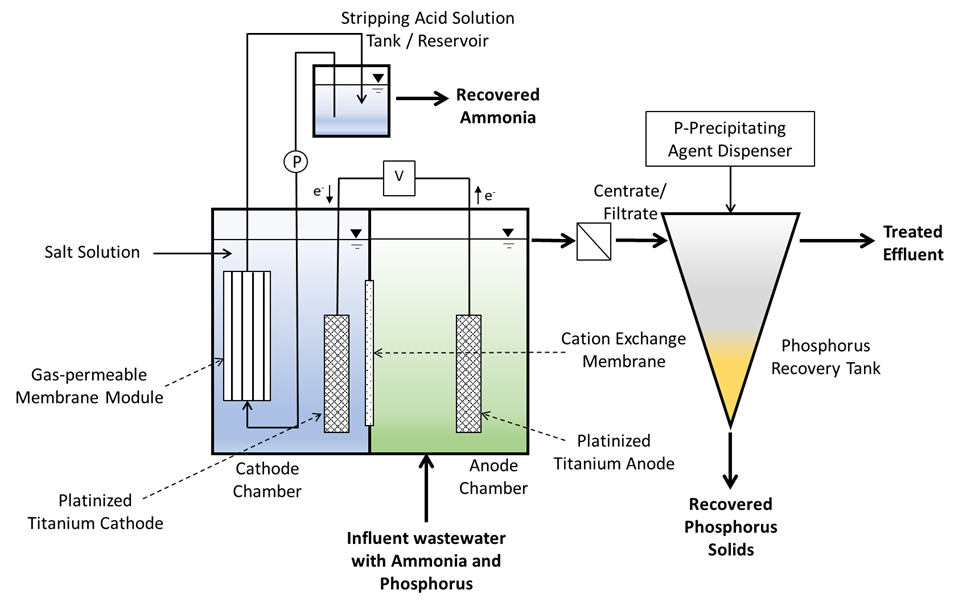
This work aimed to develop new technology for simultaneous N and P recovery that eliminates alkali chemicals used to increase pH for quick N capture using gas-permeable membranes (Vanotti and Szogi, 2015), and also eliminates acid chemicals used to solubilize the P in the manure before precipitation with P-precipitating agents (Szogi et al., 2018). The new N and P recovery system used in this example is described by Vanotti et al., 2024. It has a cathode chamber, an anode chamber, a stripping acid solution tank, and a phosphorus recovery tank (Fig. 1). The cathode chamber is fitted with a gas-permeable membrane manifold. The cathode chamber is fitted with a gas-permeable membrane manifold and contains a salt solution. The wastewater containing ammonia and phosphorus is pumped into the anode chamber. The ammonium (NH4) in the anode chamber permeates into the cathode chamber through a cation exchange membrane placed between chambers. The cathode increases the pH of the liquid and accelerates the rate of passage of ammonia through the gas-permeable membrane into an acid-stripping solution contained in a stripping tank/ reservoir and recirculated through the membrane manifold in a closed loop. The wastewater in the anode chamber is acidified by H+ released by electrolysis in the anode. The anode chamber effluent, with most of the P solubilized, is passed through a centrifuge or filter to separate suspended solids without phosphorus and liquid filtrate/centrate with phosphate. Phosphorus precipitating compounds used were MgCl2 and Ca(OH)2. After rapid mixing, the phosphorus precipitates as a solid. This precipitation proceeds quickly as a result of the previous removal of the carbonate alkalinity in the anode chamber, which interferes with phosphate precipitation.
Figure 1. Schematic diagram of an embodiment of a nitrogen (N) and phosphorus (P) recovery system using electrochemistry (Vanotti et al., 2024).
What Have We Learned?
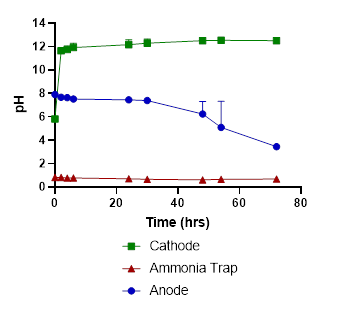
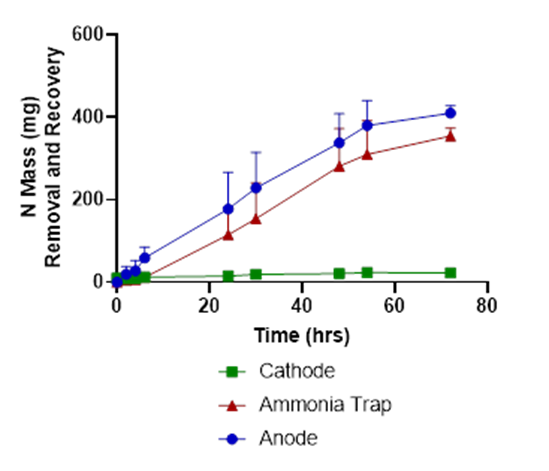
In tests with liquid swine manure, the pH in the cathode chamber was increased due to the electrochemical production of OH-, from 5.8 to 12.5 (Fig. 2). The wastewater’s ammonia was removed from the anode chamber and recovered in the stripping acid solution with 86% recovery efficiency (Fig. 3).
Figure 2. pH in anode chamber, cathode chamber, and stripping acid tank.Figure 3. Ammonia-N mass removal in anode chamber and ammonia-N mass recovery in cathode chamber and stripping acid tank.
The wastewater pH in the anode dropped from 7.9 to 3.5, and carbonate alkalinity dropped from 10750 mg/L to 0 mg/L (Figures 2 & 4). The acid was produced by oxidation at the anode (2 H2O → O2 + 4 H+). These conditions transformed the P from manure particles into soluble phosphates that were efficiently recovered in the phosphorus recovery tank. For example, using the P-precipitating compound Ca(OH)2, the process recovered 93% of the total P in a P precipitate solid compared to only 4.6% in a control without electrochemical treatment (Fig. 5). Using the P-precipitating compound MgCl2, the process recovered 95% of the total P in a P precipitate solid compared to only 6% P recovery in a control without electrochemical treatment (Fig. 5).
Figure 4. Reduction of carbonate alkalinity concentration occurring in the anode chamber.Figure 5. Phosphorus is recovered in the solid precipitate using P-precipitating compounds Ca(OH)2 or MgCl2. A) with a previous electrochemical step, and B) without an electrochemical step.
Future Plans
USDA-ARS seeks a commercial partner to bring this technology to market. For more information on commercialization, contact: Mrs. Tanaga Boozer, Technology Transfer Coordinator, USDA-ARS, OTT Southeast Area, tanaga.boozer@usda.gov
M.B. Vanotti, A.A. Szogi, P.W. Brigman, and S. Rawal, United States Department of Agriculture (USDA), Agricultural Research Service (ARS), Coastal Plains Soil, Water and Plant Research Center, Florence, South Carolina.
Additional Information
Szogi A.A., Vanotti, M.B., Shumaker, P.D. 2018. Economic recovery of calcium phosphates from swine lagoon sludge using Quick Wash process and geotextile filtration. Frontiers in Sustainable Food Systems 2, 37, https://doi.org/10.3389/fsufs.2018.00037.
Vanotti, M.B., and Szogi, A.A. 2015. Systems and methods for reducing ammonia emissions from liquid effluents and recovering ammonia. U.S. Patent 9,005,333 B1. U.S. Patent and Trademark Office.
Vanotti, M.B., Szogi, A.A., Brigman, P.W., and Rawal, S. 2024. Systems for treating wastewater using electrochemistry. U.S. Patent Appl. 18/808,123. U.S. Patent and Trademark Office
Acknowledgements
This research was part of USDA-ARS National Program 212, ARS Project 6082-12630-001-00D. Mention of trade names or commercial products in this article is solely for the purpose of providing specific information and does not imply recommendation or endorsement by the U.S. Department of Agriculture.
The authors are solely responsible for the content of these proceedings. The technical information does not necessarily reflect the official position of the sponsoring agencies or institutions represented by planning committee members, and inclusion and distribution herein does not constitute an endorsement of views expressed by the same. Printed materials included herein are not refereed publications. Citations should appear as follows. EXAMPLE: Authors. 2025. Title of presentation. Waste to Worth. Boise, ID. April 7–11, 2025. URL of this page. Accessed on: today’s date.
Animal manure is frequently applied to crop fields to supplement manufactured fertilizers, as manure is rich in many of the nutrients required for plant growth. Most nutrients in manure exist in organic forms, which must first be mineralized to inorganic forms before they can be used by plants. Direct land application of manure relies on in situ mineralization of nutrients by soil microorganisms, which is a slow and difficult-to-control process. In anticipation of limited immediate nutrient availability, manure is often applied to fields in excess of actual agronomic nutrient need. The excess nutrients can leach into water sources, causing accelerated eutrophication and threatening human and ecosystem health. As such, it is advantageous to investigate technologies designed to recover manure nutrients in inorganic forms, which can then be more easily regulated and applied to suit specific agricultural demand. Bioelectrochemical systems (BES) are a novel treatment option employing electrogenic microorganisms to drive operation and recover mineralized nutrients, making them an advantageous resource recovery mechanism.
What Did We Do?
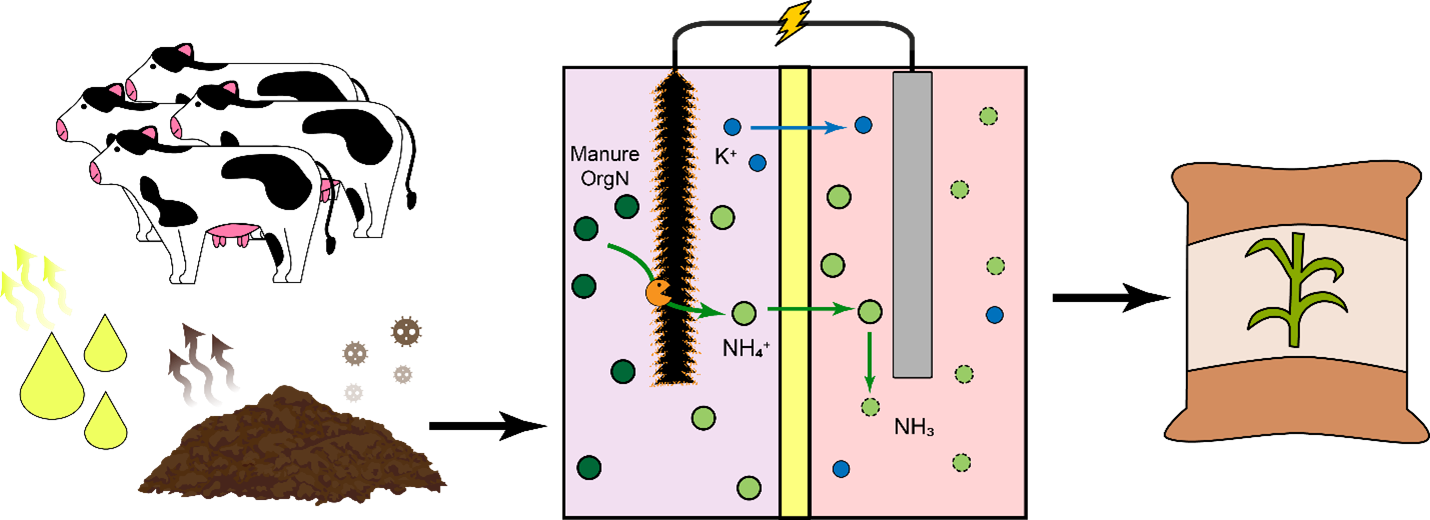
This study investigated a BES for organic nitrogen mineralization and ammonia recovery from synthetic (e.g. prepared solution of organic nitrogen and acetate) and real dairy manure. The BES was custom fabricated and followed a two-chamber design as outlined in Burns and Qin (2023). Briefly, a cation exchange membrane separated a biological anode and chemical cathode in respective chambers. Electrodes were connected via a 10 Ohm resistor to allow for current flow, and synthetic or real dairy manure was fed to the biological anode depending on the experimental condition under investigation. The BES was operated in both fuel cell and electrolysis cell (applied voltage = 0.8 V) modes.
Figure 1. Schematic of the bioelectrochemical system used to treat dairy manure and produce ammonia fertilizer.
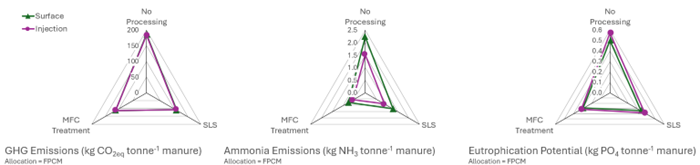
System performance was evaluated for organics removal (measured as chemical oxygen demand or COD), nitrogen removal, and total ammoniacal nitrogen production. We also calculate the nitrogen removal efficiency, RN, which measures how current is partitioned to drive nitrogen transport (as NH4+) across the cation exchange membrane. We modeled full-scale implementation of this technology on a theoretical Wisconsin dairy farm based on the experimental results obtained when treating real dairy manure. Results from the model (functional unit: tonne of manure treated, allocation: kg fat-and-protein-corrected milk (FPCM)) were used to investigate environmental impacts including greenhouse gas (GHG) emissions (in kg CO2eq tonne-1 manure), ammonia losses (in kg NH3 tonne-1 manure), and eutrophication potential (kg PO42- tonne-1 manure).
What Have We Learned?
In synthetic manure experiments, the BES consistently achieved excellent organics removal, exhibiting COD removal efficiencies well above 90%. Furthermore, total nitrogen removal efficiency averaged around 40% in electrolysis cell operation, and was seen to reach as high as 60% for some experiments. In fuel cell operation, nitrogen removal efficiency was decreased, averaging around 23%, indicating a slight advantage for nitrogen removal in electrolysis operation. RN exhibited interesting trends before, during, and after electrolysis cell operation. For the same system operational parameters, RN in fuel cell mode was around 1 mol N mol-1 electrons before electrolysis cell operation. However, during electrolysis operation and when the system returned to fuel cell operation after electrolysis cell operation, RN was and remained elevated at nearly 3 mol N mol-1 electrons with much more variability. This variability suggests that the microbial community was less tolerant to applied voltage conditions, and that there was perhaps some significant change during electrolysis operation that was difficult to recover from upon return to fuel cell operation. When treating real dairy manure, the system achieved average removals of 60% of total nitrogen and 58% of organic matter (Burns et al., 2024). The system exhibited similar nitrogen removal across multiple dairy manure feedstocks, however, a decrease in RN was observed with more complex dairy manure feedstock, likely due to the presence of competing ions (Burns et al., 2024).
Figure 2. Radar plots showing greenhouse gas emissions, ammonia losses, and eutrophication potential of three manure treatment scenarios: no processing/direct land application, solids-liquids separation (SLS), and microbial fuel cell (MFC) treatment for both surface and injection application of products. Results are reported per tonne of manure treated with an allocation of fat and protein corrected milk (FPCM).
We also investigated the environmental impacts of BES manure treatment when scaled up to a ~730 cow dairy farm. Impacts on greenhouse gas emissions, ammonia losses, and eutrophication potential were compared for surface and injection application of three manure treatment scenarios: (1) no manure treatment or processing, (2) solids-liquids separation (SLS) manure processing, and (3) BES manure treatment. Preliminary results from the model reported that BES manure treatment decreased impacts in all three categories when compared to the no treatment scenarios, and resulted in less ammonia loss when compared to the SLS treatment scenarios (Figure 2). For GHG emissions, BES manure treatment had slightly increased emissions when compared to SLS, mostly due to the added energy and freshwater inputs. However, BES manure treatment received more credits for P and N-based fertilizers than SLS treatment. For eutrophication potential, BES manure treatment had slightly less impact when compared to SLS treatment, despite the added impacts of freshwater, energy, and supplemental chemicals required for the treatment. Based on these results and those from experimental data, BES manure treatment is concluded to be a promising and competitive technology worthy of further development.
Future Plans
The results of this research prove bioelectrochemical systems to be a viable manure treatment alternative to current technologies. Our future work will involve investigating the organic nitrogen degradation kinetics in the BES treating dairy manure. Our goal is to determine reaction rate orders and calculate kinetic constants for degradation of COD, TN, and organic N within the cell, which can be used to develop more accurate full-scale models of the process. This analysis can be extended to investigate differing compositions of dairy manure based on the dairy’s variable feed compositions throughout the year. Additionally, we plan to expand the environmental impact analysis to include two other comparison scenarios which would be realistic at the industrial scale: (1) minimizing freshwater inputs for manure dilution and (2) harvesting electricity produced by the BES towards meeting pumping and aeration demands. Based on the model, BES manure treatment would require approximately 1,700 kWh of electricity per week to meet pumping an aeration demands, some of which can be provided by the microbially-generated electric current in the system. Furthermore, due to reactor size constraints at the lab scale, there is currently a large amount of freshwater used to dilute the manure prior to treatment with the MFC. This work will help to contextualize BES within existing manure treatment frameworks and will help both researchers and practitioners make informed decisions regarding manure treatment options.
Authors
Presenting author
McKenzie Burns, PhD Candidate, the University of Wisconsin—Madison
Corresponding author
Dr. Mohan Qin, Assistant Professor, the University of Wisconsin—Madison, mohan.qin@wisc.edu
Additional authors
Dr. Horacio Aguirre-Villegas, Scientist III, the Nelson Institute for Environmental Studies at the University of Wisconsin—Madison
Dr. Rebecca Larson, Associate Professor, the University of Wisconsin—Madison
Additional Information
Published journal articles (these are also the citations for this conference proceeding):
The authors would like to thank the support from National Science Foundation CBET 2219089. In addition, the authors would like to thank the startup fund from the Department of Civil and Environmental Engineering, College of Engineering, the Office of the Vice-Chancellor for Research and Graduate Education (OVCRGE) at the University of Wisconsin–Madison, and the Wisconsin Alumni Research Foundation (WARF) for the support of this study. The authors gratefully acknowledge support from Jackie Cooper of the Environmental Engineering Core Facility at the University of Wisconsin–Madison for use of facilities and equipment. Finally, the authors thank Andrew Beaudet, Ethan Napierala, Katie Mangus, and David Xiong for their contributions as undergraduate researchers on this project.
The authors are solely responsible for the content of these proceedings. The technical information does not necessarily reflect the official position of the sponsoring agencies or institutions represented by planning committee members, and inclusion and distribution herein does not constitute an endorsement of views expressed by the same. Printed materials included herein are not refereed publications. Citations should appear as follows. EXAMPLE: Authors. 2025. Title of presentation. Waste to Worth. Boise, ID. April 7–11, 2025. URL of this page. Accessed on: today’s date.
As large dairies move into western Minnesota, a consistent supply of manure is available that was not historically present. These dairies are using a new technology to separate solids from liquids in the manure, and the impact on nutrient availability in this region’s climate and soil types is unknown. Understanding this is particularly important for sugarbeet growers in the region as late season N availability in the soil affects sugar content of the crop (high late season soil nitrate levels typical result in reduced sugar production). Where in the crop rotation should this manure be applied to maximize the beneficial properties while minimizing risk?
What Did We Do?
A three-year crop rotation including sugarbeet, corn, and soybean was set up at two locations (west central and northwestern Minnesota) with each crop present each year (Figure 1) and then rotated accordingly in subsequent years. Two rates of liquid separated dairy manure from a nearby commercial dairy were applied in the first year (in the fall prior to planting of each crop) and compared with standard synthetic fertilizer-only practices (fertilizers were applied each spring prior to planting). The two manure application rates were approximately 15,000 gallons per acre, which supplied approximately 195 pounds first-year available nitrogen per acre, or approximately 10,000 gallons per acre, which supplied approximately 150 pounds of first year available nitrogen per acre. In following years, only commercial fertilizer was applied according to soil test phosphorus and potassium levels or state nitrogen guidelines, considering manure nitrogen credits if applicable, for each crop. At the end of each growing season, yield was determined for each crop. Sugarbeet was also evaluated for sugar content and quality.
Figure 1. Aerial photograph taken in July 2021 of the plot setup with each crop labeled. Each crop was replicated four times in a randomized complete block design.
What Have We Learned?
The manured treatments typically resulted in similar or higher yields than synthetic- fertilizer-only for corn and sugarbeet during all three years of the rotation. For soybean, yields were significantly decreased by manure application at one site in the first year and generally unaffected at the second site. In the second and third years, there were no differences in soybean yield across nutrient treatments.
Future Plans
This study was conducted in two fields that did not have a recent history of manure application. Since we know that manure is the “gift that keeps on giving”, we want to repeat this study to see if there are long-term effects of nitrogen release from repeated applications of manure. Thus, manure was applied after the third growing season of the rotation and the rotation will begin again at both sites.
Authors
Presenting & corresponding author
Melissa L. Wilson, Associate Professor and Extension Specialist, University of Minnesota, mlw@umn.edu
Additional Information
Search for manure research: https://www.sbreb.org/research/
Acknowledgements
Thanks to the Sugarbeet Research and Education Board of Minnesota and North Dakota for funding this work.
The authors are solely responsible for the content of these proceedings. The technical information does not necessarily reflect the official position of the sponsoring agencies or institutions represented by planning committee members, and inclusion and distribution herein does not constitute an endorsement of views expressed by the same. Printed materials included herein are not refereed publications. Citations should appear as follows. EXAMPLE: Authors. 2025. Title of presentation. Waste to Worth. Boise, ID. April 7–11, 2025. URL of this page. Accessed on: today’s date.
We estimated milking cow manure production for US states from 1970 to 2023 with the aim to provide a broad perspective to stakeholders who manage and optimize the use of dairy manure. Stakeholders include producers and those working on their behalf such as agronomists, applicators, engineers, extension agents, researchers, governmental agencies, cooperatives, and markets.
It is hoped that with increased understanding of how manure production has changed over time and location stakeholders can better understand trends and historical conditions which impact their efforts.
What Did We Do?
We estimated milking cow manure production for 48 US states from 1970 to 2023 using an empirical equation estimating manure production as a function of milk production published by the American Society of Agricultural and Biological Engineer’s Manure Production and Characteristics standard. To apply this equation to each state we utilized two data sources produced by the United States Department of Agriculture’s National Agricultural Statistics Service (NASS), annual milk production and annual milking cow herd size. To gain further insight data sources reporting the number of dairy farms and land available for manure application in each state were additionally gathered from NASS and reported in combination with manure production. The workflow and references for combining this data are displayed in the following figures.
Figure 1. Workflow to estimate annual dairy manure production using ASABE’s Manure Production and Characteristics standard and NASS milk cow production and cow herd inventory data sources.Figure 2. Workflow to estimate number of dairies and acres for manure application from NASS data sources.
What Have We Learned?
Nationally annual dairy manure production has decreased from 1970-2023 by approximately 4% (2.2 billion gallons). From 1998 to 2023 annual dairy manure production increased by approximately 13% (6.4 billion gallons). Although national milking cow numbers generally declined from 1970 to 1998 then nearly remained constant until 2023, this trend was offset by continual increase in manure production per cow from 1970-2023 due to the direct relationship with milk production, which has continued to increase from 1970-2023. Also, the annual number of gallons of manure per dairy farm has increased from 1970-2023 due to a decrease in number of dairies combined with an increase in manure production per cow. It is accepted that the US dairy industry has consolidated over time, this data supports that its’ manure production has consolidated as well. The author posits based on experience and this analysis that nationally, over time, manure systems in support of livestock production have contributed to an increase in volume of manure being managed to date. As dairy cows move to increasing levels of confinement, from pasture and lots which utilize land base as a manure system to barns with more engineered manure systems, greater collection of manure occurs and therefore must be managed. Regarding the impact of the specific type of engineered manure systems impact on volume of manure that must be managed the author posits this currently varies based on the kind of manure system selected, either adding or subtracting to the managed manure stream, which is a function heavily dependent on local climate (precipitation, evaporation, and length of storage period) and technology adoption (covers, flush systems, separation, and advanced treatment). In the upper Midwest with relatively high precipitation, low evaporation, and long winter periods dairy manure systems are predominantly collect and store only, overall adding to the volume of manure to be managed as additional precipitation is also captured by the uncovered nature of most storages in this region.
Figure 3. National change in manure and milk production, milking cow inventory, and number of dairies from 1970 to 2023.
At the state level the change in manure production has varied. From 1970 to 2023, 12 states have increased manure production, the remaining 26 states have decreased manure production. This has resulted in a change in the location of where manure is produced. In 2023, most manure was produced in a few states. In 2023, 10 states produced 70% of the total annual US dairy manure production, with 6 states producing over 50%.
Figure 4. 2023 annual milking cow manure production, millions of gallons, and percent change of annual milking cow manure production from 1970 to 2023.
Future Plans
Authors seek to maintain this data analysis in a method available to stakeholders, additionally incorporating manure production from swine, beef, and poultry into it, and updating it as future NASS reports are published.
Authors
Presenting & corresponding author
Mike Krcmarik, Professional Engineer, mikekrcmarik@gmail.com
Additional Information
Email corresponding author for copy of all data and figures used in this analysis, including figures published on the poster only.
Acknowledgements
American Society of Agricultural and Biological Engineers, Engineering Practices Subcommittee of the ASAE Agricultural Sanitation and Waste Management Committee responsible for standard ASAE D384.2 Manure Production and Characteristics used in this analysis.
United States Department of Agriculture’s National Agricultural Statistics Service responsible for the various surveys and reports used in this analysis.
Allen Young, Eric County Soil and Water Conservation District (New York) providing valuable review and discussion.
The authors are solely responsible for the content of these proceedings. The technical information does not necessarily reflect the official position of the sponsoring agencies or institutions represented by planning committee members, and inclusion and distribution herein does not constitute an endorsement of views expressed by the same. Printed materials included herein are not refereed publications. Citations should appear as follows. EXAMPLE: Authors. 2025. Title of presentation. Waste to Worth. Boise, ID. April 7–11, 2025. URL of this page. Accessed on: today’s date.
Due to a technical glitch, we did not get this presentation recorded. Please accept our apologies.
Purpose
Climate solutions are often talked about in a vacuum and conversation participants can sometimes overlook unintended consequences upon local environment and health. Solutions to mitigate methane from livestock agriculture are no exception to these climate discussions, and can impact other potential pollutants including ammonia, nitrous oxide, and odors. Moreover, it can be a particularly difficult space to work in climate and environmental justice, as many different communities are seemingly villainized and pit against each other, which make climate solutions even harder to implement.
What Did We Do?
Environmental Defense Fund is in the midst of an ongoing pilot project to engage communities in workshops around solutions regarding manure management. The goal of these workshops is to demonstrate best practices for effective collaboration and solution co-creation between farmers/producers and communities that can then be taken to local policymakers and stakeholders to implement. In this way, we can co-create solutions that align with community concerns, climate change mitigation, and feasibility for farmers.
What Have We Learned?
Community co-creation is possible, and even stakeholders who may seem hyper-polarized can still sit together at the same table to work together with ample time, transparency, and trust. Policy implications are enormous here and this session will discuss learnings we have regarding common misconceptions and myths around working with different affected stakeholders, as well as necessary guardrails surrounding commonly discussed methane mitigation technologies.
Future Plans
We will continue to work with the affected communities, including community groups and producer groups, to find common ground, with the hope of making these processes shareable across the country.
Authors
Presenting & corresponding author
Mindi W. DePaola; Senior Manager, Community and Equity, Ag Methane; Environmental Defense Fund, mdepaola@edf.org
Acknowledgements
We’d like to thank groups who have continued to give us time, as time is the biggest resource. These groups include White Earth Nation, EJCAN, Leadership Counsel for Environmental Justice, and MN Milk. NOTE: these are not necessarily official partners but again, want to acknowledge their time spent meeting with EDF.
The authors are solely responsible for the content of these proceedings. The technical information does not necessarily reflect the official position of the sponsoring agencies or institutions represented by planning committee members, and inclusion and distribution herein does not constitute an endorsement of views expressed by the same. Printed materials included herein are not refereed publications. Citations should appear as follows. EXAMPLE: Authors. 2025. Title of presentation. Waste to Worth. Boise, ID. April 7–11, 2025. URL of this page. Accessed on: today’s date.
Bio-based biodegradable plastics led by polylactic acid (PLA) are becoming increasingly popular as a sustainable alternative to traditional plastics. Although bioplastics are designed to break down easily, many do not fully degrade in the natural environment as intended. Anaerobic digestion (AD) is a promising solution for decomposing bioplastics alongside food waste, turning them into biogas for energy and digestate, rich in nutrients, that can be used as fertilizer. However, studies have shown that bioplastics, particularly PLA, does not degrade fully in AD systems. The byproducts left over from AD raise serious problems, especially if residual microplastics could still be present in the digestate and affect the quality of the soil and water. While existing research predominantly focuses on enhancing methane production and biodegradation efficiency during AD, the quality of digestate after the digestion process has been overlooked. This significant research gap was highlighted in this review, emphasizing the need for comprehensive studies that evaluate digestate composition alongside biogas production.
What Did We Do?
A systematic review of peer-reviewed studies was conducted using databases such as Scopus, ScienceDirect and Google Scholar to assess research on bioplastic degradation in anaerobic digestion. The literature search was performed using the keywords ‘bioplastic degradation’, ‘pretreatment methods,’ ‘Anaerobic digestion,’ ‘biodegradation,’ ‘biogas production’ and ‘digestate quality’. Search filters were applied to prioritize recent studies (2010-present), peer-reviewed journal articles, and experimental studies analyzing bioplastic degradation and digestate quality. The initial search yielded 172 papers, which were then screened for relevance based on their focus on bioplastic degradation, biogas production, and digestate analysis. After filtering out studies that were not directly related, 42 papers were selected for detailed analysis. A significant portion of the literature examined the effectiveness of different pretreatment methods in improving bioplastic degradation. These methods included but not limited to thermal pretreatment, where the plastics are exposed to elevated temperatures to increase its hydrolysis potential; alkaline pretreatment, which involves chemical treatments to enhance polymer degradation; and thermo-alkaline pretreatment, a combination of heat and chemical treatment to increase its susceptibility to decomposition. This allowed us to assess the extent to which bioplastic degradation has been addressed and the incomplete degradation persisting, highlighting the need for more comprehensive studies into the digestate quality.
What Have We Learned?
Studies consistently showed that bioplastic, especially PLA, degradation in AD remains incomplete in most cases, leading to concerns about the accumulation of microplastics residues in digestate. While pretreatment methods have been effective, with thermo-alkaline pretreatment yielding the highest methane outputs across most studies. The variability in methane yields across different pretreatment conditions suggests that degradation efficiency is highly dependent on factors such as temperature, retention time, microbial communities, and chemical additives. However, very few studies have explicitly analyzed whether residual bioplastic particles persist in the digestate post-AD. Given that AD is promoted as a promising solution for sustainable plastic waste solution, failing to assess digestate composition may lead to unintended environmental consequences. The implications of these findings are significant, particularly for large-scale implementation. If AD-derived digestate is to be used in agriculture or soil restoration, it must be free of persistent microplastics. Without comprehensive digestate analysis, the environmental benefits of AD for bioplastic waste management remain uncertain.
Future Plans
We are currently conducting an experimental study to evaluate the degradation of PLA in AD under different pretreatment conditions – thermal, alkaline, and thermo-alkaline treatments – to enhance PLA degradation and improve methane yields. More importantly, we aim to go beyond methane production by analyzing the resulting digestate for microplastic residues and overall chemical composition. Future studies will involve optimizing pretreatment strategies to minimize microplastic residues and investigating the long-term impacts of digestate when applied to soil systems.
Authors
Presenting & corresponding author
Nadia Bawa Fio Bekoe, Graduate Research Assistant, Biosystems and Agricultural Engineering Department, Oklahoma State University, nbekoe@okstate.edu
Additional author
Douglas W. Hamilton, PhD, P.E., Associate Professor and Extension Waste Management Specialist, Biosystems and Agricultural Engineering, Oklahoma State University
Acknowledgements
South Central Sun Grant Program Fellowship
Livestock & Poultry Environmental Learning Community (LPELC) Professional Development Grants
The authors are solely responsible for the content of these proceedings. The technical information does not necessarily reflect the official position of the sponsoring agencies or institutions represented by planning committee members, and inclusion and distribution herein does not constitute an endorsement of views expressed by the same. Printed materials included herein are not refereed publications. Citations should appear as follows. EXAMPLE: Authors. 2025. Title of presentation. Waste to Worth. Boise, ID. April 7–11, 2025. URL of this page. Accessed on: today’s date.
Manage Cookie Consent
To provide the best experiences, we use technologies like cookies to store and/or access device information. Consenting to these technologies will allow us to process data such as browsing behavior or unique IDs on this site. Not consenting or withdrawing consent, may adversely affect certain features and functions.
Functional
Always active
The technical storage or access is strictly necessary for the legitimate purpose of enabling the use of a specific service explicitly requested by the subscriber or user, or for the sole purpose of carrying out the transmission of a communication over an electronic communications network.
Preferences
The technical storage or access is necessary for the legitimate purpose of storing preferences that are not requested by the subscriber or user.
Statistics
The technical storage or access that is used exclusively for statistical purposes.The technical storage or access that is used exclusively for anonymous statistical purposes. Without a subpoena, voluntary compliance on the part of your Internet Service Provider, or additional records from a third party, information stored or retrieved for this purpose alone cannot usually be used to identify you.
Marketing
The technical storage or access is required to create user profiles to send advertising, or to track the user on a website or across several websites for similar marketing purposes.