Demonstration of a Pilot Scale Leach-bed Multistage Digester for Treating Dry-lot Wastes

Waste to Worth: Spreading science and solutions logoWaste to Worth home | More proceedings….

Abstract

Dry-lot feedlot wastes have historically been a challenging feed-stock for digestion due to the dry recalcitrant nature of the waste, and the presence of settleable sand. Leach-bed dry digestion systems could theoretically circumnavigate these difficulties but poor hydraulic conductivities are noted in the literature. In addition to the poor hydraulic conductivities there are often serious problems with system stability and operation.  A leach-bed based design which addresses the hydraulic limitations of previous systems and utilizes a multiple process stages to enhance system stability is currently under development. By adding readily available inert shear stabilizers and biodegradable porosity improvers, hydraulic improvements have been demonstrated to be an order of magnitude higher than without the modifications.  By utilizing a multiple stage process the liquid leachategenerated from the leachate beds is treated through two stages, the buffering/storage tank and the high rate methanogenic reactor. The buffering tank is a tank for the leachate to reach chemical equilibrium and to store the leachate before it is precisely metered into the methanogenic tank.  Within the high rate methanogenic reactor compounds with the leachate are converted into methane which is removed and combusted. This system is demonstrated in a 48’ long refrigeration transport trailer which is essentially energy independent under continuously operation. This system will provide support for the validation of the technology with various wastes and will also serve as a research vessel for the continual optimization of this technology.

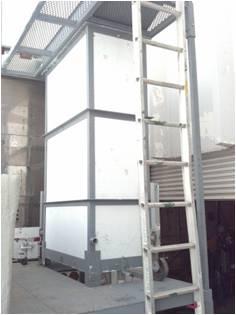
Front of the Pilot Unit

Is It Possible to Digest Dry or Solid Manure?

This new anaerobic digestion system has been designed from the ground up based on extension work carried out on Colorado dairy and beef facilities. Previous feasibility studies conducted on these sites indicated that conventional anaerobic digestion was not a recommended technology due to a variety of economic and technical parameters.

However, upon further review, it was found that these constraints were tied to specific technologies, not anaerobic digestion in general. Using an iterative design process, a digestion system was created which could effectively address these problems. In its most basic form, it will efficiently process difficult wastes like Colorado’s dry-lot manures as well as other more conventional waste streams.

What Did We Do?

Colorado State University has a pilot system located on the Foothills Campus. The purpose of this pilot unit is to gather data about the performance of the leachate bay reactor in an integrated system and to provide design criteria for scaling this concept. The system is currently in the inoculation stage. Using a consortium of animal manures and bedding waste generated onsite, the reactors are growing the bacteria needed before further testing can commence.

Intrinsic to the design is a three phased process that is tailored to the available substrates. Solid type wastes (Typically >20% total solids) are placed into the leachate bay reactor where liquid (leachate) is passed through, slowly striping away methane forming organic chemicals.

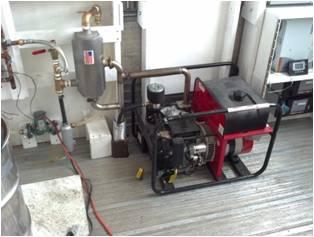
6kW Generator with Heat Exchanger for Heat Reactors with Waste Heat

Slurry wastes (Typically <20% total solids with high suspended solids) can pass into the second stage of the process- the leachate storage tank. This vessel acts as a pre digestion vessel, solids sedimentation basin, and storage tank for the pre-digestion products. Clarified leachate, rich with dissolved organic compounds, is then pumped into the final stage- the high rate reactor. In the high rate reactor process upset is mitigated by providing a very controlled flow rate of the acidic leachate into the reactor. This moderates the pH in the reactor, allowing the methane producing organisms to operate at maximum potential. Quickly degraded waste waters such as: milk processing water, run-off lagoon water, or nearby industrial wastes can be added directly to the high rate reactor.

What Have We Learned?

Solid wastes appropriate for the leachate bay reactor are dry-lot cattle manure, crop residues, equine and poultry manures, among many others. These types of wastes were the important drivers in the breakdown of technical and economic feasibility of conventional digestion systems. Due to the design of the leachate bay reactors though, many of these constraints were avoided and these wastes instead play a powerful role in this systems effectiveness by allowing digestion of often overlooked waste products. Related: Update on this project presented at the 2015 Waste to Worth conference in Seattle.

Manure Loading Dock with LBR

Future Plans

Extensive infrastructure has been built into this pilot unit to facilitate monitoring and logic control of this facility. Ongoing work will be to build out this sensing network. 

Important design parameters will be teased out of the collected data to guide the development of optimization models. With the use of these models, the system can be further modified. Potential technological enhancements include: nutrient recovery from leachate, various flushing procedures to reduce salt loading, and digestion of ligno-cellulotic by-products.

Authors

Sybil Sharvelle, Sybil.Sharvelle@colostate.edu

Lucas Loetscher, Graduate Reseach Assistant, Colorado State University

Sybil Sharvelle, Assistant Professor, Colorado State University

Acknowledgements

  • Colorado Agriculture Experiment Station
  • Colorado NRCS
  • Colorado Bioscience Discovery Grant
  • Colorado Governors Energy Office

The authors are solely responsible for the content of these proceedings. The technical information does not necessarily reflect the official position of the sponsoring agencies or institutions represented by planning committee members, and inclusion and distribution herein does not constitute an endorsement of views expressed by the same. Printed materials included herein are not refereed publications. Citations should appear as follows. EXAMPLE: Authors. 2013. Title of presentation. Waste to Worth: Spreading Science and Solutions. Denver, CO. April 1-5, 2013. URL of this page. Accessed on: today’s date.

Vegetative Environmental Buffers (VEBs) for Mitigating Air Emissions from Livestock Facilities: A Review

Waste to Worth: Spreading science and solutions logoWaste to Worth home | More proceedings….

Abstract

Air emissions from livestock facilities are receiving increasing attention because of concerns related to nuisance, health and upcoming air quality regulations. Vegetative buffers have been proposed as a potential cost effective mitigation strategy to reduce dust, odor and other air pollutants from farm and can be an important part of air quality management plan. However, the effectiveness of vegetative buffers in mitigating air emissions seems to be site specific and can be affected by many factors. This study aims to provide a thorough literature review on the performance of vegetative buffers in mitigating air emissions, to investigate critical factors, and to identify research gaps. The results will be used as basis for planning future wind tunnel and field studies. The ultimate objective is to develop general guidance for vegetative buffer design and to demonstrate the variety and effectiveness of vegetative buffers for mitigating air emissions from livestock facilities.

Why Study Trees As a Potential Odor Management Strategy?

Vegetative environmental buffers (VEBs) have been proposed as a mitigation strategy for air emissions from livestock facilities. Survey indicated producers are interested in using VEBs for odor management. But lack of information on performance, cost and technical guidelines are barriers to adoption of VEBs.

What Did We Do?

Review published research on effectiveness of VEBs for mitigating air emissions from livestock facilities.

What Have We Learned?

VEBs have been examined primarily in swine and poultry farms. Iowa, Pennsylvania and Delaware are actively involved in research and implementation of VEBs for livestock farms. VEBs are potential cost effective strategy for reducing dust (by up to 56%), odor (by up to 68%), NH3 (by up to 54%) and H2S (by up to 85%) from farms, although effectiveness and costs are highly variable and depend on site specific design. Most effective reduction occurs just beyond the VEBs. Wind tunnel simulation on barriers at roadside showed that percentage reduction of pollutants decreasing with downwind distance, and they are generally below 50% beyond 15 barrier height.

Mitigation Mechanisms of VEBs

Future Plans

Measure the concentrations of multiple air emission constituents at various distance from a swine facility with and without the presence of a VEB under various weather conditions; determine the effectiveness of the VEB under various design parameters (height and depth) and evaluate how height and depth of the VEB will affect the mitigation effectiveness; develop design suggestions and best management procedures to utilize a VEB in order to maximize effectiveness with limited costs. 

Authors

Zifei Liu, Assistant Professor, Kansas State University.  Zifeiliu@ksu.edu

Ronaldo Maghirang, Pat Murphy, Kansas State University

Additional Information

http://www.bae.ksu.edu/~zifeiliu/


The authors are solely responsible for the content of these proceedings. The technical information does not necessarily reflect the official position of the sponsoring agencies or institutions represented by planning committee members, and inclusion and distribution herein does not constitute an endorsement of views expressed by the same. Printed materials included herein are not refereed publications. Citations should appear as follows. EXAMPLE: Authors. 2013. Title of presentation. Waste to Worth: Spreading Science and Solutions. Denver, CO. April 1-5, 2013. URL of this page. Accessed on: today’s date.

Integrating Probable Fieldwork Days into Nutrient Management Plans

Waste to Worth: Spreading science and solutions logoWaste to Worth home | More proceedings….

Abstract

Weather conditions impact land application of manure.  Wet soils hinder equipment from accessing fields.  Regulations prohibit application on frozen or snow cover soils.  Uncertain soil and atmospheric conditions can cause the best plans to fail.  Nutrient management plans that are expected to succeed might fail given any particular year’s weather. Incorporating fieldwork days information into nutrient management plans can make them more robust to uncertain weather conditions.

The USDA publishes the number of fieldwork days for different crop reporting districts within states. These data are from field reporters who provide their opinion on the number of days that were available for farmers to conduct fieldwork such as disking, planting and harvesting.  USDA Fieldwork Days data cover the growing season (approximately April to December). Estimates of fieldwork days do not exist for the non-growing season (approximately December to April).  However, certain states have agricultural weather station networks that collect soil temperature and other critical information that can be used to estimate the number of fieldwork days that exist for manure application within regulatory limits.

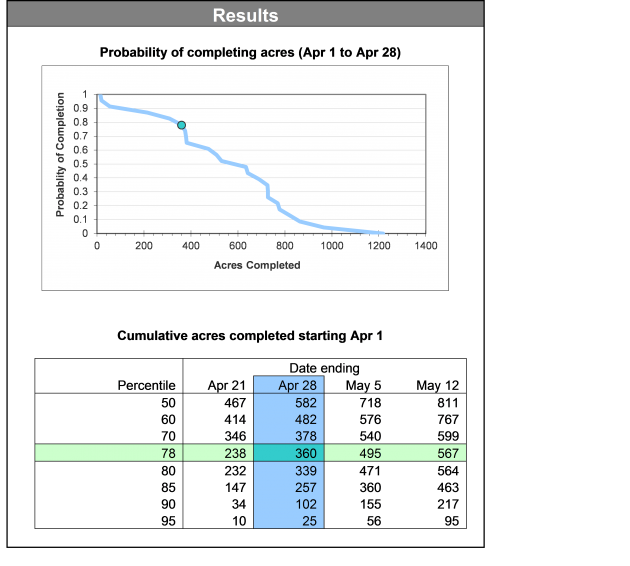
This project integrates fieldwork days from the USDA Fieldwork Days data with the Missouri Agricultural Weather Station Network winter soil temperature and precipitation data for the corresponding crop reporting district.  This compiled database gives a complete year of fieldwork day estimates.  The data are used in a model that allows nutrient management planners to incorporate climatological impacts into their land application plans.  Users specify their equipment complement and size, quantity of manure, and desired beginning and ending dates.  The model reports output in a cumulative distribution function that estimates the probability of completing fieldwork within the specified parameters and a sensitivity table of ending dates.

Why Consider Fieldwork Days for Nutrient Planning?

We currently have no mechanism to evaluate the feasibility of implementing nutrient management plans.  A plan that successfully finds sufficient fields for using nutrients in manure may fail because there is insufficient time to apply manure with the designated equipment.  Incorporating fieldwork day information into the nutrient management planning process could make plans more robust, informing the planner and farmer how likely the plan will succeed.

What Did We Do?

This project developed two spreadsheets that help nutrient management planners incorporate USDA and climatic data into their plans to estimate the likelihood of successfully completing the plan objectives.

The first spreadsheet incorporates fieldwork day data from the USDA with machinery management decisions to estimate the probability of completing manure application within a planned window.  This spreadsheet and data report the number of days in a week when fieldwork can be done in various regions of the state during the period April through November.  The second spreadsheet integrates soil temperature and precipitation data from the Missouri Agricultural Weather Station Network to estimate the probability of completing manure application within a planned window during the months of December through March period.

Users specify their equipment complement and size, quantity of acres receiving manure, desired beginning and ending dates for manure application, and hours per day and days per week they can apply manure.  The model reports output in a cumulative distribution function that estimates the probability of completing fieldwork within the specified parameters and a sensitivity table of ending dates.

Sample output of the probability of completing necessary fieldwork.

What Have We Learned?

Plans do not normally consider the feasibility of accomplishing manure application within an appropriate time frame.  Missouri fieldwork day data indicate that time available for field work varies significantly over the year and within the state at any given time.    For example, a nutrient management plan that requires 100 hours of application time in northwest MO during the month of April would be successful 78% of the time.  The same nutrient management plan needing 100 hours of fieldwork during February would be successful 40% of the time.  In April the median number of fieldwork days 11.5 days compared to 8.3 days in February.

Sample imput screen for describing the manure application parameters.

Future Plans

We will expand the tool beyond Missouri.  We are looking for funding opportunities to integrate it into our nutrient management plan document generators.

Authors

John Lory, Associate Professor of Extension, Plant Science Divsion, University of Missouri loryj@missouri.edu

Dr. Ray Massey, Professor of Extension, Agricultural Economics, University of Missouri

Pat Guinan, Assistant Professor of Extension, Soil and Environmental Systems, University of Missouri

Additional Information

The spreadsheets that incorporates fieldwork days into manure management decisions can be obtained at swine.missouri.edu/manure/ under the link names of Probable Fieldwork Days and Probable Winter Fieldwork Days.

Acknowledgements

Scott Gerlt and Brent Carpenter of the Food and Agriculture Policy Institute created the initial spreadsheet tool.


The authors are solely responsible for the content of these proceedings. The technical information does not necessarily reflect the official position of the sponsoring agencies or institutions represented by planning committee members, and inclusion and distribution herein does not constitute an endorsement of views expressed by the same. Printed materials included herein are not refereed publications. Citations should appear as follows. EXAMPLE: Authors. 2013. Title of presentation. Waste to Worth: Spreading Science and Solutions. Denver, CO. April 1-5, 2013. URL of this page. Accessed on: today’s date.
Feed Management Planners Certification Program to Reduce Nutrient Loads in Impaired Watersheds

Waste to Worth: Spreading science and solutions logoWaste to Worth home | More proceedings….

Why Develop a Feed Management Certification Program?

To develop a program to train ARPAS-certified (American Registry of Professional Animal Scientists) dairy and beef nutritionists on how to prepare and evaluate Feed Management plans as it relates to the NRCS Feed Management (592) practice in Pennsylvania. The objective is to compare how formulated diets match to the consumed diets. Phosphorus is monitored through manure testing and nitrogen by milk urea nitrogen and calculating milk nitrogen efficiency. Dry matter intake efficiency is also monitored as this can affect the total manure volume excreted.

What Did We Do?

In 2007, Mid-Atlantic Water Program (MAWP) scientists applied the national feed management program to meet the needs of dairy consultants to implement feed management in the Chesapeake Basin. This program certifies consultants in precision feed management, a practice that reduces nutrient loads in animal wastes by minimizing the phosphorus and nitrogen content in the feed. 

With the recent release of the US Environmental Protection Agency’s Total Maximum Daily Load for the Chesapeake Bay, the agricultural community is looking for the best practices to control nutrient pollution while minimizing impacts to profit. Over the years, the work of this project team has established precision feed management as both an economically and environmentally viable best management practice.  As such, state watershed implementation plans include precision feed management as a method to meet load allocations.

Pennsylvania currently has twenty-four NRCS qualified nutritionists to write feed management plans. In 2011, fifty-one operations received EQIP or CBWI funding through USDA-NRCS for feed management, with the majority consisting of dairy farms.  An additional 10 farms entered into contracts with NRCS in 2012.  Farms are currently in the process of being assessed on how well they implemented recommendations from the first year of quarterly reports and are working through their second year of implementation.

Additional efforts have been implemented to educate consultants about the regulations and issues affecting dairy producers. Currently, the Pennsylvania team is working with producers to monitor income over feed costs and to develop cash flow plans, which provides the opportunity to implement precision feeding practices while monitoring the economic benefits to the herd.  A study of six component fed dairy herds in Pennsylvania is also being completed to evaluate the effects of the feed, forage, and manure sampling protocols along with feeding order on fecal phosphorus levels and to update current sampling recommendations.

Funding from the MAWP was critical to providing these trainings and projects and establishing precision feed management as a best management practice that farmers can realistically utilize.  The infrastructure is in place to address the demand for more feed management plans and the MAWP will continue to meet the educational needs of this audience.

What Have We Learned?

There are a lot of opportunities on farms to improve feed management and nutrient balance. Challenges have been observed pertaining to nutrient reduction strategies that could impact overall nutrient balances in dairy and beef rations. Many of these challenges are greatly influenced by the volatility in today’s commodity pricing. Producers need to become more engaged in what they are feeding and how it affects their profitability.  It has been observed that inorganic phosphorus is still being used in grain mixtures when rations contain high phosphorus forages or inclusion of byproduct feeds. We have also observed some challenges in obtaining test analyses for complete grain and mineral mixes on a regular basis.  More education is needed for both industry professionals as well as producers.

Future Plans

As the feed management program in Pennsylvania progresses, pounds of phosphorus excreted can be tracked to monitor the effects of reducing phosphorus in dairy and beef rations. This can be used to evaluate its effect on water quality and potential phosphorus accumulations in the soil when manure is applied to crops at nitrogen-based rates. Crop rotations, inclusion of alternative forages and whole farm nutrient balance will be included in future trainings and feed management plans. The Penn State Extension Dairy team is also working on the development of a Feed Management mobile app for producers and nutritionist to be able to track and monitor their progress on nutrient reductions in their rations.

Authors

Daniel Ludwig, Natural Resources Specialist, USDA – NRCS, dan.ludwig@pa.usda.gov

Virginia Ishler, Dairy Complex Manager/Nutrient Specialist, Penn State University

Rebecca White, Program Manager-Penn State Extension Dairy Team

Additional Information

Feed Management for Producers

Pennsylvania NRCS on Feed Management


The authors are solely responsible for the content of these proceedings. The technical information does not necessarily reflect the official position of the sponsoring agencies or institutions represented by planning committee members, and inclusion and distribution herein does not constitute an endorsement of views expressed by the same. Printed materials included herein are not refereed publications. Citations should appear as follows. EXAMPLE: Authors. 2013. Title of presentation. Waste to Worth: Spreading Science and Solutions. Denver, CO. April 1-5, 2013. URL of this page. Accessed on: today’s date.
The Farm Manure to Energy Initiative: Using Excess Manure to Generate Farm Income in the Chesapeake’s Phosphorus Hotspots

Waste to Worth: Spreading science and solutions logoWaste to Worth home | More proceedings….

Abstract

Currently, all the Bay states are working to achieve nutrient reduction goals from various pollution sources.  Significant reductions in phosphorus pollution from agriculture, particularly with respect to phosphorus losses from land application of manure are needed to support a healthy aquatic ecosystem.  Producers in high-density animal agricultural production areas such as Lancaster County region of Pennsylvania, the Delmarva Peninsula, and the Shenandoah Valley region of Virginia, need viable alternatives to local land application in order to meet nutrient reduction goals.

Field demonstrations will be monitored to determine whether the technologies are environmental beneficial, and economically and technically feasible. Specific measures of performance include: reliability and heat distribution, in-house air quality, avoided propane or electricity use, costs to install and maintain, fertilizer and economic value of ash or biochar produced, air emissions, and fate of poultry litter nutrients. Technology evaluation results will be shared on a clearinghouse website developed in partnership with eXtension.

The Farm Manure to Energy Initiative is also supporting efforts to develop markets for nutrient rich ash and biochar co-products. Field trials using nutrient rich ash and biochar from poultry litter thermochemical processes for fresh market vegetable production are currently underway at Virginia Tech’s Eastern Shore Agricultural Research and Experiment Station.

Purpose

The Farm Manure to Energy Initiative is a collaborative effort to evaluate the technical, environmental, and economic feasibility of farm-scale manure to energy technologies in an effort to expand management and revenue-generating opportunities for excess manure nutrients in concentrated animal production regions of the Chesapeake Bay watershed.

What Did We Do?

The project team went through a comprehensive review process and identified three farm-scale, manure to energy technologies that we think have the potential to generate new revenue streams and provide alternatives to local land application of excess manure nutrients.  Installation and performance evaluation of two of these technologies on four host farms in the Chesapeake Bay region are underway. Partners have also completed a survey of financing options for farm-scale technology deployment and published a comprehensive financing resources guide for farmers in the Chesapeake Bay region.

What Have We Learned?

To date, we have not identified any manure to energy technologies that also provide alternatives to local land application of excess manure nutrients for liquid manures.  Thermochemical manure to energy technologies using poultry litter as a fuel source seem to show the most promise for offering opportunities to export excess nutrients from phosphorus hotspots in the Chesapeake Bay region. Producing heat for poultry houses is the most readily available energy capture option.  We did not identify any vendors with a proven approach to producing electricity via farm-scale, thermochemical manure to energy technologies. With respect to the fate of poultry litter nutrients, preliminary air emissions data indicates that most poultry litter nitrogen (greater than 98%) is converted to non-reactive nitrogen in the thermochemical process. Phosphorus and potash are preserved in the ash or biochar coproducts. Preliminary field trial results indicate that phosphorus in ash and biochar is bioavailable and can be used as a replacement for commercial phosphorus fertilizer, but bioavailability varied according to the thermochemical process.

Future Plans

We are currenty in the process of installing and measuring the performance of farm-scale demonstrations in the Chesapeake Bay region.  We are collaborating with the Livestock and Poultry Environmental Learning Center to develop a clearinghouse website for thermochemical farm-scale manure to energy technologies that will be hosted on the eXtension website.  Performance data from our projects will be shared on this website, which can also be used as a platform to share information about the performance of other farm-scale, thermochemical technology installations around the U.S. Technical training events using farm demonstrations as an educational platform will be hosted during the later half of the project. Additional field and row crop trials to demonstrate the fertilizer value of the concentrated nutrient coproducts are also planned using ash from farm demonstrations.

Authors

Jane Corson-Lassiter, USDA NRCS, Jane.Lassiter@va.usda.gov; Kristen Hughes Evans, Executive Director, Sustainable Chesapeake

Additional partners in the Farm Manure to Energy Initiative include: Farm Pilot Project Coordination, Inc., University of Maryland Center for Environmental Studies, University of Maryland Environmental Finance Center, Virginia Cooperative Extension, Lancaster County Conservation District, the Virginia Tech Eastern Shore Agricultural Research and Extension Center, National Fish and Wildlife Foundation, Chesapeake Bay Funders Network, Chesapeake Bay Commission, and International Biochar Institute.

Additional Information

www.sustainablechesapeake.org

www.fppcinc.org

Acknowledgements

Funding for this project is provided by a grant from the USDA Conservation Innovation Grant program, the National Fish and Wildlife Foundation via the U.S. EPA Innovative Nutrient and Sediment Reduction Program, the Chesapeake Bay Funders Network, as well as technology vendors and host farmers participating in the technology demonstrations.


The authors are solely responsible for the content of these proceedings. The technical information does not necessarily reflect the official position of the sponsoring agencies or institutions represented by planning committee members, and inclusion and distribution herein does not constitute an endorsement of views expressed by the same. Printed materials included herein are not refereed publications. Citations should appear as follows. EXAMPLE: Authors. 2013. Title of presentation. Waste to Worth: Spreading Science and Solutions. Denver, CO. April 1-5, 2013. URL of this page. Accessed on: today’s date.

Mortality Composting in the Semi-Arid West

Waste to Worth: Spreading science and solutions logoWaste to Worth home | More proceedings….

Why Is Proper Mortality Management Important?

Proper management of animal mortalities has important implications for nutrient management, water quality, animal health, and farm/ranch family and public health.  To best ensure human health and safety, reduce regulatory risks, and protect environmental resources, livestock producers should become familiar with best management practices (BMPs) for dealing with dead animals. Producers should also be aware of state laws related to proper disposal or processing of mortalities. 

Mortality composting is an increasingly popular and viable alternative when compared to other disposal practices because of cost savings, bio-security benefits, and reduced environmental risks.  Static mortality composting differs from traditional composting in both management intervals and carbon to nitrogen ratios.   The objective of this workshop is to provide those who advise livestock producers with the knowledge, tools, and resources to develop a mortality management plan, with specific focus on the static composting option.   

The Rocky Mountain based authors conducted demonstrated research, reviewed pertinent literature, studied USDA-NRCS standards, and documented mortality composting systems already in-use by regional producers. 

Recording of the author’s presenting the workshop
Options for managing dead animals
Principles of mortality composting
Managing animal mortality compost piles
Economics of mortality composting

Curriculum Materials

Data from these activities provided a basis for the following tools:

  1. Decision aid spreadsheet that evaluates the costs of mortality composting against other mortality disposal options (in English and Spanish),
  2. How-to-manual on mortality composting in English and Spanish),
  3. Video illustrating on-the-ground mortality composting
  4. PowerPoint presentation explaining mortality composting principles, methods and resources (in English and Spanish).

Learning Objectives

This 90 minute in-service workshop will provide background and step-by-step considerations for mortality composting, with an emphasis on the practice in the semi-arid environments of the western United States.  However, fundamentals of the workshop will apply to all climates.   To the right, you will find recordings of the authors presenting the workshop using the slides from the curriculum materials.

Presenters

Thomas Bass, Livestock Environment Associate Specialist, Montana State University tmbass@montana.edu. Mr. Bass has been an Extension Specialist in the area of livestock and environmental management for 12 years.  He has been involved in composting research and demonstrations for much of his career. 

Jessica Davis, PhD, Colorado State University.  Dr. Davis is an Extension Specialist and the director of the Institute for Livestock and the Environment, a diverse group of CSU faculty working together to solve problems at the interface of livestock production and environmental management. She is the principal investigator and originator of this SARE project.    

John Deering, MS, Colorado State University.  Mr. Deering, is a regional Extension Specialist in Eastern Colorado.  He is an economist by training with an emphasis on agriculture and business management.  He developed the economic tools and narratives associated with the products of this project.

Michael Fisher, MS, Colorado State Univeristy.  Mr. Fisher is an area Extension Agent, with an emphasis in livestock production, meat science, range management, and overall ranch management.  He is an important conduit between producers, other government agencies, and industry groups in north eastern Colorado.      

Additional Information

This project was funded by the Western Region Sustainable Agriculture Research and Education (SARE) program.

Archive webcast: https://connect.extension.iastate.edu/p93vve55l1f/?launcher=false&fcsContent=true&pbMode=normal

Curriculum Materials

Companion Video: https://www.youtube.com/watch?list=PL62C6899F81B769B7&v=1DwUrOxpTxw&feature=player_detailpage

Manual (eng): http://livestockandenvironment.org/wp-content/uploads/2012/02/CompostingManual-final-webview.pdf

Manual (span): http://livestockandenvironment.org/wp-content/uploads/2011/03/CompostingManual_spanish_web-2.pdf

Ppt: https://extension.colostate.edu/docs/pubs/ag/mortality.pdf

Ppt (span): http://livestockandenvironment.org/wp-content/uploads/2011/03/Mortality-Spanish.pptx

Partial Budget: http://livestockandenvironment.org/wp-content/uploads/2011/03/Partial-Budget-Form-English.xls

Partial Budget (span): http://livestockandenvironment.org/wp-content/uploads/2011/03/Partial-Budget-Form-Spanish.xls

The authors are solely responsible for the content of these proceedings. The technical information does not necessarily reflect the official position of the sponsoring agencies or institutions represented by planning committee members, and inclusion and distribution herein does not constitute an endorsement of views expressed by the same. Printed materials included herein are not refereed publications. Citations should appear as follows. EXAMPLE: Authors. 2013. Title of presentation. Waste to Worth: Spreading Science and Solutions. Denver, CO. April 1-5, 2013. URL of this page. Accessed on: today’s date.
Sustainable Dairy Cropping Systems

Waste to Worth: Spreading science and solutions logoWaste to Worth home | More proceedings….

Abstract

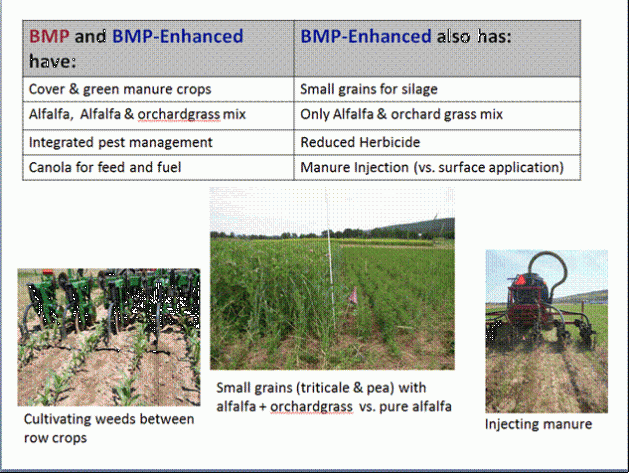
An interdisciplinary team of Penn State and USDA-ARS researchers are evaluating a Sustainable Cropping System to test the hypothesis that a dairy farm can minimize off-farm inputs and environmental impacts, and be productive, profitable and sustainable. Established in 2010 at the Penn State Agronomy Research Farm, the farm produces grain, forage and tractor fuel at 1/20th the scale of an average sized Pennsylvania dairy of 240 acres. The farm includes two diverse 6-yr crop rotations that include manure injection, perennial legumes, cover and green manure crops; a cover crop roller, winter canola, and a straight vegetable oil tractor. Within each crop rotation two management practices for no-till crop production are compared:

1. Forage Rotation compares injected manure (IM) to broadcast manure (BM); and

2. Grain Rotation compares a combination of weed management strategies designed to reduce herbicide (RH) use relative to a “standard” herbicide (SH) weed management program.

The two diverse cropping systems are designed to provide all the forage and feed for 65 lactating cows housed in a tie-stall barn, 10 dry cows and 75 young-stock. Crops are analyzed for crude protein, neutral detergent fiber, and net energy of lactation; the production of a “virtual dairy herd” is simulated using the 2001 NRC dairy nutrition model. Performance of the two farm scenarios (BMSH or IMRH) is compared. Income-over-feed costs are monitored monthly to evaluate impact of forage quality and quantity on profitability. The economic performance of the two cropping systems: BMSH vs. IMRH will be highlighted.  In 2010, the IMRH scenario had a slight trend of higher income over feed cost compared to the BMSH scenario. Related: Manure value & economics

Why Is a ‘Systems’ Approach Important for Dairies?

New agronomic management practices and technologies are often evaluated in one or two specific crops for a few growing seasons. Management practices on farms however are integrated into crop rotations, where a combination of practices can have cumulative effects on multiple aspects of the agroecosystem. This project takes an interdisciplinary approach to develop sustainable dairy cropping systems and monitor multiple indicators of systems performance. Utilizing ecological principles and innovative practices, we designed two six-year dairy crop rotations to minimize off-farm inputs and environmental impacts for a typical-sized Pennsylvania dairy farm. Within each rotation we have been comparing innovative manure or weed management strategies, as well as evaluating two green manure crops, and a tactic to sustain mycorrhizae populations in canola. The two crop rotations also compare two approaches to integrating winter canola into a dairy crop rotation.

What Did We Do?

Two cropping systems were developed to compare diverse strategies that include canola in a dairy farm rotation. The two rotations consist of 12 crop entries, each main plot being 90’ x 121’with split plots of 45’ x 121’.

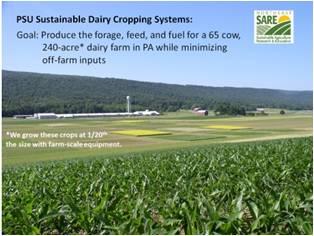
Agronomy farm at Penn State University where the cropping systems are being evaluated.

The splits within the two cropping system rotations are:

Forage rotation: Corn silage/winter wheat underseeded red clover – Corn silage – canola – alfalfa (3 yr)Split plots in the forage rotation compare the use of manure shallow disk injection versus surface-applied, broadcast manure.

Grain rotation: Alfalfa (2 yr)-Canola – Rye –Soybeans/Rye -Corn grain

To reduce herbicide use, split plots evaluate a combination of mechanical and cultural weed control practices used to reduce herbicides use (banding herbicides over the crop row, inter-row cultivation, companion cropping annual with alfalfa, and one plowing event).

What Have We Learned?

By assessing the performance of the innovative practices and the dairy cropping systems from a multidisciplinary perspective, over the past three years we have gained an understanding of their performance, as well as agroecosystem interactions, benefits, and trade-offs. Overall the cropping systems and the majority of the innovative practices are providing multiple agroecosystem benefits, although a few practices need to be modified to improve their performance.

In the first three years, both of the sustainable dairy cropping systems (inject manure and reduced herbicide (IMRH) and broadcast manure and standard herbicide (BMSH)) produced almost all of the virtual dairy herd’s feeds and forage, and all of the farm’s tractor fuel needs along with some additional canola oil to sell. The economics of the virtual farm show the purchased feed costs per cow are about half of what they would be on a “typical” dairy operation.

The assumptions made for the virtual dairy farm is that it is a start-up herd with the land and buildings in place. Loans were taken out to purchase animals and to remodel the facilities. This explains why the breakeven income over feed costs is high compared to what is observed on established dairy farms in Pennsylvania. When summarizing the cash flow plans for both scenarios, the IMRH has been trending with more income per cow compared to the BMSH. Even with the high breakeven income over feed costs, the BMSH has averaged about $1.00 and IMRH about $1.85 above breakeven for 2011-2012 on average.


Future Plans

We are still simulating and analyzing the virtual dairy herd production and economic performance and plan to conduct additional advanced economic analyses over the next three years. We will continue to monitor the cropping systems, learn how to improve their performance, and share this information through scientific literature and outreach educational activities and materials.

Authors

Virginia Ishler, Dairy Complex Manager and Nutrient Management Specialist, Penn State University, vishler@psu.edu

Heather Karsten, Associate Professor of Crop Production/Ecology, Penn State University

Glenna Malcolm, Post Doctoral Researcher, Penn State University

Tim Beck, Extension Educator, Penn State University

Additional Information

Detailed information about this project as well as publications and other resources can be found at http://plantscience.psu.edu/research/areas/crop-ecology-and-management/cropping-systems

A link to our 2012 Project summary report on the NESARE website. https://projects.sare.org/sare_project/lne09-291/

Acknowledgements

Funding has been provided NESARE (Northeast Sustainable Agriculture Research and Extension) and collaboration with USDA-ARS.


The authors are solely responsible for the content of these proceedings. The technical information does not necessarily reflect the official position of the sponsoring agencies or institutions represented by planning committee members, and inclusion and distribution herein does not constitute an endorsement of views expressed by the same. Printed materials included herein are not refereed publications. Citations should appear as follows. EXAMPLE: Authors. 2013. Title of presentation. Waste to Worth: Spreading Science and Solutions. Denver, CO. April 1-5, 2013. URL of this page. Accessed on: today’s date.

Money from Something: Carbon Market Developments for Agriculture

Waste to Worth: Spreading science and solutions logoWaste to Worth home | More proceedings….

Abstract

* Presentation slides are available at the bottom of the page.

For more than a decade, the potential to earn revenue from climate-saving activities in agriculture has been touted throughout farm-related industries. This presentation will assume a basic knowledge of the concept of carbon markets as a kind of ecosystem service market. The focus will instead be put on current market opportunities and the importance of learning from past mistakes. Included in the discussion will be carbon offset opportunities for methane capture from manure digesters and composting and nitrous oxide reduction from controls on nitrogen fertilization. Participants will learn about voluntary and compliance market opportunities and the value of offsets versus transactions costs in today’s markets. Sources of market information will also be discussed.

Topics:

  • Ecosystem services markets: Carbon credits and more.
  • Types of offsets relevant to livestock and crop producers (e.g., methane and nitrous oxide).
  • Rules of the road: How to read the key parts of project protocols.
  • Once and future markets: Consider the differences between voluntary and compliance markets.
  • Show us the money: Have any producers really made money from carbon markets?

Purpose

During the past decade, the potential to earn revenue from greenhouse gas reductions in agriculture, especially from anaerobic digestion projects, generated some enthusiasm for this emerging ecosystem market. In 2005, dairies in Washington and Minnesota received the first carbon credit payments for their digesters through the Chicago Climate Exchange (CCX), a pilot cap-and-trade market established in 2003. With the failure of the 111th Congress to complete passage of a national cap-and-trade law in the summer of 2010, the CCX closed shop. What has happened since that time? What is the potential today for livestock producers to benefit from carbon markets or carbon pricing? We look at current markets and summarize the opportunities.

What Did We Do?

The Washington State University (WSU) Energy Program monitors technology, policy and market developments about anaerobic digestion as part of its land-grant mission to support industry and agriculture in Washington state. Because of the potential value of digesters to dairy producers, we follow developments in a wide range of existing and potential ecosystem markets, including renewable energy and fuels, carbon/GHGs, nutrients, and water. Preparation for this presentation included surveys of academic and popular literature, interviews with project developers and market insiders, and analysis of the participation in carbon trading by existing livestock digester projects in the U.S.

What Have We Learned?

The existing landscape of livestock anaerobic digestion projects illustrates three major types or models of carbon market finance: utility-based programs, voluntary carbon markets and compliance-based cap-and-trade markets.

Utility-Based Opportunities

Vermont is home to at least 15 operational dairy-based digesters. Only two digesters serve farms with more than 2,000 cows. Of the balance, about half are below and half above 1,000 cows. All of the Vermont digesters produce renewable electricity and participate in one or more utility-based incentive programs. One example is the Vermont’s Sustainably Priced Energy Enterprise Development (SPEED) program, which establishes standard offer contracts between utilities and renewable energy project developers. The goal of the SPEED program is to support in-state production of renewable power from hydro, solar PV, wind, biomass, landfill gas and farm methane with an overall portfolio target of 20 percent by 2017.

A key mechanism of the program is the long-term (20-year) Standard Offer contract and default pricing for the different types of renewable power. Default prices were calculated to allow developers to recover their costs with a positive return on investment. The default prices established for the first two rounds of farm methane projects were $0.16/kWh and $0.14/kWh, respectively. This compares to an average retail price of $0.146/kWh for electricity in the state. The default prices do not account for the environmental attributes of the green power for farm methane projects.

Many of the Vermont digesters participate in the Cow Power Program, established by  the former Central Vermont Public Service (CVPS), now a part of Green Mountain Power, in 2004. The Cow Power Program offers customers the opportunity to purchase the environmental attributes (renewable energy and GHG reduction) from participating dairy digester projects at a rate of $0.04/kWh. This value was passed along to the suppliers of the dairy-based green power.

These two Vermont programs continue to operate in tandem and provide maximum benefit to Vermont’s diary digester projects. By one estimate, customers participating through the Cow Power program have provided to dairy digester operators more than $3.5 million in value for the environmental attributes created in the past eight years.

Other examples of this type of type of utility-based standard offer or incentive pricing for farm power can be found in North Carolina and Wisconsin.

Voluntary Carbon Offsets Opportunities

Voluntary carbon markets are built on decisions by utilities, corporations, and other businesses to offset their carbon footprint impacts through the purchase of third-party verified carbon credits. While the voluntary carbon market has suffered ups and downs, especially during the recent economic downturn, corporations continue to respond to pressures such as corporate stewardship policies or carbon disclosure programs that require accounting for environmental and greenhouse gas impacts. 

The voluntary market is inhabited by both nonprofit and for-profit organizations that bring sellers and buyers together. The types and value of offsets are more varied, depending on the appetites and budgets of the buyers.

For example, the voluntary carbon market has been a preferred option for Washington-based Farm Power, which has agreements with The Carbon Trust (Portland, OR) and Native Energy (Burlington, VT) for carbon credits generated from the capture and destruction of methane from its farm digester projects in Washington state. Both The Carbon Trust and Native Energy use designated registries and protocols, such as the Carbon Action Registry (CAR) or Verified Carbon Standard (VCS), as the vehicle through which credits are registered, verified, and eventually retired on behalf of their customers.

The Climate Trust – Retires registered carbon offsets on behalf of at least five Oregon-based utilities that are required by state law to offset the GHG impacts that occur from installing new power plants in the state. The Trust also sources offsets for the Smart Energy program created by NW Natural as an opportunity for customers to support production of “carbon-neutral” natural gas through farm-based biodigesters.

Native Energy – Has a diverse base of individual and business customers. They source carbon offsets for a wide range of large, environmentally conscious businesses, such as eBay, Stonyfield Farm, Brita, and Effect Partners, who provided some funding up front for offsets from Farm Power’s Rainier Biogas project. Offset values vary widely depending on demand, supply, and the “value” of the project’s story. In a few cases, offset values may loosely track the prices for compliance-grade carbon offsets with a discount for funding provided in advance of project implementation.

Compliance Cap-and-Trade Offsets Opportunities

Finally, the compliance market opportunity refers to cap-and-trade programs established by state governments to reduce GHG pollution. These are formal regulatory systems. The government establishes caps on GHGs for targeted sources and issues permits or allowances that are distributed, sold, or auctioned to regulated entities for each ton of emissions they generate. Allowances are typically tradable instruments, so entities can easily manage their allowance needs and accounts. The goal of cap-and-trade systems is to use market-based mechanisms to achieve pollution reductions at the lowest possible cost and with the least disruption to the economy.

Systems might also allow covered entities to use offsets generated voluntarily by non-covered entities to meet some portion of their emission reduction target. Allowed offsets are generated using approved protocols, verified by approved third-party verifiers, and registered/sold through approved registries. 

Two domestic cap-and-trade programs survived the past decade and are in operation today—the Regional Greenhouse Gas Initiative (RGGI), which involves nine Northeastern states, and the California market, established by Assembly Bill 32 (AB 32) and administered by the California Air Resources Board (CARB). Each of these systems operates under its own sets of rules.

The table below highlights features of these two market approaches.

Regional Greenhouse Gas Initiative (RGGI)

AB 32 – California Market

Nine states: Connecticut, Delaware, Maine, Maryland, Massachusetts, New Hampshire, New York, Rhode Island, and Vermont

California only (may establish a market connection with Ontario, Canada)

Covers the electricity sector: 200 power plants

Covers power and industrial entities that generate more than 25,000 metric tons of CO2e annually; will expand to include the transportation fuel sector in 2015

Allowances based on U.S. short tons of CO2

Allowances based on metric  tons of CO2

Allowances are auctioned

Allowances are auctioned, with a minimum floor price of $10/MtCO2e

Offsets are very limited – few types, very strict rules, only 3% of compliance allowed

Offsets are allowed in four categories: livestock methane, forestry, urban forestry, and ozone-depleting substances; entities may use offsets for up to 8% of their compliance obligation

Current auction prices: ~ $2.00

Current auction prices: ~$13.50; offset values are estimated to lag allowance prices by about 25%


Among farm digester project developers, interest in the California market is guarded. Agricultural methane capture and destruction is one of just four approved offset categories. The demand for these offsets could become strong, and the rules allow projects from any state to participate. On the other hand, the costs for monitoring equipment can be significant, $15,000 or more for start up, with similar sums every year for verification and registration.  These monitoring and transaction costs will tend to favor projects with larger livestock numbers (1,500+ dairy animal units, or AUs). To date, 60 existing digester projects have listed with the Climate Action Registry—a first step to participation in the California market. Of these projects, 36 have registered more than 800,000 verified carbon credits.

Conclusions:

Values for carbon (i.e., GHG reductions) can be observed in the marketplace and measured in terms of market goodwill or as prices for environmental attributes or carbon credits from voluntary and compliance markets.

Developers of smaller farm digester projects (<1,500 AUs) may find their best value through utility-based incentive programs or through participation in voluntary carbon markets.

Developers of larger farm digester projects (>1,500 AUs) should explore the potential costs and benefits of registering to participate as an offset project in the California carbon market.

Future Plans

The WSU Energy Program will continue to monitor market developments related to this topic and encourage livestock producers to consider methane capture and anaerobic digestion as means to control odors, manage nutrients, and produce valuable biogas resources.

Authors

Jim Jensen, Sr. Bioenergy and Alternative Fuel Specialist, Washington State University Energy Program jensenj@energy.wsu.edu

Additional Information


The authors are solely responsible for the content of these proceedings. The technical information does not necessarily reflect the official position of the sponsoring agencies or institutions represented by planning committee members, and inclusion and distribution herein does not constitute an endorsement of views expressed by the same. Printed materials included herein are not refereed publications. Citations should appear as follows. EXAMPLE: Authors. 2013. Title of presentation. Waste to Worth: Spreading Science and Solutions. Denver, CO. April 1-5, 2013. URL of this page. Accessed on: today’s date.
Manure Application Method and Timing Effects on Emission of Ammonia and Nitrous Oxide

Waste to Worth: Spreading science and solutions logoWaste to Worth home | More proceedings….

Abstract

We conducted a field study on corn to evaluate the effect of liquid dairy manure applied pre-plant (injection or surface broadcast with immediate or 3-day disk incorporation) or sidedressed at 6-leaf stage (injected or surface-applied) on emission of NH3 and N2O. Manure was applied at a rate of 6500 gal/acre, which supplied an average of 150 lb/acre of total N and 65 lb/acre of NH4-N. Ammonia emission was measured for 3 days after manure application using the dynamic chamber/equilibrium concentration technique, and N2O flux was quantified using the static chamber method at intervals of 3 to 14 days throughout the season. Ammonia-N losses were typically 30 to 50 lb/acre from pre-plant surface application, most of the loss occurring in the first 6 to 12 hours after application. Emission rates were reduced 60-80% by quick incorporation and over 90% by injection. Losses of N2O were relatively low (1 lb/acre or less annually), but pronounced peaks of N2O flux occurred from either pre-plant or sidedress injected manure in different years. Results show that NH3 emission from manure can be reduced substantially by injection or quick incorporation, but there may be some tradeoff with N2O flux from injection.

Why Study Land Application Emissions of Ammonia and Nitrous Oxide?

Figure 1. Injection equipment used for pre-plant application (top) and sidedress application (bottom) of liquid dairy manure.

Manure is a valuable source of nitrogen (N) for crop production, but gaseous losses of manure N as ammonia (NH3) and nitrous oxide (N2O) reduce the amount of N available to the crop and, therefore, its economic value as fertilizer. These N losses can also adversely affect air quality, contribute to eutrophication of surface waters via atmospheric deposition, and increase greenhouse gas emission. And the decreased available N in manure reduces the N:P ratio and can lead to a more rapid build-up of P in the soil for a given amount of available N. The most common approach to controlling NH3 volatilization from manure is to incorporate it into the soil with tillage or subsurface injection, which can reduce losses by 50 to over 90% compared to surface application (Jokela and Meisinger, 2008). Injecting into a growing corn crop at sidedress time offers another window of time for manure application (Ball-Coelho et al., 2006). While amounts of N lost as N2O are usually small compared to NH3, even low emissions can contribute to the greenhouse effect because N2O is about 300 times as potent as carbon dioxide in its effect on global warming (USEPA, 2010). We carried out a 4-year field experiment to evaluate the effect of dairy manure application method and timing and time of incorporation on a) corn yield, b) fertilizer N credits, c) ammonia losses, and) nitrous oxide emissions.

What Did We Do?

Figure 2. Average (2009-2011) NH3-N emission rates as affected by method and timing of manure application.

This field research was conducted at the Univ. of Wisconsin/USDA Agricultural Research Station in Marshfield, WI, on predominantly Withee silt loam (Aquic glossudalf), a somewhat poorly drained soil with 0 to 2% slope. Dairy manure was applied either at pre-plant (mid- to late May) or sidedress time (5-6-leaf stage). Pre-plant treatments were either injected with an S-tine injector (15-inch spacing; Fig. 1) or incorporated with a tandem disk immediately after manure application (< 1 hour), 1-day later, or 3 days later. All plots were chisel plowed 3 to 5 days after application. Sidedress manure applications were either injected with an S-tine injector (30-inch spacing) or surface applied (Fig. 1). Fertilizer N was applied to separate plots at pre-plant at rates of 0, 40, 80, 120, 160, and 200 lb/acre as urea and incorporated with a disk. Liquid dairy manure (average 14% solids) was applied at a target rate of 6,500 gal/acre. Manure supplied an average of 158 lb total N and 62 lb NH4-N per acre, but rates varied across years and application times.

Ammonia emission was measured following pre-plant and sidedress manure applications in 2009-2011 with the dynamic chamber/equilibrium concentration technique (Svensson, 1994). Measurement started immediately after manure application and continued through the third day. Ammonia measurement ended just before disking of the 3-day incorporation treatment, so the 3-day treatment represents surface-applied manure. Nitrous oxide was measured using the static, vented chamber technique following the GRACEnet protocol (Parkin and Venterea, 2010). Measurement began two days after pre-plant manure application and continued approximately weekly into October.

What Have We Learned?

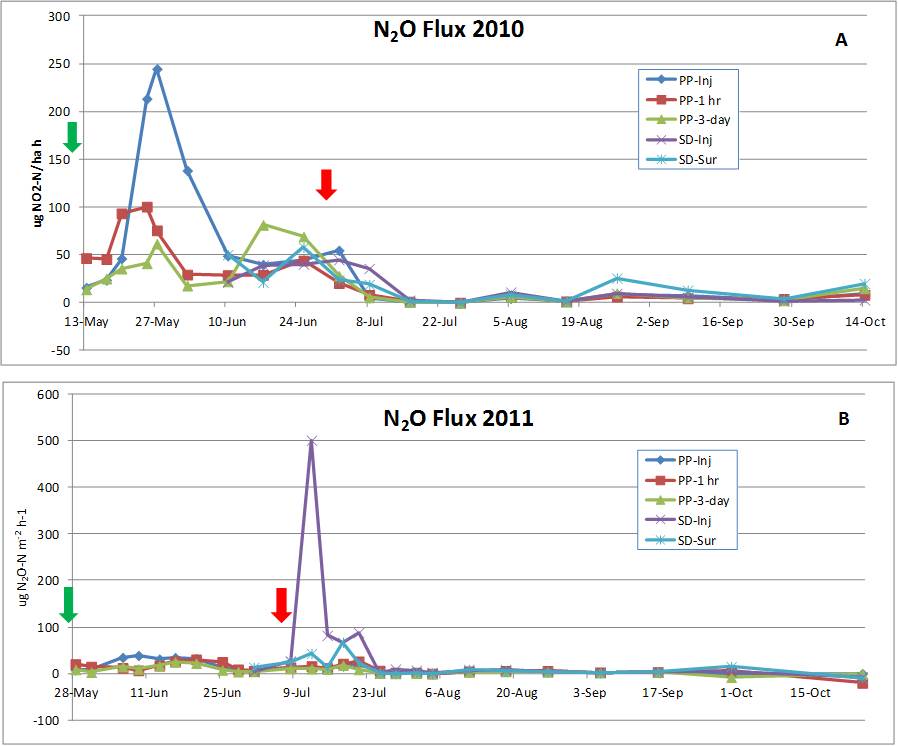
Figure 3. Nitrous oxide (N2O) flux as affected by method and timing of dairy manure application from May to October of 2010 (A) and 2011 (B). Arrows show times of manure application. Note differences in scale for 2010 and 2011.

The 3-year average annual NH3 emission rate from surface applied (3-day incorporation) manure was relatively high immediately following application but declined rapidly after the first several hours to quite low levels (Fig. 2). Cumulative NH3-N loss over the full measurement period averaged over 40 lb/acre from surface application but was reduced by 75% with immediate disking and over 90% by injection. Ammonia losses varied somewhat by year, but patterns over time and reductions by incorporation were similar. The pattern of ammonia loss, 75% of the total loss in the first 6 to 12 hours, emphasizes the importance of prompt incorporation to reduce losses and conserve N for crop use.

Nitrous oxide flux was quite low for most manure treatments during most of the May to October period in both years (Fig. 3). However, there were some increases in N2O flux after manure application, and pronounced peaks of N2O emission from the injection treatment at either pre-plant (2010) or sidedress (2011) time. Greater emission from injection compared to other treatments may have occurred because injection of liquid manure places manure in a relatively concentrated band below the surface, creating anaerobic (lacking in oxygen) conditions. Nitrous oxide is produced by denitrification, a microbial process that is facilitated by anaerobic conditions. Reasons for the difference between 2010 and 2011 are not readily obvious, but are probably a result of different soil moisture and temperature conditions.

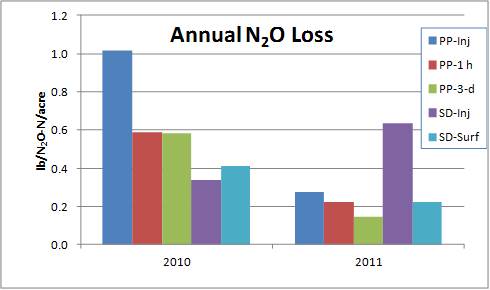
Figure 4. Annual (May-Oct.) loss of N2O as affected by method and timing of liquid dairy manure application. 2010 and 2011.

Based on these results, injection of liquid dairy manure resulted in opposite effects on NH3 and N2O emission, suggesting a trade-off between the two gaseous N loss pathways. However, the total annual N losses from N2O emissions (1 lb/acre or less; Fig. 4) were only a fraction of those from ammonia volatilization, so under the conditions of this study N2O emission is not an economically important loss. As noted earlier, however, N2O is a potent greenhouse gas, so even small amounts can contribute to the potential for global climate change. The dramatic reduction in NH3 loss from injection, though, may at least partially balance out the increased N2O because 1% of volatilized N is assumed to be converted to N2O (IPCC, 2010). Immediate disk incorporation was almost as effective as injection for controlling NH3 loss and, on average, resulted in less N2O emission than injection. But the separate field operation must be done promptly after manure application to be effective. A possible alternative is to use sweep injectors or other direct incorporation methods that place manure over a larger volume of soil and/or create more mixing with soil, thus creating conditions less conducive to denitrification and N2O loss.

Manure application timing and method/time to incorporation significantly affected grain yield in 2009, 2010, and 2012 and silage yield in 2012. Pre-plant injection produced greater yields than one or more of the broadcast treatments in 2009 (grain) and 2012 (grain and silage). Overall, yield effects of application and incorporation timing were variable from year to year, probably because of differences in weather and soil conditions and actual manure N rates applied. The fertilizer N equivalence of manure was calculated by comparing the yield achieved from each manure treatment to the yield response function from fertilizer N. Fertilizer N equivalence values were quite variable by year, but 4-year averages expressed as percent of total manure N applied were 52% for injection (pre-plant and sidedress), 37% for 1-hour or 1-day incorporation, and 34% for 3-day incorporation. So, when expressed as a percent of total manure N applied, N availability generally decreased as time to incorporation increased, which reflects the amounts of measured NH3 loss.

In summary, ammonia volatilization losses increased as the time to incorporation of manure increased. Injection of manure resulted in the lowest amount of NH3 volatilization, but higher N2O emissions. In this study, reducing the large NH3 losses by injecting manure provided more environmental benefit compared to the small increase in N2O emissions. In addition, injection or immediate incorporation resulted, on average, in higher fertilizer N value of manure for corn production. The decreased need for commercial fertilizer N could potentially result in greater profitability and a smaller carbon footprint.

Future Plans

We have started other research to evaluate yield response, N cycling, and emission of NH3 and N2O from various low-disturbance manure application methods in silage corn and perennial forage systems.

Authors

Bill Jokela, Research Soil Scientist, USDA-ARS, Dairy Forage Reserch Center, Marshfield, WI, bill.jokela@ars.usda.gov

Carrie Laboski, Assoc. Professor, Dept. of Soil Science, Univ. of Wisconsin

Todd Andraski, Researcher, Dept. of Soil Science, Univ. of Wisconsin

Additional Information

Acknowledgements

The authors gratefully acknowledge Matt Volenec and Ashley Braun for excellent technical assistance in conducting this research. Funding was provided, in part, by the USDA-Agricultural Research Service and the Wisconsin Corn Promotion Board.

The authors are solely responsible for the content of these proceedings. The technical information does not necessarily reflect the official position of the sponsoring agencies or institutions represented by planning committee members, and inclusion and distribution herein does not constitute an endorsement of views expressed by the same. Printed materials included herein are not refereed publications. Citations should appear as follows. EXAMPLE: Authors. 2013. Title of presentation. Waste to Worth: Spreading Science and Solutions. Denver, CO. April 1-5, 2013. URL of this page. Accessed on: today’s date.

Valuing Feedstocks for Anaerobic Digestion – Balancing Energy Potential and Nutrient Content

Waste to Worth: Spreading science and solutions logoWaste to Worth home | More proceedings….

Why Study the Interaction Between Energy and Nutrients for Digestion?

To improve the energy production and revenue generation, many farm digester operators are including off-farm feedstocks in the blend.  Off-farm feedstocks are raw materials with high carbon concentrations that can be degraded anaerobically.  Common off-farm feedstocks include food service or retail waste, food processing byproducts, residuals from biofuels production and FOG (fat, oil & grease) resulting from food preparation.  Typically, off-farm feedstocks have a higher energy potential when compared to manure.  Manures generally have biogas potential in the range of 280 to 500 L of biogas/kg of VS, compared to off-farm feedstocks which can range from 300 to 1,300 L of biogas/kg of VS [1].  In addition to the increased biogas production, revenue can also be generated from tipping fees collected for feedstock brought onto a farm.  The tipping fee is typically comparable to the cost of disposing of the material at a landfill or wastewater treatment plant. 

The purpose of this ongoing project is to evaluate the biogas potential and impact on nutrient management of off-farm feedstocks for anaerobic digestion.  

What Did We Do?

The Anaerobic Digestion Research and Education Center (ADREC) has carried out hundreds of biogas methane potential tests (BMP’s) over the past 5 years.  The purpose of the BMP is to evaluate if a feedstock is anaerobically degradable and predict the biogas production under ideal conditions.  As part of the biogas testing, many feedstocks were also characterized for their nutrient composition.

What Have We Learned?

While off-farm feedstocks do offer opportunities to improve the profitability of anaerobic digestion systems, operators must also consider the costs associated with bring material onto the farm.  Water contained in off-farm feedstock contributes to the manure volume and adds cost during land application.  Nutrients contained in feedstocks need to be measured and considered in the context of nutrient management planning.  In addition, the regulatory and record keeping requirements associated with off-farm feedstock should also be factored into any cost-benefit analysis.

Future Plans

ADREC is planning to continue the BMP evaluations as part its normal fee for service activities.

Authors

Dana Kirk, Specialist, Michigan State University, kirkdana@anr.msu.edu

Louis Faivor, Technician, Michigan State Univeristy

Additional Information

http://researchgroups.msu.edu/adrec/about


[1] KTBL.  2012.  Biogas Profitability Calculator.  http://daten.ktbl.de/biogas/showSubstrate.do?zustandReq=3#anwendung


The authors are solely responsible for the content of these proceedings. The technical information does not necessarily reflect the official position of the sponsoring agencies or institutions represented by planning committee members, and inclusion and distribution herein does not constitute an endorsement of views expressed by the same. Printed materials included herein are not refereed publications. Citations should appear as follows. EXAMPLE: Authors. 2013. Title of presentation. Waste to Worth: Spreading Science and Solutions. Denver, CO. April 1-5, 2013. URL of this page. Accessed on: today’s date.