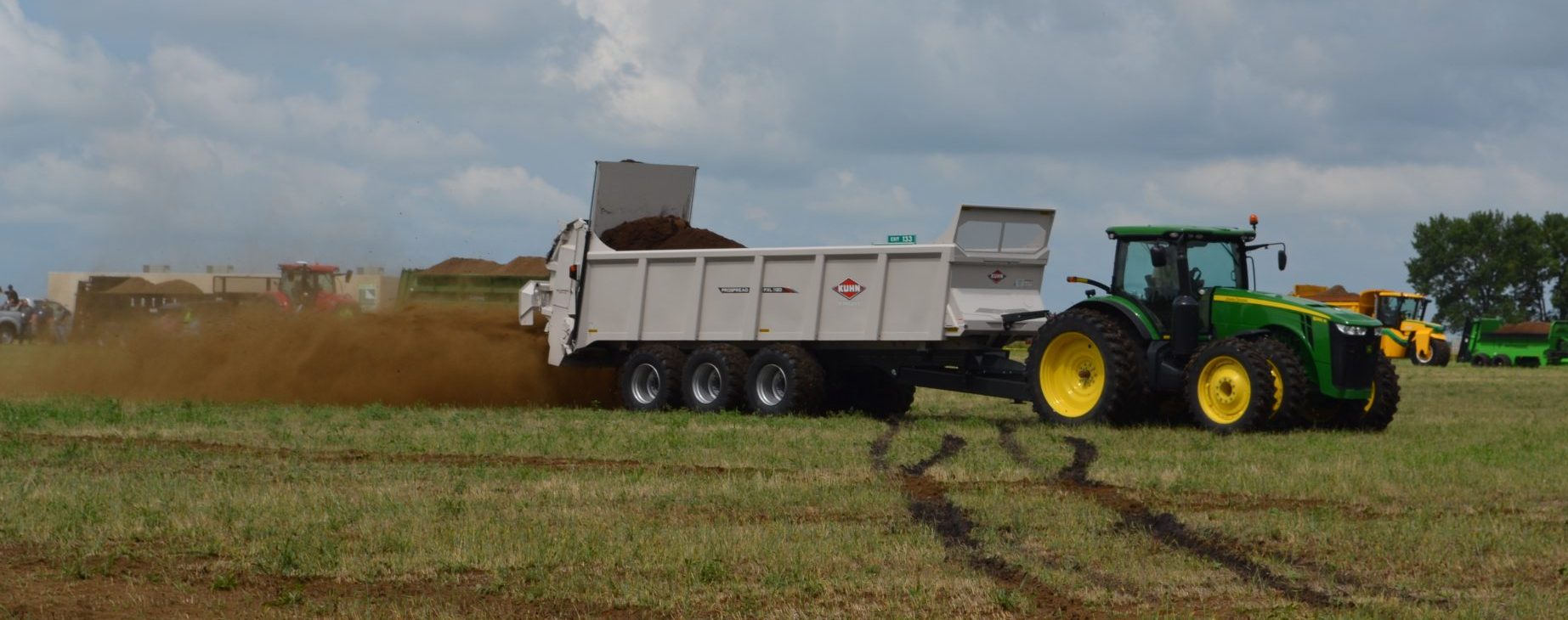
Compost containing animal carcasses should probably be utilized on crops that are not meant for human consumption for a couple of different reasons.
Disposal of the end product with regard to roadkill compost…we use it on the roadsides and plant vegetation on the roadsides.
With [farm] mortality compost, we want to be careful about where we are putting cows and chickens because we are using it back on the farm. So we may want to remove the large bones [and reuse them as part of the base for the next mortality compost pile]. We do not want to puncture any tires. But the bones do get pitted and will start breaking apart after a couple of cycles of the composting process. We do not want to use this on food crops. We may prefer to use this on field crops where the soil is tilled. We can apply the compost and then till it in. Definitely use it on crops that are harvested above the ground…corn and things like that. Do not use [mortality compost] on root vegetable or on things where we risk contamination if there is a problem.
Mortality compost can also be used in forested areas.
For active decomposition of animal carcasses, compost microorganisms require a source of nitrogen (N) (dead livestock or birds), carbon (C) (straw, corn stalks, shavings, litter, etc.), oxygen, water and elevated temperatures. An ideal C:N ratio should fall between 15:1 to 35:1. Oxygen (air) can be introduced when turning the compost. If proper moisture is not supplied, the organisms cannot survive. Ideally, moisture content should range from 45-55%, or wet enough when the compost is squeezed to leave your hand feeling moist, without actually forming drops of water. When all components are present in the correct ratio, the compost pile heats naturally, destroying most pathogens while microbial activity degrades the carcasses.
Reviewers: Shafiqur Rahman, North Dakota State University and Jean Bonhotal, Cornell University
Manage Cookie Consent
To provide the best experiences, we use technologies like cookies to store and/or access device information. Consenting to these technologies will allow us to process data such as browsing behavior or unique IDs on this site. Not consenting or withdrawing consent, may adversely affect certain features and functions.
Functional
Always active
The technical storage or access is strictly necessary for the legitimate purpose of enabling the use of a specific service explicitly requested by the subscriber or user, or for the sole purpose of carrying out the transmission of a communication over an electronic communications network.
Preferences
The technical storage or access is necessary for the legitimate purpose of storing preferences that are not requested by the subscriber or user.
Statistics
The technical storage or access that is used exclusively for statistical purposes.The technical storage or access that is used exclusively for anonymous statistical purposes. Without a subpoena, voluntary compliance on the part of your Internet Service Provider, or additional records from a third party, information stored or retrieved for this purpose alone cannot usually be used to identify you.
Marketing
The technical storage or access is required to create user profiles to send advertising, or to track the user on a website or across several websites for similar marketing purposes.