Awful Offal: Partnerships to Benefit Livestock Producers, Local Food Chains, Human Health, and the Environment

Purpose

Livestock producers and meat processors are facing ever evolving challenges when it comes to waste management. Increasing levels of regulation continue to challenge producers, including Washington State’s recently established Organics Management law which sets Methane reduction goals for landfills. This has led many landfills in the state to begin turning away organic material like offal and animal carcasses. Meanwhile climate change is increasing the frequency and intensity of catastrophic animal mortality events, driving the urgent need for solutions to build resources and infrastructure to manage large animal losses.

The Awful Offal group serves as the primary inter-agency effort for addressing policy barriers and problem-solving acute and ongoing animal waste disposal scenarios. The group and its members also participate in state-wide catastrophic mortality preparedness planning. This presentation aims to engage participants with real-world examples of successes and challenges this group has faced through its inception.

What Did We Do?

The Awful Offal work group meets regularly to update members on specific cases or trends in their respective programs. Over years of collaboration, we have been able to identify gaps, provide training and create resources to address some of the largest challenges the state faces with animal carcass management. This has taken shape in the form of offal focused composting workshops, market studies, and countless hours providing resources and technical assistance to operators in need.

What Have We Learned?

We have learned much since this group’s inception, one thing that routinely comes up is that Washington’s diverse climate is going to require an equally diverse set of solutions for tackling this challenge. Composting is a viable and environmentally responsible option for many but also comes with its own unique needs and challenges. Many small meat processors have described the switch from sending material to landfill to composting onsite as “running a second business.” If you also consider many commercial composting operations do not accept this material, we must recognize that no single solution will solve this issue state-wide.

Future Plans

Through robust technical assistance and economic incentives, Washington State Department of Agriculture (WSDA) plans to lead a State-wide effort to promote adoption of on and off-farm composting as a waste management strategy.  WSDA also intends to conduct an in-depth economic and market analysis to identify the specific regional needs and barriers so to further determine how the State can best support additional infrastructure, fund pilot projects and develop resources.

Authors

Presenting author

AJ Mulder, Nutrient Management Specialist, Washington State Department of Agriculture, aj.mulder@agr.wa.gov

Acknowledgements

I would like to acknowledge all the members of the Awful Offal work group, including my colleagues at Washington State Department of Agriculture, Department of Ecology, Washington State University, Department of Health, Department of Fish and Wildlife, USDA and all our industry partners whose input and cooperation this work would be impossible without.


The authors are solely responsible for the content of these proceedings. The technical information does not necessarily reflect the official position of the sponsoring agencies or institutions represented by planning committee members, and inclusion and distribution herein does not constitute an endorsement of views expressed by the same. Printed materials included herein are not refereed publications. Citations should appear as follows. EXAMPLE: Authors. 2025. Title of presentation. Waste to Worth. Boise, ID. April 711, 2025. URL of this page. Accessed on: today’s date. 
The Economics of Carbon Markets for Dairy Industry

Purpose

Dairy farmers in Washington state have been under significant pressure to reduce their carbon footprint in recent years. Dairy cooperative sustainability initiatives such as achieving carbon neutrality by 2050 have left many producers wondering what will be required of them to help their cooperatives meet this goal. Coupled with regulatory pressures to report on their greenhouse gas emissions and the threat of regulation to reduce them, uncertainty remains for producers around the types of climate-smart practices that will enable them to reduce their carbon footprint while remaining economically viable.

Without a thorough understanding of the costs and risks, pressures, or requirements to implement climate-smart practices may inadvertently drive consolidation and the accelerated loss of small to medium sized farms.

What Did We Do?

Utilizing Washington state dairy facility data, I conducted an economic cost benefit analysis of two climate-smart practices that capture GHGs from anaerobic storage: anaerobic digestors and the covered lagoon and flare system and the size of operation needed to implement both practices based on current and historic market conditions and technology costs. Private and public investment in climate-smart practices can have a substantial impact on whether they are economically feasible for producers to implement. I considered the impacts of various levels of cost-share on the size of farm able to adopt the technology based on several economic indicators.

What Have We Learned?

Most dairy farms cannot simply raise their prices to offset the costs of climate-smart practices, therefore it is critical to understand the broad economic impacts of imposing emissions reductions mandates. With consolidation being a well-documented trend across dairy farms in the United States, it is possible that climate regulations will only further exacerbate this trend due to the high capital costs and market risk associated with climate-smart farming that only facilities of scale can take on.

Future Plans

I am actively assisting research right now in Washington state with university and private researchers into dairy farm carbon intensities, across various farm sizes and facility types. An overview of this research may be available by Summer of 2025. Once this work is completed, we will have a better understanding of overall farm emissions and what climate-smart practices may be necessary for farms to implement to help achieve cooperative net zero targets.

Authors

Presenting & corresponding author

Nina Gibson, Agricultural Economist and Policy Specialist, Washington State Department of Agriculture, KGibson@agr.wa.gov

Additional Information

Link to Podcast I hosted, the Carbon and Cow$ Podcast, which covers the risks and opportunities associated with carbon markets for dairy and livestock producers: https://csanr.wsu.edu/program-areas/climate-friendly-farming/carbon-and-cows-podcast/

Link to my program’s homepage at WSDA: https://agr.wa.gov/manure

My Linkedin: https://www.linkedin.com/in/nina-gibson-b482a8119/

The authors are solely responsible for the content of these proceedings. The technical information does not necessarily reflect the official position of the sponsoring agencies or institutions represented by planning committee members, and inclusion and distribution herein does not constitute an endorsement of views expressed by the same. Printed materials included herein are not refereed publications. Citations should appear as follows. EXAMPLE: Authors. 2025. Title of presentation. Waste to Worth. Boise, ID. April 711, 2025. URL of this page. Accessed on: today’s date.

Performance of Mitigation Measures in the Dairy Sector under Future Climate Change


Proceedings Home W2W Home w2w17 logo

Purpose

Climate change is an economic, environmental and social threat, and worthy of scientific study. Immediate action must be taken to reduce greenhouse gas emissions and mitigate negative impacts of future climate change. Proposed action can start at the farm level and has the potential of making a contribution to mitigation of climate change. Dairy farmers are able to significantly reduce their emissions by implementing better management practices, primarily through feed production, enteric fermentation, and manure management. We model the corresponding changes in emissions from proposed mitigation efforts to understand their impact on global climate change.

What did we do?

Best Management Practices (BMPs) for dairy systems have been identified and simulated using the Integrated Farm System Model (IFSM). Simulations representative of a large New York farm (1500 cows) and a small Wisconsin farm (150 cows) estimated the emission of greenhouse gases for a whole farm system. Percent reductions were calculated by comparing a baseline scenario without any implemented mitigation, to scenarios that included the identified BMPs. Refer to Table 1 for emission and percent reduction estimates for the simulated BMPs.Table 1. Emissions and percent reductions from baseline for simulated mitigation strategies

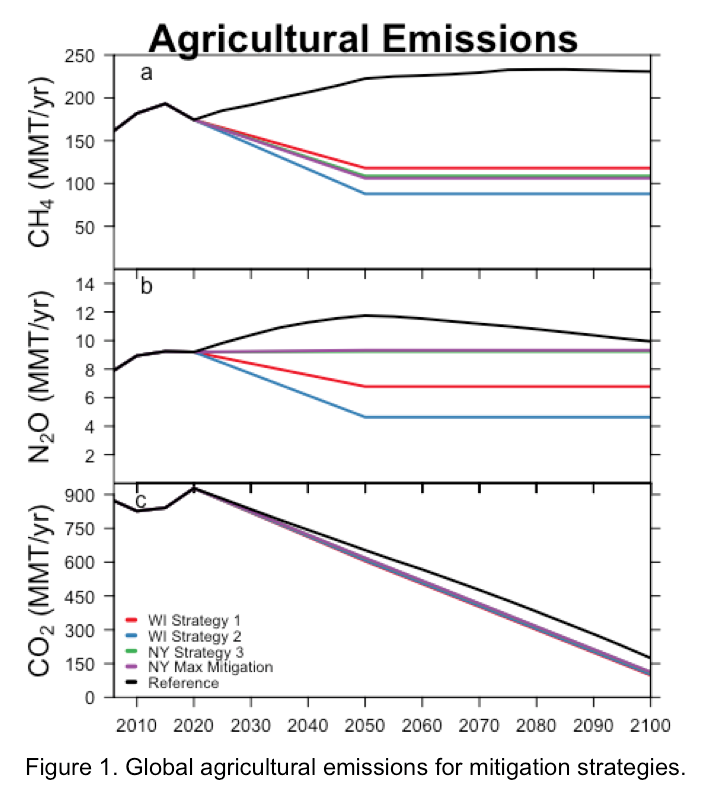
Percent reduction estimates were then applied to a projected “business as usual” emission scenario. This scenario prescribes anthropogenic emissions through 2100 and excludes any climate action or policy after 2015. Taking 2020 as a reference year and 2050 as a target year, we applied the estimated percent reductions to the projected global agricultural emissions. Emission reductions were decreased linearly from 2020 to 2050, and held constant between 2050 and 2100 (Figure 1). This assumes that all farms globally can reduce emissions despite increases in production. To compare the performance of the mitigation measures under future climate change, we employed a fully coupled earth system model of intermediate complexity – the Integrated Global System Model (IGSM). The model includes an interactive carbon-cycle capable of addressing important feedbacks between the climate and terrestrial biosphere.

Figure 1. Global agricultural emissions for mitigation strategiesWhat have we learned?

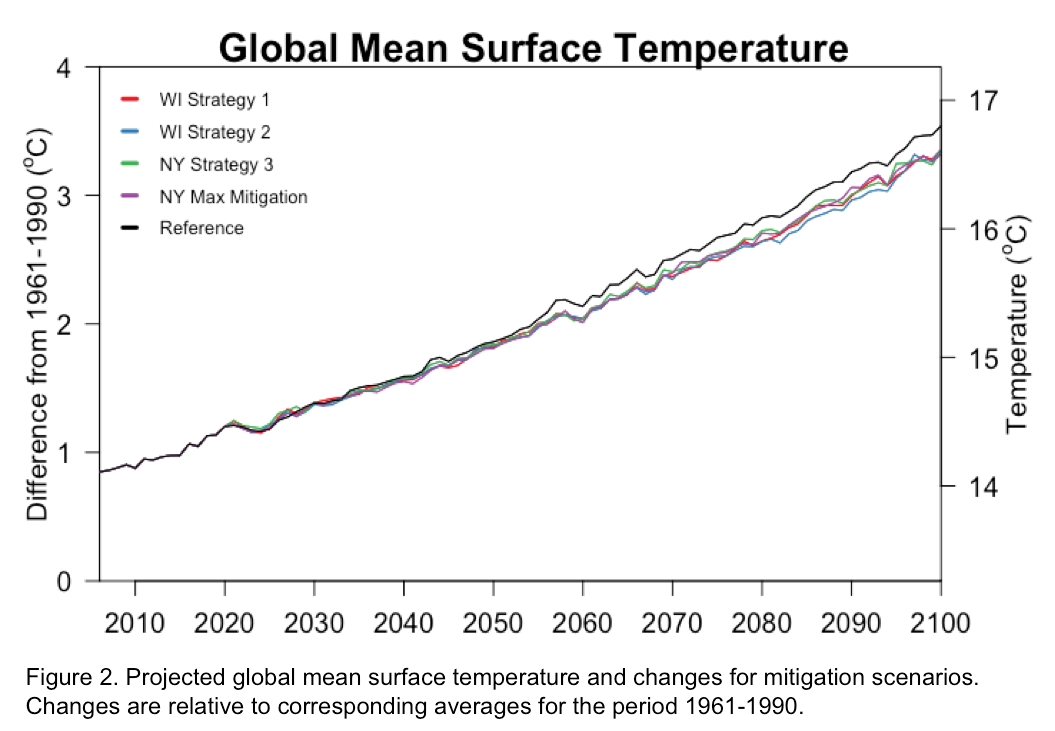
Action taken globally in the agricultural sector to reduce greenhouse gas emissions over the first half of the 21st century is likely to have an impact in mitigating global warming. Following a “business as usual” emission scenario without any climate policy or action beyond 2015, an increase in global mean surface temperature by the end of the 21st century (2081-2100) relative to pre-industrial (1961-1990) levels is projected to be 2.8 C to 3.5 C (Figure 2). This exceeds the 2 C temperature target described as the maximum warming allowed to avoid dangerous and irreversible climate change. An associated net radiative

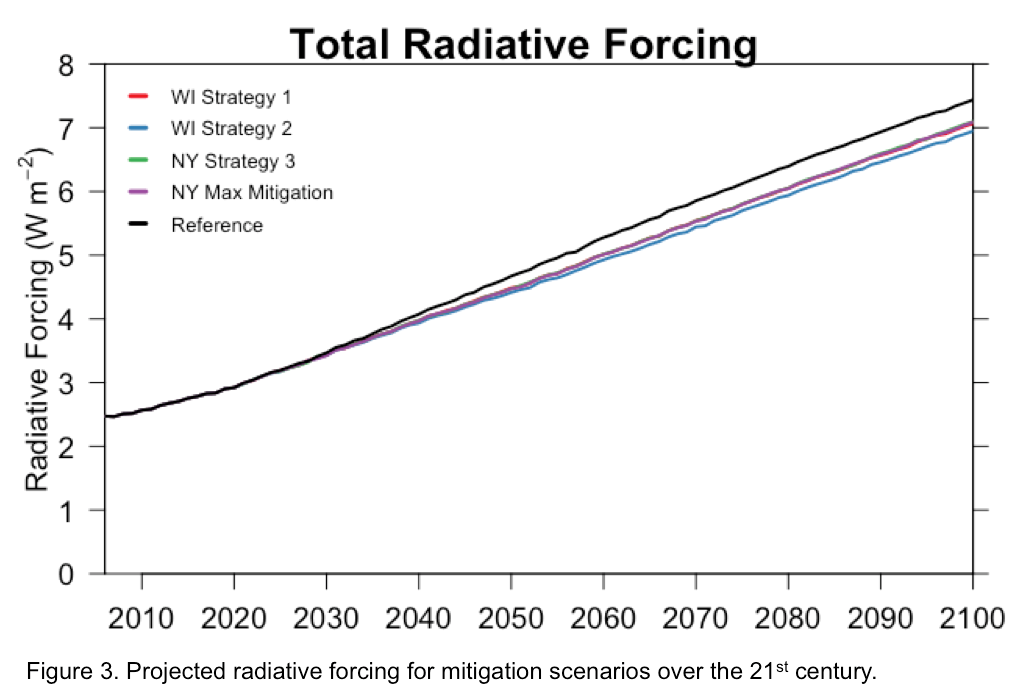
forcing for the “business as usual” scenario is projected to be 7.4 W/m^2 by 2100 (Figure 3). Adopting the identified BMPs in the dairy sector and decreasing global agricultural emissions by 2050 is projected to decrease global mean surface temperatures for 2100 by 0.2 C and net radiative forcing by 0.4 W/! m^2 on av erage. In summary, this modeled experiment demonstrates that ongoing efforts to decrease greenhouse gas emissions in the dairy and agricultural sector are effective at reducing the overall warming of climate change.

Figure 2. Projected global mean surface temperature and changes for mitigation scenarios

Figure 3. Projected radiative forcing for mitigation scenarios over the 21st century

Future Plans

Future work will look further into the evolution of regional temperature and rainfall profiles for the mitigation scenarios. Then, ecological risk assessment methodologies will be applied to determine the probable impacts of climate change by each scenario on agricultural production.

Corresponding author, title, and affiliation

Kristina Rolph – Graduate Student, The Pennsylvania State University.

Corresponding author email

kar5469@psu.edu

Other authors

Chris Forest – Associate Professor of Climate Dynamics, The Pennsylvania State University.

Rob Nicholas – Research Associate, Earth & Environmental Systems Institute.

Additional information

  1. The Sustainable Dairy Project, funded by the USDA, researches alternative management practices in the dairy industry. http://www.sustainabledairy.org
  2. The Integrated Farm System Model simulates all major farm components to represent the many biological and physical processes on a farm. https://www.ars.usda.gov/northeast-area/up-pa/pswmru/docs/integrated-farm-system-model/
  3. The MIT Integrated Global System Model is a fully coupled earth system model of intermediate complexity designed to analyze interactions between human activities and the Earth system. https://globalchange.mit.edu/research/research-tools/global-framework

Acknowledgements

This material is based upon work that is supported by the National Institute of Food and Agriculture, U.S. Department of Agriculture, under award number 2013-68002-20525. Any opinions, findings, conclusions, or recommendations expressed in this publication are those of the author(s) and do not necessarily reflect the view of the U.S. Department of Agriculture.