What Temperature Is Required To Reduce Pathogens In an Animal Mortality Compost Piles?

Research studies have been done to correlate the temperature of a compost pile containing livestock or poultry carcasses and the amount of pathogen kill achieved at those temperatures. How do you take the temperature of a compost pile? And how does that temperature correlate to pathogen reduction?

Maintaining a temperature of 131 deg F for at least 4 hours assures us that we have reached an appropriate temperature for pathogen reduction. However, to destroy most pathogen and viruses, compost pile should sustain temperature 131 °F or greater for at least 3 consecutive days. The heat is the result of microbial metabolic activity within the compost pile as they are consuming the carcass.

Check out the other video FAQs on carcass management

Author: Joshua Payne, Oklahoma State University

Reviewers: Shafiqur Rahman, North Dakota State University and Jean Bonhotal, Cornell University

When Composting Animal Carcasses, Do the Bones Break Down? If Not, What Can Be Done With Them?

Most bones break down when composting animal carcasses, but a few large bones will usually remain.

With proper composting, the bones will break down over time. This may take several months for larger livestock bones and as little as 60 days for smaller carcasses such as poultry. If large bones remain in the compost pile, they can be added to additional compost piles until completely degraded.

Check out the other video FAQs on carcass management

Author: Joshua Payne, Oklahoma State University

Reviewers: Shafiqur Rahman, North Dakota State University and Jean Bonhotal, Cornell University

Can I Use Rendering As an Option For Managing Animal Mortalities?

There are many options available for disposing of livestock and poultry carcasses. Rendering is an option in areas where the service is offered, but has some limitations on the type of animals they will pick up.

Check out the other video FAQs on carcass management.

Author: Joshua Payne, Oklahoma State University

Reviewers: Shafiqur Rahman, North Dakota State University and Jean Bonhotal, Cornell University


Why Is It Important To Manage Animal Mortalities Properly?

Improperly disposed livestock or poultry carcasses represent a threat to water and air quality.

Proper management of on-farm animal mortalities is vital to every farming operation. Improper disposal of dead animal carcasses can negatively impact surface water and groundwater from carcass leachate. If the animal died of an infectious disease, pathogenic bacteria and viruses may be present within the carcass. These pathogens can be spread by insects, rodents, preda­tors, and subsurface or above ground water movement, as well as through direct contact with other livestock or poultry leading to increased disease transmission risks. Furthermore, many states have rules regulating the proper disposal of livestock and poultry mortalities. Therefore, the purpose of proper mortality disposal is to prevent the spread of infectious, contagious and communicable diseases and to protect air, water and soil quality. Note that regulated AFOs must abide by their animal mortality disposal plan outlined in their nutrient management plan.

Check out the other video FAQs on carcass management

Author: Joshua Payne, Oklahoma State University

Reviewers: Shafiqur Rahman, North Dakota State University and Jean Bonhotal, Cornell University

What are the necessary components for composting animal mortalities?

For active decomposition of animal carcasses, compost microorganisms require a source of nitrogen (N) (dead livestock or birds), carbon (C) (straw, corn stalks, shavings, litter, etc.), oxygen, water and elevated temperatures. An ideal C:N ratio should fall between 15:1 to 35:1. Oxygen (air) can be introduced when turning the compost. If proper moisture is not supplied, the organisms cannot survive. Ideally, moisture content should range from 45-55%, or wet enough when the compost is squeezed to leave your hand feeling moist, without actually forming drops of water. When all components are present in the correct ratio, the compost pile heats naturally, destroying most pathogens while microbial activity degrades the carcasses.

Resources:

Check out the other video FAQs on carcass management

Author: Joshua Payne, Oklahoma State University

Reviewers: Shafiqur Rahman, North Dakota State University and Jean Bonhotal, Cornell University

Costs of Manure Application and Transport

When talking about the value of manure, costs are reported in terms of dollars. While reporting in terms of dollars is usually helpful, it is not the only metric for discussing costs. Any resource that is required to accomplish a task can be considered a cost. With this in mind, this page will discuss the cost of manure distribution in terms of dollars and time. The limiting resource, dollar cost or hours required, determines how manure is distributed. Hours could be converted to dollars but that would possibly obscure the management of these costs.

Factors Influencing Cost of Manure Management

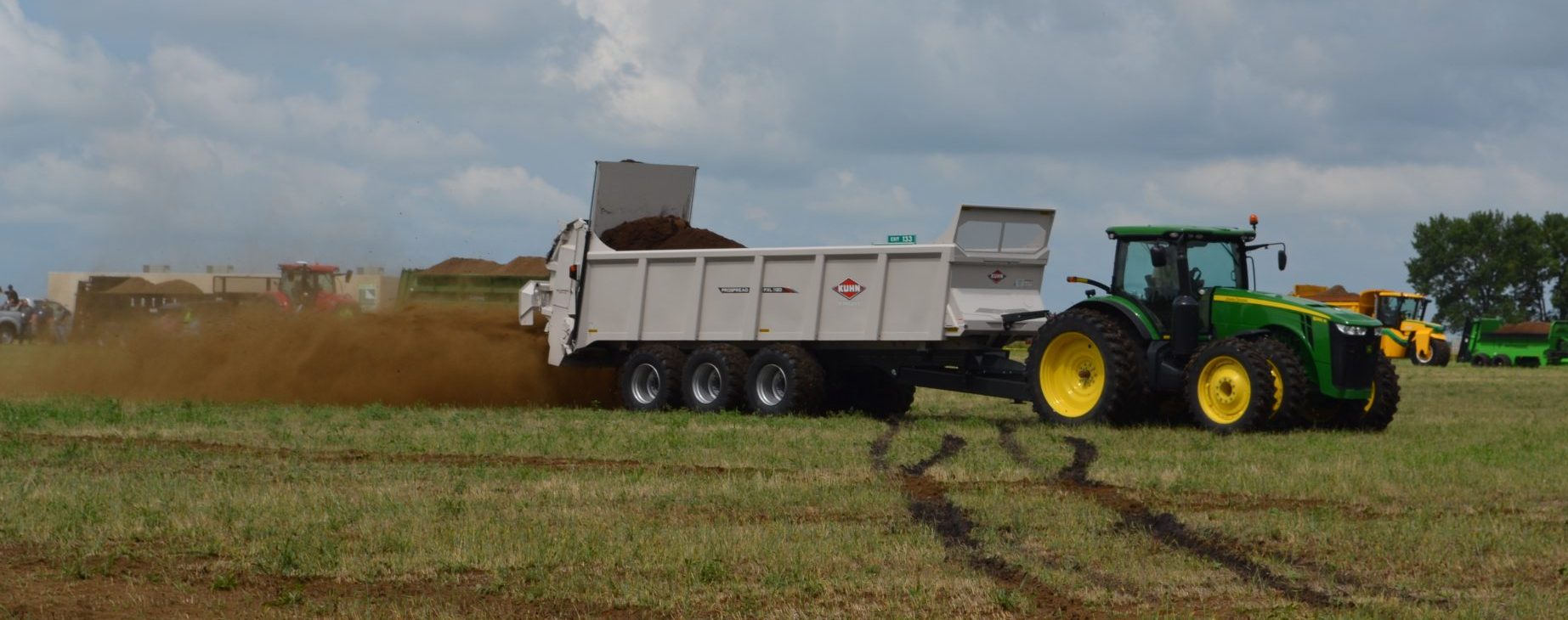
The three major activities that influence the cost of manure management are loading, transporting and land applying. Each activity can require its own specialized equipment and can constrain the use of the manure. For example, except for an external manure storage structure, loading is best done when animals are not present and thus limited to those time periods. Transportation can be time consuming depending on the distance traveled and the amount of water hauled in the manure. Land applying requires proper soil and plant conditions and specialized equipment.

Livestock manure is either liquid, slurry or solid. Different types of manure will have different impacts on the cost of distribution. For example, solid manure can usually be hauled farther for less money because less water is being transported. Liquid manure, because of its high water content, can’t be transported as far but low cost irrigation systems can be used to distribute it relatively inexpensively. This page will address each manure type separately. Because the dollar cost of managing manure is so dependent on location, type of livestock, form of manure, availability of land, etc. No dollar estimate will be given in this page. The quickest way to get a cost estimate would be to contact a custom manure hauler and ask the price charged for different services.

The table below summarizes the relative costs of manure application and distribution. When reading it, compare the costs within a column, rather than within a row. In other words, use it to compare the cost of loading, transportation, or land application for each type of manure. The more dollar signs ($) a manure type has, the more expensive it is relative to the other types of manure. Click on a type of manure in this table to be taken to a description of why different manures will have different costs.

Summary of Manure Application and Distribution Costs
Manure Type Loading Transportation Land Application
Solid Manure      
Fresh $$ $$ $$$
Stockpiled $$$ $$ $$$
Slurry Manure      
Tanker $ $$$$ $$$
Dragline hose $ $$$ $$
Liquid Manure      
Dragline hose $ $$$ $$
Irrigation system $ $ $

Custom application

Because much of the equipment used in manure application is unique to manure application, many livestock producers choose to not own the equipment but rather hire custom operators to handle their manure. Custom operators can lower the cost of manure management, relative to owner operated equipment, by spreading the cost of expensive equipment over more units. Many custom operators can also apply the manure more quickly due to experience and because they have larger equipment or multiple pieces of equipment. Because they work for many livestock producers, they may not be able to apply an individual’s manure at opportune times. This uncertainty of when the manure will be applied is a cost that needs to be taken into account. Contracting Certified Manure Haulers contains instructions for comparing custom hauling with producer hauling of manure.

Livestock manures are an excellent source of organic nutrients. However, they are generally more expensive to transport and land apply than more concentrated commercial fertilizers. The cost of manure transport and distribution are critical to understand and manage in order to derive maximum value from manure. A research project completed in the late 1990’s includes this information. The actual costs presented may no longer be relevant but the conclusions are still valid.

A spreadsheet to estimate the cost of hauling various types of manure can be obtained at University of Missouri.

Related Web Pages

Authors: Ray Massey, University of Missouri and Josh B. Payne, Oklahoma State University