
Measured methane emission rates relative to the chemical composition of dairy manure samples

Purpose

Methane emissions from liquid manure storage systems contribute a significant portion of methane emissions from the US agricultural sector (EPA, 2024). There is a need for more farm-level methane emission values to guide decision-making activities within the dairy industry and by government agencies. Cost, time, and labor constraints are challenges related to on-farm methane emission measurements. There is a need for simpler emission measurement methods.

The purpose of this work was to investigate relationships between methane emission rates (MER) in a laboratory assay and commonly measured characteristics including total solids (TS), volatile solids (VS), ash, and total Kjeldahl nitrogen (TKN). The relationships were also examined in conjunction with storage type, season, manure type, and storage duration.

What Did We Do?

We collected dairy manure samples from manure storages at 27 farms in Minnesota and Wisconsin at 2 to 4-month intervals throughout 2024. These samples represented various storage types, storage durations, and manure temperatures. To date, a majority of these samples have been processed for TS, VS, Ash, and TKN using standard methods for manure chemical analyses (American Water Works Association, 2017; Wilson et al., 2022). Additionally, MER were estimated in triplicate with a 3-day in vitro assay (Andersen et al., 2015). Relationships between MER and these manure chemical constituents were examined using Spearman correlation analysis and bivariate plots across all manure samples and with respect to other manure management characteristics. These include storage type, season, manure type, and storage duration. Manure chemical constituents were treated as numerical data whereas storage characteristics were treated as categorical data in the analysis. It is important to note that many samples may only have a partial set of manure analyses completed at this point. This resulted in varying counts of available samples used in the statistical analyses below (Table 1-3). Summary statistics (mean, median, range) are also presented for the different manure chemical constituents.

What Have We Learned?

Table 1 shows summary statistics of dairy manure samples processed for this work (wet basis). There was a wide range of concentrations observed for each manure chemical constituent; however, average values were comparable to American Society of Agricultural and Biological Engineers (ASABE) manure characteristics values (ASABE, 2019).

Table 1: Summary statistics of dairy manure chemical characteristics (% wet basis) (n = 148 for TKN, n = 155 for other manure constituents)

Mean Median Min Max
TS 5.92% 4.98% 0.53% 17.89%
VS 4.39% 3.50% 0.27% 16.60%
Ash 1.53% 1.21% 0.26% 11.12%
TKN 0.31% 0.29% 0.08% 0.83%

Generally, overall correlations (Table 2) and correlations within categories (Table 3) were not strong, however there were some exceptions. These exceptions were observed in TS and VS relationships with MER for flush water and long-term storage duration (Table 3). Here, both positive and negative correlations that were at least moderately strong (rs ≥ |0.5|) were observed. Since methane emissions are a product of organic matter degradation, positive correlations between VS and MER were expected, but not always reflected in the results. Other trends in relationships between other manure constituents and MER are not well understood. However, manure management factors may also influence other microbial activity with respect to TS, Ash, and TKN content, which may have indirect effects on MER that cannot be discerned from a correlative relationship.

Additionally, given the wide range in the concentrations of all manure constituents and MER, it may be difficult to distinguish these relationships when comparing across the aggregate values. Instances where the strongest correlations were observed (Table 3) describe samples from a single farm, which suggests conducting a similar analysis within individual farms to better understand these relationships.

Table 2: Overall Spearman correlation values (rs) between manure constituents and MER

Total solids Volatile solids Ash Total Kjeldahl Nitrogen
MER 0.060 0.052 0.137 -0.046


Table 3: Spearman correlation values (rs) between manure constituents and MER by manure storage type, manure type, storage duration, and season

TS vs MER VS  vs MER Ash vs MER TKN vs MER
Manure storage type Transfer pit (n = 169) 0.150 0.124 0.271 0.075
Underfloor pit (n = 34) -0.103 -0.121 -0.125 -0.153
Manure type Raw manure (including bedding (n=36) 0.270 0.267 0.312 0.369
Raw manure (including bedding + others) (n = 140) 0.042 0.047 0.094 -0.093
Liquid separated manure (n =24) -0.213 -0.297 -0.025 -0.156
Flush water (n = 9) 0.800 0.800 0.883 0.833
Storage duration Short term (< 1 month) (n = 176) 0.082 0.090 0.117 -0.020
Long term (> 1 month) (n =6) -0.771 -0.771 -0.143 -0.200
Point sample (not a storage) (n= 29) 0.029 -0.078 0.350 -0.136
Season Winter (n= 23) 0.013 0.081 -0.011 0.132
Spring (n= 57) 0.406 0.399 0.411 0.238
Summer (n = 46) -0.268 -0.291 -0.165 -0.436
Fall (n =66 -0.188 -0.198 -0.023 -0.011

 Future Plans

We plan to conduct a stepwise regression analysis to better understand the significant independent variables (manure constituents) that influence MER. Correlations between manure constituents and MER using measurements from samples within individual farms will also be conducted.

Authors

Presenting author

Noelle Soriano, PhD candidate, University of Minnesota

Corresponding author

Erin Cortus, Associate Professor and Extension Engineer, University of Minnesota, Ecortus@umn.edu

Additional author

MaryGrace Erickson, Postdoctoral associate, University of Minnesota

Additional Information

Andersen, D. S., Van Weelden, M. B., Trabue, S. L., & Pepple, L. M. (2015). Lab-assay for estimating methane emissions from deep-pit swine manure storages. Journal of Environmental Management, 159, 18-26.

American Water Works Association. (2017). Standard Methods for the Examination of Water and Wastewater. American Water Works Association.

ASABE. (2019). Manure Production and Characteristics (ASAE D384.2). ASABE.

EPA. (2024). Inventory of U.S. Greenhouse Gas Emissions and Sinks 1990-2022 (No. EPA 430-R-24-004). U.S. Environmental Protection Agency. https://www.epa.gov/ghgemissions/inventory-us-greenhouse-gas-emissions-andsinks-1990-2022

Wilson, M., Brimmer, R., Floren, J., Gunderson, L., Hicks, K., Hoerner, T., Lessl, J., Meinen, R. J., Miller, R. O., Mowrer, J., Porter, J., Spargo, J. T., Thayer, B., & Vocasek, F. (2022). Recommended Methods Manure Analysis (M. Wilson & S. Cortus, Eds.; 2nd ed.). University of Minnesota Libraries Publishing.

Acknowledgements

We are grateful to the farms that participated in this research for providing samples and for sharing their observations with us. We are also grateful to Kevin Bourgeault, Seth Heitman, Sabrina Mueller, and Jacob Olson for contributing to sampling and laboratory analysis.

This research is supported by through USDA NIFA Award 2023-68008-39859, and the Minnesota Rapid Agricultural Response Fund.

The authors are solely responsible for the content of these proceedings. The technical information does not necessarily reflect the official position of the sponsoring agencies or institutions represented by planning committee members, and inclusion and distribution herein does not constitute an endorsement of views expressed by the same. Printed materials included herein are not refereed publications. Citations should appear as follows. EXAMPLE: Authors. 2025. Title of presentation. Waste to Worth. Boise, ID. April 7-11, 2025. URL of this page. Accessed on: today’s date. 
 

Predicting Manure Nitrogen and Phosphorus Characteristics of Beef Open Lot Systems

This project involves the analysis of a new data set for manure characteristics from open lot beef systems demonstrating both average characteristics and factors contribution to variability in manure characteristics among these systems. Defining the characteristics and quantities of harvested manure and runoff from open earthen lot animal systems is critical to planning storage requirements, land requirements for nutrient utilization, land application rates, and logistical issues, such as equipment and labor requirements. Accuracy of these estimates are critical to planning processes required by federal and state permitting programs. Poor estimates can lead to discharges that result in court action and fines, neighbor nuisance complaints, and surface and ground water degradation. Planning procedures have historically relied upon standard values published by NRCS (Stettler et al., 2008), MWPS (Lorimor et al., 2000), and ASABE (2014) for average characteristics.

What Did We Do?

A large data set of analyses from manure samples collected over a 15-year period from 444 independent cattle feedlot pens at a single eastern Nebraska research facility was reviewed to provide insight to the degree of variability in observed manure characteristics and to investigate the factors influencing this variability. No previous efforts to define these characteristics have included data gathered over such a wide range of dietary strategies and weather conditions. This exclusive research data set is expected to provide new insights regarding influential factors affecting characteristics of manure and runoff harvested from open lot beef systems. The objective of this paper is to share a preliminary summary of findings based upon a review of this data set.

What Have We Learned?

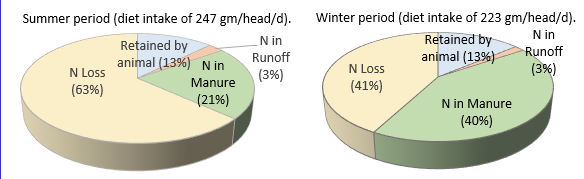
A review of this unique data set reveals several important preliminary observations. Standard values reported by ASABE and MWPS for beef manure characteristics in open lot systems are relatively poor indicators of the significant variability that is observed within open lot feeding systems. Our data set reveals significant differences between manure characteristics as a function of feeding period (Table 1) and substantial variability within feeding period, as illustrated by the large coefficients of variation for individual characteristics. Differences in winter and summer conditions influence the characteristics and quantities of solids, organic matter, and nutrients in the harvested manure. The timing of the feeding period has substantial influence on observed differences in nitrogen loss and nitrogen in manure (Figure 1). Nitrogen recovery for the warmer summer feeding periods averaged 51 and 6 grams/head/day in the manure and runoff, respectively, with losses estimated to be 155 grams/head/day.  Similarly, nitrogen recovery in manure and runoff for the winter feeding period was 90 and 4 grams/head/day, respectively, with losses estimated at 92 grams/head/day (Figure 1 and Koelsch, et al., 2018). In addition, differences in weather and pen conditions during and following winter and summer feeding periods impact manure moisture content and the mixing of inorganics with manure (Table 1).

Table 1. Characteristics of manure collected from 216 and 228 cattle feedlot pens during Summer and Winter feeding periods, respectively1.
University of Nebraska Feedlot in East Central Nebraska Standard Values
Summer Winter ASABE NRCS MWPS3
Mean CV2 Mean CV2 Mean Mean
Total Manure (wet basis), kg/hd/d 9.3 99% 13.1 43% 7.5 7.9
DM    % 71% 10% 63.2% 15% 67% Collected 55%
    kg/hd/d 5.4 80% 8.0 41% 5.0 manure 4.3
OM    % 24% 28% 25.3% 41% 30% is not 50%
    kg/hd/d 1.00 52% 1.87 41% 1.5 reported. 2.2
Ash    % 76% 9% 74.7% 14% 70% 50%
    kg/hd/d 4.16 72% 6.10 49% 3.5 2.2
N    % 1.3% 36% 1.19% 23% 1.18% 1.2%
    g/hd/d 51 50% 90 33% 88 95
P    % 0.37% 41% 0.34% 29% 0.50% 0.35%
    k/hd/d 17.7 55% 26.0 42% 37.5 27.7
DM = dry matter; OM = organic matter (or volatile solids)

1    Summer = April to October feeding period, Winter = November to May feeding period

2    Coefficient of variation, %

3    Unsurfaced lot in dry climate with annual manure removal.

two pie charts
Figure 1. Distribution of dietary nitrogen consumed by beef cattle among four possible ed points for summer and winter feeding periods.

Dietary concentration of nutrients was observed to influence the harvested manure P content (Figure 2) but produce minimal impact on harvested manure N content (not shown). Diet was an important predictor in observed N losses, especially during the summer feeding period. However, its limited value for predicting harvested manure N and moderate value for predicting harvesting manure P suggests that other factors such as weather and management may be influential in determining N and P recovered (Koelsch, et al., 2018).

scatter plot with trendlines
Figure 2. Influence of dietary P concentration on harvested manure P.

Significant variability exists in the quantity of total solids of manure harvested with a factor of 10 difference between the observed low and high values when compared on a mass per finished head basis (note large CVs in Table 1). This variability has significant influence on quality of the manure collected as represented by organic matter, ash content, and moisture content.

Although individual experimental trials comparing practices to increase organic matter on the feedlot surface have demonstrated some benefit to reducing nitrogen losses, the overall data set does not demonstrate value from higher pen surface organic matter for conservation of N in the manure (Koelsch, et al., 2018). However, higher organic matter manure is correlated to improved nitrogen concentration in the manure suggesting a higher value for the manure (Figure 3).

scatter plot with trendlines
Figure 3. Influence of pen surface organic matter measured as organic matter in the harvested manure) on nitrogen concentration in the manure.

It is typically recommended that manure management planning should be based upon unique analysis for manure characteristics representative of the manure being applied.  The large variability in harvested manure from open lot beef systems observed in this study further confirms the importance of this recommendation. The influence of weather on the manure and the management challenges of collecting manure from these systems adds to the complexity of predicting manure characteristics.  In addition, standard reporting methods such as ASABE should consider reporting of separate standard values based upon time of the year feeding and/or manure collection period. This review of beef manure characteristics over a 15 year period further documents the challenge of planning based upon typical or standard value for open lot beef manure.

Future Plans

The compilation and analysis of the manure and runoff data from these 444 independent measure of feedlot manure characteristics is a part of an undergraduate student research experience. Final review and analysis of this data will be completed by summer 2019 with the data published at a later time. The authors will explore the value of this data for adjusting beef manure characteristics for ASABE’s Standard (ASABE, 2014).

References

ASABE. 2014.  ASAE D384.2 MAR2005 (R2014):  Manure Production and Characteristics. ASABE, St. Joseph, Ml. 32 pages.

Koelsch, R. , G. Erickson2, M. Homolka2, M. Luebbe. 2018. redicting Manure Nitrogen, Phosphorus, and Carbon Characteristics of Beef Open Lot Systems. Presented at the 2018 ASABE Annual International Meeting. 15 pages.

Lorimor, J., W. Powers, and A. Sutton. 2000. Manure characteristics. Manure Management Systems Series MWPS-18. Midwest Plan Service. Ames Iowa: Iowa State University.

Stettler, D., C. Zuller, D. Hickman. 2008. Agricultural Waste Characteristics.  Chapter 4 of Part 651, NRCS Agricultural Waste Management Field Handbook. pages 4-1 to 4-32.


Authors

Richard (Rick) Koelsch, Professor of Biological Systems Engineering and Animal Science, University of Nebraska-Lincoln

rkoelsch1@unl.edu

Megan Homolka, student, and Galen Erickson Professor of Animal Science, University of Nebraska-Lincoln

Additional Information

Koelsch, R. , G. Erickson2, M. Homolka2, M. Luebbe. 2018. Predicting Manure Nitrogen, Phosphorus, and Carbon Characteristics of Beef Open Lot Systems. Presented at the 2018 ASABE Annual International Meeting. 15 pages.


The authors are solely responsible for the content of these proceedings. The technical information does not necessarily reflect the official position of the sponsoring agencies or institutions represented by planning committee members, and inclusion and distribution herein does not constitute an endorsement of views expressed by the same. Printed materials included herein are not refereed publications. Citations should appear as follows. EXAMPLE: Authors. 2019. Title of presentation. Waste to Worth. Minneapolis, MN. April 22-26, 2019. URL of this page. Accessed on: today’s date.