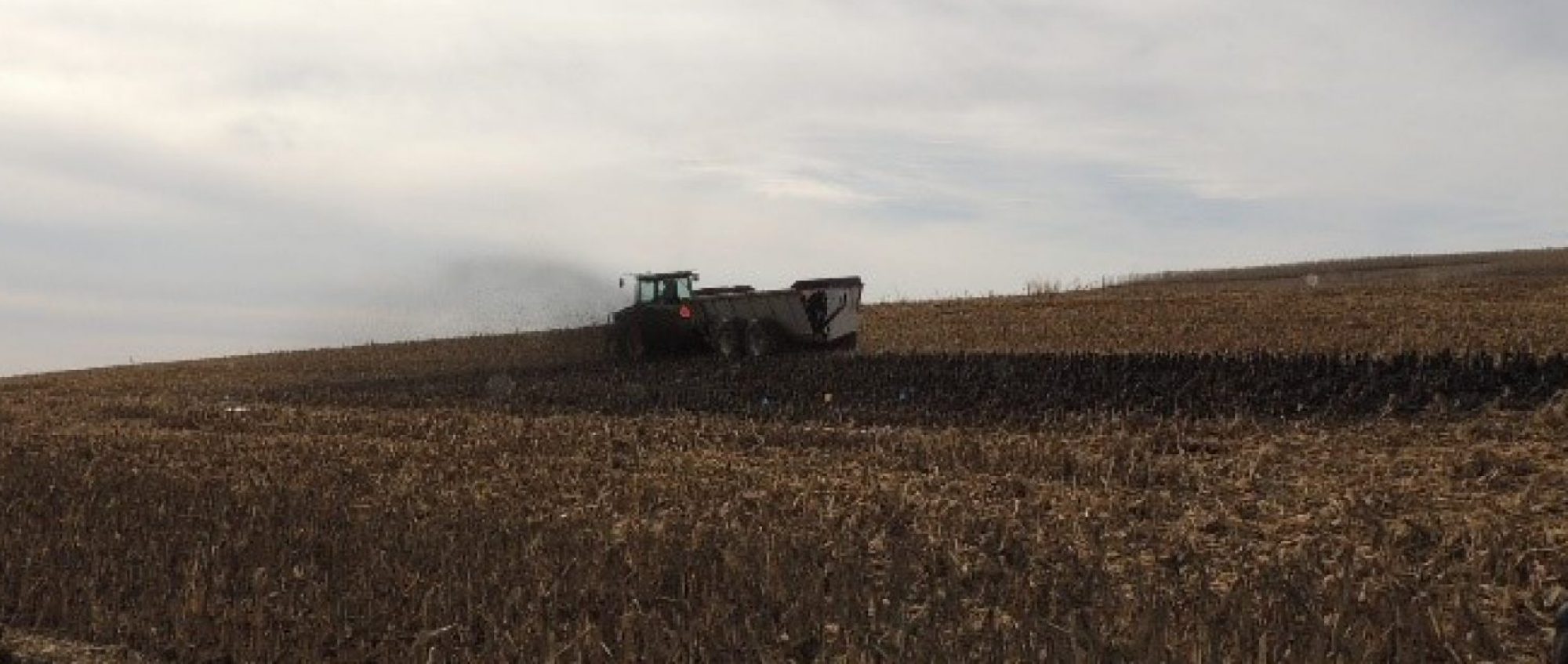

Impact of ammonia reduction management practices in land applied manure on nitrogen losses and nitrogen use efficiency

Purpose

Manure nitrogen losses from agricultural soils presents a significant challenge with far-reaching implications for global food security and environmental health. This project evaluates common manure application practices and studies some mechanistic factors and relationships that influence manure nitrogen losses via leaching and volatilization when manure is soil applied. The study highlights the tradeoffs between reduction of ammonia emissions and nitrogen leaching aiming to promote effective manure management techniques that increase crop nutrient use efficiency while minimizing nutrient losses to the environment.

What Did We Do?

Dairy manure was applied to a silt loam agricultural field using different manure applications. The study involves six experimental treatments, each applying 94 m³ ha-1 of liquid dairy manure through different methods: injection, incorporation, surface broadcast, and two treatments with urease inhibitor-one injected and one surface broadcast. Additionally, there are control plots with no manure application. Immediately after manure application, ammonia emissions were routinely measured using an FTIR while cumulative nitrate leaching for the growing season was assessed using the resin cartridge methodology. Corn silage was planted and yield data collected at the end of the growing season and nitrogen use efficiency following each experimental treatment determined.

What Have We Learned?

Preliminary results suggest that manure incorporation and injection with or without the urease inhibitor, have a comparable significant impact on corn silage yield when compared to surface manure application and plots with no manure application. However, there were no significant differences in N uptake among treatments. Additionally, there were significant differences in the cumulative nitrates leached when comparing the manure application methods to the no-manure plots. Manure injection and incorporation resulted in the highest significant nitrates leached with averages of 104.4 kg ha-1 and 108.4 kg ha-1  respectively, in comparison to surface manure application. Overall, current project data suggests that ammonia emissions tend to be lower in the manure injection especially when the manure is treated with urease inhibitor compared to when manure is surface applied.

These preliminary results suggest that certain manure application practices may offer superior environmental benefits while the agronomic benefits may remain comparable across different practices.

Future Plans

The field project will be extended into a second year under similar soil types to collect additional data for better comparisons and identifications of trends among experimental treatments. Future plans will also include a new project involving the incorporation of biochar and investigating its potential in simultaneously reducing ammonia volatilization and nitrogen leaching in manure and crop systems.

Authors

Presenting & corresponding author

Juma Bukomba, PhD Candidate, University of Wisconsin-Madison, bukomba@wisc.edu

Additional authors

Rebecca Larson, Associate Professor, University of Wisconsin-Madison;

Mathew Ruark, Professor, University of Wisconsin-Madison

Acknowledgements

This material is based upon work supported by the National Science Foundation under Grant No. EFMA-2132036. Any opinions, findings, and conclusions or recommendations expressed in this material are those of the author(s) and do not necessarily reflect the views of the National Science Foundation.

The authors are solely responsible for the content of these proceedings. The technical information does not necessarily reflect the official position of the sponsoring agencies or institutions represented by planning committee members, and inclusion and distribution herein does not constitute an endorsement of views expressed by the same. Printed materials included herein are not refereed publications. Citations should appear as follows. EXAMPLE: Authors. 2025. Title of presentation. Waste to Worth. Boise, ID. April 7-11, 2025. URL of this page. Accessed on: today’s date. 

Variation in state-based manure nitrogen availability approaches

The phosphorus (P) index is the primary strategy used in nutrient management planning to identify field management strategies and/or manure application strategies likely to lead to excessive risk of P loss.  Current P Indices were developed primarily as strategic planning tools guiding the development of a nutrient management plan spanning one to five years.  In reality, a nutrient management plan should be viewed more as a process than a result.  After completing the initial strategic plan there are tactical adjustments for new information such as new soil and manure tests and changes in crop selection.  Additional assessments are needed when implementing the plan, determining if current weather and soil conditions are appropriate for application.  Many current P Indices require using the soil erosion program RUSLE2 which is then a barrier to the use of these P Indices by anyone except planners with specialized planning.  Such expertise is never available on some farms and unlikely to be available on most farms during tactical and implement phases of the plan.  There has also been suggestions that more complex strategies such as models should replace existing P Indices; this will lead to more complex P loss assessment tools.  Next generation P Indices will be more effective if we consider the capabilities and training of those likely to be making decisions at each critical juncture.  Instead of “the” P Index we need to design a suite of tools that target key decision points.  In each instance a first step of the development process must be defining who the likely decision maker is and what are their skills and training.  We can only succeed if our tools are accessible to those that need to use them.

Purpose      

Extensive research has documented fertilizer value of manure nutrients for crops. It has been long recognized that manure nitrogen (N) excreted by animals is not 100% available to crops. Surveys indicate failure to credit or under crediting manure nutrient value to a crop by farmers continues to be an issue. Our goal was to assess the current state of manure nutrient availability recommendations and requirements in the US.

What did we do?

We surveyed state recommendations for state nutrient availability calculations for four sources of manure: finish hog slurry, dairy cow slurry, solid cattle manure and broiler litter. The top 12 states for production of each associated commodity were determined using inventory data from the 2012 Agricultural Census; the top 12 states for production were states we surveyed for each manure type. For each state and each manure type surveyed we attempted to identify nitrogen availability calculation recommendations from three sources: the State Land Grant University, the state USDA Natural Resource Conservation Service (NRCS) standards and supporting documents, and the state regulatory documentation for operations with a National Pollution Discharge and Elimination System (NPDES) permit.

What have we learned?

We were able to identify a primary publication or publications published by the State Land Grant University in all but four of the 30 surveyed states for the manure types of interest. Median date of publication for the 22 dated publications was 2006 (range 1991-2014). The NRCS documentation referenced the state Land Grant publication (10 states), a state-specific NRCS worksheet or reported numbers in the standard (7 states) or referred to regional or national reference (3 states). The USEPA NPDES regulatory documentation did not specify availability coefficients in 11 of 30 states. In nine states the regulatory documentation cited the USDA-NRCS 590 standard but in three of those states the NRCS standard did not provide nutrient availability coefficients. Consequently it was not possible to determine regulatory nutrient availability coefficients in nearly half of the surveyed states (14 of 30). Availability calculation approaches fell into two main categories, states that calculate availability based on manure total nitrogen content and states that account separately for availability of organic and ammonium nitrogen. Availability estimates among states were more variable for strategies known to be more variable (e.g. surface application of liquid manure).

Future Plans

Our work emphasizes the varied approach to N availability calculations as we cross state borders. We hope this publication will encourage regional discussions among states with similar climate to work towards more consistent recommendations. More consistent recommendations may help farmers have more confidence in those recommendations,

Our work also demonstrates how difficult it can be to identify the appropriate calculations within a given state. We encourage that state recommendations from all three organizations (Land Grant, NRCS, regulatory) be documented in a standard place in the state NRCS Nutrient Management Standard so planners, farmers, and people developing and managing nutrient management tools can easily and with confidence access the most current information on N availability information for manure nutrients.

Authors    

Dr. John A. Lory, Associate Professor of Extension, University of Missouri, Columbia, MO loryj@missouri.edu

Ms. Caitlin Conover, USEPA and Visiting Scholar, University of Missouri, Columbia, MO

Additional information         

Please contact the first author for more information.

The authors are solely responsible for the content of these proceedings. The technical information does not necessarily reflect the official position of the sponsoring agencies or institutions represented by planning committee members, and inclusion and distribution herein does not constitute an endorsement of views expressed by the same. Printed materials included herein are not refereed publications. Citations should appear as follows. EXAMPLE: Authors. 2015. Title of presentation. Waste to Worth: Spreading Science and Solutions. Seattle, WA. March 31-April 3, 2015. URL of this page. Accessed on: today’s date.