
From Barn to Field: Plastic Pathways

In this webinar, we discuss how the use of plastics in agriculture contributes to soil contamination, microplastic pollution, and reduced long-term soil health. Single-use plastics like mulch films, bale wrap, and silage bags and covers can degrade into contaminants that can alter soil pH, disrupt microbial communities, and hinder plant growth. Additionally, plastic residues can leach hazardous chemicals, which could end up in the food chain. The panel addresses concerns about plastic use in agricultural settings, alternatives to traditional plastics, recycling agricultural plastics, and equipment design to handle agricultural plastics. This presentation was broadcast on August 21, 2026.

An application for continuing education credit for Certified Crop Advisors (CCAs) and members of the American Registry of Professional Animal Scientists (ARPAS) will be submitted.

Panel Discussion – From Barn to Field: Plastic Pathways

All Speakers (1:00:31)

About the Speakers

Leslie Johnson, University of Nebraska
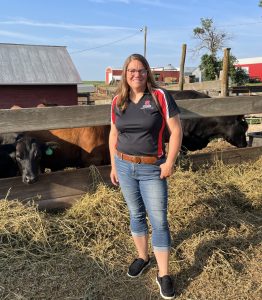
Leslie Johnson Standing in front of cattle on her farm.
Leslie Johnson, University of Nebraska

Leslie Johnson is the Animal Manure Management Extension Educator at the University of Nebraska – Lincoln. She does regular manure programming across the state of Nebraska and serves the Livestock and Poultry Environmental Learning Community in many ways. Additionally, she is actively engaged in her family’s farming operation in rural Wayne County. On their farm, they raise dryland row crops, alfalfa, and have a small cow-calf herd and a few chickens and ducks.

George Huber, University of Wisconsin

2026 Studio Portrait of George Huber, Richard L. Antoine Professor of Chemical and Biological Engineering
George Huber, University of Wisconsin

George W. Huber is the Richard L. Antoine Professor of Chemical and Biological Engineering at the University of Wisconsin–Madison and a leading researcher in sustainable plastics, renewable chemicals, and the circular bioeconomy. His research develops new biodegradable plastics and biobased materials designed to meet performance needs while reducing environmental impacts, alongside technologies for recycling and upcycling existing plastic waste. As founding Executive Director of the U.S. Department of Energy-funded Center for Chemical Upcycling of Waste Plastics (CUWP), he has led efforts to create scalable solutions for managing plastic waste and advancing sustainable materials. Professor Huber has published over 230 scientific papers, holds more than 30 patents, and has co-founded several companies to commercialize innovations in renewable chemicals, sustainable plastics, and waste valorization.

Loren Haselhorst, Christensen Family Farms

Loren Haselhorst, Christensen Family Farms

Loren is an Agronomist with Christensen Family Farms. His focus on manure management, compliance, and record-keeping. He is a Certified Crop Advisor. Loren also has a grain and livestock operation with his family.

Bobbi Stromer, USDA ARS

Bobbi Stromer, USDA ARS

Bobbi is a chemist with a decade of experience investigating how chemicals interact with surfaces. She earned a bachelor’s degree in chemistry from the University of Nebraska Kearney and a PhD from the University of Connecticut. She focuses on leveraging knowledge of chemicals and the environment to design impactful solutions.

Mindy Spiehs (moderator), USDA ARS

Mindy Spiehs, USDA ARS

Mindy is a Research Animal Scientist evaluating effects of diet, housing, livestock bedding material, and other management factors on odor and greenhouse gas emissions from livestock waste and housing facilities.

More Resources on the Topic

Find out more about this webinar and future webinars by the Livestock and Poultry Environmental Learning Community (LPELC).


Bioplastic Degradation in Anaerobic digestion: A Review on Degradability and Digestate Quality

Purpose

Bio-based biodegradable plastics led by polylactic acid (PLA) are becoming increasingly popular as a sustainable alternative to traditional plastics. Although bioplastics are designed to break down easily, many do not fully degrade in the natural environment as intended. Anaerobic digestion (AD) is a promising solution for decomposing bioplastics alongside food waste, turning them into biogas for energy and digestate, rich in nutrients, that can be used as fertilizer. However, studies have shown that bioplastics, particularly PLA, does not degrade fully in AD systems. The byproducts left over from AD raise serious problems, especially if residual microplastics could still be present in the digestate and affect the quality of the soil and water. While existing research predominantly focuses on enhancing methane production and biodegradation efficiency during AD, the quality of digestate after the digestion process has been overlooked. This significant research gap was highlighted in this review, emphasizing the need for comprehensive studies that evaluate digestate composition alongside biogas production.

What Did We Do?

A systematic review of peer-reviewed studies was conducted using databases such as Scopus, ScienceDirect and Google Scholar to assess research on bioplastic degradation in anaerobic digestion. The literature search was performed using the keywords ‘bioplastic degradation’, ‘pretreatment methods,’ ‘Anaerobic digestion,’ ‘biodegradation,’ ‘biogas production’ and ‘digestate quality’. Search filters were applied to prioritize recent studies (2010-present), peer-reviewed journal articles, and experimental studies analyzing bioplastic degradation and digestate quality. The initial search yielded 172 papers, which were then screened for relevance based on their focus on bioplastic degradation, biogas production, and digestate analysis. After filtering out studies that were not directly related, 42 papers were selected for detailed analysis.  A significant portion of the literature examined the effectiveness of different pretreatment methods in improving bioplastic degradation. These methods included but not limited to thermal pretreatment, where the plastics are exposed to elevated temperatures to increase its hydrolysis potential; alkaline pretreatment, which involves chemical treatments to enhance polymer degradation; and thermo-alkaline pretreatment, a combination of heat and chemical treatment to increase its susceptibility to decomposition. This allowed us to assess the extent to which bioplastic degradation has been addressed and the incomplete degradation persisting, highlighting the need for more comprehensive studies into the digestate quality.

What Have We Learned?

Studies consistently showed that bioplastic, especially PLA, degradation in AD remains incomplete in most cases, leading to concerns about the accumulation of microplastics residues in digestate. While pretreatment methods have been effective, with thermo-alkaline pretreatment yielding the highest methane outputs across most studies. The variability in methane yields across different pretreatment conditions suggests that degradation efficiency is highly dependent on factors such as temperature, retention time, microbial communities, and chemical additives. However, very few studies have explicitly analyzed whether residual bioplastic particles persist in the digestate post-AD. Given that AD is promoted as a promising solution for sustainable plastic waste solution, failing to assess digestate composition may lead to unintended environmental consequences. The implications of these findings are significant, particularly for large-scale implementation. If AD-derived digestate is to be used in agriculture or soil restoration, it must be free of persistent microplastics. Without comprehensive digestate analysis, the environmental benefits of AD for bioplastic waste management remain uncertain.

Future Plans

We are currently conducting an experimental study to evaluate the degradation of PLA in AD under different pretreatment conditions – thermal, alkaline, and thermo-alkaline treatments – to enhance PLA degradation and improve methane yields. More importantly, we aim to go beyond methane production by analyzing the resulting digestate for microplastic residues and overall chemical composition. Future studies will involve optimizing pretreatment strategies to minimize microplastic residues and investigating the long-term impacts of digestate when applied to soil systems.

Authors

Presenting & corresponding author

Nadia Bawa Fio Bekoe, Graduate Research Assistant, Biosystems and Agricultural Engineering Department, Oklahoma State University, nbekoe@okstate.edu

Additional author

Douglas W. Hamilton, PhD, P.E., Associate Professor and Extension Waste Management Specialist, Biosystems and Agricultural Engineering, Oklahoma State University

Acknowledgements

    • South Central Sun Grant Program Fellowship
    • Livestock & Poultry Environmental Learning Community (LPELC) Professional Development Grants

The authors are solely responsible for the content of these proceedings. The technical information does not necessarily reflect the official position of the sponsoring agencies or institutions represented by planning committee members, and inclusion and distribution herein does not constitute an endorsement of views expressed by the same. Printed materials included herein are not refereed publications. Citations should appear as follows. EXAMPLE: Authors. 2025. Title of presentation. Waste to Worth. Boise, ID. April 711, 2025. URL of this page. Accessed on: today’s date.