The inconsistency among P Indices in terms of level of detail and scientific underpinnings among states, as well as in recommendations and interpretations based on site risk, prompted a review and possible revision of the 590 Standard and P-Indexing approach. The need for revision has been heightened by a slower than expected decrease in P-related water quality impairment and, in some cases, an increase in soil P to levels several fold greater than agronomic optimum due to the inability of the P Index to prevent the continued over-application of P to soils. While the basic scientific foundations of the P-Indexing approach are sound, these concerns are real. In this presentation, we propose the use of lower and upper boundaries of P Index use and describe an approach to evaluate individual State P Indices.
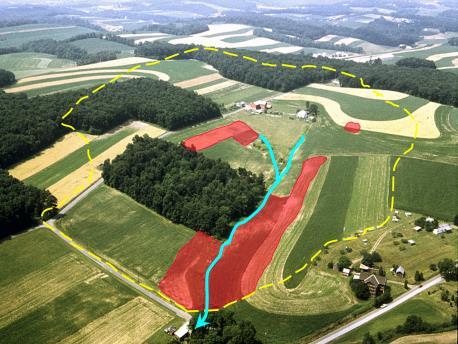
An aerial shot of the FD-36 watershed in south-central Pennsylvania (defined by the dashed white line), where soil chemistry, hydrologic, and agronomic research by USDA–ARS at University Park and Klingerstown locations identified areas of the watershed (in red) at great risk of contributing phosphorus to the stream (the blue line). This research was key to framing the application of the Phosphorus Index in Nutrient Management Planning. See N.O. Nelson and A.L. Shober, “Evaluation of Phosphorus Indices after Twenty Years of Science and Development,” p. 1703. Photo: Andrew Sharpley.
Why Is It Important to Review the Phosphorus Index?
Since its inception nearly 20 years ago, the phosphorus (P) Index has morphed from an educational tool to a Best Management Practice targeting and implementation tool, a manure-scheduling tool, and in many cases, a regulatory tool. A great deal of research has been conducted across the U.S. to derive, validate, and support components of the P Indexing concept, particularly those related to source factors. As different versions of the P Index have emerged, ostensibly to account for local topography, hydrology, soils, land use, and individual state policies and agendas, so too have differences in the P management recommendations that are made using the P Index. As a result, there are many variations in P Indices now in use as part of the NRCS 590 Nutrient Management Conservation Standard. This variation is both a strength and weakness of the P Indexing concept.
Author
Andrew Sharpley, Professor, Division of Agriculture, University of Arkansas System. Sharpley was one of a core group of scientists that back in the early 1990’s developed the scientific foundation of the Phosphorus Indexing approach. Since then he has conducted extensive field research to justify source and transport factors included in Indices, which have been adopted in 49 of 51 States to guide nutrient management planning as part of the 590 Standard. He was instrumental in changing USDA and US EPA nutrient management planning strategies away from single numeric soil phosphorus environmental thresholds to the Indexing approach for risk assessment of phosphorus management and land application. In the last year, he coordinated a group of researchers and extension folks from diverse backgrounds to review and propose revisions to Phosphorus Indices in compliance with the 2011 590 Standard.
The authors are solely responsible for the content of these proceedings. The technical information does not necessarily reflect the official position of the sponsoring agencies or institutions represented by planning committee members, and inclusion and distribution herein does not constitute an endorsement of views expressed by the same. Printed materials included herein are not refereed publications. Citations should appear as follows. EXAMPLE: Authors. 2013. Title of presentation. Waste to Worth: Spreading Science and Solutions. Denver, CO. April 1-5, 2013. URL of this page. Accessed on: today’s date.
While large-scale farms have typically been the focus of anaerobic digestion systems in the U.S., an emerging need has been identified to serve smaller farms with between 50 and 500 head of cattle. Implementing such a small, standardized, all-in-one system for these small farm applications has been developed. Small-scale digesters open the playing field for on-farm sustainability and waste management.
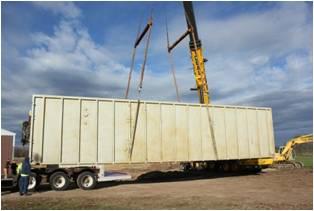
Unloading the first biodigester unit.
This presentation on small-scale digestion would discuss the inputs, processing, function, and outputs of BIOFerm™ Energy Systems’ small agitated plug flow digester (EUCOlino). This plug-and-play digester system has the ability to operate on dairy manure, bedding material, food waste, or other organic feedstocks with a combined total solids content of 15-20%. A case study would be presented that describes the site components needed, the feedstock amount and energy production, as well as biogas end use. Additional details would include farm logistics, potential sources of funding, installation, operation, and overall impact of the project.
This type of presentation would fill an information gap BIOFerm™ has discovered among dairy farmers who believe anaerobic digestion isn’t feasible on a smaller scale. It would provide farmers who attend with an understanding of the technology, how it could work on their specific farm and hopefully reveal to them what their “waste is worth”.
Why Study Small-Scale Anaerobic Digestion
To inform and educate attendees about small-scale anaerobic digestion surrounding the installation and feasibility of the containerized, paddle-mixed plug flow EUCOlino system on a small dairy farm <150 head.
Biodigester unit being installed at Allen Farms.
What Did We Do?
Steps taken to assist in financing the digestion system include receiving grants from the State Energy Office and Wisconsin Focus on Energy. Digester installation includes components such as feed hopper, two fermenter containers, motors, combined heat and power unit, electrical services, etc…
What Have We Learned?
Challenges associated with small project implementation regarding coordination, interconnection, and utility arrangements.
Future Plans
Finalize commissioning phases and optimize operation.
Steven Sell, Biologist/Application Engineer, BIOFerm™ Energy Systems
Gabriella Huerta, Marketing Specialist, BIOFerm™ Energy Systems
Additional Information
Readers interested in this topic can visit www.biofermenergy.com and for more information on our plants, services and project updates please visit us on our website at www.biofermenergy.com. You will also see frequent updates from us in industry magazines (BioCycle, REW Magazine, Waste Age). BIOFerm will also be present at every major industry conference or tradeshow including the Waste Expo, Waste-to-Worth and BioCycle– stop by our booth and speak with one of our highly trained engineers for further information.
The authors are solely responsible for the content of these proceedings. The technical information does not necessarily reflect the official position of the sponsoring agencies or institutions represented by planning committee members, and inclusion and distribution herein does not constitute an endorsement of views expressed by the same. Printed materials included herein are not refereed publications. Citations should appear as follows. EXAMPLE: Authors. 2013. Title of presentation. Waste to Worth: Spreading Science and Solutions. Denver, CO. April 1-5, 2013. URL of this page. Accessed on: today’s date.
Current Best Management Practices (BMPs) only measure past land application of nutrients at Animal Feeding Operations (AFO) and Concentrated Animal Feeding Operations (CAFO). Because the current BMP calculates nutrient application at the end of the year, the CAFO operator finds out if they have over applied CAFO-generated nutrients, when it is too late to adjust nutrient applications.
Over application of nutrients in land application fields limits a CAFO operator’s ability to reuse his/her green water or manure solids as nutrients. Green water, manure solids, and chemical fertilizers are fungible assets and should be managed as resources, not wastes. Over application can result in high (>30 ppm) or very high (>50 ppm) soil nitrate concentrations beneath land application fields that must be mined from the soil. Where there is sufficient hydraulic head in the land application fields, excess nitrate can leach through the soils and root zone to groundwater. When ground water quality standards are exceeded, the nutrients are being disposed of as wastes rather than reused as a resource and EPA or other regulatory agencies can require costly soils and ground water investigations and abatement/remediation.
To prevent turning the manure and green water resources into an environmental liability and financial burden, we developed the online CAFOweb software to allow CAFOs to manage their nutrients in real time from the fields. Real time forecasting works best when all nutrient and water contributions are quantified using chemical analyses of soil and plant tissue coupled with and the meter readings that allow the operator to determine if he is operating at peak efficiency. The CAFOweb data management and interpretations allow CAFO operators to make informed real time decisions on land application of nutrients at agronomic rates, insuring “wastes” are converted to assets or worth. Real time management of dairy-generated nutrients retains the value of the CAFO facility for future generations.
Why Develop Software for Managing Manure Nutrients?
Currently BMP calculates nutrient application at the end of the year causing the CAFO operator to find out if they have over applied CAFO-generated nutrients, when it is too late to adjust nutrient applications. We developed CAFOweb as online software to allow CAFOs to manage their nutrients in real time from the fields.
What Did We Do?
To prevent turning the manure and green water resources into an environmental liability and financial burden, we developed the online CAFOweb software to allow CAFOs to manage their nutrients in real time from the fields.
What Have We Learned?
The best way to preserve the value of your dairy is to predict nutrient application rates.
Future Plans
In the future, we hope to continue monitoring dairies to see how CAFOweb affects CAFO operators in making informed real-time decisions on land application of nutrients at agronomic rates. Also in the plans is developing new modules for CAFOweb to manage other aspects of CAFOs such as freshwater and air quality.
The authors are solely responsible for the content of these proceedings. The technical information does not necessarily reflect the official position of the sponsoring agencies or institutions represented by planning committee members, and inclusion and distribution herein does not constitute an endorsement of views expressed by the same. Printed materials included herein are not refereed publications. Citations should appear as follows. EXAMPLE: Authors. 2013. Title of presentation. Waste to Worth: Spreading Science and Solutions. Denver, CO. April 1-5, 2013. URL of this page. Accessed on: today’s date.
In high yielding row crop intensive regions the role of swine manure as a crop nutrient source has increased in value, replacing the purchase of increasingly expensive commercial fertilizer by providing the nutrient needs of crops. Nutrients from manure are recycled to fertilize high yielding crops in an environmentally friendly, synergistic system.
Access to the value of the nutrients in manure has been a primary motivation for constructing swine facilities. However, as the energy cost of swine diets has increased, feeding programs have been dramatically changed. Changes in ingredients composition has changed from manipulations of dietary formulations. These changes can alter the nutrient composition of the resulting manure and thus the nutrient value of the manure as fertilizer. What does not occur is the consideration that owners/users of the manure composition and if changes need to be made in application rates for optimizing fertilizer rates for crops.
The swine nutritionist can reduce the nitrogen (N) level in manure by 40 or 50% or they can increase the N level by 76%. If the nitrogen produced by a pig is, for example worth $4 as a manure nutrient. The range in value will be from $2/head to $7/head depending on diet formulation. The broader analyses that producers should think about is comparing feed savings from diet manipulation to loss or gain of manure value from that manipulation. Case studies that will be discussed include low protein synthetic amino acid addition, phytase addition, and feeding DDGS.
Information will be presented that will compare feed cost savings from common diet manipulation strategies to the change in the nutrient value of the manure because of the diet manipulation. We are developing a simple spreadsheet to help understand the economics on a holistic operation basis, that we plan to make available to workshop participants.
Why Look At the Value of Manure Nutrients When Formulating Pig Rations?
Producers in Iowa entering the pig business by constructing a contract barn are often influenced by the potential value of manure from that facility. There is interest in saving the expense of commercial fertilizer. Most of these producers, especially those that are row crop oriented with limited swine experience, don’t realize that swine diet formulation will change the manure value.
In Iowa at the farm level nutrients in manure are highly valued for commercial fertilizer replacement, crop and swine production systems are symbiotic. Crops feed the livestock and manure from the livestock is used as fertilizer for crops. Therefore, in Iowa manure has typically been highly regarded for its fertilizer value.
However, the manure can be dramatically changed by diet formulation and thereby the nutrient content of the principle fertilizer components, Nitrogen (N) and Phosphorus (P). Thus the value of the manure used for fertilizer changes as well.
Contract growers should realize that the value of the manure can be dramatically changed by diet formulation, and that usually the lower cost diet results in less value in the manure nutrients. Also, that it is possible that the value of the nutrients for the crop is actually less than the cost to haul. Therefore, the purpose of this talk is to discuss the whole farm financial and environmental impact of formulating a change in the swine diet compared to the change in the level of nutrients in swine manure.
We want producers to be aware of the value of swine manure for various reasons. A common problem in the field is that manure is spread on the field adjacent to the facility, therefore soil P levels typically are increased to the upper levels of very high soil test leading to potential pollution problems. If the concentration of nutrients is increased through diet formulation the extra value would make it more likely to economically haul the manure to a low testing, more environmentally friendly field. The reason swine producers have not understood that diet formulation changes nutrient density is because large differences in water management/wastage have hidden the diet formulation changes. Therefore, measuring manure yield per pig using a manure test is an important management tool not yet utilized by producers.
What Did We Do?
We built a spreadsheet to compare the feed savings from diet formulation to the value of nutrients in the manure. Additionally, Dr Matt Swantek developed a feeding model to predict the feed cost and manure nutrient changes on a per pig basis so swine producers will be able to see and understand the concept.
What Have We Learned?
With diet formulation, the value of the swine manure will vary greatly. In the model we used, given the price assumptions the value of manure ranged from $41.52 to $84.77 per 1000 gallons. The range is more than $5.00 per head. This is 2.5 times more than the standard labor cost of about $2.00 per head. It is desirable environmentally to transport to low P soil test fields rather than over application of nutrients in the field next to the facility, higher nutrient value per gallon is more economically feasible to transport. Water wastage causes wide variation in manure test results and masks the diet formulation differences that are important to the producer. With diet formulation and water wastage it is possible to decrease to value of the manure below the cost of application. Measuring nutrient yield per pig is important to know. It can be determined calculating the gallon of manure produced per pig, the number of pigs per 1000 gallon and then calculating each pig’s nutrient (NPK) contribution based on the manure test pound of nutrient per 1000 gallon.
Future Plans
We plan to hold educational workshops regarding this topic and make the spreadsheet tool available on line to help producers understand these concepts
Authors
David Stender, Iowa State University Extension Swine Field Specialist dstender@iastate.edu
Dr Matt Swantek, Iowa State University Extension Swine Field Specialist
The authors are solely responsible for the content of these proceedings. The technical information does not necessarily reflect the official position of the sponsoring agencies or institutions represented by planning committee members, and inclusion and distribution herein does not constitute an endorsement of views expressed by the same. Printed materials included herein are not refereed publications. Citations should appear as follows. EXAMPLE: Authors. 2013. Title of presentation. Waste to Worth: Spreading Science and Solutions. Denver, CO. April 1-5, 2013. URL of this page. Accessed on: today’s date.
* Presentation slides are available at the bottom of the page.
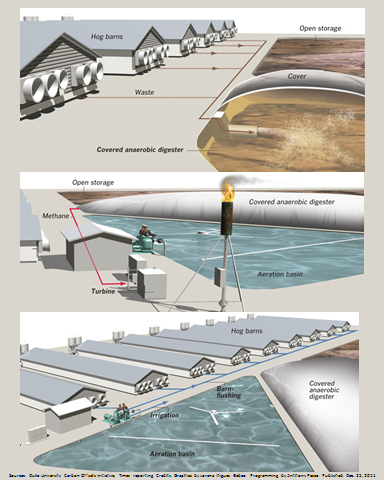
The Loyd Ray Farms project is the first swine waste project in the State of North Carolina to generate and transfer renewable energy credits (RECs) to a public utility. Utilizing an anaerobic digester as primary treatment, this waste treatment system is designed to meet the Environmental Performance Standards set forth by NC law for new and expanded swine facilities through the use of nitrification/denitrification and further treatment. The system implemented at this farm utilizes anaerobic digester technology to turn raw animal waste into biogas. The biogas is used to fuel a microturbine, generating electricity to power the environmental treatment system, and about half of the farm. Related: Manure value & economics
The farm is a finishing swine operation that houses approximately 9,000 pigs near Yadkinville, NC. The concept for this approach was conceived by the team in 2006, followed by economic and performance modeling, permitting, and construction of the commercial-scale system. The project was commissioned on May 27, 2011. Funding for construction was provided by Duke Energy and Duke University, with support from USDA-NRCS and the NC Division of Soil and Water Conservation. Google provides operational funding support in exchange for a portion of the carbon offsets created.
Loyd Ray Farms is the only innovative Swine waste system in North Carolina that generates Renewable Energy Credits for an electric utility, which generates enough power for the treatment system and has enough surplus electricity to power about half of the farm. Cavanaugh collaborated in this study with Duke University, Duke Energy, and Google with funding from NC Soil & Water Conservation and USDA/Natural Resources Conservation Service.
Forefront: Tatjana Vujic of Duke University views the meter readings
The project began as a conversation about greenhouse gas emissions, sources for renewable energy, and sustaining the state’s swine industry among Duke Energy, Duke University, Google, and Cavanaugh. That conversation led to a project that is getting attention around the world, for its successes in combining strategies to address the concerns for generating renewable energy from agricultural sources, sustaining agriculture, and addressing farming’s relationship to climate change.
The system’s goals: generating about 500 megawatt-hours of electricity annually, reducing greenhouse gas emissions equivalent to 5,000 tons of carbon dioxide annually, reducing ammonia and odor emissions from the farm, and improving the quality of treated wastewater on the farm.”
Is Manure to Energy Important?
We will discuss the successes and challenges in partnered efforts by farmers, electric utilities, and other stakeholders in the marrying of renewable energy generation with enhanced environmental treatment and green house gas emissions reduction, including the economics of such effort.
What Did We Do?
Waste generated by the animals is flushed into an anaerobic digester where bacteria consume the waste and respire energy-rich biogas. The biogas fuels a microturbine that generates electricity, and excess gas is flared. After digestion, the liquid waste is further treated to achieve the Environmental performance Standards set forth by North Carolina for Innovative Swine Waste Treatment Systems.
The process by which the stakeholders came together in a partnership, the technologies and approaches selected, and the successes/challenges that can be gleaned for advancing future projects. The Loyd Ray Farms project is the first Swine Waste-to-Energy project in the State of North Carolina to place RECs on the North Carolina Utilities Commission REC Tracking System, and is the first swine farm in North Carolina to transfer RECs to Duke Energy. Coupling techniques to improve the environmental treatment system employed at the farm, the Loyd Ray Farm project is also the first ‘Innovative Swine Waste Treatment System’ permitted that utilizes an anaerobic digester as a primary form of waste treatment.
Gus Simmons, lead designer, M. Steve Cavanaugh, Jr., and Marvin Cavanaugh, Sr. during the commissioning of the system. Cavanaugh developed the concept for Duke University in an effort to create a cost-effective solution that converts swine waste into renewable energy while achieveing a superior level of waste treatment and a reduction in the carbon footprint created by the conventional waste management system.
Gus Simmons, P.E., is the Director of Engineering at Cavanaugh & Associates, a consulting firm specializing in stewardship through innovation. An NC State University graduate with a BS in Biological & Agricultural Engineering, Gus has worked for a major agricultural producer where he was Director of Environmental Affairs and Engineering Services, managing engineering and construction for facilities in the US and Europe. Gus has designed, permitted, and managed over 5,000 acres of wastewater irrigation in NC, and thousand of acres of wastewater irrigation in the Western US. He has assisted many municipalities and private entitites with the development and implementation of reclaimed water systems and reuse irrigation systems, and has actively participated in alternative wastewater management strategies for the NC Pork Industry. His recent sucessess include the engineering design of an anaerobic digester for animal waste to energy project in Yadkinville, NC which has gained world-wide recognition for its successes in generating RECs and greenhouse gas credits.
The authors are solely responsible for the content of these proceedings. The technical information does not necessarily reflect the official position of the sponsoring agencies or institutions represented by planning committee members, and inclusion and distribution herein does not constitute an endorsement of views expressed by the same. Printed materials included herein are not refereed publications. Citations should appear as follows. EXAMPLE: Authors. 2013. Title of presentation. Waste to Worth: Spreading Science and Solutions. Denver, CO. April 1-5, 2013. URL of this page. Accessed on: today’s date.
This research is evaluating management options for conventional hog producing facilities in regions of Manitoba that will have insufficient land base for sustainably applying raw slurry manure when manure application regulations switch from nitrogen based to phosphorus based rates. Producers are being encouraged to use solid-liquid separation, such as centrifugation, to remove the phosphorus rich solid fraction so that it can be transported and applied further away where there is a phosphorus deficiency. However, the resulting separated hog solids (SHS) product is still odorous and prone to nitrogen losses through ammonia volatilization. Therefore, it has been suggested that composting the SHS before it is applied is a beneficial management practice that would allow producers to capitalize on agricultural and environmental benefits such as reduced odours, stabilization of minerals, application of a homogeneous product, and acts as a multi-beneficial soil conditioner. However, the low starting C:N of 15:1 and small particle size of SHS make it a unique and challenging product to compost in windrows, a common form of large production on-farm composting. The SHS must be combined with a bulking agent that allows adequate nutrient balance for decomposition as well as a porous structure. Therefore, this project is comparing wood shavings (WS) and wheat straw (WHT) as bulking agents to evaluate which is the better management practice based upon minimizing greenhouse gas emissions and additional nitrogen gas losses as well as overall quality of the mature compost.
LI-8100a automated flux chamber
What Did We Do?
Starting in October 17, 2012 we created two windrows containing SHS, one with wood shavings as a bulking agent and one with wheat straw. The materials were mixed in a feed mixer to produce a homogeneous mixture with the initial starting parameters shown in Table 1. The windrows were turned once a week for the first four weeks with a Backus windrow turner.
Gas emissions were measured with the use of the highly innovative technology of the LI-8100a automated chamber system (LICOR BioSciences) and Fourier Transform Infrared spectroscopy (FTIR) multi-gas analyzer (Gasmet DX4015). By combining these two instruments it has the advantage of nearly continuous unattended data collection and simultaneous measurement of greenhouse gases (carbon dioxide, methane, nitrous oxide) and additional nitrogen gases (ammonia, nitrous dioxide, and nitrogen monoxide). There were four automated chambers on each windrow; a flux measurement was taken every half hour, alternating between the two windrows. Flux emissions were calculated using linear regression analysis.
Table 1. Initial starting parameters for the two windrows
Initial In-process Compost
Starting C:N
Starting Moisture %
Starting Bulk Density (kg/m3)
Starting pH
WHT + SHS
32.5
63.70
170.5
6.86
WS + SHS
35.5
60.45
350
6.5
The temperature, % oxygen, and moisture content of the windrows were recorded to identify when the compost needed to be turned and to track the composting process and relate it to the gases emitted.
Backhus compost windrow turner
What Have We Learned?
In September 2011 we conducted a trial that used straw as a bulking agent but found the contact between the separated hog solids and straw was poor due to the difference in particle size allowing for large pore spaces and the waxy texture of straw. The porous structure made it difficult to maintain moisture in the compost windrow and when water was added some of the separated hog solids actually “washed off”. In the winter, the windrow wasn’t big enough or it was too porous that it did not insulate well so self heating stopped and the pile froze in January. These problems slowed the decomposition process and resulted in compost with straw pieces still visible.
For this trial we decided to try using wood shavings as an alternative bulking agent, because wood shavings have a smaller particle size which we predicted would result in better contact with the separated hog solids and a less porous structure allowing better insulation against the weather (water loss in the summer, heat loss in the winter). Additionally, it is expected that wood shavings are also beneficial in reducing ammonia losses.
However, during this trial we experienced much wetter and cooler conditions compared to the year before, so we did not have to add water to the windrows. This was beneficial for the windrow with straw because the moisture content did not decline resulting in a steady rate of decomposition during the first month of composting noted by continuous CO2 emissions. Eventually the moisture content became too high creating anaerobic conditions and the production of CH4 after the second and fourth turnings. NO2 emissions were also detected during the same time as CH4, indicating some aerobic respiration occurring. After CO2 emissions reduced there was a small amount of N2O and NO measured.
The windrow with wood shavings took a little longer to start producing CO2 because it became anaerobic from the start. CH4 was produced much early and at higher emission rates compared to the windrow with the straw as a bulking agent. N2O, NO, and NO2 were emitted at the same time as CH4, indicating there were anaerobic and aerobic pockets throughout the windrow. N2O emissions continued after CO2 emissions declined.
Composting in the winter
After the windrows had been in the active stage of composting for three months, the temperature within the windrows gradually declined and both windrows froze up in early January.
We are currently in the process of calculating the ammonia flux determinations. Due to the nature of ammonia it is prone to absorbtion reactions on the surface of the LI-8100a and FTIR systems’ tubing. The surface reactions cause a time delay for the FTIR to analyze the concentration compared to the other gases. Thus, this gas requires a different time interval to calculate the flux.
Future Plans
A common problem with using chamber measurements on compost windrows is underestimation of gas emissions from chambers placed on the top of the windrow when high winds blow through the windrow horizontally, reducing the “chimney effect”. Having the ability to collect gas emission data at such a high frequency using the LI-8100a automated chamber and FTIR system allows us to identify when gases emissions may be underestimated due to wind. The next step is to determine if we can correlate the wind speed and direction with under estimation of gas losses.
Mario Tenuta, Canada Research Chair in Applied Soil Ecology, University of Manitoba
Matt Gervais, Soil Ecology Field Technician, University of Manitoba
Acknowledgements
Western Economic Diversification Canada, Manitoba Pork Council, Manitoba Horticultural Productivity Enhancement Centre, Manitoba Rural Adaptation Council, NSERC, National Center for Livestock and the Environment, University of Manitoba Soil Ecology Laboratory, Glenlea Research Farm, Prairie Agricultural Machinery Institute, Compo-stages, Puratone
The authors are solely responsible for the content of these proceedings. The technical information does not necessarily reflect the official position of the sponsoring agencies or institutions represented by planning committee members, and inclusion and distribution herein does not constitute an endorsement of views expressed by the same. Printed materials included herein are not refereed publications. Citations should appear as follows. EXAMPLE: Authors. 2013. Title of presentation. Waste to Worth: Spreading Science and Solutions. Denver, CO. April 1-5, 2013. URL of this page. Accessed on: today’s date.
Recent research has shown that over half of nitrogen excreted by chickens is lost into the atmosphere via ammonia volatilization before the litter is removed from poultry houses. Large quantities of particulate matter and volatile organic compounds (VOCs) are also emitted from animal rearing facilities. During the past decade we have developed and patented an acid scrubber for capturing ammonia, VOCs and dust from air exhausted from poultry and swine barns. The objectives of this project were; (1) to re-design the scrubber to improve the ammonia removal efficacy, (2) conduct full-scale testing of the scrubber under controlled conditions at various ventilation rates, (3) evaluate the cost, practicality and efficacy of various acids for scrubbing ammonia, and (4) install scrubbers on exhaust fans of poultry houses located in Virginia and Arkansas and measure the efficiency of ammonia removal from the exhaust air. The efficiency of ammonia removal by the scrubber varied from 55-95%, depending on the type of acid used, air flow rate, and the internal scrubber configuration. This technology could potentially result in the capture of a large fraction of the N lost from AFOs, while simultaneously reducing emissions of bacteria, dust, and odors, which would improve the social, economic, and environmental sustainability of poultry and swine production.
Purpose
The objectives of this project were; (1) to re-design our ammonia scrubber to improve the ammonia removal efficacy, (2) conduct full-scale testing of the scrubber under controlled conditions at various ventilation rates, and (3) evaluate the cost, practicality and efficacy of various acids for scrubbing ammonia.
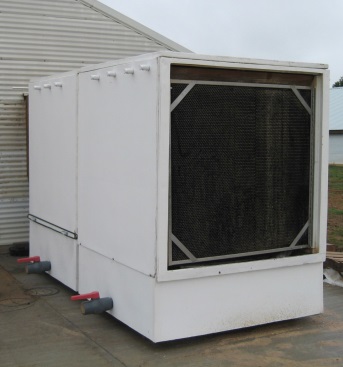
Acid scrubber developed by USDA/ARS in Fayetteville, AR, for reducing ammonia, dust and odor emissions from animal rearing facilities.
What Did We Do?
During the first year of this project the main task of our team was to re-design the ammonia scrubber developed and patented by Moore (2007). A full scale prototype was constructed of wood and a series of tests were conducted to evaluate various configurations on air flow and static pressure drop in tests conducted in a machine shop. The scrubber was connected to a 48” variable speed poultry fan. Air flow was measured using a fan assessment numeration system (FANS unit). Static pressure difference was measured using a Setra 2601MS1 differential pressure sensor. The effects of slat angle, number and arrangement of slats, and thickness of cool cell material were evaluated.
Following the initial testing a fiberglass mold was made and six scrubbers were constructed. One of these was used to evaluate the effectiveness of water, strong acids, acid salts, and a neutral salt on scrubbing ammonia. Anhydrous ammonia was metered out into a distribution system located within the fan at a sufficient rate to result in 25 ppm NH3 in the plenum between the fan and the dust scrubber. Evaluations of each acid were made with the variable speed fan set at 60 and 40 Hz, which corresponded to air flows of approximately 8,000 and 5,000 cfm, respectively. A stainless steel star sampler was used to take air samples from the plenum and from the air exhausted from the scrubber. Ammonia concentrations were measured using a photoaccustic multigas analyzer (Innova 1412). All personal involved in this testing wore respirators equipped with NH3 cartridges. Three 2-hour trials were conducted with solutions of the following acids at both 40 and 60 Hz: alum, aluminum chloride, ferric sulfate, ferric chloride, sodium bisulfate, sulfuric acid, hydrochloric acid, phosphoric acid, and nitric acid. The effects of water and calcium chloride were also evaluated. For these trials the amount of each acid added was equivalent to 2 liters of concentrated sulfuric acid.
In addition to measuring inflow and outflow ammonia levels, the mass accumulation of ammonia in both the dust and acid scrubber reservoirs was determined by analyzing the contents for ammonium using an auto-analyzer. Twenty ml aliquots of the scrubber solution were taken at times 0, 1 and 2 hours for ammonia and pH measurements. These data were used to validate that the difference in inlet and outlet ammonia were, in fact, due to accumulation of NH3 in the scrubber. Notes were also taken on each chemical’s ease of use and potential for problems. For example, some dry acids did not readily dissolve and some strong acids, like sulfuric acid, had very strong exothermic reactions. Salts of aluminum and iron become aluminum and iron hydroxides at high pH which have the potential to clog cool cell material.
Another performance issue that was monitored was the loss of fine droplets (mist) from the scrubber. When dealing with high air volumes and small droplet sizes, there is a potential for mist to exit the system, resulting in not only the loss of N, but of the acid used to scrub NH3. In order to measure mist loss, five 12.5 cm Whatman 42 filters were attached on a wire cage on the exhaust of the scrubber. These filters were placed in a 50 ml centrifuge tub at the end of each trial and shaken with 25 ml of DDI water, which was analyzed for ammonium, along with sulfate, chloride, nitrate, or phosphate, depending on the acid used.
What Have We Learned?
Early on in this research we learned that two scrubbers (a dust scrubber and an acid scrubber) were needed rather than one. If the dust isn’t removed from the exhaust air of poultry houses, then a large amount of the acid will be wasted neutralizing the dust.
We found that the relationship between slat angle and pressure drop was exponential and the angle that would maximize particle collisions on a wet surface while minimizing pressure drop was 45o. We also found that as the number of rows of slats increased the effect on pressure drop was linear. The final configuration chosen was eight rows of slats in the dust scrubber and three rows of slats in the chemical scrubber, followed by one or two 6” thick layers of cool cell material. The pressure drop using this configuration was about 0.1” of water at 5,000 cfm and 0.3” of water at 8,000 cfm.
All of the acids scrubbed ammonium from air, whereas water and calcium chloride only worked for a very short period of time. The iron (Fe) and aluminum (Al) compounds tended to work a little better than the other acid salts or the strong acids. We believe this is due to Fe and Al compounds coating the cool cell material. Although no difference was observed in the static pressure during these short tests, we believe Al and Fe hydroxides would eventually form and may clog the cool cells. Due to the inherit danger in dealing with strong acids, we concluded that an acid salt that did not contain Al and Fe, such as sodium bisulfate, would be used for our research in the future. This product is sold under the tradename PLT for a poultry litter treatment and is readily available to poultry growers.
Future Plans
Four NH3 scrubbers will be attached to sidewall fans of a commercial broiler house located in Madison County, Arkansas. The efficacy of these scrubbers for reducing ammonia, volatile organic compounds (VOCs), and particulate matter will be evaluated. We will also measure the amount of sodium bisulfate, water and electricity used by the scrubbers, as well as the mass of nitrogen captured. A cost-benefit analysis will be performed based on this data. Data on the efficacy to scrub ammonia will also be conducted on farms in DE, VA, and PA.
This research was funding by USDA/ARS and by grants from USDA/NRCS and the National Wildlife Foundation. The authors would like to thank the hard work and great ideas supplied by Scott Becton and Jerry Martin, without which this scrubber could not have been built.
The authors are solely responsible for the content of these proceedings. The technical information does not necessarily reflect the official position of the sponsoring agencies or institutions represented by planning committee members, and inclusion and distribution herein does not constitute an endorsement of views expressed by the same. Printed materials included herein are not refereed publications. Citations should appear as follows. EXAMPLE: Authors. 2013. Title of presentation. Waste to Worth: Spreading Science and Solutions. Denver, CO. April 1-5, 2013. URL of this page. Accessed on: today’s date.
The National Air Quality Site Assessment Tool (NAQSAT) has been developed for the voluntary use of livestock producers and their advisors or consultants. It is intended to provide assistance to livestock and poultry producers in determining the areas in their operations where there are opportunities to make changes that result in reduced air emissions. Air emissions research from livestock production systems is increasing every year. NAQSAT is based on the most accurate, credible data currently available regarding mitigation strategies for air emissions of ammonia, methane, volatile organic compounds, hydrogen sulfide, particulates, and odor.
From the NAQSAT home page users may watch a video explaining the tool, read an overview, study the user manual or select a species to start using the program.
Purpose
The National Air Quality Site Assessment Tool (NAQSAT) was developed for livestock producers who are interested in investigating opportunities to reduce air emissions from their livestock operation. The online tool is designed to provide farmers and their advisors air emissions information explicitly for their farm in a confidential setting. The tool may be run from any computer with internet access. All information entered into NAQSAT and the corresponding results remain confidential.
What Did We Do?
NAQSAT considers the air emissions from eight management categories; animal housing, feed and water, manure collection and transfer, manure storage, land application, mortality management, public perception and on-farm roads.
On the NAQSAT Effectiveness Results page the green area indicates the effectiveness of current management practices, the white area indicates the opportunity for improvement. At the end of each session users are encouraged to select “Print My Report” to receive a paper copy of all inputs that had been entered and a copy of the Effectiveness Results page for their records.
Users of the tool are asked a series of questions under each of the eight management categories. Based on the responses to previously answered questions the program determines what additional questions need to be answered such that only questions pertaining to the operation currently being evaluated are asked. Pop-up pictures assist the user in determining the relative rating to select when questions require a visual evaluation of the existing practices.
NAQSAT addresses seven emissions of concern; odor, particulate matter (dust), ammonia (NH3), hydrogen sulfide (H2S), methane (CH4), volatile organic compounds (VOCs) and nitrous oxide (N2O) under each of the eight management categories. Within the results page the green area in each rectangle indicates the effectiveness of current management practices, the white area indicates the opportunity for improvement.
NAQSAT allows users to save and run different scenarios providing the opportunity to compare the results of implementing new management practices.
It is easy to save NAQSAT sessions and return at a later date to make adjustments or consider additional alternatives. Each “saved” user session of NAQSAT is stored under its own URL available only to the person or persons with access to that URL. Individual URLs remain available for a minimum of 30 days before they are removed from the host computer.
The tool’s results page does not provide emissions data and/or regulatory guidance. It does identify opportunities for reducing air emissions and the ability to evaluate which practices might have the most impact. NAQSAT was developed for voluntary and educational use. The tool is designed to be used by livestock and poultry producers, however, the results may be more valuable when NAQSAT is used in cooperation with agency personnel or private consultants that can provide follow-up with suggestions for mitigation practices.
What Have We Learned?
NAQSAT has been used by members of the tool’s development committee to address odor conflicts in Colorado and in Michigan. In each case the tool confirmed the farm management teams were using acceptable management practices to limit odors from the livestock operation. In both states the local and state agencies involved in the conflict resolution were appreciative of the information provided by the tool.
Authors
Gerald May, Educator, Michigan State University Extension, mayg@msu.edu
Additional Information
The NAQSAT on-line tool is currently available at: http://naqsat.tamu.edu/. It is available at no cost from its host website (it does not download onto your computer). To assist first time users an overview of the tool, an informative video and a user’s manual are available on the NAQSAT home page.
Are there any organizations or individuals (besides the authors) that should be acknowledged?
Development of NAQSAT was partially funded by the USDA – NRCS Conservation Innovation Grant program. Over twenty partner organizations and universities contributed to the development of NAQSAT.
Partner universities:
Partner organizations:
Colorado State University
C.E. Meadows Endowment
Iowa State University
Colorado Livestock Association
Michigan State University
Iowa Turkey Federation
Oregon State University
Iowa Pork Producers
Penn State University
Iowa Pork Industry Center
Purdue University
Iowa State Univ. Experiment Station
Texas A&M University
Michigan Milk Producers Association
University of California, Davis
Michigan Pork Producers Association
University of Georgia
Michigan State Univ. Extension
University of Maryland
National Pork Board
University of Minnesota
Nebraska Environmental Trust
University of Nebraska
Western United Dairymen
The authors are solely responsible for the content of these proceedings. The technical information does not necessarily reflect the official position of the sponsoring agencies or institutions represented by planning committee members, and inclusion and distribution herein does not constitute an endorsement of views expressed by the same. Printed materials included herein are not refereed publications. Citations should appear as follows. EXAMPLE: Authors. 2013. Title of presentation. Waste to Worth: Spreading Science and Solutions. Denver, CO. April 1-5, 2013. URL of this page. Accessed on: today’s date.
* Presentation slides are available at the bottom of the page.
Abstract
Ration optimization models currently minimize the purchase price of feeds used to meet nutrient requirements. Not included in optimization models is the value of manure nutrients resulting from ration alternatives. This project extends the linear program that is used to minimize ration cost to include the value of manure excreted and stored. Microsoft EXCEL’s Solver GRG Nonlinear Add-in is used to optimize the integrated decision because of the non-linear aspects of manure excretion as a function of feed fed.
Several economic and production changes over the last 10 years warrant an investigation of the impact of optimizing both feed and manure decisions simultaneously. Distillers Dried Grains with Solubles (DDGS) have become a common feed high in phosphorus, lessening the need for inorganic phosphorus sources. Including DDGS in the diet also increases the manure concentration of phosphorus. If phosphorus is needed on nearby crop fields, there is potential to increase manure value while simultaneously reducing feed cost. In contrast, feeding phytase may reduce feed cost, while reducing manure value if phosphorus in manure is valued. Feeding synthetic amino acids can also reduce feed cost while reducing the amount of nitrogen excreted and available as a fertilizer in the manure. Adding to the importance of considering manure value is the increased costs of fertilizers. Manure is increasingly seen as a viable alternative to commercial fertilizers and might affect the whole farm profitability if included in the ration cost decision.
This project considers swine rations and examines how they might have changed during the past 10 years if manure value had been incorporated into the ration optimization decision. We will attempt to determine when manure fertilizer value relative to feed costs justifies integrating feed and manure optimization. Results indicate that incorporating manure value into the optimization routine would change some diet formulations.
Why Consider Manure Nutrients When Balancing Rations?
The value of manure supplied nutrients (N, P and K) has increased significantly over the past decade. Feedstuffs, such as DDGS, have been incorporated into the diets in ways that reduce the need for P supplementation. These developments have moved manure from a waste product to a co-product in livestock production. By integrating feed and manure management decisions it was hypothesized that profit could be improved.
What Did We Do?
The 2012 version of the National Swine Nutrition Guide (NSNG) ration software contains an optimization model for least cost ration formulation that calculates the potential manure value associated with different optimized diets. This recognition of the value of manure is an important contribution.
We incorporated the value of manure (as estimated by the NSNG) into the least cost ration optimization routine so that the objective function changed from minimizing the cost of feed to minimizing the net cost of feed. Net diet cost was defined as the cost of feed less the value of manure. Optimization of this equation required the use of the GRG non-linear optimization routine of Microsoft EXCEL.
This project evaluated least cost swine rations and how they might have changed during the past 10 years if manure value had been incorporated into the ration optimization decision. We specifically examined rations for 50-100 lb. and 200-250 lb. pigs. Rations were optimized with the following limitations: 1) manure was/was not included in the objective function; 2) DDGS were/were not allowed as a feedstuff in the rations.
What Have We Learned?
Assuming that the full value of the manure could be obtained, incorporating manure into the least cost ration optimization reduced net diet cost seven of the last 10 years for 50-100 lb. and 200-250 lb. pigs when DDGS were allowed in the diets. The ten-year mean improvement in net diet cost was $0.61/ton with a range from $0 to $8.41/ton of feed. More typically differences were small, exceeding $1.00/ton only in 2005 and 2006. Increasing manure value required increasing feed cost by an a 10-year average of $1.14/ton. The uncertainty in extracting manure value may make farmers hesitant to increase feed cost in hopes of capturing additional manure value. Two years may provide insight into the opportunity to incorporate manure value into the least cost feed decision. In 2006, a savings of $8.41/ton of feed fed was obtained by including 40% DDGS in the 50-100 lb. pig diet; this savings required increasing the feed cost by $1.76/ton resulting in a $10.18/ton increase in manure value in associated excreted nutrients. In 2009, a net ration savings of $.61/ton was obtained by eliminating phytase which was in the original least cost ration formulation. Phytase reduced the need for expensive phosphorus feedstuffs but not sufficiently when the value of manure was considered.
Future Plans
Non-linear optimization routines may find local optima rather than a global optimum. A procedure needs to be developed that insures that the global optimum is found before incorporating manure into the least cost ration decision will become widespread.
Authors
Dr. Ray Massey, Extension Professor, Agricultural and Applied Economics, University of Missouri, masseyr@missouri.edu
John Lory, Extension Associate Professor of Extension, Division of Plant Science, University of Missouri
Marcia Shannon, Associate Professor, Swine Nutrition, University of Missouri
The authors are solely responsible for the content of these proceedings. The technical information does not necessarily reflect the official position of the sponsoring agencies or institutions represented by planning committee members, and inclusion and distribution herein does not constitute an endorsement of views expressed by the same. Printed materials included herein are not refereed publications. Citations should appear as follows. EXAMPLE: Authors. 2013. Title of presentation. Waste to Worth: Spreading Science and Solutions. Denver, CO. April 1-5, 2013. URL of this page. Accessed on: today’s date.
Management practices from large-scale swine production facilities have resulted in the increased collection and storage of manure for off-season fertilization use. Odor produced during storage has increased the tension among rural neighbors and among urban and rural residents, and greenhouse gas emissions may contribute to climate change. Production of these compounds from stored manure is the result of microbial activity of the anaerobic bacterial populations present during storage. We have been studying the bacterial populations of stored manure to develop methods to reduce bacterial metabolic activity and production of gaseous emissions, including the toxic odorant hydrogen sulfide produced by sulfate-reducing bacteria. Quebracho and other condensed tannins were tested for effects on total gas, hydrogen sulfide, and methane production and levels of sulfate-reducing bacteria in in vitro swine manure slurries. Quebracho condensed tannins were found to be most effective of tannins tested, and total gas, hydrogen sulfide, and methane production were all inhibited by greater than 90% from in vitro manure slurries. The inhibition was maintained for at least 28 days. Total bacterial numbers in the manure were reduced significantly following addition of quebracho tannins, as were sulfate-reducing bacteria. These results indicate that the condensed tannins are eliciting a collective effect on the bacterial population, and the addition of quebracho tannins to stored swine manure may reduce odorous and greenhouse gas emissions.
Why Would We Want to Inhibit Gas Production of Stored Manure?
Develop methods for reducing odor and emissions from stored swine manure.
What Did We Do?
Tested the effects of addition of condensed tannins to in vitro swine manure slurries on production of total gas, hydrogen sulfide, methane, and on the levels of hydrogen sulfide-producing sulfate reducing bacteria.
What Have We Learned?
Addition of condensed tannins to in vitro swine manure slurries reduces production of total gas, with quebracho condensed tannins being the most effective. 0.5% w/v Quebracho condensed tannins reduced total gas, hydrogen sulfide, and methane by at least 90% over a minimum of 28 days. Levels of sulfate reducing bacterial were also significantly reduced by addition of the tannns. This technique should assist swine producers in lowering emission and odors from stored manure.
Future Plans
We are interested in scaling up the testing to on-farm sites and also testing the tannins for reducing foaming from manure storage pits.
Authors
Terence R. Whitehead, Research Microbiologist, USDA-ARS-National Center for Agricultural Utilization Research, Peoria, IL 61604, terry.whitehead@ars.usda.gov
Cheryl Spence, USDA-ARS-National Center for Agricultural Utilization Research, Peoria, IL 61604
Michael A. Cotta, USDA-ARS-National Center for Agricultural Utilization Research, Peoria, IL 61604
Additional Information
Whitehead, T.R., Spence, C., and Cotta, M.A. Inhibition of Hydrogen Sulfide, Methane and Total Gas Production and Sulfate-Reducing Bacteria in In Vitro Swine Manure Slurries by Tannins, with Focus on Condensed Quebracho Tannins. (2012) Appl. Microbiol. Biotech. http://link.springer.com/article/10.1007/s00253-012-4562-6/fulltext.html
The authors are solely responsible for the content of these proceedings. The technical information does not necessarily reflect the official position of the sponsoring agencies or institutions represented by planning committee members, and inclusion and distribution herein does not constitute an endorsement of views expressed by the same. Printed materials included herein are not refereed publications. Citations should appear as follows. EXAMPLE: Authors. 2013. Title of presentation. Waste to Worth: Spreading Science and Solutions. Denver, CO. April 1-5, 2013. URL of this page. Accessed on: today’s date.
Manage Cookie Consent
To provide the best experiences, we use technologies like cookies to store and/or access device information. Consenting to these technologies will allow us to process data such as browsing behavior or unique IDs on this site. Not consenting or withdrawing consent, may adversely affect certain features and functions.
Functional
Always active
The technical storage or access is strictly necessary for the legitimate purpose of enabling the use of a specific service explicitly requested by the subscriber or user, or for the sole purpose of carrying out the transmission of a communication over an electronic communications network.
Preferences
The technical storage or access is necessary for the legitimate purpose of storing preferences that are not requested by the subscriber or user.
Statistics
The technical storage or access that is used exclusively for statistical purposes.The technical storage or access that is used exclusively for anonymous statistical purposes. Without a subpoena, voluntary compliance on the part of your Internet Service Provider, or additional records from a third party, information stored or retrieved for this purpose alone cannot usually be used to identify you.
Marketing
The technical storage or access is required to create user profiles to send advertising, or to track the user on a website or across several websites for similar marketing purposes.
 Waste to Worth home | More proceedings….

 Authors