
Impacts of Swine Manure Application on Soil Properties in Continuous Corn Plot

Purpose

Land application of swine manure (SM) offers a practical approach to supplying nutrients to crop fields while enhancing soil organic carbon and micronutrient contents. This study is a part of a multi-state project evaluating the effects of SM land application on soil properties and corn yield in comparison to inorganic fertilizer (IF).

What Did We Do?

The experiment is conducted on a five-acre plot using randomized complete block design, consisting of three treatments [IF, SM, and SM+ Starter Fertilizer (SF)], over five years. The study aims to measure various soil properties (organic carbon, nitrogen content, bulk density, porosity, water holding capacity, soil respiration, pH, electrical conductivity, and soil macro- and micronutrient contents). Soil samples are collected from each plot at various depths (0-3, 3-6, 6-12,12-18, 18-24, 24-36 inches) to evaluate treatment effects over time.

What Have We Learned?

Although the study is still in its early stages, preliminary data show promising results for corn yield in the first year, with 144.96, 174.09, and 168.39 bushels per acre for the IF, SM and SM+SF treatments, respectively. While the differences were statistically non-significant (p = 0.32), the SM treatment achieved the highest yield. Soil compaction (measured using SHT-003 Soil Load Penetrometer) of the field was non-significant (p = 0.56) for the treatments. However, the highest soil compaction was observed with the inorganic fertilizer (11.86 Newton) treatment, followed by SM (11.07 Newton), and the lowest soil compaction with the SM + SF (10.99 Newton) treatment. These findings suggest that swine manure may have a positive impact on the corn yield and soil compaction.
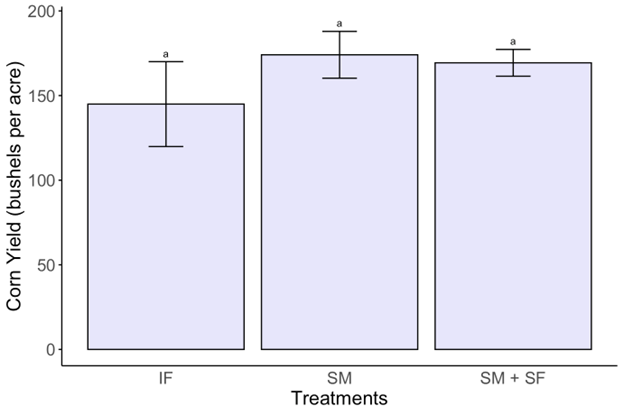
Figure 1: Effects of SM, IF & SM+IF applications on corn yield(SM- Swine Manure, IF- Inorganic fertilizer, SM+SF: Swine manure + Starter Fertilizer)

(Data are presented as mean with standard error, bars with different letters denote significantly different at p<0.05)
Figure 1: Effects of SM, IF & SM+IF applications on corn yield
(SM- Swine Manure, IF- Inorganic fertilizer, SM+SF: Swine manure + Starter Fertilizer)
(Data are presented as mean with standard error, bars with different letters denote significantly different at p<0.05)

Furthermore, we observed significant differences (p < 0.05) in Soil Plant Analysis Development (SPAD, chlorophyll and nitrogen contents in leaves measured using Minolta Chlorophyll Meter) values among the treatments, with IF showing the highest value (52.37), followed by SM (48.15) and then the SM+SF (45.56).

Figure 2: Effects of SM, IF & SM+IF application on SPAD values(SM- Swine Manure, IF- Inorganic fertilizer, SM+SF: Swine manure + Starter Fertilizer, SPAD- Soil Plant Analysis Development)

(Data are presented as mean with standard error, bars with different letters denote significantly different at p<0.05)
Figure 2: Effects of SM, IF & SM+IF application on SPAD values
(SM- Swine Manure, IF- Inorganic fertilizer, SM+SF: Swine manure + Starter Fertilizer, SPAD- Soil Plant Analysis Development)
(Data are presented as mean with standard error, bars with different letters denote significantly different at p<0.05)

The electrical conductivity (measured using Hanna GroLine Soil EC Tester) of the soil was significantly influenced (p < 0.05) by the treatments. The highest electrical conductivity was observed with the application of SM (0.36) which is statistically similar to SM+SF (0.32) treatment, but significantly higher than the IF (0.22) treatment.

Fig. 3 Effects of SM, IF & SM+IF application on electrical conductivity (EC)(SM- Swine Manure, IF- Inorganic fertilizer, SM+SF: Swine manure + Starter Fertilizer, EC- Electrical Conductivity)

(Data are presented as mean with standard error, bars with different letters denote significantly different at p<0.05)
Fig. 3 Effects of SM, IF & SM+IF application on electrical conductivity (EC)
(SM- Swine Manure, IF- Inorganic fertilizer, SM+SF: Swine manure + Starter Fertilizer, EC- Electrical Conductivity)
(Data are presented as mean with standard error, bars with different letters denote significantly different at p<0.05)

Future Plans

We plan to take the growth parameters including plant height and chlorophyll content (SPAD) at regular intervals. Additionally, we intend to sample soil microbiome composition in the field. This year we harvested 6 rows per plot but starting next year, we will harvest 18 center rows per plot (out of 31) for yield measurement. We will also exclude 15 feet from both the northern and southern ends of each plot.

Authors

Presenting author

Ravi Raj Mishra, Graduate student, University of Missouri, Columbia

Corresponding author

Teng-Teeh Lim, Extension Professor, University of Missouri, Columbia, limt@missouri.edu

Additional author(s) (name, title, and affiliation for each)

Manobendro Sarker, Graduate student, University of Missouri, Columbia

Keywords

Swine Manure, Soil Health, Soil Properties, Starter Fertilizers

Acknowledgements

We acknowledge the National Pork Board for the funding and collaboration with South Dakota State University. Our sincere thanks also go to Manobendro Sarker, Moh Moh Thant Zin, and Rana Das from our research group, and the research farm team for their support in field operations.

The authors are solely responsible for the content of these proceedings. The technical information does not necessarily reflect the official position of the sponsoring agencies or institutions represented by planning committee members, and inclusion and distribution herein does not constitute an endorsement of views expressed by the same. Printed materials included herein are not refereed publications. Citations should appear as follows. EXAMPLE: Authors. 2025. Title of presentation. Waste to Worth. Boise, ID. April 711, 2025. URL of this page. Accessed on: today’s date.
Impact of swine manure on soil health properties: A systematic review

Purpose

As the campaign to improve agricultural soil health has gained momentum among conservationists and researchers worldwide, a comprehensive assemblage of outcomes from manure and soil health-related research studies is important. Particularly, the identification of knowledge gaps is an important step to direct future research that informs soil health improvement outreach programs. A thorough review of data reporting the effects of swine manure on soil health properties that is applicable to agricultural producers is lacking. Although previous research studies have looked at the effects of manure on individual soil properties, there are conflicting conclusions. Livestock manure literature reviews fail to consider inconsistent methodologies between individual research studies and whether research is applicable to producers utilizing manure as amendments to improve soil health, and none of the reviews focus on swine manure or swine manure by-products. The objectives of this review were (a) to synthesize literature describing effects of swine manure on soil properties that affect soil health and (b) to identify knowledge gaps and research needs to further our understanding of this topic.

What Did We Do?

We conducted a systematic literature review based on peer-reviewed studies that evaluated the effect of swine manure on soil health properties. First, we identified studies using three criteria: species (swine, pig, hog), manure source (i.e., solid [SM] or liquid manure [LSM], compost, deep pack), and soil property (i.e., soil organic carbon [SOC], total nitrogen, soil pH, bulk density, available water capacity). Second, studies had to meet the following criteria in order to be included: (a) the studies were replicated field experiments, (b) manure was the only differing factor between or among treatments, and (c) data means of organically amended treatments and controls were included. In total, 40 peer-reviewed studies were included in this review.

What Have We Learned?

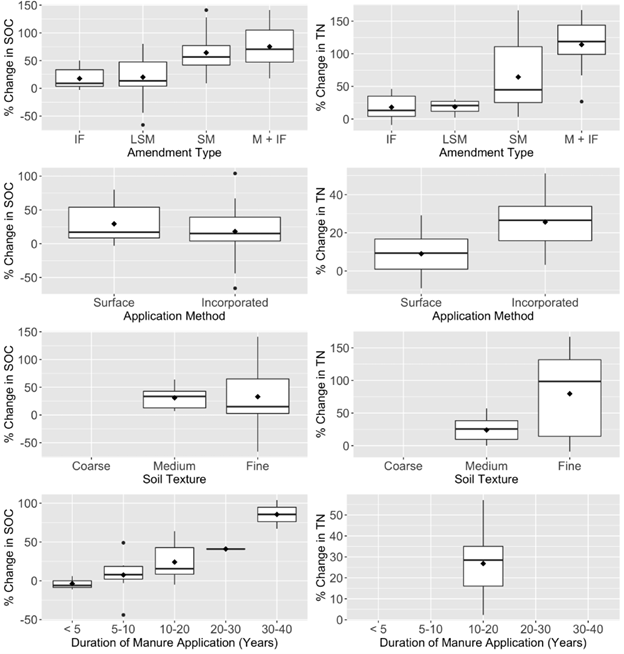
Recycling of manure locally prior to importing inorganic fertilizer (IF) has the potential to reduce nutrient imbalances and improve soil health. Based on this review, swine manure has the potential to add significant amounts of organic carbon to the soil and to improve soil health metrics. In general, the application of swine manure increases soil organic matter (SOM) and SOC, decreases soil bulk density, and increases microbial biomass carbon Soil organic carbon and total N tended to be highest when manure and inorganic fertilizer were applied to the field (Figure 1). Soil chemical properties did not seem to change much when manure was applied to the soil surface or incorporated into the topsoil. The duration of swine manure application (annually) did not seem to increase the percent change in most chemical properties; however, this could be due to a lack of data. The percent change in SOC did increase when the swine manure was applied for a longer time period (Figure 1), and we would expect to see a similar trend with SOM and total carbon if there were more data. Few articles had data on soil physical and biological properties. Depending on soil type, swine manure has the potential to increase available water holding capacity and saturated hydraulic conductivity. Although more research is needed, it can be inferred that swine manure additions increase microbial activity, which promotes healthier soils and better crop yields.

Figure 1: Average percent change in soil organic carbon (SOC) and total nitrogen (TN) based on amendment type, application method, soil texture, and duration of swine manure application. Black circles represent outlier data, and diamonds represent mean. IF = inorganic fertilizer; LSM = liquid swine manure; M + IF = manure (liquid and solid) plus inorganic fertilizer; SM = solid swine manure

Future Plans

Previous literature reviews failed to account for differences in methodologies between individual research studies and whether research is applicable to producers utilizing swine manure as amendments to improve soil health (i.e., unreasonable application rates of swine manure, overapplication of nutrients). The evaluation of the effect of swine manure on soil health properties is difficult to do based on current literature because (a) there are few comprehensive studies (i.e., only one study reported properties from chemical, physical, and biological categories) and (b) there are non-consistent research methodologies between studies. Therefore, we recommend redirecting research studies to demonstrate the value of manure to the suitability of agricultural cropping systems. Future swine manure research should include (a) a range of soil physical, chemical, and biological properties, (b) initial soil data prior to manure application, and (c) manure type, application method, application rate, total carbon and nitrogen of the manure, duration of swine manure application, and swine manure application timing. In addition, future research should also focus on the short- and long-term effects of a single application of manure to support an effort to identify optimal frequency of application for improving soil health. More research is also needed to compare the effects of manure and inorganic fertilizer additions on crop yield and soil health by balancing nitrogen, phosphorus, and potassium additions.

Authors

Jenifer L. Yost, Research Soil Scientist, USDA-ARS

Corresponding author email address

jenifer.yost@usda.gov

Additional authors

Amy M. Schmidt, Livestock Manure Management Engineer, University of Nebraska-Lincoln; Rick Koelsch, Livestock and Bio Environmental Engineer, University of Nebraska-Lincoln; Kevin Kruger, Research Support Scientist, University of Idaho; Linda R. Schott, Nutrient and Waste Management Extension Specialist, University of Idaho

Additional Information

For more information about this project, please check out our Open Access journal article. The citation for the journal article is:

Yost, J.L., Schmidt, A.M., Koelsch, R., and Schott, L.R. (2022). Effect of swine manure on soil health properties: A systematic review. Soil Science Society of America Journal.

https://doi.org/10.1002/saj2.20359

This research was presented at the ASA, CSSA, SSSA International Annual Meeting in Salt Lake City, Utah, in November of 2021. The link to the recorded presentation is found in the citation below:

Yost, J. L., Schmidt, A. M., Koelsch, R., & Schott, L. R. (2021). Impact of Swine Manure on Soil Health Properties: A Systematic Review [Abstract]. ASA, CSSA, SSSA International Annual Meeting, Salt Lake City, UT. https://scisoc.confex.com/scisoc/2021am/meetingapp.cgi/Paper/138180

Acknowledgements

This project was supported by funding from the National Pork Checkoff. The authors would also like to thank Meg Clancy and Drew Weaver for their assistance.


The authors are solely responsible for the content of these proceedings. The technical information does not necessarily reflect the official position of the sponsoring agencies or institutions represented by planning committee members, and inclusion and distribution herein does not constitute an endorsement of views expressed by the same. Printed materials included herein are not refereed publications. Citations should appear as follows. EXAMPLE: Authors. 2022. Title of presentation. Waste to Worth. Oregon, OH. April 18-22, 2022. URL of this page. Accessed on: today’s date.