
Seasonal greenhouse gas emissions from dairy manure slurry storages in New York State

Due to a technical glitch, the beginning of the recorded presentation was not recorded. Please accept our apologies.

Purpose

As the adoption of dairy manure storage systems has increased as a best management practice for protecting water quality, the anaerobic conditions in these systems has inadvertently led to an increase in emission of the greenhouse gas methane. Current inventory and modeled estimates of this potent greenhouse gas are based on limited datasets, and there is a need for methodologies to better quantify these emissions so that the impacts of storage conditions, manure treatments and seasonality can be better assessed, mitigation strategies can be implemented, and greenhouse gas reduction estimates can be correctly accounted for.

What Did We Do?

We are developing a ground-based, mobile measurement approach where manure storage systems are circled with a backpack methane gas analyzer and measurements are integrated with on-site wind measurements to calculate emission flux rates. Twelve commercial dairy farm manure storage systems, representing a range of herd sizes and pre-storage manure treatments are collaborating on the research. Once per month, each manure storage structure at each site is circled 10 consecutive times with a methane gas analyzer. A drone equipped with a separate methane analyzer is also used to verify ground-based measurements amidst the methane plumes. Divergence (Gauss’s) theorem is then applied to concentration measurements and anemometer wind data to estimate the net rate of methane flux. These observed methane emission fluxes are compared to International Panel of Climate Change (IPCC) modeled emissions as well as state inventories.

What Have We Learned?

We find that this methodology provides a reliable, cost-effective way to estimate methane emissions from manure storages. Observed emissions track modeled emissions with similar magnitudes, though models may be overestimating emissions during the growing season and underestimating during the winter months in this region (Figure 1). While emissions patterns are generally similar for each of the farm sites, with some farms and some individual monthly observational estimates there can be substantial deviation from predicted emission rates.
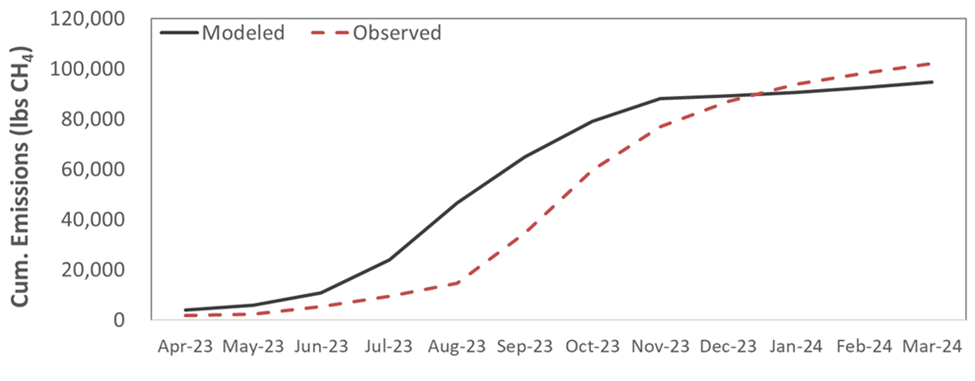
Figure 1. Modeled and measured cumulative methane emissions from a dairy manure storage system over a 12-month period.

Future Plans
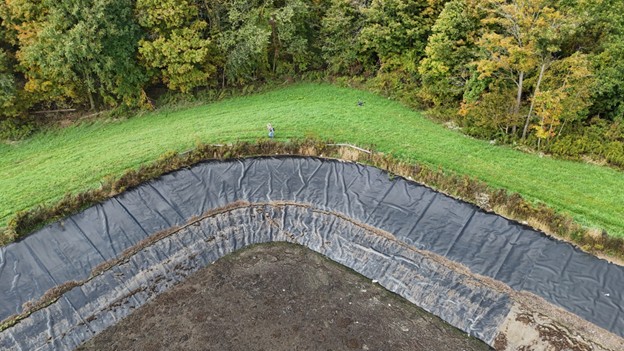
Evaluation of 2024 field data is ongoing, and we will continue to measure methane around storages with ground-based and drone measurements into the summer of 2025. We will explore plume dynamics and the effects of pre-storage treatments on measured methane emission flux. For select sites, measurements will be expanded to include continuous, open-path laser absorption spectroscopy to verify this novel measurement approach, footprint emissions, and explore the implications of pre-storage manure treatments.

Authors

Presenting & corresponding author

Jason P. Oliver, Dairy Environmental Systems Engineer, Cornell University | PRO-DAIRY, jpo53@cornell.edu

Additional authors

Lauren Ray, Agricultural Sustainability and Energy Engineer, Cornell University | PRO-DAIRY

Eric Leibensperger, Associate Professor, Physics and Astronomy, Ithaca College

Additional Information

https://cals.cornell.edu/pro-dairy/our-expertise/environmental-systems/climate-environment/greenhouse-gas-emissions

https://leibensperger.github.io/

Acknowledgements

Funding for this work was provided by the New York State Department of Agriculture and Markets. Agreement #  CM04068CO


The authors are solely responsible for the content of these proceedings. The technical information does not necessarily reflect the official position of the sponsoring agencies or institutions represented by planning committee members, and inclusion and distribution herein does not constitute an endorsement of views expressed by the same. Printed materials included herein are not refereed publications. Citations should appear as follows. EXAMPLE: Authors. 2025. Title of presentation. Waste to Worth. Boise, ID. April 711, 2025. URL of this page. Accessed on: today’s date.

Laboratory estimation of methane emission rates from Midwest dairy manure samples representing common manure types and storage conditions

Purpose

Methane (CH4) emissions from manure storage are a substantial contributor to the cradle-to-farmgate climate footprint for many dairy farms, especially for farms storing manure as liquid or slurry (Rotz et al., 2021). Dairy systems handle, treat, and store manure in various ways. In combination with environmental conditions, these differences in manure-related structures and processes potentially cause substantial farm-to-farm variability in CH4 production and intensity. However, few methods are available to estimate CH4 emissions specific to a manure storage or farm system.

To enable estimation of CH4 emission rate per unit of manure (methane emission rate, MER), research by Andersen et al. (2015) tested a laboratory assay on swine manure from deep pits. These authors showed that MER was related to manure chemical composition and varied across the year, with the highest values recorded in late fall. Our research aimed to build on Andersen et al. (2015) by testing dairy rather than swine manure to 1) compare MER across a variety of manure types, storage types, and typical storage durations, 2) examine seasonal differences in MER, and 3) quantify farm-to-farm and storage-to-storage variation in MER. Ultimately, we expected to illustrate how the MER laboratory assay could be used in estimating farm-specific CH4 emission rates from dairy manure storages.

What Did We Do?

We partnered with 27 dairies in the U.S. Upper Midwest with liquid and slurry manure storages. At approximately 2–4-month intervals throughout 2024, we collected composite samples (n = 208) representing various manure types, typical storage durations, and storage types. Most samples were whole manure (n = 165, 79%) or liquid separated manure (n = 34, 16%), with remaining samples representing flush water and digestate. Samples represented areas where manure was stored for short durations (≤1 mo.; n = 120, 58%) and long durations (>1 mo.; n = 88, 42%). Most long-term storage was unroofed, and most short-term storage was roofed. Samples represented transfer pits (n = 84, 40%), unroofed basins or pits (n = 67, 32%), and below-building pits (n = 30, 14%), among other storage types. Samples were distributed evenly across seasons for most farms, except that fewer samples were collected during winter due to outdoor storages freezing over.

For the MER assay, we incubated 75.06 ± 0.02 g (mean ± standard error) of manure at 72°F in triplicate 100 mL serum bottles for 2.99 ± 0.01 days. Then, we measured gas displacement with a syringe and headspace CH4 concentration with gas chromatography (Agilent 490 Micro GC, Agilent Technologies, Inc., Santa Clara, CA). We calculated MER as the average CH4 emission (mL) at 72°F per liter of manure per day. To examine differences due to manure type, typical storage duration, storage type, and season, we fit linear mixed models to log-transformed MER, then back-transformed model-implied means and standard errors. Additionally, we examined variance components attributable to individual storages and farms in relation to the residual variance. Storage-to-storage differences explained a small amount of total variance, so the random effect of storage was removed. Significance was declared at p<0.05.

What Have We Learned?

Across samples, the MER was highly variable and right-skewed (mean = 37, median = 21, standard deviation = 45 mL CH4 L-1 d-1; Figure 1), with a small fraction of extremely high values (maximum = 236 mL CH4 L-1 d-1). In contrast with our expectations, we found no effect of manure type, typical storage duration, and storage type on MER. Season influenced MER (F [3, 183.4] = 11.3, p < 0.001), with Fall samples exhibiting a larger MER compared with other seasons (Table 1). Larger MERs in Fall samples were driven by greater gas volume and CH4 concentrations in headspace; model-implied means of both variables nearly doubled in Fall compared with other seasons. Considering that all samples were incubated at the same temperature during the MER assay, greater MER during Fall may indicate that these samples had more abundant and active methanogen populations. Additionally, differences in chemical and physical properties of manure may have enhanced substrate availability for methanogenesis in Fall samples relative to other seasons.

Table 1. Results of a laboratory assay to estimate methane emission rate from dairy manure samples (n = 208) by incubating at 72°F in serum bottles for 3 days.
Model-Implied Mean (Confidence Interval)
Variable Spring Summer Fall Winter
Volume displacement, mL 14 (3, 25) 16 (4, 27) 26 (14, 37) 13 (0, 26)
Headspace methane, % 5 (3, 10) 8 (5, 16) 14 (8, 26) 6 (3, 12)
Methane emission rate,
mL CH4 L-1 d-1
13 (7, 25) 22 (11, 43) 41 (21, 79) 15 (7, 33)


Although our results illustrated that the mean MER was generally similar across categories of manure types, storage durations, and storage types, we found that between-farm differences accounted for 18% of the total variance in MER. In other words, samples from the same farm were correlated on average 0.18. This suggests that there are farm-to-farm differences in MER that were not explained by the predictors we considered as fixed effects.

Figure 1. Methane emission rates of samples (n = 208 points) showing the median and first and third quartiles (box) with whiskers 1.5 times the interquartile range.

Future Plans

In future work on this project, we plan to explore if between-farm differences in MER can be explained by other farm meta-data such as bedding type, manure removal frequency, storage volume, and surface area of manure. Additionally, we will explore relationships between manure chemical composition (total solids, volatile solids, total nitrogen) and MER. Similar to Andersen et al. (2015), we are examining the temperature sensitivity of methanogenesis in different sample types. In subsequent work, we may consider relating MER to other chemical constituents in manure samples related to substrate availability (e.g., fiber fractions) or fermentation end-products (e.g., volatile fatty acids).

Authors

Presenting author

MaryGrace Erickson, Postdoctoral Associate, University of Minnesota

Corresponding author

Erin Cortus, Associate Professor and Extension Engineer, University of Minnesota, ecortus@umn.edu

Additional author

Noelle Cielito Soriano, Ph.D. Candidate, University of Minnesota

Additional Information

Andersen, D. S., Van Weelden, M. B., Trabue, S. L., & Pepple, L. M. (2015). Lab-assay for estimating methane emissions from deep-pit swine manure storages. Journal of Environmental Management, 159, 18–26. https://doi.org/10.1016/j.jenvman.2015.05.003

Rotz, A., Stout, R., Leytem, A., Feyereisen, G., Waldrip, H., Thoma, G., Holly, M., Bjorneberg, D., Baker, J., Vadas, P., & Kleinman, P. (2021). Environmental assessment of United States dairy farms. Journal of Cleaner Production, 315, 128153. https://doi.org/10.1016/j.jclepro.2021.128153

Acknowledgements

We thank the farms who participated in this research for providing samples and data. Additionally, we are grateful to Kevin Bourgeault, Seth Heitman, Sabrina Mueller, and Jacob Olson for contributing to sampling and laboratory analysis. This research is supported by USDA NIFA Award 2023-68008-39859, and the Minnesota Rapid Agricultural Response Fund.


The authors are solely responsible for the content of these proceedings. The technical information does not necessarily reflect the official position of the sponsoring agencies or institutions represented by planning committee members, and inclusion and distribution herein does not constitute an endorsement of views expressed by the same. Printed materials included herein are not refereed publications. Citations should appear as follows. EXAMPLE: Authors. 2025. Title of presentation. Waste to Worth. Boise, ID. April 7-11, 2025. URL of this page. Accessed on: today’s date.