Comparative Evaluation of Dairy Manure Compost Supply Chains in the US Pacific Northwest

Purpose

The overall objectives of this research are to describe the current linkages among participants in the dairy manure compost supply chains in the Pacific Northwest (PNW) states of ID, OR, and WA and to provide analytical insights into the challenges and opportunities for enhancing manure compost marketability and usage in the different regions. Obtaining an enhanced understanding of these market dynamics is necessary for explaining why and how dairy compost quality varies and for identifying strategies for establishing and/or strengthening linkages among market participants. Improving dairy compost quality and increasing usage among crop producers is important for achieving sustainable environmental quality and agricultural business profitability in all PNW states.

What Did We Do?

Our analysis builds on the underlying concept that is outlined in Extension bulletins and other references from universities in the PNW (e.g., Chen et al. 2011), which emphasize that developing good quality dairy manure-based compost requires achieving a proper Carbon (C) to Nitrogen (N) ratio (C:N) of about 30:1. It is common that supplemental C is needed to increase the C:N balance in dairy manure-based compost to that magnitude. There are various sources of supplemental C used by PNW compost producers, but the most common are cereals (barley and wheat) straw, corn stalks/silage, sawdust, and wood chips.

We created Figure 1 to describe, with several assumptions, the major participants in the PNW dairy compost supply chains and the nature of their typical interactions with each other. The main participants include dairies, compost businesses, logging businesses, cereals farms, laboratory testers, and silage farmers. We next implemented data-driven analyses to determine if and the extent to which the linkages among the dairy compost supply chain participants differ across PNW states, based on the structure of the dairy and other aligned industries (e.g., logging) in each state. The principal objective of the analyses was to quantify the relative spatial concentration of the dairy industries, which has implications for business profitability and policy-driven incentives for implementing the composting process. We used a couple of different measures of dairy market concentration for comparison. The first is the Herfindahl-Hirschman Index (HHI), which is a statistical measure of industry concentration (Rhoades, 1993). We applied the calculation of the HHI in a manner that is different than is typically done such that the obtained values represent differences in the spatial concentration of the dairy industries in ID, OR, and WA. We supplemented the HHI values with calculations of the ratios of dairy cow inventories to cropland acreage. Lastly, to obtain insights about the relative strengths of linkages among potential dairy compost supply chain entities, we estimated the correlation between county level dairy cow inventories, cropland acreage, and the numbers of other entities (e.g., logging businesses) for each state.

Figure 1. Diagram of major PNW dairy compost supply chain linkages (Source: Authors)

What Have We Learned?

The estimated HHI values in our context could range from close to about 100, which would reflect an even distribution of dairy cows among all counties in a state, to 10,000, which would imply that all dairy cows are in a single county. Our estimated HHI values based on 2022 data from the USDA Census of Agriculture were 1,378 for ID, 2,307 for OR, and 2,082 for WA. Thus, by the HHI measure, the dairy industries in OR and WA are more spatially concentrated than that in ID. However, by the ratio of dairy cow inventory to cropland acreage measure, all states have counties with relatively high concentrations of dairy cows, but to different extents across states. Additionally, estimates from the correlation analysis at the county level show a positive relationship between dairy cow inventories and cropland acreage for all states (statistically significant at the 5% confidence level for OR). A negative, but not statistically significant, relationship was found between the number of logging businesses and dairy cows in all states, but the magnitude was largest in ID. Thus, it is more common that counties have both dairy cows and logging businesses in a county in OR and WA than in ID. These relationships help explain why wood-based amendments with higher C are likely more commonly used in the composting process in OR and WA than in ID, as well as how the associated compost qualities differ across states.

Future Plans

The analyses we have implemented so far are at the county level. We plan to implement additional analyses that include identifying larger multi-county dairy producing regions and compiling more data on the existing supply chain participants, including cropland acreage for other crops (i.e., non-grain and silage) in such regions. This expanded analysis will provide more regionally specific assessments of the differences in dairy compost components/quality among the major dairy producing regions in the PNW.

Authors

Presenting & corresponding author

Patrick Hatzenbuehler, Associate Professor and Extension Specialist – Crop Economics, University of Idaho, phatzenbuehler@uidaho.edu

Additional authors

Srijan Budhathoki, Graduate Student, Washington State University

Mario de Haro-Martí, Extension Educator – Gooding County, University of Idaho

Anthony Simerlink, Extension Educator – Power County, University of Idaho

Additional Information

Idaho Sustainable Agriculture Initiative for Dairy

Acknowledgements

Research funding was provided by USDA-NIFA Sustainable Agricultural Systems Grant No. 2020-69012-31871 and the Idaho Agricultural Experiment Station.

The authors are solely responsible for the content of these proceedings. The technical information does not necessarily reflect the official position of the sponsoring agencies or institutions represented by planning committee members, and inclusion and distribution herein does not constitute an endorsement of views expressed by the same. Printed materials included herein are not refereed publications. Citations should appear as follows. EXAMPLE: Authors. 2025. Title of presentation. Waste to Worth. Boise, ID. April 711, 2025. URL of this page. Accessed on: today’s date.
Nutrient Circularity for Sustainability in Beef Supply Chains: Comparing the Performance of Three Manureshed Approaches

Purpose

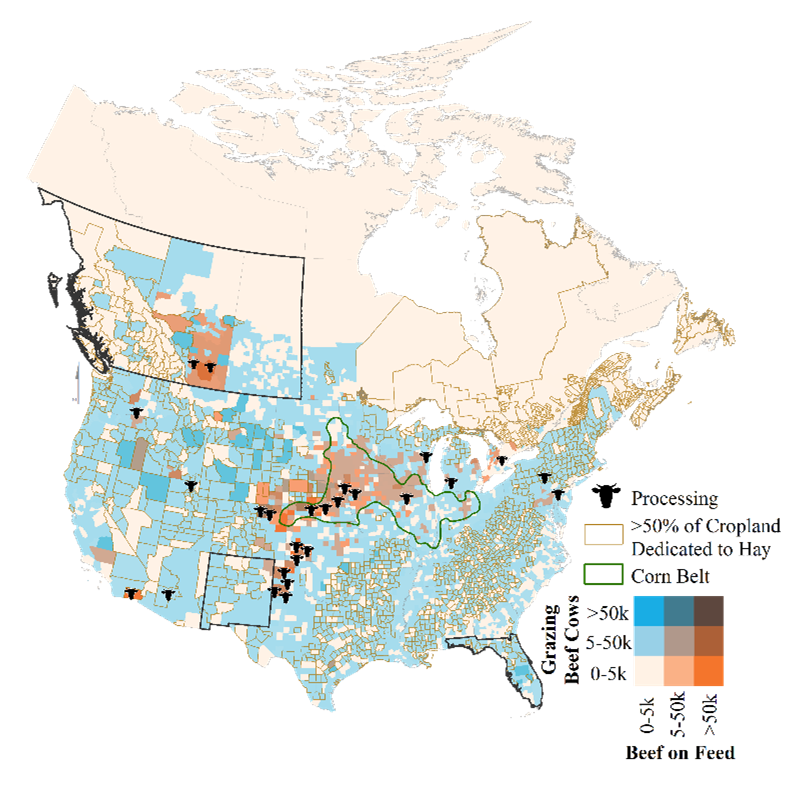
Figure 1. Geography of grazing cattle, hay production, and the Corn Belt – major components of the U.S. and Canadian beef supply chains. The grazing systems that send cattle to feedlots and could potentially use surplus feedlot manure instead of fertilizer for hay production are symbolized with blue shading and brown boundary lines. A geographic unit in the 0-5000 range may represent a US county or Canadian Consolidated Census Unit with no data available.

Expectations of the beef industry are multiplying as communities seek to build sustainable agri-food systems for the long term. Nutrient circularity – recovering nutrients from manures and post-harvest byproducts and reusing them for agricultural production – is a promising yet complex strategy for achieving sustainability goals from grazing pasture to dinner plate. In the United States and Canada, flows of cattle from land-based systems to feedlots in the built environment provide opportunities for circular management, in which concentrated feedlot manure is cycled back onto either corn fed to cattle in the feedlot phase or the hay fed to grazing cattle in “earlier” links of the cattle supply chain. However, such flows can span great distances because feedlots that produce large volumes of manure tend to be concentrated in particular regions, but the Corn Belt that could use much of their nutrient loads is in the Upper Midwest and the hay-grazing systems that send cattle to feedlots are widely distributed (Figure 1).

Systematically recycling manure from concentrated feedlots back to the land-based systems where cattle originated can help the US and Canadian beef industries meet their goals, but such efforts would require initial investments to transform management practices, trade structures, and social networks. With these major societal investments at stake, a reliable understanding of the tradeoffs of various approaches is needed. In turn understanding tradeoffs requires reliable data about geographically-specific flows coupled with expertise from multiple disciplines to interpret the data. Yet this sort of knowledge is rare. We sought to help fill this knowledge gap by comparing three manure recycling strategies using the conceptual framework of the ”manureshed” – the lands where surplus manure nutrients from concentrated animal feeding sites can be recycled to meet production, environmental, and socio-economic goals.

What Did We Do

We used a diversity of data — agricultural censuses, interviews of manure managers, and nutrient concentrations in manure and crops at multiple scales — to estimate the environmental and socio-economic performance of three different manureshed management approaches with different degrees of nutrient circularity:

Figure 2. Three types of manuresheds explored in our analysis
    1. Local recycling where surplus manure from individual feedlots is transported to nearby crop farms within local networks, with little coordination or incentive from the beef industry or public programs (Figure 2a);
    2. Regional-scale recycling where surplus manure nutrients from a major beef-feeding hotspot (many feedlots close to each other) are distributed onto croplands of adjacent nutrient “sink” counties that could use the nutrients for crop production, in a systematic fashion supported by community and programmatic coordination (Figure 2b);
    3. National- or international-scale recycling where surplus manure from individual feedlots is transported back to the hay-grazing systems where cattle in the feedlots originated (as envisioned in Purpose above), with systematic coordination among links of the geographically extensive beef supply chain (Figure 2c). We used New Mexico, Florida, and western Canada as three “cattle origination areas” (Figure 1).

To illuminate the tradeoffs of the three manureshed approaches, we “scored” each in terms of their performance regarding goals in five domains of sustainability. We used input from literature reviews, interviews of manure managers, and knowledge of the complex structure of the North American beef supply chain. With each domain, we identified the investments needed to overcome the shortcomings in scores, as appropriate.

What Have We Learned

The manureshed concept helps stakeholders to weigh pros and cons of different management and policy approaches to nutrient circularity, because the concept can highlight the many barriers that must be removed for manure export from feeding sites to be sustainable. The concept also provides spatially explicit information and knowledge about where and how such recycling would actually work.

All three manureshed management approaches promote a form of nutrient circularity. The international, extensive approach (Figure 2c) was explicitly designed to cycle nutrients between feedlots and land-based systems of cattle production, but the other two also granted some circularity to the general agri-food system – especially when manure nutrients are prioritized to be spread on farms that supply part of the feed ration to nearby feedlots. For context, the top feedlots of the US import around 35% of their feed from local sources.

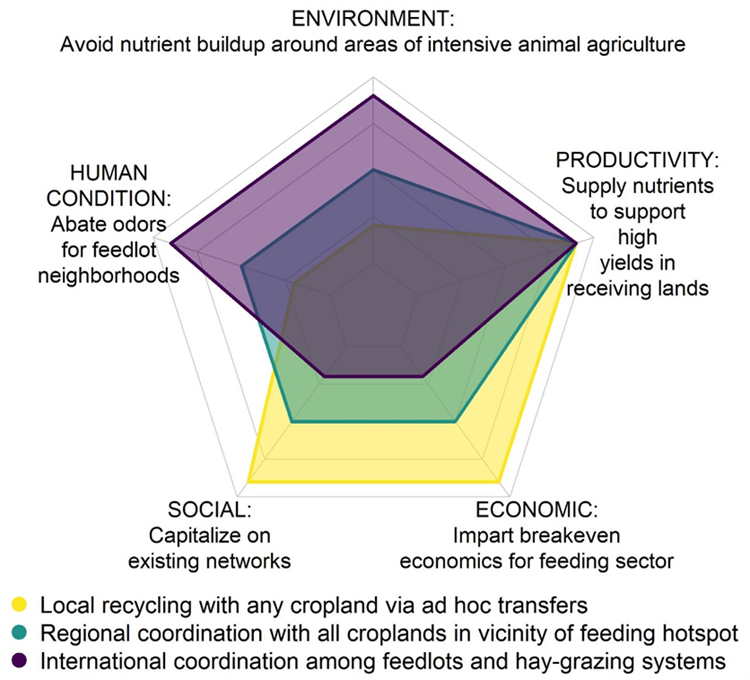
The three approaches “scored” differently with respect to goals in five domains of sustainability, resulting in different shapes of tradeoffs among environmental and socioeconomic goals for each approach (Figure 3). Importantly, these scores reflect the performance of the three management systems in the current agri-food system. If we, as a society, seek to promote nutrient circularity and its potential benefits in the future, alternatives such as the international approach – which seem economically infeasible now – may ultimately prove to be the most favorable, all things considered. The expense of transporting manure from beef feedlots to productive hayfields telecoupled to feedlots is now a major barrier to this approach (low score in Economic domain in Figure 3). However, redesigning systems so that hay-grazing agroecosystems receive feedlot manure may ultimately improve overall adaptive capacity during times of drought, reducing instances of herd destocking when appropriate and supporting the working landscapes valued by North Americans now and in the future (not pictured on Figure 3).

Figure 3. Performance of three approaches to beef manureshed management in the current agri-food system, with respect to one goal in each of five domains of sustainability. High scores are represented on the outer edges of the diagram. Comparing scores within and among approaches illustrates tradeoffs and co-benefits among the domains.


Future Plans

We plan to conduct a full life cycle analysis of the three manureshed approaches, with attention to environmental, productivity, and economic outcomes, including the role of manures in emerging Carbon markets. We plan to conduct the assessments within current and projected future conditions of the agri-food system, with special attention to future scenarios of climate change and rock-based Phosphorus scarcity.

We will also encourage collaborative science and management. Effective nutrient circularity for sustainability requires coordinated, comprehensive collaborations and partnerships across systems that are sometimes located far apart, beyond any one producer, consumer, or policy maker. To understand our options, a wealth of data, information, and knowledge is needed, especially that which prioritizes co-production among researchers, practitioners, and agri-food consumers.

Authors

Sheri Spiegal, Range Management Specialist, USDA-ARS Range Management Research Unit
sheri.spiegal@usda.gov

Additional Authors

    • Gwendwr Meredith, Social-Ecological Rangeland Scientist, University of Nebraska
    • Shabtai Bittman, Research Scientist, Agriculture and AgriFood Canada
    • Maria Silveira, Professor, Soil Fertility and Water Quality, Range Cattle Research Experiment Station, University of Florida
    • JV Vendramini, Professor of Agronomy & Forage Specialist, Range Cattle Research Experiment Station, University of Florida
    • C Alan Rotz, Agricultural Engineer, USDA-ARS-Pasture Systems and Watershed Management Research Unit
    • K Colton Flynn, Soil Scientist, USDA-ARS Grassland Soil and Water Research Laboratory
    • Mark Boggess, Center Director, USDA-ARS U.S. Meat Animal Research Center
    • Peter JA Kleinman, Soil Scientist and Research Leader, USDA-ARS, Soil Management and Sugar Beet Research Unit

Additional Information

Meredith, G., S. Spiegal, and P. Kleinman. 2022. Manure Cycling Interview Data ver 2. Environmental Data Initiative. https://doi.org/10.6073/pasta/c9dabfc6b9185c127cf2f5f719a6fb69 (Accessed 2022-03-05).

Rockefeller Foundation. 2021. True Cost of Food Measuring What Matters to Transform the U.S. Food System. https://www.rockefellerfoundation.org/report/true-cost-of-food-measuring-what-matters-to-transform-the-u-s-food-system/

Spiegal, S., J. Vendramini, S. Bittman, M. Silveira, C. Gifford, C. Rotz, J. Ragosta, and P. Kleinman. 2022. Data to explore circular manureshed management in beef supply chains of the United States and western Canada ver 3. Environmental Data Initiative. https://doi.org/10.6073/pasta/a81b6a2dd23a8b12360412c492fe8040 (Accessed 2022-03-05).

https://www.ars.usda.gov/oc/dof/from-problem-to-solution-recycling-manure-to-help-crops/

Acknowledgements

This research was a contribution from the Long-Term Agroecosystem Research (LTAR) network. LTAR is supported by the United States Department of Agriculture, which is an equal opportunity provider and employer. Additional support for this effort was from USDA-NIFA AFRI’s Sustainable Southwest Beef Coordinated Agricultural Project grant #12726269. We thank AAFC and Canadian Cattlemen’s Association (CANFAX), New Mexico Livestock Board, and Florida Department of Agriculture and Consumer Services for their data and assistance.


The authors are solely responsible for the content of these proceedings. The technical information does not necessarily reflect the official position of the sponsoring agencies or institutions represented by planning committee members, and inclusion and distribution herein does not constitute an endorsement of views expressed by the same. Printed materials included herein are not refereed publications. Citations should appear as follows. EXAMPLE: Authors. 2022. Title of presentation. Waste to Worth. Oregon, OH. April 18-22, 2022. URL of this page. Accessed on: today’s date.