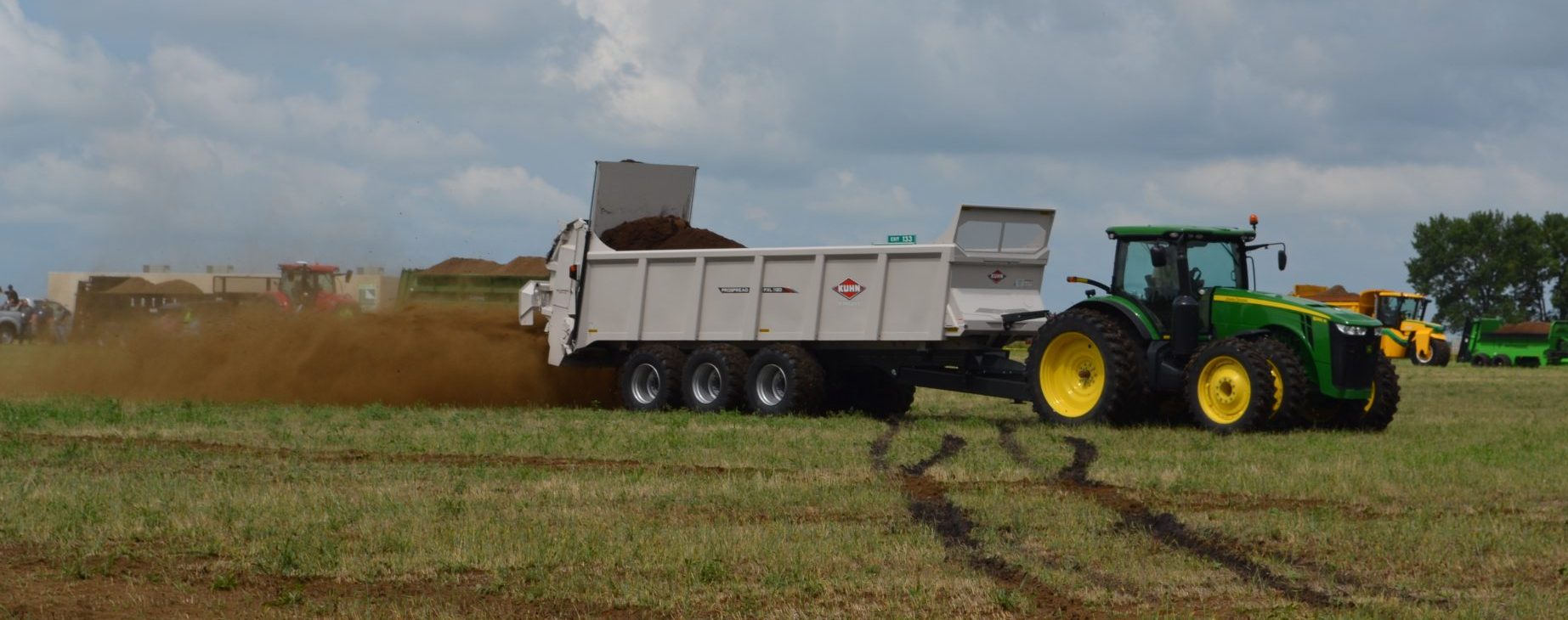
This webinar will examine the potential of advanced manure processing systems to treat manure to water quality standards suitable for discharge. It will feature insights from Dane County Land Conservation, including their objectives in supporting system installation, the ownership and operational structure, financial support mechanisms, observed outcomes, and future planning. This presentation was originally broadcast on June 20, 2025. Continue reading “Manure processing for discharge water quality – technical performance and county perspectives for advancing water quality”
Augmenting sustainability through bioenergy generation using aquaponics production wastes
Purpose
With a rapid increase in global population, food security has become a significant concern. This has led to a significant rise in the demand for protein rich sustainable food. Therefore, worldwide tilapia cultivation is being seen as one of the most economical paths to meet the demand of protein rich food. Moreover, with increasing urbanization and pressing need of nutrient circularity, cost reduction and sustainability has driven the concept of aquaponics system, integrating aquaculture with hydroponics.
Aquaponics has gained significant demand both in the USA and globally and is postulated to reduce overall cost and land footprint, while simultaneously recycling the nutrients in a closed system. Further integration of an anaerobic digestion (AD) system for biogas production using aquaponics waste can make the aquaponic system energy resilient and environmentally sustainable. Therefore, the purpose of this study is to investigate the potential of various aquaponics waste for biogas production, and their fate under co-digestion.
What Did We Do?
In this study, aquaponics waste viz., aquaponic sludge, and lettuce roots and leftover leaves after harvesting were obtained as AD substrate from the aquaponic test bed, running under controlled conditions at Purdue University. A centroid simplex design was created to test the biochemical methane potential (BMP) of the substrate under co-digestion. The BMP test was performed in 1.2-L BMP anaerobic digesters, which have a working volume of 1 L. Dairy manure-based digestate obtained from a continuously running industrial digester was used as an inoculum. For all the test groups, substrate to inoculum ratio was maintained at 1:3. All the test groups were set up in triplicates, and the digesters were incubated in the water bath at 37 °C for 30 days. Biogas volume was measured daily using a syringe method.
What Have We Learned?
The study results showed that the aquaponic sludge and lettuce leaves fed in the anaerobic digesters at a ratio of 50:50 on volatile solids (VS) basis had the highest specific methane yield of 0.525 m3 kg-1 VS. However, the lettuce roots showed an antagonistic effect on co-digestion, giving a specific biogas yield of 0.173 m3 kg-1 VS. The results indicate that enhanced methane yields can be achieved by co-digesting aquaponic sludge with farm residues in an appropriate ratio.
Future Plans
This study is part of a USDA research project to develop sustainable blue food systems driven by integrated aquaponics. Further efforts in AD of aquaponics waste are planned to mitigate the inhibitory effect of lettuce roots on co-digestion, so all aquaponics farm residues can be optimally utilized, simultaneously addressing waste management and generating nutrient-rich digestate as a biofertilizer for aquaponic crops. This approach can transform organic waste from aquaponics and plant harvesting into renewable energy, offsetting external energy needs and reducing the environmental footprint.
Authors
Presenting & corresponding author
Ji-Qin Ni, Professor, Agricultural and Biological Engineering, Purdue University, Jiqin@purdue.edu
Additional authors
Mohit Singh Rana, Postdoctoral Research Associate, Purdue University
Rajesh Nandi, Ph.D. student, Purdue University
Additional Information
Web: https://ag.purdue.edu/department/foodsci/big-project/index.html
Instagram: https://www.instagram.com/whenblueisgreenproject?igsh=MTF5a2xsdmppbWE0
X: https://twitter.com/WBlueIsGreen?_ga=2.200172589.2080482534.1739499225-1469780589.1739498857
Acknowledgements
This research was supported by the intramural research program of the U.S. Department of Agriculture, National Institute of Food and Agriculture, Agriculture and Food Research Initiative grants no. 2023-68012-39001.
The authors are solely responsible for the content of these proceedings. The technical information does not necessarily reflect the official position of the sponsoring agencies or institutions represented by planning committee members, and inclusion and distribution herein does not constitute an endorsement of views expressed by the same. Printed materials included herein are not refereed publications. Citations should appear as follows. EXAMPLE: Authors. 2025. Title of presentation. Waste to Worth. Boise, ID. April 7-11, 2025. URL of this page. Accessed on: today’s date.
Optimizing Manure Nitrogen Application Timing in Corn Production for Sustainability and Profitability
Purpose
Nitrogen (N) application timing is crucial in balancing crop productivity and environmental sustainability. While fall applications are typical among Iowa corn producers due to favorable field conditions, they pose a high risk of N loss through denitrification, volatilization, and leaching. Spring and in-season sidedress applications offer improved nitrogen use efficiency (NUE) by aligning N availability with crop demand.
This study evaluates the effects of different N application timings—fall, spring, and sidedress—on corn yield and NUE. Using data from 65 site-years, we assess how application timing influences yield, economic returns, and environmental impacts. The findings provide insights into best management practices for improving profitability and sustainability in corn production.
What Did We Do?
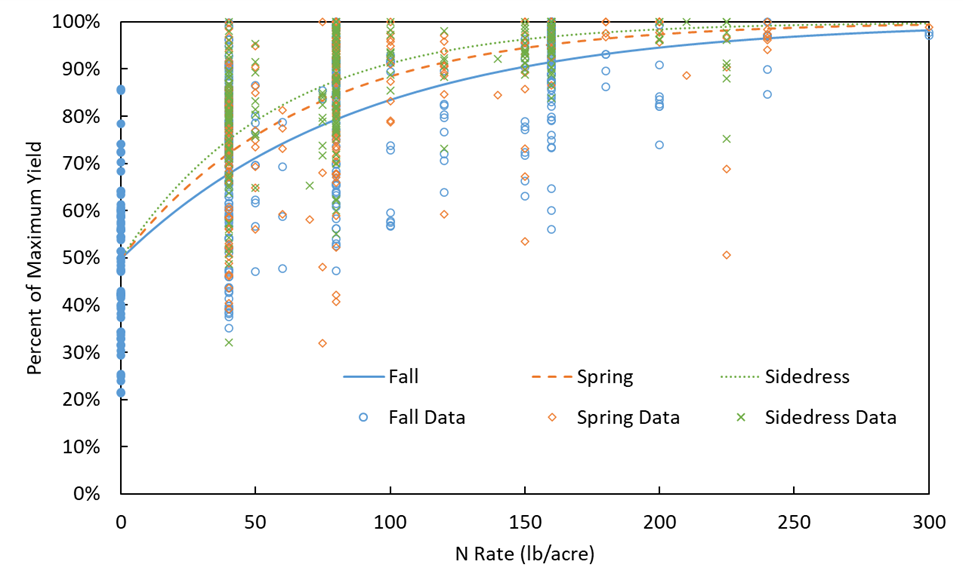
A review of studies comparing N application timing in corn production was conducted, including a long-term experiment from the University of Minnesota (1960-1996) and additional datasets totaling 65 site-years. Treatments were separated into three categories: fall, spring, and sidedress. Relative yield was used to normalize data across years, and yield response was modeled using a Mitscherlich-Baule equation (Figure 1).
Economic impacts were analyzed using maximum return to nitrogen (MRTN), which identifies the N rate that maximizes economic return (Figure 2). Corn prices ($4.62/bu) and anhydrous ammonia prices ($0.45/lb N) were used to estimate profitability in each application scenario. The environmental effects were assessed by examining N-loss pathways and the potential for emission reduction of nitrous oxide (N2O), a greenhouse gas estimated to be 273 times more potent than carbon dioxide.

What Have We Learned?
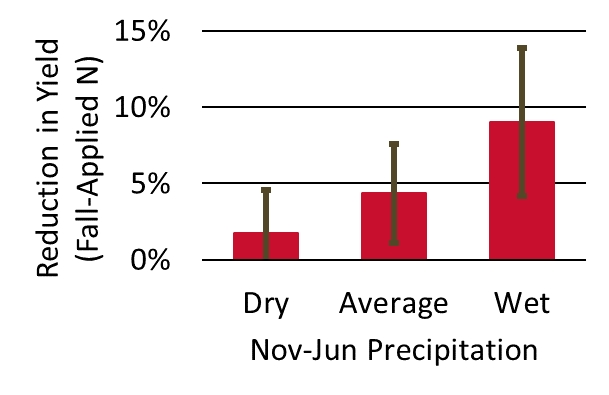
Results show that year-to-year, sidedress applications consistently produce the highest corn yield, followed by spring applications, with fall applications being the least effective. Yield differences are particularly evident in wet years (November to June rainfall > 1 inch above average), where sidedress applications outperform fall by an average of 9% (Figure 3). MRTN analysis shows that sidedress applications require 25% less N than fall applications while achieving higher yields, demonstrating their economic advantage.
The environmental analysis indicates that reducing N application rates through improved timing could cut N2O emissions by up to 25%. With a carbon credit of $30/metric ton CO2e abated the reduction in N2O equates to a $2.66/acre credit for a reduced N application rate. Fall-applied N is most susceptible to losses due to prolonged exposure to wet conditions, while spring and sidedress applications minimize the risk of loss by reducing time in the field and matching crop demand.
Future Plans
Further research is needed to refine N application strategies by incorporating real-time weather data and precision agriculture tools. The development of high-clearance application equipment, such as 360 RAIN from 360 Yield Center, offers opportunities for more flexible and targeted in-season applications, potentially enhancing NUE and reducing losses.
Additional studies should assess the risk of spring or sidedress applications from year to year. Weather conditions often limit pre-plant N application, so a thorough analysis of the frequency and financial impact of interrupted field management operations should be conducted.
Future studies should also explore the economic feasibility of split applications, which combine the benefits of multiple timings to reduce risk. Additionally, expanding MRTN models to include seasonal effects would improve decision-making for producers seeking to optimize N application timing while minimizing environmental impact.
Authors
Presenting author
Jacob R. Willsea, Graduate Research Assistant, Iowa State University Department of Agricultural and Biosystems Engineering
Corresponding author
Daniel S. Andersen, Associate Professor, Iowa State University Department of Agricultural and Biosystems Engineering, dsa@iastate.edu
Additional Information
Talkin’ Crap Podcast Episode:
Andersen Lab Poster Repository:
https://iastate.box.com/s/4s9gjhkd93d95yvqip8q5rr46frshtln
https://iastate.box.com/s/icg6clbamksfzciw8ze3lc301p8homg1
Acknowledgements
USDA-NRCS
Brent Renner
360 Yield Center
The authors are solely responsible for the content of these proceedings. The technical information does not necessarily reflect the official position of the sponsoring agencies or institutions represented by planning committee members, and inclusion and distribution herein does not constitute an endorsement of views expressed by the same. Printed materials included herein are not refereed publications. Citations should appear as follows. EXAMPLE: Authors. 2025. Title of presentation. Waste to Worth. Boise, ID. April 7-11, 2025. URL of this page. Accessed on: today’s date.
Pilot-scale Composting System to Measure Air Emissions from Dairy Manure and other Byproducts
Purpose
The overall objectives of this research are to investigate the design, implementation, and evaluation of a pilot-scale composting system for dairy manure. This composting system was developed because of the significant quantities of dairy manure produced in Idaho and the need to improve dairy compost quality while reducing air emissions during the composting process. This composting system provides the ability to simulate on-farm composting in Idaho while measuring and regulating key composting parameters, gas emissions, and implementing changes during operation.
What Did We Do?
This pilot-scale composting system was developed by adapting a home composter to simulate a mechanically turned windrow system. The composters were modified to include aeration control, air monitoring equipment (Gasmet), and measure key composting parameters throughout the process. Ten compost reactors were built, which allowed for several combinations of treatments and multiple replications. Each reactor is connected to a plenum with the capacity to interconnect several reactors or isolate each one and regulate airflows and chamber pressure. During the initial trial, two replications of each amendment: control, biochar, pumice, wood chips, and zeolites were evaluated. A follow-up trial will repeat the two replications per treatment, for a total of four replications. Modifications of the composting system during the trial addressed challenges with moisture control, odor, temperature regulation, air velocity, and compost balling.
Figures 1 and 2 define the blocking pattern and layout of the composting system for all ten compost reactors. The blocking pattern was generated for two primary reasons: Create replications for each treatment and compensate for a temperature differential between both ends of the research space caused by the cooling method in the greenhouse.


What Have We Learned?
We learned that the pilot-scale composting system can effectively simulate different types of on-farm composting methods, demonstrating its adaptability for research. During the composting trial, the aeration was regulated to simulate forced and natural airflow composting systems. The ability to continuously measure the headspace size confirmed a significant decrease in composting volume, as expected in a full sized composting system. The temperature monitoring showed we were able to reach thermophilic composting for the first two weeks of the trial and showed temperature increases at each turning event. These findings indicate that this system can be a valuable tool for developing more efficient on-farm dairy manure management practices at the pilot-scale.
Future Plans
The design and implementation of this composting system have only completed one trial run. The immediate next step is to complete another round of the compost trial. Each resulting compost mix with the corresponding amendment will be tested in a crop-testing greenhouse trial. The amount of compost, or any other products, handled by these reactors allows for further tests in the lab, at the pilot scale, or in a greenhouse.
In the short term and beyond the dairy manure trials, the reactor system will be tested for other processes, including different composting techniques and amendments. Other processes to be tested include soil amendments and their impact on air emissions, anaerobic digestion without mixing, emissions from diverse waste streams and amendment combinations, among others.
Authors
Presenting author
Anthony Scott Simerlink, Assistant Professor, Extension Educator – Power County, University of Idaho
Corresponding author
Mario E. de Haro-Martí, Professor, Extension Educator – Gooding County, University of Idaho, mdeharo@uidaho.edu
Acknowledgements
Funding for this project was provided by a USDA-NIFA Sustainable Agriculture Systems (SAS) grant #2020-69012-31871.
The authors are solely responsible for the content of these proceedings. The technical information does not necessarily reflect the official position of the sponsoring agencies or institutions represented by planning committee members, and inclusion and distribution herein does not constitute an endorsement of views expressed by the same. Printed materials included herein are not refereed publications. Citations should appear as follows. EXAMPLE: Authors. 2025. Title of presentation. Waste to Worth. Boise, ID. April 7–11, 2025. URL of this page. Accessed on: today’s date.