Use of Orchard Debris for Vermifiltration: Advancing Regenerative Agriculture and Wastewater Treatment

Purpose

This study assesses the economic and air quality benefits of using chipped apple orchard wood as a carbon source in a vermifiltration wastewater system. Instead of burning orchard debris, which releases harmful pollutants, the Perca system repurposes it as a substrate for earthworm-microbial wastewater treatment. The study also compares apple wood chips to traditional conifer chips, evaluating their effectiveness and the broader environmental and economic advantages of diverting orchard waste.

What Did We Do?
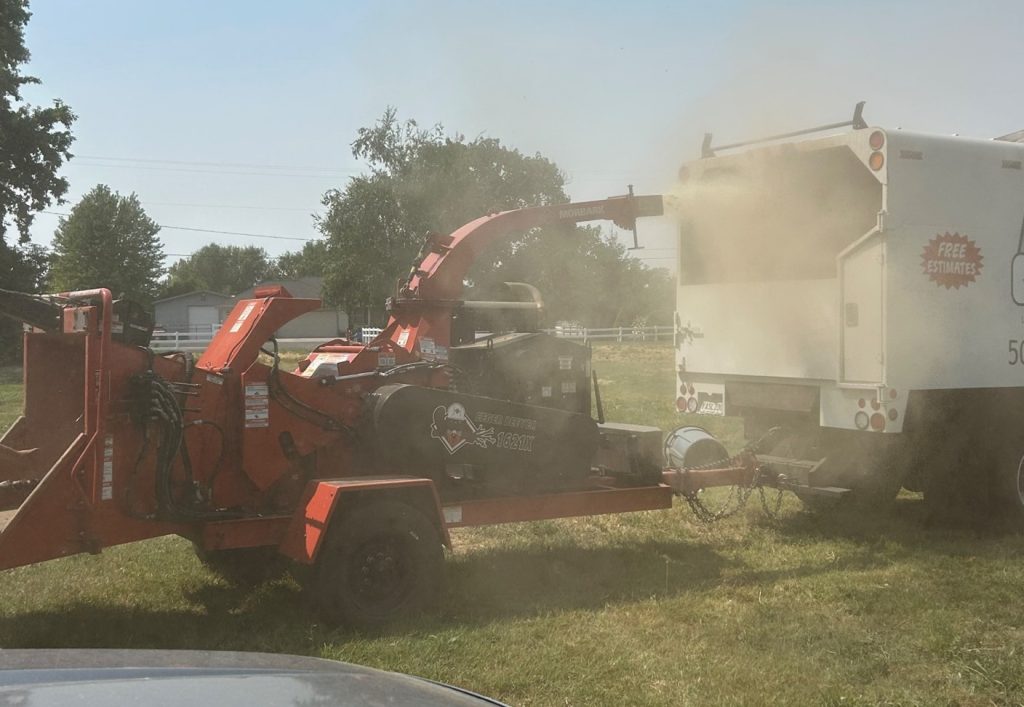
Image 1. Chipping process of apple orchard tear-out debris using Morbark, Eeger Beever, 1621” x 18”x 20.5” feeder throat with 140 horsepower motor.

Apple orchard tear-out debris from a local orchard was collected, chipped, and transported for installation as a substrate for the Perca vermifiltration system. Debris was screened to remove foreign materials, chipped to less than ½ inch size, and weighed to calculate tons of usable wood per ton of orchard debris. Data from processing, including chipping costs and labor requirements, were used to assess economic feasibility and air quality impact. In addition, a bench-scale test was conducted to evaluate the efficacy of wastewater treatment by apple orchard chips when compared to the standard conifer chips used in the Perca vermifiltration system. Removal efficiencies of total suspended solids (TSS), biological oxygen demand (BOD), and polychlorinated biphenyls (PCBs) were measured for both substrates.
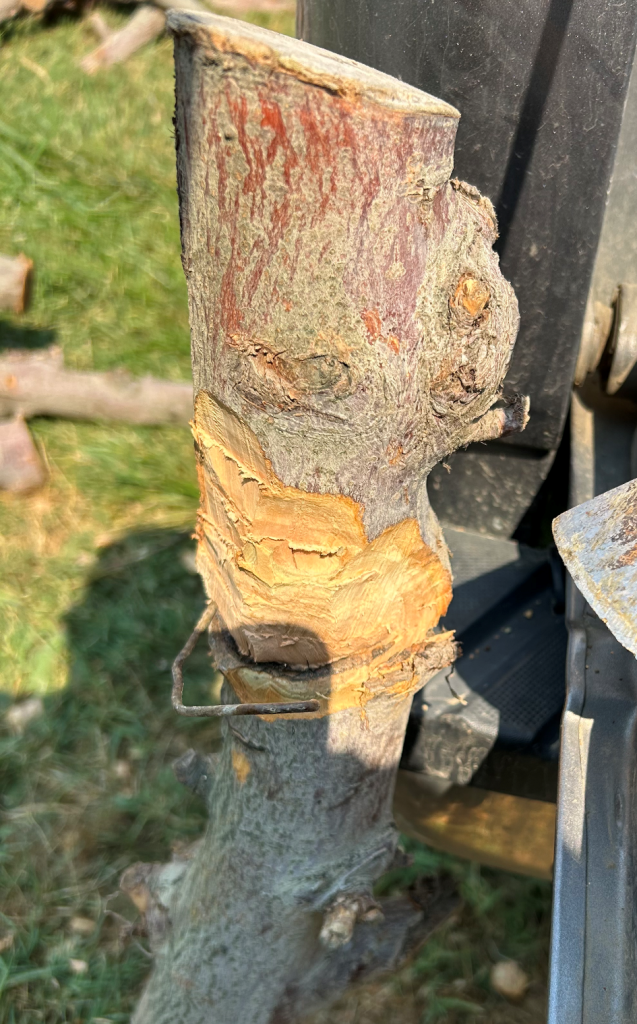
Image 2. Example of foreign objects (wire) embedded in apple wood pieces.

Market projections for Perca’s vermifiltration system show a compound annual growth rate (CAGR) of 113.45%, reaching 9.57% of the market over the next five years. Calculated market projection estimates over 16,000 tons of orchard debris could be converted into a value-added substrate product rather than burning. This shift could eliminate more than 500 tons of emissions between 2025 and 2029. Economic analysis shows that while chipping costs and wood size restrictions pose challenges for trellised orchards, non-trellised orchards offer better yields and lower costs, with market trends and technology advancements pointing toward broader economic feasibility. Bench-scale tests showed that both apple wood and conifer substrates effectively reduced TSS, BOD, and PCBs by more than 80% in all categories with no significant difference in performance, confirming apple debris works as well as conifer media. These findings demonstrate that apple orchard debris provides an environmentally sustainable alternative to burning, thus contributing to improved air quality, while also an efficient, cost-effective vermifiltration substrate for wastewater treatment.
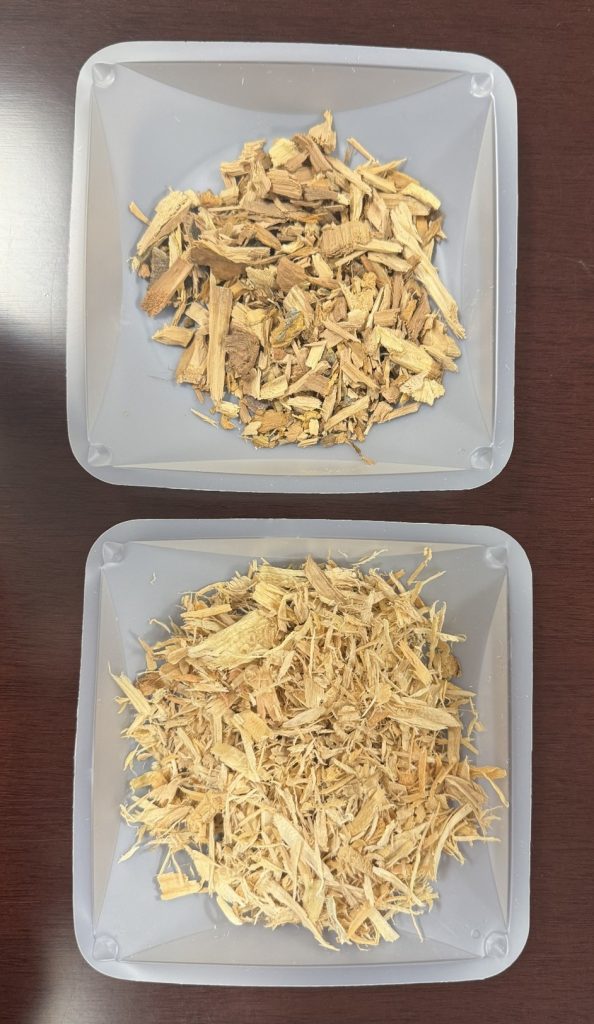
Image 3. Pine media and apple orchard tear-out fines.
Image 4. Rapid Assay Vermifiltration System (RAVS) used to test wastewater contaminant removal capability in traditional (pine) media and apple orchard tear-out fines.

Future Plans

Ongoing efforts focus on refining the use of apple orchard debris to create a cost-effective, reliable wood chip that matches or exceeds current substrates in reducing conventional and nonconventional wastewater pollutants, while offering an economic alternative to burning. Additionally, strategies are being developed to integrate vermifiltration into regenerative agriculture and circular bioeconomy practices by repurposing spent substrate as a nutrient-rich soil amendment or for soil remediation. This approach transforms agricultural waste into multiple value-added resources, supporting both environmental sustainability and economic viability through continued innovation, collaboration, and stakeholder engagement.

Authors

Presenting & Corresponding author

Sierra J. Smith, Director of Research and Development, Perca, Inc., sierrasmith@perca.net

Additional authors

Joseph S. Neibergs, Professor Extension Economist and Director Western Center for Risk Management Education, Washington State University

George A. Damoff, Chief Science Officer, Perca, Inc.

David A. Elmenhurst, Chief Financial Officer, Perca, Inc.

Additional Information

perca.net

https://ecology.wa.gov/about-us/accountability-transparency/partnerships-committees/boards-councils/agricultural-burning-research-task-force

Acknowledgements

Washington State Department of Ecology for funding and support

Washington State Agricultural Burning Practices & Research Task Force, under direction of the Department of Ecology, for funding and support

The authors are solely responsible for the content of these proceedings. The technical information does not necessarily reflect the official position of the sponsoring agencies or institutions represented by planning committee members, and inclusion and distribution herein does not constitute an endorsement of views expressed by the same. Printed materials included herein are not refereed publications. Citations should appear as follows. EXAMPLE: Authors. 2025. Title of presentation. Waste to Worth. Boise, ID. April 711, 2025. URL of this page. Accessed on: today’s date. 
Vermifiltration as a Technology for Lowering Dairy Wastewater’s Nutritional and Organic-Strength

Purpose

Due to increased demand for milk and milk products, the dairy industry has grown tremendously over the last several decades. This has resulted in an increase in the production of dairy manure. In recent years, the industry has also seen significant changes, such as a decrease in the number of dairy farms but an increase in the size of individual operations, and regional concentrations of dairy operations. Because of the regional concentrations of large dairies, large volumes of manure are produced in small geographical areas, raising concerns about the effects on local air, land, and water resources. Various dairy manure management technologies have been suggested ranging from anaerobic lagoons to membrane filtration. Many of these technologies, however, are not considered economically viable due to the high energy and labor requirements for sludge management.

Vermifiltration is on the other hand an emerging low-cost manure management technology, which is an aerobic wastewater treatment system that employs a community of microorganisms and earthworms in a filter bed media. The purpose of this research was to assess the effectiveness of this technology in reducing solids, organic strength, and nutrients (nitrogen and phosphorus) in dairy wastewater from a dairy operation with a manure-flush system. The treatment’s ultimate goal was to: (1) reduce the nutrient load of the wastewater so that it could be recycled via irrigation on nearby land, (2) recycling to flush fresh manure from the barns, and (3) recover the nutrients in the form of earthworm biomass and vermicasts.

What Did We Do

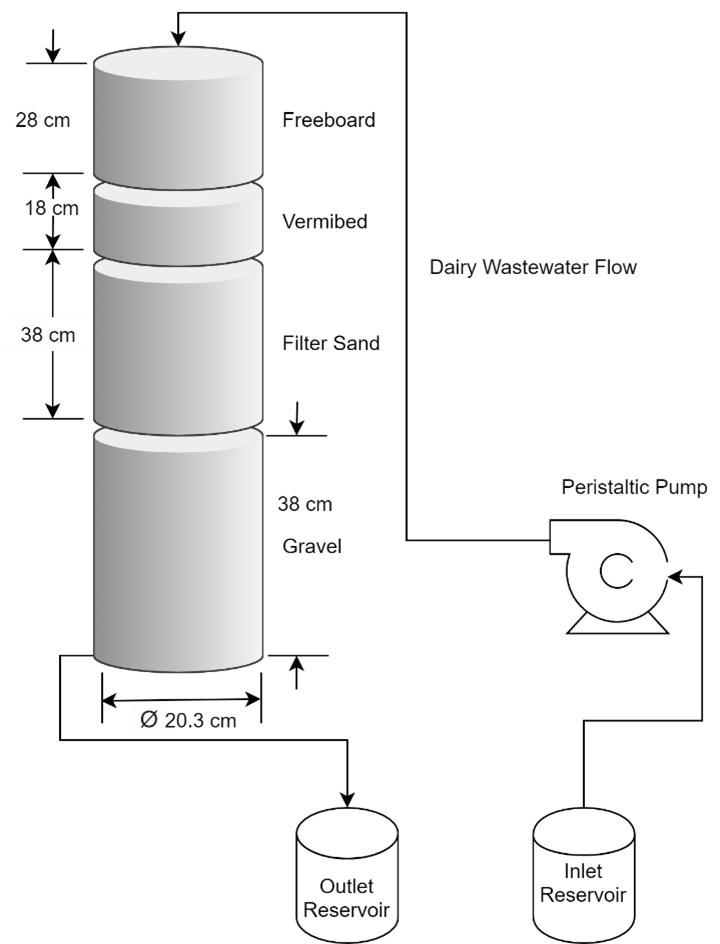
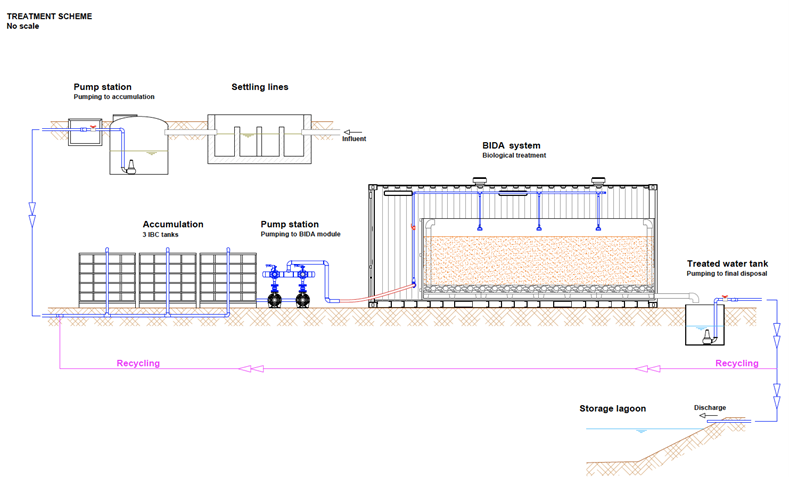
In this study, we assessed the efficacy of a vermifilter for treating dairy wastewater in terms of effluent quality and potential air emission reductions. For these tests, a pilot-scale vermifilter unit (Fig 1) was installed on a commercial dairy and monitored for 6 months. Additional lab-scale (Fig 2) studies looked into the effects of earthworm density, organic loading rate, and hydraulic loading rate on the vermifilter’s performance. Total solids, total suspended solids, chemical oxygen demand, total nitrogen, total ammonia-nitrogen, nitrate-nitrogen, total phosphorus, and orthophosphate were among the wastewater parameters of interest. A closed-loop dynamic chamber method was used to measure potential gas emissions (ammonia—NH3, methane—CH4, carbon dioxide—CO2, and nitrous oxide—N2O) from these samples. Lab scale Plexiglass vermifilters were also used to study the effect of earthworm density, organic and hydraulic loading rates.

Fig 1: Layout of the pilot scale vermifilter system (IIBC tanks for storage, BIDA is the vermifiltration system)
Fig 2: Lab scale vermifilter system

What Have We Learned

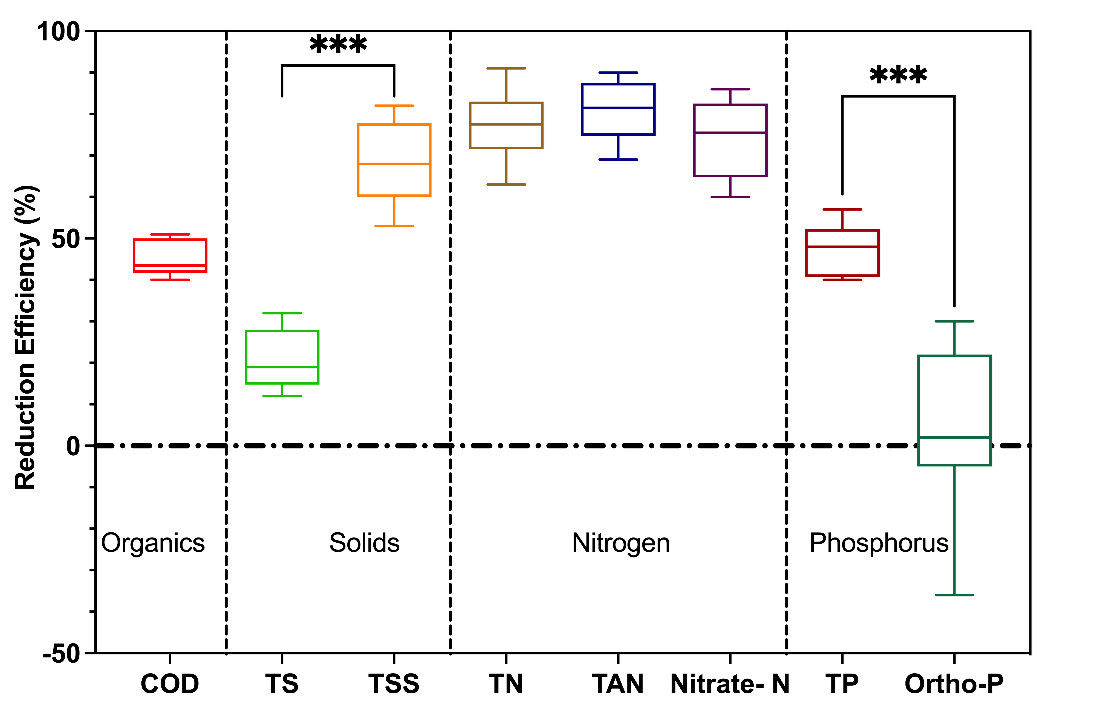
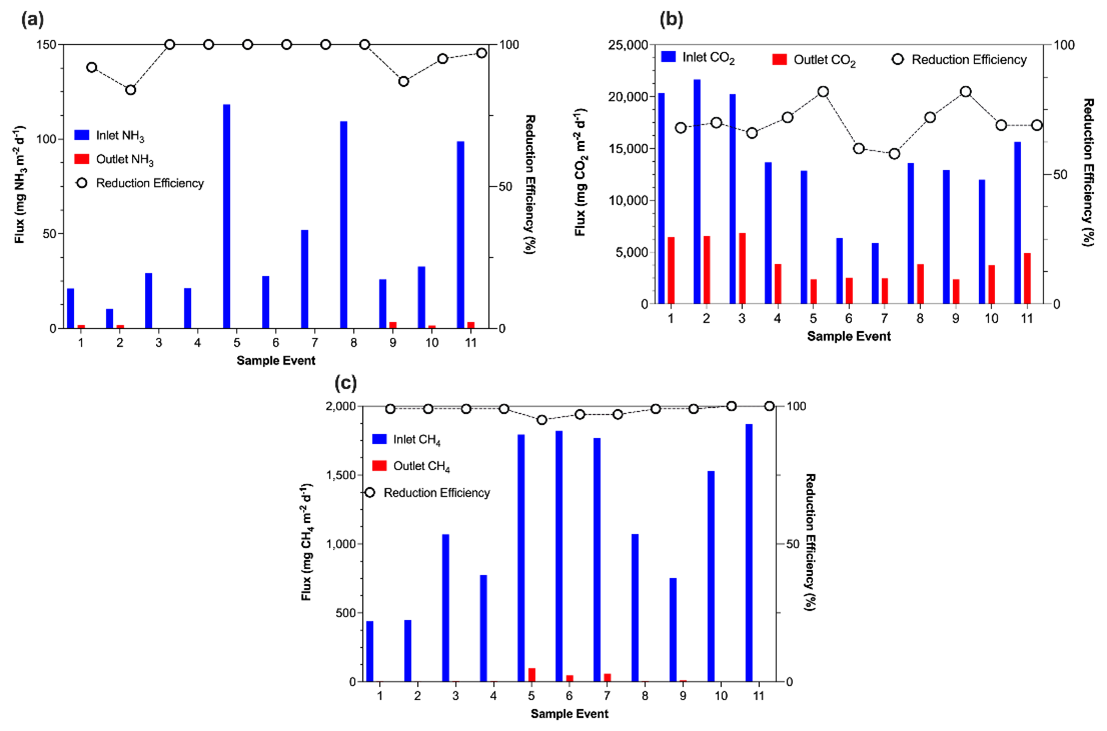
We observed that reduction efficiencies of up to 90% of inlet wastewater organics, nutrients, and solids can be achieved by the vermifilter (Fig 3). These results showed that vermifiltration has a high potential for reducing the concentrations of organics, nutrients, and solids in dairy wastewater. We also noted that the vermifilter system reduced emissions of gases by 84 – 100% for NH3, 58 – 82% for CO2, and 95 – 100% for CH4. Nitrous oxide emissions were mostly undetectable. We also learned that the vermifilter system reduced the global warming potential of untreated dairy wastewater by up to 100% and demonstrated the ability to generate carbon credits while maintaining a low carbon footprint. We further learned that vermifiltration at earthworm densities of 10,000 and 15,000 earthworms m-3 is best for treating dairy wastewater in terms of organic matter, nutrients, and solids concentration removal.

Fig 3: Reduction efficiencies of organics, solids, nitrogen and phosphorus
Fig 4: Influent, effluent gas fluxes through the vermifilter system

Future Plans

To enable effective scale-up, additional studies of a full-scale vermifilter system’s techno-economic and life cycle assessment are required. The techno-economic analysis will serve as a foundation for addressing vermifiltration optimization processes, as well as determining the system’s cost implications and economic performance. The life cycle assessment, on the other hand, will reveal potential environmental impacts associated with a full-scale vermifilter system.

Vermifiltration uses a variety of microbial pathways for nutrient conversion, including aerobic and anaerobic organic matter stabilization, ammonification, nitrification, immobilization, and denitrification. These pathways are heavily reliant on the system’s dominant microbiota, which has an impact on the system’s treatment efficiency. Genomic sequencing is required to better understand the microbiota present in dairy wastewater streams and vermifilter units, as well as how the introduction of earthworms affects the microbial communities. This will allow us to optimize the treatment and thus increase the vermifilter’s efficiency.

Authors

Gilbert Miito, Post Doctoral scholar, University of Missouri
gilbertjohn.miito@wsu.edu

Additional Authors

-Pius Ndegwa, Professor, Washington State University
-Femi Alege, Post Doctoral Fellow, University of California Berkeley
-Joe Harrison, Professor, Washington State University

Additional Information

Publication: https://www.sciencedirect.com/science/article/abs/pii/S2352186421002960

Acknowledge

Biofiltro, Organix Inc, Washington State University, Washington State Department of Agriculture


The authors are solely responsible for the content of these proceedings. The technical information does not necessarily reflect the official position of the sponsoring agencies or institutions represented by planning committee members, and inclusion and distribution herein does not constitute an endorsement of views expressed by the same. Printed materials included herein are not refereed publications. Citations should appear as follows. EXAMPLE: Authors. 2022. Title of presentation. Waste to Worth. Oregon, OH. April 18-22, 2022. URL of this page. Accessed on: today’s date.