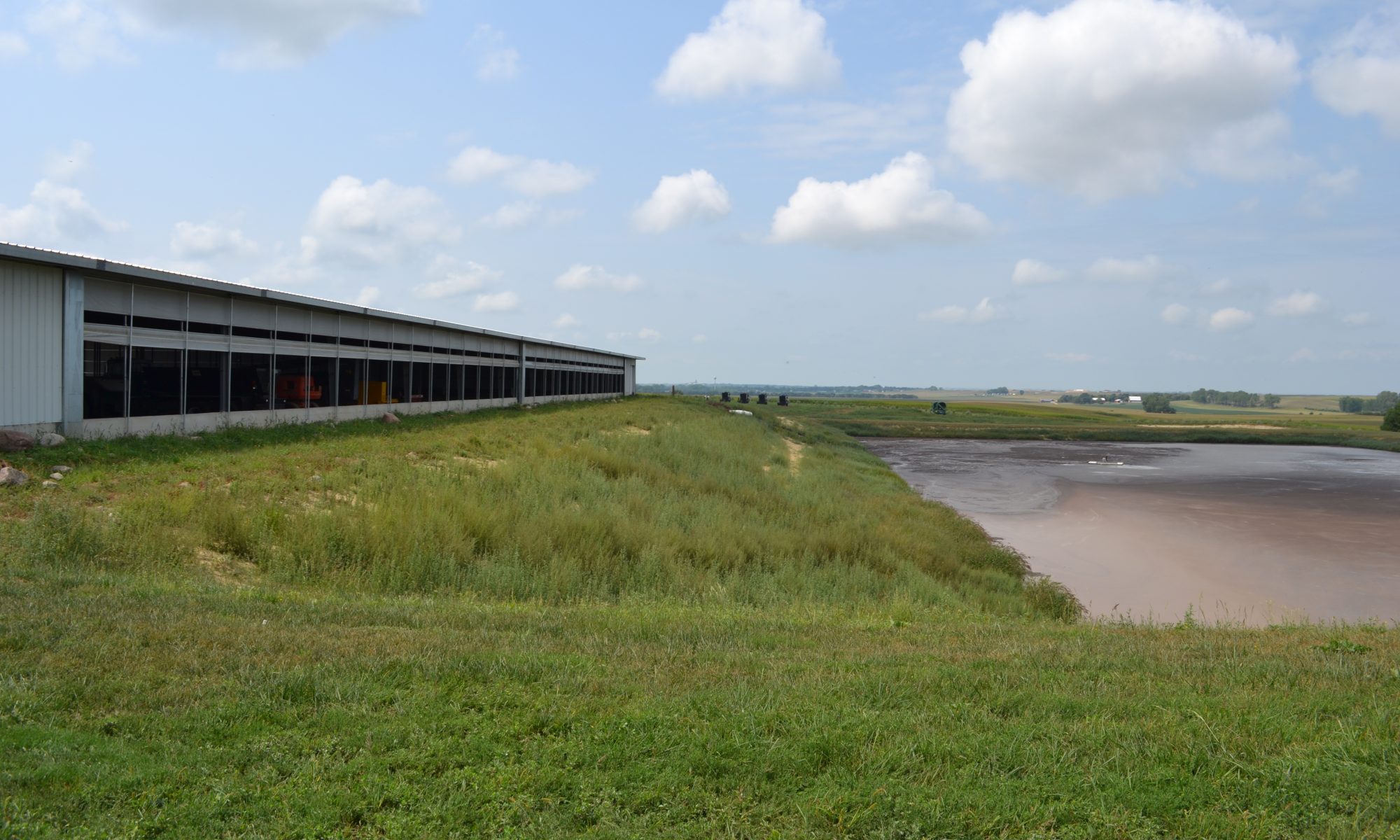
Long-term manure storages on dairy farms are temporary containment structures for byproducts of milk production. Manure, milkhouse wash, bedding, leachate, and runoff are stored until they can be utilized as fertilizer, bedding, irrigation, or energy. The practice of long-term storage creates stakeholders who collect data in their interactions with storages. This presents an opportunity to support data driven decision making on best use and operation of storages.
What Did We Do?
Prevalent stakeholders who collected data on storages were identified and the information they collected was examined. Data that could assist in depicting storage infrastructure was retained. Data not collected but of value to decision makers was noted. From this a combined data set was proposed that could depict the size, state, and impact of storage infrastructure. The feasibility of such a combined data set and opportunities from it were considered.
What Have We Learned?
General volume, general configuration, and year installed are most often collected by stakeholders while detailed configuration and detailed waste type are rarely collected. Cost is not collected. (Table 1) Stakeholders do not collect data on operations of all sizes. Most data is collected on large and medium operations while data is rarely collected on small operations. Stakeholders use their own definitions and classification structures.
| Table 1 Combined data to be collected to assist decision makers |
| Data |
Specificity |
Currently collected by |
| Location |
County |
State, NRCS, CNMP |
| City |
STATE, CNMP |
| Address |
STATE, CNMP |
| Lat, Long |
NONE |
| Storage Volume |
Total |
STATE, NRCS, CNMP |
| Operational |
STATE, CNMP |
| Geometric Dimensions |
STATE, CNMP |
| Above/Below Ground |
STATE, NRCS, CNMP |
| Year Built |
Year Built |
STATE, NRCS, CNMP |
| Year Inspected |
STATE, CNMP |
| Year Recertified |
STATE, CNMP |
| Year Upgraded |
STATE, CNMP |
| Configuration |
Liner (Dug,Clay,Plastic,Concrete,Steel) |
STATE, NRCS, CNMP |
| Certification(313,PE,ACI318,ACI350) |
STATE, NRCS, CNMP |
| Cover(none, rain, gas) |
STATE, NRCS, CNMP |
| Waste |
Volume Produced |
STATE, CNMP |
| Type(manure,washwater,leachate,runoff) |
STATE, CNMP |
| Manure Type(liquid, stack, pack, liquid sand, liquid recycled) |
CNMP |
| Advanced Treatment |
CNMP |
| Costs |
Total |
NONE |
| Per Component |
NONE |
| Operational |
NONE |
| *STATE-State of Michigan
*NRCS-United States Department of Agriculture Natural Resources Conservation Service |
| Table 2 First level characterization |
| Parameter |
| Number |
| Location |
| Age |
| Total Stored Capacity |
| Precipitation Stored Capacity |
| Waste Stored Capacity |
| Produced Waste Volume |
| Produced Waste Type |
| Produced Manure Volume |
| Produced Manure Type |
| Liner Type |
| Cover Type |
| Certification Type |
A first level characterization of storage infrastructure is proposed from Table 1, Table 2. Items in the first level characterization depict the location and condition of the storage infrastructure. Each of these items may be represented over a specific geographic area, such as state, watershed, or county. In a yearly inventory each of these items may be represented over time.
| Table 3 Second level characterization |
| Parameter |
| Length of Storage Estimate |
| Proximity to Sensitive Area Estimate |
| Storage Density |
| Seepage Estimate |
| Emissions Estimate |
Using Table 2 a second level characterization is proposed, Table 3. Items in the second level characterization estimate the capacity and impact of the state’s storage infrastructure. Supplementary information to estimate certain parameters is required. Each of these items may be represented over time and specific geographic area. Cost to implement and operate storage infrastructure are the third characterization, Table 4. Each of these items may be represented over time and specific geographic area.
| Table 4 Cost characterization |
| Parameter |
| Cost Estimate |
| Implement, Per Volume |
| Per Configuration |
| Operate, Per Volume |
| Per Configuration |
Combining and characterizing data from different stakeholders can provide a data-driven representation of storage infrastructure. Condition, capability, and impact of the storage infrastructure can be represented over time and geographic area. Monitoring, evaluating actions, forecasting issues, and targeting priority areas1 is made feasible. Example opportunities are as follows.
Long-term storage is desirable to enable storage of manure during winter months. Combined data can provide feedback on average days of storage in the state or watershed. The cost to achieve target days of storage may be estimated and the days of storage may be tracked over time as a result of funding efforts.
New York State released $50 million for water quality funding, which assisted in the implementation of new storages. In the implementation of these storages opportunity exits to collect cost data to inform future funding levels, quantify the increase in long-term storage provided as a result of the funding, and forecast when these storages are projected to reach the end of their lifecycle2.
As interest in cover and flare storages increase to offset livestock emissions combined data sets can assist in evaluating feasibility of such a proposal3 4 5. Potential emissions to be captured and cost to implement can be estimated.
Obstacles to collecting and combining data are cost, insufficiency, and misuse. As specificity in the data to be collected increases so does the cost to collect, combine, and maintain. Additionally, stakeholders have existing data collection infrastructure that must be modified at cost to allow combination. If the combined data set is not sufficiently populated by stakeholders is will depict an inaccurate representation of storage infrastructure. Finally, the risk of misuse and conflict amongst decision makers is present. Stakeholders may purposely or inadvertently use the inventory to reach erroneous conclusions.
Future Plans
Obstacles to implementation are not insignificant. Detailed analysis is required to determine the exact data to be collected, definitions to be agreed upon, and extent of coverage such that maximum benefit will be derived for decision makers.
Full benefit of storage data is increased by additional data sets such as state-wide livestock numbers, precipitation and temperature distributions, surface water locations, ground water levels, populations center locations, well locations, shallow bedrock locations, karst locations, complaint locations, and operator violations locations. The feasibility of obtaining these data sets should be determined.
The implementation and use of storages has additional stakeholders outside of those identified here. Additional stakeholders should be identified that can enhance or derive value from a combined data set on long term storages, such as manure applicators, handling and advanced treatment industry, extension services, zoning officials, professional engineers, environmental groups, and contractors.
Authors
Corresponding author
Michael Krcmarik, P.E., Area Engineer, United States Department of Agriculture Natural Resources Conservation Service, Flint, Michigan
Michael.Krcmarik@usda.gov
Other authors
Sue Reamer, Environmental Engineer, United States Department of Agriculture Natural Resources Conservation Service, East Lansing, Michigan
Additional Information
-
- “Conservation Effects Assessment Project (CEAP).” Ceap-Nrcs.opendata.arcgis.com, ceap-nrcs.opendata.arcgis.com/.
- $50 Million in Water Quality Funding Available for NY Livestock Farms.” Manure Manager, 27 Sept. 2017, www.manuremanager.com/state/$50-million-in-water-quality-funding-available-for-ny-livestock-farms-30286.
- Wright, Peter, and Curt Gooch. “ASABE Annual International Meeting.” Estimating the Economic Value of the Greenhouse Gas Reductions Associated with Dairy Manure Anaerobic Digestions Systems Located in New York State Treating Dairy Manure, July 16-19 2017.
- Wightman, J. L., and P. B. Woodbury. 2016. New York Dairy Manure Management Greenhouse Gas Emissions and Mitigation Costs (1992–2022). J. Environ. Qual. 45:266-275. doi:10.2134/jeq2014.06.0269
- Barnes, Greg. “Smithfield Announces Plans to Cover Hog Lagoons, Produce Renewable Energy.” North Carolina Health News, 28 Oct. 2018, www.northcarolinahealthnews.org/2018/10/29/smithfield-announces-plans-to-cover-hog-lagoons-produce-renewable-energy/.
- Michigan Agriculture Environmental Assurance Program. MAEAP Guidance Document For Comprehensive Nutrient Management Plans. 2015,www.maeap.org/uploads/files/Livestock/MAEAP_CNMP_Guidance_document_April_20_2015.pdf.
The authors are solely responsible for the content of these proceedings. The technical information does not necessarily reflect the official position of the sponsoring agencies or institutions represented by planning committee members, and inclusion and distribution herein does not constitute an endorsement of views expressed by the same. Printed materials included herein are not refereed publications. Citations should appear as follows. EXAMPLE: Authors. 2019. Title of presentation. Waste to Worth. Minneapolis, MN. April 22-26, 2019. URL of this page. Accessed on: today’s date.