
Enhancing the Productivity of Livestock Production Through Improved Feeding: Empirical Evidence from Highland of Ethiopia


Forage development as feed resources in Tiyo district (Elephant grass)

Waste to Worth: Spreading science and solutions logoWaste to Worth home | More proceedings….

Abstract

The Feed Assessment Tool (FEAST) was used to characterize the farming and livestock system in Limu-Bibilo district in Ethiopia. Prior to data collection, a Sustainable Livelihoods Framework (SLF) was conducted in August 2012. The quantitative data from individual interviews of 18 farmers were entered and analyzed using FEAST. Livestock production is an integral component of the farming system of the study area. Cattle are kept for food, cash, draught power and manure production. For the above average group grazing, crop residues, and cultivated fodder contributes 49%, 25% and 12% to the dry matter (DM) content of the total diet respectively. Similarly, grazing, crop residue, and purchased feeds contributes 33%, 23% and 20% of the DM respectively as to the below average groups. Grazing, crop residues and cultivated fodders are the major feed resources that are contributing 49%, 20%, and 14% of the metabolizable energy (ME) respectively as to the above average group and 32%, 17% and 14% respectively to the below average group. For above average group Grazing, cultivated fodder, purchased feeds, and crop residues contribute 42%, 17%, 16%, and 15% crude protein (CP) content respectively whereas purchased feeds, grazing, and cultivated fodders contribute 35%, 25%, and 15% of CP in the total diet in the case of below average groups. The problems that were raised by the farmers encompass, shortage of feed, scarcity of water, unavailability of cash or credit services, shortage of veterinary service, lack AI service, awareness and communication gap. In light of the problems the study recommends the development of herbaceous forage legumes and fodder trees species which can mitigate the constraints of feed scarcity. Training on cost effective livestock ration formulation techniques to reduce the feed shortages observed must be part of a strategy which requires attention to improve the production of the sector.

Why Study Feed Resource Availability?

The study area Lemu-Bilbilo district is located in Arsi zone in Oromia regional state of Ethiopia. It is characterized by a crop-livestock mixed farming system where dairy production contributes significantly to livelihoods of the smallholder farmers. Market-oriented dairy production based on crossbred dairy cows is also practiced in the district. However, economic benefits accruing from the livestock sector are not significant. Livestock production is constrained by ecological, technical and economic limitations which result in severe feed shortages. Thus, the objective of the current study was to assess feed resource availability and utilization using a feed assessment tool (FEAST) within the context of the overall farming and livestock production systems and to determine the potential of site-specific feed interventions in Lemu Bilbilo district.

What Will Be Learned In This Presentation?

The feed resources in the study area was primarily natural pasture, crop residue (cereals and legumes), purchased feed, cultivated fodder and naturally occurring and collected fodder. Crop residue was a major component in the diet of livestock. Animals rely on crop residues throughout the year especially when grazing pastures are scarce. Farmers who do not have adequate quantity of crop residue from cropping activities purchase additional straw from other farmers who produced cereals in surplus. The straw was usually fed to the animals without any form of processing or manipulation prior to feeding. However, some farmers were aware of mixing straws with linseed cake, wheat bran or salt as a means of improving quality and palatability. The contribution of grazing to dry matter (DM), metabolizable energy (ME) and crude protein content (CP) was relatively high for the above average group farmers who reserve more land for grazing pasture through land renting. Due to limitations of grazing and crop residue resources, farmers in the below average group were forced to purchase feeds. Purchased feeds thus contribute relatively higher to the DM, ME and CP of their livestock diets compared to that of the above average farmers. Feed shortage was identified by both groups of farmers as the most important problem of livestock production. Other constraints like water problem, inefficient veterinary and AI services were similar and equally important for farmers in both groups.

Silage pit in AMAE which was used as training ground for practical feed formulation techniques

Presenters

Presenters: Mesay Yami1, Bedada Begna1, TeklemedihinTeklewold1, Jane Wamatu 2, Peter Thorne 3 and Alan Duncan

1Ethiopian Institute of Agricultural Research (EIAR), Kulumsa Agricultural Research center, Socio-economics, extension Research Process, P. O. Box 489, Assela, Ethiopia: 2 International Center for Agricultural Research in the Dry Areas (ICARDA), Associate Scientist – Animal Nutritionist,: 3Crop Livestock Scientist, International Livestock Research Institute (ILRI), P.O .Box 5689, Addis Ababa, Ethiopia:

*Corresponding author E-mail: mesay44@gmail.com

The authors are solely responsible for the content of these proceedings. The technical information does not necessarily reflect the official position of the sponsoring agencies or institutions represented by planning committee members, and inclusion and distribution herein does not constitute an endorsement of views expressed by the same. Printed materials included herein are not refereed publications. Citations should appear as follows. EXAMPLE: Authors. 2013. Title of presentation. Waste to Worth: Spreading Science and Solutions. Denver, CO. April 1-5, 2013. URL of this page. Accessed on: today’s date.
Livestock GRACEnet

Waste to Worth: Spreading science and solutions logoWaste to Worth home | More proceedings….

Abstract

Livestock GRACEnet is a United States Department of Agriculture, Agricultural Research Service working group focused on atmospheric emissions from livestock production in the USA. The working group presently has 24 scientists from 13 locations covering the major animal production systems in the USA (dairy, beef, swine, and poultry). The mission of Livestock GRACEnet is to lead the development of management practices that reduce greenhouse gas, ammonia, and other emissions and provide a sound scientific basis for accurate measurement and modeling of emissions from livestock agriculture. The working group fosters collaboration among fellow scientists and stakeholders to identify and develop appropriate management practices; supports the needs of policy makers and regulators for consistent, accurate data and information; fosters scientific transparency and rigor and transfers new knowledge efficiently to stakeholders and the scientific community.  Success in the group’s mission will help ensure the economic viability of the livestock industry, improve vitality and quality of life in rural areas, and provide beneficial environmental services. Some of the research highlights of the group are provided as examples of current work within Livestock GRACEnet. These include efforts aimed at improving emissions inventories, developing mitigation strategies, improving process-based models for estimating emissions, and producing fact sheets to inform producers about successful management practices that can be put to use now.

Why Was GRACEnet Created?

The mission of Livestock GRACEnet is to lead the development of livestock management practices to reduce greenhouse gas, ammonia, and other emissions and to provide a sound scientific basis for accurate measurement and modeling of emissions.

What Did We Do?

The Livestock GRACEnet group is comprised of 24 scientists from 13 USDA-ARS locations researching the effects of livestock production on emissions and air quality.

Our goals are to:

  • Collaborate with fellow scientists and stakeholders to identify and develop appropriate management practices
  • Support the needs of policy makers and regulators for consistent, accurate data and information
  • Foster scientific transparency and rigor
  • Transfer new knowledge efficiently to stakeholders and the scientific community

Success in our mission will help to ensure the economic viability of the livestock industry, vitality and quality of life in rural areas, and provide environmental services benefits.

Authors

April Leytem, Research Soil Scientist, USDA-ARS april.leytem@ars.usda.gov

Additional Information

https://www.ars.usda.gov/anrds/gracenet/livestock-gracenet/


The authors are solely responsible for the content of these proceedings. The technical information does not necessarily reflect the official position of the sponsoring agencies or institutions represented by planning committee members, and inclusion and distribution herein does not constitute an endorsement of views expressed by the same. Printed materials included herein are not refereed publications. Citations should appear as follows. EXAMPLE: Authors. 2013. Title of presentation. Waste to Worth: Spreading Science and Solutions. Denver, CO. April 1-5, 2013. URL of this page. Accessed on: today’s date.
Feed Management Planners Certification Program to Reduce Nutrient Loads in Impaired Watersheds

Waste to Worth: Spreading science and solutions logoWaste to Worth home | More proceedings….

Why Develop a Feed Management Certification Program?

To develop a program to train ARPAS-certified (American Registry of Professional Animal Scientists) dairy and beef nutritionists on how to prepare and evaluate Feed Management plans as it relates to the NRCS Feed Management (592) practice in Pennsylvania. The objective is to compare how formulated diets match to the consumed diets. Phosphorus is monitored through manure testing and nitrogen by milk urea nitrogen and calculating milk nitrogen efficiency. Dry matter intake efficiency is also monitored as this can affect the total manure volume excreted.

What Did We Do?

In 2007, Mid-Atlantic Water Program (MAWP) scientists applied the national feed management program to meet the needs of dairy consultants to implement feed management in the Chesapeake Basin. This program certifies consultants in precision feed management, a practice that reduces nutrient loads in animal wastes by minimizing the phosphorus and nitrogen content in the feed. 

With the recent release of the US Environmental Protection Agency’s Total Maximum Daily Load for the Chesapeake Bay, the agricultural community is looking for the best practices to control nutrient pollution while minimizing impacts to profit. Over the years, the work of this project team has established precision feed management as both an economically and environmentally viable best management practice.  As such, state watershed implementation plans include precision feed management as a method to meet load allocations.

Pennsylvania currently has twenty-four NRCS qualified nutritionists to write feed management plans. In 2011, fifty-one operations received EQIP or CBWI funding through USDA-NRCS for feed management, with the majority consisting of dairy farms.  An additional 10 farms entered into contracts with NRCS in 2012.  Farms are currently in the process of being assessed on how well they implemented recommendations from the first year of quarterly reports and are working through their second year of implementation.

Additional efforts have been implemented to educate consultants about the regulations and issues affecting dairy producers. Currently, the Pennsylvania team is working with producers to monitor income over feed costs and to develop cash flow plans, which provides the opportunity to implement precision feeding practices while monitoring the economic benefits to the herd.  A study of six component fed dairy herds in Pennsylvania is also being completed to evaluate the effects of the feed, forage, and manure sampling protocols along with feeding order on fecal phosphorus levels and to update current sampling recommendations.

Funding from the MAWP was critical to providing these trainings and projects and establishing precision feed management as a best management practice that farmers can realistically utilize.  The infrastructure is in place to address the demand for more feed management plans and the MAWP will continue to meet the educational needs of this audience.

What Have We Learned?

There are a lot of opportunities on farms to improve feed management and nutrient balance. Challenges have been observed pertaining to nutrient reduction strategies that could impact overall nutrient balances in dairy and beef rations. Many of these challenges are greatly influenced by the volatility in today’s commodity pricing. Producers need to become more engaged in what they are feeding and how it affects their profitability.  It has been observed that inorganic phosphorus is still being used in grain mixtures when rations contain high phosphorus forages or inclusion of byproduct feeds. We have also observed some challenges in obtaining test analyses for complete grain and mineral mixes on a regular basis.  More education is needed for both industry professionals as well as producers.

Future Plans

As the feed management program in Pennsylvania progresses, pounds of phosphorus excreted can be tracked to monitor the effects of reducing phosphorus in dairy and beef rations. This can be used to evaluate its effect on water quality and potential phosphorus accumulations in the soil when manure is applied to crops at nitrogen-based rates. Crop rotations, inclusion of alternative forages and whole farm nutrient balance will be included in future trainings and feed management plans. The Penn State Extension Dairy team is also working on the development of a Feed Management mobile app for producers and nutritionist to be able to track and monitor their progress on nutrient reductions in their rations.

Authors

Daniel Ludwig, Natural Resources Specialist, USDA – NRCS, dan.ludwig@pa.usda.gov

Virginia Ishler, Dairy Complex Manager/Nutrient Specialist, Penn State University

Rebecca White, Program Manager-Penn State Extension Dairy Team

Additional Information

Feed Management for Producers

Pennsylvania NRCS on Feed Management


The authors are solely responsible for the content of these proceedings. The technical information does not necessarily reflect the official position of the sponsoring agencies or institutions represented by planning committee members, and inclusion and distribution herein does not constitute an endorsement of views expressed by the same. Printed materials included herein are not refereed publications. Citations should appear as follows. EXAMPLE: Authors. 2013. Title of presentation. Waste to Worth: Spreading Science and Solutions. Denver, CO. April 1-5, 2013. URL of this page. Accessed on: today’s date.

Sustainable Dairy Cropping Systems

Waste to Worth: Spreading science and solutions logoWaste to Worth home | More proceedings….

Abstract

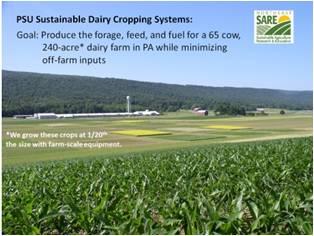
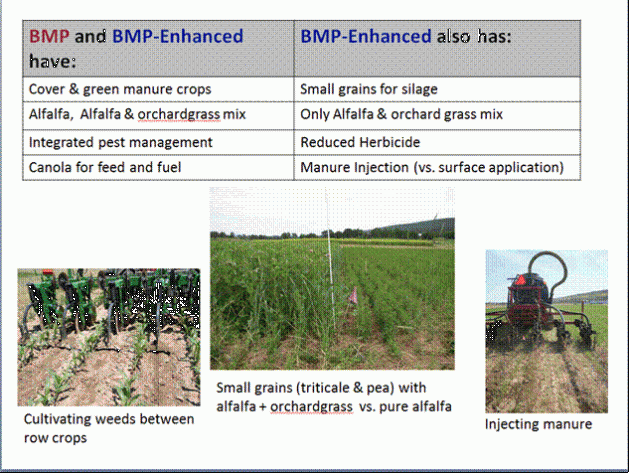
An interdisciplinary team of Penn State and USDA-ARS researchers are evaluating a Sustainable Cropping System to test the hypothesis that a dairy farm can minimize off-farm inputs and environmental impacts, and be productive, profitable and sustainable. Established in 2010 at the Penn State Agronomy Research Farm, the farm produces grain, forage and tractor fuel at 1/20th the scale of an average sized Pennsylvania dairy of 240 acres. The farm includes two diverse 6-yr crop rotations that include manure injection, perennial legumes, cover and green manure crops; a cover crop roller, winter canola, and a straight vegetable oil tractor. Within each crop rotation two management practices for no-till crop production are compared:

1. Forage Rotation compares injected manure (IM) to broadcast manure (BM); and

2. Grain Rotation compares a combination of weed management strategies designed to reduce herbicide (RH) use relative to a “standard” herbicide (SH) weed management program.

The two diverse cropping systems are designed to provide all the forage and feed for 65 lactating cows housed in a tie-stall barn, 10 dry cows and 75 young-stock. Crops are analyzed for crude protein, neutral detergent fiber, and net energy of lactation; the production of a “virtual dairy herd” is simulated using the 2001 NRC dairy nutrition model. Performance of the two farm scenarios (BMSH or IMRH) is compared. Income-over-feed costs are monitored monthly to evaluate impact of forage quality and quantity on profitability. The economic performance of the two cropping systems: BMSH vs. IMRH will be highlighted.  In 2010, the IMRH scenario had a slight trend of higher income over feed cost compared to the BMSH scenario. Related: Manure value & economics

Why Is a ‘Systems’ Approach Important for Dairies?

New agronomic management practices and technologies are often evaluated in one or two specific crops for a few growing seasons. Management practices on farms however are integrated into crop rotations, where a combination of practices can have cumulative effects on multiple aspects of the agroecosystem. This project takes an interdisciplinary approach to develop sustainable dairy cropping systems and monitor multiple indicators of systems performance. Utilizing ecological principles and innovative practices, we designed two six-year dairy crop rotations to minimize off-farm inputs and environmental impacts for a typical-sized Pennsylvania dairy farm. Within each rotation we have been comparing innovative manure or weed management strategies, as well as evaluating two green manure crops, and a tactic to sustain mycorrhizae populations in canola. The two crop rotations also compare two approaches to integrating winter canola into a dairy crop rotation.

What Did We Do?

Two cropping systems were developed to compare diverse strategies that include canola in a dairy farm rotation. The two rotations consist of 12 crop entries, each main plot being 90’ x 121’with split plots of 45’ x 121’.

Agronomy farm at Penn State University where the cropping systems are being evaluated.

The splits within the two cropping system rotations are:

Forage rotation: Corn silage/winter wheat underseeded red clover – Corn silage – canola – alfalfa (3 yr)Split plots in the forage rotation compare the use of manure shallow disk injection versus surface-applied, broadcast manure.

Grain rotation: Alfalfa (2 yr)-Canola – Rye –Soybeans/Rye -Corn grain

To reduce herbicide use, split plots evaluate a combination of mechanical and cultural weed control practices used to reduce herbicides use (banding herbicides over the crop row, inter-row cultivation, companion cropping annual with alfalfa, and one plowing event).

What Have We Learned?

By assessing the performance of the innovative practices and the dairy cropping systems from a multidisciplinary perspective, over the past three years we have gained an understanding of their performance, as well as agroecosystem interactions, benefits, and trade-offs. Overall the cropping systems and the majority of the innovative practices are providing multiple agroecosystem benefits, although a few practices need to be modified to improve their performance.

In the first three years, both of the sustainable dairy cropping systems (inject manure and reduced herbicide (IMRH) and broadcast manure and standard herbicide (BMSH)) produced almost all of the virtual dairy herd’s feeds and forage, and all of the farm’s tractor fuel needs along with some additional canola oil to sell. The economics of the virtual farm show the purchased feed costs per cow are about half of what they would be on a “typical” dairy operation.

The assumptions made for the virtual dairy farm is that it is a start-up herd with the land and buildings in place. Loans were taken out to purchase animals and to remodel the facilities. This explains why the breakeven income over feed costs is high compared to what is observed on established dairy farms in Pennsylvania. When summarizing the cash flow plans for both scenarios, the IMRH has been trending with more income per cow compared to the BMSH. Even with the high breakeven income over feed costs, the BMSH has averaged about $1.00 and IMRH about $1.85 above breakeven for 2011-2012 on average.


Future Plans

We are still simulating and analyzing the virtual dairy herd production and economic performance and plan to conduct additional advanced economic analyses over the next three years. We will continue to monitor the cropping systems, learn how to improve their performance, and share this information through scientific literature and outreach educational activities and materials.

Authors

Virginia Ishler, Dairy Complex Manager and Nutrient Management Specialist, Penn State University, vishler@psu.edu

Heather Karsten, Associate Professor of Crop Production/Ecology, Penn State University

Glenna Malcolm, Post Doctoral Researcher, Penn State University

Tim Beck, Extension Educator, Penn State University

Additional Information

Detailed information about this project as well as publications and other resources can be found at http://plantscience.psu.edu/research/areas/crop-ecology-and-management/cropping-systems

A link to our 2012 Project summary report on the NESARE website. https://projects.sare.org/sare_project/lne09-291/

Acknowledgements

Funding has been provided NESARE (Northeast Sustainable Agriculture Research and Extension) and collaboration with USDA-ARS.


The authors are solely responsible for the content of these proceedings. The technical information does not necessarily reflect the official position of the sponsoring agencies or institutions represented by planning committee members, and inclusion and distribution herein does not constitute an endorsement of views expressed by the same. Printed materials included herein are not refereed publications. Citations should appear as follows. EXAMPLE: Authors. 2013. Title of presentation. Waste to Worth: Spreading Science and Solutions. Denver, CO. April 1-5, 2013. URL of this page. Accessed on: today’s date.

Silage Runoff Treatment

Waste to Worth: Spreading science and solutions logoWaste to Worth home | More proceedings….

Abstract

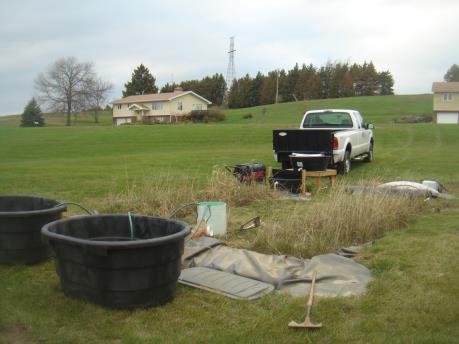
Agricultural filter strips are commonly used to treat runoff from agricultural farmstead areas.  Many filter strips have been assessed in terms of surface water quality impacts but have failed to determine the fate of pollutants once they have infiltrated the soil subsurface.  Two side-by-side filter strips plots were installed to assess the performance of and determine the fate of contaminants in a filter strip system.  One of the two plots also contained a pretreatment system to facilitate nitrogen removal in an attempt to reduce nitrate leaching.  Both plots were lined with an impermeable membrane to collect subsurface leachate as well as surface runoff.  A mass balance could then be determined for these filter strip systems to assess the fate of nutrients and the ability of a low cost pretreatment system to reduce nitrate leaching.

Filter-strip Construction

Why Is It Important to Prevent Runoff from Silage Piles from Reaching Water?

Silage runoff, or the flow of surface excess water over an area containing silage or silage leachate, contains nutrients harmful to watersheds.  A filter-strip, a long narrow buffer strip used in agriculture as a BMP, could be used to reduce nutrient concentrations within silage runoff.  A study that investigates design storm loading and seasonal operation could benefit producers and their surrounding watershed.  A pre-treatment design consisting of an aerobic and anaerobic section, is also analyzed to quantify improvements in pollutant reduction.

What Did We Do?

Before Establishment of Vegetation

Two experimental filter-strips, one control and one pre-treatment design, were applied with silage runoff at volumes and rates corresponding to a 25 year – 24 hour and a 2 year – 24 hour design storm.  Design storm rates and volumes were determined from the runoff modeled from a 1:1 dairy bunker to filter strip area.  Three runs of each design storm were accomplished throughout the months of October, November, and early December 2012.

What Have We Learned?

The pre-treatment filter strip design distributed higher BOD5 reduction however, nitrite concentrations increased in the effluent.  Application in November and December had lower infiltration and changes in ammonia reduction were illustrated. 

Experimental Filter-strip and Sampling

Future Plans

Applications in the spring  and summer will determine further seasonal variation.  Expanding design storms applied will help determine prescriptive loading and aid in modeling.

Authors

Michael Holly, Master’s Candidate Biological System Engineering, University of Wisconsin – Madison, maholly@wisc.edu

Dr. Rebecca Larson, Assistant Professor and Extension Specialist, University of Wisconsin – Madison

Acknowledgements

Zach Zopp, Lab and Field Tech

Shayne Havlovitz, Undergraduate Research Assistant


The authors are solely responsible for the content of these proceedings. The technical information does not necessarily reflect the official position of the sponsoring agencies or institutions represented by planning committee members, and inclusion and distribution herein does not constitute an endorsement of views expressed by the same. Printed materials included herein are not refereed publications. Citations should appear as follows. EXAMPLE: Authors. 2013. Title of presentation. Waste to Worth: Spreading Science and Solutions. Denver, CO. April 1-5, 2013. URL of this page. Accessed on: today’s date.
Silage Runoff Characterization

Waste to Worth: Spreading science and solutions logoWaste to Worth home | More proceedings….

Abstract

Silage leachate is a high strength waste which contributes to surface and groundwater contamination of various pollutants from runoff, direct leaching through concrete storage structures, and infiltration of runoff. Feed storage is required for the majority of dairy operations in the country (which are expanding in size and fed storage requirements) leading to widespread potential contamination. Limited data on silage leachate quality and treatment has made management and regulation based solely on observation. This project investigated three bunker silage storage sites to assess the water quality characteristics of silage leachate and runoff from various feed sources and surrounding environmental factors. Surface samples were collected from feed storage structures and analyzed for numerous water quality parameters. Using collected hydrologic data, contaminant loading was analyzed for various storm events and assessed for first flush effects and potential to impact handling and treatment designs. Determination of first flush provides essential data for separation of waste streams (high and low strength) to ease management in terms of operation and cost, reduce loading to treatment systems, and reducing the overall environmental impact.

Why Is It Important to Characterize Silage Leachate?

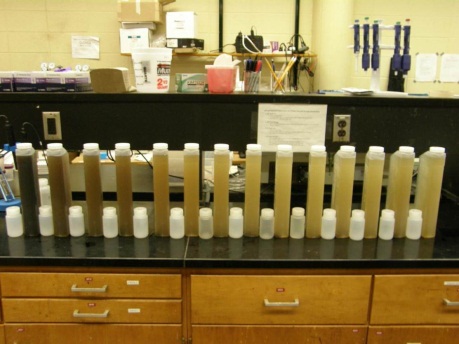
Silage Runoff Samples from an October Rain Event

Silage runoff, or the flow of surface excess water over an area containing silage or silage leachate, contains nutrients harmful to watersheds. Nutrient concentrations within silage runoff are variable and are dependent on event size, seasonality, bunker condition, and concentration of silage. Knowledge of nutrient loading thoughout a storm can benefit silage runoff storage and treatment standards.

What Did We Do?

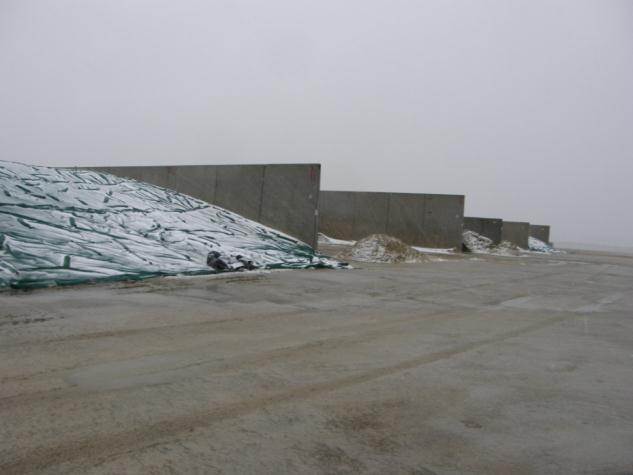
Three horizontal bunkers in south central Wisconsin were anzlyzed over the seasons of fall, spring and summer.  Two of the bunkers sampled were designed with subsurface leachate collection.  Runoff was collected using ISCO automated samplers and samples were triggered by flow rate. Water quality analysis was completed on the campus of University of Wisconsin – Madison and alkalinity, NH3, BOD5, COD, NO2, NO3, ortho-p, pH, TKN, TP and TS were analyzed. Thirty-five storms in total were analyzed ranging from 0.03 – 1.74 inches.

Horizontal Dairy Bunker During a Storm Event

What Have We Learned?

Seasonality can impact the nutrient concentrations within silage runoff.  Normalized cumulative pollution load curves illustrate moderate first flush in the fall and a moderate delayed load curve in the summer.

Future Plans

Correlating silage runoff concentrations with bunker conditions such as date, amount filled, moisture content, and amount of litter present on pad could help explain seasonal variability.  Collection of future storms could aid in explaining variances and facilitate modeling.

Authors

Michael Holly, Master’s Candidate Biological System Engineering, University of Wisconsin – Madison, maholly@wisc.edu

Dr. Rebecca Larson, Assistant Professor and Extension Specialist, University of Wisconsin – Madison

Acknowledgements

Zach Zopp, Lab and Field Tech

Shayne Havlovitz, Undergraduate Research Assistant


The authors are solely responsible for the content of these proceedings. The technical information does not necessarily reflect the official position of the sponsoring agencies or institutions represented by planning committee members, and inclusion and distribution herein does not constitute an endorsement of views expressed by the same. Printed materials included herein are not refereed publications. Citations should appear as follows. EXAMPLE: Authors. 2013. Title of presentation. Waste to Worth: Spreading Science and Solutions. Denver, CO. April 1-5, 2013. URL of this page. Accessed on: today’s date.
Feeding Cattle Without the Feedlot

Waste to Worth: Spreading science and solutions logoWaste to Worth home | More proceedings….

Abstract

Typically cattle producers can have improved animal performance through controlled systems such as an open lot feedlot.  Open lots provide for improved control of diet, health, and monitoring of activity of the animals.  Feeding areas such as these also can have disadvantages such as solid manure accumulation,  surface water contamination when runoff water is uncontrolled, such systems are labor and machine intensive, and can contribute herd health issues because of high stocking densities, dust, or mud.  Forage based grazing can negate many of these issues and is arguably more sustainable and environmentally friendly.  However intensive grazing strategies must be employed to obtain comparable productivity.  Development of technology that allows for these benefits is needed.  Cross fencing and rotational grazing practices would benefit from more flexible and less labor intensive ways of controlling the grazing area.

Figure 1. Calves waiting for new windrows of oats.

A device has been developed by UNL Extension that adapts a center pivot irrigation system into a moveable fence by placing the fence on the center pivot structure. Livestock producers can move anywhere from several hundred to several thousand feet of fence by simply moving the center pivot (while not irrigating).  Swath grazing, forage grazing, or crop residue grazing can be accomplished more efficiently by only allowing minimal access to the forage.  Essentially moving the animals to the feed rather than bringing the feed to the animals.  Advancing a cross fence periodically not improves the grazing efficiency, but it encourages a natural spread of manure and gives the producer more control of remaining crop residue, a necessary requirement to maintain pasture status and avoid the Animal Feeding Operation designation.  The device was tested on working farms over a two year period and improved profitability and minimized environmental impact compared to the operator’s previous practices.

Can Intensive Forage Grazing Be Profitable?

The project started from a request for some alternatives to help reduce the cost of gain for feeder calves in 2010.  Eliminating the forage activities of baling / stacking, transporting, grinding, feeding and also the spreading of manure can significantly reduce labor and equipment expenses.    Keeping feeder calves in a grazing operation instead of concentrated feeding operation has the potential to minimize surface water contamination.  The health and welfare of the calf can be improved by having a lower stock density, larger area for exercise, and with crop residue a reduced impact of dusty or muddy conditions.  Forage based grazing is arguably more sustainable and environmentally friendly than concentrated feeding areas.  However intensive grazing strategies must be employed to obtain comparable productivity.  Development of technology that allows for these benefits is necessary.  Cross fencing and rotational grazing practices would benefit from more flexible and less labor intensive ways of controlling the grazing area.

Figure 2. Calves grazing standing oats.

What Did We Do?

The project was focused for fall / winter grazing opportunities for newly weaned spring born calves of the semi-arid region of western Nebraska.  A successful grazing operation of windrowed or standing forage will have to include a method of controlling daily forage intake through cross fencing( Figures 1 & 2).  This would reduce waste and give the producer a feedlot like control of dry matter intake so a desired daily gain could be achieved.  Current portable fencing has to be manually installed and moved which is labor intensive especially in frozen soils.  A new development in portable fencing was developed by UNL Biological Systems Engineering that a device attaches to a center pivot and properly suspends an electrified wire under tension.  This gives the producer a portable cross fence (1,300 ft) that can be moved by the center pivot’s control panel or wirelessly with a computer.

In the fall of 2011 and 2012, four grazing programs were developed to demonstrate this new cross fence.  Two were fall planted oats and two were grazed corn stalk residues.  The fall oats were grazed as a standing forage and also as a windrow.  The corn stalk residue was grazed in a manner to minimize the overgrazing of downed corn ears and reduce the protein supplement.

What Have We Learned?

The projects demonstrated that calves can be successfully maintained in theses grazing systems.   The management and the relocations of the cross fence was done easily done though the center pivot’s control panel (average time of 15 minutes).  The

Figure 3. Natural manure distribution.

forage quality of the windrowed oats maintained its quality throughout the 105 (fall 2011) and the 120 (fall 2012) day grazing period.  In 2011 the oat forage deteriorated only 17% in crude protein and 14% in total digestible nutrients.  In 2012 the oat forage deteriorated only 2% in crude protein and 3% in total digestible nutrients.  Cost savings in the fall oat grazing are reported at$7,268.85 total or $28.70 / ton grazed ($22.16 per head) for 105 days in the 2011 trial.  In the 2012 trial the savings were a total of $4,625.60 or $29.50 / ton ($25.70 per head) for a 120 day trial.  The cost savings for the corn stalk residue weren’t measured.  The project only demonstrated the control of grain intake in the calves or cow, which it accomplished.  The manure was naturally spread throughout the fields and the cattle health and welfare was maintained (Figure 3).

Future Plans

A future plan is being developed to continue to demonstrate the ability to control dietary intake of calves or cows on irrigated forages.  With a portable and mechanically moveable cross fence the conveniences of a concentrated feeding operation can be placed into a grazing operation in large scale.

Authors

Jason Gross, Engineering Tech, UNL Extension, jgross3@unl.edu

Additional Information

http://water.unl.edu/web/manure/small-afos

The authors are solely responsible for the content of these proceedings. The technical information does not necessarily reflect the official position of the sponsoring agencies or institutions represented by planning committee members, and inclusion and distribution herein does not constitute an endorsement of views expressed by the same. Printed materials included herein are not refereed publications. Citations should appear as follows. EXAMPLE: Authors. 2013. Title of presentation. Waste to Worth: Spreading Science and Solutions. Denver, CO. April 1-5, 2013. URL of this page. Accessed on: today’s date.
Youth Ag Greenhouse Gas Educational Lab Materials Via Pork Production Scenarios

Waste to Worth: Spreading science and solutions logoWaste to Worth home | More proceedings….

Abstract

Many of today’s high school students have little insight into the basic day-to-day operational decisions and challenges faced by Agricultural producers. Therefore, there is a need for the development of ag-centric and dynamic educational material. Furthermore; there is an even greater need to provide high-school instructors with innovative classroom materials and instructional tools that are conducive to the structured conveyance of ag principles. Targeting the need for these innovative ag educational materials within Arkansas classrooms, this project presents an dynamic lab activity with emphasis on introductory level subject matter about Arkansas swine production systems and the related greenhouse gas emissions. Due to the particular nature of the subject matter, the activity materials were crafted into two complementary products for practicality. The first product is a compilation of swine production reference materials including: terminology and layman definitions of Arkansas swine management strategies and the basic dynamics of greenhouse gasses (CO2, N2O, CH4) as they relate to swine production. The second product is a scenario based critical thinking exercise, implemented from a manipulative decision-tree platform.

Purpose

  1. Educate students within the state of Arkansas about the various management systems intrinsic to swine production operations within their state.
  2. Provide students insight into the management obstacles that Arkansas swine producers are challenged with through balancing Carbon footprints, economic resources, natural resources, and legal compliance with production profitability and productivity

What Did We Do?

This project presents an dynamic lab activity with emphasis on introductory level subject matter about Arkansas swine production systems and the related greenhouse gas emissions. The activity materials were crafted into two complementary products for practicality. The first product is a compilation of swine production reference materials including: terminology and layman definitions of Arkansas swine management strategies and the basic dynamics of common greenhouse gasses (CO2, N2O, CH4) as they relate to this activities scope of swine production. The reference material serves as both an introduction to basic ideas and practices native to swine production and GHGs, and as a guide which aids the students in completion of the second product (lab activity).

The second product is a scenario based critical thinking exercise, implemented from a manipulative decision-tree platform. Flashcards are used to represent three specific swine management systems using a three tier hierarchy. This hierarchy is distinguished by the allocation of Categories, Components, and Options. The “Categories” are the designated ranking class and will represent three major swine production management systems: Housing Management, Waste Management, and Feed Management. The “Components’ are the first sub-order class, and are used to represent various functions/considerations that comprise each “Category” of production system. The “Options” class holds the lowest position within the hierarchy and represents the different configurations/settings for the individual “Components”. For the context of this exercise the students will act as consultants hired by a producer to design the three management systems (via the flashcards) to “best match” the producer’s desired specifications, as defined within by a supplied catalog of unique scenarios.

Graphical reference to the hierarchical structure of the manipulatives used within this project’s lab activity.

Future Plans

Implementation of this project’s developed lab-activity within Arkansas’ high school classrooms via the Arkansas Farm Bureau supported (Ag-In-the-Classroom) program.

Authors

Szymanski “Rick” Fields II, Program Associate, Biological and Agricultural Engineering, University of Arkansas Division of Agriculture Extension rfields@uaex.edu

Karl VanDevender, Professor-Engineer, Biological and Agricultural Engineering, University of Arkansas Division of Agriculture Extension

Additional Information

http://www.extension.org/pages/65635/integrated-resource-management-tool-to-mitigate-the-carbon-footprint-of-swine-produced-in-the-united

Acknowledgements

This is a NIFA funded project (Proposal # 2010-04269; Title of Proposal “Integrated Resource Management Tool to Mitigate the Carbon Footprint of Swine Produced in the U.S”)

Special thanks to Donna VanDevender (High School Science Teacher-Bauxite Arkansas) for her insight into the development of the materials and for providing the opportunity to conduct trial runs of the lab-activity.

The authors are solely responsible for the content of these proceedings. The technical information does not necessarily reflect the official position of the sponsoring agencies or institutions represented by planning committee members, and inclusion and distribution herein does not constitute an endorsement of views expressed by the same. Printed materials included herein are not refereed publications. Citations should appear as follows. EXAMPLE: Authors. 2013. Title of presentation. Waste to Worth: Spreading Science and Solutions. Denver, CO. April 1-5, 2013. URL of this page. Accessed on: today’s date.

Natural Resource Conservation Service (NRCS) Manure Related Conservation Innovation Grants (CIG)

Waste to Worth: Spreading science and solutions logoWaste to Worth home | More proceedings….

Abstract

A number of the manure related Conservation Innovation Grants (CIG) have been successful.  Several feed management related projects have been major successes under the CIG program.  Other successful projects have dealt with such technologies as anaerobic digesters; community digesters; environmental credit trading; lagoon management; manure to energy generation; alternative litter sources, storage, and handling; and pathogen, odor, and emissions mitigation, to name just a few. 

The presentation will provide specific numbers of projects and funding per year, and information about actual projects that NRCS considers to have been successful. 

What Is the Purpose of the CIG Grant Program?

Glenn Carpenter came to Natural Resources Conservation Service as a Senior Economist in December of 2001 with the Animal Husbandry and Clean Water Division.  In May, 2004 he became the agency’s National Leader for Animal Husbandry, with that Division.  In 2010 his position was moved to the Ecological Sciences Division.  Much of his work with NRCS has been related to the animal waste issue and the agency’s interaction with EPA over the CAFO Rule. 

Glenn has three degrees in Poultry Science from Michigan State University.  Prior to joining NRCS, Glenn served in Extension Poultry positions at two universities.

The 2002 Farm Bill created a mechanism under the Environmental Quality Incentives Program (EQIP) for a program of Conservation Innovation Grants (CIG).  These grants were “…intended to stimulate innovative approaches to leveraging Federal investment in environmental enhancement and protection, in conjunction with agricultural production…”  The grants were to provide a mechanism for funding projects to aid in technology development and transfer.    The granting program actually began in 2004, and has continued since that time.

What Did We Do?

By statute, the USDA Natural Resources Conservation Service cannot do research.  Because of this, and because the interest of NRCS lies in directly assisting farmers and ranchers in the adoption of technologies that will benefit conservation, projects funded under this program must be in the field demonstration or tool application stages.  Since the initial grant funding cycle in 2004, NRCS has provided funding through EQIP every year.  To date nearly 500 grants have been awarded, with total funding in excess of $180 million. 

A large share of these CIGs has been strongly animal, and/or manure related.  Almost 25 percent of the total number of grants has been animal related, and these grants have received slightly over 26 percent of the total dollars.  About 19 percent of the total grants have been manure related and these have received about 22 percent of the funding.  Those animal related grants that are not manure related largely deal with range and pasture systems.

What Have We Learned?

Several feed management related projects have been major successes under the CIG program.  Other successful projects have dealt with such technologies as anaerobic digesters; community digesters; environmental credit trading; lagoon management; manure-to-energy generation; alternative litter sources, litter storage, and handling; and pathogen, odor, and emissions mitigation from manure, to name just a few. 

The number and variety of funded projects has covered a wide range of geographic areas and technical  innovations.  A multistate feed management project resulted in training programs, a tech note for NRCS, and many fact sheets and other materials that are available on Livestock and Poultry Environmental Learning Center webpage.   Another major grant demonstrated the effectiveness of filter strips and other vegetated treatment areas on mitigating manure runoff from cattle feedlots.  Utilizing high pressure injection of manure, a Pennsylvania project demonstrated a decrease in odor and runoff while also preserving nitrogen.  Several projects have successfully demonstrated the effects of precision feeding of dairy cattle to show the change in manure nutrients.  Projects have demonstrated the effectiveness of different tillage systems and technologies on manure nutrient runoff.  Other projects have dealt with innovative waste-to-energy technologies, or waste to value-added-product creation.   These are just a few of the number and variety of projects funded  through the Conservation Innovation Grants program.

Future Plans

The success of the CIG program since 2004, both in numbers of projects and in innovative technologies and tools applied, demonstrates that the program is important to agriculture in the U.S.  NRCS has shown its support by continually funding the program, and by making additional moneys available for special targeted CIGinitiatives.

Authors

Glenn H. Carpenter, National Leader, Animal Husbandry, USDA Natural Resources Conservation Service glenn.carpenter@wdc.usda.gov

Gregorio Cruz, CIG Program Manager, NRCS, Rosslyn, VA;  William Reck, Environmental Engineer,  NRCS, Greensboro, NC;  Jeffrey Porter, Environmental Engineer, NRCS, Greensboro, NC; Cherie Lafleur, Environmental Engineer, NRCS, Ft Worth, TX; Sally Bredeweg, Environmental Engineer, NRCS, Portland, OR; Harbans Lal, Environmenal Engineer, NRCS, Portland, OR; Greg Zwicke, Environmenatl Engineer, NRCS, Ft Collins, CO

Additional Information

NRCS Conservation Innovation Grant webpage at:  http://www.nrcs.usda.gov/wps/portal/nrcs/main/national/programs/financial/cig/

Acknowledgements

United States Department of Agriculture, Natural Resources Conservation Service, Conservation Innovation Grants Program

The authors are solely responsible for the content of these proceedings. The technical information does not necessarily reflect the official position of the sponsoring agencies or institutions represented by planning committee members, and inclusion and distribution herein does not constitute an endorsement of views expressed by the same. Printed materials included herein are not refereed publications. Citations should appear as follows. EXAMPLE: Authors. 2013. Title of presentation. Waste to Worth: Spreading Science and Solutions. Denver, CO. April 1-5, 2013. URL of this page. Accessed on: today’s date.
 

Improving Methane Yields from Manure Solids through Pretreatment

Waste to Worth: Spreading science and solutions logoWaste to Worth home | More proceedings….

Abstract

This paper presents a description of the ABFX (Ammonium Bicarbonate Fiber Explosion) pretreatment process. The ABFX process is an extremely simple and inexpensive process that possesses the attributes of the Ammonia Fiber Explosion Process (AFEX) and CO2 explosion process while eliminating the cost associated with high temperature, high pressure and ammonia recovery. The process uses ammonia bicarbonate (ABC) recovered from anaerobic digestate to pretreat the substrate. The ABC is simply added to the substrate, pumped to a reactor, heated to temperatures less than 100°C, for a short duration. The pressure created by ABC volatilization is then released and the gases (CO2, NH3, H2O) condensed at ambient temperature to produce ABC that is then reused in the process. The process can operate with low temperature waste heat.

This paper presents a description of the process and the results of a National Science Foundation Small Business Innovative Research investigation that compared the methane gas yields from both pretreated and untreated grass silage and pretreated and untreated screened (screw press) dairy manure solids. The ABFX pretreated manure solids produced 38% more methane gas than the untreated while the ABFX pretreated grass silage produced 14% more methane gas than the untreated. The economic benefits of the process will be discussed.

Is There Potential to Improve Methane Yields from Manure?

A large fraction of municipal solid waste (MSW), crop residues, animal manures, forest residues, or dedicated energy crops are composed of lignocellulouse. Lignocellulosic substrates consist of a tightly woven matrix of cellulose, hemicellulose, and lignin polymers. Biological degradation of these polymers are carried out by a variety of enzymes. Pretreatment can enhance the bioconversion of the wastes or cop residues for ethanol or biogas production by increasing the accessibility of the enzymes to the substrate. Thus, pretreatment can increase the energy yield (biogas or ethanol) while decreasing the residual waste to be disposed.

Anaerobic bacteria easily convert the hemicellulose and amorphous cellulose to gas. However, conversion of the crystalline cellulose and lignin is far more difficult. Lignin is not converted to gas by anaerobic organisms. Only a fraction of the crystalline cellulose is converted to gas within the detention times commonly used (20 days) in anaerobic digestion. Pretreatment is required to rupture the crystalline cellulose for enzymatic hydrolysis. A wide variety of pretreatment technologies have been developed. Dilute acid pretreatment solubilizes the hemicellulose. Alkali, lime or sodium hydroxide pretreatment solubilize the lignin thus exposing the hemicellulose and cellulose for enzymatic attack. A variety of explosion processes such as steam, carbon dioxide, and liquid ammonia (AFEX) have also been developed that disrupt the crystalline cellulose and hemicellulose. Ammonia soaking, over prolonged periods of time, has also been used to pretreat straw for animal feed and thereby improve rumen digestibility and animal weight gain. All of the processes use high pressure and temperature, or toxic chemicals. The commonly used, conventional processes are not suitable for on-farm use.

What Did We Do?

Figure 1: ABFX Process

We substantiated the feasibility of a breakthrough pretreatment technology under a National Science Foundation Small Business Innovative Research (SBIR) grant that used the non-toxic Ammonium Bicarbonate (ABC) recovered from the anaerobic digestate. The pretreatment was accomplished with a simple device, shown in Figure 4, composed of a pump, that pumps the solid biomass substrate, mixed with a small amount of ABC, into a reactor. The reactor is closed and heated to temperatures below the boiling point of water. Once heated the ABC breaks down to its water, ammonia, and carbon dioxide components putting the contents under significant pressure. The pressure is then rapidly released causing the explosion or disruption of the lignocellulosic substrate and the breakdown of the crystalline cellulose. The gases (H2O, NH3, and CO2), are then condensed in a separate chamber to produce ABC that is reused in the next cycle. Nothing is wasted. The ABC is recovered and reused. The applied heat and detention time provided is sufficient to pasteurize the biomass and meet the temperature requirements of the downstream anaerobic reactor. It is a simple process composed of a solids pump, heat pump, and two low detention time (10± minutes) reactors.

The SBIR research consisted of pretreating both grass silage and concentrated, screw press, manure solids and digesting both pretreated and untreated silage and manure solids. The pretreated and untreated solids were digested in 10 reactors at a 12.5 day HRT and 35°C.

What Have We Learned?

Pretreatment of the grass silage increased the methane yield 16% over several months of operation. Pretreatment increased the methane yield from the pretreated manure solids by 35% over the same period. The increased gas yield was approximately equal to the methane yield from the crystalline cellulose present in the substrate that is normally not converted to gas. The research demonstrated the feasibility of pretreating lignocellulosic substrates in a simple, short detention time, low temperature process that does not dilute the substrate stream or use toxic chemicals such as liquid or gaseous ammonia, acids, or caustic.

Future Plans

The current plan is to build a prototype facility to pretreat a variety of crop residuals (corn stover, rice straw, wheat straw), dry feedlot manure and poultry litter.

Author

Dennis A. Burke, CEO, Environmental Energy & Engineering Company engineer@makingenergy.com

Additional Information

www.makingenergy.com


The authors are solely responsible for the content of these proceedings. The technical information does not necessarily reflect the official position of the sponsoring agencies or institutions represented by planning committee members, and inclusion and distribution herein does not constitute an endorsement of views expressed by the same. Printed materials included herein are not refereed publications. Citations should appear as follows. EXAMPLE: Authors. 2013. Title of presentation. Waste to Worth: Spreading Science and Solutions. Denver, CO. April 1-5, 2013. URL of this page. Accessed on: today’s date.