Liquid Manure Treatment Lagoons

There are many options for the handling and storage of liquid manure. This page describes and differentiates some of the most common systems.

Anaerobic Treatment Lagoons Compared to Aerobic Lagoons and Storage Ponds

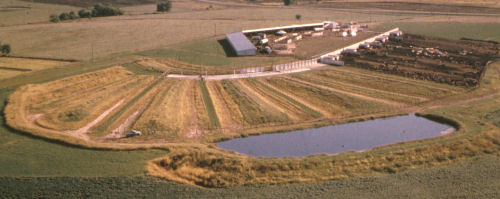
Most agricultural treatment lagoons are anaerobic lagoons. Anaerobic lagoons are earthen structures, which look at first glance like farm ponds. These lagoons are designed to provide biological treatment and long term storage of animal waste. Anaerobic lagoons are larger than manure storage basins, which do not provide significant biological treatment or long storage periods, but smaller than aerobic lagoons. Even though aerobic lagoons are designed to provide a higher degree of treatment with fewer odors, anaerobic lagoons decompose more organic matter per unit volume. Because of their treatment and storage capabilities anaerobic lagoons are a good compromise between storage basins and aerobic lagoons.

Anaerobic treatment of waste occurs without free oxygen to liquefy or degrade high BOD (biochemical oxygen demand) organic waste. With proper design and management the anaerobic lagoon can function for years. Odor from a well-designed and well-managed lagoon will be only slightly musty; foul odor indicates a malfunction requiring corrective action.

Advantages of Anaerobic Lagoons

Advantages of anaerobic lagoon systems are: manure can be handled with water flushing systems, sewer lines, pumps, and irrigation equipment; the high degree of stabilization reduces odors during land application; high nitrogen reduction minimizes the land area required for liquid effluent disposal, and long-term storage is provided at low cost.

Disadvantages of Anaerobic Lagoons

Disadvantages of anaerobic lagoons include: public perception that a lagoon is an open container of manure; offensive odors if improperly designed and maintained, and limited nitrogen availability if manure is used as a fertilizer. Lagoon design is based on the manure volume produced by the animals, plus any wash down water or wasted feed. An impoundment outside in the weather must also have space for runoff which may enter the impoundment, and rainfall less evaporation, that will occur over the storage area. Additional space for a 25-year 24-hour rainfall event and required freeboard is also necessary. Lagoons must have volume for all of the above plus the minimum pool or treatment volume to allow biological degradation, and in some cases, volume for sludge accumulation.
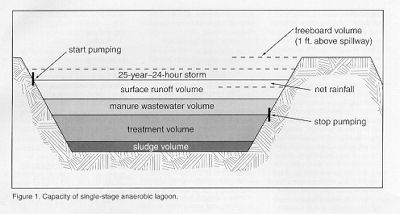


Figure 1. Single stage lagoon capacity Figure 2. Two-stage lagoon capacity

Contributed to eXtension CC2.5


Although emergency spillways as shown in the accompanying figures have the purpose of protecting embankments from overtopping and washing away during emergency weather situations (hurricanes, etc.), some states (i.e., Arkansas, at this writing) do not include these structures in lagoon and storage pond design requirements to save on construction costs.

Lagoons have been used extensively to treat swine manure and store wastewater prior to land application using normal irrigation equipment, Lagoon Design and Management for Livestock Waste Treatment and Storage.
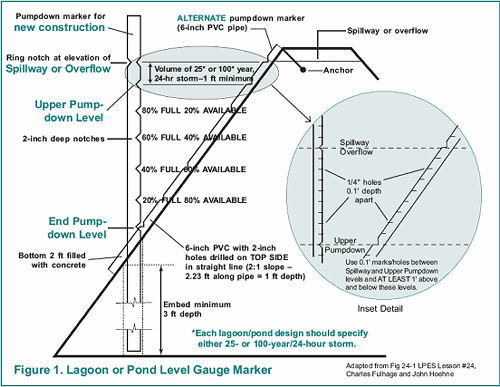
 

Lagoon level gauge marker.jpg


Recommended Educational Resources

Research Summaries

National Center for Manure and Animal Waste Management white paper summary, “Manure Management Strategies” published by North Carolina State University. A two page Executive Summary is available. The full white paper can be ordered from MWPS, Iowa State University.

Page Managers: Ted Tyson, Auburn University, tysontw@auburn.edu and Saqib Mukhtar, Texas A&M University, mukhtar@tamu.edu .

Slurry Manure Collection and Handling Systems

Slurry manure is typically generated in systems where little or no bedding is added to the excreted manure/urine. Slurry manure is typically between 5% and 15% solids. It is “thicker” than liquid manure, but cannot be stacked or handled the same way as solid manure. Some common system for handling and storage of slurry manure are described in this article.

Collecting Slurry Manure

Slotted Floor

The simplest manure collection arrangement for slurry manure is the slotted or perforated floor over a manure collection tank. In this scenario excreted manure simply falls through openings in the floor on which the animals stand and collects in a tank below.

Slotted floors above a manure tank are a simple means of collecting slurry manure.

Scrapers

Slurry manure can also be collected using scrapers. In this case the manure is usually confined in an alley (dairy freestall barn) or gutter under slats (swine confinement building). A scraper moves along the length of the alley or gutter and deposits the slurry manure in a reception pit or tank at the end.

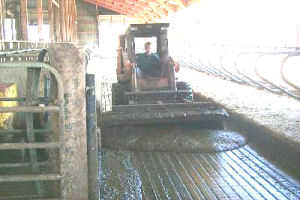
Mechanical or tractor-mounted tire scrapers can be used to collect slurry manure in a dairy freestall barn.

no description no description

Vacuum

Another type of slurry manure collection device utilizes a vacuum to “suck” slurry manure from a concrete surface and deposit it into a tank. This approach eliminates the need to pump the slurry manure into a tank or wagon.

Labor is reduced when a suction or vacuum is used to collect slurry manure from a concrete alley.

Slurry Pumps

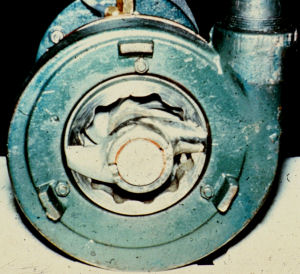
Slurry manure has fluid properties that allow it to be moved by pumps that are specially designed to handle thick fluids containing solids and stringy material. Slurry manure pumps are designed with open-type impellers and usually have cutting or chopping devices at the inlet to the impeller to minimize plugging problems. Low-pressure/high volume slurry pumps are used to fill tankwagons and move manure in other applications where higher pressures are not required. High-pressure slurry pumps are used to move manure through long pipelines and provide the needed pressure for land application in crop fields.

Slurry pumps have open impellers and cutter/chopper blades designed to handle manure with high solids content.

Low-pressure/high volume slurry manure pumps are used to quickly fill manure tankwagons.

High pressure slurry manure pumps can move manure long distances through pipelines to field application equipment.

Transporting Slurry Manure

Tankwagons

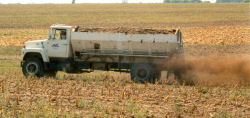
Tankwagons can be used to transport or move slurry manure from one point to another, usually from a manure storage facility to a crop field. Tankwagons are available in a variety of sizes from small (1,000 gallons) to quite large (12,000 gallons). Tankwagons typically serve the dual function of transporting slurry manure to a crop field and spreading or injecting the manure into the soil for crop nutrient uptake.

Large tankwagons allow producers to empty manure storage facilities quickly with less labor.

Pipelines

Since slurry manure has fluid properties it can be pumped through pipelines from storage to crop field as an alternative to hauling with a tankwagon. Pumping is a “continuous flow” process whereas hauling is necessarily a “batch” process. Hence pumping can offer significant advantages over hauling in moving large amounts of manure in shorter lengths of time. Tankwagons are generally used to move manure over longer distances although pipelines have been used for distances up to five miles.

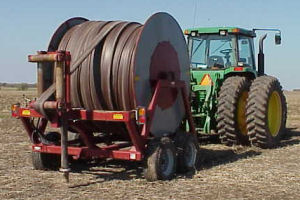
Rigid aluminum irrigation pipe has been used for pumping slurry manure in the past. However the labor advantages of using flexible “layflat” tubing for pumping make this type of pipeline more attractive in many cases. Long lengths of this tubing can be stored on reels and placed overland with much less labor than is required with rigid tubing.

Flexible hose or tubing requires less labor for a manure pipeline than rigid pipe.

Slurry Manure Land Application

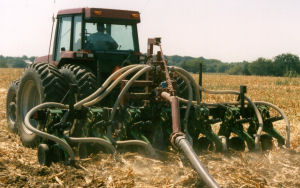
Field or land application of slurry manure requires that the application devices place the manure in the proper location and at the proper rate for good nutrient management practices. Devices which inject or incorporate manure into the soil are generally preferred since the following advantages are associated with this practice.

  1. Odor is reduced
  2. More nutrients are retained
  3. Runoff potential is reduced

Injection units place manure into the soil to reduce odor, conserve nutrients and minimize runoff.

Some injection units are designed for sod with minimal surface disturbance.

Authors: Charles Fulhage and Joe Harner

Photos: CC 2.5 Charles Fulhage or Joe Harner

Solid Manure Collection and Handling Systems

Solid manure is typically generated in systems where bedding is added to manure to absorb moisture and enhance environmental conditions in the production area. Solid manure can also result from drying conditions such as occur on the surface of a beef feedlot. Solid manure storage and handling is typically more forthright than liquid or slurry manure systems.

Solid Manure Collection

Solid manure is usually collected using scrapers, box scrapers, blades, front-end or skid-steer loaders or similar devices. Equipment sizes range from small blades suitable for tractors of 50 hp or less to large bucket loaders mounted on dedicated power units for operations generating large volumes of manure.

Solid Manure Handling

Solid manure is typically handled, transferred or transported in box-type vehicles (truck-mounted or pull-type) equipped with drag or apron chains to unload the material. Additionally, some type of fragmentation devices such as beaters, spinner plates or flails are usually employed at the unloading point to chop and spread the manure as it discharges from the vehicle. In some cases, large piston pumps or paddle-type barn cleaners are used to transfer solid manure from a production area to a manure storage area.

For more information, visit the Solid Manure Application Equipment page.

Authors: Charles Fulhage, University of Missouri and Joe Harner, Kansas State University


Poultry litter contains bedding to create manure mixture with as much as 50% solids.


Solid manure handling equipment should have heavy-duty characteristics and be able to operate in corrosive environments.


Box-type manure spreaders (left) with flails or beaters can handle manure containing large amounts of bedding.
Trucks spreading poultry litter (right) are equipped with spinner plates to spread the manure in a wide swath.


no description no description


Images CC 2.5 Charles Fulhage or Joe Harner

Solid Manure Application Equipment

Livestock and Poultry Environmental Learning Center:

Home Page

All articles about:

Handling, Storage & Mortalities

How is solid manure applied to cropland?

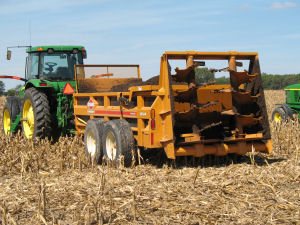
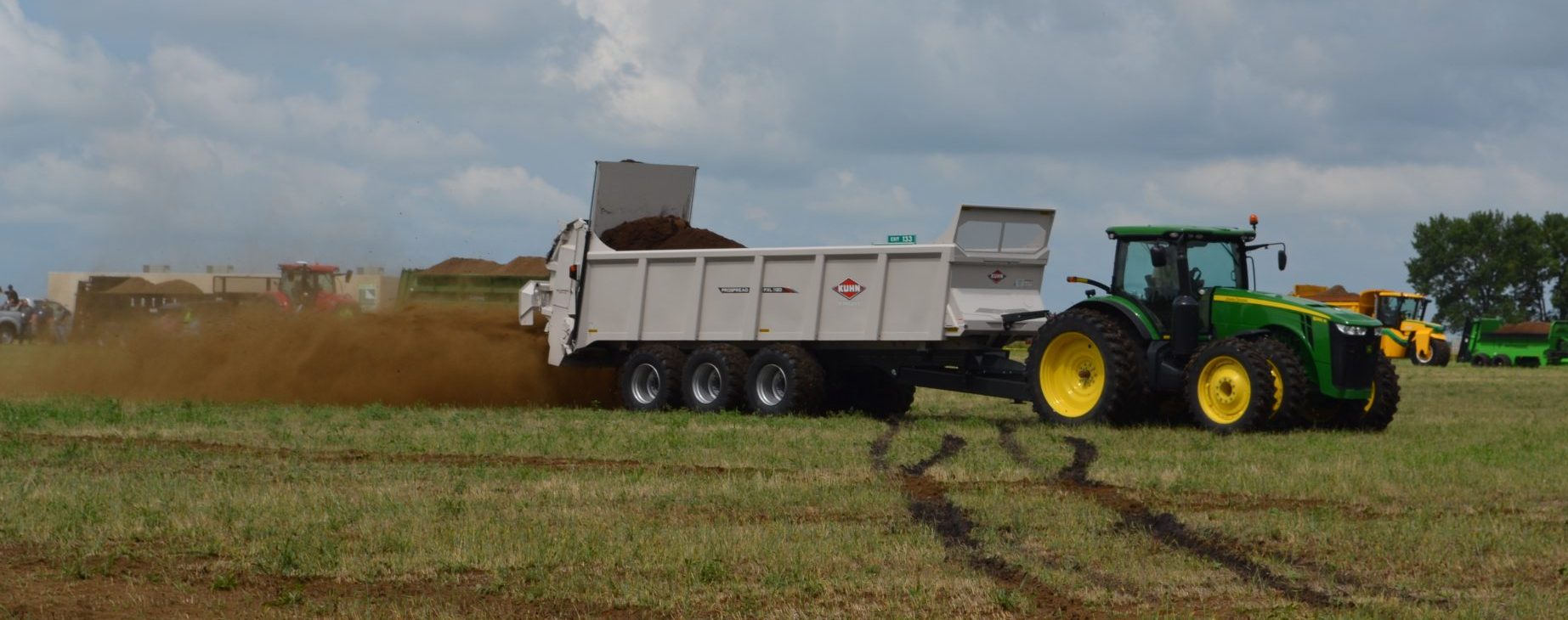
The most common equipment for applying solids to the land is a rear-discharge, box-type spreader equipped with beaters that broadcast the manure over a width of several feet (see Image 1).

Usually, the manure is conveyed to the beaters at the rear by slats attached at each end to a sprocket-driven chain. Some use a powered front end-gate to push the material to the beaters at the rear. To handle semisolid manure, a tight-fitting, closable rear end-gate is required.

Some spreaders have a side discharge; most of these have V-shaped hoppers and feed the material to the discharge with augers. A rotating expeller slings the material out of the discharge port. The application rate is varied by an adjustable gate opening, usually operated by a hydraulic cylinder.

Flail-type spreaders have a semicircular hopper bottom and a rotating shaft with chain-suspended hammers to fling the material from the hopper. The flail-type and the side-discharge spreaders are adapted to both semisolid and solid manure.

Image 1: Broadcasting manure on cropland.

Manure spreaders may be tractor-drawn models or they may be mounted on a truck. Most tractor-drawn spreaders are PTO operated, but some are driven from the ground wheels. Some are hydraulically powered for greater speed variation, especially for the apron drive, to vary the application rate. In the past, spreader capacities varied from about 30 to 400 cubic feet with tractor horsepower requirements ranging from 10 to more than 120.

Recommended Reading About Land application of Manure

Land Application Equipment for Livestock and Poultry Manure Management

Authors: Jon Rausch, Ohio State University and Ted Tyson, Auburn University.

Role of Solid Liquid Separation in Manure Storage

There are benefits for manure storage systems in separating manure into solid and liquid components. Solid-liquid manure separation is also a desirable first step in many systems used for manure treatment (composting, anaerobic digestion, etc.)

Solids Accumulation

Waste solids, particularly those from dairy freestall housing bedding, can accumulate quickly in waste storage ponds. Solids accumulation requires longer, more thorough agitation at pump out time to re-suspend settled solids and special manure solids handling “chopper” pumps for transfer to tanker wagons or waste slurry irrigation systems.

Solids can cause pumping problems, and over time can greatly reduce usable storage pond volume. Serious consideration is usually given to the installation of solids separation equipment between animal housing, particularly dairy freestall barns, and the waste storage pond.

Mechanical separators are typically either rotating or stationary screens and generally remove 20 to 30 percent of the waste solids. These separators require little attention although operation in freezing weather requires special considerations. They produce manure solids that may be easily recycled as bedding or land applied off-farm with solid manure spreaders.

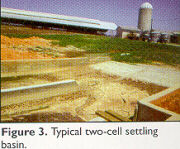
vibrating screen separator conveyor inclined screen separator typical two-cell settling basin

Settling Basins

Properly designed gravity settling basins can remove up to 50 percent of the waste solids but need enough elevation between the barn collection channel bottom and the maximum storage pond liquid surface height for installation of the settling basin and associated minimum 1% slope gravity in/out transfer lines. Gravity settling basins require periodic cleaning out with a tractor front end loader and work best when at least two are constructed side by side to allow alternating use and some manure solids drying out before cleaning.

Separated solids can be handled by conventional manure solids handling equipment. These nutrient-rich solids can be spread on distant fields and pastures as fertilizer and soil amendments, or sold for horticultural uses, with or without composting. Removing solids that retain their nutrients can help reduce nutrient loading on nearby fields, which are often irrigated from storage ponds or lagoons during the periodic pump outs required for proper management.

Related Web Pages

Page Managers: Ted Tyson, Auburn University, tysontw@auburn.edu and Saqib Mukhtar, Texas A&M University, mukhtar@tamu.edu .
Liquid Manure Collection and Handling Systems

Handling and storage of liquid manure requires planning and consideration of the best fit for the entire system. Below are some descriptions of common liquid manure systems.

Systems Which Produce Liquid Manure

Liquid manure containing 5 percent solids or less generally results from the addition of washwater or rainwater to manure. Examples of liquid manure sources include lagoons, holding ponds and dairy parlor washwater.

Flush Systems

A typical example of a collection system resulting in liquid manure is the flush removal of manure from a dairy freestall barn. In this scenario dilute lagoon wastewater is pumped into flush tanks which in turn release the water into freestall alleys to wash the manure to the lagoon.

Flush water released into dairy freestall alleys dilutes manure and washes it to the lagoon.

Open Lots

Another form of dilute or liquid manure is runoff from lot surfaces. In these cases, most of the manure solids remain on the lot, or are removed by solids separation devices prior to a lagoon or holding pond that receives the runoff. The runoff then contains primarily fine suspended or dissolved solids that result in dilute liquid in the receiving basin.

Runoff holding ponds for beef feedlots typically contain dilute wastewater with less than 5% solids.

Equipment for Liquid Manure Handling

Liquid manure (less than 5% solids) is less difficult to handle hydraulically with pumps and pipes than the thicker slurry-type manure. Equipment designed to handle irrigation water is often suitable for handling the dilute wastewater found in liquid manure systems. However, operators often elect to use the same pumping and handling equipment for liquid manure as for slurry manure. This practice provides for the possible need to handle manure that may be occasionally thicker than anticipated and reduces the likelihood of plugging.

Irrigation

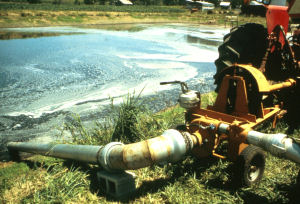
Conventional irrigation equipment may be suitable for handling dilute manure from certain lagoons or runoff holding ponds when the likelihood of encountering solids at problem levels is remote. In these cases, pumps designed for irrigation (typically more efficient than slurry manure pumps) will usually be acceptable for handling the wastewater.

Conventional irrigation pumps can handle manure wastewater with limited solids content.

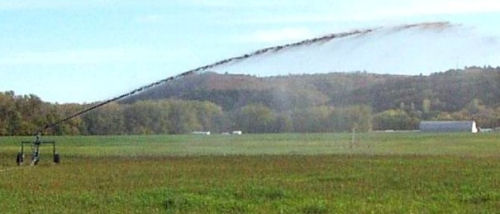
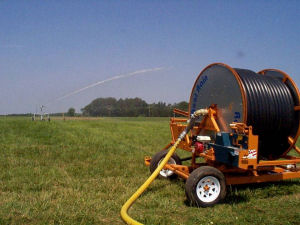
Conventional irrigation application equipment can also be used to land apply dilute manure wastewater if solids levels are low enough to preclude plugging nozzles and orifices. Traveling guns have been used for many years for surface application of effluent from lagoons and runoff holding ponds. Traveling guns are applicable to small and irregular fields and thus find acceptance in areas where crop fields may be limited in size by terrain, timber or property boundaries. Center pivot systems are also able to handle dilute wastewater and are applicable where fields tend to be larger and reduced labor for land application is desired.

This traveling gun applies dilute manure wastewater to a growing crop as it travels across the field.

Center pivot irrigators can apply dilute manure wastewater with low labor input.

For additional information, see Liquid Manure Application and Irrigation Equipment

Authors: Charles Fulhage, University of Missouri, and Joe Harner, Kansas State University

Photos: CC 2.5 Charles Fulhage or Joe Harner

Liquid Manure Application and Irrigation Equipment

Liquid manure application to crop land

Direct injection of liquid animal manure

Liquid animal manure is land applied using liquid manure tankers or irrigation equipment. Liquid manure tanks are frequently pulled, much like a wagon, behind a tractor or mounted on a truck or other power source. Pull type tanks range in size from less than 1,000 gallons to over 8,000 gallons. Those that are mounted on a truck are generally between 3,000 and 6,000 gallons. Truck mounted tankers make over the road travel quicker and safer.

Drag-line direct injection of animal manure

Liquid manure tankers generally discharge manure from the rear of the tank on the soil surface. Alternatively, various types of soil incorporation tools may be used and are generally mounted directly to the tanker. Manure from the tank is distributed through a series of hoses and discharges through the soil incorporation tool. Soil incorporation of liquid animal manure can minimize odors and conserve nutrients.

Irrigation of wastewater by hard hose traveling gun

Land applications by sprinkler irrigation or by a drag-hose, tractor-mounted applicator are the current practical methods of applying large volumes of lagoon effluent or contained lot runoff. Drag-hose applicators can decrease odor problems and the loss of ammonia nitrogen to the air by incorporating the manure. The advantages of sprinkler irrigation include reduced cost because of lower energy and labor requirements.

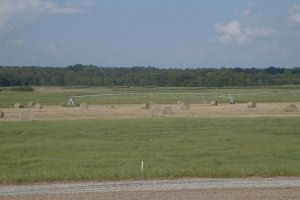
Lagoon wastewater applied by pivot irrigation for hay production

Labor requirements can be further reduced by permanently installed underground pipes to sprinkler risers, center-pivot irrigators or hose attachment points for traveling guns or drag-hose applicators. However, land application of manure slurry and lagoon effluent with irrigation equipment requires a higher level of management than other methods of spreading to avoid pollution and nuisance problems.

Recommended Reading on Liquid Manure Application and Irrigation Equipment

Authors: Jon Rausch, Ohio State University and Ted Tyson, Auburn University

Costs of Manure Application and Transport

When talking about the value of manure, costs are reported in terms of dollars. While reporting in terms of dollars is usually helpful, it is not the only metric for discussing costs. Any resource that is required to accomplish a task can be considered a cost. With this in mind, this page will discuss the cost of manure distribution in terms of dollars and time. The limiting resource, dollar cost or hours required, determines how manure is distributed. Hours could be converted to dollars but that would possibly obscure the management of these costs.

Factors Influencing Cost of Manure Management

The three major activities that influence the cost of manure management are loading, transporting and land applying. Each activity can require its own specialized equipment and can constrain the use of the manure. For example, except for an external manure storage structure, loading is best done when animals are not present and thus limited to those time periods. Transportation can be time consuming depending on the distance traveled and the amount of water hauled in the manure. Land applying requires proper soil and plant conditions and specialized equipment.

Livestock manure is either liquid, slurry or solid. Different types of manure will have different impacts on the cost of distribution. For example, solid manure can usually be hauled farther for less money because less water is being transported. Liquid manure, because of its high water content, can’t be transported as far but low cost irrigation systems can be used to distribute it relatively inexpensively. This page will address each manure type separately. Because the dollar cost of managing manure is so dependent on location, type of livestock, form of manure, availability of land, etc. No dollar estimate will be given in this page. The quickest way to get a cost estimate would be to contact a custom manure hauler and ask the price charged for different services.

The table below summarizes the relative costs of manure application and distribution. When reading it, compare the costs within a column, rather than within a row. In other words, use it to compare the cost of loading, transportation, or land application for each type of manure. The more dollar signs ($) a manure type has, the more expensive it is relative to the other types of manure. Click on a type of manure in this table to be taken to a description of why different manures will have different costs.

Summary of Manure Application and Distribution Costs
Manure Type Loading Transportation Land Application
Solid Manure      
Fresh $$ $$ $$$
Stockpiled $$$ $$ $$$
Slurry Manure      
Tanker $ $$$$ $$$
Dragline hose $ $$$ $$
Liquid Manure      
Dragline hose $ $$$ $$
Irrigation system $ $ $

Custom application

Because much of the equipment used in manure application is unique to manure application, many livestock producers choose to not own the equipment but rather hire custom operators to handle their manure. Custom operators can lower the cost of manure management, relative to owner operated equipment, by spreading the cost of expensive equipment over more units. Many custom operators can also apply the manure more quickly due to experience and because they have larger equipment or multiple pieces of equipment. Because they work for many livestock producers, they may not be able to apply an individual’s manure at opportune times. This uncertainty of when the manure will be applied is a cost that needs to be taken into account. Contracting Certified Manure Haulers contains instructions for comparing custom hauling with producer hauling of manure.

Livestock manures are an excellent source of organic nutrients. However, they are generally more expensive to transport and land apply than more concentrated commercial fertilizers. The cost of manure transport and distribution are critical to understand and manage in order to derive maximum value from manure. A research project completed in the late 1990’s includes this information. The actual costs presented may no longer be relevant but the conclusions are still valid.

A spreadsheet to estimate the cost of hauling various types of manure can be obtained at University of Missouri.

Related Web Pages

Authors: Ray Massey, University of Missouri and Josh B. Payne, Oklahoma State University

Costs of Slurry Manure Application and Transport

Livestock and Poultry Environmental Learning Center:

Home Page

All articles about:

Manure Value and Economics

Livestock such as dairy and swine often have slurry type manure. The manure is liquid but does not flow easily. It is either stored directly below the animal pens, or scraped or pumped periodically into a holding pen outside of the building.

Loading Slurry Manure

Loading slurry manure is accomplished with a pump powered by a tractor or stationary engine. The slurry can be loaded into tractor-pulled or truck-mounted tankers, or pumped through a hose attached to a tractor that applies it as it is being pumped from the pit. The cost of loading slurry is usually low because the pump can do it quickly and the volume per animal is not usually high.

Slurry Manure Transport

Transportation of slurry by tanker can be expensive because a lot of water is being transported and the same equipment that is hauling the slurry is usually land applying the slurry. When tankers are used, the number of hours spent transporting the slurry is frequently the limiting cost. The land may become unavailable to receive the slurry, due to crop planting times or soil conditions, before all of the slurry can be land applied. Often, the distance transported is limited so that the time constraints can be met.

If the slurry is pumped through a hose to the field, the transport time is negligible. As the slurry is pumped, it is simultaneously injected or surface applied to the land. The important cost becomes the cost of purchasing pipe and hose that is sufficient for this method of land application.

Land Application of Slurry Manure

The cost of land application of slurry varies with the type of equipment used. Tankers can be expensive to own unless they are used for many animals on many acres. There is a definite economy of scale with tankers. Additionally, the tankers usually require fairly large tractors or trucks. If the livestock owner does not have a cropping enterprise that requires the large tractor, ownership of the tractor for manure distribution alone becomes expensive.

Tankers are economical for large-scale operations with slurry manure.

When slurries are applied via hoses (called dragline hoses), a tractor pulled distributor is used to move the hose around the field so that the slurry is evenly distributed. The cost of the equipment can be very expensive, but the amount of time is decreased considerably compared to using tankers because most of the time is spent in applying the slurry. Very little time is spent getting into and out of the field, as is the case when using tankers.

Authors: Ray Massey, University of Missouri and Josh Payne, Oklahoma State University

Costs of Solid Manure Application and Transport

Poultry litter and beef feedlot manure are the most common types of “solid” manure. Separated solids from dairies can also be a source of solid manure. Solid manures must be scraped off the floor of the pen or house where the animals were raised. Scraping and loading onto trucks usually is done with a front end loader. If the manure is not land applied at the time the pens are cleaned, the manure can be stockpiled until needed. Poultry litter, in particular, when stockpiled is stored in covered sheds. The cost of the storage shed is an additional cost to manure loading.

Transport Costs of Solid Manure

As previously mentioned, solid manures are the least expensive to transport because most of the bulk transported is dry organic matter containing fertilizer nutrients (N, P and K). Water has little value in manure and adds a lot of weight that costs money to transport. Often, the manure is loaded into transport trucks that haul it to the receiving field, where it is unloaded and then loaded into an application truck.

Land application of solid manure. CC 2.5 Charles Fulhage or Joe Harner

Land Application of Solid Manure

Land application of dry manures is done with a flail type spreader. The manure, as it comes out of the truck-mounted or tractor-pulled spreader box, is flailed out in small pieces onto the surface of the soil. The spreader box is usually a specialized piece of equipment that can be expensive unless it is used to spread a lot of manure on many acres. If the manure needs to be incorporated into the soil, the cost of disking the manure into the soil could also be considered a cost of manure management.

Transportation Cost Assistance

To encourage appropriate use of the nutrients in manure, several government programs subsidize manure management costs. These programs can help reduce transportation costs, increasing manure value as it is more fully utilized as a soil amendment/fertilizer where it is most needed.

Examples of assistance include:

  • subsidy programs in Oklahoma and Arkansas that assist in moving poultry litter from nutrient sensitive watersheds to nutrient deficient areas;
  • loan guarantees to producers purchasing appropriate manure transportation equipment in Missouri;
  • USDA Environmental Quality Incentives Program (EQIP) that cost shares on certain manure investments depending on the priorities of each individual state.

Potential applicants for assistance programs could contact their local USDA Natural Resources Conservation Service office and state Departments of Agriculture or Environental Quality.

Authors: Ray Massey, University of Missouri and Josh Payne, Oklahoma State University

Page reviewers: Alan Lauver, NRCS and Chandra Theegal, Lousiana State University