
Anaerobic Co-digestion of Agro-industrial Feedstocks to Supplement Biogas Produced from Livestock Manure

Purpose

Anaerobic digestion (AD) is commonly used in agriculture to break down livestock manure and produce a sustainable source of energy by producing biogas, which is predominantly methane. Digestion of livestock manure can be supplemented with additional agricultural or industrial organic waste, potentially adding sources of revenue to the farm or digestion facility through tipping fees and additional biogas production. However, quantifying the anticipated impact on digester performance and operation is challenging, particularly as some potential feedstocks have not been studied previously. Understanding how a feedstock might impact a digester’s performance is critical, as digester upsets can lead to loss of revenue or even digester failure.

What Did We Do?

We conducted a set of mono-digestion biomethane potential experiments of several feedstocks currently in use at an agricultural AD facility that accepts mixed industrial waste streams in addition to digesting beef manure. The mono-digestion studies used triplicate 1-L working volume batch digesters which ran for 30-38 days. We tested beef manure, off-spec starch from food manufacturing, slaughterhouse wastewater treatment sludge, waste activated sludge from a corn processing facility, soap stock from glycerin refining, filter press slurry from a food grade water treatment facility, and food waste dissolved air flotation sludge. We also included a treatment for the effluent from the digester’s ammonia recovery system and a mixture of all the feedstocks at the same time. A blank (inoculum only) and positive control (cellulose with inoculum) digester were included as controls. This set of studies is described here as Experiment 1 (E1).

We then conducted a set of co-digestion biomethane potential tests combining the manure pairwise with some of the industrial feedstocks, specifically starch, slaughterhouse waste, soap stock, and filter press slurry (Experiment 2 or E2). These combinations were made at two different ratios of the two feedstocks. The first set of treatments combined the manure and an additional substrate at a 1:1 ratio on a volatile solids basis. The second set of treatments combined the feedstocks proportional to the amounts commonly used in the AD facility providing the materials. A final treatment pairing starch and soap stock at a 3:1 ratio was also included. These co-digestion treatments were conducted in triplicate alongside a single mono-digestion treatment of each feedstock for comparison. Finally, we examined the potential synergistic or antagonistic impacts of these combinations on methane yield and production rate. This was done by comparing the measured methane production at each time point compared to the expected methane production if the feedstocks each contributed additively to the methane production.

What Have We Learned?

Figure 1 shows the cumulative specific biogas production on a volatile solids basis for the mono-digestion experiment (E1). Some feedstocks, such as soap stock and slaughterhouse waste, experienced a substantial lag phase at the beginning of the experiment, which may have been due to the high levels of lipids and proteins.

Figure 1: Average biogas production of all treatments during mono-digestion experiment (Experiment 1).

During the co-digestion experiment (E2), we observed both total yield and kinetic synergy in all treatments. Only two digesters (one of the replicates from the starch and manure proportional treatment and one from the starch and soap stock treatment) produced substantially less (<30%) methane than would be expected for an additive effect for more than one day. This effect can be seen in Figure 2, which shows the cumulative methane curves (corrected for inoculum contribution and averaged over the three replicates) of the mono-digestion digesters for manure and starch individually and the curves for both co-digestion treatments using both manure and starch. Figure 3 shows the same curves for the co-digestion of manure and slaughterhouse waste. These co-digestion treatments show that combining the feedstocks causes an increase in methane production at a faster rate. They also show that co-digestion alleviates the lag phase experienced by the slaughterhouse waste.

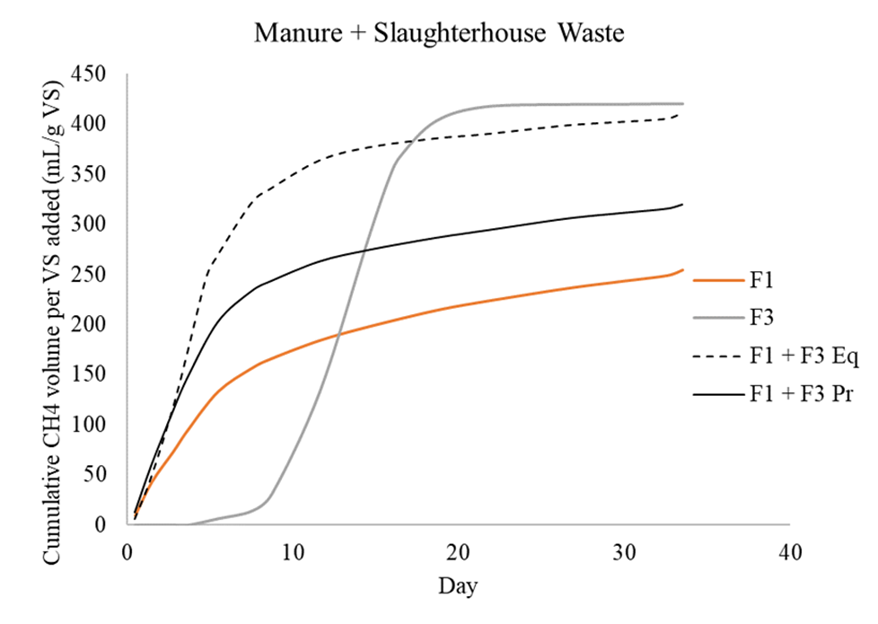
Figure 2: Cumulative specific methane production for manure (F1) and starch (F2). F1 + F2 Eq = 1:1 ratio of VS; F1 + F2 Pr = ratio of VS is proportional to what full-scale digester receives.
Figure 3: Cumulative specific methane production for manure (F1) and slaughterhouse waste (F3). F1 + F3 Eq = 1:1 ratio of VS; F1 + F3 Pr = ratio of VS is proportional to what full-scale digester receives.

Future Plans

We plan to continue exploring the impact of co-digestion on methane yield and production rate by using additional combinations of these feedstocks and exploring the impact of macromolecular composition (percentages of carbohydrates, proteins, and lipids) on synergistic effects. These results will help inform current or future agricultural AD operators regarding the use of co-digestion feedstocks for optimal energy production and best practices in selecting new feedstocks for co-digestion.

Authors

Jennifer Rackliffe, Graduate Research Fellow, Purdue University

Corresponding author email address

jracklif@purdue.edu

Additional authors

Dr. Ji-Qin Ni, Professor, Purdue University; Dr. Nathan Mosier, Professor, Purdue University

Additional Information:

https://www.sare.org/wp-content/uploads/2021-NCR-SARE-GNC-Funded.pdf

Acknowledgements:

This material is based upon work that is supported by the National Institute of Food and Agriculture, U.S. Department of Agriculture, under agreement number 2020-38640-31522 through the North Central Region SARE program under project number GNC21-334. USDA is an equal opportunity employer and service provider. Any opinions, findings, conclusions, or recommendations expressed in this publication are those of the author(s) and do not necessarily reflect the view of the U.S. Department of Agriculture. We also thank Purdue’s Institute for Climate, Environment and Sustainability for supporting the dissemination of this work. Finally, we acknowledge the assistance of Gabrielle Koel, Kyra Keenan, Amanda Pisarczyk, and Emily McGlothlin in conducting the laboratory work.


The authors are solely responsible for the content of these proceedings. The technical information does not necessarily reflect the official position of the sponsoring agencies or institutions represented by planning committee members, and inclusion and distribution herein does not constitute an endorsement of views expressed by the same. Printed materials included herein are not refereed publications. Citations should appear as follows. EXAMPLE: Authors. 2022. Title of presentation. Waste to Worth. Oregon, OH. April 18-22, 2022. URL of this page. Accessed on: today’s date.


Impact of Swine Sludge Inclusion Rate on the Composting Process and Compost Quality

Purpose

The purpose of this study was to develop and analyze potential recipes for composting swine lagoon sludge. Composting is a simple treatment; it is widely adopted on farms, generates a stable value-added stackable product, and conserves organic matter and nutrients. All these benefits along with an affordable cost and lower environmental emissions make it a potential candidate for the management of lagoon sludge, a byproduct of swine operations in southeast US.

Sludge accumulation in lagoons can result in increased odor from lagoons, impact animal productivity, increase risk of environmental and social consequences and lead to operation non-compliance. Developing affordable sludge management alternatives is important because current practices (land application post dredging and dewatering using organic polymers and geo-bags) are not widely adoptable, cost-prohibitive and non-sustainable (Owusu-Twum and Sharara, 2020, Soil facts) and current farm nutrient management plans do not consider management of sludge nutrients.

What Did We Do?

We developed two recipes by mixing different sludge amounts with locally available low-cost amendments: poultry litter, Bermuda hay, yard debris and lagoon liquid. We composted these recipes in triplicates using 13-cubic feet in-vessel composters and recorded changes in temperatures, weight loss, volume, moisture, and organic matter. We also recorded greenhouse gases emitted from the piles at regular intervals. Forced, intermittent aeration was maintained during composting for replicates to ensure adequate oxygen supply and avoid prematurely drying mixtures. Finally, we analyzed the final compost to determine its suitability as a soil amendment.

We used the observations from the experiments to evaluate if proposed recipes resulted in successful compost and determine whether sludge inclusion significantly impacts composting process and product quality. We also analyzed which factors influence weight and organic matter losses in the piles and if the proposed recipes have comparable cumulative GHG and NH3 emissions to previous observations.

What Have We Learned?

We learned that sludge can be composted at both 10% and 20% inclusion rates using the above ingredients, as the process met time and temperatures for pathogen reduction (15A NCAC, 13B.1406) and the final product were stable (TMECC, US Composting council). For 100 lbs. of an initial wet mixture (60.8 to 61.4% moisture) both recipes experienced a total weight loss of 33.8-35.2 lbs. with 24.5 to 25.4 lbs. being lost as moisture and 8.8 to 9.7 lbs. lost as organic matter during the active phase of composting (31 days). Post-screening the recipes resulted in 42.3 to 48.6 lbs. of the stable final product (45 to 47% moisture) that can be directly land applied.

We learned that the composting process generated similar GHG, and ammonia emissions as reported in the previous studies however, most of the methane (CH4) and nitrous oxide (N2O) were generated in the later stages of composting, which can be potentially reduced by proper management of the composting process. Another observation was larger losses in ammonia in the earlier stages of composting which on reduction; using certain additives, changes in recipe or management practices, can result in optimal utilization of nitrogen, increase product value, and reduce environmental impacts.

Future Plans

We plan to further analyze the impact of the composting process on total nutrients and water-extractable fractions, this will provide information on land use rate and potential losses in runoffs. This information is critical for swine lagoon sludge-derived products due to the high concentration of P, Zn, and Cu in sludge as losses can lead to eutrophication in surface and marine waters and potential toxicity in soils.

Future work proposed also involves techno-economic evaluation of this process to determine the cost of treatment, and fair price of the final product. We also plan to conduct a cradle to gate life cycle assessment of the process to determine global warming potential, eutrophication, acidification, and particulate matter generation for farm and large-scale systems. These efforts will help guide further research to improve the technology and provide knowledge to stakeholders and producers on alternative sludge management options.

Figure 1. Swine lagoon sludge composting process and products.


References

Authors

Piyush Patil, Ph.D. Candidate, Bio&Ag. Engineering, North Carolina State University

Corresponding author

Mahmoud Sharara, Asst. Professor and Extension Specialist, Bio&Ag. Eng. North Carolina State University

Corresponding author email address

msharar@ncsu.edu

Additional authors

Stephanie Kulesza, Assistant Professor, Crop & Soil Sciences, North Carolina State University

Sanjay Shah, Professor and Extension specialist, Bio&Ag. Eng. North Carolina State University

John Classen, Associate Professor, Bio&Ag. Eng. North Carolina State University

Additional Information

Publication is in progress currently so best resource is the corresponding author.

Acknowledgements

We would like to acknowledge the support from Joseph Stuckey and Chris Hopkins (Poultry, livestock, and animal waste management facility, NCSU).

Funding sources

Bioenergy Research Initiative (BRI) – Contract No #17-072-4015, North Carolina Department of Agriculture & Consumer Services

National Institute of Food and Agriculture (NIFA) – Critical Agricultural Research and Extension (CARE) – Award No. 2019-68008-29894, U.S. Department of Agriculture


The authors are solely responsible for the content of these proceedings. The technical information does not necessarily reflect the official position of the sponsoring agencies or institutions represented by planning committee members, and inclusion and distribution herein does not constitute an endorsement of views expressed by the same. Printed materials included herein are not refereed publications. Citations should appear as follows. EXAMPLE: Authors. 2022. Title of presentation. Waste to Worth. Oregon, OH. April 18-22, 2022. URL of this page. Accessed on: today’s date.

I’m an Expert… Why Aren’t You Listening to Me?!

Purpose

The ability to communicate about a scientific topic in a manner that is trusted and compelling is known as “scientific discourse.” The highly globalized, connected, and digital world in which we live today is overwhelming audiences with information sources, many of which are not evidence based. Many mainstream topics have already transcended the realm of simple data presentation and entered the complexities of socio-scientific issues that encompass conflicting principles of ethics, cultural perspectives, and economic theories or human livelihoods. For many complex scientific topics, the dearth of public knowledge and engagement has led to confusion and misunderstanding, exacerbated by the public perception of the media’s authority. Mistaken information and extreme opinions often promote messages of blame. Regardless of subject matter or audience, Extension professionals are expected to impact stakeholder knowledge and behavior through programming that is evidence-based – and often extraordinarily complex. STEM professionals seeking to navigate this information space need new strategies for breaking out from the pack and targeting audiences with new and innovative methods of outreach. This is especially true in emerging and potentially controversial issues like antimicrobial resistance (AMR).

This session – curated by members of the iAMResponsible Project, a nationwide outreach program focused on AMR from the perspectives of food producers and food consumers – will feature experts in science communication discussing scientific discourse. Participants in this session can expect to:

    • gain knowledge about evidence-based rhetorical elements of successful communication;
    • learn new ways to approach communication-based on lessons learned from past and current health communication efforts,
    • and generate innovative ideas for programming based on a proposed model for message design and delivery.

A moderated panel of communication experts will discuss how the public forms their perceptions of science information, the kind of information sources they trust and seek out, and how socioeconomic and cultural differences impact audience engagement with scientific information.

Panel

Amy Schmidt, Associate Professor, University of Nebraska (Moderator)

Having grown up in rural Iowa, Amy appreciates the agricultural production systems that feed people worldwide and chose her career path to support responsible livestock production by helping farmers adopt research-based practices that optimize agronomic productivity and minimize potential environmental and social risks. Keeping up with two active kids, her husband, and their family dog is her other full-time job! She spends a lot of evenings and weekends cheering on her kids at baseball and softball games, about as much time scrubbing dirt and grass stains out of white baseball pants, and not nearly enough time sleeping.
Panelists

Kari Nixon, Assistant Professor, Whitworth University

Kari Nixon is an assistant professor at Whitworth University. Her research focuses on the mutually constitutive nature of social understandings of death, disease, and community. Formerly studying to be a clinical psychologist with an emphasis in data science, she shifted to the humanities early on in her graduate career. Her work has appeared in Disability Studies Quarterly and Journal for Medical Humanities, among others. Her co-edited collections, Endemic: Essays in Contagion Theory and Syphilis and Subjectivity were published with Palgrave in 2016 and ’17, respectively. Her first monograph, Kept from All Contagion: Germ Theory, Disease, and the Dilemma of Human Contact was published in June 2020 with SUNY UP, and her mass-market book teaching lay audiences how to critically interpret COVID-19 public health messaging came out through Simon and Schuster in June 2021

David Lansing, Associate Professor, University of Maryland-Baltimore County

Dr. David Lansing is an Associate Professor in Geography and Environmental Systems at the University of Maryland Baltimore County. Growing up in Wyoming and spending many years in rural areas across Central America, Dr. Lansing has witnessed all types of farming styles and livelihoods. Since 2005 his research has studied how conservation policy is formed and implemented, and the effects such policies have on the land use decisions and livelihoods of farmers. He has conducted research in Costa Rica, Honduras, Maryland, New York, and Nebraska. His more recent work is focused on how various land use stakeholders conceive of the environment, how this affects their approach toward sustainable farming practices, and their relationship toward environmental regulations. He is currently undertaking this approach through a multidisciplinary project that studies changing antibiotic use practices across dairy and beef cattle industries.

Andy King, Assistant Professor, Iowa State University.

Dr. Andy King conducts research in strategic health, science, and risk communication, focusing on message design and campaign evaluation. His work advances applied communication theorizing relevant to message design and message processing, with the goal of contributing to improving public health through evidence-based practice. Much of his research has looked at the role of visual imagery and its influence in strategic health messages. He has published over 40 peer-reviewed journal articles in outlets including Journal of Health Communication, Cancer Epidemiology, Risk Analysis, Journal of Communication and Health Communication and has received research funding from the Health Resources and Services Administration and the National Institutes of Health. He serves on the editorial boards for Communication Monographs and Journal of Health Communication. He is a senior editor at Health Communication.

Acknowledgements

Funding for the iAMR Project was provided by USDA-NIFA Award Nos. 2017-68003-26497, 2018-68003-27467 and 2018-68003-27545. Any opinions, findings, conclusions, or recommendations expressed in this publication are those of the author(s) and do not necessarily reflect the view of the U.S. Department of Agriculture.


The authors are solely responsible for the content of these proceedings. The technical information does not necessarily reflect the official position of the sponsoring agencies or institutions represented by planning committee members, and inclusion and distribution herein does not constitute an endorsement of views expressed by the same. Printed materials included herein are not refereed publications. Citations should appear as follows. EXAMPLE: Authors. 2022. Title of presentation. Waste to Worth. Oregon, OH. April 18-22, 2022. URL of this page. Accessed on: today’s date.

A Decision-Support Tool for The Design and Evaluation of Manure Management and Nutrient Reuse in Dairy and Swine Farm Facilities

Purpose

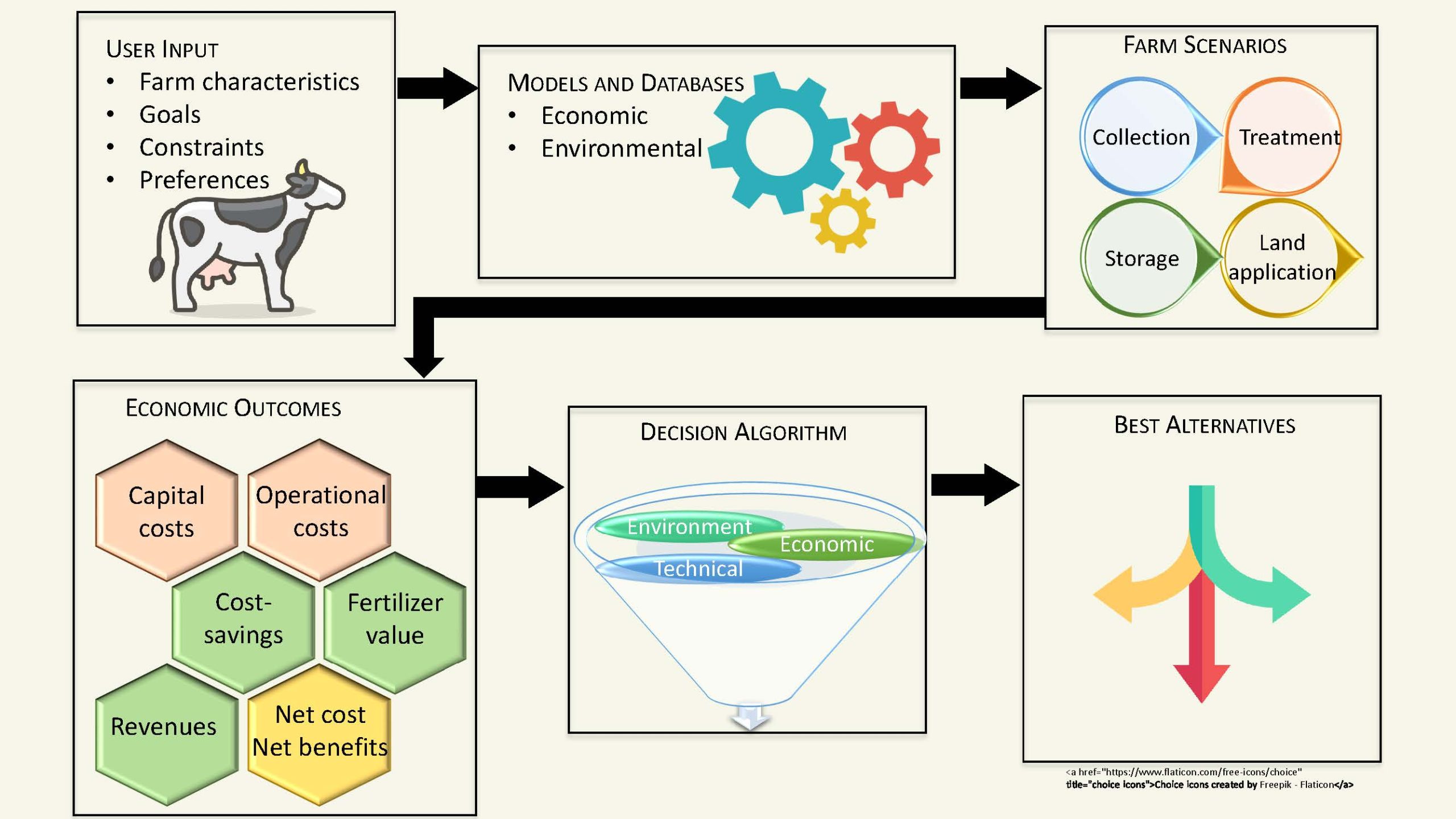
The decision-support tool (DST) being developed facilitates the selection of manure treatment technology based on farm needs and nutrient balance requirements. A life cycle assessment (LCA) approach is used to determine and allocate among sources the whole-farm greenhouse gas (GHG) emissions and environmental impact of different manure management systems (MMS) to facilitate decision-making. The purpose of the tool is to help users identify the suite of technologies that could be used, given the farm’s unique set of preferences and constraints. The tool asks for an initial set of farm details and these values are cross-checked with predefined conditions before starting the simulation. This tool helps in the rapid quantification and assessment of treatment technology feasibility, GHG emissions, environmental, and economic impacts during the manure management decision-making process (Fig. 1). The decision algorithm operates based on user input for weightage priorities of criteria and sub-criteria related to environmental, economic, and technical components.

Figure 1. Graphical abstract

What Did We Do?

The DST is a Microsoft Excel-based tool with precalculated mass balance for a selected number of MMS alternatives representing current and emerging treatment technologies and practices. The MMS considered for the tool includes various handling systems, aerobic and anaerobic treatment systems, solid-liquid separation techniques, chemical processing units, etc. Modules were developed based on mass and energy balances, equipment capital & operating costs, unit process, and technology performance, respectively. The tool utilizes data specific to the country/region/farm where feasible and default values to calculate the overall economic and environmental performance of different MMS, providing results unitized per animal/day or per year.

Then, an LCA approach is used to evaluate the potential environmental footprints of each MMS considered. A life cycle impact assessment (LCIA) is comprised of detailed quantification of inputs and outputs of material flows in a specific treatment and/or conversion process. At the output level, it also defines and quantifies the main product, co-products, and emissions. The major focus on the treatment methods is quantifying the raw materials (manure, wash-water, bedding, etc.) that are to be handled in each MMS, thereby characterizing the properties of effluents (nutrients, gas emissions, etc.). The results include carbon, energy, water, land, nitrogen, and phosphorus footprints along with the effluent nitrogen, phosphorous, and potassium concentrations.

What Have We Learned?

Systematic selection of appropriate technology can provide environmental and economic benefits. Manure management systems vary in their design, due to individual farm settings, geography, and end-use applications of manure. However, the benefits of technological advancements in MMS provide manure management efficiencies and co-production of valuable products such as recycled water, fiber, sand bedding, and nutrient-rich bio-solids, among others. The handling efficiencies and environmental benefits provided by manure treatment technologies come with additional costs, however, so the tradeoffs between environmental benefits and implementation costs also need evaluation.

Future Plans

The next steps are to finalize the dairy module. We are refining the tool’s user interface and demonstrating to stakeholders to gather information regarding key assumptions, outputs, and the functionality of the tool. Further, we also plan to complete the swine module.

Authors

Sudharsan Varma Vempalli, Research Associate, University of Arkansas

Corresponding author email address

svvempal@uark.edu

Additional authors

Sudharsan Varma Vempalli, Research Associate, University of Arkansas

Erin Scott, PhD Graduate Assistant, University of Arkansas

Jacob Allen Hickman, Project Staff, University of Arkansas

Timothy Canter, Extension Specialist, University of Missouri

Richard Stowell, Professor, University of Nebraska-Lincoln

Teng-Teeh Lim, Extension Professor, University of Missouri

Lauren Greenlee, Associate Professor, The Pennsylvania State University

Jennie Popp, Professor, University of Arkansas

Greg Thoma, Professor, University of Arkansas

Additional Information

Detailed economic impacts and tradeoffs expected with the implementation of certain MMS related to this tool is presented during the conference by Erin Scott et al., on the topic “Evaluating Costs and Benefits of Manure Management Systems for a Decision-Support Tool”.

Varma, V.S., Parajuli, R., Scott, E., Canter, T., Lim, T.T., Popp, J. and Thoma, G., 2021. Dairy and swine manure management–Challenges and perspectives for sustainable treatment technology. Science of The Total Environment, 778, p.146319. https://www.sciencedirect.com/science/article/pii/S0048969721013875

Acknowledgements  

We acknowledge funding support from the United States Department of Agriculture (USDA) National Institute of Food and Agriculture (NIFA) grant award (# 2018-68011-28691). We would also like to thank our full project team and outside experts for their guidance on this project.


The authors are solely responsible for the content of these proceedings. The technical information does not necessarily reflect the official position of the sponsoring agencies or institutions represented by planning committee members, and inclusion and distribution herein does not constitute an endorsement of views expressed by the same. Printed materials included herein are not refereed publications. Citations should appear as follows. EXAMPLE: Authors. 2022. Title of presentation. Waste to Worth. Oregon, OH. April 18-22, 2022. URL of this page. Accessed on: today’s date.

Evaluating Costs and Benefits of Manure Management Systems for a Decision-Support Tool

Purpose

The purpose of the decision-support tool is to help livestock producers understand the costs of implementing new technology and the potential benefits associated with nutrient and water recovery, and how these compare across systems. Livestock agriculture is under increased scrutiny to better manage manure and mitigate negative impacts on the environment. At the same time, the nutrients and water present in manure management systems hold potential economic value as crop fertilizer and irrigation water. While technologies are available that allow for recovery and/or recycling of solids, nutrients and water, appropriate decision-support tools are needed to help farmers evaluate the practicality, costs, and benefits of implementing these systems on their unique farms.

What Did We Do?

In designing and refining the tool, we consider which economic components are important in driving the decision algorithm, as well as what is the most valuable economic output information for the user. We developed several “scenarios” defined by the unit processes used in the capture, treatment, storage, and usage of dairy manure. The costs and benefits related to each unit process were evaluated and aggregated for each scenario. Unit processes included flush/scrape activities, reception pit, sand recovery, solids separation, anaerobic digestion, composting, pond/lagoon storage, and tanker/drag hose land application.

Economic information was gathered from published literature, government documents, extension tools, and communication with academic, industry, and extension experts. We evaluated capital costs as an annual capital recovery value; operational costs including labor, energy, and repair and maintenance; cost savings resulting from sand/organic bedding and water reuse; fertilizer value of manure for use on-farm; revenue potential including the sale of treated manure nutrients and energy from anaerobic digestion; and the combined net costs or net benefits. Economic results are integrated into the multi-criteria decision algorithm. Results also elucidate economic tradeoffs across manure management systems (MMS), which can be used by farmers to assist in their decision-making.

What Have We Learned?

Economics is often about evaluating trade-offs between different choices or decisions. When evaluating results from the tool, we see that an increase in capital spending may lead to decreases in operational costs relative to capital costs, depending on farm size. This is due to a general reduction in labor and fuel costs associated with automated or additional manure treatment (e.g. increased spending on an MMS). For example, additional manure treatment can reduce land application expenses and increase cost savings from recovered sand or organic bedding. However, this larger capital outlay may or may not be possible based on the farm’s financial circumstances.

Future Plans

The next steps are to complete the economic analyses of a total of 60 MMS and integrate these into the decision-support tool. We plan to demonstrate this tool to extension specialists and producers to refine the user interface, key assumptions, functioning of the decision algorithm, and the usability of the results.

Authors

Erin E. Scott, PhD Graduate Assistant, University of Arkansas

Corresponding author email address

erins@uark.edu

Additional authors

Sudharsan Varma Vempalli, Postdoctoral Research Associate, University of Arkansas

Jacob Hickman, Program Coordinator, University of Arkansas

Jennie Popp, Professor, University of Arkansas

Richard Stowell, Professor, University of Nebraska-Lincoln

Teng Lim, Extension Professor, University of Missouri

Greg Thoma, Professor, University of Arkansas

Lauren Greenlee, Associate Professor, Penn State University

Additional Information

Related presentation during this session by Varma et al., titled “A Decision-Support Tool for The Design and Evaluation of Manure Management and Nutrient Reuse in Dairy and Swine Farm Facilities”.

Acknowledgements

We acknowledge funding support from the United States Department of Agriculture (USDA) National Institute of Food and Agriculture (NIFA) grant award (# 2018-68011-28691). We would also like to thank our full project team and outside experts for their guidance on this project.


The authors are solely responsible for the content of these proceedings. The technical information does not necessarily reflect the official position of the sponsoring agencies or institutions represented by planning committee members, and inclusion and distribution herein does not constitute an endorsement of views expressed by the same. Printed materials included herein are not refereed publications. Citations should appear as follows. EXAMPLE: Authors. 2022. Title of presentation. Waste to Worth. Oregon, OH. April 18-22, 2022. URL of this page. Accessed on: today’s date.

Exploring the Effect of a Peptide Additive on Struvite Formation and Morphology: a High-Throughput Method

Purpose

Precipitation of struvite (MgNH4PO4·6H2O), a slow-release fertilizer, provides a means of recycling phosphorus from wastewater streams. In this work, a method for high-throughput struvite precipitation is developed to investigate the effects of a peptide additive.

What Did We Do?

The reactions occurred in small volumes (300 μL or less of magnesium, ammonium, and phosphate solutions) in a 96-well plate for 45 minutes. The formation of struvite was monitored by fitting absorbance at 600 nm over time to a first-order model with induction time. The impact of struvite seed dosing was also investigated, highlighting the importance of optimization when peptide is present. The composition of the precipitate was confirmed through Fourier-transform infrared spectroscopy, while morphology and crystal size were analyzed through optical microscopy. Finally, the utility of the high-throughput platform was demonstrated with a 25 full factorial design to capture the effects and interactions of: magnesium dose, mixing time, seed dose, pH, and temperature.

What Have We Learned?

The addition of peptide induced significant changes to the yield parameter and formation constant in the model. Crystals grown in the presence of peptide were morphologically different, having a higher aspect ratio than crystals grown in the absence of peptide. Controlling the shape of the crystal may impact the dissolution properties of struvite.

Future Plans

We anticipate that the general technique investigated can be applied to more complex water matrices (e.g. wastewater), with purity investigated spectroscopically or through other high-throughput assays. Future work will focus on identifying the mechanism by which the peptide acts. The use of a sequence-defined peptide paves the way for further developments in favorably modifying struvite formation and growth. With the effects of shADP5 documented, other similar peptides can be explored via either computational simulations or experimentation to modulate the quality and yield of struvite – potentially increasing its value as a fertilizer. Further computational studies also need to be explored to elucidate the exact mechanism by which shADP5 modulates the thermodynamics of struvite crystallization.

Authors

Presenting author

Jacob D Hostert, PhD candidate, Case Western Reserve University

Corresponding author

Julie N. Renner, Assistant professor, Case Western Reserve University

Corresponding author email address

Jxr484@case.edu

Additional authors

Olivia Kamlet, undergraduate, Case Western Reserve University

Zihang Su, Postdoctoral scholar, Columbia University

Naomi S. Kane, B.S., Case Western Reserve University

Additional Information

Hostert, J. D.; Kamlet, O.; Su, Z. H.; Kane, N. S.; Renner, J. N. Exploring the effect of a peptide additive on struvite formation and morphology: a high-throughput method. RSC Advances 2020, 10 (64), 39328-39337, Article. DOI: 10.1039/d0ra06637k.

Acknowledgements

This work was supported by the United States Department of Agriculture (Award No. 2018-68011-28691) and the National Science Foundation (Award No. 1739473).


The authors are solely responsible for the content of these proceedings. The technical information does not necessarily reflect the official position of the sponsoring agencies or institutions represented by planning committee members, and inclusion and distribution herein does not constitute an endorsement of views expressed by the same. Printed materials included herein are not refereed publications. Citations should appear as follows. EXAMPLE: Authors. 2022. Title of presentation. Waste to Worth. Oregon, OH. April 18-22, 2022. URL of this page. Accessed on: today’s date.

Advances in Nutrient Recovery Technology: Approaches to Controlling Recovered Product Chemistry

Purpose

Our recent work has focused on developing approaches to nutrient management and recovery, with a particular focus on using electrochemical and membrane technologies to control the chemistry of the recovered nutrient products. We are interested in being able to recover both ammonia and phosphate, and our goal is to create recycled fertilizer products that can allow the agricultural community to control the ratio of nitrogen to phosphorus in the recycled fertilizer products and to control whether those fertilizer products are in liquid form or in solid form. With the electrochemical technology focus, we see benefits that include no required chemical dosing, scalable reactor design, and the ability to couple to renewable energy sources. Our engineering research on nutrient recovery technology is conducted within a team that includes life cycle assessment, economic analysis, agronomic greenhouse and row crop studies, agricultural sector outreach, and the development of a decision-support tool to help farmers understand technology options for water and nutrient management.

What Did We Do?

We have investigated an electrochemical cell design that includes a magnesium metal anode and a stainless-steel cathode. The corrosion of the magnesium anode results in the release of magnesium cations into solution, and these magnesium cations promote the precipitation of struvite, otherwise known as magnesium ammonium phosphate hexahydrate (Figure 1). We have investigated how operating conditions of the electrochemical cell, including voltage, residence time, batch vs flow, and membrane separation of the two electrodes, affect nutrient recovery efficiency and the overall chemistry of the recovered precipitate. Our studies have included control experiments on synthetic wastewater compositions relevant to hog and dairy farm wastewaters, while we have also conducted laboratory-scale studies on natural wastewater samples from both agricultural and municipal sources. To demonstrate initial scale-up of an electrochemical reactor, we have designed a bench-scale reactor (Figure 2) that is capable of producing kilogram-level batches of struvite.

Figure 2. (a) Bench-scale batch reactor demonstration for kg-level struvite precipitation. (b) One engineering challenge is the precipitation of struvite on the electrode surface.

What Have We Learned?

The production of struvite from an electrochemical reactor can be controlled by the applied voltage and residence time of the wastewater in the reactor. Changes in reactor design, including the inclusion of a membrane to separate the anode and cathode and operation in batch vs flow mode, can change the composition of the struvite precipitate and can cause a change in the balance of struvite formed vs hydrogen gas formed from the electrochemical cell. We are also able to produce K-struvite, a potassium-based alternative to conventional struvite, that includes potassium rather than ammonium, and the production of K-struvite allows the recovery of the phosphate in a particulate fertilizer while also allowing the separation and recovery of ammonia in a separate liquid stream. We have learned that one of the primary challenges to the electrochemical reactor operation is fouling of the electrodes by the struvite precipitate (Figure 2), and we have developed a dynamic voltage control approach that enables minimal electrode fouling and therefore increases struvite recovery and decreases energy consumption. Our energy consumption values are similar to that of chemical precipitation processes that have been developed for nutrient recovery.

Future Plans

Future plans include further development and optimization of the dynamic voltage control approach to electrochemical reactor operation, which will allow us to control electrode fouling. We also plan to continue working with natural wastewater samples and further develop flow cell reactor design to understand how to translate our batch reactor studies to a flow reactor environment. Studies on K-struvite will focus on understanding the kinetics of K-struvite precipitation and the competing reactions (e.g., calcium precipitation and struvite precipitation) that might impact K-struvite recovery.

Authors

Lauren F. Greenlee, Associate Professor, Pennsylvania State University

Corresponding author email address

greenlee@psu.edu

Additional authors

Laszlo Kekedy-Nagy, Postdoctoral Fellow, Concordia University

Ruhi Sultana, Graduate Research Assistant, Pennsylvania State University

Amir Akbari, Graduate Research Assistant, Pennsylvania State University

Ivy Wu, Graduate Research Assistant, Colorado School of Mines

Andrew Herring, Professor, Colorado School of Mines

Additional Information

    1. Kekedy-Nagy, Z. Anari, M. Abolhassani, B.G. Pollet, L.F. Greenlee. Electrochemical Nutrient Removal from Natural Wastewater Sources and its Impact on Water Quality. Water Research (2022), 210, 118001, DOI: 10.1016/j.watres.2021.118001.
    2. Kékedy-Nagy, M. Abolhassani, R. Sultana, Z. Anari, K.R. Brye, B.G. Pollet, L. F. Greenlee. The Effect of Anode Degradation on Energy Demand and Production Efficiency of Electrochemically Precipitated Struvite, Journal of Applied Electrochemistry (2021), DOI: 0.1007/s10800-021-01637-y.
    3. Kékedy-Nagy, M. Abolhassani, S.I. Perez Bakovic, J.P. Moore II, B.G. Pollet, L.F. Greenlee. Electroless Production of Fertilizer (Struvite) and Hydrogen from Synthetic Agricultural Wastewaters, Journal of the American Chemical Society (2020), 142(44), 18844-18858. DOI: /10.1021/jacs.0c07916.
    4. Wu, A. Teymouri, R. Park, L.F. Greenlee, and A.M. Herring. Simultaneous Electrochemical Nutrient Recovery and Hydrogen Generation from Model Wastewater Using a Sacrificial Magnesium Anode, Journal of the Electrochemical Society (2019), 166(16), E576-E583. DOI: 10.1149/2.0561916jes.

Acknowledgements

The authors acknowledge funding from the USDA NIFA AFRI Water for Food Production Systems program, grant #2018-68011-28691 and funding from the National Science Foundation, grant #1739473.


The authors are solely responsible for the content of these proceedings. The technical information does not necessarily reflect the official position of the sponsoring agencies or institutions represented by planning committee members, and inclusion and distribution herein does not constitute an endorsement of views expressed by the same. Printed materials included herein are not refereed publications. Citations should appear as follows. EXAMPLE: Authors. 2022. Title of presentation. Waste to Worth. Oregon, OH. April 18-22, 2022. URL of this page. Accessed on: today’s date.

Promoting Manure Composting for Livestock Operations

Purpose

While both raw and composted manure benefit soil health and crop production, there are benefits to creating and land-applying composted manure over raw manure. Product uniformity, volume, weed seed, pathogen and parasite reduction and nutrient stability are just a few of the benefits. However, composting manure in Minnesota and North Dakota have yet to gain popularity.

A group of compost producers, who ultimately became our producer cooperators and partnered with us for workshops, were consulted on the reason composting manure is not more common. One said, “It is lack of understanding and time management that holds most other farmers back from composting manure; they do not know how much composting can help their operation.” Another mentioned, “When I started researching composting for my farm, I took a three-day class in Illinois because there wasn’t anything available in North Dakota or Minnesota. Most farmers are not willing to travel that far. There is a need for composting education programs in the two-state area.”

What Did We Do?

NDSU Extension partnered with the University of Minnesota Extension with the original plan of holding four workshops in two years (two each in ND and MN). When implications from the COVID-19 pandemic ensued, we changed our plans to host an online workshop in 2020 and were able to continue with two in-person workshops in 2021.

The online workshop consisted of 13 videos that were sent to registrants 2 weeks before an online, live discussion was held in August 2020 with the presentation team as well as 3 producer cooperators. One of the videos consisted of on-farm interviews with each of our producer cooperators to show the registrants the ability to manage compost differently with similar results. The videos are still available and have been viewed collectively 1,845 times.

The in-person workshops were held in July and August of 2021. Each workshop covered the same material as the online workshop and all three producer cooperators attended each event. The producer cooperators were responsible for helping attendees with the compost diagnostics activity as well as answering questions during a panel discussion.

What Have We Learned?

Online Workshop

    • 180 people registered for the online workshop and 50 joined the live discussion with presenters and producer cooperators
    • 43 responded to the immediate follow-up survey where
      • 76% thought the self-paced format was excellent
      • 64% thought the amount of material was excellent
      • 62% thought the topics covered were excellent
    • 15 months after the online workshop, 21 people participated in a follow-up survey and as a result of the workshop, 58% reported they had altered their manure composting practices.
    • When asked what manure composting change(s) they made, 58% reported they improved their operations adding,
      • “I have more confidence in my ability to compost successfully and have a better understanding of the environmental impacts of composting.”
      • “I no longer have to pay someone to haul away our waste”
      • “Although not composting on a commercial level, I manage several community gardens where large volumes of biomass are accumulated. After learning additional techniques, my piles were hotter and decomposed more quickly. The key? More moisture!”

Moving the workshop online for the first year allowed us to fully engage our producer cooperators. The online workshop resulted in participant comments such as,

    • “Well organized and executed. Appreciated that videos were individual by topic area, short, and focused. That allowed me to watch what was relevant and fit it into my day more easily.”
    • “Really enjoyed the discussion and interaction between the three cooperators. Also appreciated having enough time to flesh out the information, i.e., didn’t try to squeeze it into one hour.”

Though an in-person meeting would have allowed more hands-on experience, the online version reached a broader audience with attendees from 31 states and 3 countries.

In-person Workshops

    • 31 people attended the in-person workshops in ND and MN, of which 10 participated in a 4-month follow-up survey
      • 67% of those who made changes as a result of the workshop stated they started composting manure
    • 100% of those who did not make changes were either agency or university Extension/research personnel who reported the workshops impacted them, their work, and/or their relationship with their clients by:
      • “Allowing me to be more educated about manure composting so that when producers inquire about composting I am able to give them accurate information.”
      • “Using workshop information to inform clients of another manure handling method to consider; composting.”

The workshops, both online and in-person, facilitated discussion and mutual learning among experienced and novice composters of livestock manure.

Future Plans

Questions about static composting were asked during both the online and in-person workshops. This practice is not common in North Dakota or Minnesota so there is certainly a future learning and workshop opportunity.

Authors

Mary A. Keena, Extension Specialist, North Dakota State University

Corresponding author email address

mary.keena@ndsu.edu

Additional authors

Chryseis Modderman, Extension Educator, University of Minnesota; Melissa L. Wilson, Assistant Professor and Extension Specialist, University of Minnesota; William J. Gale, Extension Agent, North Dakota State University

Additional Information

    1. Online Composting Workshop Videos YouTube playlist: https://youtube.com/playlist?list=PLnn8HanJ32l6uhwdS9m-G1z8Bq1U0aJzF
    1. Two compost-related publications for producers were created for use while at the compost rows:

Acknowledgements

This project was funded by North Central Sustainable Agriculture Research and Education (NC-SARE).


The authors are solely responsible for the content of these proceedings. The technical information does not necessarily reflect the official position of the sponsoring agencies or institutions represented by planning committee members, and inclusion and distribution herein does not constitute an endorsement of views expressed by the same. Printed materials included herein are not refereed publications. Citations should appear as follows. EXAMPLE: Authors. 2022. Title of presentation. Waste to Worth. Oregon, OH. April 18-22, 2022. URL of this page. Accessed on: today’s date.

Assessment of physical properties for cover crop and manure applied soils in Idaho’s Magic Valley

Purpose

Idaho ranks in the top 10 in the US for dairy, potato, barley, hay, sugarbeet, corn silage, and dry bean production with the highest producing area being in South Central Idaho. Crop and livestock producers in the Magic Valley depend on affordable access to clean water, healthy and productive soils, and quality grazing land to remain profitable. However, portions of the Middle Snake River, which provides irrigation and drinking water to the Magic Valley, have been impaired by high phosphorous and sediment loading for over two decades (Tetra Tech, 2014). To measure progress in producer efforts for reducing erosion and runoff, appropriate methods need identified. The soils in this region are prone to crusting, have low organic matter, and are high in calcium carbonates making these soils unique to much of the United States. Thus, the overall goal of this project was to identify management practices that enhance soil health physical properties in the Magic Valley.

What Did We Do?

Two study sites were located on the USDA-ARS Northwest Irrigation & Soils Research Laboratory farm in Kimberly, Idaho, and were established in 2013 (Long-Term Manure) and 2016 (Cover Crop). Long-Term Manure was set up as a randomized complete block design with four replicates and eight treatments. The treatments are as follows: annual application of solid dairy manure at rates of (i) 10, (ii) 20, and (iii) 30 ton per acre(dry weight), biennial application of solid dairy manure at rates of (iv) 10, (v) 20, and (vi) 30 ton per acre (dry weight), (vii) application of inorganic fertilizer (applied to match manure N and P rates; Fert), and (viii) no amendments (Control). A commercial crop rotation of wheat-potato-barley-sugarbeet was used at this study site, and sampling occurred under sugarbeet in 2020. All plots were disked immediately after manure application, and all plots were moldboard plowed prior to sugarbeet and potato planting. The Cover Crop study was set up as a split plot design with four replications and tillage as the main experimental factor (strip till vs disk/chisel plow). The four sub-treatments are as follows: (a) no cover crop or dairy manure (Control), (b) cover crop only (CC only), (c) manure only (M only), and (d) cover crop with manure (CC + M). Treatments that did not receive manure received inorganic fertilizer to meet recommended crop needs based on spring soil tests. Inorganic fertilizer was only applied to manure treatments if spring soil tests indicated that additional nutrients were required and the manure did not meet the crop needs. From 2016 to 2021, the field was cropped with continuous silage corn. Triticale was used as a winter forage cover crop and was planted directly after manure application and was harvested within one week of corn planting. Stockpiled dairy manure was applied at a rate of 30 ton per acre (dry weight) in the fall after corn silage harvest and incorporated by disking or left on the surface.

The physical properties accessed for each study in late summer 2020 were soil aggregate stability, runoff rate and rainfall before runoff, bulk density, and compaction. Two methods were used to measure soil aggregate stability: wet sieving and a hybrid method utilizing a Cornell Sprinkle Infiltrometer (CSI). The wet sieving method incorporated four nested stainless steel wire sieves at particle diameters of 5/32, 5/64, 1/64, and 0.002 inch. The samples were submerged in 9.5 inch of water oscillating up and down 1.5 inch at 30 oscillations per minute for 10 minutes. A CSI was used to measure soil aggregate stability at the heights of 1, 3, and 5 feet. The CSI operated at a constant rainfall rate of 0.79 inch of rainfall per 10 min of operation. Runoff rate and rainfall before runoff were calculated based on the values collected from the CSI using the equations listed in van Es and Schindelbeck (2001). The CSI was placed on top of a metal ring (9.5 inch diameter), and a runoff tube was fitted in the metal ring to measure runoff. The CSI had an air entry of 3.9 inch, and data was recorded every 2 minutes once runoff started to occur until the outflow reached steady state. Because each measurement took a minimum of one hour, only one block was measured each day for a total of four days. Bulk density measurements were taken at depths of 0-2, 2-4, and 4-6 inch at each plot. Compaction was measured using a penetrometer to measure a total depth of 12 inch at increments of 1 inch.

What Have We Learned?

Two methods (wet sieving and CSI hybrid) were compared for accessing soil aggregate stability among the two studies. No differences in aggregate stability were found when the wet sieving method was used among treatments for both studies (Figure 1). However, the CSI hybrid method was found to be statistically different at an operational height of 1 foot among treatments at mean values of 0.147 ± 0.005 inch (CC + M), 0.145 ± 0.005 inch(CC only), and 0.146 ± 0.005 inch (M only) as compared to the control (0.124 ± 0.005 inch) for the Cover Crop study. It is also clear that there are large numerical differences in mean weight diameters between the operational heights for the Cover Crop study.

Figure 1. The mean weight diameter (MWD) at the Long-Term Manure (A, B) and Cover Crop (C, D) study sites. A and C represent MWD using the traditional wet sieving method, and B and D represent MWD using the Cornell Sprinkle Infiltrometer at 1, 3, and 5 foot. At the Long-Term Manure study site, 10A, 20A, and 30A represents plots that received dairy manure annually (ton per acre), and 10B, 20B, and 30B represents plots that received dairy manure biennially (ton per acre). Bars represent mean plus standard error. Columns within years not connected by the same letter are significantly different (p<0.05).


Significant differences in rainfall before runoff were found between treatments in the Cover Crop study, and the mean values were 2.26 ± 0.23 in (CC + M), 1.70 ± 0.23 in (CC only), and 1.53 ± 0.23 in (M only) when compared to the control (1.45 ± 0.23 in) (Figure 2). No differences were found in the Long-Term Manure study. When measuring bulk density, it was found that measurements at the 0–2-inch depth were found to be statically significant (p≤0.05) with means of 52.7 ± 3.7 pound per cubic foot (CC + M), 59.6 ± 3.7 pound per cubic foot (CC only), and 49.4 ± 3.7 pound per cubic foot (M only) when compared to the control (65.9 ± 3.7  pound per cubic foot), respectively. Compaction was found to be statistically significant at the depths of 1 through 4 inch and 10 and 12 inches. The tillage by treatment effect was also found to be statistically significant at 2 and 3 inches. Assessing physical properties among management practices can give producers a clearer insight into soil health in the Magic Valley.

Figure 2. The average runoff rate and rainfall before runoff at the Long-Term Manure (A, B) and Cover Crop (C, D) study sites. At the Long-Term Manure study site, 10A, 20A, and 30A represents plots that received dairy manure annually (ton per acre), and 10B, 20B, and 30B represents plots that received dairy manure biennially (ton per acre). Bars represent mean plus standard error. Columns within years not connected by the same letter are significantly different (p<0.05).

Future Plans

At the Long-Term Manure study site, dairy manure was applied annually or biannually from 2013-2019. The project now focuses on nutrient drawdown and manure will no longer be applied. Cover crops may be incorporated into the project. At the Cover Crop study site, inversion tillage will be performed spring of 2022 prior to planting silage corn to incorporate the dairy manure into the topsoil. Dairy manure has not been applied to the field since fall of 2020. Inorganic fertilizer will be applied if needed.

Authors

Presenting author

Kevin Kruger, Research Support Scientist, University of Idaho

Corresponding author

Linda R. Schott, Nutrient and Waste Management Extension Specialist, University of Idaho

Corresponding author email address

lschott@uidaho.edu

Additional authors

Jenifer L. Yost, Research Soil Scientist, USDA-ARS; April B. Leytem, Research Soil Scientist, USDA-ARS; Robert S. Dungan, Research Microbiologist, USDA-ARS; Amber D. Moore, Soil Fertility Specialist, Oregon State University

Additional Information

Part of this research was presented at the ASA, CSSA, SSSA International Annual Meeting in Salt Lake City, Utah, in November of 2021. The link to the recorded presentation is found in the citation below:

Yost, J.L., Kruger, K., Leytem, A.B., Dungan, R.S., & Schott, L.R. (2021). Measuring Soil Aggregate Stability Using Three Methods in Aridisols Under Continuous Corn in Southern Idaho [Abstract]. ASA, CSSA, SSSA International Annual Meeting, Salt Lake City, UT.

https://scisoc.confex.com/scisoc/2021am/meetingapp.cgi/Paper/138171

More information about the Long-Term Manure project can be found in the following scientific papers:

Leytem, A.B., Moore, A.D., & Dungan, R.S. (2019). Greenhouse gas emissions from an irrigated crop rotation utilizing dairy manure. Soil Science Society of America Journal, 83, 137-152.

https://eprints.nwisrl.ars.usda.gov/id/eprint/1693/

Bierer, A.M., Leytem, A.B., Dungan, R.S., Moore, A.D., & Bjorneberg, D.L. (2021). Soil organic carbon dynamics in semi-arid irrigated cropping systems. Agronomy, 11, 484.

https://doi.org/10.3390/agronomy11030484

The papers that were referenced in this proceedings paper are:

Reynolds, W. D., & Elrick, D. E. (1990). Ponded infiltration from a single ring: I. Analysis of steady flow. Soil Science Society of America Journal, 54, 1233–1241.

https://doi.org/10.2136/sssaj1990.03615995005400050006x.

Tetra Tech. (2014). Reevaluation of Mid Snake/Upper Snake-Rock Subbasin TMDL: Data Summary, Evaluation, and Assessment.

van Es, H. & Schindelbeck, R. (2001). Field Procedures and Data Analysis for the Cornell Sprinkler Infiltrometer. Department of Crop and Soil Science Research Series R03-01. Cornell University.

Acknowledgements

This project was funded by a USDA ARS Cooperative Agreement and USDA NIFA Project Number IDA01657. The authors would like to thank Emerson Kemper for assisting with the lab work and Peiyao Chen for assisting with field work.


The authors are solely responsible for the content of these proceedings. The technical information does not necessarily reflect the official position of the sponsoring agencies or institutions represented by planning committee members, and inclusion and distribution herein does not constitute an endorsement of views expressed by the same. Printed materials included herein are not refereed publications. Citations should appear as follows. EXAMPLE: Authors. 2022. Title of presentation. Waste to Worth. Oregon, OH. April 18-22, 2022. URL of this page. Accessed on: today’s date.

Impact of swine manure on soil health properties: A systematic review

Purpose

As the campaign to improve agricultural soil health has gained momentum among conservationists and researchers worldwide, a comprehensive assemblage of outcomes from manure and soil health-related research studies is important. Particularly, the identification of knowledge gaps is an important step to direct future research that informs soil health improvement outreach programs. A thorough review of data reporting the effects of swine manure on soil health properties that is applicable to agricultural producers is lacking. Although previous research studies have looked at the effects of manure on individual soil properties, there are conflicting conclusions. Livestock manure literature reviews fail to consider inconsistent methodologies between individual research studies and whether research is applicable to producers utilizing manure as amendments to improve soil health, and none of the reviews focus on swine manure or swine manure by-products. The objectives of this review were (a) to synthesize literature describing effects of swine manure on soil properties that affect soil health and (b) to identify knowledge gaps and research needs to further our understanding of this topic.

What Did We Do?

We conducted a systematic literature review based on peer-reviewed studies that evaluated the effect of swine manure on soil health properties. First, we identified studies using three criteria: species (swine, pig, hog), manure source (i.e., solid [SM] or liquid manure [LSM], compost, deep pack), and soil property (i.e., soil organic carbon [SOC], total nitrogen, soil pH, bulk density, available water capacity). Second, studies had to meet the following criteria in order to be included: (a) the studies were replicated field experiments, (b) manure was the only differing factor between or among treatments, and (c) data means of organically amended treatments and controls were included. In total, 40 peer-reviewed studies were included in this review.

What Have We Learned?

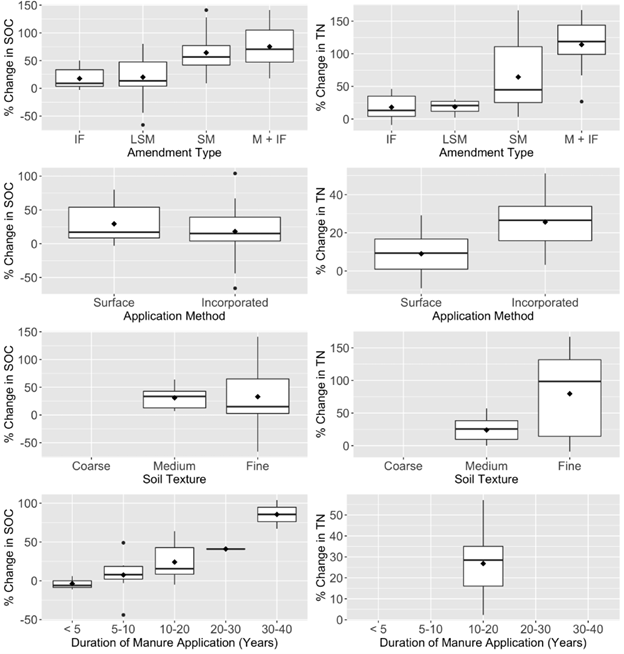
Recycling of manure locally prior to importing inorganic fertilizer (IF) has the potential to reduce nutrient imbalances and improve soil health. Based on this review, swine manure has the potential to add significant amounts of organic carbon to the soil and to improve soil health metrics. In general, the application of swine manure increases soil organic matter (SOM) and SOC, decreases soil bulk density, and increases microbial biomass carbon Soil organic carbon and total N tended to be highest when manure and inorganic fertilizer were applied to the field (Figure 1). Soil chemical properties did not seem to change much when manure was applied to the soil surface or incorporated into the topsoil. The duration of swine manure application (annually) did not seem to increase the percent change in most chemical properties; however, this could be due to a lack of data. The percent change in SOC did increase when the swine manure was applied for a longer time period (Figure 1), and we would expect to see a similar trend with SOM and total carbon if there were more data. Few articles had data on soil physical and biological properties. Depending on soil type, swine manure has the potential to increase available water holding capacity and saturated hydraulic conductivity. Although more research is needed, it can be inferred that swine manure additions increase microbial activity, which promotes healthier soils and better crop yields.

Figure 1: Average percent change in soil organic carbon (SOC) and total nitrogen (TN) based on amendment type, application method, soil texture, and duration of swine manure application. Black circles represent outlier data, and diamonds represent mean. IF = inorganic fertilizer; LSM = liquid swine manure; M + IF = manure (liquid and solid) plus inorganic fertilizer; SM = solid swine manure

Future Plans

Previous literature reviews failed to account for differences in methodologies between individual research studies and whether research is applicable to producers utilizing swine manure as amendments to improve soil health (i.e., unreasonable application rates of swine manure, overapplication of nutrients). The evaluation of the effect of swine manure on soil health properties is difficult to do based on current literature because (a) there are few comprehensive studies (i.e., only one study reported properties from chemical, physical, and biological categories) and (b) there are non-consistent research methodologies between studies. Therefore, we recommend redirecting research studies to demonstrate the value of manure to the suitability of agricultural cropping systems. Future swine manure research should include (a) a range of soil physical, chemical, and biological properties, (b) initial soil data prior to manure application, and (c) manure type, application method, application rate, total carbon and nitrogen of the manure, duration of swine manure application, and swine manure application timing. In addition, future research should also focus on the short- and long-term effects of a single application of manure to support an effort to identify optimal frequency of application for improving soil health. More research is also needed to compare the effects of manure and inorganic fertilizer additions on crop yield and soil health by balancing nitrogen, phosphorus, and potassium additions.

Authors

Jenifer L. Yost, Research Soil Scientist, USDA-ARS

Corresponding author email address

jenifer.yost@usda.gov

Additional authors

Amy M. Schmidt, Livestock Manure Management Engineer, University of Nebraska-Lincoln; Rick Koelsch, Livestock and Bio Environmental Engineer, University of Nebraska-Lincoln; Kevin Kruger, Research Support Scientist, University of Idaho; Linda R. Schott, Nutrient and Waste Management Extension Specialist, University of Idaho

Additional Information

For more information about this project, please check out our Open Access journal article. The citation for the journal article is:

Yost, J.L., Schmidt, A.M., Koelsch, R., and Schott, L.R. (2022). Effect of swine manure on soil health properties: A systematic review. Soil Science Society of America Journal.

https://doi.org/10.1002/saj2.20359

This research was presented at the ASA, CSSA, SSSA International Annual Meeting in Salt Lake City, Utah, in November of 2021. The link to the recorded presentation is found in the citation below:

Yost, J. L., Schmidt, A. M., Koelsch, R., & Schott, L. R. (2021). Impact of Swine Manure on Soil Health Properties: A Systematic Review [Abstract]. ASA, CSSA, SSSA International Annual Meeting, Salt Lake City, UT. https://scisoc.confex.com/scisoc/2021am/meetingapp.cgi/Paper/138180

Acknowledgements

This project was supported by funding from the National Pork Checkoff. The authors would also like to thank Meg Clancy and Drew Weaver for their assistance.


The authors are solely responsible for the content of these proceedings. The technical information does not necessarily reflect the official position of the sponsoring agencies or institutions represented by planning committee members, and inclusion and distribution herein does not constitute an endorsement of views expressed by the same. Printed materials included herein are not refereed publications. Citations should appear as follows. EXAMPLE: Authors. 2022. Title of presentation. Waste to Worth. Oregon, OH. April 18-22, 2022. URL of this page. Accessed on: today’s date.