Diet, Tillage and Soil Moisture Effects on Odorous Emissions Following Land Application of Beef Manure


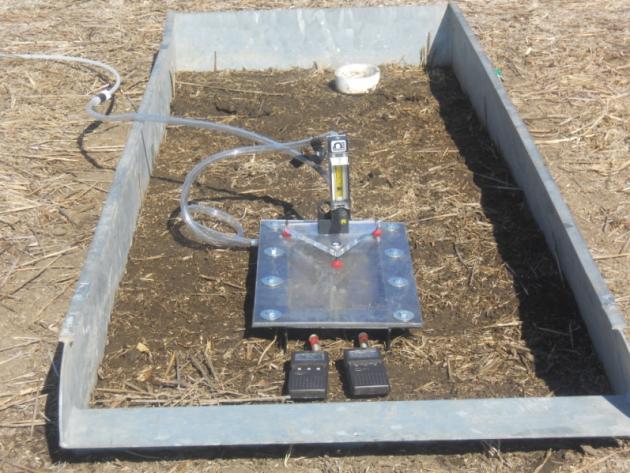
Figure1.  Gas sampling equipment used during the study.

Waste to Worth: Spreading science and solutions logoWaste to Worth home | More proceedings….

Abstract

Little information is currently available concerning odor emissions following land application of beef cattle manure. This study was conducted to measure the effects of diet, tillage, and time following land application of beef cattle manure on the emission of volatile organic compounds (VOC).

Each of the experimental treatments which included tillage (broadcast or disked) and diet (0, 10, or 30% wet distillers grain (WDGS)) were replicated twice. A 5-m tandem finishing disc was used to incorporate the manure to a depth of approximately 8 cm.  Small plots (0.75 m x 2.0 m) were constructed using 20 cm-wide sheet metal frames. A flux chamber was used to obtain air samples within the small plots at 0, 1, 2, 6, and 23 hours following manure application. The flux of fifteen VOC including fatty acids, aromatic compounds, and sulfur containing compounds were measured. Based on odor threshold, isolavleric acid, butyric acid, and 4-methylphenol provided 28.9%, 18.0%, and 17.7%, respectively, of the total measured odor activity. Heptanic acid, acetic acid, skatole, 4-methyphenol, and phenol each contributed less than 1% of the total odor activity. Dimethy disulfide (DMDS) and dimethyl trisulfide were the only measured constituents that were significantly influenced by diet.

DMDS values were significantly greater for the manure derived from the 30% WDGS diet than the other manure sources. No significant differences in DMDS values were found for manure derived from diets containing 0% and 10% WDGS. Tillage did not significantly affect any of the measured VOC compounds. Each of the VOC was significantly influenced by the length of time that had expired following land application. In general, the smallest VOC measurements were obtained at the 23 hour sampling interval.  Diet, tillage, and time following application should each be considered when estimating VOC emissions following land application of beef cattle manure.

Why Study Factors Affecting Manure Application Odors?

Measure the effects of diet, tillage and soil moisture on odor emissions follow land applied beef manure.
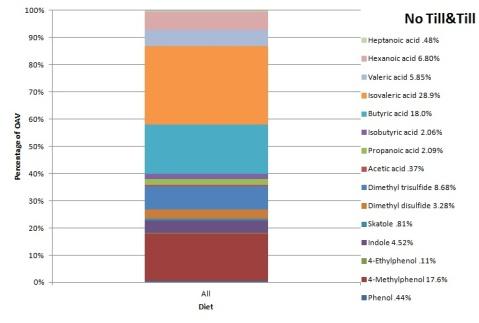
Figure 2.  Relative contribution of odorant to the total odor activity.

What Did We Do?

Twelve plots were established across a hill slope. Treatments were tillage (broadcast or disked) and diet (0%, 10%, or 30% WDGS).  Beef manure was applied at 151 kg N ha-1 yr-1.  Gas samples were collected using small wind tunnels and analyzed using a TD-GC-MS. (Fig. 1).  VOC samples were collected at 0, 1, 2, 6, and 23 hours following manure application.  A single application of water was applied and the gas measurement procedure was repeated. The effects of tillage, diet, test interval, and the sample collection time on VOC measurements were determined using ANOVA (SAS Institute, 2011).

What Have We Learned?

Isovaleric acid, butyric acid, and 4-methylphenol accounted for 28.9%, 18.0%, and 17.7%, respectively of the total odor activity (Fig. 2). Dimethyl disulfide (DMDS) and dimethyl trisulfide (DMTS) emissions were significantly increased by the 30 % WDGS diet. The flux increase for DMDS was over 4 times greater for the 30% WDGS diets. Tillage did not significantly affect any of the measured VOC compounds. The largest propionic, isobutric, butyric, isovaleric, and valeric acid measurements occurred with no-tillage under dry condition (Fig. 3A-E). Generally, measured values for these constituents were significantly greater at the 0, 1, 2, and 6 hour sampling intervals than at the 23 hour interval (Fig. 3A-E). The larger emissions for no-till, dry conditions may be due to the drying effect resulting when the manure was broadcast on the surface.  As the manure begins to dry, the water soluble VOCs are released from solution.  The tilled and wet conditions would reduce its release of VOC due to the increased moisture conditions.
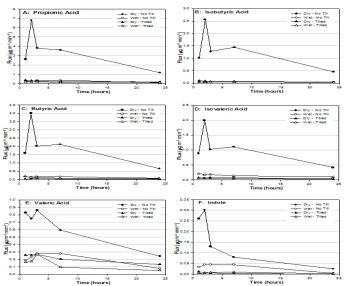
Figure 3. Flux values for propionic, isobutyric, butyric, isovaleric , valeric acid and indole as affected by tillage, soil moisture, and time.

Future Plans

Additional studies are planned to quantify the moisture and temperature effect on odorous emissions.

Authors

Bryan L. Woodbury, Research Agricultural Engineer, USDA-ARS,  bryan.woodbury@ars.usda.gov

John E. Gilley, Research Agricultural Engineer, USDA-ARS;

David B. Parker, Professor and Director, Commercial Core Laboratory, West Texas A&M University;

David B. Marx, Professor Statistics, University of Nebraska-Lincoln;

Roger A. Eigenberg, Research Agricultural Engineer, USDA-ARS

Additional Information

http://www.ars.usda.gov/Main/docs.htm?docid=2538

Acknowledgements

We would like to thank Todd Boman, Sue Wise, Charlie Hinds and Zach Wacker for their invaluable help on making this project a success.

The authors are solely responsible for the content of these proceedings. The technical information does not necessarily reflect the official position of the sponsoring agencies or institutions represented by planning committee members, and inclusion and distribution herein does not constitute an endorsement of views expressed by the same. Printed materials included herein are not refereed publications. Citations should appear as follows. EXAMPLE: Authors. 2013. Title of presentation. Waste to Worth: Spreading Science and Solutions. Denver, CO. April 1-5, 2013. URL of this page. Accessed on: today’s date.
BFNMP$: A Tool for Estimating Feedlot Manure Economics

Waste to Worth: Spreading science and solutions logoWaste to Worth home | More proceedings….

Why Consider the Costs of Manure Transport in Nutrient Planning?

* Presentation slides are available at the bottom of the page.

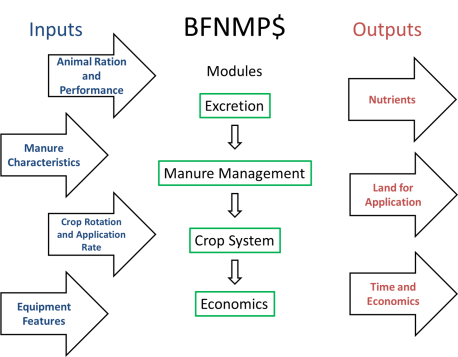
The Beef Feed Nutrient Management Planning Economics (BFNMP$) computer program can assist producers in understanding the impacts manure handling changes could have on their operation.  It calculates manure management economics based on animal nutrient intake, manure nutrient availability, land requirements for spreading, operating costs, and fertilizer value.  These values can be altered to fit individual operations.  The objective of this analysis was to use the BFNMP$ software tool to evaluate the effect of distillers grains inclusion, nitrogen (N) volatilization, and manure application rate on feedlot nutrient management plans.

The BFNMP$ software tool is organized into 4 modules with producers entering information about their operation and then viewing the results.  Outputs include nutrients produced, land needed for manure application, time the plan will take to implement, and economic implications.

What Did We Do?

This program was used to determine 1) impact of dietary N and P from traditional grain based diets compared to diets including 40% distillers grains (DG); 2) effect of different N volatilization (VOL) rates; 3) impact of changing manure application rates from N to P based and from 1 to 4 yr rates.  While comparing scenarios, all other factors in the model were constant.  These scenarios fed out 5,000 cattle per year in 100 hd pens from 341 to 591 kg with 144 d on feed.

What Have We Learned?

Increasing dietary N and P, with a 40% DG diet, increases excretion of these nutrients.  Capturing these nutrients in manure increases costs, but increases value at a greater rate.  Manure from cattle fed a traditional feedlot diet with 50% N VOL has a value of $21.53/animal ($14.45/Mg) based on inorganic fertilizer values.  Feeding a 40% DG ration results in manure worth $29.70/animal ($19.94/Mg).  Decreasing N VOL to 20% increases value of the manure to $26.55/animal ($17.83/Mg) and $37.11/animal ($24.93/Mg) for the grain based and DG diet, respectively.  Phosphorus based applications require about 3 times the acres of N based applications, but spreading on a N basis results in excess P buildup.  Spreading enough manure in 1 yr to meet crop P requirements for 4 yrs costs approximately the same as spreading manure every yr to meet N requirements.

Future Plans

The BFNMP$ program has been designed to aid feedlots in implementing a nutrient management plan.  This tool allows them to see the potential effects of changes before implementing them and promotes better utilization of valuable manure nutrients.

Authors

Andrea Watson, graduate student, University of Nebraska awatson3@unl.edu

Galen Erickson, professor, University of Nebraska

Terry Klopfenstein, professor, University of Nebraska

Rick Koelsch, assistant dean, extension and former professor, University of Nebraska

Ray Massey, professor, University of Missouri

Joseph Harrison, professor, Washington State University

Matt Luebbe, assistant professor, University of Nebraska

Additional Information

http://beef.unl.edu/reports 2006 Beef Report pg. 98; 2008 Beef Report pg. 59; 2012 Beef Report pg. 104

http://water.unl.edu/web/manure/software       website to download the software tool and user guide

Acknowledgements

Funding provided by USDA NRCS CIG Program – Decision Aid Tool to Enhance Adoption of Feed Management 592 (FMPS 592) – Contract No. 69-3A75-10-121.

The authors are solely responsible for the content of these proceedings. The technical information does not necessarily reflect the official position of the sponsoring agencies or institutions represented by planning committee members, and inclusion and distribution herein does not constitute an endorsement of views expressed by the same. Printed materials included herein are not refereed publications. Citations should appear as follows. EXAMPLE: Authors. 2013. Title of presentation. Waste to Worth: Spreading Science and Solutions. Denver, CO. April 1-5, 2013. URL of this page. Accessed on: today’s date.

Anaerobic Digestion of Finishing Cattle Manure

Waste to Worth: Spreading science and solutions logoWaste to Worth home | More proceedings….

Purpose

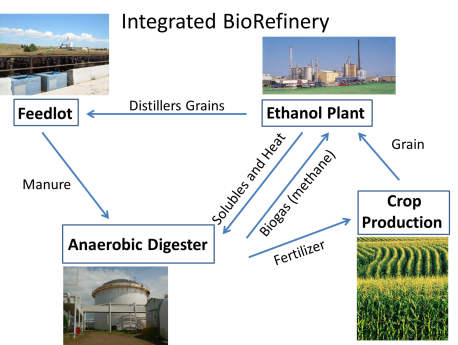
The concept of utilizing feedlot manure in an anaerobic digester to power an ethanol plant, which then produces feed for cattle, has been called a closed loop system.  In this system inputs are minimized and outputs are used by another component.  This research looked at differences in manure quality within this system.  Trial 1 considered incorporating distillers grains into the cattle diet and the effects on methane potential of the manure.  For this system to be utilized by the feedlot industry in Nebraska, the manure collected for anaerobic digestion must be collected from soil-based open feedlot pens which account for over 95% of the feedlot cattle raised in Nebraska.  Trial 2 addressed the methane potential of open-lot feedlot manure and its feasibility for anaerobic digestion.

An integrated biorefinery utilizes distillers grains for cattle feed and cattle manure for biogas generation to power an ethanol plant.  This system has been referred to as a “closed loop” system due to energy recycling within the segments.

What Did We Do?

Seven continuously stirred anaerobic digesters were used to compare degradation of manure from 2 cattle diets (Trial 1) and 2 cattle housing methods (Trial 2).  In Trial 1 manure was collected from confinement cattle on a control diet with 82.5% dry rolled corn or 40% of the corn was replaced with wet distillers grains plus solubles (WDGS), a byproduct of the ethanol industry.  For Trial 2, manure was collected from cattle in complete confinement or soil-based open feedlot pens with all cattle on a similar byproduct diet.  In both trials, organic matter (OM) degradation and methane production was measured for digesters on each treatment.  In Trial 1, samples of effluent removed from the digesters were also used to identify differences in microbial community structure (Eubacterial and Archaeal) due to treatment.

What Have We Learned?

Trial 1.  Organic matter degradation was slightly improved for manure from cattle fed WDGS (P = 0.10).  Methane production was 0.137 L/g OM fed for WDGS manure and 0.116 L/g OM fed for the corn-based diet (P = 0.05).  Microbial communities identified using 454-pyrosequencing revealed structuring of the microbial community based on diet (P < 0.001).  This suggests that the microbial food chain that contributes to methane production is greatly influenced by the diet fed to cattle, and dietary manipulation may provide opportunities to increase or decrease methane production from cattle manure.

Trial 2.  Manure collected from open-lot pens had an OM content of 26% compared to 88% for manure from complete confinement.  This resulted in decreased methane production and OM degradation (P < 0.01) for digesters fed open-lot manure.  However, methane was produced from open-lot manure suggesting that if ash buildup can be avoided open lot manure may be a viable feedstock for anaerobic digestion.

Future Plans

We are currently exploring new technologies that may enhance the use of open lot manure in anaerobic digestion.  We are also identifying key microbes involved in methane production in order to better understand how things such as cattle diet affect methane production.

Authors

Andrea Watson, graduate student, University of Nebraska awatson3@unl.edu

Samodha Fernando, assistant professor, University of Nebraska

Galen Erickson, professor, University of Nebraska

Terry Klopfenstein, professor, University of Nebraska

Additional Information

A summary of these trials is available at beef.unl.edu/reports; 2013 Beef Report pg. 98-99.

Acknowledgements

Funding provided by Nebraska Center for Energy Sciences Research

The authors are solely responsible for the content of these proceedings. The technical information does not necessarily reflect the official position of the sponsoring agencies or institutions represented by planning committee members, and inclusion and distribution herein does not constitute an endorsement of views expressed by the same. Printed materials included herein are not refereed publications. Citations should appear as follows. EXAMPLE: Authors. 2013. Title of presentation. Waste to Worth: Spreading Science and Solutions. Denver, CO. April 1-5, 2013. URL of this page. Accessed on: today’s date.

Estimation of Ammonia Emissions from Beef Cattle Feedyards in the Southern High Plains with Process-Based Models

Waste to Worth home | More proceedings….

Why Is It Important to Validate Models?

Beef cattle are responsible for around 15% of the total anthropogenic ammonia (NH3) emitted in the U.S., and the cattle feeding industry is highly concentrated spatially, with the majority of commercial feedyards located in Texas, Iowa, Kansas,Colorado, and Nebraska (USEPA, 2005; USDA-NASS, 2009). Valid estimates of ammonia (NH3) emissions from beef cattle feedyards are needed to assess the impact of beef production on the environment, to comply with reporting requirements, and to develop reasonable regulatory policies. The processes involved in production and volatilization of NH3 from livestock housing are strongly influenced by environmental conditions and management practices (Fig. 1), which may not be captured by constant emission factors or mathematically-derived empirical models. Among different modeling approaches, process-based models, which track components of interest through biochemical and geochemical reactions as functions of specific conditions (e.g. temperature, wind speed, pH, precipitation, surface heating, animal diet), offer a better approach for predicting NH3 emissions from open-lot animal production systems than emission factors or empirical models. However, while process-based models have been developed to estimate NH3 emissions from dairy barns and other livestock facilities, little work has been conducted to assess their accuracy for large, commercial feedyards in the semi-arid Texas High Plains: the top beef producing region in the United States.

Figure 1. Processes and factors affecting feedyard ammonia emissions and modeled with IFSM and Manure-DNDC.

What Did We Do?

We evaluated two process-based models, the Integrated Farm Systems Model (IFSM) (Rotz et al., 2012) and the newly developed Manure-DNDC (DeNitrification DeComposition) model (Li et al., 2012), for predicting feedyard NH3 emissions in the Texas High Plains. To meet this objective, we compared model-simulated emissions to measured NH3 flux data collected from two commercial feedyards, Feedyard A and Feedyard E, in Deaf Smith County, Texas. Feedyard NH3 fluxes were measured from February 2007 to January 2009 using open-path lasers and an inverse dispersion model (Todd et al., 2011). The input data for the two models differed slightly; however, both required daily climate data (temperature, precipitation, wind speed, solar radiation), animal population (Feedyard A, 12,684 head; Feedyard E, 19,620 head), and concentration of crude protein (%CP) in cattle diets. Model performance was evaluated by the difference between predicted and observed emissions using both linear regression analysis and summary, univariate, and difference measures (Wilmott et al., 1982).

Figure 2 (above). Comparison of observed and IFSM predicted per capita NH3 emission rates (g head-1 d-1) at (a) Feedyard A, and (b) Feedyard E. Daily predictions were in good agreement (p < 0.001) with observations at both feedyards and responded appropriately to changes in ambient temperature and % CP in feedyard diets.
Figure 3 (below). Comparison of observed and Manure-DNDC predicted NH3 emission rates (kg ha-1 d-1) at (a) Feedyard A, and (b) Feedyard E. The units for Manure-DNDC (kg hectare-1 d-1) differ from IFSM (g head-1 d-1); however, daily Manure-DNDC predictions for 2008 agreed with observations (p < 0.001) in a manner similar to IFSM predictions.

What Have We Learned?

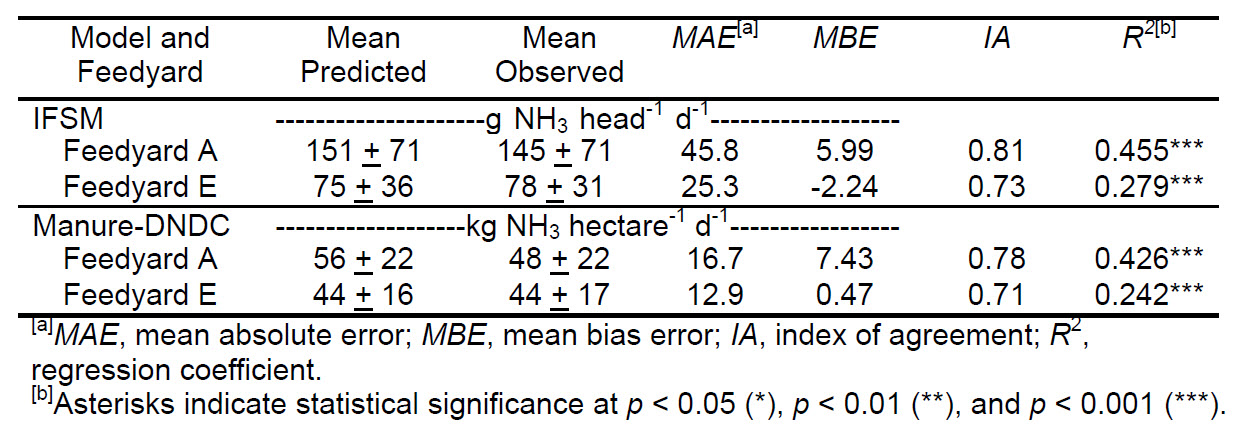
Predictions of daily NH3 emissions made by IFSM and Manure-DNDC were in good agreement (p < 0.001) with observations at both feedyards (Figs. 2 and 3, Table 1). IFSM predicted average NH3 fluxes of 151 and 75 g head-1 d-1 for Feedyards A and E, respectively (Table 1). Manure-DNDC output is on an area basis, and average modeled NH3 fluxes were 56 (Feedyard A) and 44 kg hectare-1 d-1 (Feedyard E). In addition, both models responded appropriately to changes in ambient temperature and %CP in feedyard diets, as shown by higher emissions in summer than winter, and the period of February to October 2008 at Feedyard A, when diets contained as much as 19% CP due to the inclusion of distillers grains (Figs. 2 and 3). The index of agreement (IA) indicates 71% to 81% agreement between model predictions and observed emissions (Table 1). Overall, both IFSM and Manure-DNDC predictions for Feedyard E had lower values for error and bias (MAE and MBE), while there was better agreement between observations and model predictions for NH3 emissions for Feedyard A.

</a>
Figure 4. Comparison of mean predicted and observed per capita NH3 emission rates from (a) Feedyard A and (b) Feedyard E in 2008. For most months, model predictions did not differ from observations, indicating that both models were useful for predicting average feedyard NH3 emissions.

Comparisons of modeled and observed mean daily per capita NH3 emissions for each month in 2008 are shown in Figure 4. For most months, model predictions did not differ significantly from observations, indicating that both models were useful for predicting average emissions. We also wanted to compare model predictions for annual per capita NH3 emissions to the emission factor of 13 kg head-1 y-1 that is currently used by the USEPA (USEPA, 2005). For 2008, IFSM and Manure-DNDC estimates of annual per capita emissions were 61 and 55 kg head-1 y-1 (Feedyard A) and 33 and 25 kg head-1 y-1 (Feedyard E), and model estimates for total feedyard emissions were within 3% to 24% of measured values (Table 2). In contrast, the current EPA emission factor underestimated total feedyard emissions by 61% to 79%: indicating that predictions by IFSM and Manure-DNDC can more accurately predict feedyard NH3 emissions than current constant emission factors.

Table 1. Regression and mean difference comparisons for observed and predicted daily feedyard NH3 emissions from Feb. 2007 to Jan. 2009, where there were 386 and 272 paired comparisons for Feedyard A and Feedyard E, respectively. Regression analysis indicated a highly significant (p < 0.001) relationship between observations and predictions made by both models. The index of agreement (IA) indicates 71% to 81% agreement between model predictions and observed emissions. Overall, both IFSM and Manure-DNDC model predictions for Feedyard E had lower values for error and bias (MAE and MBE), while there was better agreement between observations and model predictions for NH3 emissions for Feedyard A.
Table 2. Comparison of observed annual emissions at Feedyards A and E in 2008 with predictions by Manure-DNDC, IFSM, and the USEPA emission factor (EF) for beef cattle. For 2008, IFSM and Manure-DNDC estimates were within 3% to 24% accuracy. In contrast, the current EPA emission factor underestimated emissions by as much as 79%.

Future Plans

Future plans include using process-based models to predict nitrous oxide (N2O) emissions from feedyard pen surfaces. In addition, we will conduct laboratory and field-scale studies to better characterize the chemical and physical properties of feedyard manure in order to refine input parameters and improve model predictions of feedyard NH3 and N2O emissions.

Authors

Heidi M. Waldrip, Research Soil Scientist, USDA-ARS Conservation and Production Laboratory, Bushland, TX, heidi.waldrip@ars.usda.gov

C. Alan Rotz, Agricultural Engineer, USDA-ARS Pasture Systems and Watershed Management Research Unit, University Park, PA.

Changsheng Li, Research Professor, Institute for the Study of Earth, Oceans, and Space, University of New Hampshire, Durham, NH.

Richard W. Todd, Soil Scientist, USDA-ARS Conservation and Production Laboratory, Bushland, TX.

William Salas, President and Chief Scientist, Applied Geosolutions, LLC, Durham, NH.

N. Andy Cole, Research Leader and Animal Scientist, USDA-ARS Conservation and Production Laboratory, Bushland, TX.

Additional Information

Li, C., W. Salas, R. Zhang, C. Krauter, A. Rotz, and F. Mitloehner. 2012. Manure-DNDC: a biogeochemical process model for quantifying greenhouse gas and ammonia emissions from livestock manure systems. Nutr. Cycl. Agroecosyst. 93:163-200.

Rotz, C.A., M.S. Corson, D.S. Chianese, F. Montes, S.D. Hafner, R. Jarvis, and C.U. Coiner. 2012. Integrated Farm System Model: Reference Manual. University Park, PA: USDA Agricultural Research Service. Available at: http://www.ars.usda.gov/Main/docs.htm?docid=21345. Accessed 5 January 2013.

Todd, R. W., N. A. Cole, M. B. Rhoades, D. B. Parker, and K. D. Casey. 2011. Daily, monthly, seasonal, and annual ammonia emissions from Southern High Plains cattle feedyards. J. Environ. Qual. 40:1090-1095.

USDA-NASS, 2009. Cattle and calves: total number on feed by state and United States, January 1, 2004-2008. Cattle Final Estimates 2004-2008. Statistical Bulletin No. 1019. National Agricultural Statistics Service, Washington DC. Available at: http://usda.mannlib.cornell.edu/MannUsda/viewDocumentInfo.do;jsessionid=E329A9AE615645F1319CC8FB6B111CA8?documentID=1523. Accessed 03/01/2013.

USEPA. 2005. National Emission Inventory – Ammonia Emissions from Animal Agricultural Operations: Revised Draft Report. 2005 Apr. 22. United States Environmental Protection Agency, Washington DC. Available at: http://www.epa.gov/ttnchie1/net/2002inventory.html. Accessed 02/27/2013.

Wilmott, C. J. 1982. Comments on the evaluation of model performance. Bull. Am. Meterol. Soc. 63:1309-1313.

USDA-ARS Conservation and Production Laboratory: https://www.ars.usda.gov/plains-area/bushland-tx/cprl/

USDA-ARS Pasture Systems and Watershed Management Research Unit/IFSM download: http://www.ars.usda.gov/main/site_main.htm?modecode=19-02-00-00

Applied Geosolutions: http://www.appliedgeosolutions.com/

Acknowledgements

This project was partially supported by USDA-NIFA funding to Texas A&M AgriLife Research for the federal special grant project TS2006-06009, “Air Quality: Reducing Emissions from Cattle Feedlots and Dairies (TX & KS)”.

The authors are solely responsible for the content of these proceedings. The technical information does not necessarily reflect the official position of the sponsoring agencies or institutions represented by planning committee members, and inclusion and distribution herein does not constitute an endorsement of views expressed by the same. Printed materials included herein are not refereed publications. Citations should appear as follows. EXAMPLE: Authors. 2013. Title of presentation. Waste to Worth: Spreading Science and Solutions. Denver, CO. April 1-5, 2013. URL of this page. Accessed on: today’s date.

Livestock GRACEnet

Waste to Worth: Spreading science and solutions logoWaste to Worth home | More proceedings….

Abstract

Livestock GRACEnet is a United States Department of Agriculture, Agricultural Research Service working group focused on atmospheric emissions from livestock production in the USA. The working group presently has 24 scientists from 13 locations covering the major animal production systems in the USA (dairy, beef, swine, and poultry). The mission of Livestock GRACEnet is to lead the development of management practices that reduce greenhouse gas, ammonia, and other emissions and provide a sound scientific basis for accurate measurement and modeling of emissions from livestock agriculture. The working group fosters collaboration among fellow scientists and stakeholders to identify and develop appropriate management practices; supports the needs of policy makers and regulators for consistent, accurate data and information; fosters scientific transparency and rigor and transfers new knowledge efficiently to stakeholders and the scientific community.  Success in the group’s mission will help ensure the economic viability of the livestock industry, improve vitality and quality of life in rural areas, and provide beneficial environmental services. Some of the research highlights of the group are provided as examples of current work within Livestock GRACEnet. These include efforts aimed at improving emissions inventories, developing mitigation strategies, improving process-based models for estimating emissions, and producing fact sheets to inform producers about successful management practices that can be put to use now.

Why Was GRACEnet Created?

The mission of Livestock GRACEnet is to lead the development of livestock management practices to reduce greenhouse gas, ammonia, and other emissions and to provide a sound scientific basis for accurate measurement and modeling of emissions.

What Did We Do?

The Livestock GRACEnet group is comprised of 24 scientists from 13 USDA-ARS locations researching the effects of livestock production on emissions and air quality.

Our goals are to:

  • Collaborate with fellow scientists and stakeholders to identify and develop appropriate management practices
  • Support the needs of policy makers and regulators for consistent, accurate data and information
  • Foster scientific transparency and rigor
  • Transfer new knowledge efficiently to stakeholders and the scientific community

Success in our mission will help to ensure the economic viability of the livestock industry, vitality and quality of life in rural areas, and provide environmental services benefits.

Authors

April Leytem, Research Soil Scientist, USDA-ARS april.leytem@ars.usda.gov

Additional Information

https://www.ars.usda.gov/anrds/gracenet/livestock-gracenet/


The authors are solely responsible for the content of these proceedings. The technical information does not necessarily reflect the official position of the sponsoring agencies or institutions represented by planning committee members, and inclusion and distribution herein does not constitute an endorsement of views expressed by the same. Printed materials included herein are not refereed publications. Citations should appear as follows. EXAMPLE: Authors. 2013. Title of presentation. Waste to Worth: Spreading Science and Solutions. Denver, CO. April 1-5, 2013. URL of this page. Accessed on: today’s date.

Demonstration of a Pilot Scale Leach-bed Multistage Digester for Treating Dry-lot Wastes

Waste to Worth: Spreading science and solutions logoWaste to Worth home | More proceedings….

Abstract

Dry-lot feedlot wastes have historically been a challenging feed-stock for digestion due to the dry recalcitrant nature of the waste, and the presence of settleable sand. Leach-bed dry digestion systems could theoretically circumnavigate these difficulties but poor hydraulic conductivities are noted in the literature. In addition to the poor hydraulic conductivities there are often serious problems with system stability and operation.  A leach-bed based design which addresses the hydraulic limitations of previous systems and utilizes a multiple process stages to enhance system stability is currently under development. By adding readily available inert shear stabilizers and biodegradable porosity improvers, hydraulic improvements have been demonstrated to be an order of magnitude higher than without the modifications.  By utilizing a multiple stage process the liquid leachategenerated from the leachate beds is treated through two stages, the buffering/storage tank and the high rate methanogenic reactor. The buffering tank is a tank for the leachate to reach chemical equilibrium and to store the leachate before it is precisely metered into the methanogenic tank.  Within the high rate methanogenic reactor compounds with the leachate are converted into methane which is removed and combusted. This system is demonstrated in a 48’ long refrigeration transport trailer which is essentially energy independent under continuously operation. This system will provide support for the validation of the technology with various wastes and will also serve as a research vessel for the continual optimization of this technology.

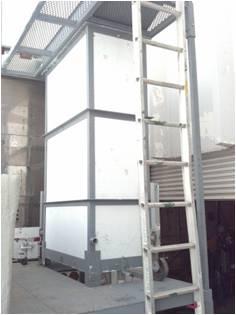
Front of the Pilot Unit

Is It Possible to Digest Dry or Solid Manure?

This new anaerobic digestion system has been designed from the ground up based on extension work carried out on Colorado dairy and beef facilities. Previous feasibility studies conducted on these sites indicated that conventional anaerobic digestion was not a recommended technology due to a variety of economic and technical parameters.

However, upon further review, it was found that these constraints were tied to specific technologies, not anaerobic digestion in general. Using an iterative design process, a digestion system was created which could effectively address these problems. In its most basic form, it will efficiently process difficult wastes like Colorado’s dry-lot manures as well as other more conventional waste streams.

What Did We Do?

Colorado State University has a pilot system located on the Foothills Campus. The purpose of this pilot unit is to gather data about the performance of the leachate bay reactor in an integrated system and to provide design criteria for scaling this concept. The system is currently in the inoculation stage. Using a consortium of animal manures and bedding waste generated onsite, the reactors are growing the bacteria needed before further testing can commence.

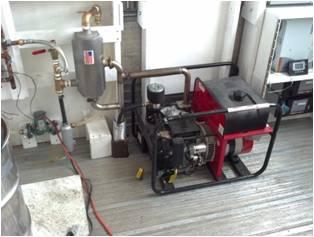
Intrinsic to the design is a three phased process that is tailored to the available substrates. Solid type wastes (Typically >20% total solids) are placed into the leachate bay reactor where liquid (leachate) is passed through, slowly striping away methane forming organic chemicals.

6kW Generator with Heat Exchanger for Heat Reactors with Waste Heat

Slurry wastes (Typically <20% total solids with high suspended solids) can pass into the second stage of the process- the leachate storage tank. This vessel acts as a pre digestion vessel, solids sedimentation basin, and storage tank for the pre-digestion products. Clarified leachate, rich with dissolved organic compounds, is then pumped into the final stage- the high rate reactor. In the high rate reactor process upset is mitigated by providing a very controlled flow rate of the acidic leachate into the reactor. This moderates the pH in the reactor, allowing the methane producing organisms to operate at maximum potential. Quickly degraded waste waters such as: milk processing water, run-off lagoon water, or nearby industrial wastes can be added directly to the high rate reactor.

What Have We Learned?

Solid wastes appropriate for the leachate bay reactor are dry-lot cattle manure, crop residues, equine and poultry manures, among many others. These types of wastes were the important drivers in the breakdown of technical and economic feasibility of conventional digestion systems. Due to the design of the leachate bay reactors though, many of these constraints were avoided and these wastes instead play a powerful role in this systems effectiveness by allowing digestion of often overlooked waste products. Related: Update on this project presented at the 2015 Waste to Worth conference in Seattle.

Manure Loading Dock with LBR

Future Plans

Extensive infrastructure has been built into this pilot unit to facilitate monitoring and logic control of this facility. Ongoing work will be to build out this sensing network. 

Important design parameters will be teased out of the collected data to guide the development of optimization models. With the use of these models, the system can be further modified. Potential technological enhancements include: nutrient recovery from leachate, various flushing procedures to reduce salt loading, and digestion of ligno-cellulotic by-products.

Authors

Sybil Sharvelle, Sybil.Sharvelle@colostate.edu

Lucas Loetscher, Graduate Reseach Assistant, Colorado State University

Sybil Sharvelle, Assistant Professor, Colorado State University

Acknowledgements

  • Colorado Agriculture Experiment Station
  • Colorado NRCS
  • Colorado Bioscience Discovery Grant
  • Colorado Governors Energy Office

The authors are solely responsible for the content of these proceedings. The technical information does not necessarily reflect the official position of the sponsoring agencies or institutions represented by planning committee members, and inclusion and distribution herein does not constitute an endorsement of views expressed by the same. Printed materials included herein are not refereed publications. Citations should appear as follows. EXAMPLE: Authors. 2013. Title of presentation. Waste to Worth: Spreading Science and Solutions. Denver, CO. April 1-5, 2013. URL of this page. Accessed on: today’s date.

Feed Management Planners Certification Program to Reduce Nutrient Loads in Impaired Watersheds

Waste to Worth: Spreading science and solutions logoWaste to Worth home | More proceedings….

Why Develop a Feed Management Certification Program?

To develop a program to train ARPAS-certified (American Registry of Professional Animal Scientists) dairy and beef nutritionists on how to prepare and evaluate Feed Management plans as it relates to the NRCS Feed Management (592) practice in Pennsylvania. The objective is to compare how formulated diets match to the consumed diets. Phosphorus is monitored through manure testing and nitrogen by milk urea nitrogen and calculating milk nitrogen efficiency. Dry matter intake efficiency is also monitored as this can affect the total manure volume excreted.

What Did We Do?

In 2007, Mid-Atlantic Water Program (MAWP) scientists applied the national feed management program to meet the needs of dairy consultants to implement feed management in the Chesapeake Basin. This program certifies consultants in precision feed management, a practice that reduces nutrient loads in animal wastes by minimizing the phosphorus and nitrogen content in the feed. 

With the recent release of the US Environmental Protection Agency’s Total Maximum Daily Load for the Chesapeake Bay, the agricultural community is looking for the best practices to control nutrient pollution while minimizing impacts to profit. Over the years, the work of this project team has established precision feed management as both an economically and environmentally viable best management practice.  As such, state watershed implementation plans include precision feed management as a method to meet load allocations.

Pennsylvania currently has twenty-four NRCS qualified nutritionists to write feed management plans. In 2011, fifty-one operations received EQIP or CBWI funding through USDA-NRCS for feed management, with the majority consisting of dairy farms.  An additional 10 farms entered into contracts with NRCS in 2012.  Farms are currently in the process of being assessed on how well they implemented recommendations from the first year of quarterly reports and are working through their second year of implementation.

Additional efforts have been implemented to educate consultants about the regulations and issues affecting dairy producers. Currently, the Pennsylvania team is working with producers to monitor income over feed costs and to develop cash flow plans, which provides the opportunity to implement precision feeding practices while monitoring the economic benefits to the herd.  A study of six component fed dairy herds in Pennsylvania is also being completed to evaluate the effects of the feed, forage, and manure sampling protocols along with feeding order on fecal phosphorus levels and to update current sampling recommendations.

Funding from the MAWP was critical to providing these trainings and projects and establishing precision feed management as a best management practice that farmers can realistically utilize.  The infrastructure is in place to address the demand for more feed management plans and the MAWP will continue to meet the educational needs of this audience.

What Have We Learned?

There are a lot of opportunities on farms to improve feed management and nutrient balance. Challenges have been observed pertaining to nutrient reduction strategies that could impact overall nutrient balances in dairy and beef rations. Many of these challenges are greatly influenced by the volatility in today’s commodity pricing. Producers need to become more engaged in what they are feeding and how it affects their profitability.  It has been observed that inorganic phosphorus is still being used in grain mixtures when rations contain high phosphorus forages or inclusion of byproduct feeds. We have also observed some challenges in obtaining test analyses for complete grain and mineral mixes on a regular basis.  More education is needed for both industry professionals as well as producers.

Future Plans

As the feed management program in Pennsylvania progresses, pounds of phosphorus excreted can be tracked to monitor the effects of reducing phosphorus in dairy and beef rations. This can be used to evaluate its effect on water quality and potential phosphorus accumulations in the soil when manure is applied to crops at nitrogen-based rates. Crop rotations, inclusion of alternative forages and whole farm nutrient balance will be included in future trainings and feed management plans. The Penn State Extension Dairy team is also working on the development of a Feed Management mobile app for producers and nutritionist to be able to track and monitor their progress on nutrient reductions in their rations.

Authors

Daniel Ludwig, Natural Resources Specialist, USDA – NRCS, dan.ludwig@pa.usda.gov

Virginia Ishler, Dairy Complex Manager/Nutrient Specialist, Penn State University

Rebecca White, Program Manager-Penn State Extension Dairy Team

Additional Information

Feed Management for Producers

Pennsylvania NRCS on Feed Management


The authors are solely responsible for the content of these proceedings. The technical information does not necessarily reflect the official position of the sponsoring agencies or institutions represented by planning committee members, and inclusion and distribution herein does not constitute an endorsement of views expressed by the same. Printed materials included herein are not refereed publications. Citations should appear as follows. EXAMPLE: Authors. 2013. Title of presentation. Waste to Worth: Spreading Science and Solutions. Denver, CO. April 1-5, 2013. URL of this page. Accessed on: today’s date.

Valuing Feedstocks for Anaerobic Digestion – Balancing Energy Potential and Nutrient Content

Waste to Worth: Spreading science and solutions logoWaste to Worth home | More proceedings….

Why Study the Interaction Between Energy and Nutrients for Digestion?

To improve the energy production and revenue generation, many farm digester operators are including off-farm feedstocks in the blend.  Off-farm feedstocks are raw materials with high carbon concentrations that can be degraded anaerobically.  Common off-farm feedstocks include food service or retail waste, food processing byproducts, residuals from biofuels production and FOG (fat, oil & grease) resulting from food preparation.  Typically, off-farm feedstocks have a higher energy potential when compared to manure.  Manures generally have biogas potential in the range of 280 to 500 L of biogas/kg of VS, compared to off-farm feedstocks which can range from 300 to 1,300 L of biogas/kg of VS [1].  In addition to the increased biogas production, revenue can also be generated from tipping fees collected for feedstock brought onto a farm.  The tipping fee is typically comparable to the cost of disposing of the material at a landfill or wastewater treatment plant. 

The purpose of this ongoing project is to evaluate the biogas potential and impact on nutrient management of off-farm feedstocks for anaerobic digestion.  

What Did We Do?

The Anaerobic Digestion Research and Education Center (ADREC) has carried out hundreds of biogas methane potential tests (BMP’s) over the past 5 years.  The purpose of the BMP is to evaluate if a feedstock is anaerobically degradable and predict the biogas production under ideal conditions.  As part of the biogas testing, many feedstocks were also characterized for their nutrient composition.

What Have We Learned?

While off-farm feedstocks do offer opportunities to improve the profitability of anaerobic digestion systems, operators must also consider the costs associated with bring material onto the farm.  Water contained in off-farm feedstock contributes to the manure volume and adds cost during land application.  Nutrients contained in feedstocks need to be measured and considered in the context of nutrient management planning.  In addition, the regulatory and record keeping requirements associated with off-farm feedstock should also be factored into any cost-benefit analysis.

Future Plans

ADREC is planning to continue the BMP evaluations as part its normal fee for service activities.

Authors

Dana Kirk, Specialist, Michigan State University, kirkdana@anr.msu.edu

Louis Faivor, Technician, Michigan State Univeristy

Additional Information

http://researchgroups.msu.edu/adrec/about


[1] KTBL.  2012.  Biogas Profitability Calculator.  http://daten.ktbl.de/biogas/showSubstrate.do?zustandReq=3#anwendung


The authors are solely responsible for the content of these proceedings. The technical information does not necessarily reflect the official position of the sponsoring agencies or institutions represented by planning committee members, and inclusion and distribution herein does not constitute an endorsement of views expressed by the same. Printed materials included herein are not refereed publications. Citations should appear as follows. EXAMPLE: Authors. 2013. Title of presentation. Waste to Worth: Spreading Science and Solutions. Denver, CO. April 1-5, 2013. URL of this page. Accessed on: today’s date.

Extension Outreach Response to Livestock Mortality Events Associated With Algal Toxin Production in Georgia Farm Ponds

Waste to Worth: Spreading science and solutions logoWaste to Worth home | More proceedings….

Purpose

Excessive nutrient enrichment in watersheds can create harmful algal blooms (HABs) in aquatic systems, including ponds, which are frequently used to water livestock. Harmful algal blooms are typically dominated by cyanobacteria (commonly referred to as “blue green algae”) many of which produce toxins that can be harmful to fish, wildlife and humans.  In May 2012, our laboratory began receiving reports of cattle mortalities associated with HABs. We began an outreach effort to screen and identify algal species and toxins in water samples submitted by private citizens from ponds throughtout Georgia. Prior to this effort, no state or federal laboratories offered such a service. Private laboratories conduct these services, however the collection protocols and analytical costs preclude the average citizen from utilizing them. Rapid detetion of a HAB is critical for farmers so that access to the water source can be restricted. We recognized the need to provide such a service and to educate the public regarding exposure effects, preventative measures, and treatment of HABs.

During Summer 2012 sampling events we commonly encountered Microcystis blooms in both farm ponds used by humans for fishing and recreation (above) and for watering livestock (below).

What Did We Do?

We documented dense blooms of  planktonic cyanobacteria, predominantly Microcystis aeruginosa, and  extremely high levels of the potent hepatotoxin, Microcystin, in water samples submitted by Georgia cattle producers (Haynie et al. 2013). Many of these samples were submitted by producers who had experienced cattle mortalities, potentially due to algal toxin exposure.

Through a collaborative effort with UGA’s Agriculture and Environmental Services Laboratories, we established a water screening service that includes algal speciation and toxin detection. This service became available to the public in Februrary 2013. This effort included a detailed outreach letter to extension agents, sampling protocol and materials for water sample collection and shipping. This screening service is avalible for either a $30.00 (algal identification) or $45.00 (toxin analysis and algal identification) fee. The submitter will receive an electronic report within 24 hours with results, interpretation, and recommendations.

We have begun promoting this service and educating the public about HABs by participating in various short courses, meetings and outreach opportunities.

What Have We Learned?

We have demonstrated that HABs and cyanotoxins are common in Georgia agriculture ponds. Therefore, the potential for livestock exposure and subsequent effects including mortality are likely to occur. Education and establishment of a rapid toxin detection service is warranted and will be beneficial to producers. The livestock deaths have highlighted an important issue for Georgia farmers and pond owners that will likely be increasingly prevalent under projected climatic models.

Future Plans

We will continue our outreach efforts by participating in University and industry sponsored workshops and meetings. We will use these opportunities to educate and inform the public about the newly available algal screening service. We have included, in recently submitted grants, funding to subsidize testing expenses in order to encourage more farmers/pond owners to use this service. We intend to utilize the testing service to gather spatially referenced data on the prevalence of HABs and toxin levels in GA ponds. This information, which is not currently available,  will inform nutrient management plans and BMPs that will ultimately improve nutrient management and water resources in Georgia.  We hope that this effort will serve as a model for other states experiencing similar increases in frequency and severity of HABs in agricultural settings.

Authors

Rebecca S. Haynie, Post Doctoral Associate, Warnell School of Forestry and Natural Resources, University of Georgia, Athens, GA 30602 hayniers@uga.edu

Susan Wilde, Assistant Professor, Warnell School of Forestry and Natural Resources, University of Georgia, Athens, Georgia 30602

David Kissel, Director and Professor, Agriculture and Environmental Services Laboratory, University of Georgia, 2400 College Station Road, Athens, Georgia 30602-9105

Leticia Sonon, Program Coordinator, Soil, Plant, and Water Analysis Laboratory, University of Georgia, 2400 College Station Road, Athens, Georgia 30602-9105

Uttam Saha, Program Coordinator, Feed and Environmental Water Analysis Laboratory, University of Georgia, 2400 College Station Road, Athens, Georgia 30602-9105

Additional Information

Haynie, R. S., J. R. Morgan, B. Bartelme, B. Willis, J. H. Rodgers Jr., A.L. Jones and S. B. Wilde.  Harmful algal blooms and toxin production in Georgia ponds. (in review). Proceedings of the Georgia Water Resources Conference. Athens, Georgia. April 2013.

UGA Agriculture and Environmental Services Laboratory: http://aesl.ces.uga.edu/

Burtle, G.J. July 2012. Managing Algal Blooms and the Potential for Algal Toxins in Pond Water. University of Georgia Cooperative Extension Temporary Publication 101.

Haynie, R.S., J.R. Morgan, B. Bartelme, S. B. Wilde. Cyanotoxins: Exposure Effects and Mangagement Options. Proceedings of the UGA Extension Beef Cattle Shortcourse. Ed. L. Stewart. Athens, Georgia. January 2013.

News article: https://www.wsbtv.com/news/local/experts-say-toxic-algae-may-pose-threat-kids-pets/242741856/

Acknowledgements

Drs. Lawton Stewart, Gary Burtle (Animal and Dairy Science, College of Agriculture and Environmental Sciences, UGA)  coordinated sample delivery from pond owners to our laboratory. Brad Bartelme, James Herrin and Jamie Morgan (Warnell School of Forestry and Natural Resources, UGA) contributed significant technical assistance with algal screening and sample processing.

The authors are solely responsible for the content of these proceedings. The technical information does not necessarily reflect the official position of the sponsoring agencies or institutions represented by planning committee members, and inclusion and distribution herein does not constitute an endorsement of views expressed by the same. Printed materials included herein are not refereed publications. Citations should appear as follows. EXAMPLE: Authors. 2013. Title of presentation. Waste to Worth: Spreading Science and Solutions. Denver, CO. April 1-5, 2013. URL of this page. Accessed on: today’s date.

Feeding Cattle Without the Feedlot

Waste to Worth: Spreading science and solutions logoWaste to Worth home | More proceedings….

Abstract

Typically cattle producers can have improved animal performance through controlled systems such as an open lot feedlot.  Open lots provide for improved control of diet, health, and monitoring of activity of the animals.  Feeding areas such as these also can have disadvantages such as solid manure accumulation,  surface water contamination when runoff water is uncontrolled, such systems are labor and machine intensive, and can contribute herd health issues because of high stocking densities, dust, or mud.  Forage based grazing can negate many of these issues and is arguably more sustainable and environmentally friendly.  However intensive grazing strategies must be employed to obtain comparable productivity.  Development of technology that allows for these benefits is needed.  Cross fencing and rotational grazing practices would benefit from more flexible and less labor intensive ways of controlling the grazing area.

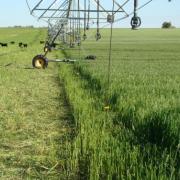
Figure 1. Calves waiting for new windrows of oats.

A device has been developed by UNL Extension that adapts a center pivot irrigation system into a moveable fence by placing the fence on the center pivot structure. Livestock producers can move anywhere from several hundred to several thousand feet of fence by simply moving the center pivot (while not irrigating).  Swath grazing, forage grazing, or crop residue grazing can be accomplished more efficiently by only allowing minimal access to the forage.  Essentially moving the animals to the feed rather than bringing the feed to the animals.  Advancing a cross fence periodically not improves the grazing efficiency, but it encourages a natural spread of manure and gives the producer more control of remaining crop residue, a necessary requirement to maintain pasture status and avoid the Animal Feeding Operation designation.  The device was tested on working farms over a two year period and improved profitability and minimized environmental impact compared to the operator’s previous practices.

Can Intensive Forage Grazing Be Profitable?

The project started from a request for some alternatives to help reduce the cost of gain for feeder calves in 2010.  Eliminating the forage activities of baling / stacking, transporting, grinding, feeding and also the spreading of manure can significantly reduce labor and equipment expenses.    Keeping feeder calves in a grazing operation instead of concentrated feeding operation has the potential to minimize surface water contamination.  The health and welfare of the calf can be improved by having a lower stock density, larger area for exercise, and with crop residue a reduced impact of dusty or muddy conditions.  Forage based grazing is arguably more sustainable and environmentally friendly than concentrated feeding areas.  However intensive grazing strategies must be employed to obtain comparable productivity.  Development of technology that allows for these benefits is necessary.  Cross fencing and rotational grazing practices would benefit from more flexible and less labor intensive ways of controlling the grazing area.

Figure 2. Calves grazing standing oats.

What Did We Do?

The project was focused for fall / winter grazing opportunities for newly weaned spring born calves of the semi-arid region of western Nebraska.  A successful grazing operation of windrowed or standing forage will have to include a method of controlling daily forage intake through cross fencing( Figures 1 & 2).  This would reduce waste and give the producer a feedlot like control of dry matter intake so a desired daily gain could be achieved.  Current portable fencing has to be manually installed and moved which is labor intensive especially in frozen soils.  A new development in portable fencing was developed by UNL Biological Systems Engineering that a device attaches to a center pivot and properly suspends an electrified wire under tension.  This gives the producer a portable cross fence (1,300 ft) that can be moved by the center pivot’s control panel or wirelessly with a computer.

In the fall of 2011 and 2012, four grazing programs were developed to demonstrate this new cross fence.  Two were fall planted oats and two were grazed corn stalk residues.  The fall oats were grazed as a standing forage and also as a windrow.  The corn stalk residue was grazed in a manner to minimize the overgrazing of downed corn ears and reduce the protein supplement.

What Have We Learned?

The projects demonstrated that calves can be successfully maintained in theses grazing systems.   The management and the relocations of the cross fence was done easily done though the center pivot’s control panel (average time of 15 minutes).  The

Figure 3. Natural manure distribution.

forage quality of the windrowed oats maintained its quality throughout the 105 (fall 2011) and the 120 (fall 2012) day grazing period.  In 2011 the oat forage deteriorated only 17% in crude protein and 14% in total digestible nutrients.  In 2012 the oat forage deteriorated only 2% in crude protein and 3% in total digestible nutrients.  Cost savings in the fall oat grazing are reported at$7,268.85 total or $28.70 / ton grazed ($22.16 per head) for 105 days in the 2011 trial.  In the 2012 trial the savings were a total of $4,625.60 or $29.50 / ton ($25.70 per head) for a 120 day trial.  The cost savings for the corn stalk residue weren’t measured.  The project only demonstrated the control of grain intake in the calves or cow, which it accomplished.  The manure was naturally spread throughout the fields and the cattle health and welfare was maintained (Figure 3).

Future Plans

A future plan is being developed to continue to demonstrate the ability to control dietary intake of calves or cows on irrigated forages.  With a portable and mechanically moveable cross fence the conveniences of a concentrated feeding operation can be placed into a grazing operation in large scale.

Authors

Jason Gross, Engineering Tech, UNL Extension, jgross3@unl.edu

Additional Information

http://water.unl.edu/web/manure/small-afos

The authors are solely responsible for the content of these proceedings. The technical information does not necessarily reflect the official position of the sponsoring agencies or institutions represented by planning committee members, and inclusion and distribution herein does not constitute an endorsement of views expressed by the same. Printed materials included herein are not refereed publications. Citations should appear as follows. EXAMPLE: Authors. 2013. Title of presentation. Waste to Worth: Spreading Science and Solutions. Denver, CO. April 1-5, 2013. URL of this page. Accessed on: today’s date.