
System for Treating Livestock Wastewater Using Electrochemistry to Recover the Nitrogen and Phosphorus

Purpose

Conservation and recovery of nitrogen (N) and phosphorus (P) from livestock, industrial, and municipal effluents are important for economic and environmental reasons.  Therefore, a need exists for improved systems and methods for N and P recovery from wastewater, especially by using fewer chemicals.  A new method was developed using electrochemistry to enhance the gasification and rate of ammonia capture by a gas-permeable membrane and the solubilization and the rate of phosphate capture using P-precipitating compounds.  The process was tested using liquid swine manure.  It recovered 86% of the ammonia and more than 93% of the phosphorus contained in the manure.

What Did We Do?

This work aimed to develop new technology for simultaneous N and P recovery that eliminates alkali chemicals used to increase pH for quick N capture using gas-permeable membranes (Vanotti and Szogi, 2015), and also eliminates acid chemicals used to solubilize the P in the manure before precipitation with P-precipitating agents (Szogi et al., 2018).  The new N and P recovery system used in this example is described by Vanotti et al., 2024. It has a cathode chamber, an anode chamber, a stripping acid solution tank, and a phosphorus recovery tank (Fig. 1).  The cathode chamber is fitted with a gas-permeable membrane manifold. The cathode chamber is fitted with a gas-permeable membrane manifold and contains a salt solution. The wastewater containing ammonia and phosphorus is pumped into the anode chamber. The ammonium (NH4) in the anode chamber permeates into the cathode chamber through a cation exchange membrane placed between chambers.  The cathode increases the pH of the liquid and accelerates the rate of passage of ammonia through the gas-permeable membrane into an acid-stripping solution contained in a stripping tank/ reservoir and recirculated through the membrane manifold in a closed loop. The wastewater in the anode chamber is acidified by H+ released by electrolysis in the anode.  The anode chamber effluent, with most of the P solubilized, is passed through a centrifuge or filter to separate suspended solids without phosphorus and liquid filtrate/centrate with phosphate. Phosphorus precipitating compounds used were MgCl2 and Ca(OH)2.   After rapid mixing, the phosphorus precipitates as a solid.  This precipitation proceeds quickly as a result of the previous removal of the carbonate alkalinity in the anode chamber, which interferes with phosphate precipitation.
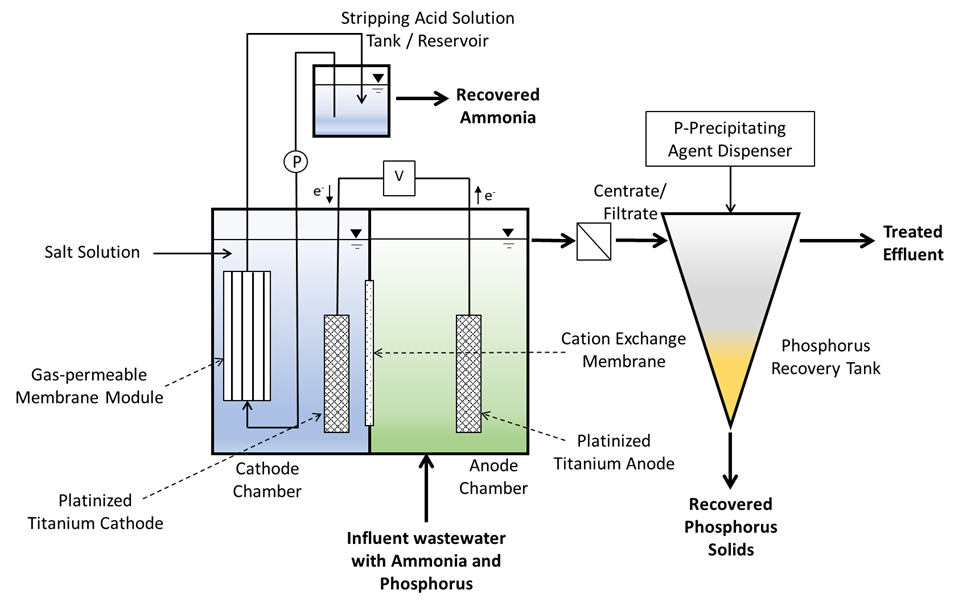
Figure 1. Schematic diagram of an embodiment of a nitrogen (N) and phosphorus (P) recovery system using electrochemistry (Vanotti et al., 2024).

What Have We Learned?

In tests with liquid swine manure, the pH in the cathode chamber was increased due to the electrochemical production of OH-, from 5.8 to 12.5 (Fig. 2).  The wastewater’s ammonia was removed from the anode chamber and recovered in the stripping acid solution with 86% recovery efficiency (Fig. 3).
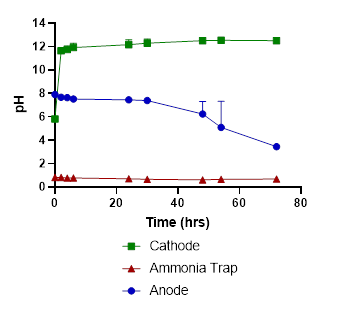
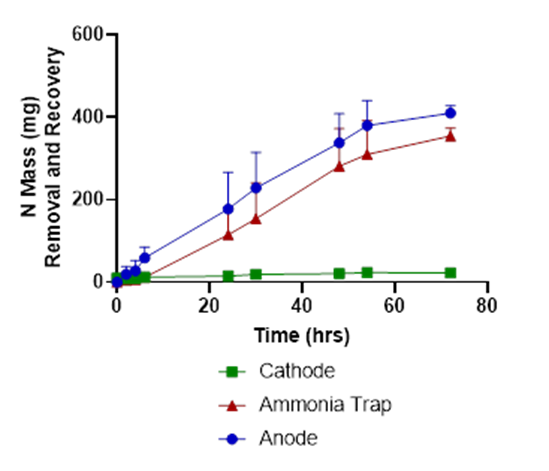
Figure 2.  pH in anode chamber, cathode chamber, and stripping acid tank.  
Figure 2.  pH in anode chamber, cathode chamber, and stripping acid tank.
Figure 3.  Ammonia-N mass removal in anode chamber and ammonia-N mass recovery in cathode chamber and stripping acid tank.

The wastewater pH in the anode dropped from 7.9 to 3.5, and carbonate alkalinity dropped from 10750 mg/L to 0 mg/L (Figures 2 & 4).  The acid was produced by oxidation at the anode (2 H2O → O2 + 4 H+).  These conditions transformed the P from manure particles into soluble phosphates that were efficiently recovered in the phosphorus recovery tank.   For example, using the P-precipitating compound Ca(OH)2, the process recovered 93% of the total P in a P precipitate solid compared to only 4.6% in a control without electrochemical treatment (Fig. 5).  Using the P-precipitating compound MgCl2, the process recovered 95% of the total P in a P precipitate solid compared to only 6% P recovery in a control without electrochemical treatment (Fig. 5).

Figure 4. Reduction of carbonate alkalinity concentration occurring in the anode chamber. 
Figure 4. Reduction of carbonate alkalinity concentration occurring in the anode chamber.
Figure 5. Phosphorus is recovered in the solid precipitate using P-precipitating compounds Ca(OH)2 or MgCl2.  A) with a previous electrochemical step, and B) without an electrochemical step.  
Figure 5. Phosphorus is recovered in the solid precipitate using P-precipitating compounds Ca(OH)2 or MgCl2.  A) with a previous electrochemical step, and B) without an electrochemical step.

Future Plans

USDA-ARS seeks a commercial partner to bring this technology to market.  For more information on commercialization, contact: Mrs. Tanaga Boozer, Technology Transfer Coordinator, USDA-ARS, OTT Southeast Area, tanaga.boozer@usda.gov

Authors

Presenting & corresponding author

Matias Vanotti, USDA-ARS, Matias.vanotti@usda.gov

Additional authors

M.B. Vanotti, A.A. Szogi, P.W. Brigman, and S. Rawal, United States Department of Agriculture (USDA), Agricultural Research Service (ARS), Coastal Plains Soil, Water and Plant Research Center, Florence, South Carolina.

Additional Information

Szogi A.A., Vanotti, M.B., Shumaker, P.D. 2018.  Economic recovery of calcium phosphates from swine lagoon sludge using Quick Wash process and geotextile filtration. Frontiers in Sustainable Food Systems 2, 37, https://doi.org/10.3389/fsufs.2018.00037.

Vanotti, M.B., and Szogi, A.A. 2015. Systems and methods for reducing ammonia emissions from liquid effluents and recovering ammonia. U.S. Patent 9,005,333 B1. U.S. Patent and Trademark Office.

Vanotti, M.B., Szogi, A.A., Brigman, P.W., and Rawal, S. 2024. Systems for treating wastewater using electrochemistry. U.S. Patent Appl. 18/808,123. U.S. Patent and Trademark Office

Acknowledgements

This research was part of USDA-ARS National Program 212, ARS Project 6082-12630-001-00D. Mention of trade names or commercial products in this article is solely for the purpose of providing specific information and does not imply recommendation or endorsement by the U.S. Department of Agriculture.


The authors are solely responsible for the content of these proceedings. The technical information does not necessarily reflect the official position of the sponsoring agencies or institutions represented by planning committee members, and inclusion and distribution herein does not constitute an endorsement of views expressed by the same. Printed materials included herein are not refereed publications. Citations should appear as follows. EXAMPLE: Authors. 2025. Title of presentation. Waste to Worth. Boise, ID. April 711, 2025. URL of this page. Accessed on: today’s date.
Electrochemical K-struvite formation for simultaneous phosphorus and potassium recovery from hog and dairy manures

Purpose

Intensive animal husbandry produces large  volumes of liquid manure with significant amounts of phosphorus, ammonium, and potassium as they pass through the feed of farm animals. As a result, direct land application of manure, the current common approach, causes environmental concerns such as soil over-fertilization and groundwater and surface water contamination, which leads to eutrophication. Manure nutrient management is, therefore, necessary to address these problems. While most engineering options are focused on phosphorus and ammonium recovery, few studies have pursued recovery methods for potassium. In this talk, we present an electrochemical technology using a sacrificial magnesium anode and a stainless-steel cathode for simultaneous recovery of phosphorus and potassium in the form of potassium-magnesium-phosphate (KMgPO4·xH2O, K-struvite).

Mg2+ + K+ + HnPO4n-3 + 6H2O = KMgPO4*6H2O + nH+

K-struvite has the potential to be used as a slow-release fertilizer and this technology will add flexibility to the  manure management strategies currently available by diversifying the recoverable by-products.

What Did We Do?

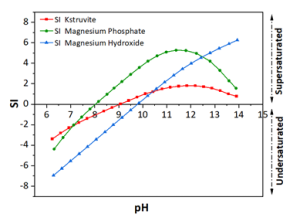
Figure 1. Calculated saturation index values as a function of pH. The water matrix contains 3000 mg/L potassium, 1000 mg/L phosphate, and magnesium with Mg:P ratio of 1.4.

To predict the thermodynamic stability of K-struvite, a thermodynamic model was developed based on the average ion concentrations of phosphorus, and potassium measured in real liquid pig manure (Figure 1). According to this model, magnesium phosphate is a possible by-product of K-struvite precipitation. Also, the probable formation of magnesium hydroxide was enhanced with increasing pH value due to the increase in hydroxide ion concentration. As a result, the ideal range for precipitation of K-struvite lies at pH values between 10 and 11.

To understand the role of pH on K-struvite formation, a 50 mM KH2PO4 solution was used to perform the preliminary batch electrochemical experiments. A constant voltage of -0.8 V vs. the Ag/AgCl reference electrode was applied to the pure magnesium anode using a potentiostat. One experiment was performed on the natural pH of the initial solution, 4.5, while potassium hydroxide was used to raise the initial pH of the second experiment to 9.5.

What Have We Learned?

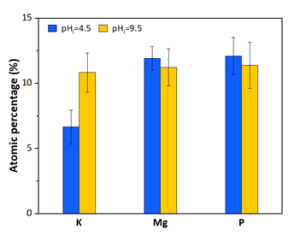
Figure 2. The EDS results obtained of the recovered precipitates (a) pH=4.5, (b) pH=9.5 in 50 mM KH2PO4.

Energy-dispersive x-ray spectroscopy (EDS) of the recovered precipitates (Figure 2) indicate that by raising the initial pH from 4.5 to 9.5 the amount of potassium is increased in the precipitates. Also, due to the equimolar ratios of K:Mg:P at pH=9.5, the produced precipitates are likely K-struvite, while the pH= 4.5 sample likely contains some amount of magnesium phosphate.

This process also eliminates the disadvantages of the commonly used chemical precipitation methods, including magnesium salt dosing, and adding base to the system for pH control, due to in situ magnesium corrosion and hydroxide production at the magnesium anode surface. These advantages could potentially reduce the operating cost of the system and eliminate the addition of unnecessary salinity to wastewater through magnesium salt dosing.

Future Plans

Further investigation by using multiple characterization techniques (e.g., x-ray diffraction (XRD) and Fourier transform infrared spectroscopy (FT-IR)) is necessary to identify the exact nature of precipitates. The initial experiments will be repeated at additional pH values to further understand the role of pH on the precipitation of K-struvite in the simplified synthetic wastewater and to further detail the characterization of the composition and morphology of K-struvite precipitates. These experiments are valuable , particularly because there are few literature reports that detail the physical and chemical structure of K-struvite.

Authors

Presenting author

Amir Akbari, Ph.D. Candidate, Department of Chemical and Biomedical Engineering, Pennsylvania State University

Corresponding author

Lauren F. Greenlee, Associate Professor, Department of Chemical and Biomedical Engineering, Pennsylvania State University

Corresponding author email address

greenlee@psu.edu


Additional Information

Once completed, future publications and data repository information will be available at https://sites.psu.edu/greenlee/

Acknowledgements

The authors would like to thank the U.S. Department of Agriculture, NIFA AFRI Water for Food Production Systems (#2018-68011-28691) for providing the funding support of this research through the “Water and Nutrient Recycling: A Decision Tool and Synergistic Innovative Technology” project.


The authors are solely responsible for the content of these proceedings. The technical information does not necessarily reflect the official position of the sponsoring agencies or institutions represented by planning committee members, and inclusion and distribution herein does not constitute an endorsement of views expressed by the same. Printed materials included herein are not refereed publications. Citations should appear as follows. EXAMPLE: Authors. 2022. Title of presentation. Waste to Worth. Oregon, OH. April 18-22, 2022. URL of this page. Accessed on: today’s date.