The cover of the Watershed Management Resources DVD
The Watershed Management Resources DVD is an interactive e-learning tool created by Agriculture and Agri-Food Canada. It was created for a wide variety of audiences including watershed groups, government and non-government organizations, post-secondary students , agricultural producers and any others who wish to learn more about water quality, water sampling and integrated watershed management. This tool promotes a synergistic approach to watershed management and increases leadership capacity by encouraging all members of a watershed community to work together to reduce harmful impacts to watersheds and to monitor their watershed for improvements.
What Did We Do?
A screen shot of the Welcoming page in the Surface Water Sampling section of the DVD
Agriculture and Agri-Food Canda used past experiences and current information to create a trilingual (English, French and Spanish) set of educational modules. This self-paced DVD provides users with interactive flash animations, video clips and text screens which educates about issues of water quality, beneficial management practices (BMPs) and watershed management. The DVD is available free of charge to any interested parties.
What Have We Learned?
A screen shot of the Hydrologic Cycle Animation that is found on the DVD.
Integrated watershed management is a complex topic and involves all types of people with varying levels of knowledge. Any type of educational tool that can be used to help stakeholders better understand their watersheds and how to appropriately monitor and manage them are very useful.
Future Plans
To continue to find ways to extend our knowledge to the sector.
Authors
Serena McIver, Senior Water Quality Engineer, Agriculture and Agri-Food Canada, serena.mciver@agr.gc.ca
Additional Information
More information on the organization and agriculture in Canada can be found at www.agr.gc.ca
The authors are solely responsible for the content of these proceedings. The technical information does not necessarily reflect the official position of the sponsoring agencies or institutions represented by planning committee members, and inclusion and distribution herein does not constitute an endorsement of views expressed by the same. Printed materials included herein are not refereed publications. Citations should appear as follows. EXAMPLE: Authors. 2013. Title of presentation. Waste to Worth: Spreading Science and Solutions. Denver, CO. April 1-5, 2013. URL of this page. Accessed on: today’s date.
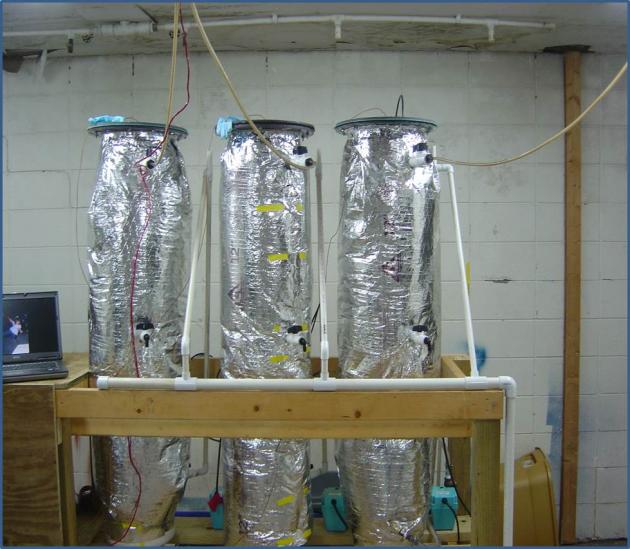
Ninety liter (90 L) anaerobic digesters (anaerobic filters) were constructed from PVC pipe. The digesters were filled with lava rock. A thermocouple is placed in the center of each digester to be used in controlling temperature. Each digester is controlled by a datalogger by reading temperature and turning on or off pumps to circulate water around digester maintaining temperature at 35 oC. Biogas is collected in a tipping bucket and recorded on datalogger.
Abstract
Consumers demand high quality fruits and vegetables. As a result, packing sheds around the country cull or remove bad fruits and vegetables prior to packing then in boxes for shipment to stores. The culling process produces millions of pounds of waste fruits and vegetables annually. This culled fruit or vegetable then has to be disposed of in some form or fashion. Therefore, a project was designed to investigate the feasibility of using culled onions in conjunction with dairy waste to produce methane gas. The experiment used 90 liter downflow anaerobic filters to process a 50/50 mix of onion juice and dairy waste. Results from this study indicate the co-digestion of culled onions and dairy waste provides a good way to dispose of the waste onions while at the same time producing a renewable energy that can potentially be used in the packing shed where the onions are separated. The 50/50 blend of onion waste and dairy waste has consistently returned an average of 15 liters of biogas (70-75% methane) per 3 liters of mixed waste entering the digesters with a cleaning efficiency over 85%.
Why Look at Food Waste for Co-Digestion with Manure?
Culled onions or any fruit and vegetable has to be disposed. Some of these are fed to animals, but some are thrown on fields and potentially tilled into the soil. However, if they are piled and allowed to decay in place the liquid produced during the decaying process can have a high chemical oxygen demand (COD). If this liquid is allowed to run into waterbodies they could be polluted or if allowed to infiltrate could be transferred to a waterbody through underground movement. Therefore, this project investigated the characteristic of liquid produced from decaying onions as well as the feasibility of using waste onions along with dairy waste to produce methane gas in anaerobic digesters. If feasible, the culled onions (or other fruits and vegetables) could be used as a source of energy verses a disposal issue.
What Did We Do?
The experiment had two parts. The first part placed whole onions in a steel tank on a 2 foot bed of sand where the onions could naturally decay. The liquid along with any rainwater was collected in portions and tested for its pH and Chemical Oxygen Demand. Additionally, waste onions were juiced and mixed with dairy wastewater in a 50/50 mixture and used as feedstock for an anerobic filter digester. Temperature was controlled in the mesophilic range and biogas was measured.
What Have We Learned?
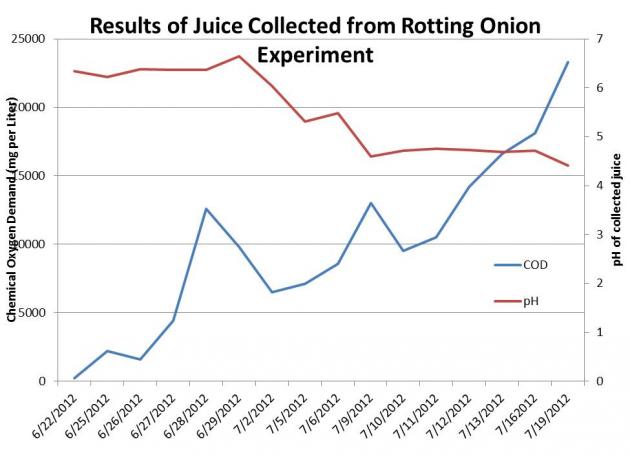
As expected, the decaying onions release a liquid that over time increases the COD profile of the liquid draining from the decaying pile. It is expected that if onions were continually piled on the same spot, the COD and pH of the liquid would equalized at a COD value measured to be approximately 80 g/L and the pH would drop to approximately 3.5 (these numbers based on some previous studies and bench scale observations). The data also suggest that, and as would be expected, onions decay faster in the summer months as opposed to winter months in Georgia. It was also found that a 50/50 mix of onion waste and dairy wastewater fed to a pilot scale mesophilic anaerobic filter fed at 3 liters per day and a retention time of 7 days will produce approximately 15 liters of biogas daily with a methane composition of 70-75%. The treatment level of the influent was also found to average greater than 85%.
The Chemical Oxygen Demand (COD) of liquid collected from the bottom of a tank full of decaying onions increases over time. Likewise, the pH of the liquid decreases. If these onions are disposed of in a wet area or area adjacent to a waterbody, the stream would be affected by the high COD and low pH liquid.
Biogas production from the mixed 50/50 onion/dairy waste fed at a rate of 3 liters per day. The methane composition of the biogas ranged from 70-75%. Treatment efficiencies of the waste, based on COD reduction, averaged greater than 85% (over 20 g L-1 influent to less than 2 gL-1 in effluent).
Future Plans
Future plans will be continue the investigation of using waste onions (and other fruit and vegetables) as a feedstock for anaerobic digesters. This feedstock, which is very available in onion growing regions seasonally, liquid from the onions can be stored over time (as observed in other research project) to provide a year round feedstock for the production of methane gas. As we now know that the decaying onions release a liquid that has a high COD, using the onions for production of energy may reduce potential problems with water pollution as well as provide growers with additional income streams. Plans will be to continue this work and look at optimizing the feed rate and mix ratios.
A few articles have been written about the project, research papers will be written in the near future.
Acknowledgements
The Vidalia Onion Research Committee and the USDA-AFRI Speciality Crops Initative
The authors are solely responsible for the content of these proceedings. The technical information does not necessarily reflect the official position of the sponsoring agencies or institutions represented by planning committee members, and inclusion and distribution herein does not constitute an endorsement of views expressed by the same. Printed materials included herein are not refereed publications. Citations should appear as follows. EXAMPLE: Authors. 2013. Title of presentation. Waste to Worth: Spreading Science and Solutions. Denver, CO. April 1-5, 2013. URL of this page. Accessed on: today’s date.
The online Bioenergy Training Center provides educational training resources for Extension educators focused not only on the technical feasibility of bioenergy generation, but also on approaches and processes that assist communities in understanding the comprehensive implications of bio-based alternative energy. The intended outcome of the courses is to bring viable bioenergy projects into communities by providing Extension educators with tools and knowledge they can use to make this happen.
What Did We Do?
Developed three peer-reviewed, research-based online modular courses. Content was developed by experts from across the North Central Region. Included in one of the modules is a bioenergy and renewable energy community assessment toolkit.
Screen shot of the front page of the Bioenergy Training web site.
What Have We Learned?
The curriculum went live on the web in February 2013. We have not received any feedback on it to date. However, based on the reviews of individuals who used the bioenergy and renewable energy community assessment toolkit in 2012, it does a very good job of helping developers and communities objectively assess renewable energy projects.
Future Plans
Use the curriculum as a foundation for distance learning courses targeting other audiences.
Authors
M. Charles Gould, Extension Educator, Michigan State University, gouldm@msu.edu
Over 50 individuals participated in some aspect of curriculum development.
Additional Information
The Bioenergy Training Center web site is being revamped. It will be posted here at a later date.
Acknowledgements
Curriculum materials and training programs of ‘The Bioenergy Training Center’ were made possible through a grant from the National Water Resources Program, National Institute of Food and Agriculture, U.S. Department of Agriculture. NIFA/USDA Agreement No. WISN-2007-03790. Project Title: “Energy Independence, Bioenergy Generation and Environmental Sustainability: The Role of a 21st Century Engaged University”.
The authors are solely responsible for the content of these proceedings. The technical information does not necessarily reflect the official position of the sponsoring agencies or institutions represented by planning committee members, and inclusion and distribution herein does not constitute an endorsement of views expressed by the same. Printed materials included herein are not refereed publications. Citations should appear as follows. EXAMPLE: Authors. 2013. Title of presentation. Waste to Worth: Spreading Science and Solutions. Denver, CO. April 1-5, 2013. URL of this page. Accessed on: today’s date.
Computer models are excellent ways to integrate years of scientific research into decision tools that producers and policy makers can use to reduce the environmental impact of agricultural phosphorus. Models are playing more important roles in efforts to manage phosphorus at the farm and watershed scales, so it is increasingly important to make sure models are well developed to meet the needs of users, give reliable predictions, and are consistently updated to keep pace with scientific knowledge.
What Did We Do?
Our research over the past 10 years has concentrated on developing scientifically sound, reliable models that can be used to better manage agricultural phosphorus. This includes developing state-of-the-art models for soil phosphorus cycling and loss to the environment in surface runoff and leaching from soils, manures, and fertilizers. We have also concentrated on making sure models of different complexity, from daily processed-based models to annual empirical models, are based on the same principles and give similar predictions so there are a variety of model choices available to meet user needs.
What Have We Learned?
It is certainly possible to develop reliable, scientifically sound, phosphorus management models, as our research success demonstrates. The best model development requires interdisciplinary collaborations and excellent communication between experimentalists, model developers, and model users. Such a framework of interconnected experimentation and model development should symbiotically advance the science of agricultural P and environmental protection beyond the point that the two proceeding independently can achieve.
Future Plans
Model development research continues to make sure that available models are kept up to date with scientific knowledge and meet the needs of users concerning ease of use and data requirements.
Authors
Peter Vadas, Dairy Systems Scientist, USDA-ARS Dairy Forage Research Center, peter.vadas@ars.usda.gov
The authors are solely responsible for the content of these proceedings. The technical information does not necessarily reflect the official position of the sponsoring agencies or institutions represented by planning committee members, and inclusion and distribution herein does not constitute an endorsement of views expressed by the same. Printed materials included herein are not refereed publications. Citations should appear as follows. EXAMPLE: Authors. 2013. Title of presentation. Waste to Worth: Spreading Science and Solutions. Denver, CO. April 1-5, 2013. URL of this page. Accessed on: today’s date.
Onions are valued as food and medicine primarily for the flavor and medicinal properties of their sulfur compounds. A field study was conducted at KSU Research Farm. The soil in five plots was mixed with sewage sludge, five plots were mixed with yard waste compost, five plots were mixed with laying hen manure each at 15t acre-1, and five unamended plots that never received soil amendments were used for comparison purposes. Plots were planted with onion, Allium cepa L. var. Super Star-F1. The objectives of this investigation were to: i) determine the concentrations of organosulfur compounds (dipropyl disulfide and dipropyl trisulfide) in onion bulbs and ii) investigate the effect of mixing soil with three amendments (sewage sludge, yard waste, and chicken manure) on the concentration of sulfur compounds in onion bulbs. Gas chromatographic/mass spetrometric (GC/MS) analyses of onion oil in chloroform extracts revealed the presence of two major fragment ions that correspond to dipropyl disulfide and -trisulfide. Concentration of these two organic sulfur compounds was greatest (1.5 and 0.8 mg 100 g-1 fresh weight, respectively) in onion bulbs of plants grown in chicken manure and lowest (0.4 and 0.07 mg 100 g-1 fresh weight, respectively) in onion bulbs of plants grown in yard waste compost treatments. We concluded that chicken manure could be exploited in growing onions with health-promoting properties.
Why Study Chicken Manure and Onions?
The objectives of this investigation were to: i) determine the concentrations of organosulfur compounds (dipropyl disulfide and dipropyl trisulfide) in onion bulbs and ii) investigate the effect of mixing soil with three amendments (sewage sludge, yard waste, and chicken manure) on the concentration of sulfur compounds in onion bulbs.
What Did We Do?
A field study was conducted on a Lowell silty-loam soil (2.0% organic matter, pH 7) at Kentucky State University Research Farm, Franklin County, KY. Plots (n=20) of 2 ×10m each were separated using grass strips to prevent cross contamination between adjacent treatments. The soil in five plots was mixed with sewage sludge (SS) from Metropolitan Sewer District, Louisville, KY at 15 t acre-1 (on dry weight basis). Five plots were mixed yard waste (YW) compost made from yard and lawn trimmings, and vegetable remains (Con Robinson Co., Lexington, KY) at 15 t acre-1 (on dry weight basis), and five plots were mixed with chicken manure (CM) obtained from University of Kentucky Poultry Research Facility, Lexington, KY at 15 t acre-1. The native soil in five plots was used as a no-mulch (NM) control treatment (roto-tilled bare soil) for comparison purposes. Amendments were incorporated into the topsoil with a plowing depth of 15 cm. Seedlings of onion, Allium cepa var. Super Star F1 were planted under the four soil management practices. At harvest, onion bulbs were blended with chloroform. After cleaning-up the extract, one μL (n=3) of the filtrate was injected into a gas chromatograph (GC) model 5890A equipped with a mass spectrometric detector (GC/MSD) model 5971A operated in total ion monitoring with electron impact ionization (EI) mode and 70 eV electron energy for identification and confirmation of individual peak. Concentrations of the two sulfur compounds (dipropyl disulfide and dipropyl trisulfide) in onion bulbs grown under four soil management practices were statistically analyzed using ANOVA. Means were compared using Duncan’s multiple range test.
What Have We Learned?
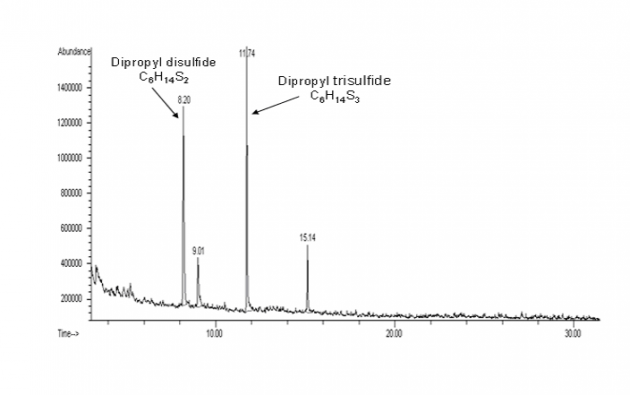
Mass spectrometric analysis of purified chloroform extracts prepared from onion bulbs revealed the presence of two organosulfur compounds, dipropyl disulfide and dipropyl trisulfide (Figure 1). Analyses of onion bulbs of plants grown under three soil management practices and plants grown in no-mulch treatments showed fragments with identical molecular ions at m/z 150 (Figure 2) and at m/z 182 (Figure 3), along with other characteristic fragment ions which are consistent with the assignment of the molecular formula of dipropyl disulfide (C6H14 S2) and dipropyl trisulfide (C6H14 S3), respectively, known as major constituents of onion bulbs. Dipropyl disulfide spectral data, which showed a molecular ion peak (M+) at m/z 150, were in agreement with those previously reported in onion bulbs. [1] Dipropyl trisulfide was also assigned on the basis of its mass fragmentation pattern, which gave a molecular ion peak (M+) at m/z 182, along with other characteristic fragment ion peaks as determined by GC/MSD in total ion mode. Figures 2 and 3 also indicated that the two sulfur compounds have a common fragment ion at m/z 48 that can be used for monitoring dipropyl disulfide and –trisulfide in onion extracts. Concentrations of dipropyl disulfide and dipropyl trisulfide were significantly higher (P< 0.05) in onion bulbs of plants grown in soil amended with chicken manure compared to other soil treatments (Figure 4). This response may be due to improved soil porosity, soil water holding capacity and nutrient retention in chicken manure treated soil. There were about 1.5 mg of the disulfide and 0.8 mg of the trisulfide per 100 g onion bulb. These results are in agreement with the results reported by the onion oil manufacturer and wholesaler in India (Shiva Exports India-2007), [2] who reported that out of all the compounds present in onion, dipropyl disulfide comprises the largest amount of the sulfur compounds present in onion oil.
Chicken manure used in this study was obtained from laying hens fed diets containing 19% crude protein and approximately 0.8% sulfur amino acids, which provided approximately 0.2% sulfur to the diet. Other minor sources of sulfur in the diet were sulfate salts of several trace minerals. The diets were formulated to meet or exceed the requirements published by the National Research Council [3] and commercial feeding recommendations. To the best of our knowledge, no reports in the literature have documented the importance and value of chicken manure in increasing organic sulfur compounds, having health-promoting activity. >
Figure 1. Gas chromatographic-mass spectrometric (GC/MS) chromatogram of onion, Allium cepa L. var. Super Star-F1 extract prepared in chloroform.
Figure 2. Electron impact mass spectrum of dipropyl disulfide (C6H14S2) extracted from onion, Allium cepa L. var. Super Star F1 bulbs indicating the molecular ion m/z 150.
Figure 3. Electron impact mass spectrum of dipropyl trisulfide (C6H14S3) extracted from onion, Allium cepa L. var. Super Star F1 bulbs indicating the molecular ion m/z 182, along with other characteristic fragments ions.
Figure 4.Concentrations of dipropyl disulfide (upper graph) and dipropyl trisulfide (lower graph) in onion bulbs of plants grown in soil amended with chicken manure (CM), sewage sludge (SS), yard waste (YW), and no-mulch (NM) soil. Statistical comparisons were carried out between soil treatments. Bars accompanied by different letter are significantly different (P< 0.05) from each other, using Duncan’s multiple range test.
Future Plans
Future objectives will include the impact of soil amendments on the nutritional composition of field-grown vegetables and monitoring bioaccumulation of trace-elements in edible plants.
Authors
Eric T. Turley, Co-Investigator, Kentucky State University-College of Agriculture, Food Science, and Sustainable Systems- Division of Environmental Studies and Sustainable Systems, Frankfort, KY 40601, USA, eric.turley@kysu.edu
Regina R. Hill, Research Assistant, Kentucky State University-College of Agriculture, Food Science, and Sustainable Systems- Division of Environmental Studies and Sustainable Systems, Frankfort, KY 40601, USA
George F. Antonious, Professor, Kentucky State University –College of Agriculture, Food Science, and Sustainable Systems- Division of Environmental Studies and Sustainable Systems, Frankfort, KY 40601, USA
Acknowledgements
We thank Jami Rogers for her assistance in preparing onion extracts. This investigation was supported by a grant from USDA/CSREES to Kentucky State University under agreement No KYX-10-08-43P.
The authors are solely responsible for the content of these proceedings. The technical information does not necessarily reflect the official position of the sponsoring agencies or institutions represented by planning committee members, and inclusion and distribution herein does not constitute an endorsement of views expressed by the same. Printed materials included herein are not refereed publications. Citations should appear as follows. EXAMPLE: Authors. 2013. Title of presentation. Waste to Worth: Spreading Science and Solutions. Denver, CO. April 1-5, 2013. URL of this page. Accessed on: today’s date.
Ammonia volatilization is a major component of the nitrogen balance of a feedyard, and the effects of ammonia loss range from the economic (loss of manure fertilizer value) to the environmental (air quality degradation, overfertilization of ecosystems). Although not yet regulated, ammonia emissions from cattle are required to be reported under the Emergency Planning and Community Right to Know Act. Emission factors are used to estimate ammonia emissions for purposes of reporting and national inventories, but current emission factors are based on limited data. Our objective was to definitively quantify ammonia emissions and emission factors from commercial feedyards on the southern High Plains of Texas.
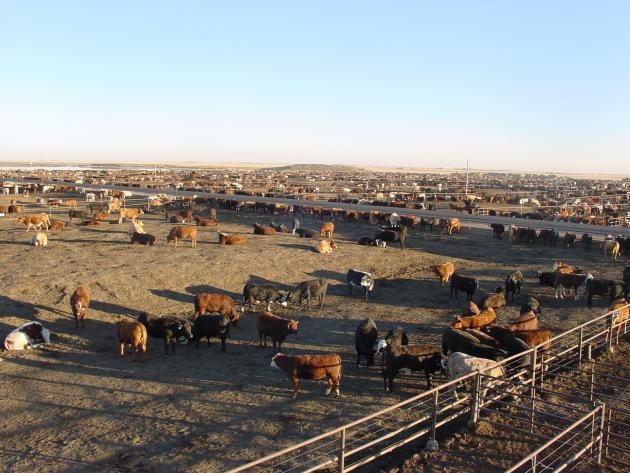
A typical feedyard on the High Plains of Texas. In the foreground, cattle in corrals with a stocking density of about 150 sq. ft./animal. In the background on the left, the runoff water retention pond, and center, a mound of stockpiled manure.
What Did We Do?
Ammonia emissions were quantified at three commercial feedyards in the Texas Panhandle from 2002 to 2008 using micrometeorological methods. Seasonal, intensive measurement campaigns were conducted from 2002 to 2005 at one feedyard, and ammonia emissions were near-continously monitored from 2007-2008 at two more feedyards. Meteorological and cattle management data were also collected.
What Have We Learned?
Ammonia emissions followed a distinct annual pattern. Emissions during summer were about twice those during winter, while spring and autumn emissions were intermediate. Annualized ammonia emissions ranged from 0.20 to 0.37 lb NH3/animal/day, and averaged 0.26 lb NH3/animal/day over all studies. Ammonia loss as a fraction of nitrogen fed to cattle averaged 41% during winter and 69% during summer; on an annual basis, 54% of fed nitrogen was lost as ammonia. Greatest emissions were observed when crude protein in cattle rations exceeded the nutrient requirements of beef cattle. Mean monthly ammonia emissions were strongly correlated with mean monthly temperature, and the relationship can be used to predict ammonia emissions from southern High Plains feedyards. Cattle feeders that meet recommended crude protein in rations can expect to lose half of fed N as ammonia. We recommend an annual emission factor of 88 lb/head for beef cattle feedyards based on one-time capacity, or 39 lb/head fed, based on a 150-d feeding period.
The annual pattern of ammonia emission rates (ER) followed seasonal temperatures, but also was sensitive to dietary crude protein (CP). Adding distillers grains to rations from March, 2008 to October, 2008 increased crude protein at Feedyard A to as high as 19%. Ammonia emissions greatly increased compared with the previous year and compared with Feedyard E.
Future Plans
Next steps involve using the extensive database from this research to adapt and refine process-based models of ammonia emissions. These models, based on the actual physical and chemical processes that control ammonia loss, will be more generally applicable than emission factors to a wider range of feedyards.
On an annual basis, ammonia emission averaged 0.26 lb per animal per day across the three feedyards and six years of study. Increased ammonia emission at Feedyard A in 2008 was due to high dietary crude protein when distillers grains were added to rations. Using these data and other estimates of ammonia loss from retention ponds and stockpiles, we recommend, for beef cattle fed a diet that meets protein requirements, an annual emission factor of 88 lb/head based on one-time capacity, or 39 lb/head fed, based on a 150-d feeding period.
Authors
Richard W. Todd, Research Soil Scientist, USDA-ARS Conservation and Production Research Laboratory, Bushland, Texas, richard.todd@ars.usda.gov
Richard W. Todd, Research Soil Scientist; N. Andy Cole, Research Leader and Research Animal Scientist (Nutrition); and Heidi M. Waldrip, Research Soil Scientist: USDA-ARS Conservation and Production Research Laboratory, Bushland, Texas.
Additional Information
Cole, N.A., R.N. Clark, R.W. Todd, C.R. Richardson, A. Gueye, L.W. Greene, and K. McBride. 2005. Influence of dietary crude protein concentration and source on potential ammonia emissions from beef cattle manure. J. Anim. Sci. 83:722 731.
Cole, N.A., A.M. Mason, R.W. Todd, M. Rhoades, and D.B. Parker. 2009. Chemical composition of pen surface layers of beef cattle feedayrds. Prof. Anim. Sci. 25:541-552.
Flesch, T.K., J.D. Wilson, L.A. Harper, R.W. Todd, and N.A. Cole. 2007. Determining ammonia emissions from a cattle feedlot with an inverse dispersion technique. Agric. For. Meteorol. 144:139-155.
Hristov, A. N., M. Hanigan, A. Cole, R. Todd, T. A. McAllister, P. M. Ndegwa, A. Rotz. 2011. Ammonia emissions from dairy farms and beef feedlots: A review. Can. J. Anim. Sci. 91:1-35.
Rhoades, M.B., D.B. Parker, N.A. Cole, R.W. Todd, E.A. Caraway, B.W. Auvermann, D.R. Topliff, and G.L. Schuster. 2010. Continuous ammonia emission measurements from a commercial beef feedyard in Texas. Trans. ASABE 53:1823-1831.
Sakirkin, S.L., N.A. Cole, R.W. Todd, and B.W. Auvermann. 2011. Ammonia emissions from cattle-feeding operations. Part 1: issues and emissions. Texas Agricultural Experiment Station Bulletin, Air Quality Education in Animal Agriculture, Issues: Ammonia, December, 2011. p. 1-11.
Sakirkin, S., R.W. Todd, N.A. Cole, and B.W. Avermann. 2011. Ammonia emissions from cattle-feeding operations. Part 2: abatement. Texas Agricultural Experiment Station Bulletin, Air Quality Education in Animal Agriculture, Issues: Abatement, December, 2011. p. 1-11.
Todd, R.W., N.A. Cole, and R.N. Clark. 2006. Reducing crude protein in beef cattle diet reduces ammonia emissions from artificial feedyard surfaces. J. Environ. Qual. 35:404-411.
Todd, R.W., N.A. Cole, M.B. Rhoades, D.B. Parker, and K.D. Casey. 2011. Daily, monthly, seasonal and annual ammonia emissions from southern High Plains cattle feedyards. J. Environ. Qual. 40:1-6.
Todd, R.W., N.A. Cole, H.M. Waldrip, and R.M. Aiken. 2013. Arrhenius equation for modeling feedyard ammonia emissions using temperature and diet crude protein. J. Environ. Qual. 2013. (accepted for publication).
Acknowledgements
Research was supported by CSREES Grant #TS2006-06009 under the direction of Dr. John Sweeten, Resident Director, Texas A&M University AgriLife Research and Extension Center, Amarillo, TX. Larry Fulton, Research Technician, USDA-ARS-CPRL, provided invaluable technical and logistical support and expertise.
The authors are solely responsible for the content of these proceedings. The technical information does not necessarily reflect the official position of the sponsoring agencies or institutions represented by planning committee members, and inclusion and distribution herein does not constitute an endorsement of views expressed by the same. Printed materials included herein are not refereed publications. Citations should appear as follows. EXAMPLE: Authors. 2013. Title of presentation. Waste to Worth: Spreading Science and Solutions. Denver, CO. April 1-5, 2013. URL of this page. Accessed on: today’s date.
Manure generated from concentrated animal feeding operations may serve as a source of steroids in surface water and adversely impact the development of aquatic ecosystems. The objectives of this research were to determine the amount of steroids and metabolites in manure from beef cattle production pens, and runoff from crop production fields.
What Did We Do?
Heifers were treated with zeranol, trenbolone acetate, and 17b-estradiol implants and fed melengestrol acetate, while a second group was not treated with growth promoters. Manure was sampled in the pens during feeding, run-off was collected during rainfall events, after feeding manure was collected, and either composted or stockpiled overwinter. In the following summer both composted and stockpiled manure was spread on a field, with plots subjected three tillage practices. Following application, two rainfall simulation events were conducted: one day (1 DAT) and one month later (30 DAT) to determine the effects of rainfall timing, manure handling (treated compost, untreated compost, treated stockpile and untreated stockpile) and tillage (no-till, moldboard plow+disk and disk) on the runoff losses of steroids.
What Have We Learned?
Simulated rainfall apparatus.
Results from the manure composting showed reduction in steroid concentrations over stockpiling for some compounds in manure samples such as 4-androstenedione, a-zearalenol, and progesterone, though not for all steroids. Very low concentrations of steroids were found in most runoff samples, approaching or below detection limits. Considering only detection frequency, fewer runoff samples showed traces of steroids on the 1 DAT in comparison to the 30 DAT simulations. The amount of rainfall before runoff was initiated was affected by tillage, and was different for the 1 DAT and 30 DAT events. A second year’s study with a smaller set of treatments, and use of a surrogate estrogen applied at known mass showed that disking significantly reduced runoff losses of the steroids. Runoff risk is affected by the storm event needed to initiate runoff, and also the time since manure application.
Soil during rain simulation and tube to take runoff to collection point.
Future Plans
From both the steroid runoff and general manure applications risk perspectives, how the soil receives rainfall changes during the first month after tillage. Therefore, this process needs to be investigated more closely and models predicting runoff have to take these changes into account.
Authors
Charles A. Shapiro, Professor, Department of Agronomy and Horticulture, University of Nebraska-Lincoln, Haskell Agricultural Laboratory, Concord, NE cshapiro@unl.edu
Sigor Biswas, Research Assistant, William L. Kranz, Associate Professor, David P. Shelton, Professor, Simon J. van Donk, Assistant Professor, Biological Systems Engineering; Daniel D. Snow, Associate Professor, Schol of Natural Resources; Shannon L. Bartelt-Hunt, Assistant Professor, Tian C. Zhang, Professor, Civil Engineering; Terry L. Mader, Professor, Animal Science, University of Nebraska-Lincoln; David D. Tarkalson, Soil Scientist, USDA-ARS, Kimberly-ID.
Additional Information
Bartelt-Hunt, S., D. Snow, W. Kranz, T. Mader, C. Shapiro, S. van Donk, D. Shelton, D. Tarkelson, and T.C. Zhang. 2012. Effect of growth promotants on the occurrence of steroid hormones on feedlot soils and in runoff from beef cattle feeding operations. Environ. Sci. Technol. 46(3): 1352-1360.
Biswas, S., C. A. Shapiro, W. L. Kranz, T. L. Mader, D. P. Shelton, D.D. Snow, S. L. Bartell-Hunt, D. D. Tarkalson, S. J. van Donk, T. C. Zhang, S. Enslay. Current knowledge on the environmental fate, potential impact and management of growth promoting steroids used in the US beef cattle industry. J. of Soil and Water Cons. (In press, July 2013 issue).
Acknowledgements
This research was funded by US-EPA Science to Achieve Results (STAR) grant R833423.
The authors are solely responsible for the content of these proceedings. The technical information does not necessarily reflect the official position of the sponsoring agencies or institutions represented by planning committee members, and inclusion and distribution herein does not constitute an endorsement of views expressed by the same. Printed materials included herein are not refereed publications. Citations should appear as follows. EXAMPLE: Authors. 2013. Title of presentation. Waste to Worth: Spreading Science and Solutions. Denver, CO. April 1-5, 2013. URL of this page. Accessed on: today’s date.
Agriculture in Arkansas is under increasing pressure to manage nutrients and sediment in an environmentally sustainable manner. In many sectors of the farming community, this has created severe constraints to remaining economically viable and competitive in today’s global market place. In northwest Arkansas, home to the nation’s second largest broiler poultry production, farmers have been under intense scrutiny and litigation over the last decade, due to downstream water users (i.e., Oklahoma) questioning the role of agriculture in water quality impairment. Also, increasing national attention is being focused on reducing nutrients to the Gulf of Mexico, which will further increase the need of agricultural producers to increase nutrient efficiency while declining groundwater levels in crop producing areas of eastern Arkansas will increase the need for greater water efficiency. The Arkansas Discovery Farm Program was initiated in 2009 to document the effectiveness of conservation practices on “real-world” private farms across the diverse forage, livestock, and row crop agricultural setting across the State.
What Did We Do?
We are monitoring runoff quality from seven farms as we are quantify sediment and nutrient losses from all major row crop and livestock commodities including rice, soybean, corn, cotton, poultry and beef cattle. We are currently monitoring the quality of runoff from 19 fields using automated water quality samplers that are now equipped modems that contact us via cell phone when sampling is initiated. On our row crop fields, we have increased our efforts to monitor irrigation water use and needs. All fields are equipped with turbine-type irrigation flow meters that utilize dataloggers to automatically records flow data. On two farms, we split fields in half and monitored evapotranspiration with atmometers (ET gages) and compared to our computer irrigation scheduler to calibrate the ET gages as an easier field method for irrigation scheduling.
What Have We Learned?
Due to the fact that we have been monitoring runoff since mid-2011 at the longest, we have limited reliable information to present. As our first year, 2011 produced several severe flood-stage storms and 2012 provided a record breaking drought, it is difficult to quantify impact at this point. While the water quality monitoring is a cornerstone, empowering agricultural producers to take ownership in finding solutions to minimize environmental impact is paramount to protecting voluntary efforts for the industry. Our major findings to date have been the willingness of Arkansas farmers in general to embrace the Program, to be environmentally accountable for their actions, and to be proactive rather than reactionary.
Future Plans
We have plans to develop another Discovery Farm in the litigated Illinois River Watershed, Northwest Arkanas. While there is a great deal of interest in developing a commerical forestry Discovery Farm, a lack of potneital funding has limited those plans to date. As we continue to collect data, we hope we can provide timely information on both economic and natural resource sustainability on behalf of Arkansas Agriculture to regulators, lawmakers and other decision makers.
Authors
Andrew Sharpley, Professor, Division of Agriculture, University of Arkansas System, sharpley@uark.edu
Mike Daniels, Professor, Cooperative Extension, Division of Agriculture, University of Arkansas System
Neal Mays, Program Technician, Division of Agriculture, University of Arkansas System
Cory Hallmark, Program Technician, Cooperative Extension, Division of Agriculture, University of Arkansas System
Arkansas Association of Conservation Districts, Arkansas Conservation Commission, Arkansas Natural Resource Conservation Service, Arkansas Farm Bureau
The authors are solely responsible for the content of these proceedings. The technical information does not necessarily reflect the official position of the sponsoring agencies or institutions represented by planning committee members, and inclusion and distribution herein does not constitute an endorsement of views expressed by the same. Printed materials included herein are not refereed publications. Citations should appear as follows. EXAMPLE: Authors. 2013. Title of presentation. Waste to Worth: Spreading Science and Solutions. Denver, CO. April 1-5, 2013. URL of this page. Accessed on: today’s date.
Quantifying the long term environmental impacts of dairy and beef production is complex due to the many interactions among the physical and biological components of farms that affect the amount and type of emissions that occur. Emissions are influenced by climate and soil characteristics as well as internal management practices. Software models are needed to perform an integrated and comprehensive assessment of all important environmental and economic effects of farm management and mitigation strategies. Related: Manure value & economics
What Did We Do?
Figure 1. The Integrated Farm System Model simulates the performance, determines the economics, and predicts the air and water emissions of farm production systems.
Software tools were created that perform whole-farm analyses of the performance, economics and environmental impact of dairy and beef production systems. The Integrated Farm System Model (IFSM) is a comprehensive research tool that simulates production systems over many years of weather to quantify losses to the environment and the economics of production. From the simulated performance and losses, environmental footprints are determined for carbon, energy use, water use and reactive nitrogen loss. Crop, dairy and beef producing farms can be simulated under different management scenarios to evaluate and compare potential environmental and economic benefits. The Dairy Gas Emissions Model (DairyGEM) provides a simpler educational tool for studying management effects on greenhouse gas, ammonia and hydrogen sulfide emissions and the carbon, energy and water footprints of dairy production systems.
What Have We Learned?
Analyses with either the IFSM or DairyGEM tools illustrate the complexity of farming systems and the resultant effect of management choices. Although IFSM was primarily developed and used as a research tool, it is also used in classroom teaching and other education applications. DairyGEM provides an easier and more graphical tool that is best suited to educational use.
Future Plans
Figure 2. DairyGEM is an educational tool for evaluating management effects on air emissions and environmental footprints of dairy production systems.
Development of these software tools continues. Work is currently underway to add the simulation of VOC emissions to both models. Routines are also being implemented to better represent the performance and emissions of beef feed yards.
The IFSM and DairyGEM software tools are available through Internet download [https://www.ars.usda.gov/research/software/?modeCode=80-70-05-00] for use in individual, workshop and classroom education. Reference manuals and other detailed information on the models is also available at this website.
Acknowledgements
Many people have contributed to the development of these models and software tools. Although they can not all be listed here, they are acknowledged in each software program.
The authors are solely responsible for the content of these proceedings. The technical information does not necessarily reflect the official position of the sponsoring agencies or institutions represented by planning committee members, and inclusion and distribution herein does not constitute an endorsement of views expressed by the same. Printed materials included herein are not refereed publications. Citations should appear as follows. EXAMPLE: Authors. 2013. Title of presentation. Waste to Worth: Spreading Science and Solutions. Denver, CO. April 1-5, 2013. URL of this page. Accessed on: today’s date.
As a major contributor in food production, beef production provides a major service to our economy that must be maintained. Production of cattle and the associated feed crops required also impact our environment, and this impact is not well understood. Several studies have determined the carbon footprint of beef, but there are other environmental impacts that must be considered such as fossil energy use, water use, and reactive nitrogen loss to the environment. Because of the large amount of data available to support model evaluation, production systems of the U.S. Meat Animal Research Center were simulated with the Integrated Farm System Model for the purpose of evaluating the environmental impact of the beef cattle produced.
What Did We Do?
The environmental footprints of beef produced at the U.S. Meat Animal Research Center (MARC) in Clay Center, Nebraska were determined with the objective of quantifying improvements achieved over the past 40 years. Relevant information for MARC operations was used to establish parameters representing their production system with the Integrated Farm System Model. The MARC farm, cow calf and feedlot operations were each simulated over recent historical weather to evaluate performance, environmental impact and economics. The current farm operation included 2,078 acres of alfalfa and 2,865 acres of corn to produce feed predominately for the beef herd of 5,500 cows, 1200 replacement heifers and 3,724 cattle finished per year. Spring and fall cow calf herds were fed on 24,000 acres of pastureland supplemented through the winter with hay and silage produced by the farm operation. Feedlot cattle were backgrounded 3 mo on hay and silage and finished over 7 mo on a diet high in corn grain and wet distiller’s grain.
What Have We Learned?
Model simulated predictions for weather year 2011 were within 1% of actual records for feed production and use, energy use, and production costs. A 25-year simulation of their current production system gave a carbon footprint of 10.9 lb of CO2 equivalent units per lb body weight (BW) sold, and the energy required to produce that beef was 11,400 Btu/lb BW. The total water required was 2,560 gallon/lb BW sold, and the water footprint excluding that obtained through precipitation was 335 gallon/lb BW. Reactive N loss was 0.09 lb/lb BW, and the simulated total cost of producing their beef was $0.96/lb BW sold. Simulation of the production practices of 2005 indicate that the use of distiller’s grain in animal diets has had a small impact on environmental footprints except that reactive N loss has increased 10%. Compared to 1970, the carbon footprint of beef produced has decreased 6% with no change in the energy footprint, a 3% reduction in the reactive N footprint, and a 6% reduction in the real cost of production. The water footprint, excluding precipitation, has increased 42% due to greater use of irrigated corn production.
Future Plans
Now that the modeling approach has been shown to appropriately represent beef production systems, further simulation analyses are planned to evaluate beef production systems on a regional and national scale.
Authors
C. Alan Rotz, Agricultural Engineer, Pasture Systems and Watershed Management Research Unit, USDA/ARS al.rotz@ars.usda.gov
B.J. Isenberg, Research Assistant, The Pennsylvania State University
K.R. Stackhouse-Lawson, Director of Sustainability Research, National Cattlemen’s Beef Association
E.J. Pollak, Director, Roman L. Hruska U.S. Meat Animal Research Center, USDA / ARS
Funded in part by The Beef Checkoff and the USDA’s Agricultural Research Service
The authors are solely responsible for the content of these proceedings. The technical information does not necessarily reflect the official position of the sponsoring agencies or institutions represented by planning committee members, and inclusion and distribution herein does not constitute an endorsement of views expressed by the same. Printed materials included herein are not refereed publications. Citations should appear as follows. EXAMPLE: Authors. 2013. Title of presentation. Waste to Worth: Spreading Science and Solutions. Denver, CO. April 1-5, 2013. URL of this page. Accessed on: today’s date.
Manage Cookie Consent
To provide the best experiences, we use technologies like cookies to store and/or access device information. Consenting to these technologies will allow us to process data such as browsing behavior or unique IDs on this site. Not consenting or withdrawing consent, may adversely affect certain features and functions.
Functional
Always active
The technical storage or access is strictly necessary for the legitimate purpose of enabling the use of a specific service explicitly requested by the subscriber or user, or for the sole purpose of carrying out the transmission of a communication over an electronic communications network.
Preferences
The technical storage or access is necessary for the legitimate purpose of storing preferences that are not requested by the subscriber or user.
Statistics
The technical storage or access that is used exclusively for statistical purposes.The technical storage or access that is used exclusively for anonymous statistical purposes. Without a subpoena, voluntary compliance on the part of your Internet Service Provider, or additional records from a third party, information stored or retrieved for this purpose alone cannot usually be used to identify you.
Marketing
The technical storage or access is required to create user profiles to send advertising, or to track the user on a website or across several websites for similar marketing purposes.
 Waste to Worth home | More proceedings….






 What Did We Do?