
Enhancing Precision Manure Nutrient Application with Near-Infrared Spectroscopy (NIRS) Sensors

Purpose

Land application of manure is crucial for providing nutrients to crops, yet challenges such as nutrient losses and reduced nutrient use efficiency (NUE) affect sustainability. This study evaluates a commercially available real-time near-infrared spectroscopy (NIRS) nutrient-sensing system to enhance precision manure nutrient application in crop production systems. The study assesses the impact of the NIRS system on manure application rates, NUE, and crop yield compared to conventional fixed-rate methods.

What Did We Do?

Field trials were conducted using a John Deere Harvest Lab 3000 NIRS system, rate controller, and Krone Flow meter on a manure tanker, Figure 1. Manure was applied to achieve a target total nitrogen rate for corn silage, with application rates varied to simulate manure nutrient variations during lagoon emptying.

Figure 1. Location of sensor on manure tanker

What Have We Learned?

Although NIRS predictions taken in laboratory conditions for total nitrogen were lower than the ranges reported for Manure analysis proficiency (MAP) certified laboratory results, the ammoniacal nitrogen,  phosphorous (P2O5), and potassium (K2O) were with the MAP lab ranges reported in Sanford et al. (2020). However, additional data is needed for assessment of the sensor accuracy during field conditions.

First-year field trial data indicate that NIRS was closer to the intended nitrogen application rates and had improved NUE with no significant differences in yield compared to those using conventional fixed-rate application methods. Further, the system is capable of producing manure nutrient application maps that can be used for supplemental nutrient applications, Figure 2.

Figure 2: Nitrogen application maps produced by the sensing system during plot trials

Overall, integrating NIRS into the land application system demonstrates potential improvements in precision nutrient application over conventional methods. Further trials and analyses are planned to assess the accuracy of the NIRS sensor and its broader impact on nutrient management and application precision.

Future Plans

Researchers plan to continue field trials for another one to two years to assess the impacts over multiple field years. This includes assessing the sensor accuracy in field conditions. Further, researchers’ previous trials have focused on applying based on manure nitrogen content. Additional trials will assess applying manure with a phosphorus limit using the same sensor. Lastly, researchers are working to guide farmers interested in integrating the system and aiding in using developed maps to improve supplemental nitrogen application.

References

Sanford, J.R., R.A. Larson, & M.F. Digman. 2020. Assessing certified manure analysis laboratory accuracy and variability. Applied Engineering in Agriculture, 36(6):905-912. https://doi.org/10.13031/aea.14214

Authors

Presenting author

Tyler Liskow, Engineer, Professor, Nelson Institute for Environmental Studies, University of Wisconsin-Madison

Corresponding author

Rebecca A. Larson, Professor, Nelson Institute for Environmental Studies, University of Wisconsin-Madison, rebecca.larson@wisc.edu

Additional authors

Tyler Liskow, Engineer, Nelson Institute for Environmental Studies, University of Wisconsin-Madison; and Joseph Sanford, Assistant Professor, University of Wisconsin-Platteville

Acknowledgements

This material is based on work that is supported by the National Institute of Food and Agriculture, U.S. Department of Agriculture under award number 2022-69008-36506.

Any opinions, findings, conclusions, or recommendations expressed in this publication are those of the author(s) and do not necessarily reflect the view of the U.S. Department of Agriculture.

The authors are solely responsible for the content of these proceedings. The technical information does not necessarily reflect the official position of the sponsoring agencies or institutions represented by planning committee members, and inclusion and distribution herein does not constitute an endorsement of views expressed by the same. Printed materials included herein are not refereed publications. Citations should appear as follows. EXAMPLE: Authors. 2025. Title of presentation. Waste to Worth. Boise, ID. April 711, 2025. URL of this page. Accessed on: today’s date.
Does Irrigation of Liquid Animal Manure Increase Ammonia Loss?

Purpose

Large bore traveling gun and center pivot irrigation systems have been used to apply treated lagoon effluent, liquid animal manure, and untreated slurry from swine and dairy farms in many parts of the USA. The primary advantage of using irrigation equipment to spread manure on cropland are the lower costs for energy and labor, and the higher speed of application as compared to using a tractor-drawn spreader. The primary disadvantages are related to increases in odor release and the possibility of spraying manure on roads or another person’s property.

Ammonia-N loss from land application of manure is important because it is a loss of fertilizer nitrogen, and it is a source of air pollution. A previous study and several extension publications state that irrigation of animal manure increases ammonia-N loss by 10% to 25% (Chastain, 2019). As a result, the total ammonia-N loss was the sum of the ammonia-N lost while the manure traveled from the irrigation nozzle to the ground and the ammonia-N lost as the manure released ammonia-N after striking the ground.

The objective of this presentation is to summarize the results of a meta-analysis of 55 data sets from 3 independent sources to quantify the ammonia-N lost during the interval of time from when the liquid manure exited the irrigation equipment and when a sample was collected on the ground. The complete review, data analysis, and the data used were provided by Chastain (2019).

What Did We Do?

The study included data from traveling gun, center pivot, and impact sprinkler irrigation of untreated liquid and slurry manure, lagoon supernatant, and effluent from an oxidation ditch. The data sets included measurements of the total solids content (TS, %), total ammoniacal N concentration (TAN = ammonium-N + Ammonia-N), and total nitrogen (TKN) for a sample collected from the lagoon or storage to describe what was in the manure that left the irrigation nozzle and measurements of the TS, TAN and TKN in the samples that were collected from containers on the ground. The concentrations of TS, TAN, and TKN in the ground collected manure samples were plotted against the TS, TAN, and TKN concentrations in the irrigated manure. The data pairs were analyzed using linear regression to determine if there was a statistically significant difference between the irrigated and ground collected samples. If there was perfect agreement the slope of the line would be 1.0. Therefore, statistical tests were used to determine if the slope of the line was statistically different from 1.0. If the test indicated that the slope was not significantly different from 1.0 then irrigation did not change the concentration of the TS, TAN, or TKN.

What Have We Learned?

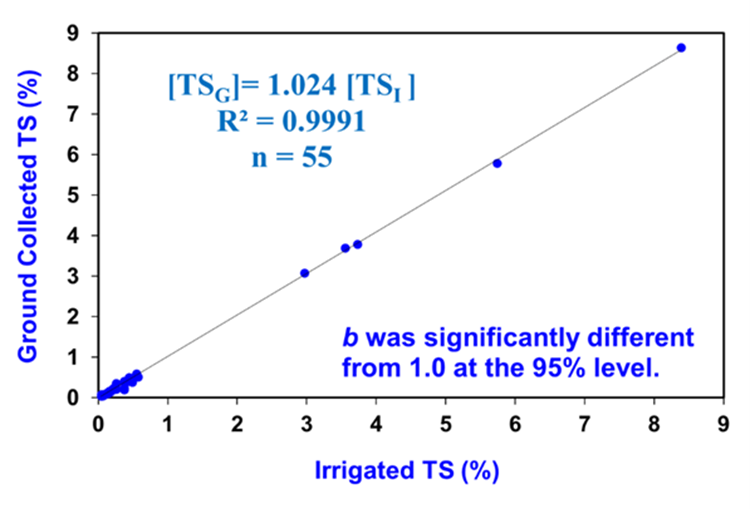
Well-known data used in irrigation design indicates that evaporation loss during irrigation ranges from 1% to 3.5%. The plot of the data for irrigated manure is shown in Figure 1. It was determined that the slope of the regression line was statistically greater than 1.0. Therefore, evaporation losses were small, 2.4%, and agreed with previous studies on irrigation performance.

Figure 1. Comparison of the total solids content of the irrigated manure and the samples collected on the ground indicated that evaporation losses were 2.4%.

The plot of the TAN concentrations collected on the ground and the TAN contained in the irrigated water is shown in Figure 2.). The results showed that irrigation of manure did not result in a change in the concentration of TAN. Therefore, irrigation of manure did not cause ammonia-N loss.

The same type of analysis was done for the total nitrogen data to serve as check on the TAN results. As expected, the analysis showed that irrigation did not significantly alter the concentration of TKN.

Figure 2. The concentration of the total ammoniacal nitrogen was not changed as the manure traveled through the air. This was indicated by a regression line slope that was not significantly different from 1.0.

A previous study reported TAN losses ranging from 10% to 25% during irrigation of liquid manure. Error analysis of the techniques used in these studies indicated that most of the average ammonia-N loss predicted was due to volume collection error in the irrigate-catch technique that was used, and not evaporation and drift as was assumed (see Chastain, 2019). It was concluded that irrigation, as a manure application method, did not increase ammonia-N losses. These results do not imply that ammonia volatilization after manure strikes the ground is to be ignored. The suitability of irrigation as a liquid manure application method should be evaluated based on the level of treatment and the potential impact of odors on neighbors.

Future Plans

These results are being used in extension programs and to help refine estimates of ammonia-N loss associated with land application of manure.

Author

John P. Chastain, Professor and Extension Agricultural Engineer, Agricultural Sciences Department, Clemson University

Corresponding author email address

jchstn@clemson.edu

Additional Information

Chastain, J.P. 2019. Ammonia Volatilization Losses during Irrigation of Liquid Animal Manure. Sustainability 11(21), 6168; https://doi.org/10.3390/su11216168.


The authors are solely responsible for the content of these proceedings. The technical information does not necessarily reflect the official position of the sponsoring agencies or institutions represented by planning committee members, and inclusion and distribution herein does not constitute an endorsement of views expressed by the same. Printed materials included herein are not refereed publications. Citations should appear as follows. EXAMPLE: Authors. 2022. Title of presentation. Waste to Worth. Oregon, OH. April 18-22, 2022. URL of this page. Accessed on: today’s date.