Factors Affecting Household Use of Organic Fertilizer

Purpose         

New uses of manure can be win-win opportunities for livestock and poultry farmers, new users, and the environment. While there is increasing interest by crop farmers in using manure as a source of nutrients, another potential market is households. This study was conducted to look at factors that affect stated use of organic fertilizer, in order to enable producers and professionals to market this product to homeowners.

What did we do?

A survey of households in the Columbia, Missouri area was conducted in spring of 2014 in order to evaluate current lawn and garden practices with a goal of improving water quality in Hinkson Creek. The response rate was 44%. One question was whether they used an “organic fertilizer (OF, composted manure)”. About 26% of respondents said they used OF but when we excluded people who indicated it was not applicable because they either didn’t use fertilizer at all or used a lawn care company for fertilizer applications, the adoption rate was 32%. A logit regression with OF use as the dependent variable was conducted and results are presented below. The pseudo R2 for the regression was 0.21. Only statistically significant variables are discussed.

What have we learned?

People who indicated that they used soil tests, had installed rain gardens, or who had planted drought tolerant plants were more likely to use OF. These practices had been adopted by 12%, 33% and 3% of households, respectively.  People who fertilized their lawns three or more times per year were less likely to adopt OF.  Those who said they watered their lawns as needed to keep them green were more likely to use OF than people who watered infrequently or only in a drought.  Those who spent more than 10 hours (per month?) gardening were more likely to adopt than those spending less than 10 hours.  People who had heard of the term watershed and knew what it meant were more likely to use OF.  People aged 46-60, or over 60, were less likely to use OF than those in the 31-45 age range. People with household incomes over $75,000 as well as those earning under $25,000 were less likely to use OF than those in the $50-74,999 range. Those who strongly trusted information about water quality from environmental groups were more likely to use OF. Those who get information about fertilizer from the internet were more likely to use OF than those who obtained information from professionals or extension agents.  Users of OF thus seem to be younger, well-informed, serious gardeners that are also more concerned with environmental issues. 

Future Plans  

In the near term, dissemination of this research in a peer-reviewed journal is planned. Future research could examine the specific perceptions that homeowners have about this product to see whether marketing efforts can either counteract incorrect perceptions, or build on the perceived positive attributes of composted manure.

Authors

Laura McCann, Associate Professor at the University of Missouri McCannL@missouri.edu

Dong Won Shin, Graduate Research Assistant at the University of Missouri

Additional information             

Dr. Laura McCann, Associate Professor
212 Mumford Hall
Dept. of Agricultural and Applied Economics
Univ. of Missouri
Columbia, MO 65211

Acknowledgements      

This project was supported by National Integrated Water Quality Grant Program number 110.C (Award 2012-03652).

The authors are solely responsible for the content of these proceedings. The technical information does not necessarily reflect the official position of the sponsoring agencies or institutions represented by planning committee members, and inclusion and distribution herein does not constitute an endorsement of views expressed by the same. Printed materials included herein are not refereed publications. Citations should appear as follows. EXAMPLE: Authors. 2015. Title of presentation. Waste to Worth: Spreading Science and Solutions. Seattle, WA. March 31-April 3, 2015. URL of this page. Accessed on: today’s date.

The North American Partnership for Phosphorus Sustainability: Creating a Circular P Economy as Part of a Sustainable Food System


Purpose           

To promote and foster the implementation of sustainable P solutions in both the private and public sectors

People standing in the formation of a 'P'What did we do? 

Recently, a team of Phosphorus researchers initiated the North American Partnership for Phosphorus Sustainability (NAPPS) with seed funding from Arizona State University. The goal of North American Partnership for Phosphorus Sustainability (NAPPS) is to actively engage stakeholders (e.g. corporations, national and local policy makers, planners and officials, representatives of agriculture, industry) to promote and foster the implementation of sustainable P solutions in both the private and public sectors. NAPPS seeks to engage partners in identifying key bottlenecks and strategies for decision-making, policy, and implementation of P efficiency and recycling technologies.

What have we learned? 

Phosphorus is necessary for life, and is essential for agricultural production, and so for food security. The growing world population, changing diets of humans to more meat and dairy and growing use of phosphate additives, and biomass production for energy or industrial uses result in an increasing need for phosphorus input, and the world is today heavily dependent on non-renewable, finite phosphate rock reserves that which are concentrated in a small number of countries, posing geopolitical vulnerability. These trends lead to the depletion of phosphate rock resources, pressure on and instability in phosphate prices, decreasing quality and increasing contaminant loads of remaining reserves, and unstable, insecure P supply for regions without local rock resources, especially in the developing world. At the same time, excess P is lost from the food system at multiple points. The result is eutrophication of freshwater and coastal ecosystems – lo ss of the amenity value of lakes and rivers as well as toxic algal blooms and impacts on fisheries.

Phosphorus stewardship is therefore essential, and we must use P more efficiently in the agri-food system, and actively develop phosphorus reuse and recycling technologies and practices. At the same time, the issue of contaminants, both in phosphate rock and in recycled phosphates must be addressed, as well as the need to reduce phosphate inputs to surface waters where these are problematic. We can reduce the use of mined P by producing and applying fertilizer from recycled sources. By using improved practices and smarter crops, we can reduce the demand for P fertilizer and reduce the runoff to surface water bodies. By reducing and re-using food waste and eating food with lower P footprints we can lower our phosphorus consumption and demand. Collectively, these will also lessen the impacts of P runoff on precious water resources.

Future Plans 

NAPPS activities and stakeholder recruitment will be organized around four main sectors: P Recycling; P Efficiency in Food Production; BioEnergy and Food Choice; and Water Quality. Projects and activities will be decided by the Board of Directors, but may include:

1. Develop a common vision for creating a sustainable P cycle in North America

2. Identifying and helping businesses and other organizations respond to opportunities offered by challenges in P management and emerging research in P sustainability

3. Building networks between different interest groups and sectors related to phosphorus management and recycling

4. Evaluating new P efficiency and recycling technologies, including feasibility, availability of suppliers, inventory of existing technologies and companies, cost/benefit analysis, and life cycle analyses

5. Fostering implementation of new technologies by improving the efficiency of business value chains

6. Assessing and facilitating regulatory development pertaining to phosphorus management, including waste, environmental, discharge, and agriculture to improve P sustainability

7. Representing North American phosphorus managers and innovators in international meetings and initiatives

8. Preparing funding RFPs for demonstration projects and integration and dissemination of new technologies and concepts

Authors

Helen Ivy Rowe, Assistant Research Professor, School of LIfe Sciences, Arizona State University hirowe@asu.edu

James J. Elser, Regents Professor, School of LIfe Sciences, Arizona State University

Additional information                

http://sustainablep.asu.edu

Acknowledgements      

We thank Arizona State University for providing funds to launch this initiative.


Logo for Sustainable Phosphorus Initiative

The Sustainable Phosphorus Initiative - farm, food, fertilizer

The authors are solely responsible for the content of these proceedings. The technical information does not necessarily reflect the official position of the sponsoring agencies or institutions represented by planning committee members, and inclusion and distribution herein does not constitute an endorsement of views expressed by the same. Printed materials included herein are not refereed publications. Citations should appear as follows. EXAMPLE: Authors. 2015. Title of presentation. Waste to Worth: Spreading Science and Solutions. Seattle, WA. March 31-April 3, 2015. URL of this page. Accessed on: today’s date.

Manure Separation: Bedding and Nutrient Recovery

Why Study Manure Solid-Liquid Separation?

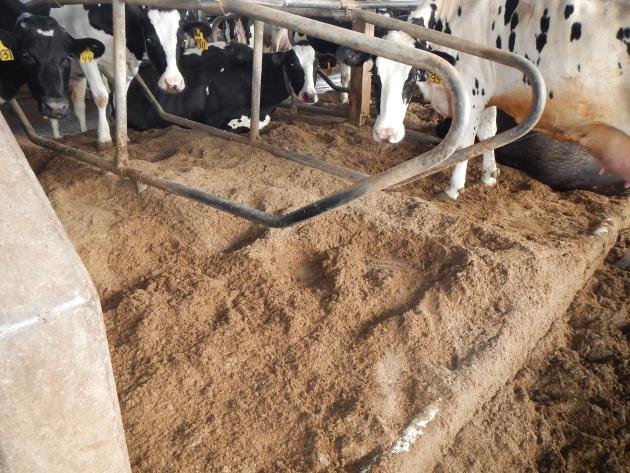
We wished to evaluate a two staged manure separation system for bedding and solids removal. Manure separation can accomplish several purposes on a dairy farm. The two most common goals are to produce a fiber bedding for the animals and the second is to remove as many solids as economically feasible prior to long term storage.

bedding in dairy barn made from separated manure solidsWhat did we do?

We looked at existing and new systems that use manure fiber bedding. Manure fiber bedding or “green bedding” is separated solids from manure collected daily on the dairy that has not been through digestion or other heat process. Manure samples were collected and analyzed for total solids and nutrient content through commercial labs. Questions were asked to dairy personnel regarding stall management practices.

What have we learned?

Separating manure for fiber bedding production is very different than separation for clean liquid. A dry solids cake from the separator does not directly correlate to a good bedding product for the cows. Dairy bedding must provide cushioning for the animal while laying and stable footing during the process of lying down and getting up. A healthy, productive cow will spend 12-14 hours per day lying down. A good bedding must be able to absorb liquid and maintain a clean, dry and comfortable stall for the cow. Typical dry solids cakes contain many small particles that prohibits the solids ability to absorb liquid on the cows lying surface.

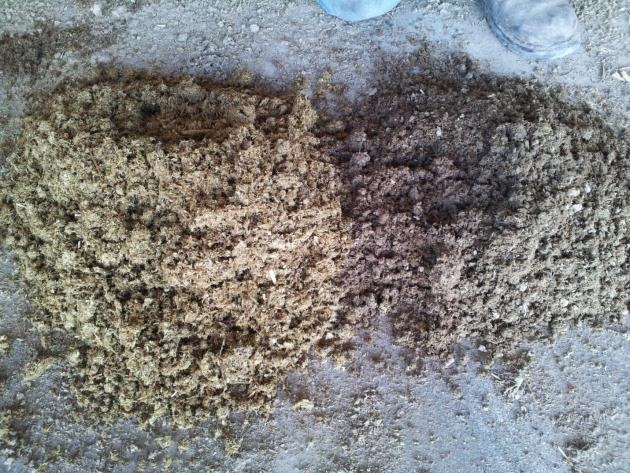
Separation equipment does have an effect on overall perceived bedding quality. Longer fibers are preferred to shorter fibers. Longer fibers appear to provide better cushioning and are less prone to sticking to the cow’s legs, flanks and teat ends.

comparison of fibers from two different manure separation systems

Figure 1. Roller press fibers on the left; screw press fibers on the right.

Fiber bedding can be used directly from the separator (often referred to as “green bedding), composted in windrows or aerobically digested in a vessel. Regardless of treatment method, the success of a manure fiber bedding system is dependent on many factors besides the equipment operation. Management of the free stalls including stall grooming, ventilation, re-bedding and frequency of manual manure removal are examples of other critical factors.

In looking at staged separation systems, the owner is willing to sacrifice capture rate efficiency on first stage separation to achieve high quality bedding. By allowing smaller solids to pass through the primary separation system, the quality of bedding often improves. Eventually, as the larger fibers are broken down while in the free stall or by pumping and processing equipment they become small enough to pass through first stage separation.

Having staged separation is extremely beneficial for advanced manure processing. Primary separation systems do more than produce a fiber bedding material, they also act as a foreign material screen for downstream equipment as well as slightly reduce the total volume to subsequent stages. Foreign material such as; plastic bottles, wooden hoof blocks, rocks, pieces of plastic etc. can cause significant damage to more sensitive (and often expensive) downstream equipment, such as a centrifuge, finer separation screen, belt filter press or other mechanical solid liquid separator. A primary separator is often better suited to handle foreign materials without disrupting operations. Furthermore, by removing the larger solids for bedding there is a slight reduction in volume going to secondary separation steps. This can lead to savings by reducing the required capacity of downstream equipment or reducing the total volume chemistry costs when using coagulants or polymers.

Primary separation for bedding has shown some nutrient removal. On farms using primary separated solids for animal bedding, the nutrient content is irrelevant since the nutrients are recycled back into to the housing system, until the fibers are broken down enough to pass. The specific capture rate of total solids and individual nutrients are show in the table below.

Primary Capture Rates Dairy TR Dairy GM Dairy CVT
Total Solids   20 43 55
Total Nitrogen   4.2 15 20
Phosphorus 3.5 5 37
Potassium   2.6 10 15

Total solids capture rates are directly correlated to incoming total solids content. Higher incoming solids results in higher capture rates (Burns and Moody, 2001). The total solids in the incoming material was lowest for Dairy TR and highest for Dairy CVT. It is a general understanding that a majority of the nutrients are contained in relatively small particles which pass through primary separation stream.

Future Plans

Staged separation systems are one example of how to incrementally add equipment and separation capacity as farms expand or field application of nutrients becomes more precise. Farms may initially install a basic separator to re-use liquid for alley flushing or flush fluming. A secondary stage separator can then be added for excess liquid prior to going to the lagoon for additional solids and nutrient removal.

Future investigation steps will be to continue evaluating secondary separation equipment for ease of operation, operational costs and nutrient removal efficiencies. Additionally further uses for the primary solids as a separation aid may prove beneficial as more systems are installed and used.

Author

Andy Lenkaitis, P.E. Environmental Systems Engineer, GEA Farm Technologies  andy.lenkaitis@gea.com

Additional information

Contact GEA Farm Technologies for additional information regarding specific information on equipment or systems for manure separation systems.

Flyer

Acknowledgements      

The author would like to acknowledge for dairy producers for sharing their insight and information to further the adaption of manure equipment. Additionally, support from key field personnel and local equipment dealers for identifying customers and servicing equipment in a less than pleasant location.

The authors are solely responsible for the content of these proceedings. The technical information does not necessarily reflect the official position of the sponsoring agencies or institutions represented by planning committee members, and inclusion and distribution herein does not constitute an endorsement of views expressed by the same. Printed materials included herein are not refereed publications. Citations should appear as follows. EXAMPLE: Authors. 2015. Title of presentation. Waste to Worth: Spreading Science and Solutions. Seattle, WA. March 31-April 3, 2015. URL of this page. Accessed on: today’s date.

Anaerobic Digestion – Highlights of Successful Project Feasibility Studies


Purpose  

Feasibility studies are a form of decision-making tool that require research, data collection and analysis to evaluate investments in new technology or projects. They answer key questions about a project’s technical and financial viability, including project structure and organization and the costs, benefits, and risks involved. The analyses completed are so important that many grant programs require feasibility studies before making project grant awards. Financial investors and banks commonly may require the most rigorous form of feasibility study prior to making any investment.

What did we do?             

To develop a catalog of steps needed to perform a successful feasibility study, we reviewed the literature on feasibility studies, as well as dozens of studies done on the subject of anaerobic digestion. We also talked with a range of experts in project development.

What have we learned?

General Assessment Study or Screening—Most basic feasibility studies assess the viability of different opportunities within a defined industry or geographic area. On a project level, a general assessment determines if a potential project meets basic criteria thresholds to support more in-depth analysis?

Project-Based, Techno-Economic Study—A higher level of research and analysis is used to establish project viability. These studies consider the costs, benefits, and risks of building a specific type of project, with specific technology, on a specific site. For this purpose the study might incorporate readily available data about technology choices and make assumed adjustments about how it would perform under site-specific conditions. This level of analysis forces project advocates to put their ideas and assumptions on paper and test whether the conclusion is sound and realistic.

Investment-Grade Study—The most rigorous feasibility study is used to validate the marketability of a specific project from an investment perspective. It would look beyond basic techno-economic viability to establish the actual planned inputs and outputs of a project. It can include detailed equipment specifications and estimates, as well as detailed mass, energy, and water balance calculations. It may also identify key providers of feedstocks as well as potential end users. Detailed scheduling may be required to complete financial analyses accurately. With a detailed proforma showing financial analyses of cash flow and return on investment, this high level of feasibility study is sometimes termed “investment-grade.” These types of studies often include sensitivity analyses to explore the impact on a project’s viability from changes to one or more key assumptions. Sensitivity analyses can clarify which of the many assumptions made are most critical to project success.

Getting the best, most reliable and accurate data is perhaps the most critical element of a successful feasibility study. Typical steps observed in many feasibility studies:

  •  Define project goals and scope
  •  Establish the project criteria necessary for success
  •  Inputs: potential feedstocks from measured results, existing data, or surveys of sources
  •  Outputs, calculated from inputs: biogas, liquid and solid effluents and nutrients, and environmental attributes
  •  Financial costs: capital expenses, including cost of money, and ongoing operation and maintenance expenses
  •  Revenues (10 or more): methane energy power or fuel, surplus thermal energy, tip fees, value of solids, liquids-water, liquids-nutrients, environmental attributes, ecosystem services (e.g., GHG offsets, water quality/quantity benefits), carbon dioxide, and/or bioplastics.
  •  Cost offsets as revenues: e.g., rainwater diversion, reduction in manure handling/spreading, odor reduction, avoided disposal, etc.
  •  Financial analyses: cash flow, simple payback, EBITA (earnings before interest, taxes and amortization), net present value, return on investment, sensitivity analyses, life-cycle analyses
  •  Project finance: grants and loan guarantees, debt, and equity
  •  Project ownership and liabilities: including design, build, own, operate, maintain

Future Plans      

We will continue to evaluate methods to add value and publish the full results in a Anaerobic Digestion technology brief on this topic.

Authors    

Jim Jensen, Sr Bioenergy & Alt Fuel Specialist, Washington State University Energy Program jensenj@energy.wsu.edu

Craig Frear, Chad Kruger, and Georgine Yorgey, Center for Sustaining Agriculture and Natural Resources, Washington State University

Additional information                 

http://www.energy.wsu.edu/

http://csanr.wsu.edu/

Acknowledgements      

This research was supported by Biomass Research Funds from the WSU Agricultural Research Center; and by the Washington State Department of Commerce.

The authors are solely responsible for the content of these proceedings. The technical information does not necessarily reflect the official position of the sponsoring agencies or institutions represented by planning committee members, and inclusion and distribution herein does not constitute an endorsement of views expressed by the same. Printed materials included herein are not refereed publications. Citations should appear as follows. EXAMPLE: Authors. 2015. Title of presentation. Waste to Worth: Spreading Science and Solutions. Seattle, WA. March 31-April 3, 2015. URL of this page. Accessed on: today’s date.

Digested Solids – Forms, Markets and Trends


Are Digested Solids a Viable Product?

Anaerobic digesters for U.S. livestock operations are becoming more complex. A study of livestock-based digesters in 2003 found they were built largely to meet on-farm needs for power or gas. Digester residuals were mostly land applied as nutrients for crop production. A few used fibrous solids as animal bedding (King, 2003). In recent years, more livestock-based digester projects have been built by third-party developer/managers. Projects increasingly employ a systems approach, where individual product streams are managed in concert for greatest profit by the project manager. This approach holds the promise that digestate residuals, especially fiber solids, will no longer be neglected, but instead play a larger role in offsetting weak performance in energy revenues.

What did we do?

Looking closely at dairy-based digesters, the solids recovered after separation from the digester eflluent have unique characteristics. Most notably, these solids tend to be fibrous with high cellulose, hemicellulose, and lignin content. Digestion also reduces pathogenic contaminants, volatile solids, odor, and viable weed seeds (MacConnell, 2010). These qualities can be influenced by the makeup of an animal’s feed and the use of co-digestion feedstocks, such as municipal or industrial wastes or other agricultural manures or byproducts

Table 1 shows the characteristics of dairy AD solids compared to raw manure and raw separated solids (MacConnell, 2010).

Table 1. Fiber Characteristics

Table 1.

As is. In bulk. Sold to a wholesale buyer—this is the easiest way to sell digested dairy fiber. Through a combination of literature search and expert interviews, this presentation looks at the methods project managers might use to add more value to their digested fiber.

What have we learned?

Composting. Perhaps the most basic way to add value to digested dairy fiber is simply to apply basic compost processing methods—aerating the material under controlled conditions for sufficient time to reduce odor and stabilize the organic matter. While already low in pathogens, hot composting practices can give additional assurance of pathogen reduction. In co-digestion situations, screening the material to remove contaminants and assure consistency and uniformity is desired. Even wholesale buyers will pay more for material that is already composted (King 2003)

Processing to compete – replacing peat. Because of its physical similarity, researchers have explored using digested dairy fiber as a direct replacement for peat moss in nursery and horticulture mixes. WSU was an early source of research and growth trials on such uses. Their research showed that with minimal post-digestion treatment, amended digested dairy fiber performed as well or better than peat in soilless mixes. (MacConnell, 2007, and Kruger, 2008) In 2007, Organix, a Washington company, announced the first shipments of RePeat, using their patent-pending FibreRite production system. Since then several new varieties of these peat replacements have hit the market nationwide, under such brands as Magic Dirt, EnerGro, and MooFiber.

Organic certification. Organic gardening and food production is growing rapidly in Washington state and around the nation. Getting an organic certification for organic matter and nutrients that have been digested and composted will add significant value to the final product (King, 2003).

Branding and marketing for retail. Moving away from bulk and wholesale are the next steps in moving material up the value chain. However, putting product in bags and selling into retail markets requires significant investments in packaging, branding, marketing and sales. This is like adding an additional business onto the back end of a digester project and demands its own feasibility analysis.

Vermicomposting. Using earthworms, especially redworms, to further process fiber solids and excrete earthworm castings, produces another specialty soil product. Vermicomposts and earthworm castings are well-known and appreciated in some growers in some markets. They are often used as a small additive in specialty soil mixes to allow the use of “earthworm castings” on the list of ingredients. Two commercial examples of vermicompost production lie on opposite coasts—Sonoma Valley Worm Farm in California and Worm Power in New York. Sonoma Valley Worm Farm direct markets high-quality vermicompost to a variety of growers throughout their region, with special emphasis on vineyards. Worm Power topped 2 million pounds of production in 2012 and signed an agreement with Rochester, NY-based Harris Seeds to market its vermicompost products regionally.

Specialty products produced from the separated fiber materials are another area of interest. Perhaps the best known of such products are the biodegradable planting nursery pots sold as Cow Pots by the Fruend Dairy Farm in Connecticut.

Biochar. This is another specialty product from a fledgling industry that fits in niche markets. It could be used to process digested fiber. It has received a strong research focus in the Pacific Northwest. The value of biochar in landscape or agricultural uses is still being studied, though at present it appears to have less to do with agronomic benefit, than on measured benefits for carbon sequestration and the value given to these benefits through carbon credits or other mechanisms (Galinato, 2011). On the other hand, replacing biochar for conventional forms of activated carbon for filtering stormwater or wastewaters shows some promising results and is getting a lot of attention.

Future Plans      

We will continue to evaluate methods to add value and publish the full results in a Anaerobic Digestion technology brief on this topic.

Authors        

Jim Jensen, Sr. Bioenergy & Alt Fuel Specialist, Washington State University Energy Program jensenj@energy.wsu.edu

Craig Frear, Chad Kruger, and Georgine Yorgey, Center for Sustaining Agriculture and Natural Resources, Washington State University

Additional information  

References:

Galinato, S., Yoder, J., Granatstein, D., 2011. The economic value of biochar in crop production. Energy Policy.

King, 2003. Study to Evaluate the Price and Markets for Residual Solids from a Dairy Cow Manure Anaerobic Digester—Final Report, King County Solid Waste, Seattle, WA.

Kruger, Chad, et.al., 2008. High-quality fiber and fertilizer as co-products from anaerobic digestion. Journal of Soil and Water Conservation.

MacConnell, C.B., Collins, H.P., 2007. Utilization of re-processed anaerobically digested fiber from dairy manure as a container media substrate. Proceedings of the International Symposium on Growing Media, Nottingham, UK.

MacConnell, C., Frear, C., Liao W., 2010. Pretreatment of AD-treated fibrous solids for value-added container media market, Center for Sustaining Agriculture and Natural Resources, Pullman, WA.

Acknowledgements      

This research was supported by funding from USDA National Institute of Food and Agriculture, Contract #2012-6800219814; Biomass Research Funds from the Washington State University Agricultural Research Center; and the Washington State Department of Ecology, Waste 2 Resources Program.

The authors are solely responsible for the content of these proceedings. The technical information does not necessarily reflect the official position of the sponsoring agencies or institutions represented by planning committee members, and inclusion and distribution herein does not constitute an endorsement of views expressed by the same. Printed materials included herein are not refereed publications. Citations should appear as follows. EXAMPLE: Authors. 2015. Title of presentation. Waste to Worth: Spreading Science and Solutions. Seattle, WA. March 31-April 3, 2015. URL of this page. Accessed on: today’s date.


A Novel Treatment System to Remove Phosphorus from Liquid Wastes

Lowering the total phosphorus (P) content of animal manures is one means of addressing concerns over P runoff following land application of animal manure. We developed a treatment system for liquid manures that conserves the manure nitrogen (N) content while removing most of the manure P content. Initial evaluation of a treatment system involving manure solid separation and precipitation of dissolved P with an alkaline salt (calcium hydroxide) resulted in poor liquid/solid separation and poor dissolved P removal and created conditions promoting ammonia-N volatilization. As a result, we developed a three step system with iterative solid removal and acid salt (ferric sulfate) precipitation of dissolved P: (1) removal of bulk and intermediate sized solids (>25 μm); (2) chemical treatment to convert dissolved P; and (3) final removal of fine solids and chemically precipitated P. When tested on manure slurries from 150 and 2700 cow dairies, 96 and 99% total P was removed respectively, resulting in liquid manure filtrates with up to 400:1 N:P ratio. While costs of treatment were roughly $38 per kg P removed, equivalent to $750 per cow annually, we anticipate that refinement of the process and beneficial uses of the solid materials (bedding, compost, etc.) will improve cost-efficacy considerably.

Author

Church,  Clinton  Clinton.Church@ars.usda.gov     USDA-ARS 

The authors are solely responsible for the content of these proceedings. The technical information does not necessarily reflect the official position of the sponsoring agencies or institutions represented by planning committee members, and inclusion and distribution herein does not constitute an endorsement of views expressed by the same. Printed materials included herein are not refereed publications. Citations should appear as follows. EXAMPLE: Authors. 2015. Title of presentation. Waste to Worth: Spreading Science and Solutions. Seattle, WA. March 31-April 3, 2015. URL of this page. Accessed on: today’s date.

The Dairy Manure Biorefinery


Why Consider Additional Technologies with Anaerobic Digestion?

Some dairy farms have experimented with “add-on” technologies to enhance the value of the products generated from anaerobic digesters to improve economics and address other environmental and management concerns. This effort has intensified in recent years, as prices paid for electricity continue to fall. This trend is making it more difficult to justify the installation of new digesters or maintain active anaerobic digestion (AD) projects based on electricity sales alone. 

What did we do?

Based on ten years of research and extension within the field of dairy digesters, we are proposing that the concept of a dairy manure biorefinery can be useful to focus ongoing research and commercialization efforts (Figure 1). A biorefinery integrates a core biomass conversion process (in this case, AD, converting manure and in many cases other organic substrates) with additional downstream technologies. These combined technologies generate multiple value-added products including fuels, electricity, chemicals, and other products (NREL, 2009). Most add-on technologies relevant to dairy facilities have been modified from technologies used in the wastewater treatment and oil and gas industries. 

What have we learned?

Ongoing research and commercialization efforts by our team and others aim to:

  • Adapt technologies to fit the economic and other constraints of dairy digesters.
  • Increase efficiency and reduce costs by maximizing the complimentary nature of technologies (e.g. waste heat from one process is used in another process).

Specific add-on technologies that are continuing to evolve within the biorefinery context include:

Biogas Upgrading to remove impurities from biogas (primarily carbon dioxide, hydrogen sulfide, and water vapor).

Output: Purified biogas that can be used as a transportation fuel (e.g. liquefied natural gas) or injected directly into natural gas piplelines.

Additional social and economic benefits: Renewable fuel can reduce demand for fossil fuels, and can often receive economic credits (e.g. renewable identification numbers, low carbon fuel standard)

Fiber Upgrading to process the fiber that is removed from AD effluent.

Output: Upgraded fiber can be sold as a higher-value soil amendment in the horticultural industry

Additional social and economic benefits: Fiber can replace use of non-renewable resource (peat moss) by horticultural industry

Nutrient Recovery to strip nitrogen (N) and phosphorus (P) from anaerobic digester effluent.

Outputs: Soil amendment products that can be sold offsite where nutrients are needed

Additional social and economic benefits: Reductions in N and P applied to nearby fields, and reduced effluent hauling distances/costs for land application due to lower nutrient concentration in effluent

Water Recovery to generate “recycled” water using advanced technologies

Output: Water that can be used for animal drinking, or as dilution water for the AD facility

Additional social and economic benefits: Reduces consumption of fresh water, a limited resource, and reduces costs for land-application of AD effluent

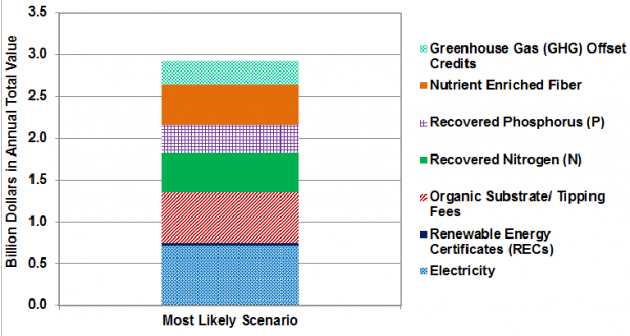
Overall Potential Impact. Improving economics and addressing other critical issues for dairy producers (e.g. nutrient issues) has the potential to advance farm-based AD adoption significantly beyond its current 244 farms. It has been estimated that a mature bio-refinery industry based on AD on large U.S. dairy farms could create an estimated bio-economy of nearly $3 billion that complements the production of milk and dairy products (ICUSD, 2013).

Figure 1. Stepwise depiction of the process

Figure 2. Total likely value added by most likely scenario

Authors

Georgine Yorgey (presenting author)a, Craig Frearb, Nick Kennedya, Chad Krugera, Jingwei Mab, and Tara Zimmermana

a Center for Sustaining Agriculture and Natural Resources, Washington State University

b Department of Biological Systems Engineering, Washington State University

Future Plans

An extension document describing this concept and the add-on technologies in additional detail is being prepared. This document is part of a series of extension documents on Dairy AD Systems, being prepared by the authors and other colleagues at Washington State University. In addition, ongoing work and collaborations by our team are seeking to investigate, evaluate, and improve individual technologies and the linkages amongst them.

Additional Information

ICUSD, 2013. National market value for anaerobic digestion products. Report to Innovation Center for US Dairy, August 2013.

Acknowledgements

This research was supported by USDA National Institute of Food and Agriculture, contract #2012-6800219814; and Biomass Research Funds from the Washington State University Agricultural Research Center.

The authors are solely responsible for the content of these proceedings. The technical information does not necessarily reflect the official position of the sponsoring agencies or institutions represented by planning committee members, and inclusion and distribution herein does not constitute an endorsement of views expressed by the same. Printed materials included herein are not refereed publications. Citations should appear as follows. EXAMPLE: Authors. 2015. Title of presentation. Waste to Worth: Spreading Science and Solutions. Seattle, WA. March 31-April 3, 2015. URL of this page. Accessed on: today’s date.

An NE-1441 Project: Proposed Methodologies for Administering a Multi-State Environmental Best Management Practices Survey of Equine Properties


*Purpose 

Several states have reported that equine are the fastest growing segment of the livestock industry. Nationwide, equine has increased by 77% since 1997; and it is reported there are approximately 9.5 million horses in the United States (AHC, 2005). Proper management of equine operations requires the adoption of Best Management Practices (BMPs) to balance nutrient production and prevent erosion. Government agencies are concerned about non-point sources of water pollution and have focused on agriculture, including equine operations, as a major contributor to water quality issues. Many states’ laws have regulated equine farms, requiring farm managers to incorporate BMPs. The objectives of this proposed national (multi-state) survey are to quantify and assess the use of the equine industry’s BMPs in pasture management, erosion control and to examine potential environmental impacts. Few state studies have investigated horse BMPs in the U.S, and more research is needed to assess the effect of horse farm management on U.S. water quality. Knowledge of the current scope and nature of equine industry management practices are important when developing regulations, laws, and educational programs to enhance the stewardship and govern land management on equine operations.

What did we do? 

The methodology to assess horse property manager/owner practices consists of gathering a minimum of 150-2,000 names and email addresses of horse owners/farm managers from the 15 states involved in the NE-1441 project. Some of the N. E. states have fewer equine operations. An email containing survey information and a link to the 40 question online survey will be sent to horse farm managers in 2016. Three follow-up reminders will be sent to non-responding addresses. It is hoped to have a 40% response rate. Data will analyzed using SPSS 16.0 (SPSS Inc., Chicago, IL) for descriptive statistics, determining response frequencies and percentages.

The Questionnaire Instrument will include the following areas:

Part I General: Involved in the horse industry? Are you the owner or manager of a horse operation? If No, then you are finished taking the survey. Business or Hobby?

Part II Demographics: Location, State, County, Survey participants gender, age, Size of farm total acreage, Confinement areas, Pasture areas, primary and 2nd use of operation, Highest average number of horses on property? On average, how many hours per day do your horses spend grazing pastures by seasons?

Part III Horse Pasture Management Rotational Grazing, unlimited access,Pasture Management Plan, Agricultural Erosion and Sedimentation Plan weed control and type, mowing, resting pastures,Sacrifice lots, pasture topography, surface water, Sheds and barns,divert runoff, roof gutters.

Part IV: Horse Pasture Applications and/or Evaluation: Line, Fertilizer, Herbicide use, Seeding practices, Lime, Soil testing.

Part V: Horse Manure Management: Nutrient Management Plan, primary manure management, collection, storage, uses, removal.

Part VI: Conclusion: What are your limitations in altering the management of your horse operation? What information resources do you use for your equine farm operations?

What have we learned? 

The questions for an equine related APHIS/USDA animal agriculture survey need to be more specific to the activities and needs of the horse industry. Whereas most animal agriculture operations do not deal directly with the general public as a necessary component of their business plan, the horse industry depends on active and engaged clientele. If we are able to gather national data through a single effort survey, the resulting information could be compared and sorted in a consistent and statistically reliable manner, allowing educational materials and opportunities to be tailored to area or regional needs.

Future Plans 

A survey will be conducted by the NE-1441 (a northeast regional Hatch research group focusing on environmental impacts of equine operations) participating states to determine the use of the following best management practices: managed storage area, composted manure storage, stream crossings, buffers and vegetative filter strips, heavy use pads and sacrifice areas, soil testing, and fertility management on fields receiving manure. Develop means of determining the impact of equine outreach programs, more specifically determination of BMP adoption rate.This will allow us to chart progress among producers who use extension services and/or implement BMPs with the assistance of extension or other service providers such as NRCS, state departments of agriculture, and etc. We will work with social scientists to determine adoption rates, what the reasons for resistance to adoption are, and how to develop programs to overcome this resistance.

Corresponding author, title, and affiliation 

Betsy Greene, Professor/Equine Extension Specialist, University of Vermont

Corresponding author email 

betsy.greene@uvm.edu

Other authors

Ann Swinker, Extension, Pennsylvania State University Amy Burk, Extension, University of Maryland Rebecca Bott, Extension, South Dakota State University Carey Williams, Extension, Rutgers, State University of New Jersey

Additional information 

Westendorf, M. L., T. Joshua, S. J. Komar, C. Williams, and R. Govindasamy. 2010. Manure Management Practices on New Jersey Equine Farms. Prof. Anim. Sci. 26:123-129.

Swinker, A., S. Worobey, H. McKernan, R. Meinen, D. Kniffen, D. Foulk, M. Hall, J. Weld, F. Schneider, A. Burk, M. Brubaker, 2013, Profile of the Equine Industry’s Environmental, Best Management Practices and Variations in Pennsylvania, J. of NACAA. 6:1, 2158-9429.

Fiorellino, N.M., K.M. Wilson, and A.O. Burk. 2013. Characterizing the use of environmentally friendly pasture management practices by horse farm operators in Maryland. J. Soil Water Conserv. 68:34-40.

Acknowledgements

The State University Extension Equine Specialists that make up the NE-1441: Environmental Impacts of Equine Operations, Multi-State Program. USDA.

The authors are solely responsible for the content of these proceedings. The technical information does not necessarily reflect the official position of the sponsoring agencies or institutions represented by planning committee members, and inclusion and distribution herein does not constitute an endorsement of views expressed by the same. Printed materials included herein are not refereed publications. Citations should appear as follows. EXAMPLE: Authors. 2015. Title of presentation. Waste to Worth: Spreading Science and Solutions. Seattle, WA. March 31-April 3, 2015. URL of this page. Accessed on: today’s date.

Case Study of Contaminated Compost: Collaborations Between Vermont Extension and the Agency of Agriculture to Mitigate Damage Due to Persistent Herbicide Residues

Why Study Herbicide Contamination of Compost?

Picloram, clopyralid, aminopyralid and aminocyclopyrochlor are broadleaf herbicides commonly used in pastures due to effectiveness in controlling undesirable plants and the very low toxicity for animals and fish. In fact, some of these herbicides do not require animal removal post application. The grazing animals can ingest treated leaves with no ill health effects, but may pass the herbicides through to the manure. Also see: Composting Livestock or Poultry Manure

When a complaint driven problem of damaged tomatoes and other garden crops in Vermont was traced back to a single compost provider in Chittenden County in Vermont, a series of actions and reactions commenced. Complaints were fielded and investigated by personnel from the Vermont Agency of Agriculture, Food and Markets (VT-AG) and the University of Vermont Extension (UVM-EXT). The compost provider sent samples of various components of the compost to a single laboratory and received positive results for persistent herbicides in sources of equine bedding/manure components. Subsequent interviews by the facility manager in both print and television media seemed to cast blame on Vermont equine operations for ruining Vermont gardens. Coincidentally, the composter had recently changed compost-processing methods. Initial samples sent to a separate laboratory did not support the composter’s laboratory results. Samples of feed, manure, shavings, and many other components which were shipped to several laboratories by VT-AG, resulted in extremely inconsistent and/or contradictory data between laboratories running the exact same samples.

Related: Small Farm Environmental Stewardship or Managing Manure on Horse Farms

What did we do? 

Several processes were underway by several agencies in a coordinated and collaborative effort to resolve and mitigate the herbicide issues:

• Vermont Agency of Agriculture, Food and Markets was receiving and investigating complaints.

• University of Vermont Extension plant biology personnel were identifying, documenting, and sampling affected plants, as well as counseling gardeners.

• University of Vermont equine extension worked with horse owners and media to mitigate unsubstantiated claims of “horses poisoning garden plants”.

• A more thorough investigation by VT-AG involved collection of raw samples (feed, hay, shavings, manure) from 15 horse farms who utilized the compost facility to dispose of manure and bedding.

• The VT Secretary of Agriculture and the VT-AG Agri-chemical Management Section Chief were brought together with equine and compost experts attending the NE-1041 Equine Environmental Extension Research group annual meeting hosted by UVM equine extension.

• VT-AG worked with herbicide manufacturers to use high quality testing equipment and procedures to gather consistent data from samples.

What have we learned? 

More extensive details of this particular case have been published in the Journal of NACAA (http://www.nacaa.com/journal/index.php?jid=201).

• The levels of persistent herbicides were low enough that they were below the acceptable limits for water, yet they still harmed sensitive garden plants.

• Nationally and locally manufactured grains tested positive for persistent herbicides; most likely due to the individual components being treated within legal limits during field production.

• Many of the laboratories were unable to provide accurate or consistent results when testing for the persistent herbicides.

• Discussions between the NE-1041 group and VT-AG resulted in a fruitful exchange of information, as well as development and delivery of pertinent information for the general public and County Agricultural Agents.

Future Plans 

Several proactive activities have already been initiated and/or completed. A peer reviewed case study on all aspects of the contaminated compost has been published in the Journal of NACAA; and two episodes of Vermont’s Agricultural television show (Across the Fence) were created to educate and update the general public on the situation. A Vermont compost working group has been assembled and set goals to create potential educational materials including a horse owner pamphlet (in final editing phase), a farmer/livestock pamphlet, and press releases for the public education on challenges with persistent herbicides. The VT-AG website has a Compost FAQs page addressing the most common questions associated with compost and herbicides.

Authors

Betsy Greene, Professor/Extension Equine Specialist, University of Vermont Betsy.Greene@uvm.edu

Carey Giguere, Agrichemical Management,Vermont Agency of Agriculture

Rebecca. Bott, Extension, South Dakota State University

Krishona. Martinson, Extension, University of Minnesota

Ann Swinker, Extension, Penn State University

Additional information

• Greene, E.A., R.C. Bott, C. Giguere, K.L. Martinson, and A.W. Swinker. 2013. “Vermont Horses vs. Twisted Tomatoes: A Compost Case Study. J of NACAA. 6:1 (http://www.nacaa.com/journal/index.php?jid=201)

• Vermont Agency of Agriculture, Food and Markets Compost FAQ’s: http://agriculture.vermont.gov/node/696

• Davis, J. Dept. of Horticultural Science, NC State University. 2010. Herbicides in Manure: How Does It Get there and why Should I Care?, Proceedings 8th Annual Mid-Atlantic Nutrition Conference, Timonium, MD. pp 155-160.

• Across the Fence Television Show: An Update on Green Mountain Compost Contamination and Testing-Greene/ Gigliuere (9/14/12)

• Across the Fence Television Show: Information from NE 1041 Meetings and National Equine Specialists-Greene (9/17/12)

• Article from Minnesota Extension explaining the problem in hay and how to avoid it. The article is devoted to “ditch hay”, but the information is relevant to all hay. https://extension.umn.edu/horse-nutrition/managing-herbicides-ditch-forages

• Washington State University Web site on clopyralid carryover includes pictures of affected vegetables, research results, and the bioassay protocol http://www.puyallup.wsu.edu/soilmgmt/Clopyralid.htm

• Dow Agrosciences United Kingdom website with information on aminopyralid: http://www.manurematters.co.uk/

• CDMS Agro-chemical database with access to all the herbicide labels: http://www.cdms.net/LabelsMsds/LMDefault.aspx?t

Acknowledgements

The State University Extension Equine Specialists that make up the NE-1441: Environmental Impacts of Equine Operations, Multi-State Program. USDA.

The authors are solely responsible for the content of these proceedings. The technical information does not necessarily reflect the official position of the sponsoring agencies or institutions represented by planning committee members, and inclusion and distribution herein does not constitute an endorsement of views expressed by the same. Printed materials included herein are not refereed publications. Citations should appear as follows. EXAMPLE: Authors. 2015. Title of presentation. Waste to Worth: Spreading Science and Solutions. Seattle, WA. March 31-April 3, 2015. URL of this page. Accessed on: today’s date.

Economical Anaerobic Digestion of CAFO Animal Waste


Purpose

The application of manure on croplands is increasingly under regulatory scrutiny, especially from impaired watersheds. The challenge facing many small farms is to find cost-effective and innovative solutions for manure reuse whilst responding to environmental, regulatory and public concerns. One option is to install an anaerobic digester (AD) in which microorganisms break down biodegradable material in the absence of oxygen. However, not all farmers are financially able to install an AD but do need the AD’s benefits to keep their livestock operation sustainable. This paper discusses a novel, cost effective and patented manure treatment system which can reduce the volume of manure for field application (see Figure 1).Earthmentor N2RTS Schematic

What did we do?

The EarthMentor® Natural Nutrient Reclamation and Treatment System (EMS), uses a combination of innovative sand separation technology (if necessary) and anaerobic treatment to concentrate manure nutrients into solid phases and treat approximately 70% of manure liquids into a product which can be applied to active cropland as low-nutrient liquid using irrigation methods. The primary economic advantage of using an EMS to treat livestock manure prior to land application is lower total manure disposal costs. The total manure handling costs are reduced because up to 75 % of the original manure volume can be handled as low-nutrient value irrigation quality liquid in bulk instead of hauling it by tanker for land application. This fact alone reduces total manure handling costs by over 50 %. Other tangible benefits of using an EMS include low odor, minimized environmental risks, and greater flexibility in proper land application of the treated manure. It can be installed at farms with as few as 250 cows. Depending on farm size, operators can realize a return on investment in as little as three years. Compared to a traditional AD installed to generate biogas the EMS is simple to operate, requires less energy, requires no chemicals or substrates to treat the waste, and reduces manure disposal costs.

The EMS involves six major steps: 1) collection of raw manure and transport to the processing center, 2) sand bedding is separated from the manure stream, 3) coarse manure components are removed from the liquid manure stream, 4) additional settling of the fine manure solids and sand particles occurs in a settling basin to a concentration of 8 to 10 percent solids, 5) AD treatment of the liquid manure and dissolved solids occurs in anaerobic treatment lagoon (ATL), and 6) The ATL effluent is stored in a Storage Pond for eventual discharge to active growing crops; additional natural treatment of the liquid manure occurs while in the Storage Pond.

All settling basins and ATL lagoon must meet state guidelines, such as Natural Resource Conservation Service technical guidelines or state requirements for waste storage facilities.

The ALT of the EMS system has a smaller footprint compared to traditional ALTs (primarily use in the south and western United States) because the majority of the nutrient-rich semi-solids are removed from the manure before discharge to the ATL. Due to this major operational change the EMS is economical to install and operate even in the northern climates of the United States where many of the top producing dairy states are located. While many facilities separate solids before land application, the EMS is different because is adds the AD step which converts the manure into a low-nutrient liquid capable of irrigation-style land disposal.  The method of solid separation can be as simple as a sloped screen followed by additional gravity separation as described in Step 4 above. The EMS ATL must be sized to account for reduced biodegradation during the colder weather. The EMS has successfully operated at multiple swine facilities and several Midwestern dairy farms.

If there is sufficient land near the farmstead, the EMS can be installed at existing dairies with minimum difficulty since the treatment system works equally well with multiple bedding materials and varying manure collection methods. Another benefit of the EMS is that is allows application on fields that may be high in phosphorus since much of the phosphorus will be stored in the accumulating ATL sludge. For dairies bedding with sand, a patented sand removal system can be provided that relies on a decanting method of sand separation. Once the sand is removed, it can be reused in the barn. 

What have we learned?

Typical Cost Savings for Manure Application Using EMS
Component
Disposal Method
Conventional Manure Handling
EarthMentor® Treatment System Handling
Liquid Manure


Land Application 100% $0.02/gallon 0% $0
Separated Solids Land Application 0% $0 10% $0.016/gallon
($4/ton equiv.)
Heavy Slurry Land Application 0% $0 20% $0.02/gallon
Treated Wastewater Center Pivot over Crop 0% $0 70% $0.002/gallon
Combined Cost   100% $0.02/gallon 100% $0.007/gallon
(weighted average of all components)

Using financial data from 2010 for a 2,000-cow Michigan dairy, it was estimated that the cost to handle manure using an EMS is reduced from $0.02/gallon to $0.007/gallon. The cost saving using the EMS is based on the assumption that the average dairy cow produces nearly 25 gallons/day of manure, including wastewater but excludes bedding since farms used different types and volumes of bedding for their dry and lactating cows. Based on the financial analysis, installation of an EMS benefits the farm’s economic sustainability while providing other benefits including reduced environment risk associated with manure land application.

Far beyond the obvious cost savings associated with the EMS installation, a livestock producer will realize many other benefits. A partial list is provided below:

  • This practical and manageable manure treatment system requires little or no additional farm labor commitments yet greatly reduces overhead expenditures to keep the farm sustainable and competitive,
  • All manure is treated prior to land application (environmentally sound),
  • The more consistent high solids slurry can be precisely applied to fields with the greatest need as opposed to the highly variable manure nutrient concentrations recovered from a traditional manure pond,
  • Minimizes the environmental risks (ecologically viable) and farm nuisance potential,
  • The window of opportunity for manure application is extended to over 200 days instead of being limited to spring and fall applications for typical liquid manure,
  • Can provide a safe unlimited recycled bedding source for cattle, if so desired, by the dairy owner,
  • Permits farmer to follow BMPs for soil conservation,
  • Permits farmer to follow timing, rate, source, and place for fertilizer/crop nutrient applications,
  • Benefits the non-farm neighbors and community through reduced nuisance odors, and
  • Continues using the farm’s manure as a soil amendment for crop production, the most efficient use known.

Future Plans

The immediate future plans for EMS is to target small livestock producers, especially those within impaired watersheds.  Since many ADs need a substrate material imported from outside the farm to be economically sustainable, the EMS is ideal for those farms that want to be good neighbors with reduced farm air emissions, need greater convenience in manure management, and desire to maximize the real cash value of their manure.

As the EMS adapts well to any bedding material, by investing time and dedicating property for the ATL any size operation can begin to treat their manure prior to land application and reduce their overall cost for manure management.

In addition to small farms we envision four possible adaptations of EMS; these examples are provided to show the transferability of this technology to farms desiring various outcomes from an EMS:

  1. Installation of an Energy-Generating AD – if a farm wishes to generate energy using a traditional AD, it would be installed prior to the EMS system whereby the AD digestate discharges into the settling ponds. Since the residence time of a traditional AD is measured in days, there is a great deal of additional treatment that can occur so that the cost savings for land application can still be realized.
  2. Use manure solids for other uses besides land application – if the livestock producer decides to bed their cattle on manure solids or to compost the manure solids for sale off-farm to landscapers or bag and sell direction from the farm then the solids from the SS can be further treated with a screw press or roller then composting by various means.
  3. Greenhouse gas capture and sale of carbon credits – a geosynthetic liner cover can be added to the ATL and all captured gases burned through a flare. However, it should be noted that by removing a significant amount of high organic solids during the initial fiber solids separation step, much less organic material is subject to organic degradation into methane gas.
  4. Greenhouse gas capture and burning of the gases – to generate electricity or heat water (typically for on-farm use or export to an adjoining business, such as a greenhouse).

One future issue to resolve includes educating state governments on the benefits of installing an EMS, especially for those farms that may be under a Consent Order or other regulatory actions or those farms that may need to implement a manure treatment system to mitigate odors from the livestock operation.  The duration to install an EMS and get it operational is much shorter than the lead time to design and install a traditional AD so the EMS can help when farms need to implement changes quickly.  A second issue to overcome is to properly educate producers on the benefits of EMS and differences between traditional ADs.  Swine, beef, and dairy producers who already have a farm irrigation system will have a lower capital investment to begin achieving the reduced manure management costs referenced above.

Author

Matthew J. Germane, P.E., President at Germane Environmental Consulting, LLC MGermane@GECEnvironmental.net

Additional information

https://www.gecenvironmental.com, Envirolytic Technologies, LLC

Acknowledgements

Acknowledgements to Envirolytic Technologies, LLC, Greenville, OH manufacturer of the Earthmentor® N2RTS system and RAM Technologies, LLC, manufacturer of the sand separation equipment used in the EMS for their assistance in providing the laboratory data used in this paper.

The authors are solely responsible for the content of these proceedings. The technical information does not necessarily reflect the official position of the sponsoring agencies or institutions represented by planning committee members, and inclusion and distribution herein does not constitute an endorsement of views expressed by the same. Printed materials included herein are not refereed publications. Citations should appear as follows. EXAMPLE: Authors. 2015. Title of presentation. Waste to Worth: Spreading Science and Solutions. Seattle, WA. March 31-April 3, 2015. URL of this page. Accessed on: today’s date.