About the Farm Manure-to-Energy Initiative

Farm Manure Energy Initiative logoThe Farm Manure-to-Energy Initiative in the Chesapeake Bay region is helping farmers demonstrate and evaluate the performance thermal technologies that convert surplus poultry litter to electricity or heat.

Case studies conducted from 2012-2015 evaluated four technologies on five working farms in areas of the Chesapeake watershed where manure management is especially important for protecting water quality.

sunrise over flintrock farm

Flintrock Farm in Lancaster County, PA, will heat at least four poultry houses by feeding poultry litter into an on-farm energy system.

The systems were evaluated for technical, environmental, and financial performance. Detailed information on the results of the evaluations can be found in the 2016 Final Report. Project leaders include National Fish and Wildlife Foundation, Chesapeake Bay Funders Network, Farm Pilot Project Coordination, Inc., Sustainable Chesapeake, University of Maryland Center for Environmental Science, University of Maryland Environmental Finance Center, Virginia Cooperative Extension, Lancaster County Conservation District (of Pennsylvania), Virginia Tech Eastern Shore Agricultural Research and Extension Center, and the Eastern Shore Resource Conservation & Development Council.

For more information, please contact Kristen Hughes Evans of Sustainable Chesapeake at Kristen@susches.org.

Environmental Protection Agency (EPA) Perspective on Nutrient Pollution

Waste to Worth: Spreading science and solutions logoWaste to Worth home | More proceedings….

Why Discuss Regulations and Nutrient Pollution?

Provide EPA’s perspective on nutrient pollution and encourage an open dialogue to help address this problem which is rapidly becoming one of the most challenging environmental problems that we face.

What Did We Do?

Although nutrients, nitrogen and phosphorus in particular, are essential for aquatic life, too many nutrients can create significant problems for our nation’s lakes, streams, and coastal waters.  Nutrient pollution can degrade habitat for fish and wildlife, render water bodies unsafe for swimming and other forms of contact recreation, create a public health concern for drinking water supplies, decrease property values, and negatively impact local economies.  According to national statistics, more than 45% of streams have medium to high levels of nutrients, approximately four million lake acres have been identified as threatened or impaired, and approximately 78% of assessed coastal areas exhibit signs of eutrophication.

Nutrients can be transported great distances and impact areas far downstream.  One of the more prominent examples in the United States is the Gulf of Mexico “dead zone,” which can be larger than the state of Connecticut in some years.  The term “dead zone” refers to waters that have been so heavily impacted by nutrient pollution that oxygen levels are depleted to the point where most aquatic life cannot survive.  Nutrients are transported to the Gulf of Mexico via tributaries of the Mississippi River from as far away as Montana in the west and Pennsylvania in the eastern portion of this large watershed.

Nutrient pollution is not restricted to the Mississippi River Basin or any one region of the country.  Nutrient pollution is widespread, impacting waters across the nation.  As we learn more about the impacts of nutrient pollution, especially the potential for some species of algae to produce toxins that can be harmful to both people and animals, states are becoming more aggressive in reducing sources and even posting health advisories when necessary.

So, what has EPA been doing to address nutrient pollution?

  1. Providing states with technical assistance and other resources to help develop water quality criteria for nitrogen and phosphorus;
  2. Working with states to identify waters impaired by nutrients and developing restoration plans;
  3. Awarding grants to states to address pollution from nonpoint sources, such as agriculture and storm water runoff;
  4. Administering a permit program designed to reduce the amount of nitrogen and phosphorus discharged to the environment from point sources;
  5. Providing funding for the construction and upgrade of municipal wastewater treatment plants;
  6. Working with states to reduce nitrogen oxide emissions from air sources;
  7. Conducting and supporting extensive research on the causes, impacts, and best approaches to  reduce nutrient pollution; and
  8. Increasing collaboration with other federal partners (e.g., USDA) to leverage financial and technical resources.

And although progress has been made over the past decade, much more is needed.  Realizing a need for greater action, In March 2011, EPA issued a memorandum titled “Working in Partnership with States to Address Phosphorus and Nitrogen Pollution through Use of a Framework for State Nutrient Reductions.”  This memo emphasized that nutrient pollution continues to have the potential to become one of the costliest and most challenging environmental problems that we face and reaffirmed the agencies commitment to partner with states and stakeholders to make greater progress in reducing nutrient loading to our nation’s waters.  If you have not already done so, please join us in protecting and restoring our nation’s waters.  For more information visit EPA’s nutrient pollution website at http://www.epa.gov/nutrientpollution/.

Author

Alfred Basile, Biologist, US Environmental Protection Agency Region 8, basile.alfred@epa.gov

Additional Information

www.epa.gov/nutrientpollution

The authors are solely responsible for the content of these proceedings. The technical information does not necessarily reflect the official position of the sponsoring agencies or institutions represented by planning committee members, and inclusion and distribution herein does not constitute an endorsement of views expressed by the same. Printed materials included herein are not refereed publications. Citations should appear as follows. EXAMPLE: Authors. 2013. Title of presentation. Waste to Worth: Spreading Science and Solutions. Denver, CO. April 1-5, 2013. URL of this page. Accessed on: today’s date.


Transformation and Agronomic Use of Nutrients From Digester Effluent

Table of Contents

Anaerobic Digestion Nutrient Transformations

Anaerobic digestion (AD) is the process in which organic compounds are broken down by naturally occurring bacteria, including methanogenic microorganisms under oxygen free conditions, transforming organic matter into biogas (methane (CH4), carbon dioxide (CO2), water vapor, ammonia, and hydrogen sulfide) (Dugba and Zhang, 1999; AgSTAR, 2010b). The end products of this process include biogas, a renewable energy source, and treated manure containing plant nutrients that can be used to replace agricultural fertilizers. The nitrogen, (N), phosphorus (P), and potassium (K) are not lost or reduced due to the AD process, but are transformed (see figure 1) from organic forms to inorganic forms while the carbon is converted to biogas (Table 1). As a result, the levels of ammonium N and inorganic P increase as a percent of total N and total P when compared to raw manure. The increase in ammonium content will vary due to pre-digester management of the manure. Data from Washington State University indicates that ~ 40% of the N going into the AD is NH4+-N, and 60 % of N coming out of the AD is NH4+-N (O’Rourke et al, 2009 SWCS presentation)

Figure 1. Transformation of nutrients passing though digester

Chemical Composition of Digested Effluent

Nitrogen

Nitrogen that enters a digester from dairy manure is either in the ammonium or organic form. Much of the organic nitrogen is converted via nitrogen mineralization during the digestion process to ammonium, raising the overall level of ammonium in the effluent (Field et al., 1984). Although a small amount of ammonia gas will be lost to biogas, the total nitrogen leaving the digester is generally considered equal to that added to the digester. (Topper, 2006).

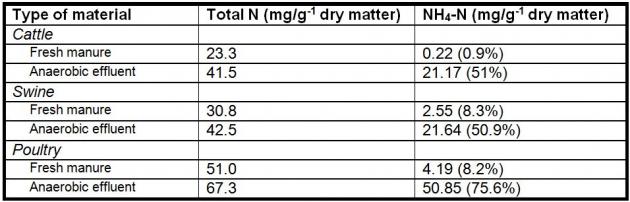
Nutrient content of the AD input will vary depending on the species of the contributing manure and if there is any addition of other organic feedstocks (co-digestion). Kirchmann and Witter (1992; Table 1) evaluated fresh and anaerobically digested manure from three different species for nutrient concentration. They conclude that anaerobic digestion of manure resulted in higher ammonium N concentrations (50-75% of total N) in the digested material. In a similar project with co-digestion of dairy manure and pre-consumer waste feedstocks, they observed an increase from 34% NH4 (% of total N) in pre-AD material to 58% NH4 (% of total N) post-AD material prior to liquid-solid separation  (7.3 NH4 and 21 total N lbs./ 1000gal before digestion; 9.1 NH4 and 15.8 total N lbs./1000 gal post digestion, Whitefield, 2009). Anaerobic digestion facilitates nitrogen mineralization, while carbon is converted to biogas.  Additionally, carbon is partially removed from the digested material,  reducing the C:N ratio (Kirchmann and Witter, 1992; Moller et al., 2008).

Table 1. Forms of nitrogen in fresh manure and anaerobic digestion effluent (Kirchmann et al., 1992; numbers in parenthesis are the percent of total N).

Phosphorus

Nutrient speciation data collected from previous AD studies suggest that a high percentage of the P can be found in the inorganic form in the AD effluent (Wrigley et al., 1992; Bowers et al., 2007; Marti et al., 2008; Moody, 2009). Moody (2009) and colleagues demonstrated a 26% increase of inorganic P (PO43) in digested swine slurry compared to the raw swine slurry (1591 mg/L and 1256.2  of PO43– respectively). Inorganic P is comprised of soluble and insoluble orthophosphates and polyphosphates. When evaluating the nutrient transformation of five different types of ADs in New York, the percent change in orthophosphorus (OP) after digestion varied from 7-27% depending on the type of AD (Figure 2). The case study data from Cornell (Figure 2) also demonstrates the percent change of total Kjeldahl nitrogen (TKN), ammonia nitrogen (NH3-N), organic nitrogen (ON), and TP (Gooch et al, 2006). The positive percent change indicates a greater concentration of the nutrient in the post digested effluent compared to the influent vs. a negative percent change which indicates the nutrient is more concentrated  in the influent before digested compared to after digestion.  These data represents several farms with digesters, some with different digester models, and therefore variation would be expected. Bowers et al., (2007) demonstrated total phosphorus (TP) content ranging from 238 to 323 ppm, from which OP contributed 106 to 231 ppm of the TP in the post digestion effluent of a co-digestion dairy manure AD. Also one should not expect loss of N or P during digestion, and variability due to sampling and analyses could have caused some error in mass balance calculations.

Figure 2.  Nutrient Transformation (% change) of five different farms with digesters from a case study in NY state (Source:  Gooch et al, 2006) The percent changes was calculated as influent nutrient value minus effluent nutrient value; therefore even though there is a negative percent change of NH3-N and OP, there is a greater amount in the digested effluent compared to the influent.

pH and Chemical Oxygen Demand

The pH of the manure remains fairly neutral throughout digestion maintaining microbial stability within the digester (Wen, 2009). In a study by Wang and collegues (2010) anaerobic digestion reduced manures’ chemical oxygen demand and amount of total and volatile solids by 30-40%.

Organic nitrogen is mineralized to ammonium while conserving total nitrogen and phosphorus (Wang et al., 2010). The Danish Biogas Institute reports 25% more available NH4-N and higher pH in AD manures (Monnet, 2003).

Liquids-Solids Separation

Many AD systems are managed with the use of liquids-solids separation after the manure has been digested. Separating out the solids for use as a soil amendment or bedding can result in a small reduction of nutrients in the remaining fraction. Preliminary data from Washington State University suggests that 27 % of the solids, 6 % of the N, and 8 % of the P are removed in the solids from AD treated manure (screw type solids separator).

Potential for Increased Efficiencies

Although there is a growing body of research on anaerobic digestion and crop nutrient availability, this technology has not been extensively studied. Most work has been focused on short term nutrient recovery (1-3 years), and not the long term impacts (5+ years) of fertilizing with AD manures (Arthurson, 2009).

AD manure has been shown to have the same positive effects on yield and crop production when applied at equal rates of plant-available N as synthetic fertilizers or raw manures in corn and forage production systems (Morris and Lathwell, 2004; Loria et al., 2007), while soil quality and fertility indicators are improved relative to synthetic fertilizers (de Boer, 2008; Arthurson, 2009).

Since anaerobically digested dairy manure could provide more plant available nitrogen than untreated manure (Kirchmann and Witter, 1992; Michel et al., 2010), the potential exists for increasing agricultural efficiences (Morris and Lathwell, 2004; Moller and Stinner, 2010). Increased concentrations of NH4-N in AD manure would increase the potential for N loss in the field, so best management practices would be required to take advantage of the higher NH4-N content.

Application of AD dairy manure to corn has been shown to produce similar total plant N uptake and equivalent or greater yields than inorganic fertilizer.  Early growth/yield of corn was greater from application of AD dairy manure than from synthetic fertilizers on acidic soils (<7.0) but not on alkaline soils (Morris and Lathwell, 2004). The acidic soils restrict ammonia loss from ammonium-rich AD manure resulting in greater N uptake (Nelson, 1982).

Figure 3 summarizes information from 2 years of a study (Saunders, 2011) conducted to look at anaerobically digested dairy manure or undigested dairy manure. When anaerobically digested or undigested manure was applied at equal amounts of total nitrogen, equivalent amounts of dry matter yield (~ 7.5 tons) and similar amounts of nitrogen uptake (~ 475 pounds) were observed. The control did not receive any form of fertilizer or manure, and was stastically different (P<.05) from the manure treatments before and after digestion.

Figure 3. Average annual yield of dry matter and annual nitrogen uptake by grass receiving equal amounts of nitrogen from anaerobically digested dairy manure or undigested dairy manure.

Manure serves as a useful, low-cost source of nutrients for crop production (Sommerfeldt et al., 1988; Jokela, 1992; Ferguson et al., 2005; Nyiraneza and Snapp, 2007). Anaerobically digested manure provides sufficient nutrients to support biomass and crop yields equivalent to synthetic fertilizers and raw manures (Bittman et al., 1999; Loria et al., 2007). Some studies, (Rubaek, 1996; Chantigny et al., 2007; de Boer, 2008) have found increased yield and nitrogen availability with application of anaerobically digested material as compared to non-digested material, possibly due to increased nitrogen content and reduced carbon content, which can result in nitrogen mineralization by microbes. In addition, manure applications to soils have enhanced soil quality and fertility compared to soils receiving synthetic fertilizers (de Boer, 2008; Arthurson, 2009). A crop will typically recover <50% of applied fertilizer nitrogen (Stevens et al., 2005). Up to 46% of applied manure nitrogen may be left over in the soil at the end of the growing season, increasing the potential for loss, after multiple applications during a season (Munoz et al., 2003). Over-application of manure nitrogen in excess of crop uptake can result in nitrate leaching (Angle et al., 1993). Some studies have indicated that manure nitrogen poses an equal or slightly less risk to leaching than synthetic fertilizers (Jokela, 1992;Trindade et al., 2009). Others have determined manure increases nitrate leaching (Jemison and Fox, 1994). During winter months when plants are dormant, nitrate leaching can be the main source of N loss (Bakhsh et al., 2007). The shift in organic to inorganic nutrients during the AD process should be considered when developing a farm nutrient management plan.

References

    1. AgSTAR Program. 2002. Managing manure with biogas recovery systems improved performance at competitive costs. Environmental Protection Agency, Office of Air and Radiation. 430-F02-004 http://www.epa.gov/agstar/documents/manage.pdf.
    2. Amon, B., V. Kryvoruchko, T. Amon, and S. Zechmeister-Boltenstern. 2006. Methane, nitrous oxide and ammonia emissions during storage and after application of dairy cattle slurry and influence of slurry treatment. Agriculture Ecosystems & Environment 112:153-162.
    3. Angle, J.S., C.M. Gross, R.L. Hill, and M.S. McIntosh. 1993. Soil nitrate concentrations under corn as affected by tillage, manure, and fertilizer applications. Journal of Environmental Quality 22:141-147.
    4. Arthurson, V. 2009. Closing the global energy and nutrient cycles through application of biogas residue to agricultural land – potential benefits and drawbacks. Energies 2:226-242.
    5. Bakhsh, A., R.S. Kanwar, C. Pederson, and T.B. Bailey. 2007. N-source effects on temporal distribution of NO3-N leaching losses to subsurface drainage water. Water Air and Soil Pollution 181:35-50.
    6. Brady, N.C., and R.R. Weil. 2002. The Nature and Property of Soils. 13 ed. Prentice Hall, Upper Saddle River, New Jersey.
    7. Bittman, S., C.G. Kowalenko, D.E. Hunt, O. Schmidt. 1999. Surface-banded and broadcast dairy manure effects on tall fescue yield and nitrogen uptake. Agronomy Journal 91: 826-833.
    8. Bowers, K.E., T.X. Zhang and J.H. Harrison. 2007. Phosphorus removal by struvite crystallization in various livestock wastewaters. American Society of Agricultural and Biological Engineers International Air and Waste Symposium (September 16-19, Broomfield, Colorado). Publication 701P0907cd of the ASABE. St Joseph, MI.
    9. Chantigny, M.H., D.A. Angers, P. Rochette, G. Belanger, D. Masse, and D. Cote. 2007. Gaseous nitrogen emissions and forage nitrogen uptake on soils fertilized with raw and treated swine manure. Journal of Environmental Quality 36:1864-1872.
    10. de Boer, H.C. 2008. Co-digestion of animal slurry can increase short-term nitrogen recovery by crops. Journal of Environmental Quality 37:1968-1973.
    11. Dugba, P.N., and R.H. Zhang. 1999. Treatment of dairy wastewater with two-stage anaerobic sequencing batch reactor systems – thermophilic versus mesophilic operations. Bioresource Technology 68:225-233.
    12. Field, J.A., J.S. Caldwell, S. Jeyanayagam, R.B. Reneau, W. Kroontje, and E.R. Collins. 1984. Fertilizer recovery from anaerobic digesters. Transactions of the American Society of Agricultural and Biological Engineers 27:1871-1876.
    13. Ferguson, R.B., J.A. Nienaber, R.A. Eigenberg, and B.L. Woodbury. 2005. Long-term effects of sustained beef feedlot manure application on soil nutrients, corn silage yield, and nutrient uptake. Journal of Environmental Quality 34:1672-1681.
    14. Fox, R.H., W.P. Piekielek, and K.E. Macneal. 1996. Estimating ammonia volatilization losses from urea fertilizers using a simplified micrometeorological sampler. Soil Science Society of America Journal 60:596-601.
    15. Gale, E.S., D.M. Sullivan, C.G. Cogger, A.I. Bary, D.D. Hemphill, and E.A. Myhre. 2006. Estimating plant-available nitrogen release from manures, composts, and specialty products. Journal of Environmental Quality 35:2321-2332.
    16. Gooch, C.A, S.F. Inglis, and P.E. Wright. 2006. Biogas Distributed Generation Systems Evaluation and Technology Transfer – Interim Report. NYSERDA Project No. 6597. New York State Energy Research and Development Authority.
    17. Jemison, J.M., and R.H. Fox. 1994. Nitrate leaching from nitrogen- fertilized and manured corn measured with zero-tension pan lysimeters. Journal of Environmental Quality 23:337–343.
    18. Jokela, W.E. 1992. Nitrogen-fertilizer and dairy manure effects on corn yield and soil nitrate. Soil Science Society of America Journal 56:148-154.
    19. Kirchmann, H., and E. Witter. 1992. Composition of fresh, aerobic and anaerobic farm animal dungs. Bioresource Technology 40:137-142.
    20. Loria, E.R., J.E. Sawyer, D.W. Barker, J.P. Lundvall, and J.C. Lorimor. 2007. Use of anaerobically digested swine manure as a nitrogen source in corn production. Agronomy Journal. 99: 1119-1129.
    21. Marti, N., A. Bouzas, A. Seco, and J. Ferrer. 2008. Struvite precipitation assessment in anaerobic digestion processes. Chemical Engineering J. 141: 67‐74.
    22. Michel, J., A. Weiske, and K. Moller. 2010. The effect of biogas digestion on the environmental impact and energy balances in organic cropping systems using the life-cycle assessment methodology. Renewable Agriculture and Food Systems 25:204-218.
    23. Moller, K., and W. Stinner. 2010. Effects of organic wastes digestion for biogas production on mineral nutrient availability of biogas effluents. Nutrient Cycling in Agroecosystems 87:395-413.
    24. Moller, K., W. Stinner, A. Deuker, and G. Leithold. 2008. Effects of different manuring systems with and without biogas digestion on nitrogen cycle and crop yield in mixed organic dairy farming systems. Nutrient Cycling in Agroecosystems 82:209-232.
    25. Monnet, F. 2003. Digested biomass as fertiliser. Available at: http://www.landbrugsraadet.dk/view.asp?ID=2281(Verified 21 Sept. 2010). Danish Biogas Association.
    26. Morris, D.R., and D.J. Lathwell. 2004. Anaerobically digested dairy manure as fertilizer for maize in acid and alkaline soils. Communications in Soil Science and Plant Analysis 35:1757-1771.
    27. Munoz, G.R., J.M. Powell, and K.A. Kelling. 2003. Nitrogen budget and soil N dynamics after multiple applications of unlabeled or (15)Nitrogen-enriched dairy manure. Soil Science Society of America Journal 67:817-825.
    28. Moody, L., R. Burns, and K.J. Stalder. 2009. Effect of anaerobic digestion on manure characteristics for phosphorus precipitation from swine waste. Appl. Eng. Agric. 25:97-102.
    29. Nelson, D.W. 1982. Gaseous losses of nitrogen other than through denitrification. In Stevenson, F.J., Bremner, J.M., Hauck, R.D., Keeney, D.R., editors. Nitrogen in Agricultural Soils. Agronomy monograph. Madison, WI: American Society of Agronomy No. 22, 327–363.
    30. Nyiraneza, J., and S. Snapp. 2007. Integrated management nitrogen and efficiency of inorganic and organic in potato systems. Soil Science Society of America Journal 71:1508-1515.
    31. Robertson G.P. 2000. Denitrification. Pagesc-181-190 in M.E. Sumner ed. Handbook of Soil Science. CRC Press, Boca Raton, Florida, USA.
    32. Rubaek, G.H., K. Henriksen, J. Petersen, B. Rasmussen, and S.G. Sommer. 1996. Effects of application technique and anaerobic digestion on gaseous nitrogen loss from animal slurry applied to ryegrass (Lolium perenne). Journal of Agricultural Science 126:481-492.
    33. Saunders, O. 2011. Environmental benefits and consequences of field applied anaerobically digested dairy manure for forage production. MS Thesis, Master of Science in Soil. Washington State University. Department of Crop and Soil Sciences.
    34. Sommerfeldt, T.G., C. Chang, and T. Entz. 1988. Long-term annual manure applications increase soil organic-matter and nitrogen, and decrease carbon to nitrogen ratio. Soil Science Society of America Journal 52:1668-1672.
    35. Stevens, W.B., R.G. Hoeft , and R.L. Mulvaney. 2005. Fate of nitrogen-15 in a long-term nitrogen rate study: II. Nitrogen uptake efficiency. Agronomy Journal 97:1046–1053.
    36. Topper, P.A., R.E. Graves, and T. Richard. 2006. The fate of nutrients and pathogens during anaerobic digestion of dairy manure. Pennsylvania State, Department of Agricultural and Biological Engineering. G71.
    37. Trindade, H., J. Coutinho, S. Jarvis, and N. Moreira. 2009. Effects of different rates and timing of application of nitrogen as slurry and mineral fertilizer on yield of herbage and nitrate-leaching potential of a maize/Italian ryegrass cropping system in north-west Portugal. Grass and Forage Science 64:2-11.
    38. Wang, L., Y.C. Li, P. Chen. M. Min, Y.F. Chen, J.Zhu, and R.R. Ruan. 2010. Anaerobic digested dairy manure as a nutrient supplement for cultivation of oil-rich green microalgae Chlorella sp. Bioresource Technology 101:2623-2628.
    39. Wen, Z., and S. Chen. 2009. Development of a sequential continuous stirred tank reactor (CSTR) system for anaerobic digestion of liquid dairy manure. American Society of Agricultural and Biological Engineers. Paper number 067070. https://elibrary.asabe.org/abstract.asp?search=1&JID=5&AID=21032&CID=por2006&v=&i=&T=1&urlRedirect=[anywhere=&keyword=&abstract=&title=&author=&references=&docnumber=on&journals=All&searchstring=21032&pg=&allwords=&exactphrase=21032&OneWord=&Action=Go&Post=Y&qu=]&redirType=newresults.asp
    40. Whitefield, E.M, J.H. Harrison, A. Bary, C. Cogger and A.M. Fortuna. 2009. Nutrient and pathogen characterization in a community anaerobic digester; presentation. Conservation Innovation Grant showcase at the Soil and Water Conservation Society Annual Meeting. July 14, 2009. Dearborn, MI.
    41. Wrigly,T., K. Webb, and H. Venkitachalm. 1992. A laboratory study of struvite precipitation after anaerobic digestion of piggery wastes. Bioresource Rechnology 41(2): 117-121.

Contributors to this Article

Authors


Peer Reviewers

Page Manager

  •  Sandy Anderson, Washington State University
Feedlot Ammonia (NH3) BMP Adoption: Barriers and Opportunities

Waste to Worth: Spreading science and solutions logoWaste to Worth home | More proceedings….

Purpose

Gaseous ammonia emissions from feedlot operations pose serious risks to human and ecosystem health. In particular, nitrogen deposition in Colorado‟s Rocky Mountain National Park may be associated with livestock feeding in the western Corn Belt and Colorado. Feedlot operators can implement a variety of Best Management Practices (BMPs) to reduce ammonia emissions. These BMPs vary in effectiveness, simplicity, managerial time, effort and financial capital. Although the ammonia-mitigating potential of various BMPs is well-researched, little research examines the barriers that prevent feedlot operations from adopting these BMPs.

What Did We Do?

To learn more about these barriers, a questionnaire was mailed to 1,998 dairy and feedlot producers in June 2007. Survey responses (overall response rate of 7.6% for feedlots and dairies) allow determination of current levels of BMP adoption as well as producer perceptions of the environmental impact and economic feasibility of each BMP.  This research uses discrete choice modeling to evaluate factors influencing adoption for the average producer as well as subsets of producers.

What Have We Learned?

Of the thirteen BMPs surveyed, six of the BMPs had adoption rates greater than 50%, indicating sizeable overall adoption levels. Probit analysis enables estimation of the conditional probability of adoption given a set of attributes. Hiring a nutritionist, incorporating manure within 48 hours, collecting runoff from drylots and testing for nutrients are practices most amenable to large operations. These practices range from 50-75% adoption rates, indicating potential for increased adoption.  The perception of high cost seems to limit the adoption of hiring a nutritionist, especially for small producers who are unable to distribute the high fixed cost across as many animals.  A perception of technical expertise decreases the probability of testing manure and compost for nutrients, as well as for performing yearly soil tests.  The technical expertise constraint particularly impacts smaller producers for testing manure and compost, while it persists across all sizes for conducting yearly soil tests.  Both providing bedding in pens and shade in drylots (require less technical assistance than the average practice. This result, combined with the negative relationship between adoption and size indicates they are better suited for adoption by smaller operations, as well as operations where the feedlot represents the principal revenue stream

Future Plans

This study aimed to provide outreach professionals with a profile of ammonia BMP adoptees and factors influencing adoption decisions, based on findings from the survey sample. Two principal limitations characterized these findings. First, the low response rate limited the ability to generalize to the population of feedlot operators. Further research needs to improve the response rate, identifying issues that hindered operator participation. Potential reasons include the length of the survey and the sensitive political nature of ammonia emissions. Furthermore, dairy operations play a key role in managing ammonia emissions, yet the survey response rate for dairy operators was prohibitively low, preventing an empirical analysis similar to the feedlot analysis. This low response rate can likely be attributed to lower overall numbers of dairy operations, as well as reluctance to participate for unknown reasons. Our intention is to repeat the survey effort with an improved elicitation method, but also to update BP’s to those that are part of the feasible set of adoption by producers.

Authors

James Pritchett, Associate ProfessorDepartment of Agriculture and Resource Economics, Colorado State University  james.pritchett@colostate.edu

Carolyn Davidson, Economic Analyst, National Renewable Energy Laboratory

Nicole Embertson, Science and Planning Coordinator, Whatcom Conservation District

Jessica Davis, Professor and Director for the Institute for Livestock and the Environment, Colorado State University

Additional Information

https://extension.colostate.edu/topic-areas/agriculture/best-management-practices-for-reducing-ammonia-emissions-1-631/

The authors are solely responsible for the content of these proceedings. The technical information does not necessarily reflect the official position of the sponsoring agencies or institutions represented by planning committee members, and inclusion and distribution herein does not constitute an endorsement of views expressed by the same. Printed materials included herein are not refereed publications. Citations should appear as follows. EXAMPLE: Authors. 2013. Title of presentation. Waste to Worth: Spreading Science and Solutions. Denver, CO. April 1-5, 2013. URL of this page. Accessed on: today’s date.

Efficient Utilization of Equine Manure

Waste to Worth: Spreading science and solutions logoWaste to Worth home | More proceedings….

Abstract

South Carolina is home to an estimated 18,000 horse owners, many of which own or house less than ten horses on their property.  Owners of such small facilities regularly obtain assistance from the Clemson Extension service concerning soil fertility, forage options, and in some cases nutrient testing, but there is very little information available concerning efficient utilization of the manure produced from their facility. In many cases the manure and bedding removed from stalls is viewed as something to be disposed of rather than a possible nutrient source than can be utilized with proper management.  This presentation provides an overview of horse manure production and nutrient content for the small horse facility owner, and addresses the best management techniques to utilize produced manure, including the benefits of composting the manure before utilization.

Purpose

South Carolina is home to an estimated 18,000 horse owners, many of which own or house less than ten horses on their property.  Owners of such small facilities regularly obtain assistance from the Clemson Extension service concerning soil fertility, forage options, and in some cases nutrient testing, but there is very little information available concerning efficient utilization of the manure produced from their facility. In many cases the manure and bedding removed from stalls is viewed as something to be disposed of rather than a possible nutrient source than can be utilized with proper management.

What Did We Do?

Several County Extension agents offer multi-week Equine Management seminars covering a range of topics primarily for the horse owner with a small number of horses.  We added a segment on horse manure production and utilization, developing a presentation detailing the manure production amounts and nutrient content of typical horse manure, and best management strategies for utilizing that manure.

What Have We Learned?

This presentation has been provided to four Equine Management Seminars to date.  In each case the horse owners were surprised in the lack of immediate availability of nitrogen in the manure, and were glad to learn of methods that provide sustainable uses for their horse manure while also helping to minimize potential disease issues and other impacts.  They also mentioned that they now view the manure as a resource, not as “something to be dealt with.”

Future Plans

We plan to offer this training during future Equine Management seminars and as a single-event program.

Authors

W. Bryan Smith, M.S., Area Extension Agent – Agricultural Engineer, Clemson Cooperative Extension Service, wsmth@clemson.edu

John P. Chastain, Ph.D., Professor and Extension Agricultural Engineer, Clemson University
Gary L. Heusner, Ph.D., Professor and Extension Specialist, University of Georgia

Additional Information

The South Carolina Confined Animal Manure Manager website – http://www.clemson.edu/camm

The authors are solely responsible for the content of these proceedings. The technical information does not necessarily reflect the official position of the sponsoring agencies or institutions represented by planning committee members, and inclusion and distribution herein does not constitute an endorsement of views expressed by the same. Printed materials included herein are not refereed publications. Citations should appear as follows. EXAMPLE: Authors. 2013. Title of presentation. Waste to Worth: Spreading Science and Solutions. Denver, CO. April 1-5, 2013. URL of this page. Accessed on: today’s date.   

Anaerobic Digestion: Co-Digestion and Operational Issues

Waste to Worth: Spreading science and solutions logoWaste to Worth home | More proceedings….

Abstract

A study was conducted to assess the performance of various mixing regimes on methanogen biomass content in anaerobic digesters.  Methane production in anaerobic digesters is directly related to the methanogens within the system.  Current systems involve mixing to increase biogas production and system efficiency, however little is known about the underlying mechanisms of this relationship.  In this study three pilot scale anaerobic digestion systems with three different mixing regimes were run with replication to examine the impacts to methanogen biomass content and biogas production.  The results will provide insight for operational recommendations as well as the basic microbial processes with digestion systems which are critical for optimization.

Authors

Rebecca Larson, University of Wisconsin-Madison            ralarson2@wisc.edu

Purpose

To evaluate various feedstocks and operational parameters for anaerobic digesters, including impacts to biogas production, quality, and operational issues.

What Did We Do?

Evaluated numerous co-feedstocks with manure in laboratory and large scale systems to identify biogas production impacts and potential operational issues associated with each.

What Have We Learned?

Analysis of ffedstocks is critical for determination of digester fundtioning.  Constituents can significantly impact the quantity and quantity of biogas produced.

Future Plans

To evaluate scale up to determine if small scale biomethane potential analyses can be used to determine full scale biogas production.

Authors

Rebecca Larson, Assistant Professor, University of Wisconsin – Madison

Corresponding author email address   ralarson2@wisc.edu

Asli Ozkaynak, Post-Doctoral Researcher, University of Wisconsin – Madison

Additional Information

Data is to be published

Acknowledgements


Funded by the USDA


The authors are solely responsible for the content of these proceedings. The technical information does not necessarily reflect the official position of the sponsoring agencies or institutions represented by planning committee members, and inclusion and distribution herein does not constitute an endorsement of views expressed by the same. Printed materials included herein are not refereed publications. Citations should appear as follows. EXAMPLE: Authors. 2013. Title of presentation. Waste to Worth: Spreading Science and Solutions. Denver, CO. April 1-5, 2013. URL of this page. Accessed on: today’s date.

Impacts of Anaerobic Digestion and Solid Liquid Separation on Pathogen Destruction

Waste to Worth: Spreading science and solutions logoWaste to Worth home | More proceedings….

Abstract

A study was conducted to evaluate the pathogen inactivation on 9 dairy facilities in Wisconsin with a combination of anaerobic digestion and solid/liquid separation technologies.  Samples were collected every 2 weeks over the course of eight months to assess dairy pathogen inactivation in full-scale operational digesters and solid/liquid separators.  Samples were then analyzed by qPCR for pathogens including protozoa, bacteria. bovine viruses, and indicators. 

Preliminary results indicate full-scale anaerobic digesters reduce pathogen levels by 99% to 99.9%.  And after digestion and separation of the digestate, the liquid fraction contains the majority of pathogens.  Although the solids fraction contained fewer pathogens, the concentration could still be above the infectious dose, particularly for calves.  Results have implications for a variety of digestate end uses including bedding and land spreading.

Purpose

Anaerobic digestion and bedding recovery units are increasing in on-farm use around the United States as a component of manure management systems.  Nearly all on-farm systems with a digester in the United States have a mechanical solid/liquid separation system following digestion which fractions the digestate into a solid and a liquid product.  Processing of manure using digestion and/or a solid/liquid separation process can impact the nutrient and pathogen content of each stream.  Lack of data for real world performance has limited the use of end products and has reduced revenues and resulted in operational problems for many dairies in Wisconsin. 

The purpose of this study was to evaluate the fate of pathogens and nutrients through full scale anaerobic digestion and solid liquid separation systems to better understand the impacts of manure processing.

What Did We Do?

In order to assess real world performance of digesters and solid/liquid separation systems, an assessment of 9 on-farm systems was conducted over the course of one year.  The study design includes sampling every other week pre and post digestion (if a digester is on-farm) and the solid and liquid portion after separation.  This allows for assessment of the digestion process and the separation system.  Samples are evaluated for nutrients, solids, pathogens (particularly those associated with herd health) and pathogen indicators.  The results indicate impacts to pathogen and nutrient concentrations throughout the system. 

What Have We Learned?

Pathogen content from farm to farm and within one farm varies significantly.  Performance of digesters on pathogen destruction is extremely variable.  Through the solid/liquid separation process the majority of the pathogens within the stream remain in the liquid portion.

Future Plans

To continue evaluation through controlled systems to identify key operational techniques to increase pathogen removal.

Authors

Rebecca Larson, Assistant Professor, University of Wisconsin – Madison, ralarson2@wisc.edu

Mark Borchardt, Research Microbiologist, USDA – ARS

Asli Ozkaynak, Post-Doctoral Researcher, University of Wisconsin – Madison

Susan Spencer, Research Microbiologist, USDA – ARS

Additional Information

Data is to be published

Acknowledgements

Funded by the USDA


The authors are solely responsible for the content of these proceedings. The technical information does not necessarily reflect the official position of the sponsoring agencies or institutions represented by planning committee members, and inclusion and distribution herein does not constitute an endorsement of views expressed by the same. Printed materials included herein are not refereed publications. Citations should appear as follows. EXAMPLE: Authors. 2013. Title of presentation. Waste to Worth: Spreading Science and Solutions. Denver, CO. April 1-5, 2013. URL of this page. Accessed on: today’s date.

On-Site Analytical Laboratories to Monitor Process Stability Of Anaerobic Digestion Systems

Waste to Worth: Spreading science and solutions logoWaste to Worth home | More proceedings….

Abstract

The anaerobic digestion of complex materials is a highly dynamic, multi-step process, where physicochemical and biochemical reactions take place in sequential and parallel ways.  The stability of the process depends on a delicate balance between the formation and consumption of products. When the concentration of a particular substance reaches the homeostatic equilibrium of certain organism or group of organisms, such balanced is disrupted, and the process becomes upset. If measures to correct the source of the problem are not taken, substrate stabilization and biogas production will progressively decrease, and eventually stop. Recovery of a digester can take several weeks to months, during which, energy generation and waste treatment are not possible, resulting in increased operational costs for the facility. To detect process perturbations and prevent major digester upsets, periodic monitoring is essential.

In this study, analytical laboratories were installed on selected on-farm anaerobic digestion systems in New York State, to periodically monitor key process parameters and to evaluate performance and stability of the operations.  Preliminary results showed that analytical labs were critical to detect process upsets efficiently, particularly in co-digestion systems, where loading rates and influent characteristics are usually variable. The laboratory is rather optional in manure-only operations, where the influent consists of a steady and predictable waste.

Authors

Rodrigo Labatut, Cornell University ral32@cornell.edu   

Curt Gooch, Cornell University


The authors are solely responsible for the content of these proceedings. The technical information does not necessarily reflect the official position of the sponsoring agencies or institutions represented by planning committee members, and inclusion and distribution herein does not constitute an endorsement of views expressed by the same. Printed materials included herein are not refereed publications. Citations should appear as follows. EXAMPLE: Authors. 2013. Title of presentation. Waste to Worth: Spreading Science and Solutions. Denver, CO. April 1-5, 2013. URL of this page. Accessed on: today’s date.

Converting Onion Waste into Energy as a Co-digestant with Dairy Waste

Waste to Worth: Spreading science and solutions logoWaste to Worth home | More proceedings….

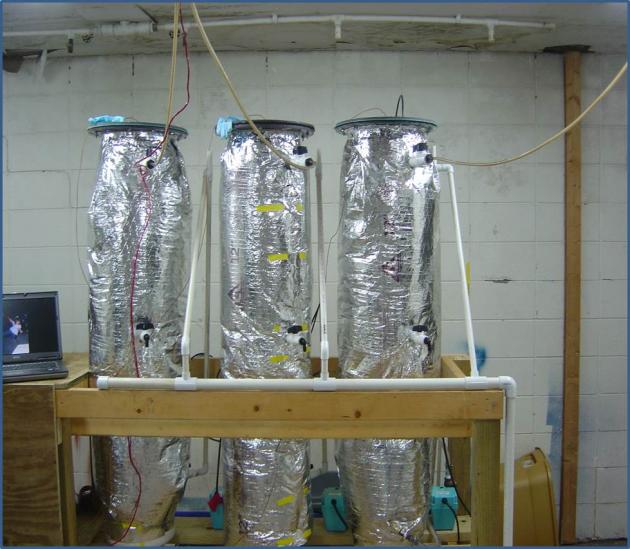
Lab scale anaerobic digesters constructed from PVC pipe used to evaluate co-digestion of manure with onion waste

Ninety liter (90 L) anaerobic digesters (anaerobic filters) were constructed from PVC pipe.  The digesters were filled with lava rock.  A thermocouple is placed in the center of each digester to be used in controlling temperature.  Each digester is controlled by a datalogger by reading temperature and turning on or off pumps to circulate water around digester maintaining temperature at 35 oC.  Biogas is collected in a tipping bucket and recorded on datalogger.

Abstract

Consumers demand high quality fruits and vegetables. As a result, packing sheds around the country cull or remove bad fruits and vegetables prior to packing then in boxes for shipment to stores. The culling process produces millions of pounds of waste fruits and vegetables annually. This culled fruit or vegetable then has to be disposed of in some form or fashion. Therefore, a project was designed to investigate the feasibility of using culled onions in conjunction with dairy waste to produce methane gas. The experiment used 90 liter downflow anaerobic filters to process a 50/50 mix of onion juice and dairy waste. Results from this study indicate the co-digestion of culled onions and dairy waste provides a good way to dispose of the waste onions while at the same time producing a renewable energy that can potentially be used in the packing shed where the onions are separated. The 50/50 blend of onion waste and dairy waste has consistently returned an average of 15 liters of biogas (70-75% methane) per 3 liters of mixed waste entering the digesters with a cleaning efficiency over 85%.

Why Look at Food Waste for Co-Digestion with Manure?

Culled onions or any fruit and vegetable has to be disposed.  Some of these are fed to animals, but some are thrown on fields and potentially tilled into the soil.  However, if they are piled and allowed to decay in place the liquid produced during the decaying process can have a high chemical oxygen demand (COD).  If this liquid is allowed to run into waterbodies they could be polluted or if allowed to infiltrate could be transferred to a waterbody through underground movement.  Therefore, this project investigated the characteristic of liquid produced from decaying onions as well as the feasibility of using waste onions along with dairy waste to produce methane gas in anaerobic digesters.  If feasible, the culled onions (or other fruits and vegetables) could be used as a source of energy verses a disposal issue.

What Did We Do?

The experiment had two parts.  The first part placed whole onions in a steel tank on a 2 foot bed of sand where the onions could naturally decay.  The liquid along with any rainwater was collected in portions and tested for its pH and Chemical Oxygen Demand.  Additionally, waste onions were juiced and mixed with dairy wastewater in a 50/50 mixture and used as feedstock for an anerobic filter digester.  Temperature was controlled in the mesophilic range and biogas was measured.

What Have We Learned?

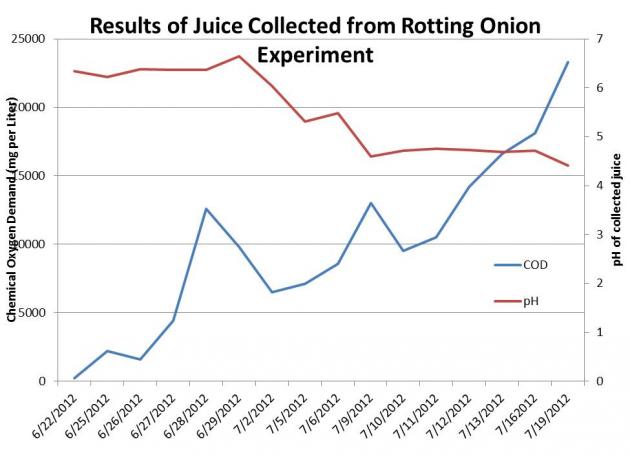
As expected, the decaying onions release a liquid that over time increases the COD profile of the liquid draining from the decaying pile.  It is expected that if onions were continually piled on the same spot, the COD and pH of the liquid would equalized at a COD value measured to be approximately 80 g/L and the pH would drop to approximately 3.5 (these numbers based on some previous studies and bench scale observations).  The data also suggest that, and as would be expected, onions decay faster in the summer months as opposed to winter months in Georgia.  It was also found that a 50/50 mix of onion waste and dairy wastewater fed to a pilot scale mesophilic anaerobic filter fed at 3 liters per day and a retention time of 7 days will produce approximately 15 liters of biogas daily with a methane composition of 70-75%.  The treatment level of the influent was also found to average greater than 85%.

The Chemical Oxygen Demand (COD) of liquid collected from the bottom of a tank full of decaying onions increases over time. Likewise, the pH of the liquid decreases. If these onions are disposed of in a wet area or area adjacent to a waterbody, the stre

The Chemical Oxygen Demand (COD) of liquid collected from the bottom of a tank full of decaying onions increases over time.  Likewise, the pH of the liquid decreases.  If these onions are disposed of in a wet area or area adjacent to a waterbody, the stream would be affected by the high COD and low pH liquid.

Biogas production from the mixed 50/50 onion/dairy waste fed at a rate of 3 liters per day. The methane composition of the biogas ranged from 70-75%. Treatment efficiencies of the waste, based on COD reduction, averaged greater than 85% (over 20 g L-1 i

Biogas production from the mixed 50/50 onion/dairy waste fed at a rate of 3 liters per day.  The methane composition of the biogas ranged from 70-75%.  Treatment efficiencies of the waste, based on COD reduction, averaged greater than 85% (over 20 g L-1 influent to less than 2 gL-1 in effluent).

Future Plans

Future plans will be continue the investigation of using waste onions (and other fruit and vegetables) as a feedstock for anaerobic digesters.  This feedstock, which is very available in onion growing regions seasonally, liquid from the onions can be stored over time (as observed in other research project) to provide a year round feedstock for the production of methane gas.  As we now know that the decaying onions release a liquid that has a high COD, using the onions for production of energy may reduce potential problems with water pollution as well as provide growers with additional income streams.  Plans will be to continue this work and look at optimizing the feed rate and mix ratios.

Authors

Gary Hawkins, University of Georgia, ghawkins@uga.edu

Additional Information

A few articles have been written about the project, research papers will be written in the near future.

Acknowledgements

The Vidalia Onion Research Committee and the USDA-AFRI Speciality Crops Initative

The authors are solely responsible for the content of these proceedings. The technical information does not necessarily reflect the official position of the sponsoring agencies or institutions represented by planning committee members, and inclusion and distribution herein does not constitute an endorsement of views expressed by the same. Printed materials included herein are not refereed publications. Citations should appear as follows. EXAMPLE: Authors. 2013. Title of presentation. Waste to Worth: Spreading Science and Solutions. Denver, CO. April 1-5, 2013. URL of this page. Accessed on: today’s date.

Coupling Dairy Manure Anaerobic Digesters with Commercial Greenhouses – An assessment of Technical and Economic Feasibility

Waste to Worth: Spreading science and solutions logoWaste to Worth home | More proceedings….

Abstract

Despite all of the positive environmental benefits of anaerobic digestion, the economics are not sufficient for widespread adoption by US farmers when selling surplus power to the grid.  Often farms are only paid the wholesale price (2 to 3 cents/kWh) for electricity, making it difficult to justify generating it in the first place.  In addition, typically in the Northeast, approximately 40% of the energy from a digester goes unused (excess heat).  Therefore, promising value-added technology/business partnerships need to be evaluated and demonstrated, such as partnering anaerobic digestion with commercial greenhouses. 

Greenhouses are an ideal end user of the waste heat and surplus electricity produced by a digester.  In the Northeast and other similar climates, heat and electricity represent a major expense for greenhouse growers.  Greenhouses can make use of excess heat to provide the necessary growing conditions for year-round production and excess electricity can be used to run supplemental lighting to keep production constant year-round.

To facilitate the adoption of digester/greenhouse unions, we are developing a comprehensive computer model of both the energy output of farm-based digesters, the energy requirements of the associated farm, and the energy required by greenhouses, in terms of timing and magnitude.  We will use existing and project-developed data collected from five Northeast digesters and three greenhouse operations to aid in developing and validating the model.  The model will be complex enough to handle varying biomass inputs and required outputs, and the economics of operation.  We will use the model to run several real-world “what ifs” and use the outputs for making recommendations to existing anaerobic digesters considering coupling with greenhouses. System economics are also going to be included.

Authors

Curt Gooch, Cornell PRO-DAIRY cag26@cornell.edu

Tim Shelford, Cornell PRO-DAIRY


The authors are solely responsible for the content of these proceedings. The technical information does not necessarily reflect the official position of the sponsoring agencies or institutions represented by planning committee members, and inclusion and distribution herein does not constitute an endorsement of views expressed by the same. Printed materials included herein are not refereed publications. Citations should appear as follows. EXAMPLE: Authors. 2013. Title of presentation. Waste to Worth: Spreading Science and Solutions. Denver, CO. April 1-5, 2013. URL of this page. Accessed on: today’s date.