The online Bioenergy Training Center provides educational training resources for Extension educators focused not only on the technical feasibility of bioenergy generation, but also on approaches and processes that assist communities in understanding the comprehensive implications of bio-based alternative energy. The intended outcome of the courses is to bring viable bioenergy projects into communities by providing Extension educators with tools and knowledge they can use to make this happen.
What Did We Do?
Developed three peer-reviewed, research-based online modular courses. Content was developed by experts from across the North Central Region. Included in one of the modules is a bioenergy and renewable energy community assessment toolkit.
Screen shot of the front page of the Bioenergy Training web site.
What Have We Learned?
The curriculum went live on the web in February 2013. We have not received any feedback on it to date. However, based on the reviews of individuals who used the bioenergy and renewable energy community assessment toolkit in 2012, it does a very good job of helping developers and communities objectively assess renewable energy projects.
Future Plans
Use the curriculum as a foundation for distance learning courses targeting other audiences.
Authors
M. Charles Gould, Extension Educator, Michigan State University, gouldm@msu.edu
Over 50 individuals participated in some aspect of curriculum development.
Additional Information
The Bioenergy Training Center web site is being revamped. It will be posted here at a later date.
Acknowledgements
Curriculum materials and training programs of ‘The Bioenergy Training Center’ were made possible through a grant from the National Water Resources Program, National Institute of Food and Agriculture, U.S. Department of Agriculture. NIFA/USDA Agreement No. WISN-2007-03790. Project Title: “Energy Independence, Bioenergy Generation and Environmental Sustainability: The Role of a 21st Century Engaged University”.
The authors are solely responsible for the content of these proceedings. The technical information does not necessarily reflect the official position of the sponsoring agencies or institutions represented by planning committee members, and inclusion and distribution herein does not constitute an endorsement of views expressed by the same. Printed materials included herein are not refereed publications. Citations should appear as follows. EXAMPLE: Authors. 2013. Title of presentation. Waste to Worth: Spreading Science and Solutions. Denver, CO. April 1-5, 2013. URL of this page. Accessed on: today’s date.
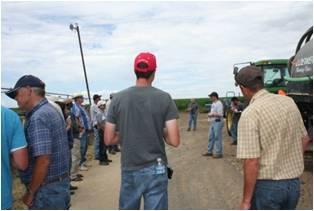
Teaching Best Management Practices (BMP) or introducing new agricultural waste management practices to livestock producers and farmers is a challenge. This poster describes a series of on-farm field days designed to deliver information and demonstrate on-site several waste management techniques, most of them well established in other parts of the country but sparsely used in Idaho. During these field days, Extension personnel presented each technique and offered written information on how to apply them. But without a doubt, presentations by the livestock producers and farmers who are already applying the techniques and hosted each field day at their farms was the main tool to spark interest and conversations with attendees.
Four field days were delivered in 2012 with more programmed for 2013. Demonstrated techniques reduce ammonia and odor emissions, increase nitrogen retention from manure, reduce run-off risks, and reduce emissions of greenhouse gases. Topics addressed on each field day were, a: Dairy manure collection and composting, 20 attendees. b: Dairy manure land application ten attendees. c: Grape vine prunings and dairy manure composting, 50 attendees. d: Mortality and offal on-farm composting, 40 attendees. In all cases farm owners and their managers presented and were available to answer attendees’ questions, sharing their experience, and opinions regarding the demonstrated practices. Many attendees expressed their interest and willingness to adopt some of the demonstrated practices. On-farm field days are an excellent tool to increase understanding and adoption of BMP and new technologies. Hearing experiences first hand from producers applying the techniques and being able to see them in action are excellent outreach tools. On-farm field days also fit the fast pace, busy schedule of modern producers who can later visit with Extension and other personnel if they need more details, information, and help on how to adopt the techniques they are interested in.
Why Hold Field Days on Ag Waste Management?
The dairy industry is the number one revenue commodity in Idaho. At the same time Idaho is ranked third in milk production in the nation. Idaho has more than 580,000 dairy cows distributed in 550 dairy operations (Idaho State Department of Agriculture 1/2013). The Magic Valley area in south-central Idaho hosts 54% of those dairies and 73% of all dairy cows in the state (Idaho Dairymen’s Association internal report, 2012). Odors from dairies and other animal feeding operations are a major issue in Idaho and across the country. In addition, the loss of ammonia from manures reduces the nutrient value of the manure and generates local and regional pollution. Dairy farmers of all sizes need more options on how to treat and dispose of the manure generated by their operations. Odor reductions, capture of nitrogen in dairy manure, reduction of greenhouse gases emissions, off-farm nutrients export, water quality protection, and reduction of their dairy operation’s environmental impact are some of the big challenges facing the dairy industry in Idaho and around the country. There are many Best Management Practices (BMP) that are proven to work on providing results related to the challenges mentioned before. Some of these practices are widely adopted in certain parts of the country or in other countries, with a lack of adoption by dairy producers and farmers in other parts of the country. This poster shows a series of Extension and research efforts designed to introduce and locally test proven BMP to dairy producers and crop farmers in southern Idaho in an effort to increase their adoption and incorporate those BMP as regular practices in Idaho agriculture. The four projects described were delivered in 2012 and some will continue in 2013.
What Did We Do?
To demonstrate and test BMP we chose to develop on-farm research projects to collect data and couple these projects with on-farm field days to demonstrate the applicability of the BMP in a real-world setting. Extension personnel developed the research and on-farm field days and did several presentations at each location. But without a doubt the stars during those field days were the dairy producers and farmers who hosted the research and demonstration events and who are already using or starting to use the techniques showcased. These pioneer producers are not only leading the way in using relatively new BMP in southern Idaho, they also share their experiences with other producers and with the academia so everybody around can learn from them. Topics addressed in each field day were, a: Dairy manure collection and composting, 20 attendees. b: Dairy manure land application, 10 attendees. c: Grapevine prunings and dairy manure composting, 50 attendees. d: Mortality and offal on-farm composting, 40 attendees.
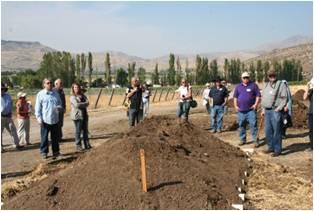
On-farm manure collection and composting field day.
Some highlights from each project are: a. The dairy manure collection and composting field day demonstrated the operation and use of a vacuum manure collection system and a compost turner. Dairy managers and machinery operators shared their experiences, benefits and challenges related to the use of these two technologies. During the field day attendees also visited the whole manure management system of the dairy and were able to observe diverse manure management techniques. As a result of this project Extension personnel determined the necessity of generating educational programs for compost and manure management operators for dairy employees. A composting school in Spanish and English proposal was presented and a grant was obtained to develop and deliver them in 2013.
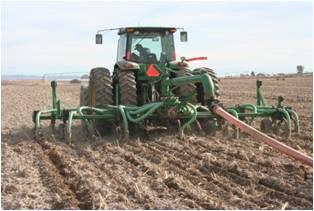
b. The dairy manure land application field day featured the demonstration of a floating manure storage pond mixer and pump, and a drag hose manure injection system. We also showed an injection tank that wasn’t operated during the demonstration. The floating pond mixer serves as lagoon mixer and pump. It mixes and pumps the manure through the drag hose system to the subsurface injector. This system dramatically reduces the time required to land apply liquid and slurried manures. It also significantly reduces ammonia and odor emissions to near background levels, as well as avoids runoff after applications. This project included research of emissions on the manure injection sites (see Chen L., et al. in this conference proceedings).
Demonstrating dairy manure subsurface injection using a drag hose system.
c. The grapevine prunings and dairy manure composting project involves research on the implications of increasing the carbon content of dairy manures using grapevine prunings and other carbon sources to retain more nitrogen in the compost, and how it varies among three diferent composting techniques. This project includes two field days, one during the project (2012), and another one at the end of it in 2013. The demonstration includes how to compost using mechanically turned windrows (common in Idaho), passive aerated, and forced aerated windrows (both very rarely used in Idaho). Another novelty in this project is that it aims to bring together dairy producers and fruit & crop producers, or landscaping insustry so they can combine their waste streams to produce a better compost and to reduce the environmental impact of each operation. Several producers of the diverse audience who attended showed interest in adopting some of the composting techniques presented during the field day.
d. The mortality and offal on-farm composting project was located at a diversified sheep farm that includes sheep and goat dairy and cheese plant, meat lambs, and chickens. A forced aerated composting box was used to compost lamb offal, hives, lamb and chicken mortalities, and whey from the cheese plant. A very diversified audience attended the field day and the composting system generated a lot of interest. The farm owner was so pleased with the system that she created a second composter with materials she had on-hand to increase her composting capabilities and compost all year round. The producer stopped disposing of lamb offal, hives, and mortalities at the local landfill.
What Have We Learned?
On-farm field days are a great tool to demonstrate and encourage the application of otherwise seldom applied techniques. They also can serve a dual purpose of demonstration and research, allowing for quality data collection if designed properly. Farmers’ collaboration and full participation during all phases of the project is paramount and pays off by having a very enthusiastic and collaborative partner. Identiying progressive and pioneer producers that are already applying new BMP or are willing to take the risk is very important to develop this kind of on-farm experience. In general these individuals are also willing to share their knowledge, experience, and results with others to increase the adoption of such techiques. Having a producer hosting and presenting during the field day, at their facilities (as opposed to a dedicated research facility) generates great enthusiasm from other producers and helps to “break the ice” and bring everybody to a friendly conversation and exchange of ideas if properly facilitated.
Future Plans
On both projects, a. manure collection and composting and b. manure injection we will generate a series of videos to demonstrate the proper application of BMP, and educational printed material will also be published. Project c. grape prunings and manure composting is still going on and we will finish collecting data by mid 2013. A second field day will be offered and videos and printed educational material will be developed. Project d. will see an expansion with a mortality composter for dairy calves being installed at a dairy, and with a field day following after the first compost batch is ready. Additional programs are in the works; these programs incorporate the on-farm demonstration and research dual purpose and have high participation from the involved producers.
Authors
Mario E. de Haro-Marti, Extension Educator, Gooding County Extension Office, University of Idaho Extension. mdeharo@uidaho.edu
Lide Chen, Waste Management Engineer
Howard Neibling, Extension Irrigation and Water Management Specialist
Mireille Chahine, Extension Dairy Specialist
Wilson Gray, District Extension Economist
Tony McCammon, Extension Educator
Ariel Agenbroad, Extension Educator
Sai Krishna Reddy Yadanaparthi, Graduate student
James Eells, Research Assistant. University of Idaho Extension.
Acknowledgements
Projects a. and b. were supported by a USDA-NRCS Conservation and Innovation Grant (CIG). Project c. was supported by a USDA-NRCS Idaho CIG. Project d. was supported by a University of Idaho USDA-SARE mini grant. We also want to thank Jennifer Miller at the Northwest Center for Alternatives to Pesticides for her help and support with projects c. and d. Finally, we want to thank all producers involved in these projects for their support and openess to work with us, and for their innovative spirit.
The authors are solely responsible for the content of these proceedings. The technical information does not necessarily reflect the official position of the sponsoring agencies or institutions represented by planning committee members, and inclusion and distribution herein does not constitute an endorsement of views expressed by the same. Printed materials included herein are not refereed publications. Citations should appear as follows. EXAMPLE: Authors. 2013. Title of presentation. Waste to Worth: Spreading Science and Solutions. Denver, CO. April 1-5, 2013. URL of this page. Accessed on: today’s date.
While large-scale farms have typically been the focus of anaerobic digestion systems in the U.S., an emerging need has been identified to serve smaller farms with between 50 and 500 head of cattle. Implementing such a small, standardized, all-in-one system for these small farm applications has been developed. Small-scale digesters open the playing field for on-farm sustainability and waste management.
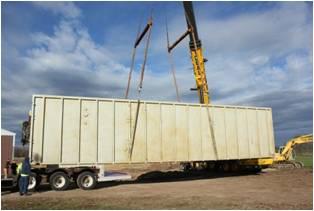
Unloading the first biodigester unit.
This presentation on small-scale digestion would discuss the inputs, processing, function, and outputs of BIOFerm™ Energy Systems’ small agitated plug flow digester (EUCOlino). This plug-and-play digester system has the ability to operate on dairy manure, bedding material, food waste, or other organic feedstocks with a combined total solids content of 15-20%. A case study would be presented that describes the site components needed, the feedstock amount and energy production, as well as biogas end use. Additional details would include farm logistics, potential sources of funding, installation, operation, and overall impact of the project.
This type of presentation would fill an information gap BIOFerm™ has discovered among dairy farmers who believe anaerobic digestion isn’t feasible on a smaller scale. It would provide farmers who attend with an understanding of the technology, how it could work on their specific farm and hopefully reveal to them what their “waste is worth”.
Why Study Small-Scale Anaerobic Digestion
To inform and educate attendees about small-scale anaerobic digestion surrounding the installation and feasibility of the containerized, paddle-mixed plug flow EUCOlino system on a small dairy farm <150 head.
Biodigester unit being installed at Allen Farms.
What Did We Do?
Steps taken to assist in financing the digestion system include receiving grants from the State Energy Office and Wisconsin Focus on Energy. Digester installation includes components such as feed hopper, two fermenter containers, motors, combined heat and power unit, electrical services, etc…
What Have We Learned?
Challenges associated with small project implementation regarding coordination, interconnection, and utility arrangements.
Future Plans
Finalize commissioning phases and optimize operation.
Steven Sell, Biologist/Application Engineer, BIOFerm™ Energy Systems
Gabriella Huerta, Marketing Specialist, BIOFerm™ Energy Systems
Additional Information
Readers interested in this topic can visit www.biofermenergy.com and for more information on our plants, services and project updates please visit us on our website at www.biofermenergy.com. You will also see frequent updates from us in industry magazines (BioCycle, REW Magazine, Waste Age). BIOFerm will also be present at every major industry conference or tradeshow including the Waste Expo, Waste-to-Worth and BioCycle– stop by our booth and speak with one of our highly trained engineers for further information.
The authors are solely responsible for the content of these proceedings. The technical information does not necessarily reflect the official position of the sponsoring agencies or institutions represented by planning committee members, and inclusion and distribution herein does not constitute an endorsement of views expressed by the same. Printed materials included herein are not refereed publications. Citations should appear as follows. EXAMPLE: Authors. 2013. Title of presentation. Waste to Worth: Spreading Science and Solutions. Denver, CO. April 1-5, 2013. URL of this page. Accessed on: today’s date.
To examine the financial, operational and health benefits of re-using composted bedding in the equine industry.
What Did We Do?
Stable waste, consisting of manure, urine and wood shavings, is a readily compostable feedstock that generates heat and can be transformed into finished homogenous compost, which can be used as bedding for horses and other livestock. This transformation can be completed in as little as 2 weeks with in-vessel technologies, 15-25 days in aerated site-built systems and 20-30 days in aerated static pile (ASP) systems. If composting is done in a biologically active, aerobic environment such as the systems mentioned above, the process destroys weed seed, parasites and harmful pathogens. These benefits are the result of system controls such as a correct ratio of C:N, moisture, porosity of the pile, and temperature. The in-vessel composting system offers the most comprehensive control of these factors ensuring the most favorable results.
The biological process that occurs when the stable waste is blended utilizes the leachable N and binds it in the organic matrix keeping it secured. There is also a reduction in N during the process as it becomes volatile and escapes through vaporization. The phosphorus is utilized by the bacteria during the process, reducing the amount available to leach by at least 50%. Since both N and Ph are needed for cellular growth, they get locked in the cells of the growing bacteria. This process generates heat, removing the moisture, killing pathogens and creating drier and more absorbent material for bedding re-use.
IOS Ranch, a private 20 horse show stable on Bainbridge Island, Washington, was the study site for this paper. They purchased an Earth Flow in vessel system and it is from this system that the lab results and observational data were collected. Their bedding of choice is medium sized bulk shavings. Also studied over the same period of time was the Earth Flow in-vessel system at Joint Base Myers/Henderson in Arlington, Virginia. The US Army Caisson horses stabled there are bedded on pelletized bedding. Lab data from this composting mix contributed to this study as well.
Washington State University, encouraged by the potential of financial savings, started using composted material as bedding in the school’s dairy farm. An unexpected benefit of this decision was the reduction of mastitis in the dairy herd. The change in bedding was the only variable altered in the care of the herd when this observation was noted. A study conducted by Cornell University’s Waste Management Institute studied the financial effects of using manure solids (DMS) as bedding. This study showed an average of $37,000 was saved annually by the diary farms who switched to re-use bedding. It was from these observations that we decided to apply the same questions to the equine industry.
A study conducted by Caitlin Price Youngquist of the Snohomish Conservation District, and funded by Western SARE is searching for the health benefits to horses with the use of composted stable waste as bedding. Preliminary examination has shown an increase in foot and leg health and a decrease in thrush, scratches and dermatitis seen on the horses in the study. General foot and leg health was also attributed to compost bedding by Dr. Hannah Mueller of Cedarbrook Veterinary Clinic and Northwest Equine Stewardship Center. She documented relief for a horse with chronic hives and a horse with a tracheotomy. The reduction of dust has been cited as a benefit to the horses suffering from heaves and other dust related ailments such as skin and respiratory irritations. The compost material has the unique quality of a large capacity for absorption while at an already higher level of moisture that makes the compost bedding less dusty. Both pellets and shavings exhibit this attribute.Youngquist’s assumption for the benefit composted bedding offers is based in the process itself. She states, “The compost has been through a very hot phase to kill all pathogens and parasites. It now has a thriving microbial population that competes aggressively with the fungal and bacterial pathogens that cause infections and irritations on skin and hooves (similar to the concept of a pro-biotic).”
Stable waste compost as bedding can be used in its entirety or screened to collect the larger remaining pieces of shavings for bedding, leaving the fines for soil amendment. Testing has shown in either case the composted material to have high absorbency, more so than green shavings. When mixed with 50% new or green shavings, the stall is at its most efficient for health and comfort for the horse. The composted material offers higher absorption, soaking up the urine off the stall floor. With a top dressing of new shavings the stall is aesthetically pleasing to the human eye, light in color and offering the horse a barrier to the wetter, compost material below. The compost bedding is odor free when reintroduced to the stall. The introduction of at least 50% new shavings also supports the ongoing composting system, refilling the system when it has its 40-50% reduction of volume and the eventual breakdown of the shaving pieces with multiple trips through the system. Continuing research is being done to understand the effect of pelletized bedding used in the bedding re-use loop without the introduction of a larger substance to affect the integrity of the material as it continues to be re –used.
The first test done was to measure the absorption ability of the three types of bedding mixes. Two inches of material was placed in a plastic container. The first test done on 2” of green shavings, the second test done on 2” of a 50/50 mix of green shavings and compost, and the third test done on 2” of compost. Each of the variations was weighed before the introduction of water. One gallon of water was poured over the material and allowed to stand for 2 minutes. The container was then drained of any standing water which was measured. The container was again weighed in each case after the water had been drained. This procedure allowed for the measurement of absorption by both the increase in weight and the volume of water not absorbed by the material.
The new shavings taken from a loose pile absorbed the least, the 50/50 mix the next higher amount and the compost bedding absorbed the most moisture. This is impressive when one considers that the density of compost bedding is higher before the introduction of the test water. The compost material is comprised of the same woody fiber as the shavings but the edges have softened and loosened, and it is possible that the breakdown of the resins, which can be hydro phobic, allows for additional absorption ability.
We also tested for the moisture content of each bedding type with a simple oven test. The material was measured by a two cup measuring cup and poured into a glass baking dish. The material was weighed before going into the oven, set at 200°. The material was then weighed again to determine the moisture content after 12 hours.
These preliminary tests were performed to study initial benefits noted with bedding re-use. These are not scientific studies and are only intended to show possible indications for the purpose of this paper and to encourage further study. With composting and bedding re-use, barns close the waste stream loop and create a value added product.
What Have We Learned?
The viability of composted stable waste to be re-used as bedding is proven to provide financial benefits by saving on the cost of material purchase and in the disposal of stable waste. It provides further savings in health care costs.
Laboratory Results for Composted Stable Waste
Laboratory Results for Composted Stable Waste
Future Plans
We will continue to support the Snohomish Conservation District study run by Caitlin Youngquist by supplying composted stable waste and collaboration.
We plan to run our dust measurement during the summer months when we actually have dust in the Pacific Northwest. A furnace filter attached to the intake side of an 18” x 18” fan would be left on at ground level in a newly bedded stall for three minutes while the horse was hand walked around the stall. This would be repeated for the three bedding variations. The filter would be weighed before being attached to the fan and again after the three minute period.
Study of pellets as bedding re-use material will be done, measuring the health benefits and the viability of the product over multiple uses.
A controlled trial on direct contact allergens will be conducted on the three bedding mixtures.
We will continue to educate the equine industry and encourage a broad scale adoption of this closed waste system.
Authors
Mollie Bogardus, MBA Sustainable Business, Equine Specialist, Green Mountain Technologies, Inc. and Michael Bryon Brown, President, Green Mountain Technologies, Inc.
Bogardus, Mollie. “Equine Applications/Case Studies/ IOS Ranch and Fort Myer/Henderson.” Green Mountain Technologies. Green Mountain Technolgies, Inc., n.d. Web. 15 Mar. 2013. http://compostingtechnology.com/equine/.
Cohen, Jamie. “Composted Horse Manure: The Pros and Cons.” The Florida Horse Feb. 2013: 23. Print.
“Equine Applications.” Green Mountain Technologies- lab results. N.p., 12 Dec. 2012. Web. 1 Mar. 2013. http://compostingtechnology.com/equine.
LeaMaster, Brad, James R. Hollyer, and Jennifer L. Sullivan. “Composted Animal Manures: Precautions and Processing.” Cooperative Extension Service,College of Tropical Agriculture and Human Resources, University of Hawai‘i. University of Hawaii at Manoa, n.d. Web. 6 Mar. 2013. http://www.ctahr.hawaii.edu/oc/freepubs.
Price Youngquist, Caitlin. “Composted Horse Manure and Stall Bedding Pilot Project – YouTube.” YouTube. Snohomish Conservation District, 17 Jan. 2013. Web. 1 Mar. 2013. https://youtu.be/B91U5UjuaXI.
Schwartz, Mary, Jean Bonhotal, and A. Edward Stachr. “Use of Dried Manure Solids as Bedding for Dairy Cows.” Cornell Waste Management Institute. Cornell University, n.d. Web. 1 Oct. 2012. http://cwmi.css.cornell.edu>.
Wheeler, Eileen , and Jennifer Smith Zajaczkowski. “Horse Stable Manure Management.” Cornell Cooperative Extension, Orange County Equine, Saratoga County Equine. Penn State University, n.d. Web. 6 Mar. 2013. http://cceequine.org.
Zaborski, Ed. “Composting to Reduce Weed Seeds and Plant Pathogens – eXtension.” eXtension – Objective. Research-based. Credible.. University of Illinois at Urbana Champaign, 22 Oct. 2012. Web. 2 Oct. 2012. http://www.extension.org/pages/28585/composting-to-reduce-weed-seeds-and….
Acknowledgements
This report could not have been done without the support of Philippe Le Dorze at IOS Ranch. His interest and pursuit of knowledge pushed us to continue to search for improvements and greater knowledge.
The staff at Joint Base Myer/Henderson, Amy Fagan especially, were also willing participants in the pursuit of the perfect compost recipe. Paul Brezovec at Concurrent Technologies Corp was a tremendous support to the project and continues to encourage the use of Earth Flow vessels for other bases.
A special thanks to Caitlin Price Youngquist for her ongoing dedication, collaboration and interest in the phenomena of bedding re-use.
The authors are solely responsible for the content of these proceedings. The technical information does not necessarily reflect the official position of the sponsoring agencies or institutions represented by planning committee members, and inclusion and distribution herein does not constitute an endorsement of views expressed by the same. Printed materials included herein are not refereed publications. Citations should appear as follows. EXAMPLE: Authors. 2013. Title of presentation. Waste to Worth: Spreading Science and Solutions. Denver, CO. April 1-5, 2013. URL of this page. Accessed on: today’s date.
To study the interactive effects of large particle solids removal, anaerobic digestion and amendment of a manure additive (More than manure®), along with environmental factors on NH3 emissions from dairy slurry during storage.
To demonstrate a cost-effective and instantaneous NH3 measurement method using GasAlert NH3 detector under field conditions.
What Did We Do?
Twenty-six liters of each manure was stored in plastic storage buckets in duplicate in a barn with the surface open to the atmosphere. GasAlert readings of NH3 were obtained weekly from each container. Samples from each manure were analyzed for total N, NH4-N, total solids and volatile solids. Data collected was manure temperature, manure pH and ambient temperature. Average NH3 concentration, peak NH3 concentration and NH3 flux was calculated for each manure treatment.
Joe Harrison, professor, Washington State University, Puyallup Research and Extension Center, jhharrison@wsu.edu
Fei Sun1, graduate student
Joe Harrison1, professor
Pius Ndegwa2, associate professor
HungSoo Joo2, post Doc research associate
Liz Whitefield1, research associate
Kris Johnson2, professor
1Washington State University Research and Extension Center, 2 Washington State University
Acknowledgements
Specialty Fertilizer Products (SFP), LLC for financial support
The authors are solely responsible for the content of these proceedings. The technical information does not necessarily reflect the official position of the sponsoring agencies or institutions represented by planning committee members, and inclusion and distribution herein does not constitute an endorsement of views expressed by the same. Printed materials included herein are not refereed publications. Citations should appear as follows. EXAMPLE: Authors. 2013. Title of presentation. Waste to Worth: Spreading Science and Solutions. Denver, CO. April 1-5, 2013. URL of this page. Accessed on: today’s date.
Raw poultry litter has certain drawbacks for energy production such as high ash and moisture content, a corrosive nature, and low heating values. A combined solution to utilization of raw poultry litter may involve fractionation and pyrolysis. Fractionation divides poultry litter into a fine, nutrient-rich fraction and a coarse, carbon dense fraction. Pyrolysis of the coarse fraction would remove the corrosive volatiles as bio-oil, leaving clean char. This paper presents the effect of fractionation and pyrolysis process parameters on the calorific value of char and on the characterization of bio-oil. Poultry litter samples collected from three commercial poultry farms were divided into 10 treatments that included 2 controls (raw poultry litter and its coarse fraction having particle size greater than 0.85 mm) and 8 other treatments that were combinations of three factors: type (raw poultry litter or its coarse fraction), heating rate (30 or 10 °C/min), and pyrolysis temperature (300 or 500°C). After the screening process, the poultry litter samples were dried and pyrolyzed in a batch reactor under nitrogen atmosphere and char and condensate yields were recorded. The condensate was separated into three fractions on the basis of their density: heavy, medium, and light phase. Calorific value and proximate and nutrient analysis were performed for char, condensate, and feedstock. Results show that the char with the highest calorific value (17.39MJ/kg) was made from the coarse fraction at 300°C, which captured 68.71% of the feedstock energy. The char produced at 300°C had 42mg/kg arsenic content but no mercury. Almost all of the Al, Ca, Fe, K, Mg, Na, and P remained in the char. The pyrolysis process reduced ammoniacal-nitrogen (NH4-N) in char by 99.14% and nitrate-nitrogen (NO3-N) by 95.79% at 500°C.
L. Mark Risse*, K.C. Das, John Worley, and Sidney Thompson, University of Georgia
The authors are solely responsible for the content of these proceedings. The technical information does not necessarily reflect the official position of the sponsoring agencies or institutions represented by planning committee members, and inclusion and distribution herein does not constitute an endorsement of views expressed by the same. Printed materials included herein are not refereed publications. Citations should appear as follows. EXAMPLE: Authors. 2013. Title of presentation. Waste to Worth: Spreading Science and Solutions. Denver, CO. April 1-5, 2013. URL of this page. Accessed on: today’s date.
Land application of manure in regions with intense confined livestock and poultry production is an environmental concern when land is limiting because it promotes soil phosphorus (P) surplus and potential pollution of water resources. A net accumulation of soil P results from the disproportion between lower nitrogen (N) and P ratio (N:P) in animal manure and the higher N:P ratio in harvested crops. Although manure can be moved off the farm, its transportation becomes less economical with increasing distances from the source. Thus, management alternatives to land application are needed to resolve agronomic P imbalances for more effective recycling of manure P.
Litter washed solids residue – Low P content
What Did We Do?
A treatment process, called “quick wash”, was developed for extraction and recovery of P from poultry litter and animal manure solids. In the quick wash process, P is selectively extracted from solid manure or poultry litter by using mineral or organic acid solutions. Following, P is recovered by addition of liquid lime and an organic poly-electrolyte to the liquid extract to form a calcium-containing P precipitate. The quick wash process generates two products: 1) washed solid residue, and 2) concentrated recovered P material.
What Have We Learned?
Recovered concentrated P material
The quick wash process selectively removes up to 80 % of the phosphorus from manure solids while leaving most of the nitrogen in the washed litter residue. Consequently, the washed solid residue has a more balanced N:P ratio for crop production and environmentally safe for land application. The concentrated P recovered materials contained more than 90% of its phosphorus in plant available form. The use of recovered P can provide a recycled P source for use as crop fertilizer while minimizing manure P losses into the environment from confined animal production.
Future Plans
USDA granted an exclusive license of the invention to Renewable Nutrients, LLC (Pinehurst, NC); a centralized plant for treating poultry litter is planned to be built and operated by Renewable Nutrients in the Mid-Atlantic region.
Authors
Ariel A. Szogi, Research Soil Scientist, USDA-ARS Coastal Plains Soil, Water, and Plant Research Center, Florence, SC. ariel.szogi@ars.usda.gov
Ariel A. Szogi, Matias B. Vanotti, Patrick G. Hunt – USDA-ARS Coastal Plains Soil, Water, and Plant Rsearch Center, Florence, SC.
Szogi, A.A., Vanotti, M.B., Hunt, P.G., 2008. Process for removing and recovering phosphorus from animal waste. U.S. Patent and Trademark Office Application Serial No. 12/026,346.
Szogi, A.A., Vanotti, M.B., and Hunt, P.G. 2008. Phosphorus recovery from poultry litter. Trans. ASABE 51(5):1727-1734.
Szogi, A.A. and Vanotti, M.B., 2009. Prospects for phosphorus recovery from poultry litter. Bioresour. Technol. 100(22):5461-5465.
Szogi, A.A., Bauer, P.J., and Vanotti, M.B. Fertilizer effectiveness of phosphorus recovered from broiler litter. Agron. J. 102(2):723-727. 2010.
Acknowledgements
This work is part of USDA-ARS National Program 214: Agricultural and Industrial Byproducts; ARS Project 6657-13630-005-00D “Innovative Bioresource Management Technologies for Enhanced Environmental Quality and Value Optimization.”
The authors are solely responsible for the content of these proceedings. The technical information does not necessarily reflect the official position of the sponsoring agencies or institutions represented by planning committee members, and inclusion and distribution herein does not constitute an endorsement of views expressed by the same. Printed materials included herein are not refereed publications. Citations should appear as follows. EXAMPLE: Authors. 2013. Title of presentation. Waste to Worth: Spreading Science and Solutions. Denver, CO. April 1-5, 2013. URL of this page. Accessed on: today’s date.
An online decision support tool for determining feasibility of anaerobic digestion has been developed (http://www.erams.info/AD_feasibility/). This decision support tool is specifically targeted to cattle operations in the arid west and provides general information on anaerobic digestion (AD), recommendations on the technical and economic feasibility of AD based on producer provided information on management practices, recommendations on appropriate AD technology based on user defined criteria for the system, guidance on technology provider selection, and required maintenance for operation of an AD system. The goal of the tool is to enable and empower producers to make informed decisions about AD based on unbiased information rather than relying on the biased information often provided by technology providers. In this workshop, the drivers for technical and economic feasibility for on farm AD installation will be discussed and the online decision support tool will be demonstrated.
Why Look at Anaerobic Digestion for Cattle Operations?
Anaerobic digestion is a waste management tool with many advantages, including generation of energy for on-site use. However, careful consideration must be given regarding technical and economic feasibility for installation on cattle operations. A web-based decision tool has been developed to provide technical and economic guidance to producers on feasibility of on-farm anaerobic digestion (http://www.eramsinfo.com/erams_beta/AD_feasibility/).
Home Page of Web-based Decision Support Tool
What Did We Do?
Based on commonalities found from feasibility studies conducted throughout the state of Colorado, a web-based decision tool has been developed to provide technical and economic guidance to producers on feasibility of on-farm anaerobic digestion (http://www.eramsinfo.com/erams_beta/AD_feasibility/)
What Have We Learned?
For use of conventional anaerobic digestion technology at dairy facilities, manure should be collected on concrete by scraping or flushing. Anaerobic digestion of manure collected on dry lots is not feasible with conventional technology. Economics are favorable when on-site energy use is high and the energy produced by the digester is primarily used on-site.
Future Plans
We will continue to develop and improve the existing web-based tool. We are also working on developing an anaerobic digestion technology suitable for dry lot collected manure.
Authors
Sybil Sharvelle, Assitant Professor, Colorado State University, Department of Civil and Environmental Engineering, sybil.sharvelle@colostate.edu
Jeffrey Lasker, Research Assistant, Colorado State University
Lucas Loetscher, Research Assistant, Colorado Sate University
The authors are solely responsible for the content of these proceedings. The technical information does not necessarily reflect the official position of the sponsoring agencies or institutions represented by planning committee members, and inclusion and distribution herein does not constitute an endorsement of views expressed by the same. Printed materials included herein are not refereed publications. Citations should appear as follows. EXAMPLE: Authors. 2013. Title of presentation. Waste to Worth: Spreading Science and Solutions. Denver, CO. April 1-5, 2013. URL of this page. Accessed on: today’s date.
Manure generated from concentrated animal feeding operations may serve as a source of steroids in surface water and adversely impact the development of aquatic ecosystems. The objectives of this research were to determine the amount of steroids and metabolites in manure from beef cattle production pens, and runoff from crop production fields.
What Did We Do?
Heifers were treated with zeranol, trenbolone acetate, and 17b-estradiol implants and fed melengestrol acetate, while a second group was not treated with growth promoters. Manure was sampled in the pens during feeding, run-off was collected during rainfall events, after feeding manure was collected, and either composted or stockpiled overwinter. In the following summer both composted and stockpiled manure was spread on a field, with plots subjected three tillage practices. Following application, two rainfall simulation events were conducted: one day (1 DAT) and one month later (30 DAT) to determine the effects of rainfall timing, manure handling (treated compost, untreated compost, treated stockpile and untreated stockpile) and tillage (no-till, moldboard plow+disk and disk) on the runoff losses of steroids.
What Have We Learned?
Simulated rainfall apparatus.
Results from the manure composting showed reduction in steroid concentrations over stockpiling for some compounds in manure samples such as 4-androstenedione, a-zearalenol, and progesterone, though not for all steroids. Very low concentrations of steroids were found in most runoff samples, approaching or below detection limits. Considering only detection frequency, fewer runoff samples showed traces of steroids on the 1 DAT in comparison to the 30 DAT simulations. The amount of rainfall before runoff was initiated was affected by tillage, and was different for the 1 DAT and 30 DAT events. A second year’s study with a smaller set of treatments, and use of a surrogate estrogen applied at known mass showed that disking significantly reduced runoff losses of the steroids. Runoff risk is affected by the storm event needed to initiate runoff, and also the time since manure application.
Soil during rain simulation and tube to take runoff to collection point.
Future Plans
From both the steroid runoff and general manure applications risk perspectives, how the soil receives rainfall changes during the first month after tillage. Therefore, this process needs to be investigated more closely and models predicting runoff have to take these changes into account.
Authors
Charles A. Shapiro, Professor, Department of Agronomy and Horticulture, University of Nebraska-Lincoln, Haskell Agricultural Laboratory, Concord, NE cshapiro@unl.edu
Sigor Biswas, Research Assistant, William L. Kranz, Associate Professor, David P. Shelton, Professor, Simon J. van Donk, Assistant Professor, Biological Systems Engineering; Daniel D. Snow, Associate Professor, Schol of Natural Resources; Shannon L. Bartelt-Hunt, Assistant Professor, Tian C. Zhang, Professor, Civil Engineering; Terry L. Mader, Professor, Animal Science, University of Nebraska-Lincoln; David D. Tarkalson, Soil Scientist, USDA-ARS, Kimberly-ID.
Additional Information
Bartelt-Hunt, S., D. Snow, W. Kranz, T. Mader, C. Shapiro, S. van Donk, D. Shelton, D. Tarkelson, and T.C. Zhang. 2012. Effect of growth promotants on the occurrence of steroid hormones on feedlot soils and in runoff from beef cattle feeding operations. Environ. Sci. Technol. 46(3): 1352-1360.
Biswas, S., C. A. Shapiro, W. L. Kranz, T. L. Mader, D. P. Shelton, D.D. Snow, S. L. Bartell-Hunt, D. D. Tarkalson, S. J. van Donk, T. C. Zhang, S. Enslay. Current knowledge on the environmental fate, potential impact and management of growth promoting steroids used in the US beef cattle industry. J. of Soil and Water Cons. (In press, July 2013 issue).
Acknowledgements
This research was funded by US-EPA Science to Achieve Results (STAR) grant R833423.
The authors are solely responsible for the content of these proceedings. The technical information does not necessarily reflect the official position of the sponsoring agencies or institutions represented by planning committee members, and inclusion and distribution herein does not constitute an endorsement of views expressed by the same. Printed materials included herein are not refereed publications. Citations should appear as follows. EXAMPLE: Authors. 2013. Title of presentation. Waste to Worth: Spreading Science and Solutions. Denver, CO. April 1-5, 2013. URL of this page. Accessed on: today’s date.
This research is evaluating management options for conventional hog producing facilities in regions of Manitoba that will have insufficient land base for sustainably applying raw slurry manure when manure application regulations switch from nitrogen based to phosphorus based rates. Producers are being encouraged to use solid-liquid separation, such as centrifugation, to remove the phosphorus rich solid fraction so that it can be transported and applied further away where there is a phosphorus deficiency. However, the resulting separated hog solids (SHS) product is still odorous and prone to nitrogen losses through ammonia volatilization. Therefore, it has been suggested that composting the SHS before it is applied is a beneficial management practice that would allow producers to capitalize on agricultural and environmental benefits such as reduced odours, stabilization of minerals, application of a homogeneous product, and acts as a multi-beneficial soil conditioner. However, the low starting C:N of 15:1 and small particle size of SHS make it a unique and challenging product to compost in windrows, a common form of large production on-farm composting. The SHS must be combined with a bulking agent that allows adequate nutrient balance for decomposition as well as a porous structure. Therefore, this project is comparing wood shavings (WS) and wheat straw (WHT) as bulking agents to evaluate which is the better management practice based upon minimizing greenhouse gas emissions and additional nitrogen gas losses as well as overall quality of the mature compost.
LI-8100a automated flux chamber
What Did We Do?
Starting in October 17, 2012 we created two windrows containing SHS, one with wood shavings as a bulking agent and one with wheat straw. The materials were mixed in a feed mixer to produce a homogeneous mixture with the initial starting parameters shown in Table 1. The windrows were turned once a week for the first four weeks with a Backus windrow turner.
Gas emissions were measured with the use of the highly innovative technology of the LI-8100a automated chamber system (LICOR BioSciences) and Fourier Transform Infrared spectroscopy (FTIR) multi-gas analyzer (Gasmet DX4015). By combining these two instruments it has the advantage of nearly continuous unattended data collection and simultaneous measurement of greenhouse gases (carbon dioxide, methane, nitrous oxide) and additional nitrogen gases (ammonia, nitrous dioxide, and nitrogen monoxide). There were four automated chambers on each windrow; a flux measurement was taken every half hour, alternating between the two windrows. Flux emissions were calculated using linear regression analysis.
Table 1. Initial starting parameters for the two windrows
Initial In-process Compost
Starting C:N
Starting Moisture %
Starting Bulk Density (kg/m3)
Starting pH
WHT + SHS
32.5
63.70
170.5
6.86
WS + SHS
35.5
60.45
350
6.5
The temperature, % oxygen, and moisture content of the windrows were recorded to identify when the compost needed to be turned and to track the composting process and relate it to the gases emitted.
Backhus compost windrow turner
What Have We Learned?
In September 2011 we conducted a trial that used straw as a bulking agent but found the contact between the separated hog solids and straw was poor due to the difference in particle size allowing for large pore spaces and the waxy texture of straw. The porous structure made it difficult to maintain moisture in the compost windrow and when water was added some of the separated hog solids actually “washed off”. In the winter, the windrow wasn’t big enough or it was too porous that it did not insulate well so self heating stopped and the pile froze in January. These problems slowed the decomposition process and resulted in compost with straw pieces still visible.
For this trial we decided to try using wood shavings as an alternative bulking agent, because wood shavings have a smaller particle size which we predicted would result in better contact with the separated hog solids and a less porous structure allowing better insulation against the weather (water loss in the summer, heat loss in the winter). Additionally, it is expected that wood shavings are also beneficial in reducing ammonia losses.
However, during this trial we experienced much wetter and cooler conditions compared to the year before, so we did not have to add water to the windrows. This was beneficial for the windrow with straw because the moisture content did not decline resulting in a steady rate of decomposition during the first month of composting noted by continuous CO2 emissions. Eventually the moisture content became too high creating anaerobic conditions and the production of CH4 after the second and fourth turnings. NO2 emissions were also detected during the same time as CH4, indicating some aerobic respiration occurring. After CO2 emissions reduced there was a small amount of N2O and NO measured.
The windrow with wood shavings took a little longer to start producing CO2 because it became anaerobic from the start. CH4 was produced much early and at higher emission rates compared to the windrow with the straw as a bulking agent. N2O, NO, and NO2 were emitted at the same time as CH4, indicating there were anaerobic and aerobic pockets throughout the windrow. N2O emissions continued after CO2 emissions declined.
Composting in the winter
After the windrows had been in the active stage of composting for three months, the temperature within the windrows gradually declined and both windrows froze up in early January.
We are currently in the process of calculating the ammonia flux determinations. Due to the nature of ammonia it is prone to absorbtion reactions on the surface of the LI-8100a and FTIR systems’ tubing. The surface reactions cause a time delay for the FTIR to analyze the concentration compared to the other gases. Thus, this gas requires a different time interval to calculate the flux.
Future Plans
A common problem with using chamber measurements on compost windrows is underestimation of gas emissions from chambers placed on the top of the windrow when high winds blow through the windrow horizontally, reducing the “chimney effect”. Having the ability to collect gas emission data at such a high frequency using the LI-8100a automated chamber and FTIR system allows us to identify when gases emissions may be underestimated due to wind. The next step is to determine if we can correlate the wind speed and direction with under estimation of gas losses.
Mario Tenuta, Canada Research Chair in Applied Soil Ecology, University of Manitoba
Matt Gervais, Soil Ecology Field Technician, University of Manitoba
Acknowledgements
Western Economic Diversification Canada, Manitoba Pork Council, Manitoba Horticultural Productivity Enhancement Centre, Manitoba Rural Adaptation Council, NSERC, National Center for Livestock and the Environment, University of Manitoba Soil Ecology Laboratory, Glenlea Research Farm, Prairie Agricultural Machinery Institute, Compo-stages, Puratone
The authors are solely responsible for the content of these proceedings. The technical information does not necessarily reflect the official position of the sponsoring agencies or institutions represented by planning committee members, and inclusion and distribution herein does not constitute an endorsement of views expressed by the same. Printed materials included herein are not refereed publications. Citations should appear as follows. EXAMPLE: Authors. 2013. Title of presentation. Waste to Worth: Spreading Science and Solutions. Denver, CO. April 1-5, 2013. URL of this page. Accessed on: today’s date.
Manage Cookie Consent
To provide the best experiences, we use technologies like cookies to store and/or access device information. Consenting to these technologies will allow us to process data such as browsing behavior or unique IDs on this site. Not consenting or withdrawing consent, may adversely affect certain features and functions.
Functional
Always active
The technical storage or access is strictly necessary for the legitimate purpose of enabling the use of a specific service explicitly requested by the subscriber or user, or for the sole purpose of carrying out the transmission of a communication over an electronic communications network.
Preferences
The technical storage or access is necessary for the legitimate purpose of storing preferences that are not requested by the subscriber or user.
Statistics
The technical storage or access that is used exclusively for statistical purposes.The technical storage or access that is used exclusively for anonymous statistical purposes. Without a subpoena, voluntary compliance on the part of your Internet Service Provider, or additional records from a third party, information stored or retrieved for this purpose alone cannot usually be used to identify you.
Marketing
The technical storage or access is required to create user profiles to send advertising, or to track the user on a website or across several websites for similar marketing purposes.
 Waste to Worth home | More proceedings….


 What Did We Do?


