The curricula contains a map where participants keep track of their progress visually as they work through the different activities.
An educational curricula was pilot tested in 2020 by Extension professionals in Nebraska and Minnesota. It utilizes a table-top sized map game board, six pre-planned scenarios, and interactive planning by small groups to select preferred manure application sites. The original curricula addresses:
How far will I need to travel to manage manure nitrogen? Phosphorus?
Which fields benefit the most agronomically from manure?
How far can I afford to travel?
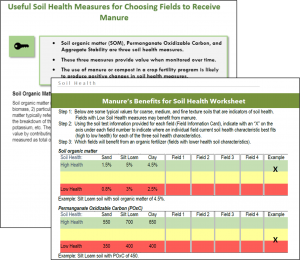
Which fields benefit most from manure’s soil health benefits?
What water quality risks are connected with individual fields?
How can I use a weather forecast to minimize neighbor’s odor risks?
These activities often lead to lots of peer-to-peer teaching. For example, we have witnessed discussions about minimizing compaction and planning to minimize impacts on community infrastructure and neighbors. As participants work through these discussions, they add visual reminders (i.e. happy and sad face emojis) to the map to weigh the benefits and concerns connected to individual fields.
Over the course of the last several years, the curricula has been expanded. There are now additional activities on the following topics:
Crediting nitrogen from all sources to choose a nitrogen rate
Determining value of commercial fertilizer nutrients
Determining manure availability
Observing setbacks and stockpiling manure
Reading soil and manure samples
Soil health practices for early career farmers and educators (developed by the Soil Health Nexus)
Resources are Available for Adapting to Your State
The curricula includes:
Fact sheets complement many of the activity’s main worksheets, helping the participants make their decision.
Scenarios
worksheets for each of the activities, and
a facilitator guide to help set up the scenario.
You may download electronic copies of all resources, adapt to your state, and begin sharing a highly interactive and peer-to-peer educational experience.
Downloadable Resources
Thank you for your interest in the curricula. Please fill out the following form to access the files:
The right amount of animal manure in the right location can benefit crops, soil, and water resources. However, too much manure or manure in the wrong place is an environmental concern. A recent survey of attitudes from farmers and their advisors on the benefits and barriers for manure use indicates that there is widespread knowledge of manure value for cropping systems, but logistical and community barriers remain. The survey also found that all respondents rated peer-to-peer interactions as the most influential on their decision-making for these topics. Thus, more extension efforts should be focused in assisting AFO managers and advisors to communicate messages on the value of manure and strategies for overcoming barriers, among their specific networks. For example, knowledge of the relationship of manure and soil health benefits is low among some segments. Farmers and their advisors all have very low opinions and understanding of manure’s benefits to environmental quality. Helping farmers, educators, and advisors articulate among themselves and to their rural communities the water quality benefits of organic fertilizers when applied to only meet agronomic needs of the crop may need expanded investments. With these needs in mind a team from the Universities of Nebraska, Minnesota, and Iowa State, and the assistance of the North Central Region Sustainable Agricultural Research and Education program developed a library to provide educators and advisors with access to recommended resources that will assist in the discussion of manure’s benefits and challenges.
What Did We Do?
Consultation among the team identified the following categories of interest for readily accessible educational or outreach materials for manure impacts on:
Soil health and soil quality
Economics of production and yield
Crop fertility
Water quality
On-farm research
And guidance to navigating barriers such as:
Direct costs associated with manure use
Odor and other community issues
Agronomic challenges (such as imbalance nutrients)
Regulations
Logistical issues of application
Using manure in specialty systems (such as organic production)
With the categories for materials established, the team conducted an initial survey of extant educational and outreach materials via general internet searches and review of content available through the Livestock and Poultry Environmental Learning Community. The types of content thus assembled were varied: social media content, video, summaries of research, published extension and scientific journal articles, websites, and other content such as podcasts and decision support tools. All were included since it was intended that these resources be helpful for educators, producers, or others to converse with their own networks easily and confidently on the manure topics identified. The team anticipated that users could use the library to expand their social media activity, and thus their communication networks, or to prepare more confidently to discuss manure via a local radio presentation or discussion with a county board. Or even to add an article to local print media or a blog or personal website. All items included in the library were free to repurpose (with attribution) in local outlets or personal sites.
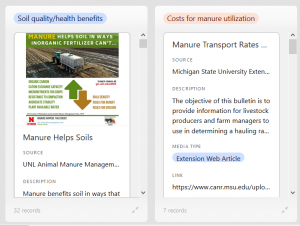
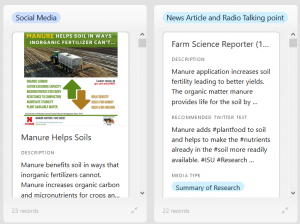
After consultation, the library was built using Airtable ™, a platform to create low-code databases, tools, or other apps. This platform allows the team to internally build a flexible database of content which can be sorted easily into pre-set categories (for example, topics of specific seasonal relevant), and arrange content into easily perused views to improve the user experience on a platform that could be easily embedded into existing team sites, such as lpelc.org (Figure 1).
Figure 1. The user interface for the merits of manure library, several such sorted views are embedded on the LPELC website for audience exploration by topic, media type, or seasonal relevance. Within each view individual entries can be further searched or sorted to further narrow exploration.
Each entry (Figure 2) in the library has an individual entry card, which includes keywords and text descriptions to improve searchability as well as a downloadable file, or links to the resource where appropriate, and a short example of how this material could be shared in the user’s social media network (recommended twitter text). The team intended to provide library users with not only the educational content, but also the means to improve their own in-network communication on manure topics. Accordingly, when posting to social media, hashtags, mentions and links to other content help (a) reach users who are following a specific topic (e.g., #manure), (b) recognize someone related to the post (e.g., @TheManureLady) and (c) direct users to more content related to the graphic (e.g., URL to online article). For our content library, each item is accompanied by recommended text that can be copied and pasted into the post of a social media engine if desired.
Figure 2. A single-entry page for the library.
What Have We Learned?
Since its launch in 2021 the library has had 343 unique users, average time that each user spends interacting with the library is 129 seconds, a solid interaction time for a website – industry standard is 120-180 seconds. However, we do not have any measure for how time spent on the library page is transformed into use of the library content. It is evident that more work is needed to improve awareness of the tool among audiences of interest. To this end, the team decided to develop a recognizable brand for library materials which might help other potential users to find their way to the site (Figure 3).
Figure 3. Library logo.
Future Plans
Library administrators continue to look for ways to improve the library content, user experience, and awareness of the tool among potential users. An overview of content, accessibility, re-purposing, and submission of relevant material will be shared to publicize the resource, encourage utilization of available materials, and invite submissions of new content relevant to the manure management community.
Authors
Amy Schmidt, Associate Professor, University of Nebraska
Leslie Johnson, Associate Extension Educator, Mara Zelt, Schmidt Lab Project Director, Amber Patterson, Schmidt Lab Media Communications Specialist, and Rick Koelsch, Professor Emeritus, University of Nebraska-Lincoln; Erin Cortus, Associate Professor, and Melissa Wilson, Assistant Professor, University of Minnesota; and Dan Andersen, Associate Professor, Iowa State University
This product was assembled with financial assistance from the North Central Region Sustainable Agricultural Research and Education program. NCR-SARE is one of four regional offices that run the USDA Sustainable Agriculture Research and Education (SARE) program, a nationwide grants and education program to advance sustainable innovation to American agriculture.
The project team assembling this product includes Amy Schmidt, Leslie Johnson, and Rick Koelsch, University of Nebraska-Lincoln; Erin Cortus and Melissa Wilson, University of Minnesota; and Dan Andersen, Iowa State University. These resources represent our recommendations for discussing the Value of Manure.
This product was assembled with financial assistance from the North Central Region Sustainable Agricultural Research and Education program. NCR-SARE is one of four regional offices that run the USDA Sustainable Agriculture Research and Education (SARE) program, a nationwide grants and education program to advance sustainable innovation to American agriculture.
Media types include social media, news articles, web pages, educational publications, decision support tools, and recommended research articles.
Authors/Sponsors
The project team assembling this product includes Amy Schmidt, Leslie Johnson, and Rick Koelsch, University of Nebraska-Lincoln; Erin Cortus and Melissa Wilson, University of Minnesota; and Dan Andersen, Iowa State University. These resources represent our recommendations for discussing the Value of Manure.
This product was assembled with financial assistance from the North Central Region Sustainable Agricultural Research and Education program. NCR-SARE is one of four regional offices that run the USDA Sustainable Agriculture Research and Education (SARE) program, a nationwide grants and education program to advance sustainable innovation to American agriculture.
Topics include agronomics, economics and yield, soil health/quality, water quality, organic systems, neighbors, regulations and logistics.
Authors/Sponsors
The project team assembling this product includes Amy Schmidt, Leslie Johnson, and Rick Koelsch, University of Nebraska-Lincoln; Erin Cortus and Melissa Wilson, University of Minnesota; and Dan Andersen, Iowa State University. These resources represent our recommendations for discussing the Value of Manure.
This product was assembled with financial assistance from the North Central Region Sustainable Agricultural Research and Education program. NCR-SARE is one of four regional offices that run the USDA Sustainable Agriculture Research and Education (SARE) program, a nationwide grants and education program to advance sustainable innovation to American agriculture.
The project team assembling this product includes Amy Schmidt, Leslie Johnson, and Rick Koelsch, University of Nebraska-Lincoln; Erin Cortus and Melissa Wilson, University of Minnesota; and Dan Andersen, Iowa State University. These resources represent our recommendations for discussing the Value of Manure.
This product was assembled with financial assistance from the North Central Region Sustainable Agricultural Research and Education program. NCR-SARE is one of four regional offices that run the USDA Sustainable Agriculture Research and Education (SARE) program, a nationwide grants and education program to advance sustainable innovation to American agriculture.
Manure is a resource that comes with many benefits and challenges. This library is designed to provide educators and advisors with access to recommended resources that will assist you in your discussion of manure’s benefits and challenges. Educators, please feel free to share and re-purpose educational products in this library with local audiences. Advisors, the library’s resources shall provide you with decision tools and educational products for enriching your discussions with clientele and rural community residents.
How to find materials
For those seeking specific resources, materials are organized visually by topic area and type of media. For those that would rather search materials more linearly, there is a grid version available.
In all views, there is a search button in the top right corner that looks like a magnifying glass and an expansion button that looks like two outward pointing arrows to view in full screen.
Preview of manure value library database sorted by purpose.
Social media
Short news articles and web pages
Educational publications
Decision support tools
Recommended research articles
Instructions for Re-purposing Educational Content
Our team encourages and welcomes educators and advisors re-purposing of many of the social media and web page/news article resources found in this library. Would these resources be helpful to you for Tweeting to your followers? Assembling talking points for a local radio presentation or discussion with a county board? Or adding an article to local print media or your blog?
Example of social media graphic to be re-purposed.
Twitter Posts: A broad range of Twitter posts, graphics with an educational message and short text introduction, are included for use with your social media connections. Please re-purpose these for your local use. We ask that you maintain the “N Extension” and “WSA” logos in your re-purposed post. You may replace the “Manure Happens. Take Credit” caption and the “Learn more at: http:// ________” with an appropriate recognition of your organization and/or a web page that you would like to promote.
Web Page/News Articles: Many of these library products can be repurposed for a variety of local uses. News articles and web pages may be revised to add local information with the new authors name included if the original authors continue to be listed.
Any Educational Products: Any of the Library resources may be used as talking points for a local radio broadcast or community group presentations. Please recognize the original authors and resource title in your presentation.
Is something missing from our library?
We welcome your suggestions of resources that you have found beneficial in your educational or advisory role. Please email any of the project team members with your suggestions or submit them via our google form for our consideration.
Authors/Sponsors
The project team assembling this product includes Amy Schmidt, Leslie Johnson, and Rick Koelsch, University of Nebraska-Lincoln; Erin Cortus and Melissa Wilson, University of Minnesota; and Dan Andersen, Iowa State University. These resources represent our recommendations for discussing the Value of Manure.
This product was assembled with financial assistance from the North Central Region Sustainable Agricultural Research and Education program. NCR-SARE is one of four regional offices that run the USDA Sustainable Agriculture Research and Education (SARE) program, a nationwide grants and education program to advance sustainable innovation to American agriculture.
To provide the best experiences, we use technologies like cookies to store and/or access device information. Consenting to these technologies will allow us to process data such as browsing behavior or unique IDs on this site. Not consenting or withdrawing consent, may adversely affect certain features and functions.
Functional
Always active
The technical storage or access is strictly necessary for the legitimate purpose of enabling the use of a specific service explicitly requested by the subscriber or user, or for the sole purpose of carrying out the transmission of a communication over an electronic communications network.
Preferences
The technical storage or access is necessary for the legitimate purpose of storing preferences that are not requested by the subscriber or user.
Statistics
The technical storage or access that is used exclusively for statistical purposes.The technical storage or access that is used exclusively for anonymous statistical purposes. Without a subpoena, voluntary compliance on the part of your Internet Service Provider, or additional records from a third party, information stored or retrieved for this purpose alone cannot usually be used to identify you.
Marketing
The technical storage or access is required to create user profiles to send advertising, or to track the user on a website or across several websites for similar marketing purposes.