Community Engagement to Mitigate Transmission of Infectious Diseases and Antibiotic Resistance from Backyard Poultry

Purpose

Backyard poultry production is growing globally with 85 million backyard chickens estimated in the U.S. (Mace & Knight, 2024). Whether kept as pets or to provide a local and sustainable food source, flocks can harbor pathogens and antibiotic-resistant bacteria that can be transmitted to humans via the environment, pests, food products, and direct contact. Poultry waste can contaminate soil and water sources, posing risks to nearby humans and other animals. Flocks can attract pests that may carry diseases and disrupt local ecosystems. This project, which will launch in the summer of 2025, aims to improve understanding among backyard poultry farmers of potential health, environmental, community, and food safety risks associated with their systems and motivate the adoption and promotion of behaviors critical to public health and sustainability of local food systems using a peer-to-peer outreach approach.

This project will evaluate an approach to motivating behavioral changes among a cohort of backyard poultry farmers that is predicated on evaluating current flock management practices among participants, improving understanding of health risks associated with current practices, and motivating implementation of recommended practices to mitigate health risks. Beneficiaries of project outcomes include members of households in which chickens are maintained, local community members, consumers of local poultry products, and the broader population that shares environmental resources with these sites and are impacted by human health threats. Our project will uniquely address multiple facets of backyard poultry production that contribute to human health, environmental sustainability, food safety, and community well-being through engagement with existing poultry owners to improve knowledge, promote the adoption of best practices, and facilitate communication networks. Assessments of current production practices among participating local backyard poultry farmers will inform educational needs related to managing these systems for environmental and public health benefits. Facilitated engagement among participants during educational events will promote shared goals, motivate practice adoption, and build confidence among participants in their role as citizen scientists capable of promoting a broader community understanding of the topics addressed.

What Did We Do?

The overall goal of this project is to mitigate potential disease transmission risks to humans from small poultry flocks by delivering data-informed educational programming and assessing subsequent behavioral changes among audience members. After a thorough investigation using previous studies conducted on the impact of community engagement in health education, we have designed our research to identify, deliver, and assess an effective methodology to achieve the following objectives.

Objective 1: Evaluate the knowledge, perceptions, and practices among backyard poultry farmers that may contribute to their risks for acquiring AMR genes/infections from their birds using a Reasoned Action Approach.
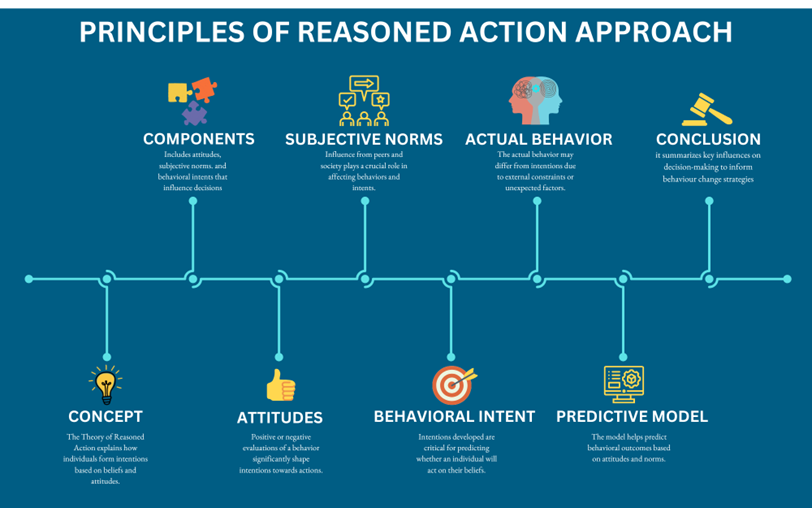
Figure 1: Graphical representation of the Reasoned Action Approach, a psychological model to explain and predict behavior

Objective 2: Quantify the contribution of backyard poultry manure and bird management practices to the presence and concentration of pathogenic organisms and resistance genes in the environment via sampling and analysis of manure, soils, runoff, and flying insects.

Objective 3: Develop, deliver, and assess impacts of educational programming designed to motivate the adoption of new integrated antimicrobial management approaches in backyard poultry farming to reduce the potential spread of AMR.

Thirty backyard poultry farmers from up to three counties in Nebraska will be recruited through community groups, personal connections, and university extension contacts. Participants will be surveyed and observed to understand their current knowledge, perceptions, and management practices, and identify knowledge gaps related to bird health, biosecurity, and disease transmission risks. The Reasoned Action Approach, a social cognitive model for behavioral analysis will be used to categorize the data, predicting and explaining their behavior towards healthy farming practices. The mixed-methods study will use standard statistical methods and qualitative data for a richer interpretation.

Sampling of environmental matrices and potential insect transmission vectors will be conducted and used to complete a risk factor assessment to understand disease demography.

Through face-to-face and digital sessions, engagement and education sessions will be designed to address knowledge gaps in poultry handling, waste management, personal hygiene, water quality, food safety, and human health risks. It will promote best practices and encourage participation through rewards, project-based learning, on-farm demonstrations, and regular reflection on personal impact. The recruited farmers will be appointed as trainers for other farmers in their locality to continue to promote the learning outcomes from the training. The training sessions will be assessed through a post-training survey using a knowledge-based questionnaire, and all discussions with farmers will be recorded for future evaluation. This data will help determine improvements for future outreach events on infectious disease control in backyard poultry farms, enhancing the training’s impact.

What Have We Learned?

The number of households engaging in “backyard poultry production” is growing regionally, nationally, and globally. Evidence also suggests that chickens are not strictly confined to the outdoors but are becoming indoor “pets,” creating complex human-chicken relationships responsible for zoonotic disease outbreaks and antibiotic resistance risks (Singh et al., 2018; Tobin et al., 2015). According to a 2010 study, the USDA confirmed almost 50% of the population related to backyard poultry production lacks knowledge about human health risks associated with contact with live birds (USDA, 2011). Studies reflect a critical need for decision-making support to ensure healthy birds, applying biosecurity practices that mitigate animal-to-human disease transmission risks and development of antibiotic-resistant bacteria, promoting environmental sustainability, and providing healthy local food sources to communities. While these systems represent only a small part of the U.S. poultry industry, their positive impact on local food systems is widely recognized, as are their potential contributions to zoonotic disease transmission, antibiotic resistance, and local ecosystem disruptions. Public awareness about poultry-associated health risks and adopting best practices for biosecurity and disease prevention is critical to balancing healthy local food production with community well-being.

Future Plans

This project aims to improve the health, prosperity, and sustainability of backyard poultry farmers by focusing on zoonotic disease transmission, pest management, and natural resource protection. It will provide training, technical assistance, and peer support to improve knowledge and adoption of best practices for producing healthy local food sources. This will reduce health risks, decrease healthcare costs, and support market access and profitability among urban farmers. The community-based approach will foster mutually beneficial relationships among producers, communities, and experts, promoting sustainable production practices that prioritize health, community needs, and the environment.

Authors

Presenting author

Nafisa Lubna, Graduate Student, University of Nebraska-Lincoln

Corresponding author

Amy Schmidt, Professor, University of Nebraska-Lincoln, aschmidt@unl.edu

Additional author

Mark E. Burbach, Environmental Social Scientist, University of Nebraska-Lincoln

Additional Information

Mace, J. L., & Knight, A. (2024). From the backyard to our beds: The spectrum of care, attitudes, relationship types, and welfare in non-commercial chicken care. Animals, 14(2), 288.

Peters, G. J., & Crutzen, R. (2021). The core of behavior change: introducing the Acyclic Behavior Change Diagram to report and analyze interventions.

Singh, S., Chakraborty, D., Altaf, S., Taggar, R. K., Kumar, N., & Kumar, D. (2018). Backyard poultry system: A boon to rural livelihood. International Journal of Fauna and Biological Studies, 5(1), 231-236.

Tobin, M. R., Goldshear, J. L., Price, L. B., Graham, J. P., & Leibler, J. H. (2015). A framework to reduce infectious disease risk from urban poultry in the United States. Public Health Reports, 130(4), 380-391.

USDA. (2011). Reference of the health and management of chicken flocks in urban settings in four U.S. cities, 2010. Fort Collins, CO: USDA.


The authors are solely responsible for the content of these proceedings. The technical information does not necessarily reflect the official position of the sponsoring agencies or institutions represented by planning committee members, and inclusion and distribution herein does not constitute an endorsement of views expressed by the same. Printed materials included herein are not refereed publications. Citations should appear as follows. EXAMPLE: Authors. 2025. Title of presentation. Waste to Worth. Boise, ID. April 711, 2025. URL of this page. Accessed on: today’s date. 
Antibiotic resistance in environment has One-Health implications

A summary of The Human Health Implications of Antibiotic Resistance in Environmental Isolates from Two Nebraska Watersheds by Donner et al. 2022

Key points

  • The interconnected health of humans, animals, and the environment is well established and increasingly studied in concert within a “One-Health” framework.
  • Approximately 40% of the bacteria isolated from watersheds in this study had acquired new antibiotic resistance genes which they had picked up in the environment.
  • Both urban and agricultural watersheds contained antibiotic-resistant bacteria, demonstrating the importance of one-health-based decision-making across industries and institutions.

Continue reading “Antibiotic resistance in environment has One-Health implications”

Antimicrobial Resistance From a One-Health Perspective: A Multi-Disciplinary University Instruction from Extension Professionals

Purpose

Contemporary issues faced by Extension professionals are often technically and politically complex, crossing a range of subjects, academic disciplines, and value systems. Addressing complex social issues to achieve desired impacts across disparate audiences requires collaborative efforts that engage multiple disciplines, represent unique geographic regions and cultural settings, and implement varying outreach methods. For example, antimicrobial resistance (AMR) is truly a “wicked problem” as it is global, complex, and difficult to solve. It is a “big picture” issue that must be addressed at multiple smaller scales where values, beliefs, cultural norms, and habits collide with science, innovation, public policy, and behavioral science, all forming a complicated intersection of separate, yet linked, continuous feedback loops.

The iAMResponsibleTM Project, is a nationwide extension program working on outreach and education on AMR within agriculture, food production, and food safety systems. In 2019, the team prioritized two approaches to promote cross-disciplinary collaborations on AMR research and increase AMR-related outreach to disparate audiences: a) greater engagement of graduate students in understanding AMR and the value of their area of study to approaching this issue from a One Health perspective; and b) improved science communication skills among graduate students. To that end, we proposed the development of a web-based, graduate-level university course to expand the impact of iAMResponsibleTM programming by engaging students in learning about the scientific, cultural, and political aspects of AMR across relevant disciplines.

The primary objectives in offering this novel, web-based university course that integrates research-based learning with science communication were to:

    1. Facilitate optimal distribution and utilization of research-based, AMR-related food safety information and resources at the state, regional and national levels among future and current food producers and consumers; and
    2. Develop AMR/Food Safety content to fill existing gaps or emerging areas of significant needs that are not being addressed regionally, nationally, and globally.

What Did We Do

Multi-university instruction

Spring 2020

A one-credit, graduate-level seminar course exploring U.S. and global challenges related to AMR in food systems, research-based strategies to mitigate potential risks associated with AMR, and successful methods of communicating this complicated scientific topic to food producers and consumers was first taught simultaneously at the University of Nebraska–Lincoln and the University of Maryland. Instructors on site at each participating institution facilitated listing of the course in their course catalog to allow students to enroll for credit at the university where they are studying. Each meeting of the class featured invited presentations by experts from across the U.S. sharing research, policy, and communication perspectives on AMR.

Spring 2021

Following the same format as the initial offering, the course was taught simultaneously at the University of Nebraska-Lincoln, University of Maryland, North Carolina State University, University of Minnesota, and Washington State University.

Based on experiences and student feedback from the 2020 and 2021 offerings of the course, lecture topics for the 2022 offering include:

Topic Presenter
Introduction to antibiotic resistance one-health Dr. Amy Schmidt, University of Nebraska – Lincoln and Dr. Stephanie Lansing, University of Maryland
Principles of extension programming and outreach Dr. Joe Harrison, Washington State University
First fully live session: Introduction to the course and student expectations All Instructors
Impact of AMR on medical practice and human health Dr. Rosa Helena Bustos – head of clinical pharmacology at Universidad de la Sabana
Challenge of AMR for animal health care Dr. Paul Morley, Texas A&M University
The natural occurrence and current state of the AMR challenge for environmental pollution Dr. Thomas Ducey (USDA-ARS)
Guided panel: Environmental mitigations for AMR Panelists: Carlton Poindexter, University of Maryland; Dr. John Schmidt, USDA-ARS; Dr. Shannon Bartelt-Hunt, University of Nebraska;

Moderators: Dr. Stephanie Lansing and Dr. Mahmoud Sharara

Intervention and tracing of AMR in the food supply Aaron Asmus – Hormel Foods

Julie Haendiges, US-FDA

History of public attitudes towards microbiology and what it tells us about how to approach AMR Dr. Kari Nixon, Whitworth University
Alternating Spring Break Class activity on identifying and evaluating science communication
Worldwide Implications of AMR Student led examination of AMR as it is experienced around the world
Challenges in development of antibiotics and alternatives for antibiotics Dr. Glenn Zhang, Oklahoma State University
How to assign risk to AMR found in non-clinical settings Dr. Bing Wang, University of Nebraska
Dead week workday – students work time. Submit reports and recorded presentations by the end of the workday on Friday, April 22. Zoom rooms will be available as needed. Led by Dr. Noelle Noyes
Final project review Student project Q&A sessions

Science Communication

As a joint offering by several extension faculty, this course was designed not only to cover the fundamentals of AMR but also as an opportunity to introduce STEM students to important skills and concepts used by extension professionals. As a part of this multi-institution collaboration, students worked together with their peers across the country to review and develop research-based resources and methods for communicating scientific information about AMR to non-academic audiences. These efforts were facilitated by the inclusion of lectures on extension principles and science communication, and team-based outreach projects, to support development of outreach and educational thinking and skill development within students in STEM fields. Moreover, content created by students through team projects that produced well-designed outreach content were intended for dissemination by the iAMResponsibleTM Project. The result was the production of outreach materials that transcended expertise represented by project team members.

Evaluation methods

Methods for evaluating the content and delivery of this course have been adjusted with each subsequent offering. During the first year an informal focus group discussion was conducted with students at the end of the term to solicit feedback and suggestions for future iterations. Throughout the second session (2021) students filled out weekly surveys following each lecture, as well as a survey assessment of the course. Instructors were also asked to evaluate the course content and delivery following the 2021 offering.

Students are evaluated on a combination of participation in the course discussion (during the lecture period or online following the lecture) and on evaluation of student projects. The student projects include a large emphasis on teams cooperating to identify a target audience for their shared topic, establishing a shared goal for their audience, and creating impactful outreach products to achieve their intended outcomes. Moreover, as a part of their participation and evaluation for this course, students are asked to review the effectiveness of their peers’ outreach products and the peer critiques are incorporated into the final student evaluation for the course.

What Have We Learned

Feedback from the students

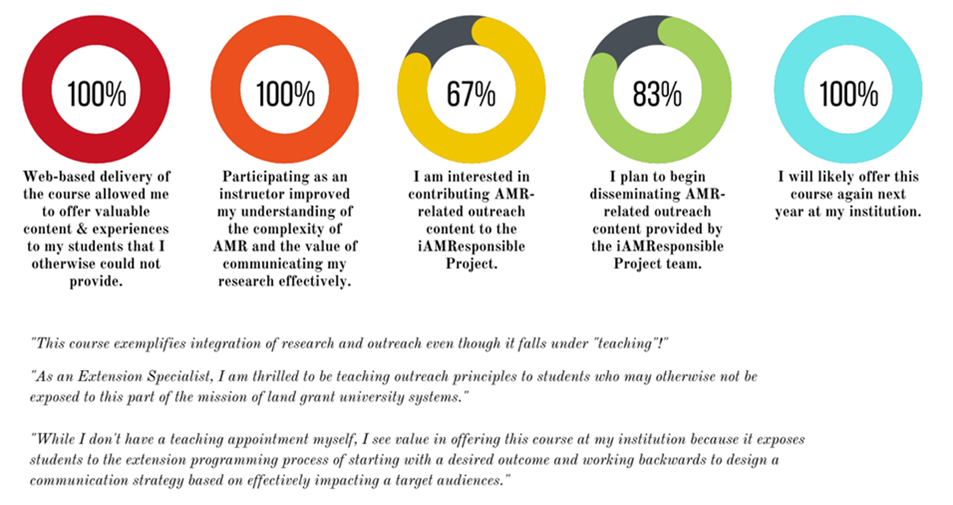
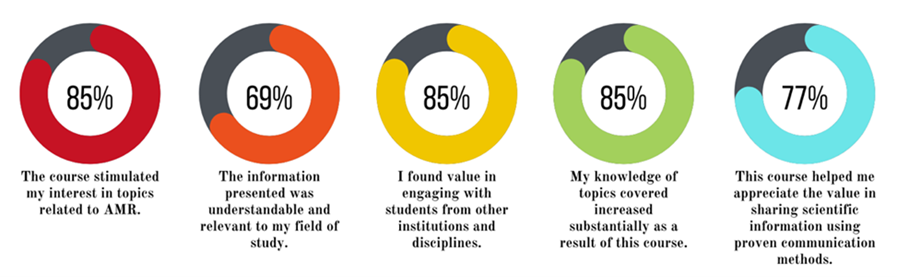
Results from the student focus group in 2020 were highly influential on the expanded instruction for science communication strategies and addition of international emphasis on AMR discussions in subsequent years. Survey results following the second session again highlighted the value the students placed in the instruction on science communication, audience identification, and navigating public attitudes toward AMR, science, and disease. Student participation in Spring 2020 (two institutions) and 2021 (five institutions) totaled 28 students. Evaluations by students revealed the following outcomes:

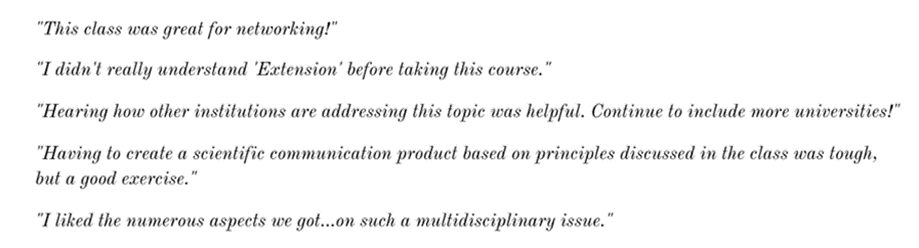
Student comments included:

Student surveys also indicated that the logistical issues surrounding the expectation for students to work with colleagues cross-institutionally on class assignments was the most significant challenge encountered. Accordingly, the syllabus for the current (Spring 2022) offering allocates more discussion time during lectures for students to grow more comfortable with one another and provides the students with a cross-institutional work environment on Slack to facilitate discussion outside of class time. We await the student evaluations from 2022 to provide a more detailed understanding of how these changes will affect student experience but, after 4 weeks of the course, the average weekly participation on Slack is holding at about 70% of participants who regularly check-in, read, or respond to discussion on the platform.

Feedback from the instructors

The development and delivery of this course has had the unintended consequence of providing an opportunity for the instructors of the course to also continue to learn and engage on this dynamic topic. Following delivery of the course in 2021, instructors were asked to evaluate the course content and delivery method, revealing the following data:

Future Plans

Utilization of course materials outside of the course

Lectures, and student projects developed during the first two offerings of the course have been repurposed and made available for a wider audience through the LPELC platform, further linking extension and classroom educational goals and providing the students in the course the opportunity to develop materials for immediate practical application within the national extension community.

How to apply the lessons learned for other extension issues areas

We believe that the results of the students’ evaluations indicate that the next generation of STEM professionals not only values expertise in extension skills but will actively seek to develop those skills for themselves if given the opportunity. Accordingly, we see a value in pursuing similar courses as part of an extension portfolio.

How to assess the long-term impacts

We will also seek to engage former participants in this course in an assessment of how the training received, in systems thinking, multidisciplinary collaboration, and science communication have been effective in their professional work in subsequent years.

Authors

Amy Schmidt, Associate Professor, University of Nebraska – Lincoln
aschmidt@unl.edu

Mara Zelt, Research Technologist, University of Nebraska
Stephanie Lansing, Professor, University of Maryland
Rohan Tikekar, Associate Professor, University of Maryland
Mahmoud Sharara, Assistant Professor, North Carolina State University
Joe Harrison, Professor Emeritus, Washington State University
Noelle Noyes, Assistant Professor, University of Minnesota

Additional Information

Selected course materials are available through the LPELC website

Acknowledgements

Funding for the iAMR Project was provided by USDA-NIFA Award Nos. 2017-68003-26497, 2018-68003-27467 and 2018-68003-27545. Any opinions, findings, conclusions, or recommendations expressed in this publication are those of the author(s) and do not necessarily reflect the view of the U.S. Department of Agriculture.


The authors are solely responsible for the content of these proceedings. The technical information does not necessarily reflect the official position of the sponsoring agencies or institutions represented by planning committee members, and inclusion and distribution herein does not constitute an endorsement of views expressed by the same. Printed materials included herein are not refereed publications. Citations should appear as follows. EXAMPLE: Authors. 2022. Title of presentation. Waste to Worth. Oregon, OH. April 18-22, 2022. URL of this page. Accessed on: today’s date.