Early Stage Economic Modeling of Gas-permeable Membrane Technology Applied to Swine Manure after Anaerobic Digestion


Proceedings Home W2W Home w2w17 logo

Purpose

The objective of this study was to conduct cost versus design analysis for a gas-permeable membrane system using data from a small pilot scale experiment and projection of cost versus design to farm scale.

What did we do?

This reported work includes two major steps. First, the design of a small pilot scale batch gas-permeable membrane system was scaled to process effluent volumes from a commercial pig farm. The scaling design maintained critical process operating parameters of the experimental membrane system and introduced assumed features to characterize effluent flows from a working pig farm with an anaerobic digester. The scaled up design was characterized in a spreadsheet model. The second step was economic analysis of the scaled-up model of the membrane system. The objective of the economic analysis was to create information to guide subsequent experiments towards commercial development of the technology. The economic analysis was performed by introducing market prices for components, inputs, and products and then calculating effects on costs and on performance of changes in design parameters.

What have we learned?

First, baseline costs and revenues were calculated for the scaled up experimental design. The commercial scale design of a modular gas-permeable membrane system was modeled to treat 6 days accumulation of digester effluent at 16,300 gallons per day resulting in a batch capacity of 97,800 gallons. The modeled large scale system is 19,485 times the capacity of the 5.02 gallon experimental pilot system. The installation cost of the commercial scale system was estimated to be $903,333 for a system treating 97,800 gallon batches over a 6 day period.

At $1/linear ft. and 7.9 ft./gallon of batch capacity, membrane material makes up 86% of the estimated installation cost. Other installation costs include PVC pipes, pumps, aerators, tanks, and other parts and equipment used to assemble the system, as well as water to dilute the concentrated acid prior to initiating circulation. The annual operating cost of the system includes concentrated sulfuric acid consumed in the process. Using limited experimental data on this point, we assume a rate of 0.009 gallons (0.133 pounds) of acid per gallon of digester effluent treated. At a price of $1.11 per gallon ($0.073/lb) of acid, acid cost per gallon of effluent treated is $0.010. Other operating costs include electric power, labor, and repairs and maintenance of the membrane and other parts of the system estimated at 2% of investment cost for non-moving parts and 6% of investment for moving parts. Potential annual revenue from the system includes the value of ammonium sulfate produced. Over the 6 day treatment period, if 85% of the TAN-N in the digester effluent is removed by the process, and if 100% of the TAN-N removed is recovered as ammonium sulfate, and given the TAN-N concentration in digester effluent was 0.012 pounds per gallon (1401 mg/l), then 0.01 pounds of TAN-N are captured per gallon of effluent treated. At an ammonium sulfate fertilizer price of $588/ton or $0.294/pound and ammonium sulfate production of 0.047 pounds (0.01 pounds TAN-N equivalent), potential revenue is $0.014 per gallon of effluent treated. No price is attached here for the elimination of internal and external costs associated with potential release to the environment of 0.01 pounds TAN-N per gallon of digester effluent or 59,073 pounds TAN-N per year from the system modeled here.

Several findings and questions, reported here, are relevant to next steps in experimental evaluation and commercial development of this technology.

1. Membrane price and/or performance can be improved to substantially reduce installation cost. Membrane material makes up 86% of the current estimated installation cost. Each 10% reduction in the product of membrane price and length of membrane tube required per gallon capacity reduces estimated installation cost per gallon capacity by 8.6%.

2. The longevity and maintenance requirements of the membrane in this system were not examined in the experiment. Installation cost recovery per gallon of effluent decreases at a declining rate with longevity. For example, Cost Recovery Factors (percentage of initial investment charged as an annual cost) at 6% annual interest rate vary with economic life of the investment as follows: 1 year life CRF = 106%, 5 year life CRF = 24%, 10 year life CRF = 14% . Repair costs are often estimated as 2% of initial investment in non-moving parts. In the case of the membrane, annual repair and maintenance costs may increase with increased longevity. Longevity and maintenance requirements of membranes are important factors in determining total cost per gallon treated.

3. Based on experimental performance data (TAN removal in Table 1) and projected installation cost for various design treatment periods ( HRT = 2, 3, 4, 5, or 6 days), installation cost per unit mass of TAN removal decreases and then increases with the length of treatment period. The minimum occurs at HRT = 4 days when 68% reduction of TAN-N in the effluent has been achieved.

Table 1. Comparison of installation cost and days of treatment capacity

4. Cost of acid relative to TAN removal from the effluent and relative to fertilizer value of ammonium sulfate produced per gallon of effluent treated are important to operating cost of the membrane system. These coefficients were beyond the scope of the experiment although some pertinent data were generated. Questions are raised about the fate of acid in circulation. What fraction of acid remains in circulation after a batch is completed? What fraction of acid reacts with other constituents of the effluent to create other products in the circulating acid solution? What fraction of acid escapes through the membrane into the effluent? Increased efficiency of TAN removal from the effluent per unit of acid consumed will reduce the cost per unit TAN removed. Increased efficiency of converting acid to ammonium sulfate will reduce the net cost of acid per gallon treated.

5. Several operating parameters that remain to be explored affect costs and revenues per unit of effluent treated. Among those are parameters that potentially affect TAN movement through the membrane such as: a) pH of the effluent and pH of the acid solution in circulation, b) velocity of liquids on both sides of the membrane, and c) surface area of the membrane per volume of liquids; effluent and acid solution, in the reactor. Similarly, the most profitable or cost effective method of raising pH of the digester effluent remains to be determined, as it was beyond the scope of the current study. Aeration was used in this experiment and in the cost modeling. Aeration may or may not be the optimum method of raising pH and the optimum is contingent on relative prices of alternatives as well as their effect on overall system performance. Optimization of design to maximize profit or minimize cost requires knowledge of these performance response functions and associated cost functions.

6. Management of ammonium sulfate is a question to be addressed in future development of this technology. Questions that arise include: a) how does ammonium sulfate concentration in the acid solution affect rates of TAN removal and additional ammonia sulfate production, b) how can ammonium sulfate be removed from, or further concentrated in, the acid solution, c) can the acid solution containing ammonium sulfate be used without further modification and in which processes, d) what are possible uses for the acid solution after removal of ammonium sulfate, e) what are the possible uses for the effluent after removal of some TAN, and f) what are the costs and revenues associated with each of the alternatives. Answers to these questions are important to designing the membrane system and associated logistics and markets for used acid solution and ammonium sulfate. The realized value of ammonium sulfate and the cost (and revenue) of used acid solution are derived from optimization of this p art of the system.

7. LCA work on various configurations and operating parameters of the membrane system remains to be done. Concurrent with measurement of performance response functions for various parts of the membrane system, LCA work will quantify associated use of resources and emissions to the environment. Revenues may arise where external benefits are created and markets for those benefits exist. Where revenues are not available, marginal costs per unit of emission reduction or resource extraction reduction can be calculated to enable optimization of design across both profit and external factors.

Future Plans

A series of subsequent experiments and analyses are suggested in the previous section. Suggested work is aimed at improving knowledge of performance response to marginal changes in operating parameters and improving knowledge of the performance of various membranes. Profit maximization, cost minimization, and design optimization across both financial and external criteria require knowledge of performance response functions over a substantial number of variables. The economic analysis presented here addresses the challenge of projecting commercial scale costs and returns with data from an early stage experimental small pilot; and illustrates use of such preliminary costs and returns projections to inform subsequent experimentation and development of the technology. We will continue to refine this economic approach and describe it in future publications.

Corresponding author, title, and affiliation

Kelly Zering, Professor, Agricultural and Resource Economics, North Carolina State University

Corresponding author email

kzering@ncsu.edu

Other authors

Yijia Zhao, Graduate Student at BAE, NCSU; Shannon Banner, Graduate Student at BAE, NCSU; Mark Rice, Extension Specialist at BAE, NCSU; John Classen, Associate Professor and Director of Graduate Programs at BAE, NCSU

Acknowledgements

This project was supported by NRCS CIG Award 69-3A75-12-183.

Talking Climate with Animal Agriculture Advisers


Proceedings Home W2W Home w2w17 logo

Purpose             

The Animal Agriculture in a Changing Climate (AACC) project was established to leverage limited Extension expertise across the country in climate change mitigation and adaptation, with the goal of building capacity among Extension professionals and other livestock advisers to address climate change issues.

What did we do? 

The Animal Agriculture in a Changing Climate project team created a suite of educational programs and products to build capacity across the United States. Key products of the project:

  • Online courses: 363 participants registered with a 35% completion rate (Whitefield et al., JOE, 2016)
  • National and regional symposia and workshops: 11 face-to-face conferences with approximately 1,350 attendees.
  • Website: Over 5,900 users with over 21,100 total views. Project videos have received nearly 8,900 views.
  • Social media: AACC weekly blog (990 subscribers); daily Southeast Climate Blog (38,506 site visits); regional newsletters (627 subscribers); Facebook & Twitter (280 followers)
  • Ready-to-use videos, slide sets, and fact sheets
  • Educational programming: 390 presentations at local, regional, and international meetings
  • Collaboration with 14 related research and education projects

What have we learned? 

A survey was sent out to participants in any of the project efforts, in the third year of the project and again in year five. Overall, participants found the project resources valuable, particularly the project website, the online course, and regional meetings. We surveyed two key measures: abilities and motivations. Overall, 60% or more of respondents report being able or very able to address all eight capabilities after their participation in the AACC program. A sizeable increase in respondent motivation (motivated or very motivated) existed after participation in the program, particularly for helping producers take steps to address climate change, informing others about greenhouse gases emitted by agriculture, answering client questions, and adding new information to programs or curriculum.

The first challenge in building capacity in Extension professionals was finding key communication methods to engage them. Two key strategies identified were to: 1) start programming with a discussion of historical trends and agricultural impacts, as locally relevant as available, and 2) start the discussion around adaptation rather than mitigation. Seeing the changes that are already apparent in the climatic record and how agriculture has adapted in the past and is adapting to more recent weather variability and climatic changes often were excellent discussion starters.

Another challenge was that many were comfortable with the science, but were unsure how to effectively communicate that science with the sometimes controversial discussions that surround climate change. This prompted us to include climate science communication in most of the professional development opportunities, which were then consistently rated as one of the most valuable topics.

Future Plans    

The project funding ended on March 31, 2017. All project materials will continue to be available on the LPELC webpage.

Corresponding author, title, and affiliation        

Crystal Powers, Extension Engineer, University of Nebraska – Lincoln

Corresponding author email    

cpowers2@unl.edu

Other authors   

Rick Stowell, University of Nebraska – Lincoln

Additional information

lpelc.org/animal-agriculture-and-climate-change

Acknowledgements

Thank you to the project team:

Rick Stowell, Crystal Powers, and Jill Heemstra, University of Nebraska – Lincoln

Mark Risse, Pam Knox, and Gary Hawkins, University of Georgia

Larry Jacobson and David Schmidt, University of Minnesota

Saqib Mukhtar, University of Florida

David Smith, Texas A&M University

Joe Harrison and Liz Whitefield, Washington State University

Curt Gooch and Jennifer Pronto, Cornell University

This project was supported by Agricultural and Food Research Initiative Competitive Grant No. 2011-67003-30206 from the USDA National Institute of Food and Agriculture.


The authors are solely responsible for the content of these proceedings. The technical information does not necessarily reflect the official position of the sponsoring agencies or institutions represented by planning committee members, and inclusion and distribution herein does not constitute an endorsement of views expressed by the same. Printed materials included herein are not refereed publications. Citations should appear as follows. EXAMPLE: Authors. 2017. Title of presentation. Waste to Worth: Spreading Science and Solutions. Cary, NC. April 18-21, 2017. URL of this page. Accessed on: today’s date.

EPA’s Nutrient Recycling Challenge


Proceedings Home W2W Home w2w17 logo

Purpose 

Come to this session to learn about the Nutrient Recycling Challenge and meet some of the involved partners and experts, as well as some innovators who are competing to develop nutrient recovery technologies that meet the needs of pork and dairy farmers. This session will begin with an overview of the challenge. Next, innovators will provide snapshot presentations about the technology ideas they are working on, followed by live feedback/Q&A sessions on each technology where we can harness the buzzing brainpower at Waste to Worth. Finally, we will move into a “workshop” designed to support innovators participating in the Nutrient Recycling Challenge as they refine their designs before they build prototypes.

What did we do?

Background on the Nutrient Recycling Challenge

At Waste to Worth 2015, the U.S. Environmental Protection Agency (EPA) hosted a brainstorm session about developing technologies that livestock farmers want to help manage manure nutrients. That session sowed the seeds for the Nutrient Recycling Challenge—a global competition to find affordable and effective nutrient recovery technologies that create valuable products farmers can use, transport, or sell to where nutrients are in demand. Pork and dairy producers, USDA, and environmental and scientific experts saw the tremendous opportunity to generate environmental and economic benefits, and partnered with EPA to launch the challenge in November 2015 (www.nutrientrecyclingchallenge.org).

What have we learned? 

There is a tremendous opportunity to generate environmental and economic benefits from manure by-products, but further innovation is needed to develop more effective and affordable technologies that can extract nutrients and create products that farmers can use, transport, or sell more easily to where nutrients are in demand.

In the Nutrient Recycling Challenge, innovators have proposed a range of technology systems to recover nitrogen and phosphorus from dairy and swine manure, including physical, chemical, biological, and thermal treatment systems. Some such systems may also be compatible with manure-to-energy technologies, such as anaerobic digesters. Farms of all sizes are interested in nutrient recovery, and there is demand for diverse types of technologies due to a diversity in end users. To improve the adoptability of nutrient recovery systems, it is critical that innovators are mindful of the affordability of technologies, and work to lower capital and operations and maintenance costs, and improve the potential for returns on investment. A key factor for offsetting the costs of a technology and improving its marketability will be in its ability to generate valuable nutrient-containing products that are competitive in the market.

Future Plans 

The challenge has four phases, in which innovators are turning concepts into designs, and eventually to pilot these working technologies on livestock farms. Thirty-four innovator teams whose concepts were selected from Phase I are refining technology designs in Phase II.  Design prototypes will be built in Phase III. This workshop is designed to help innovators maximize their potential for developing nutrient recovery technologies that meet farmer needs.

Corresponding author, title, and affiliation 

Joseph Ziobro, Physical Scientist, U.S. Environmental Protection Agency; Hema Subramanian, Environmental Protection Specialist, U.S. Environmental Protection Agency

Corresponding author email 

ziobro.joseph@epa.gov; subramanian.hema@epa.gov

Session Agenda

  1. Overview of the Nutrient Recycling Challenge, Hema Subramanian and Joseph Ziobro of EPA
  2. Nutrient Recycling Challenge Partner Introductions, Nutrient Recycling Challenge Partners (including National Milk Producers Federation, Newtrient, Smithfield Foods, U.S. Department of Agriculture Agricultural Research Service and Natural Resources Conservation Service, U.S. Department of Energy, and Water Environment & Reuse Foundation)
  3. Showcase of Innovators’ Technology Ideas
    • Decanter Centrifuge and Struvite Recovery for Manure Nutrient Management, Hiroko Yoshida
    • Manure Solids Separation BioFertilizer Produccion Drinking Water Efluente, Aicardo Roa Espinosa
    • Nutrient Recovery from Anaerobic Digestates, Rakesh Govind
    • Organic Waste Digestion and Nutrient Recycling, Steven Dvorak
    • Manure Treatment with the Black Solder Fly, Simon Gregg
  4. Nutrient Recycling Challenge Workshop for Innovators
    • Developing technologies: From concept to pilot (to full-scale), Matias Vanotti
    • Waste Systems Overview for Dairy and Swine and Innovative Technologies: What Steps Should be Taken (Lessons Learned), Jeff Porter

The authors are solely responsible for the content of these proceedings. The technical information does not necessarily reflect the official position of the sponsoring agencies or institutions represented by planning committee members, and inclusion and distribution herein does not constitute an endorsement of views expressed by the same. Printed materials included herein are not refereed publications. Citations should appear as follows. EXAMPLE: Authors. 2017. Title of presentation. Waste to Worth: Spreading Science and Solutions. Cary, NC. April 18-21, 2017. URL of this page. Accessed on: today’s date.

Exploring Interactions Betwen Agricultural Decisions and Greenhouse Gas Emissions Using Swine Production

green stylized pig logoThe materials on this page are an interactive lab designed to introduce students (high school level) to pig farming and the connections between management decisions  and the greenhouse gas emissions. It also includes information on the economic implications of those decisions. Background information and activities are provided in a graphical (visual) format. Part one can be a stand-alone activity or prepare students for part two.

You can download each of the files individually using the links below or download the entire lab (134 pages – PDF format). The information contains references to Arkansas agriculture and swine production in some areas, but the information is still applicable in other states.

What do you know about swine and greenhouse gases?

This one page (PDF format) fact sheet (including a fun short quiz) can be utilized as part of this lab or as a stand-alone handout to stimulate discussion. Download factsheet

Part One Activity  – The Basics

This section includes five files that introduce the basic concepts of greenhouse gases, swine production systems, and glossary of swine production terms. This activity utilizes both text and graphical presentation of concepts and emphasizes information comprehension. Download Part One

  • Resource information – lesson plan and background information. This includes three aspects of swine management systems including feed management, housing management, and manure management.
  • Farm management system graphics – a visual aid to depict how each individual practice/component contributes to the building of a given pig farm system.
  • Farm flashcards – brief description and graphical rendering of various swine farm components
  • Lab report form – several structured questions designed to
  • Farm management option guide (FMOG)*

*The FMOG also doubles as a scenario key for the completion of Part 2.

Part Two Activity – Challenging

This section provides more in-depth information on swine production systems and greenhouse gases. It provides insight into management obstacles faced by pig farmers in balancing carbon footprints, available resources, producer goals, and legal compliance. This critical-thinking activity is meant to be completed in small groups. Download Part Two

  • Resource information – lesson plan and background information.
  • Farm management option guide FMOG
  • Three scenarios – each covers manure, feed, and housing
  • Flashcards – including health and feed, housing, manure

Acknowledgements

Authors: Rick Fields and Karl Vandevender, University of Arkansas. For questions about these materials, contact Rick at rfields@uaex.edu

This information is part of the program “Integrated Resource Management Tool to Mitigate the Carbon Footprint of Swine Produced In the U.S.,” and is supported by Agriculture and Food Research Initiative Competitive Grant no. 2011-68002-30208 from the USDA National Institute of Food and Agriculture. Project website.

Low-Power Aerators Combined with Center Pivot Manure Application at a Northeast Nebraska Hog Finishing Facility Created an Easy to Manage, Turn-Key System

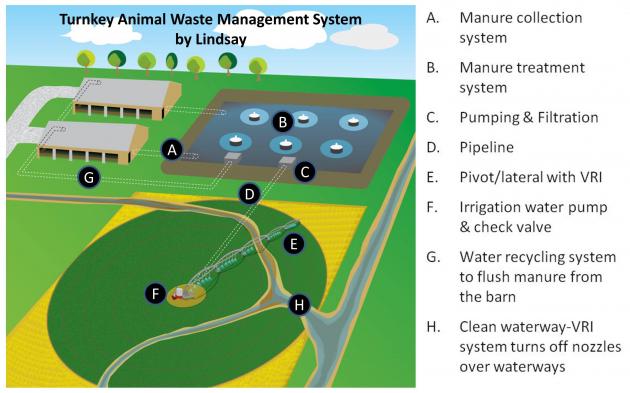
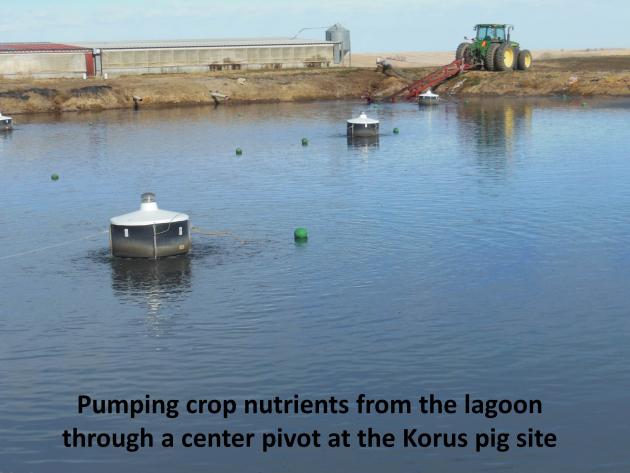
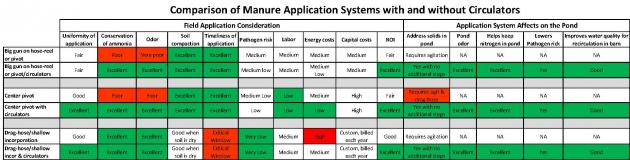
trnkey animal waste management systemApplying livestock manure from lagoon storage through center pivot irrigation has long been considered a low-labor, uniform method of application that can deliver nutrients in-season to a growing crop. Three challenges with this system have been odor, pivot nozzle clogging and loss of nitrogen. A new innovation in lagoon treatment addresses these challenges. Low-power circulators were installed at a Northeast Nebraska commercial hog finishing facility and used to aerate the lagoon by moving oxygen-rich water and beneficial microbes to the bottom of the lagoon, reducing odor and potent greenhouse gases while lowering disease pathogen risk. This process preserved nitrogen and made it 40-60% more available in the first year of application. Circulation also reduced lagoon solids and bottom sludge, resulting in reduced agitation and dredging expense. Having a continuously well-mixed lagoon facilitated accurate manure nutrient sampling and consistent nutrient concentration delivery to the irrigation system. Combined with the ease of calibration of the center pivots, precision uniform nutrient application was achieved. Center pivot application had several additional advantages over tractor-based systems: less soil compaction, optimal nutrient timing during plant growth, higher uniformity, lower labor and energy costs, and eliminating impact on public roads. The circulators combined with flush barns and center pivot irrigation creates a complete turn-key manure management system.
Do Circulators Make a Difference in Liquid Manure Storage?

pumping nutrients from lagoon on korus pig siteThe purpose of the project was to evaluate the effectiveness of low powered circulators to treat livestock waste in lagoons. The objective was to evaluate how the addition of circulators to a livestock pond would change: 1. Odor levels, 2. Pivot nozzle clogging problems, and 3. Nitrogen loss.
What did we do?

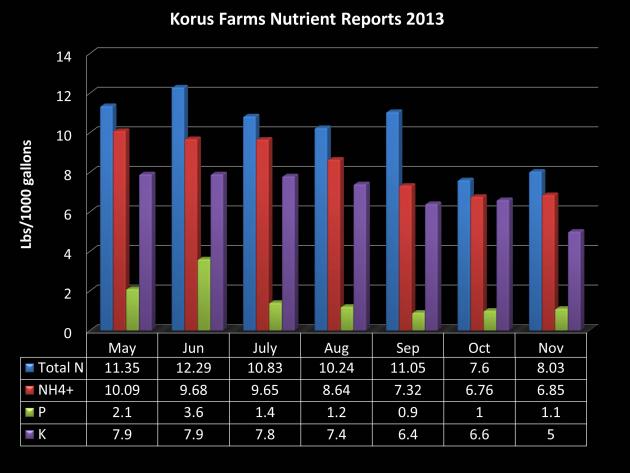
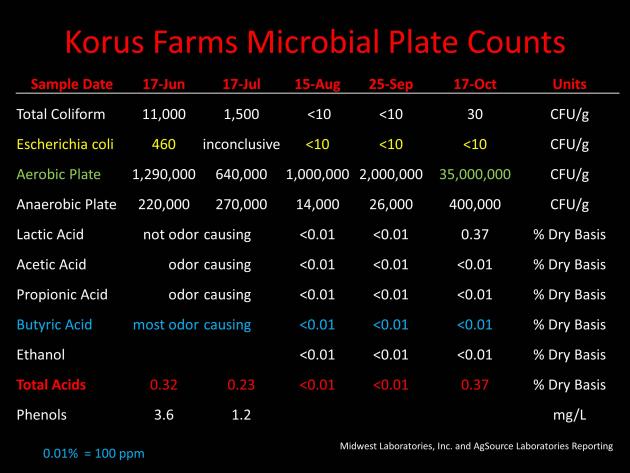
A demonstration was conducted by installing five circulators on a lagoon receiving manure from a 3000 pig finisher facility. The lagoon is owned by a Lindsay customer that was already pumping the top water from the pond through pivots, but was having difficulty with plugging nozzles and was hiring a commercial pumper to agitate and pump solids. The circulators were installed in May of 2013. Starting with the day of installation and each month after through November 2013, effluent lab samples were collected, photos of the pond and effluent were taken, and odor level estimated.

comparison of manure application systems

report from Korus farm
table of report from Korus farms

The effluent was pumped through pivots where odor and nozzle clogging problems were evaluated on August 15th and December 2nd of 2013. The pond was refilled with fresh water, circulated for a few days, and re-pumped right after the August 15th event so more of the nutrients could be utilized by the crops.

What have we learned?

The benefits of using aerobic lagoons with livestock waste have been known for many years. The challenge has been finding a cost effective and reliable method to facilitate the process. The cost to run all five circulators was about $3300 per year figuring $0.10 per kWh.

The circulators facilitated the following changes in the pond:

  • Reduced dry matter in effluent to <0.4%-starting at 0.57% and ending at 0.37%
  • Greatly reduced hog hair and soybean hulls caught in the filter resulting in virtually eliminating nozzle and pressure regulator clogging on the pivot
  • Reduced solids and bottom sludge-sonar indicated a 5+ ft reduction in bottom solids in 5 months
  • Doubled 1st year availability of nitrogen-%NH4 to total N was >80% compared to average book values of 40%
  • Greatly reduced offensive manure odor-downwind from pivot applying effluent, very little odor was observed
  • Reduced disease pathogens-Total Coliform went 11,000 to 30 CFU/g & Escherichia coli went from 460 to <10 CFU/g
  • Reduced flies-virtually eliminated floating solids and fly habitat on the pond
  • Reduced severe greenhouse gasses (GHGs)
  • Generated safer and lower odor water to recycled back through the barn for manure removal

Future Plans

We would like to continue evaluating the system for more precise odor reduction ratings, nitrogen preservation during pond storage, and affect on disease pathogens.

Author

Steve Melvin, Irrigation Applications Specialist, Lindsay steve.melvin@lindsay.com

Additional information

Call Steve Melvin at 402-829 6815 for additional information.

The authors are solely responsible for the content of these proceedings. The technical information does not necessarily reflect the official position of the sponsoring agencies or institutions represented by planning committee members, and inclusion and distribution herein does not constitute an endorsement of views expressed by the same. Printed materials included herein are not refereed publications. Citations should appear as follows. EXAMPLE: Authors. 2015. Title of presentation. Waste to Worth: Spreading Science and Solutions. Seattle, WA. March 31-April 3, 2015. URL of this page. Accessed on: today’s date.

Anaerobic Digestion Projects: Environmental Credits 101

Several renewable natural gas (RNG) projects are either recently completed or on the books as potential new projects. With such a new business model, Washington State University, in concert with State officials embarked on a feasibility study to investigate costs/revenues as well as project consideration, hurdles and options for production of RNG as compared to an industry standard combined heat and power (CHP) model. The feasibility study was for an existing dairy anaerobic digestion project located near the Yakima Valley of Washington State.  

What Are Some of the Benefits of Anaerobic Digestion?

One of the major advantages of anaerobic digestion (AD) is the environmental benefits that accompany the technology. AD systems mitigate greenhouse gas (GHG) emissions, can contribute to reducing nutrient export from dairies to surface and ground water, can reduce the risk of pathogen spread, and can improve air quality. In the field of economics, many of these types of environmental benefits and harms fall into the realm of market externalities. Externalities are outputs of a production process that are “external” to the producers’ decision-making process, such as methane emitted from a manure lagoon. A common way governments have attempted to reduce harmful environmental externalities is through emissions regulations. An alternative way to mitigate negative externalities that we have seen in recent years has been the formation of markets for environmental attributes. This induces producers to internalize the environmental costs and benefits of production. Existing environmental markets contribute revenue gains to AD adopters, and with further development have the potential to result in even larger revenue gains for AD projects.

What did we do?

We explored available and potential environmental credits that could be available to AD projects and classified them by environmental attribute. These include carbon credits, renewable energy / fuel credits, tax and utility credits, and nutrient credits. We present examples of types of these environmental credits and their impacts on AD project profitability under various scenarios. We further discuss questions of eligibility and considerations for project developers and managers in the context of positioning for future environmental credit opportunities.

Table 1: Available sources of environmental revenues for anaerobic digester owners based on combined heat and power (CHP) or compressed natural gas (CNG) generation.

AD Methane Use Environmental Credit Market Price Yearly Revenue $/Head Market Price Yearly Revenue $/Head Market Price Yearly Revenue $/Head
    Low Scenario Medium Scenario High Scenario
Combined Heat & Power Carbon Credit $10/tCO2e $42.13 $15/tCO2e $63.19 $20/tCO2e $84.25
REC $2.00/MWh $3.08 $4/MWh $6.16 $8/MWh $12.32
Compressed Natural Gas Carbon Credit $10/tCO2e $42.13 $15/tCO2e $63.19 $20/tCO2e $84.25
RIN $0.005/Mbtu $158.34 $0.01/Mbtu $316.68 $0.02/Mbtu $633.36
LCFS $12/tCO2e $380.02 $24/tCO2e $760.04 $48/tCO2e $1,520.07

What have we learned?

Environmental crediting options are highly variable both in terms of the types and mechanisms for the credit and their availability across space (jurisdiction) and time. History indicates there is likely to be continued variability and limited predictability for environmental crediting. Economic analyses show that AD projects can be profitable under many different scenarios, but is most sustainable when it allows for multiple revenues from electricity or renewable fuel, fiber products, nutrients, and carbon credits for avoided methane emissions. Environmental incentives like carbon credits and RFS credits (i.e., RIN) have a significant contribution to the profitability of an AD project, particularly when the project produces renewable natural gas.

Products AD-Combined heat and power (CHP) AD-Boiler AD-Renewable natural gas

Table 2: Net present values of alternative anaerobic digester (AD) systems given different revenue streams.

Energy1 -$2.1 million NA -$4.8 million
Energy, and fiber and nutrients $4.8 million $1.3 million $1.5 million
Energy, fiber and nutrients and environmental incentives2 $8.0 million $3.6 million $4.1 million
Note: NA – means not applicable for AD-Boiler Project because it does not produce electricity.
1Energy refers to electricity produced by the AD-CHP and AD-Boiler Projects, and electricity and renewable natural gas produced by the AD-RNG Project.
2Environmental incentives include the: Washington Energy Initiative, Renewable Energy Certificates, and carbon credits.

Future Plans

We will be publishing a Fact Sheet through WSU Extension providing more detailed discussion of environmental credits for AD projects. This fact sheet is part of an Anaerobic Digestion Systems Manual under development with support from USDA NIFA.

Authors

Chad Kruger, Director, WSU CSANR cekruger@wsu.edu

Greg Astill, Graduate Student WSU Econ; Suzette Galinato, Research Associate, WSU IMPACT Center; Craig Frear, Assistant Professor, WSU Biological Systems Engineering; Georgine Yorgey, Associate in Research, WSU CSANR; Jim Jensen

Additional information

Coppedge, B., G. Coppedge, D. Evans, J. Jensen, E. Kanoa, K. Scanlan, B. Scanlan, P. Weisberg and C. Frear. 2012. Renewable Natural Gas and Nutrient Recovery Feasibility for DeRuyter Dairy: An Anaerobic Digester Case Study for Alternative Off-take Markets and Remediation of Nutrient Loading Concerns within the Region. A Report to Washington State Department of Commerce. <http://csanr.wsu.edu/publications/deRuyterFeasibilityStudy.pdf>.

Galinatto, S.P., C.E. Kruger, and C.S. Frear (2015). Anaerobic Digester Project and System Modifications: An Economic Analysis. WSU Extension Publications EM090

Acknowledgements

The preparation of this fact sheet was funded by the WSU ARC Biomass Research Program, and USDA National Institute of Food and Agriculture Award #2012-6800219814.

The authors are solely responsible for the content of these proceedings. The technical information does not necessarily reflect the official position of the sponsoring agencies or institutions represented by planning committee members, and inclusion and distribution herein does not constitute an endorsement of views expressed by the same. Printed materials included herein are not refereed publications. Citations should appear as follows. EXAMPLE: Authors. 2015. Title of presentation. Waste to Worth: Spreading Science and Solutions. Seattle, WA. March 31-April 3, 2015. URL of this page. Accessed on: today’s date.

Swine Manure Odor Reduction Using a Humic Amendment: On-Farm Demonstration


Why Study Odors from Pig Farms?

Odor-related nuisance complaints associated with animal production facilities are on the rise as residential sprawl encroaches on once rural areas. The efficacy of odor control additives is highly variable and most have limited success. This project demonstrated the efficacy of a commercial humic-material product (ManureMaxTM, Manufactured by JDMV Holding, LLC; Huston, TX) for limited control of liquid swine manure odors.

What did we do?

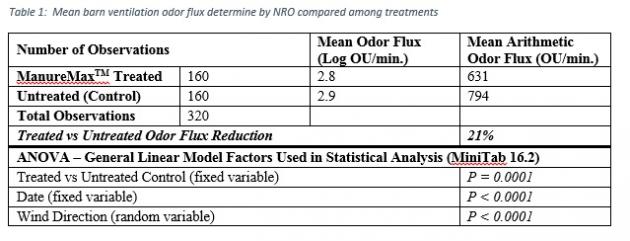
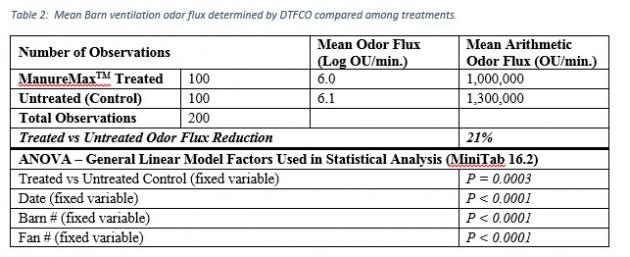
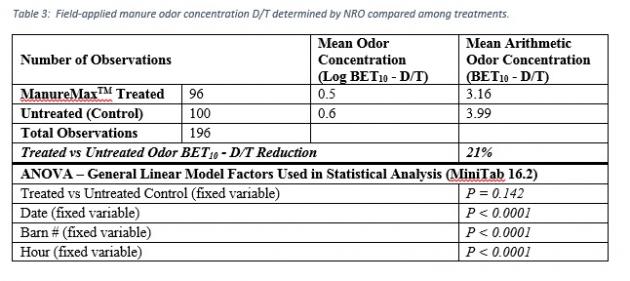
Two similarly-operated, 2,250-pig, tunnel-ventilated finishing barns on one farm were used for the demonstration. Barns were widely-separated by 1,800 feet of woodland and fields and were occupied by pigs of similar age. The underfloor manure storage pit (5-ft deep) of one barn received monthly additions with the additive while the other barn received no additive. After 20 weeks when hogs were finished for market and barns cleaned for restocking, treatments were switched so the previously untreated barn received the amendment. Odors at the barn ventilation exhaust were evaluated monthly by direct sensory methods (olfactometry) using human subjects. Field-applied manure was evaluated at the end of each 20-week grow-out period. Nasal Ranger Field Olfactometer (NRO) units were used to evaluate barn exhaust odor dilutions-to-threshold (D/T) and odors during field application, employing the Multiple-Assessor Repeat Observation (MARO) method (B randt et at., 2011a and 2011b). Barn ventilation exhaust was normalized against fan velocity and compared as odor flux (odor units min-1) among treatments. Whole air samples were collected in 10-liter TedlarTM® bags during each field visit and brought back to the Penn State Odor Assessmnt Laboratory (PSOAL) for evaluation. A team of five qualified odor panelists quantified odor detection threshold (DT) using Dynamic Triangular Forced-Choice Olfactometry (DTFCO) on an Ac’ScentTM International Dynamic Olfactometer (St. Croix Sensory, Lake Elmo, MN) within 10 hours of sample collection.

What have we learned?

Results show a 21% reduction in mean barn odor exhaust as shown in Table 1 and Table 2. The humic amendment significantly decreased barn ventilation odor flux by 21% in both field NRO and laboratory DTFCO evaluations. Evaluation of field applied manure yield a 21% and 60% decrease in odor concentrations for NRO and DTFCO, respectively.mean barn ventilation odor flux

mean barn ventilation odor flux

field-applied manure odor concentration

field-applied manure odor concentration DT

Authors

Hile, Michael, Ph. D. Candidate in Agricultural and Biological Engineering (ABE) at Penn State (PSU) mlh144@psu.edu

Brandt, Robin, Senior Lecturer in ABE at PSU, Eileen E. Fabian, Professor in ABE at PSU and Herschel A. Elliott, professor in ABE at PSU. Robert E. Mikesell, Program Coordinator and Senior Lecturer, Department of Animal Science at PSU.

Additional information

Brandt, R.C., H.A. Elliott, M.A.A. Adviento-Borbe, E.F. Wheeler, P.J.A. Kleinman, and D.B. Beegle. 2011a. Field Olfactometry Assessment of Dairy Manure Land Application Methods. J. Environ. Qual. 40: 431-437.

Brandt, R.C., M.A.A. Adviento-Borbe, H.A. Elliott, E.F. Wheeler. 2011. Protocols for Reliable Field Olfactometry Odor Evaluations. J. Appl. Engr Agr. Vol. 27(3): 457-466.

Brandt, R. C., H. A. Elliott, E. E. Fabian, M. L. Hile, R. E. Mikesell, Jr., 2014. Manure Additive Shows Swine Odor Reduction. Fact Sheet. Penn State University, Department of Agricultural and Biological Engineering.

Acknowledgements

Thanks to JDMV Holding, LLC Houston, TX) for providing funding and product for this project. This project would not have been possible without the support from Natural Resources Conservation Service’ (NRCS) Conservation Innovation Grant (CIG) program.

The authors are solely responsible for the content of these proceedings. The technical information does not necessarily reflect the official position of the sponsoring agencies or institutions represented by planning committee members, and inclusion and distribution herein does not constitute an endorsement of views expressed by the same. Printed materials included herein are not refereed publications. Citations should appear as follows. EXAMPLE: Authors. 2015. Title of presentation. Waste to Worth: Spreading Science and Solutions. Seattle, WA. March 31-April 3, 2015. URL of this page. Accessed on: today’s date.

Initial Evaluation of Vegetated Treatment Areas for Treating Runoff from Small Swine Operations in Central Texas

A vegetative treatment area (VTA), as defined by USDA-NRCS, is a “vegetative area composed of perennial grass or forages used for the treatment of runoff from an open lot production system or other process waters”. VTA’s are typically part of a vegetative treatment system (VTS) that includes additional components to remove solids, such as a settling or vegetative infiltration basin. There have been numerous studies, both modeling and field, related to the design and evaluation of VTS’s used to treat animal feeding operation (AFO) runoff; however, none of these have studies evaluated the effectiveness of VTA’s receiving direct runoff from small swine operations during natural rainfall events. Is it possible that a sufficiently sized VTA alone can effectively treat direct runoff from small swine AFO’s during daily operation? This project aims to answer that question and evaluate the effectiveness of VTA’s as a practical and cost-effective alternative wastewater management option to protect surface water quality on small swine facilities. Three locations were established in 2012 at small swine AFO’s in central Texas. In each location, sampling sites were installed to monitor runoff water quantity and quality at the inlet and outlet of the VTA and a nearby control area. Initial data show that the VTA’s provided substantial treatment of the swine facility runoff in terms of reduced nutrient concentrations, but VTA runoff was still higher in nutrients than the control site. The preliminary data highlighted the importance of solids management and year-round vegetation. Hopefully, as these VTA’s become better established, the increased capacity for infiltration and plant nutrient uptake will be reflected in the soil and runoff data.

Authors

Harmel, Daren   daren.harmel@ars.usda.gov      USDA-ARS

The authors are solely responsible for the content of these proceedings. The technical information does not necessarily reflect the official position of the sponsoring agencies or institutions represented by planning committee members, and inclusion and distribution herein does not constitute an endorsement of views expressed by the same. Printed materials included herein are not refereed publications. Citations should appear as follows. EXAMPLE: Authors. 2015. Title of presentation. Waste to Worth: Spreading Science and Solutions. Seattle, WA. March 31-April 3, 2015. URL of this page. Accessed on: today’s date.     

On-Farm Evaluation of Wood bark-Based Biofilters in Terms of Mitigation of Odor, Ammonia, and Hydrogen Sulfide


Purpose

Mitigating odor and gas emissions is a big challenge facing concentrated animal feeding operations. Biofiltrtion has been recognized as one of the most promising technologies for reducing odor and gas emissions from animal facilities. However, the rate of on-farm biofilter adoption continues to be low. The purpose of this research was to demonstrate, evaluate, and encourage the widespread adoption of biofilters for mitigating odor and gas emissions.

What did we do?

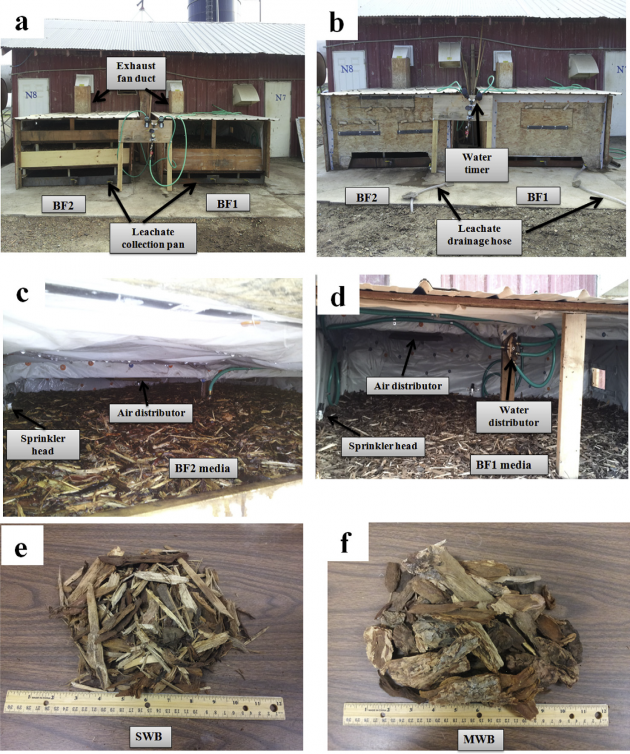
Two vertical down-flow biofilters were constructed on a commercial swine nursery farm. Both biofilter media were shredded wood bark and medium wood bark (1:2 on a volume basis). These biofilters were evaluated under real farm conditions in terms of mitigation of odor and gas emissions. Odor samples were collected using 10 L Tedlar bags and evaluated using a dynamic forced-choice olfactometer. Ammonia and hydrogen sulfide concentrations were monitored on-site by detection tubes. Pressure drop through the biofilter media was also measured on-site using an air velocity meter. A biofilter field day was held on the swine farm to demonstrate their effects and to present biofilter basics. Also, an educational video has been developed to help interested people get familiar with this technology.Picture (a)biofilter 1 (BF1) and biofilter 2(BF2) with front doors open; (b) biofilters with front doors closed; (c) media and water distribution system in BF2; (d) media and water distribution system in BF1; (e) shredded wood bark; (f) medium wood bark.

Figure 1. (a)biofilter 1 (BF1) and biofilter 2(BF2) with front doors open; (b) biofilters with front doors closed; (c) media and water distribution system in BF2; (d) media and water distribution system in BF1; (e) shredded wood bark; (f) medium wood bark.

What have we learned?

(2) Supporting materials showing biofilter basics and its effects on reducing aerosol emissions are needed to encourage biofilter adoption,
(3) Field days are a good platform for both research and demonstrations of new techniques,
(4) Producer’ collaboration and full participation are very important to make the research a success.

Odor and gas (NH3 and H2S) reduction efficiency and moisture distribution at different media depths of (a) biofilter 1 (BF1); (b) biofilter 2 (BF2)

Figure 2. Odor and gas (NH3 and H2S) reduction efficiency and moisture distribution at different media depths of (a) biofilter 1 (BF1); (b) biofilter 2 (BF2).

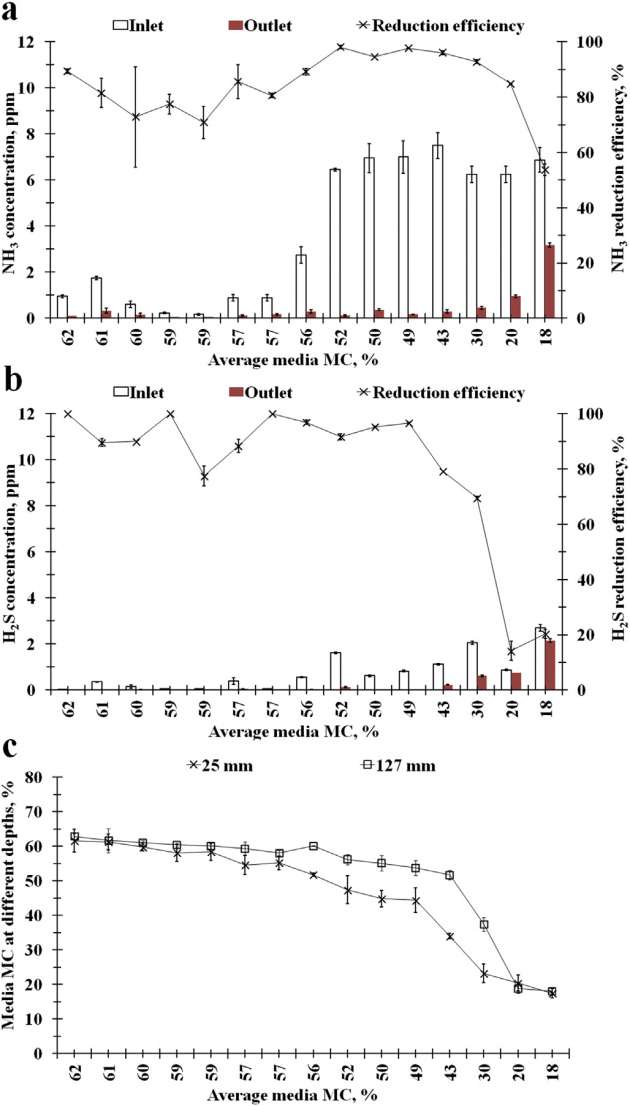
Reduction efficiency for first stage of biofilter 2 (BF2) at different media moisture contents (MC) (a) NH3; (b) H2S; (c) moisture distribution at different media depths. Shredded wood bark (depth of 127 cm) was used and EBRT was 0.9-1.0 s.

Figure 3. Reduction efficiency for first stage of biofilter 2 (BF2) at different media moisture contents (MC) (a) NH3; (b) H2S; (c) moisture distribution at different media depths. Shredded wood bark (depth of 127 cm) was used and EBRT was 0.9-1.0 s.

Reduction efficiency for second stage of biofilter 2 (BF2) at different media moisture contents (MC) (a) NH3; (b) H2S; (c) moisture distribution at different media depths. Medium wood bark (depth of 254 cm) was used and EBRT was 1.8-2.0 s.

Figure 4. Reduction efficiency for second stage of biofilter 2 (BF2) at different media moisture contents (MC) (a) NH3; (b) H2S; (c) moisture distribution at different media depths. Medium wood bark (depth of 254 cm) was used and EBRT was 1.8-2.0 s.

Future Plans

We will refine the developed educational videos and disseminate results from this study to our stakeholders.

Authors

Lide Chen, Waste Management Engineer and Assistant Professor, Biological and Agricultural Engineering Department, University of Idaho lchen@uidaho.edu

Gopi Krishna Kafle, Post-Doctoral Researcher; Howard Neibling, Extension Irrigation and Water Management Specialist and Associate Professor; B. Brian He, Professor, University of Idaho

Additional information

Contact Dr. Lide Chen at lchen@uidaho.edu for more information.

Acknowledgements

This project was partially funded by the USDA Natural Resource Conservation Service through a Conservation Innovation Grant. The authors gratefully thank Mr. Dave Roper for his cooperative efforts during this research.

The authors are solely responsible for the content of these proceedings. The technical information does not necessarily reflect the official position of the sponsoring agencies or institutions represented by planning committee members, and inclusion and distribution herein does not constitute an endorsement of views expressed by the same. Printed materials included herein are not refereed publications. Citations should appear as follows. EXAMPLE: Authors. 2015. Title of presentation. Waste to Worth: Spreading Science and Solutions. Seattle, WA. March 31-April 3, 2015. URL of this page. Accessed on: today’s date.

The Importance of Nitrogen Stabilization

This session will highlight the importance of nitrification inhibitors and how they help delay the conversion of the ammonium form of nitrogen into the nitrate form which then can lead to leaching and denitrification. By using a nitorgen stabilizer, the plant has access to the ammonium form of nitrogen for a longer period of time in the root zone, where it needs it the most.

What Did We Do?

The active ingredient in Instinct II and N-Serve, nitrapyrin, is formulated to put the bacteria known as nitrosomonas, which convert the ammonia form of nitorgen to nitrate nitrogen in the soil, in a static state so that the ammonia form can be uptaken by the plant in the most stable form of nitrogen. Our product treats the soil, not the nitrogen, but uses nitrogen as the carrier, to prevent leaching and denitrification that can occur from warm, wet soils in the spring season. Our product has been tested and approved by the EPA for 40 years and has have numerous (189+) 3rd party and university data that supports that it does what we say it does, inhibits nitrification. In addition, there are other advantages to protecting your nitrogen investment which can lead to higher yields, faster dry down, higher test weight in corn and wheat and in addition, has no negative effect on protein on wheat. Instinct II can be used in UAN, Urea, or Liquid Manure. N-Serve is used on anhydrous ammonia.

What Have We Learned?

Based on the 189+ different 3rd party and university trials, plus the meta-anaylsis published in 2004, we have proven to increase crop yield by 7%, increase soil retention by 28%, decrease nitrogen leaching by 16%, and decease greenhouse gas emission by 51%. Our retention is extremely high on his product, and has proven to be a significant benefactor when used in manure (this year along, our averages on yield increase have been 12+ bushels). Future plans further expansion to outside of US markets, Canada, China, UK, and Australia alongside other EU countries. Further market expansion in the United States into other crops such as specialty crops markets, improvement on formulation for newer, expanding markets.

Author

Tiffany Galloway tlgalloway@dow.com

Additional Information

The authors are solely responsible for the content of these proceedings. The technical information does not necessarily reflect the official position of the sponsoring agencies or institutions represented by planning committee members, and inclusion and distribution herein does not constitute an endorsement of views expressed by the same. Printed materials included herein are not refereed publications. Citations should appear as follows. EXAMPLE: Authors. 2015. Title of presentation. Waste to Worth: Spreading Science and Solutions. Seattle, WA. March 31-April 3, 2015. URL of this page. Accessed on: today’s date.