Integrated Resource Management Tool to Mitigate the Carbon Footprint of Swine Produced in the United States


green stylized pig logoOutputs of This Project: ModelResearch SummariesExtension/Outreach Content | WebcastsProfessional Conference Presentations | Journal Articles | Acknowledgments

What Did We Do?

Modeling: The overall goal of the modeling effort was to enhance the National Pork Board swine carbon footprint calculator by integration of specific modules for: animal growth and feed ingredient impacts on manure characteristics. The process model output is to be used as input to life cycle assessment (LCA) to evaluate cradle-to-farm-gate environmental impacts of swine production. An economic analysis model incorporated both process based results (live animal weight, feed, fuel, etc.) and LCA results (greenhouse gas, GHG emissions) to model the cost and potential of different options for reducing GHG emissions in swine production. More…

The model development is supported through an experimental research program focused on feed efficiency and manure management. Feed efficiency is affected by the feed composition and animal physiology which is affected by the animal’s health status. Our research addressed both issues with laboratory and full scale feeding trials.

Health Status: In trials, Porcine Reproductive and Respiratory Syndrome Virus (PRRSV) infection caused significant reductions in feed intake which led to reductions in rates of gain and body weight. The infection also caused a reduction in diet digestibility leading to greater manure nutrient output per unit of feed intake and increased greenhouse gas (GHG) production from the stored manure. The impact on GHG production is particularly striking when the data are expressed as litters of gas per kilogram of body weight gain. The increased gas production combined with reduced rates of gain results in more than a tripling of gas production per unit of gain for all of the gases. Vaccination against PRRSV appeared to offer little benefit in terms of animal performance, manure nutrient output, or gas production from manure. More…

NIFA swine carbon footprint project partnersAmino Acid Supplementation: Studies confirmed that crude protein can be replaced with feed grade AA to meet the requirement of the first 5 limiting AA without negatively impacting growth performance or carcass composition when diets are formulated on a NE basis; however, further CP reductions resulted in more variable growth performance.

Manure Management: The gasification system has been successfully operated with an algae feed stock in a series of preliminary, proof-of-concept tests. The algal turf system has been fully constructed and is now operational with samples being taken for nitrogen and bacteria levels. Nutrient retention management technologies for manure will include algal growth for on-farm nitrogen retention using a pilot scale experimental system and thermal conversion to fuel gas and bio-char (a soil amendment).

Extension, Outreach, Undergraduate Research Experiences: A significant component of this project is devoted to non-research activities including developing materials for extension work – disseminating research information to non-technical audiences for integration into existing knowledge and application in farm decision-making. Undergraduate students from several universities were also provided with opportunities to participate in research projects, gaining valuable experience and to train potential future scientists.

Model

The Swine Environmental Footprint Calculator is available from the National Pork Board. It will continue to be updated when applicable research information and data sets are available. Go to the model home page….

Research Summaries

Also visit the conference presentations section to find out more about the research findings.

Extension-Outreach Web Content and Printed Materials

The extension materials (focused on transferring research information to a non-research audience) include:

  • short articles written in an FAQ style
  • case studies (pending) on using data from commercial farms
  • curriculum materials for use in high school classrooms that includes manipulatives and activities as well as printed information
  • fact sheets: What is a water footprint? | What is a land footprint? | What is a carbon footprint?

Several Extension Webcasts Were Produced By This Project

  • Thermal Conversion of Animal Manure to Biofuel – Go to archive… (February, 2014)
  • Life Cycle Assessment Modeling for the Pork Industry – Go to archive…. (July, 2012)
  • Producer Association Efforts to Address Carbon Footprint (Pork and Poultry) – Go to archive… (June, 2012)

Conference Presentations Made By Project PI’s

Overall project  – https://scisoc.confex.com/crops/2012am/webprogram/Paper72165.html (from 2012)

Waste to Worth: Advancing Sustainability in Animal Agriculture (March-April, 2015)

  • Environmental Footprint, Cost, and Nutrient Database of of U.S. Animal Feed Ingredients More…
  • Exploring Interactions Between Agricultural Decisions and Greenhouse gas Emissions Using Swine Production More…
  • Feeding Strategies to Mitigate Cost and Environmental Footprint of Pig Production in the US More…
  • Reducing the Costs and Environmental Footprint of Pig Diets with the Experimental Optimum Synthetic Amino Acid Inclusion  More…
  • Adapting Agriculture to Sustainably Feed the World (keynote) More…

Waste to Worth: Spreading Science and Solutions (April, 2013)

  • Refining a Pork Production Carbon Footprint Mitigation Tool: A Case Study of an Integrated Research/Extension/Education Project – More…

LCA Food 2014

  • Panel presentation: Burek J, Thoma G, Popp J, et al. Developing Environmental Footprint,Cost, and Nutrient Database of the US Animal Feed Ingredients.
  • Poster presentation: Burek J, Thoma G, Popp J, et al. Formulating low-cost and low-environmental footprint swine diets.

Midwest Section – American Society of Animal Science

  • 2015 – Comparison of the effects of antibiotic-free and conventional management on growth performance in swine. C. E. Vonderohe*, A. M. Jones, B. T. Richert, J. S. Radcliffe, Purdue University, West Lafayette, IN. Abstract 102, page 47.
  • 2014 – Effect of feeding reduced-CP, amino acid supplemented diets on dietary nitrogen and energy utilization and volatile fatty acid excretion in wean-to-finish swine. A. M. Jones1*, D. T. Kelly1, B. T. Richert1, C. V. Maxwell2, J. S. Radcliffe1,1 Purdue University, West Lafayette, IN, 2 University of Arkansas, Fayetteville. Abstract 037, page 16.
  • 2013 – Effects of amino acid supplementation of reduced crude protein (RCP) diets on performance and carcass composition of growing-finishing swine. J. K. Apple1*, B. E. Bass1, T. C. Tsai1, C.V. Maxwell1, J. W. S. Yancey1, A. N. Young1, M. D. Hanigan2, R.Ulrich3, J. S. Radcliffe4, B. T. Richert4, G. Thoma3, J. S. Popp5,1 Animal Science, University of Arkansas Division of Agriculture, Fayetteville, 2 Dairy Science, Virginia Polytechnic Institute and State University, Blacksburg, 3 Chemical Engineering, University of Arkansas, Fayetteville, 4 Animal Science, Purdue University, West Lafayette, 5 Agricultural Economics & Agribusiness, University of Arkansas Division of Agriculture, Fayetteville. Abstract 0224, page 73.
  • 2013 – Effects of amino acid supplementation of reduced crude protein (RCP) diets on LM quality of growing-finishing swine. A.N. Young1,*, J. K. Apple1, J. W. S. Yancey1, J. J. Hollenbeck1, T. M.Johnson1, B. E. Bass1, T. C. Tsai1, C. V. Maxwell1, M. D. Hanigan2,J. S. Radcliffe3, B. T. Richert3, J. S. Popp4, R. Ulrich5, G. Thoma5,1 Animal Science, University of Arkansas Division of Agriculture, Fayetteville, 2 Dairy Science, Virgina Polytechnic Institute and State University, Blacksburg,3 Animal Science, Purdue University, West Lafayette,4 Agricultural Economics & Agribusiness, University of Arkansas Division of Agriculture,5 Chemical Engineering, University of Arkansas, Fayetteville. Abstract P027, page 97.
  • 2013 – Maximum replacement of CP with synthetic amino acids in nursery pigs. B. E. Bass1, T. Tsai1*, M. D. Hanigan2, J. K.Apple1, R. Ulrich3, J. S. Radcliffe4, B. T. Richert4, G. Thoma3, J.S. Popp5, C. V. Maxwell1,1 Animal Science, University of Arkansas, Fayetteville, 2Dairy Science, Virginia Polytechnic Institute and State University, Blacksburg, 3 Chemical Engineering, University of Arkansas, Fayetteville, 4 Animal Science, Purdue University, West Lafayette, 5 Agriculture Economics & Agribusiness, University of Arkansas, Fayetteville. Abstract P042, page 102.

ASA/CSSA/SSSA amino acid work https://scisoc.confex.com/crops/2012am/webprogram/Paper75311.html  overall project (also linked at top of this list) https://scisoc.confex.com/crops/2012am/webprogram/Paper72165.html

Journal Articles

Manure Management & Algae Systems

  • Sadaka, S., M. Sharara and G. Ubhi. 2014.  Performance Assessment of an Allothermal Auger Gasification System for On-Farm Grain Drying. Journal for Sustainable Bioenergy Systems. Vol. 4: 19-32.
  • Sharara M, Holeman N, Sadaka S, Costello T. 2014. Pyrolysis kinetics of algal consortia grown using swine manure wastewater. Bioresource Technology. 169: 658-666.
  • Sharara, M. and S. Sadaka. 2014. Thermogravimetric Analysis of Swine Manure Solids Obtained From Farrowing, and Growing-Finishing Farms. Journal for Sustainable Bioenergy Systems. Vol. 4: 75-86.

Acknowledgements

Project Director: Greg Thoma gthoma@uark.edu, Co-Project Director: Marty Matlock mmatlock@uark.edu
Principle Investigators: Richard Ulrich, Jennie Popp, Charles Maxwell, Thomas Costello, Scott Radcliffe, Mark Hanigan, Brian Richert, Karl VanDevender, Sammy Sadaka, Chengsheng Li, William Salas

This information is part of the program “Integrated Resource Management Tool to Mitigate the Carbon Footprint of Swine Produced In the U.S.,” and is supported by Agriculture and Food Research Initiative Competitive Grant no. 2011-68002-30208 from the USDA National Institute of Food and Agriculture. Project website: https://lpelc.org/integrated-resource-management-tool-to-mitigate-the-carbon-footprint-of-swine-produced-in-the-united-states/.

Swine Manure & Aqua-ammonia Nitrogen Application Timing on Subsurface Drainage Water

Waste to Worth: Spreading science and solutions logoWaste to Worth home | More proceedings….

Abstract

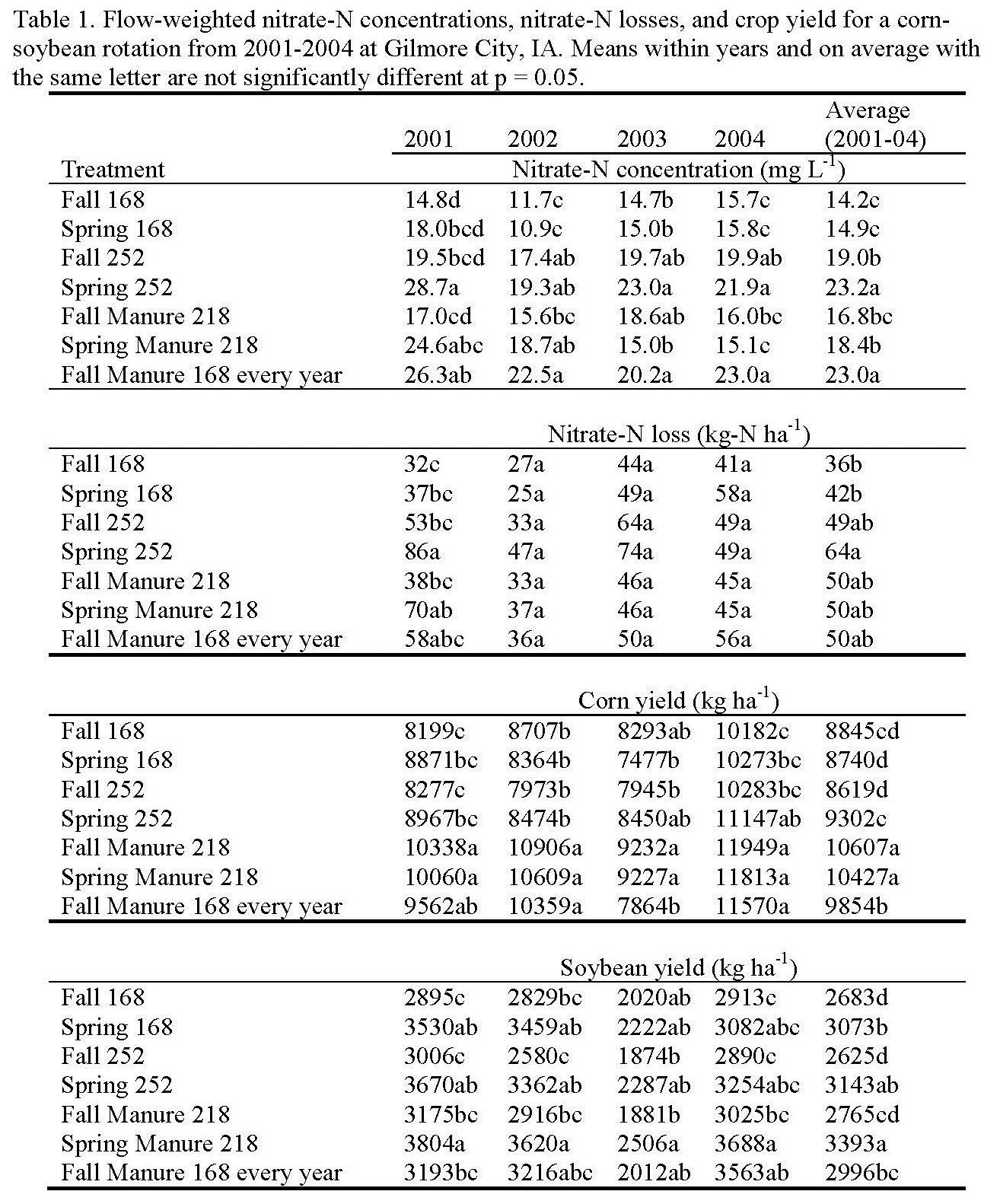
In Iowa and many other Midwestern states, excess water is removed artificially through subsurface drainage systems.  While these drainage systems are vital for crop production, nitrogen (N) added as manure or commercial fertilizer, or derived from soil organic matter, can be carried as nitrate-nitrogen (NO3-N) to downstream water bodies.  A five-year, five-replication, field study was conducted in north-central Iowa with the objective to determine the influence of seasonal N application as ammonia or liquid swine manure on flow-weighted NO3-N concentrations and losses in subsurface drainage water and crop yields in a corn-soybean rotation.  Four aqua-ammonia N treatments (150 or 225 lb-N/acre applied for corn in late fall or as an early season side-dress) and three manure treatments (200 lb-N/acre for corn in late fall or spring or 150 lb-N/acre  in the fall for both corn and soybean) were imposed on subsurface drained, continuous-flow-monitored plots. Four-year average flow-weighted NO3-N concentrations measured in drainage water were ranked: spring aqua-ammonia 225 (23 ppm) = fall manure 150 every year (23 ppm) > fall aqua-ammonia 225 (19ppm) = spring manure 200 (18 ppm) = fall manure 200 (17 ppm) > spring aqua-ammonia 150 (15 ppm) = fall aqua-ammonia 150 (14 ppm).  Corn yields were significantly greater (p=0.05) for the spring and fall manure-200 rates than for non-manure treatments. Soybean yields were significantly greater (p=0.05) for the treatments with a spring nitrogen application to the previous corn crop. Related: LPELC Manure Nutrient Management resources

Check Out These Other Presentations About Tile Drainage

Tile Drainage Field Day

Use of Filters in Drainage Control Structures

New Technologies for Drainage Water Management

Role of Drainage Depth and Intensity on Nutrient Loss

Why Study Sub-Surface Drainage and Manure Application?

Subsurface agricultural drainage has allowed for enhanced crop production in many areas of the world including the upper Midwest, United States. However, the presence of nitrate-nitrogen (nitrate-N) in subsurface tile drainage water is a topic of intense scrutiny due to several water quality issues. With the growing concern for the health of the Gulf of Mexico and local water quality concerns, there is a need to understand how recommended nitrogen management practices, such as through nitrogen rate and timing, impact nitrate-N concentrations from subsurface drainage systems.  The objective of this presentation is to summarize results of studies from Iowa that have documented the impact of nitrogen application rate and timing on tile drainage nitrate loss. 

What Did We Do?

The field experimental site was located near Gilmore City in Pocahontas County, IA. In the fall of 1999, seven treatments were initiated on 35 plots at the site to determine the effect of N source, rate, and application timing on crop yield and subsurface drainage water quality in a corn and soybean (CS) rotation. Two fertilizer N rates (168 or 252 kg ha-1) applied in the spring or fall and liquid swine manure (LSM) applied in spring or fall (218 kg ha-1) for corn production, and fall applied LSM for both crops in a CS rotation (168 kg ha-1) were randomly distributed in five blocks. Flow-weighted drainage samples were collected and volume measurements recorded for each plot through sampling/monitoring systems during drainage seasons in 2001-2004.

What Have We Learned?

This multi-year experiment demonstrated that rate and to a lesser extent timing affect concentration and losses and even at constant rates, these can be highly variable depending on precipitation patterns, N mineralization/denitrification processes and crop utilization in a given season. As expected, as nitrogen application rate to corn increases, the nitrate-N concentrations in subsurface tile drainage water increase.  This highlights the need for appropriate nitrogen application to corn and to avoid over application.  However, it is important to note that even when recommended nitrogen application rates are used, nitrate-N concentrations in subsurface drainage are still elevated and may exceed the EPA drinking water standard for nitrate-N of 10 mg L-1.  Relative to timing of nitrogen application, i.e. moving from fall to spring application, our studies showed little to moderate potential to decrease nitrate-N concentrations. Likely the largest factor when looking at the effect from fertilizer application timing is when precipitation and associated nitrate-N loss occurs.  Although timing of nitrogen application is important, perhaps the most important factor is to apply the correct amount of N. Manure treatments out yielded commercial N in all years. No significant differences in corn yield for any year were noted between application timing. Soybean yields were affected by N timing and less so by application rate.

click on image to enlarge

Future Plans

Other management practices need to be explored for their potentials in reducing nitrate loads from tile drained systems. Promising practices include drainage management, alternative cropping systems and edge-of-field practices.

Authors

Matthew Helmers, Associate Professor, Department of Agricultural & Biosystems Engineering, Iowa State University, mhelmers@iastate.edu

Xiaobo Zhou, Assistant Scientist, Department of Agricultural & Biosystems Engineering, Iowa State Univeristy

Carl Pederson, Agricultural Specialist, Department of Agricultural & Biosystems Engineering, Iowa State University

Additional Information

Lawlor, P.A., A.J. Helmers, J.L. Baker, S.W. Melvin, and D.W. Lemke. 2011. Comparison of liquid swine manure and ammonia nitrogen dynamics for a corn-soybean crop system. Trans. ASABE 54(5): 1575-1588.

LPELC Manure Nutrient Management home

Acknowledgements

Funding for this project was provided by the Iowa Department of Agriculture and Land Stewardship through the Agricultural Water Management fund.


The authors are solely responsible for the content of these proceedings. The technical information does not necessarily reflect the official position of the sponsoring agencies or institutions represented by planning committee members, and inclusion and distribution herein does not constitute an endorsement of views expressed by the same. Printed materials included herein are not refereed publications. Citations should appear as follows. EXAMPLE: Authors. 2013. Title of presentation. Waste to Worth: Spreading Science and Solutions. Denver, CO. April 1-5, 2013. URL of this page. Accessed on: today’s date.

Manure and Litter Additives for Odor Control on Farms

Air emissions from animal agriculture operations and their associated manure storage are being examined more closely as a way to mitigate potentially harmful gases and odors. Manure additives and litter amendments go right to the source and are used to change one or more characteristics of manure to try and reduce emissions emissions of odorous gases. The materials on this page were developed to assist educators and professors who include manure additives or litter amendments as a topic in their classrooms or educational programs.

Fact Sheets

Sanjay Shah, Garry Grabow, Philip Westerman, North Carolina State University

Sanjay Shah, Philip Westerman, James Parsons, North Carolina State University

Technology Summaries

These are from a 2008 conference hosted by Iowa State University

Acknowledgements

These materials were developed by the Air Quality Education in Animal Agriculture (AQEAA) project with with financial support from the National Research Initiative Competitive Grant 2007-55112-17856 from the USDA National Institute of Food and Agriculture.

For questions about the materials on this page contact Dr. Kevin Janni, University of Minnesota (kjanni@umn.edu). For questions about the AQEAA project, contact Dr. Rick Stowell, Unviersity of Nebraska (rstowell2@unl.edu).

If you have presentations, photos, video, publications, or other instructional materials that could be added to the curricula on this page, please contact Dr. Janni or Jill Heemstra (jheemstra@unl.edu).

Costs of Slurry Manure Application and Transport

Livestock and Poultry Environmental Learning Center:

Home Page

All articles about:

Manure Value and Economics

Livestock such as dairy and swine often have slurry type manure. The manure is liquid but does not flow easily. It is either stored directly below the animal pens, or scraped or pumped periodically into a holding pen outside of the building.

Loading Slurry Manure

Loading slurry manure is accomplished with a pump powered by a tractor or stationary engine. The slurry can be loaded into tractor-pulled or truck-mounted tankers, or pumped through a hose attached to a tractor that applies it as it is being pumped from the pit. The cost of loading slurry is usually low because the pump can do it quickly and the volume per animal is not usually high.

Slurry Manure Transport

Transportation of slurry by tanker can be expensive because a lot of water is being transported and the same equipment that is hauling the slurry is usually land applying the slurry. When tankers are used, the number of hours spent transporting the slurry is frequently the limiting cost. The land may become unavailable to receive the slurry, due to crop planting times or soil conditions, before all of the slurry can be land applied. Often, the distance transported is limited so that the time constraints can be met.

If the slurry is pumped through a hose to the field, the transport time is negligible. As the slurry is pumped, it is simultaneously injected or surface applied to the land. The important cost becomes the cost of purchasing pipe and hose that is sufficient for this method of land application.

Land Application of Slurry Manure

The cost of land application of slurry varies with the type of equipment used. Tankers can be expensive to own unless they are used for many animals on many acres. There is a definite economy of scale with tankers. Additionally, the tankers usually require fairly large tractors or trucks. If the livestock owner does not have a cropping enterprise that requires the large tractor, ownership of the tractor for manure distribution alone becomes expensive.

Tankers are economical for large-scale operations with slurry manure.

When slurries are applied via hoses (called dragline hoses), a tractor pulled distributor is used to move the hose around the field so that the slurry is evenly distributed. The cost of the equipment can be very expensive, but the amount of time is decreased considerably compared to using tankers because most of the time is spent in applying the slurry. Very little time is spent getting into and out of the field, as is the case when using tankers.

Authors: Ray Massey, University of Missouri and Josh Payne, Oklahoma State University

Costs of Liquid Manure Application and Transport

Livestock and Poultry Environmental Learning Center:

Home Page

All articles about:

Manure Value and Economics

What Systems Produce Liquid Manure?

Liquid manures are most common with pork production where the manure is flushed from the building and stored outside in lagoons. Liquid manures are mostly water with some organic matter and nutrients suspended in the water. Most of the organic matter decomposes in the lagoons and is not removed.

Options to Haul and Apply Liquid Manure

While some livestock producers haul liquid manure in tankers, it is usually considered cost prohibitive. The amount of water is so great that the hours spent distributing it and the resulting dollar cost exceeds the value of the manure supplied nutrients when using tankers.

Liquid manure is usually pumped through pipes and hoses to the land that will be accepting the manure. This means that loading costs and transportation costs are relatively low. Once the manure is at the field, it can be applied with a tractor that pulls the dragline hose through the field or via an irrigation system. The irrigation system can be a stationary sprinkler or a single big gun sprinkler that must be moved periodically by the operator.

Liquid manure can be land applied with a dragline hose.

Other options include, a big gun sprinkler or a center pivot irrigation system that move automatically through the field. The center pivot irrigation system is usually too expensive to own just for liquid manure distribution; it is usually part of an irrigation system that also pumps clean water. The stationary and big gun sprinklers are inexpensive and easy to use.

Authors: Ray Massey, University of Missouri and Josh Payne, Oklahoma State University

Managing Biosecurity to Control Porcine Epidemic Diarrhea virus (PEDv)

The appearance of the Porcine Epidemic Diarrhea Virus (PED) in North America presents significant challenges for manure applicators. Since the virus is primarily spread by fecal-oral contact and can survive in manure for extended periods of time, it is possible for the disease to be spread by any object that becomes contaminated with infected pig manure. Biosecurity is an important part of preventing its spread. This presentation was originally broadcast on July 18, 2014. More… Continue reading “Managing Biosecurity to Control Porcine Epidemic Diarrhea virus (PEDv)”