
Checking Ambition with Reality: The Pros and Cons of Different Approaches to Site Assessment

Purpose

This talk is intended to spark discussion over options related to site assessment for nutrient management. It will include a brief presentation followed by open discussion.

What did we do?

The revision of the USDA-NRCS national standard for nutrient management in 2011 was driven, in part, by inconsistencies in state phosphorus (P) indices, rekindling debates over standardizing indices at regional or national scales. Reasonable arguments exist for maintaining the status quo, which allows for state specific site assessment approaches, as well as for regional and national P Indices, which would take advantage of expertise, resources and technologies that may not exist locally. In addition, a diversity of site assessment approaches have now been proposed that differ from the original P Index. Understanding the benefits and limitations provided with these approaches is key to advancing site assessment for P management.

All site assessment tools are intended to identify critical source areas of P loss that should be targeted for improved management. The original P Index provided an elegant reduction of key factors affecting P loss from agricultural fields by categorizing factors into “transport” and “source.” More than a decade after the wholesale implementation of state P Indices in 47 US States, critiques of this approach range from inconsistency in their rating of P loss vulnerability, to differences in their recommendations, to poor or “clunky” links to site management.

What have we learned?

A variety of alternative approaches to site assessment have been proposed, most relying upon simulation models that produce an array of off-site metrics, most importantly, runoff P loads. These alternatives have been strongly advocated by their developers and by others interested in quantifying the effects of changing management, but have not yet replaced the original P Indices. Strong rhetoric has been employed in favor, and in opposition, to site assessment approaches. In general, supporters of the P Index argue that it is more of an educational tool, that should be “directionally correct” to affect change in management. Supporters of the modified fate-and-transport models argue that they too can be packaged to be educational and that they have the added benefit of projecting off site benefits. Concern exists over the ability of all site assessment tools to accurately quantify P loss or P loss potential.

Inconsistencies in site assessment approaches at geo-political boundaries (typically state lines but also physiographic and watershed divides) have led to proposals for regional or national approaches to P site assessment. Legitimate tension exists between the representation of unique, local conditions (physiographic or regulatory) and consistency to ensure fairness and accuracy. Past proposals to develop a national P Indexing framework from which local P Indices could be developed were intended to overcome this tension, but were unsuccessful due to local opposition and their top-down nature. Real conflicts are inevitable when state regulations are impinged, even in the name of regional consistency

Future Plans

While the P Index is decided strategic in its approach, a new crop of site assessment tools is emerging to address the day-to-day decision support tools of farmers. These tools employ short-term weather forecasting to identify the potential for runoff to occur following manure application, and range in their sensitivity from field scale to large watershed scale. In general, it is seen that these tools are complementary to the strategic site assessment tools, but, undoubtedly, opportunity exists for a merger of strategic and tactical approaches.

Authors

Peter Kleinman, Research Leader, USDA-ARS Pasture Systems and Watershed Management Research Unit peter.kleinman@ars.usda.gov

D. Beegle, Pennsylvania State University; D. Osmond, North Carolina State University; J. Lory, University of Missouri; P. Vadas, USDA-Agricultural Research Service; and A. Sharpley, University of Arkansas.

Additional information

This presentation is intended to underscore open discussion at the meeting on the subject of site assessment.

Acknowledgements

This presentation is the product of a national Conservation Innovation Grant aimed at promoting better coordination in nutrient management planning

The authors are solely responsible for the content of these proceedings. The technical information does not necessarily reflect the official position of the sponsoring agencies or institutions represented by planning committee members, and inclusion and distribution herein does not constitute an endorsement of views expressed by the same. Printed materials included herein are not refereed publications. Citations should appear as follows. EXAMPLE: Authors. 2015. Title of presentation. Waste to Worth: Spreading Science and Solutions. Seattle, WA. March 31-April 3, 2015. URL of this page. Accessed on: today’s date.
Swine Manure Odor Reduction Using a Humic Amendment: On-Farm Demonstration


Why Study Odors from Pig Farms?

Odor-related nuisance complaints associated with animal production facilities are on the rise as residential sprawl encroaches on once rural areas. The efficacy of odor control additives is highly variable and most have limited success. This project demonstrated the efficacy of a commercial humic-material product (ManureMaxTM, Manufactured by JDMV Holding, LLC; Huston, TX) for limited control of liquid swine manure odors.

What did we do?

Two similarly-operated, 2,250-pig, tunnel-ventilated finishing barns on one farm were used for the demonstration. Barns were widely-separated by 1,800 feet of woodland and fields and were occupied by pigs of similar age. The underfloor manure storage pit (5-ft deep) of one barn received monthly additions with the additive while the other barn received no additive. After 20 weeks when hogs were finished for market and barns cleaned for restocking, treatments were switched so the previously untreated barn received the amendment. Odors at the barn ventilation exhaust were evaluated monthly by direct sensory methods (olfactometry) using human subjects. Field-applied manure was evaluated at the end of each 20-week grow-out period. Nasal Ranger Field Olfactometer (NRO) units were used to evaluate barn exhaust odor dilutions-to-threshold (D/T) and odors during field application, employing the Multiple-Assessor Repeat Observation (MARO) method (B randt et at., 2011a and 2011b). Barn ventilation exhaust was normalized against fan velocity and compared as odor flux (odor units min-1) among treatments. Whole air samples were collected in 10-liter TedlarTM® bags during each field visit and brought back to the Penn State Odor Assessmnt Laboratory (PSOAL) for evaluation. A team of five qualified odor panelists quantified odor detection threshold (DT) using Dynamic Triangular Forced-Choice Olfactometry (DTFCO) on an Ac’ScentTM International Dynamic Olfactometer (St. Croix Sensory, Lake Elmo, MN) within 10 hours of sample collection.

What have we learned?

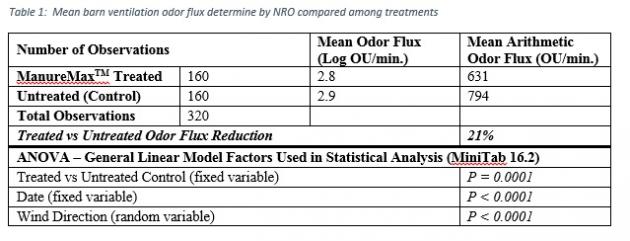
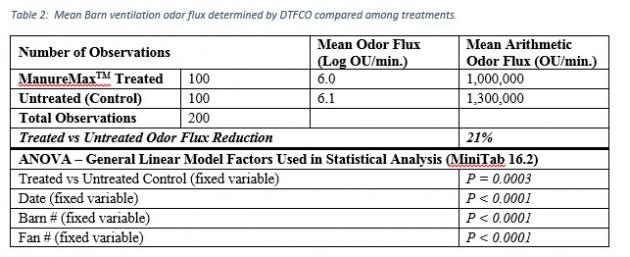
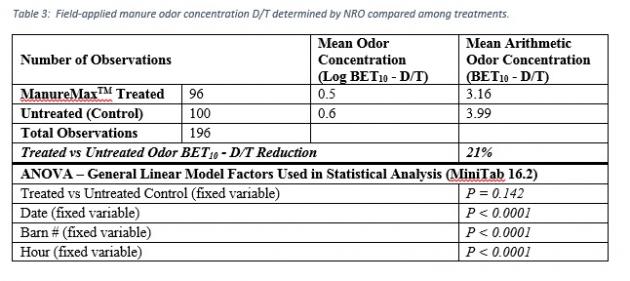
Results show a 21% reduction in mean barn odor exhaust as shown in Table 1 and Table 2. The humic amendment significantly decreased barn ventilation odor flux by 21% in both field NRO and laboratory DTFCO evaluations. Evaluation of field applied manure yield a 21% and 60% decrease in odor concentrations for NRO and DTFCO, respectively.mean barn ventilation odor flux

mean barn ventilation odor flux

field-applied manure odor concentration

field-applied manure odor concentration DT

Authors

Hile, Michael, Ph. D. Candidate in Agricultural and Biological Engineering (ABE) at Penn State (PSU) mlh144@psu.edu

Brandt, Robin, Senior Lecturer in ABE at PSU, Eileen E. Fabian, Professor in ABE at PSU and Herschel A. Elliott, professor in ABE at PSU. Robert E. Mikesell, Program Coordinator and Senior Lecturer, Department of Animal Science at PSU.

Additional information

Brandt, R.C., H.A. Elliott, M.A.A. Adviento-Borbe, E.F. Wheeler, P.J.A. Kleinman, and D.B. Beegle. 2011a. Field Olfactometry Assessment of Dairy Manure Land Application Methods. J. Environ. Qual. 40: 431-437.

Brandt, R.C., M.A.A. Adviento-Borbe, H.A. Elliott, E.F. Wheeler. 2011. Protocols for Reliable Field Olfactometry Odor Evaluations. J. Appl. Engr Agr. Vol. 27(3): 457-466.

Brandt, R. C., H. A. Elliott, E. E. Fabian, M. L. Hile, R. E. Mikesell, Jr., 2014. Manure Additive Shows Swine Odor Reduction. Fact Sheet. Penn State University, Department of Agricultural and Biological Engineering.

Acknowledgements

Thanks to JDMV Holding, LLC Houston, TX) for providing funding and product for this project. This project would not have been possible without the support from Natural Resources Conservation Service’ (NRCS) Conservation Innovation Grant (CIG) program.

The authors are solely responsible for the content of these proceedings. The technical information does not necessarily reflect the official position of the sponsoring agencies or institutions represented by planning committee members, and inclusion and distribution herein does not constitute an endorsement of views expressed by the same. Printed materials included herein are not refereed publications. Citations should appear as follows. EXAMPLE: Authors. 2015. Title of presentation. Waste to Worth: Spreading Science and Solutions. Seattle, WA. March 31-April 3, 2015. URL of this page. Accessed on: today’s date.
Digested Solids – Forms, Markets and Trends


Are Digested Solids a Viable Product?

Anaerobic digesters for U.S. livestock operations are becoming more complex. A study of livestock-based digesters in 2003 found they were built largely to meet on-farm needs for power or gas. Digester residuals were mostly land applied as nutrients for crop production. A few used fibrous solids as animal bedding (King, 2003). In recent years, more livestock-based digester projects have been built by third-party developer/managers. Projects increasingly employ a systems approach, where individual product streams are managed in concert for greatest profit by the project manager. This approach holds the promise that digestate residuals, especially fiber solids, will no longer be neglected, but instead play a larger role in offsetting weak performance in energy revenues.

What did we do?

Looking closely at dairy-based digesters, the solids recovered after separation from the digester eflluent have unique characteristics. Most notably, these solids tend to be fibrous with high cellulose, hemicellulose, and lignin content. Digestion also reduces pathogenic contaminants, volatile solids, odor, and viable weed seeds (MacConnell, 2010). These qualities can be influenced by the makeup of an animal’s feed and the use of co-digestion feedstocks, such as municipal or industrial wastes or other agricultural manures or byproducts

Table 1 shows the characteristics of dairy AD solids compared to raw manure and raw separated solids (MacConnell, 2010).

Table 1. Fiber Characteristics

Table 1.

As is. In bulk. Sold to a wholesale buyer—this is the easiest way to sell digested dairy fiber. Through a combination of literature search and expert interviews, this presentation looks at the methods project managers might use to add more value to their digested fiber.

What have we learned?

Composting. Perhaps the most basic way to add value to digested dairy fiber is simply to apply basic compost processing methods—aerating the material under controlled conditions for sufficient time to reduce odor and stabilize the organic matter. While already low in pathogens, hot composting practices can give additional assurance of pathogen reduction. In co-digestion situations, screening the material to remove contaminants and assure consistency and uniformity is desired. Even wholesale buyers will pay more for material that is already composted (King 2003)

Processing to compete – replacing peat. Because of its physical similarity, researchers have explored using digested dairy fiber as a direct replacement for peat moss in nursery and horticulture mixes. WSU was an early source of research and growth trials on such uses. Their research showed that with minimal post-digestion treatment, amended digested dairy fiber performed as well or better than peat in soilless mixes. (MacConnell, 2007, and Kruger, 2008) In 2007, Organix, a Washington company, announced the first shipments of RePeat, using their patent-pending FibreRite production system. Since then several new varieties of these peat replacements have hit the market nationwide, under such brands as Magic Dirt, EnerGro, and MooFiber.

Organic certification. Organic gardening and food production is growing rapidly in Washington state and around the nation. Getting an organic certification for organic matter and nutrients that have been digested and composted will add significant value to the final product (King, 2003).

Branding and marketing for retail. Moving away from bulk and wholesale are the next steps in moving material up the value chain. However, putting product in bags and selling into retail markets requires significant investments in packaging, branding, marketing and sales. This is like adding an additional business onto the back end of a digester project and demands its own feasibility analysis.

Vermicomposting. Using earthworms, especially redworms, to further process fiber solids and excrete earthworm castings, produces another specialty soil product. Vermicomposts and earthworm castings are well-known and appreciated in some growers in some markets. They are often used as a small additive in specialty soil mixes to allow the use of “earthworm castings” on the list of ingredients. Two commercial examples of vermicompost production lie on opposite coasts—Sonoma Valley Worm Farm in California and Worm Power in New York. Sonoma Valley Worm Farm direct markets high-quality vermicompost to a variety of growers throughout their region, with special emphasis on vineyards. Worm Power topped 2 million pounds of production in 2012 and signed an agreement with Rochester, NY-based Harris Seeds to market its vermicompost products regionally.

Specialty products produced from the separated fiber materials are another area of interest. Perhaps the best known of such products are the biodegradable planting nursery pots sold as Cow Pots by the Fruend Dairy Farm in Connecticut.

Biochar. This is another specialty product from a fledgling industry that fits in niche markets. It could be used to process digested fiber. It has received a strong research focus in the Pacific Northwest. The value of biochar in landscape or agricultural uses is still being studied, though at present it appears to have less to do with agronomic benefit, than on measured benefits for carbon sequestration and the value given to these benefits through carbon credits or other mechanisms (Galinato, 2011). On the other hand, replacing biochar for conventional forms of activated carbon for filtering stormwater or wastewaters shows some promising results and is getting a lot of attention.

Future Plans      

We will continue to evaluate methods to add value and publish the full results in a Anaerobic Digestion technology brief on this topic.

Authors        

Jim Jensen, Sr. Bioenergy & Alt Fuel Specialist, Washington State University Energy Program jensenj@energy.wsu.edu

Craig Frear, Chad Kruger, and Georgine Yorgey, Center for Sustaining Agriculture and Natural Resources, Washington State University

Additional information  

References:

Galinato, S., Yoder, J., Granatstein, D., 2011. The economic value of biochar in crop production. Energy Policy.

King, 2003. Study to Evaluate the Price and Markets for Residual Solids from a Dairy Cow Manure Anaerobic Digester—Final Report, King County Solid Waste, Seattle, WA.

Kruger, Chad, et.al., 2008. High-quality fiber and fertilizer as co-products from anaerobic digestion. Journal of Soil and Water Conservation.

MacConnell, C.B., Collins, H.P., 2007. Utilization of re-processed anaerobically digested fiber from dairy manure as a container media substrate. Proceedings of the International Symposium on Growing Media, Nottingham, UK.

MacConnell, C., Frear, C., Liao W., 2010. Pretreatment of AD-treated fibrous solids for value-added container media market, Center for Sustaining Agriculture and Natural Resources, Pullman, WA.

Acknowledgements      

This research was supported by funding from USDA National Institute of Food and Agriculture, Contract #2012-6800219814; Biomass Research Funds from the Washington State University Agricultural Research Center; and the Washington State Department of Ecology, Waste 2 Resources Program.

The authors are solely responsible for the content of these proceedings. The technical information does not necessarily reflect the official position of the sponsoring agencies or institutions represented by planning committee members, and inclusion and distribution herein does not constitute an endorsement of views expressed by the same. Printed materials included herein are not refereed publications. Citations should appear as follows. EXAMPLE: Authors. 2015. Title of presentation. Waste to Worth: Spreading Science and Solutions. Seattle, WA. March 31-April 3, 2015. URL of this page. Accessed on: today’s date.


Using Solar Power to Provide Animals with Water while Protecting Water Quality


Why Consider Solar Power for Watering Livestock?

The purpose of this paper and presentation is to show how we have been using solar powered watering stations to provide a clean water supply to livestock while also protecting water resources. The project was started as a way to assist farmers who had received funding from some federal or state agencies to improve water quality on and through their land. One way to improve water quality is to fence livestock out of local waterbodies. As a result of this practice, the farmer may lose the ability to water his/her livestock.  A secondary reason for the project was, since livestock did not have direct access to water, the farmer had to either carry water to the watering stations or use some form of energy (diesel, gasoline, electric) to provided needed water.

What did we do?

To help solve the problem, funding was received from USDA-NRCS through the Conservation Innovation Grant Program (CIG) to install solar powered livestock watering stations. Farmers were selected based on information from NRCs field personnel, County Extension Agents and other groups working with farmers to fence livestock out of the waterbodies. The first steps were to visit with the farmers to determine need for a solar powered watering station.

Through a first set of questions, it was determined: 1) if the farmer needed the watering station; 2) where the watering station would be located; 3) was there an existing well and pump and what was the source of energy?;  4) what would be the preferred energy source based on available electricity; and 5) would there be a solar system that could be designed to meet the need of the farmer (an initial design).

To further discuss these steps, we looked to see if the farmer needed the watering station. Was there was a means to put in a limited access watering spot so water was still available on a limited basis and still help with protecting water quality? The location of the watering station was determined based on plans to rotationally graze the pasture where the livestock would be located. If the livestock were to be rotated through a number of different paddocks, the suggestion would be to locate the watering station in the center of a rotation. Alternatively, could a solar powered pumping system be located in one place and pump water to various watering stations on the property? The third aspect of the initial planning process was to determine if there was an existing well or pump. If there was an existing well and pump, what was the source of power for the pump? If diesel or gasoline was being used, what was the cost of such a system on an annual basis? The next aspect asked if there was available electric power for a pump? If the answer was “Yes, there is power less than one-quarter mile” then it was suggested the farmer consult with the local power utility to determine the cost of running power to the proposed pumping location. Another aspect of this step in the process was where would the water source be and would solar even be viable due to shade or tree cover? The last aspect of the determination of using solar power was the ability of us to design a system based on the number of livestock that had or needed to be watered and the depth of the well (if currently in place), expected depth to groundwater, height from a surface water source to highest and most distant watering station, and distance of having to run pipe from water source to most distant watering station. If after going through all of these aspects with the farmer, it was determined that a solar powered watering system was a good option for the farmer, we worked with him or her to fully design a solar powered watering system, ordered the solar components and helped the farmer install the system.

What have we learned?

From this project we have learned that there are some locations that are not good for a solar powered watering systems due to location, distance to available power and economics. Most of the times when the system was determined to be non-economical, it was due to there being electric power within a short distance of the proposed solar installation site. Short distance here is defined as any distance that makes running electricity to the proposed water source location economically preferable to that of installing solar power. Sometimes location was not a good fit in that there was very little open space to install a solar powered system for pumping the water. Another thing we have learned is that the solar powered system needs to be protected or at least in a location where livestock cannot get to the panels and control boxes. In cases where small livestock are being watered, having the solar panels on poles above their height can be beneficial in providing maintenance for grass control. However, for larger livestock, the support structure and solar panels themselves can become scratching posts which can result in broken solar panels. One other thing we have learned is that based on the needs or direction of the local NRCS working groups, solar powered watering systems may or may not be included in the cost share options for farmers.

Future Plans  

Future plans are to work with County Extension Agents, NRCS, farmers and other groups promoting the use of solar powered systems for watering livestock in areas where this technology can protect water quality.

Author     

Gary L. Hawkins, Water Resource Management and policy Specialist and Assistant Professor, University of Georgia, Crop and Soil Science ghawkins@uga.edu

Additional information                

For more information please contact ghawkins@uga.edu

Sun-powered water source. Angus Journal. July 2013. Anderson, B.B.

Acknowledgements     

Thanks to Mr. Gary Murphy for his assistance in installing and demonstrating the solar system in many different venues. Thanks also is extended to USDA-NRCS for funding the projects through the CIG program.

The authors are solely responsible for the content of these proceedings. The technical information does not necessarily reflect the official position of the sponsoring agencies or institutions represented by planning committee members, and inclusion and distribution herein does not constitute an endorsement of views expressed by the same. Printed materials included herein are not refereed publications. Citations should appear as follows. EXAMPLE: Authors. 2015. Title of presentation. Waste to Worth: Spreading Science and Solutions. Seattle, WA. March 31-April 3, 2015. URL of this page. Accessed on: today’s date.

Reducing Emissions of Carbonyl Compounds with Waste-Cooking-Oil Biodiesel/Butanol/Diesel Blends Fuelled on the Diesel Engine


What Factors Should We Consider with Biodiesel?*

In recent years, the increasing depletion of petroleum resources from environment and the worsening pollution problems have led to concerns regarding alternatives to petroleum fuels. It is by now well known that the EU has set a target of replacing 10% of conventional fuels with biofuels by 2020. As renewable, biodegradable, and nontoxic fuel research has continued to the present, biodiesel has attracted considerable attention over the past decade.To the best of our knowledge, relatively little is known about CBCs produced by burning butanol and waste cooking oil (WCO) biodiesel blends in diesel engines. In this study, we use butanol and waste cooking oil biodiesel blended with diesel to evaluate the fuel potential to decrease CBC emissions from diesel engines. Emission factors are compared and discussed. Additionally, the feasibility of biodiesel blends and optimum percentage of biodiesel in fuel blends are assessed.

What did we do?  

In this study, six fuels are tested during the experiments. The base fuel is a premium diesel fuel (D100, 98%fossil diesel and 2% biodiesel) produced by Chinese Petroleum Corporation (CPC). In addition, the biodiesel (made by waste cooking oil) used for testing is produced by Greatec Green Energy Corporation in Taiwan. n-butanol is obtained from J. T. Baker (>99.5% purity). The diesel blend fuels used in this study are: B10 (10 vol% butanol), B10W10 (10 vol% butanol and 10 vol% biodiesel), B10W20 (10 vol% butanol and 20 vol% biodiesel), and B10W30 (10 vol% butanol and 30 vol% biodiesel), and B10W40 (10 vol% butanol and 40 vol% biodiesel), respectively.

The pollutant emissions from a diesel-fueled engine generator are examined. This diesel engine, made by Subaru (DY23-2D), is a four-cycle, air-cooled, overhead valve, single-cylinder. Moreover, the combustion system is direct injection and no further modification is needed. The bore and stroke are 70 mm and 60 mm, respectively. The displacement volume is 230 cc and the maximum output power is 2.8 kW at 3000 rpm. The torque is 10.5 Nm at 2200 rpm. Tests are performed at steady state condition with the engine running at 2200 rpm with torque and power outputs of 10.4 Nm (75% of the max load) and 2.1 kW, respectively, for the six test fuels.

What have we learned?

Biodiesel, a renewable and degradable fuel, is widely used due to its low emissions and toxicity. Biodiesel can be produced from animal fats or vegetable oils with methanol or ethanol as the catalyst via transesterification. Although blends of biodiesel/diesel/alcohols are well known in emission reduction, butanol has been recently found to have economic and sustainable potential as a substitute for ethanol in diesel blends. This study investigates the emissions of carbonyl compounds (CBCs) and regulated traditional pollutants that are produced from diesel engine combustion in steady-state conditions. Experimental results indicate that formaldehyde and acetaldehyde are the major and secondary carbonyls in the exhaust, which account for 84.6–69.7% of total CBC concentrations for all test fuels. It is also found out that using B10W40 instead of D100 is able to reduce PM and NOx by 46.5% and 31.8%, respectively. There is a decrease of form aldehyde concentrations in proportion to butanol-biodiesel content among the blends.

Future Plans      

The outcome of using biodiesel-butanol-diesel blends as alternative fuels is encouraging. In general, the variation of carbonyl emissions of biodiesel in engines can be affected by several factors, such as engine load, biodiesel components, and driving cycle. Further research is necessary for a better understanding of formation of carbonyl from esters. More careful attention must be paid to non-regulated emissions from biodiesel blends.

Authors         

Yuan-Chung Lin, Prof. at Inst. Environ. Eng., National Sun Yat-Sen University. Taiwan Deputy Executive Officer at Environ. Protec. & Safety Center yuanchung.lin@gmail.com

Kang-Shin Chen, Po-Ming Yang, Yuan-Chung Lin*, Kuang C. Lin, Syu-Ruei Jhang, I-Wei Wang

Additional information

Yuan-Chung (Oliver) Lin Ph.D.

Prof. at Inst. Environ. Eng., National Sun Yat-Sen University. Taiwan

Deputy Executive Officer at Environ. Protec. & Safety Center

TEL: +886-7-5252000 ext 4412

+886-7-5254412

FAX: +886-7-5254412

Cell: +886-935795228

yclin@faculty.nsysu.edu.tw

yuanchung.lin@gmail.com

The authors are solely responsible for the content of these proceedings. The technical information does not necessarily reflect the official position of the sponsoring agencies or institutions represented by planning committee members, and inclusion and distribution herein does not constitute an endorsement of views expressed by the same. Printed materials included herein are not refereed publications. Citations should appear as follows. EXAMPLE: Authors. 2015. Title of presentation. Waste to Worth: Spreading Science and Solutions. Seattle, WA. March 31-April 3, 2015. URL of this page. Accessed on: today’s date.
Food Waste and Food Processing Waste for Renewable Energy Production


Purpose *          

This high efficient and low-cost eggshell catalyst could make the process of biodiesel production economic and fully ecologically friendly. The ecologically friendly and economic process could effectively reduce the processing cost of biodiesel, making it competitive with petroleum diesel.

What did we do? 

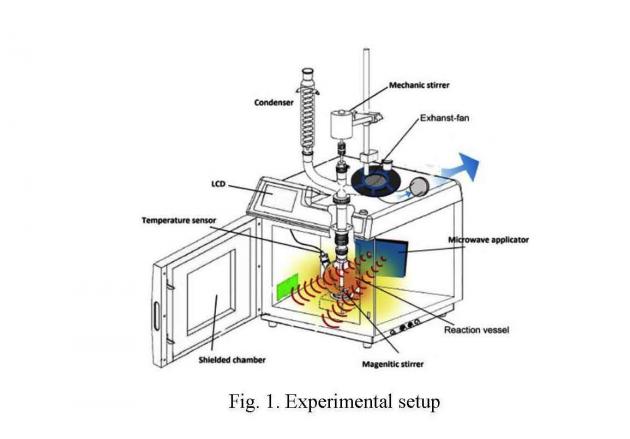
The acid value of Jatropha oil was more than 2 mg of KOH g-1. The methanol, sodium hydroxide (NaOH), and sodium methoxide (CH3-ONa) were high-performance liquid chromatography (HPLC) grade. The experimental setup is shown in Fig. 1.

Fig. 1. Experimental setup

A microwave synthesis reactor (NN-S235, Panasonic Co., Ltd., Taiwan), equipped with a mechanical stirrer and a condenser (LC-10, Hi-point Co., Ltd, Taiwan) was used for microwave reactions. The stirrer was operated at 600 rpm with a magnetic nucleus. Various catalysts (CH3ONa and NaOH), reaction times (1–6 min), methanol to oil molar ratios (3–15), and reaction powers (200–750 W) were tested. The analytic method of methyl ester content in this study followed Taiwan CNS15051 (Chinese National Standards). A GC (gas chromatography; GC-6890, Agilent, USA) system equipped with a FID (flame ionization detector) was used to determine methyl ester content.

What have we learned? 

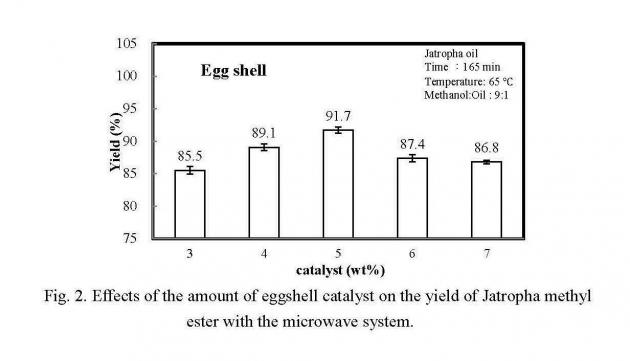
Experiments were carried out using different catalysts in order to investigate their influence on the methyl ester yield. The microwave system was operated with a reaction time of 165 min, microwave power of 750 W, and methanol to oil molar ratio of 9. eggshell and oystershell were used as the catalysts. The fractions of the catalysts were 3, 4, 5, 6, and 7 wt%.

Fig. 2. Effects of the amount of eggshell catalyst on the yield of Jatropha methyl ester with the microwave system

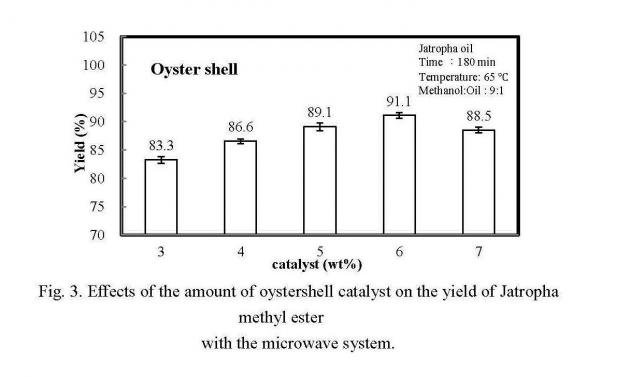
As shown in Fig. 2, the yields of methyl ester were 85.5%, 89.1%, 91.7%, 87.4%, and 86.8% for 3, 4, 5, 6, and 7 wt% eggshell catalysts, respectively. The best performances were with 5 wt% eggshell catalysts. Comparing the eggshell as catalyst, operational condition addition of 6 wt% oystershell catalysts as shown in Fig. 3, the reaction time was 180 min, reaction temperature was 65 ℃, and the methanol-to-oil ratio was 9:1.

Fig. 3. Effects of the amount of oystershell catalyst on the yield of Jatropha methyl ester with the microwave system.

The results indicated that the catalysts derived from eggshells showed yield better than oystershell for biodiesel production.These results indicate that although excess catalyst might increase the biodiesel yield, the amount of glycerin also increased due to saponification, causing a reduction in biodiesel yields.

Future Plans 

High active, reusable solid catalyst was obtained by just calcining eggshell and oytershell. Calcined eggshell and oytershell exhibited high activity towards the transesterification of jatropha oil with methanol to produce biodiesel. The method of reusing eggshell waste and oystershell to prepare catalyst could recycle the waste, minimizing contaminants, reducing the cost of catalyst, and making the catalyst environmentally friendly. This high efficient and low-cost eggshell catalyst could make the process of biodiesel production economic and fully ecologically friendly. Future, the ecologically friendly and economic process could effectively reduce the processing cost of biodiesel, making it competitive with petroleum diesel.

Authors   

Yuan-Chung Lin, Prof. at Inst. Environ. Eng., National Sun Yat-Sen University. Taiwan Deputy Executive Officer at Environ. Protec. & Safety Center yuanchung.lin@gmail.com

Syu-Ruei Jhang1, Yuan-Chung Lin*, Chin-En Chen, Po-Ming Yang, Shang-Cyuan Chen, I-Wei Wang

Additional information                

Yuan-Chung (Oliver) Lin Ph.D.

Prof. at Inst. Environ. Eng., National Sun Yat-Sen University. Taiwan

Deputy Executive Officer at Environ. Protec. & Safety Center

TEL: +886-7-5252000 ext 4412

+886-7-5254412

FAX: +886-7-5254412

Cell: +886-935795228

yclin@faculty.nsysu.edu.tw

yuanchung.lin@gmail.com

The authors are solely responsible for the content of these proceedings. The technical information does not necessarily reflect the official position of the sponsoring agencies or institutions represented by planning committee members, and inclusion and distribution herein does not constitute an endorsement of views expressed by the same. Printed materials included herein are not refereed publications. Citations should appear as follows. EXAMPLE: Authors. 2015. Title of presentation. Waste to Worth: Spreading Science and Solutions. Seattle, WA. March 31-April 3, 2015. URL of this page. Accessed on: today’s date.
 

Livestock grazing in a changing climate: Implications for adaptive management


How Could Climate Change Impact Grazing Livestock?

Predictions that global population will reach nine billion persons by the mid-21st century, combined with the rising middle class in Asia, increases the demand for animal protein production.  Concurrent with the increasing human population is the continued directional rise in atmospheric carbon dioxide (CO2) which just passed the 400 parts per million volume level. Projections are that this concentration will increase to 550 parts per million volume by the end of the 21st century.  Increases in greenhouse gases (like CO2) can lead to 1) increasing temperatures, 2) influencing patterns and amounts of precipitation, 3) raising the sea level and 4) increasing the acidity of oceans.  For vegetation, increases in CO2 atmospheric concentrations result in greater water use efficiency, changes in species composition with “weedy” and “invasive” plants benefiting at the expense of native species, enhanced aboveground primary production, and lower forage quality.  The predicted warmer air temperatures and associated longer growing seasons (i.e., earlier start of spring and later falls) should lead to an increased frequency and intensity of wildfires, as well as greater pest abundance and spread of disease.  As the frequency and intensity/severity of extreme events (e.g., droughts) increases, animal heat stress is expected to become more problematic leading to reduced animal performance and as a result less livestock production.

Related: See the other presentations in this Western Region symposium (cattle selection, policy, climate hubs, ag outlook)

What Is Adaptive Management?

Although livestock managers have historically dealt with drought conditions (e.g., Dust Bowl year of the 1930s, the mid 1950s drought, and the 1988 drought), current efforts associated with the dry years of the early 21st century demonstrate that there is a need for adaptive management to increase resiliency of the rangeland vegetation and sustainability of rural communities and economies.  Adaptive management necessitates that 1) adjustments are made when temporally appropriate (both within and across years), 2) experiential and experimental knowledge is blended to provide sufficient capacity for flexibility with predicted long-term droughts that are more intense/severe, as well as “flash” droughts like the one experienced across a wide swath of the US in 2012, and 3) spatial and temporal variability are embraced rather than looked at as negatives. Key for livestock managers is how to increase flexibility in management to adapt to increasing weather variability associated with a changing climate.  For many managers, matching animal management with intrinsically high inter- and intra-annual variability in forage production is difficult due to inherent maintenance of herd genetics and the lack of a proactive national drought policy.  For example, although a majority (60%) of ranchers in Wyoming have a drought management plan, that still leaves 4 in ten ranchers without a pre-plan to shape management decisions when drought occurs (Kachergis et al. 2014). 

Proactive (i.e., preparation) and reactive (i.e., response) drought management strategies are showcased in Figure 1 (per Kachergis et al. 2014). 

Figure 1.  Proactive and reactive drought management strategies employed by Wyoming ranchers (from Kachergis et al. 2014).

Figure 1.  Proactive and reactive drought management strategies employed by Wyoming ranchers (from Kachergis et al. 2014).

Proactive strategies embrace 1) reserve forage supply and/or 2) varying stocking rate with forage supply, whereas reactive strategies address 1) reducing forage demand, 2) increasing forage supply and/or 3) increasing income, often from off-ranch sources or governmental drought declaration financial assistance.  For proactive strategies, grassbanking, incorporating yearling livestock into the enterprise, and using seasonal weather predictions to adjust stocking rate are all practices that are currently limited in use (< 30% of the managers), but have high potential to increase drought management flexibility.  This is important to managers as 40% of the ranchers surveyed in Wyoming thought that drought would be more influential in their management plans in the future compared to the past (Kachergis et al. 2014).  For dealing with the temporal variability of forage production for livestock grazing, managers can implement adaptive management to 1) manage for reserve forage through conservative stocking rates and grassbanking, 2) match cattle numbers to forage availability by proactively developing enterprise capacity to quickly remove/add grazing animals, or add forage quickly through leasing land, purchasing feed or implementing regional risk reduction strategies such as cooperative arrangements with managers in other regions of the US to move cattle, and 3) understand sources and scales of variability at the ranch/landscape/regional levels due to soils, topography and rainfall.

Related: Agricultural Environmental Management Systems

Author

Justin D. Derner

USDA-Agricultural Research Service, Rangeland Resources Research Unit, Cheyenne, WY USA 82009

Literature Cited

Kachergis, E., J. D. Derner, B. B. Cutts, L. M. Roche, V. T. Eviner, M. N. Lubell, and K. W. Tate. 2014. Increasing flexibility in rangeland management during drought. Ecosphere 5:1-14.

The authors are solely responsible for the content of these proceedings. The technical information does not necessarily reflect the official position of the sponsoring agencies or institutions represented by planning committee members, and inclusion and distribution herein does not constitute an endorsement of views expressed by the same. Printed materials included herein are not refereed publications. Citations should appear as follows. EXAMPLE: Authors. 2015. Title of presentation. Waste to Worth: Spreading Science and Solutions. Seattle, WA. March 31-April 3, 2015. URL of this page. Accessed on: today’s date.
Initial Evaluation of Vegetated Treatment Areas for Treating Runoff from Small Swine Operations in Central Texas

A vegetative treatment area (VTA), as defined by USDA-NRCS, is a “vegetative area composed of perennial grass or forages used for the treatment of runoff from an open lot production system or other process waters”. VTA’s are typically part of a vegetative treatment system (VTS) that includes additional components to remove solids, such as a settling or vegetative infiltration basin. There have been numerous studies, both modeling and field, related to the design and evaluation of VTS’s used to treat animal feeding operation (AFO) runoff; however, none of these have studies evaluated the effectiveness of VTA’s receiving direct runoff from small swine operations during natural rainfall events. Is it possible that a sufficiently sized VTA alone can effectively treat direct runoff from small swine AFO’s during daily operation? This project aims to answer that question and evaluate the effectiveness of VTA’s as a practical and cost-effective alternative wastewater management option to protect surface water quality on small swine facilities. Three locations were established in 2012 at small swine AFO’s in central Texas. In each location, sampling sites were installed to monitor runoff water quantity and quality at the inlet and outlet of the VTA and a nearby control area. Initial data show that the VTA’s provided substantial treatment of the swine facility runoff in terms of reduced nutrient concentrations, but VTA runoff was still higher in nutrients than the control site. The preliminary data highlighted the importance of solids management and year-round vegetation. Hopefully, as these VTA’s become better established, the increased capacity for infiltration and plant nutrient uptake will be reflected in the soil and runoff data.

Authors

Harmel, Daren   daren.harmel@ars.usda.gov      USDA-ARS

The authors are solely responsible for the content of these proceedings. The technical information does not necessarily reflect the official position of the sponsoring agencies or institutions represented by planning committee members, and inclusion and distribution herein does not constitute an endorsement of views expressed by the same. Printed materials included herein are not refereed publications. Citations should appear as follows. EXAMPLE: Authors. 2015. Title of presentation. Waste to Worth: Spreading Science and Solutions. Seattle, WA. March 31-April 3, 2015. URL of this page. Accessed on: today’s date.     

A Novel Treatment System to Remove Phosphorus from Liquid Wastes

Lowering the total phosphorus (P) content of animal manures is one means of addressing concerns over P runoff following land application of animal manure. We developed a treatment system for liquid manures that conserves the manure nitrogen (N) content while removing most of the manure P content. Initial evaluation of a treatment system involving manure solid separation and precipitation of dissolved P with an alkaline salt (calcium hydroxide) resulted in poor liquid/solid separation and poor dissolved P removal and created conditions promoting ammonia-N volatilization. As a result, we developed a three step system with iterative solid removal and acid salt (ferric sulfate) precipitation of dissolved P: (1) removal of bulk and intermediate sized solids (>25 μm); (2) chemical treatment to convert dissolved P; and (3) final removal of fine solids and chemically precipitated P. When tested on manure slurries from 150 and 2700 cow dairies, 96 and 99% total P was removed respectively, resulting in liquid manure filtrates with up to 400:1 N:P ratio. While costs of treatment were roughly $38 per kg P removed, equivalent to $750 per cow annually, we anticipate that refinement of the process and beneficial uses of the solid materials (bedding, compost, etc.) will improve cost-efficacy considerably.

Author

Church,  Clinton  Clinton.Church@ars.usda.gov     USDA-ARS 

The authors are solely responsible for the content of these proceedings. The technical information does not necessarily reflect the official position of the sponsoring agencies or institutions represented by planning committee members, and inclusion and distribution herein does not constitute an endorsement of views expressed by the same. Printed materials included herein are not refereed publications. Citations should appear as follows. EXAMPLE: Authors. 2015. Title of presentation. Waste to Worth: Spreading Science and Solutions. Seattle, WA. March 31-April 3, 2015. URL of this page. Accessed on: today’s date.

Measuring nitrous oxide emissions from a Wisconsin dairy forage cropping system

Nitrous oxide emitted from cropland constitutes a significant component of the agricultural sector’s overall greenhouse gas footprint. In order to accurately evaluate mitigation strategies, predict impacts, and model system behavior under future climate scenarios, it is essential to have access to flux measurements collected under regionally relevant conditions of soil, weather, and management strategies. As part of the Climate Change Mitigation and Adaptation in Dairy Production Systems of the Great Lakes Region USDA Coordinated Agricultural Project, we are measuring nitrous oxide flux from a typical dairy forage rotation in south-central Wisconsin. The rotation consists of one year of corn and three years of alfalfa, receiving liquid dairy manure fertilization in corn and alfalfa establishment years. Fluxes have been tracked over two growing seasons, and comparisons are possible between years as well as between phases of the rotation. Ultimately this data will be used to calibrate models for use in footprinting and benchmarking efforts and in predicting future productivity and resilience of dairy-based systems.

Author

Collier   Sarah     smcollier@wisc.edu        University of Wisconsin-Madison

The authors are solely responsible for the content of these proceedings. The technical information does not necessarily reflect the official position of the sponsoring agencies or institutions represented by planning committee members, and inclusion and distribution herein does not constitute an endorsement of views expressed by the same. Printed materials included herein are not refereed publications. Citations should appear as follows. EXAMPLE: Authors. 2015. Title of presentation. Waste to Worth: Spreading Science and Solutions. Seattle, WA. March 31-April 3, 2015. URL of this page. Accessed on: today’s date.