
Ammonia Loss Following Application of Swine Manure

Purpose

The amount of nitrogen lost to the air as ammonia following the application of manure is important for two reasons. From the farmer’s point of view, the loss of nitrogen as ammonia gas represents a loss of fertilizer that could have contributed to the production of a crop. From an environmental point of view, ammonia lost from a field to the atmosphere is a source of air pollution that can combine with sulfites and nitrates in the atmosphere to form extremely fine particulate matter (PM2.5) that can have harmful effects on human health and can contribute to water pollution when deposited into surface water by rainfall. Land application of animal manure is one of many sources of ammonia emissions that also include municipal and industrial waste treatment, use and manufacture of fertilizers, combustion of fossil fuel, coke plants and refrigeration (USEPA, 1995).

Animal manure can be used as a fertilizer substitute. However, the types of nitrogen in manure are more complicated than those found in most common chemical fertilizers. Nitrogen can be present in manure as ammonium-N, ammonia-N, organic-N, and nitrate-N. Not all the nitrogen in manure is immediately available for plant use. Most animal manure contains very little nitrate-N and as a result it is typically not measured. However, manure that receives aerobic treatment, i.e., composting or aeration, should be analyzed for nitrate-N since it is a valuable form of nitrogen that is the same as contained in one of the most common types of fertilizer – ammonium nitrate.

Most laboratories measure the total ammoniacal nitrogen content (TAN) of animal manure, which includes ammonium-N and ammonia-N (TAN = NH4+-N + NH3 -N). The amount of TAN that is in the ammonia form depends greatly on the pH of the manure. At a pH of 6.5 none of the TAN is in the ammonia form – it is all ammonium-N which is a great form of plant fertilizer.  At a high pH, such as, 9.5, 65% of the TAN is in the ammonia form. Most animal manures have a pH in the range of 8 to 8.5 and about 10% most of the TAN is ammonia-N and can be lost to the air. As a result, TAN is often labeled as ammonium-N on manure analysis reports.

A key aspect of using animal manure as a fertilizer substitute is to make a good estimate of the fraction of the total nitrogen contained in the animal manure that can be used to grow a plant. This portion of the nitrogen is called the plant available nitrogen (PAN) and can be estimated using the following equation:

PAN =mf Organic-N + Af TAN + Nitrate-N. (1)

Most of the nitrogen in untreated slurry and solid animal manure is organic nitrogen (organic-N) that must be mineralized in the soil to become available to plants as ammonium-N. The fraction of the organic-N that will be mineralized during the growing season is represented in equation 1 as the mineralization factor, mf. The value of the mineralization factor varies depending on animal species, the amount of treatment, as well as soil pH, moisture, and temperature. The values of mf recommended are 0.70 for lagoon water and 0.50 for swine slurry (Chastain, 2006).

The fraction of TAN in manure that will be available to the plant is represented by the ammonium-N availability factor, Af. The ammonium-N availability factor (a decimal) is determined from the fraction of TAN lost to the air as ammonia-N using the following formula:

Af =1-( AL/ 100). (2)

The amount of ammonia-N lost following application varies with the method of application, the extent and timing of incorporation in the soil by disking as well as the pH of the manure, the pH that the manure attains following application, and the air temperature. Most extension publications provide recommended values for estimating ammonia-N losses. For example, Clemson Cooperative Extension (CAMM, 2005) recommends use of an ammonia loss (AL) of 50% for broadcast of manure without incorporation. This would mean that a value of 0.5 is used for ammonium-N availability factor (Af) in equation 1. If the manure is incorporated into the soil within one day the recommended value for AL is 20% giving an Af value of 0.80.

The amount of nitrate-N contained in animal manure is often so small that it is not measured. However, manure that is exposed to enough air or that is treated aerobically will have a significant amount and measurement of the nitrate-N content is recommended. All the nitrate-N contained in manure is 100% plant available.

Various studies and reviews (Chastain, et al., 2001; Montes, 2002; Montes and Chastain, 2003; Chastain, 2006) have indicated that the amount of ammonia lost following application of animal manure varies much more than indicated by most extension recommendations (e.g., CAMM, 2005). The result of large differences between recommended estimates and actual values is either substantial over or under estimation of the amount of ammonia emissions to the air as well as over or underestimation of the amount of nitrogen that will be available for the plant. The objective of this paper is to provide practical recommendations for the ammonium-N availability factors for swine manure based on the application method, total solids content, and the time between broadcast and incorporation.

What Did We Do?

The data and the correlations used to develop the recommendations in this paper were provided by Montes (2002) and Chastain (2006).  The effect of the application method on ammonia-N loss was estimated using the following equation:

AL =fA ALBC. (3)

The application factors, fA, that correspond to an application method are given in Table 1 and ALBC was the ammonia loss for broadcast manure. The value of the ammonium-N availability factor, Af, for each application method was calculated using the definition given previously in equation 2.

How fast ammonia is lost following broadcast application of manure was determined by Montes (2002). The results indicated that ammonia-N loss following irrigation of lagoon water occurred too quickly to consider incorporation by disking. Values for broadcast and incorporation for slurry manure are given in Table 1. The results indicated that incorporation must follow broadcast of slurry manure within 8 hours if it is desired to reduce ammonia-N loss by 50% (fA=0.50).


Table 1. Application method factors to describe the reduction in ammonia loss as compared to broadcast application of manure. (Values based on reviews of the literature by Chastain et al., 2001 and Montes, 2002).
Application Method fA What type of manure can use this method?
Broadcast without incorporation 1.0 All
Broadcast followed by incorporation within 4 hoursA 0.29 Slurry
Broadcast followed by incorporation within 6 hoursA 0.40 Slurry
Broadcast followed by incorporation within 8 hoursA 0.50 Slurry
Broadcast followed by incorporation within 12 hoursA 0.64 Slurry
Band spreading (drop or trailing hose) 0.50 Liquid and Slurry
Band spreading with immediate shallow soil cover 0.12 Liquid and Slurry
Shallow injection (2 to  inches below soil surface) 0.10 Liquid and Slurry
Deep injection (4 to 6 inches below soil surface) 0.08 Liquid and Slurry
AfA calculated using K = 0.086 h-1 (Chastain, 2006)

A few studies indicated that application of manure to bare soil versus cut hay, or plant residue reduced ammonia-N loss following broadcast by 10% to 20% (see Montes, 2002 and Chastain, 2006). However, it was decided that there was not sufficient data to generalize the result for practical use.

What Have We Learned?

The model was applied to as wide a range of swine manure application situations as possible. The results were tabulated as ammonium-N availability factors, Af, that may be used in the PAN equation (equation 1) along with an estimate for the mineralization factor.

Variation in Ammonium-N Availability by Application Method

The impact of application method on the ammonium-N availability factor for swine manure is shown in Table 2. Application method had the least impact on irrigation of surface water from an anaerobic treatment lagoon. The value of Af was 0.98 for irrigated swine lagoon water. This corresponded to an ammonia-N loss of 2% (AL = (1-Af) x 100). The amount of ammonia-N lost was low since more than 0.25 inches of lagoon water was applied, and most of the ammonium-N was washed into the soil. However, the ammonium-N availability factors for broadcast of manure decreased sharply as the total solids content of swine manure increased. This corresponded to ammonia-N loss ranging from 8% for liquid manure (TS = 1% to 4%) to 58% for thick slurry (TS = 15% to 20%). It can also be seen in the table that all the ammonium-N conserving application methods increased in effectiveness as the TS content of swine manure increased.


Table 2. Variation in ammonium nitrogen availability factors, Af, for swine manure and treatment lagoon surface water based on application method. (AL = (1 – Af) x 100)
Description Broadcast or Large Bore Irrigation Broadcast followed by incorporation within 6 hours Band Spreading Band Spreading with Shallow Cover Shallow Injection Deep Injection
Lagoon Surface WaterA 0.98 NA 0.99 1.00 1.00 1.00
Liquid or SlurryB
TS=1% to 4% 0.92 0.97 0.96 0.99 0.99 0.99
TS=5% to 6% 0.82 0.93 0.91 0.98 0.98 0.99
TS=7% to 8% 0.75 0.90 0.88 0.97 0.98 0.98
TS=9% to 12% 0.66 0.86 0.83 0.96 0.97 0.97
TS=13% to 14% 0.56 0.82 0.78 0.95 0.96 0.96
TS=15% to 20% 0.42 0.77 0.71 0.93 0.94 0.95
AALBC = 14.30 TS – 4.75, R2 = 0.791, TS = 0.5%, Chastain (2006)
BALBC = 23.284 TS, R2 = 0.875, Chastain (2006)

Comparison of the Use of New Ammonium-N Availability Factors and Current Clemson Extension Recommendations for Broadcast Application of Swine Manure

Selection of the ammonium-N availability factor (Af) and mineralization factor (mf) for a manure type and application method has a large effect on the accuracy of the estimate of nitrogen that can be used to fertilize a crop as well as the estimate of ammonia-N lost to the air. The PAN estimate determines the amount of manure applied per acre (gal/ac) and the amount of P2O5 and K2O that are applied (lb/ac). The impact of using constant values of Af and mf that are different from values that more closely match the data was studied by comparing the results for spreading lagoon water (TS = 0.5%) and slurry (TS = 7.5%) to meet a target application rate of 100 lb PAN/ac. The results are provided in Table 3. The impact of settling and biological treatment in the lagoon was indicated by the low TS content (TS=0.5%) and the fact that the lagoon water contained two pounds of TAN for every pound of organic-N. Swine slurry (TS = 7.5%) contained 1.2 pounds of TAN per pound of organic-N.

Comparison of the estimates using Clemson Extensions current recommendations with the results provided in this paper led to the following observations.

    • Using the new Af and mf values that varied by manure type (lagoon water vs slurry) provided higher PAN estimates than the Clemson Extension recommendations.
    • The higher PAN estimates resulted in reductions in the amount of manure needed to provide 100 lb PAN/ac.
    • The amount of ammonia-N lost per acre per 100 lb PAN applied was much lower using the new factors for estimating PAN as compared to using Clemson Extension values for lagoon water and swine slurry. Using Clemson Extension values over-estimated the ammonia-N loss/ac by 133% to 1133%.
    • The inaccuracies in PAN estimates for lagoon water and slurry manure also impacted plant nutrient application rates. Using the PAN estimates based on Clemson Extension recommendations to determine manure application rates resulted in over application of nitrogen by 17% to 21%. Similar over-applications were observed for P2O5 and K2 Therefore, better estimates of PAN can help to reduce excessive applications of phosphorous and provide better estimates of potash (K2O) application rates.
    • Comparison of the estimates of the ammonia-N lost per acre following broadcast of manure for the examples shown in Table 4 demonstrates the need to consider using values of Af and mf that more closely agree with the available data.
    • It must be emphasized that slurry manure with a higher TS content than 7.5% and heavily bedded manure were not included in the examples in this paper. The ammonia-N loss values will be higher and must be calculated using the Af values provided in this paper along with the corresponding manure analysis to yield valid conclusions.

Impact of Selected Ammonium-N Conserving Application Methods on Ammonia-N Loss per Acre, and P2O5 Application Rate

The impact of application method on the estimates of PAN, ammonia-N loss, and phosphorous application rates was calculated for swine slurry using the tabulated values for the ammonium-N availability factors given in Table 2.  Lagoon water was not included because irrigation is the most common and cost-effective method of application, and the amount of ammonia-N lost to the air was the least. The application methods that were compared were broadcast, broadcast followed by incorporation within 6 hours, band spreading, band spreading with shallow soil cover, and shallow injection. Results for deep injection were not included because the improvements were very small compared with shallow injection (see Table 2). Furthermore, the horsepower and fuel costs of deep injection are higher than for shallow injection. The results are given in Table 4.

The results indicated that broadcast with incorporation within 6 hours provided a reduction in ammonia-N loss per acre of 65% and a reduction in the P2O5 application rate of 11%. Band spreading provided almost the same benefits (57% reduction in ammonia-N loss and 10% reduction in lb P2O5/ac) but would be achieved with only one pass across a field. Adding a method to immediately cover a band of manure with soil provided reductions in ammonia-N loss of 90% and reduction of the P2O5 application rate by 16%. Shallow injection provided a modest improvement in ammonia-N emissions (93%) as compared to band spreading with shallow cover. Shallow injection also provided about the same benefit in reduction of phosphorous application rate as band spreading with shallow cover.


Table 3. Comparison of land application rate and ammonia-N loss estimates using tabulated model results and current Clemson University Extension recommendations for broadcast application of swine lagoon surface water and slurry manure. Target nutrient application rate = 100 lb PAN/ac.
Swine
Lagoon Water Slurry
TS, % 0.5 7.5
TAN, lb/1000 gal 4.3 23.0
Org-N, lb/1000 gal 2.0 19.0
P2O5, lb/1000 gal 3.6 33.0
K2O, lb/1000 gal 7.9 28.0
Land Application Rates and Ammonia-N Loss Estimates Using Clemson Extension Recommendations
Mineralization factor, mf 0.60 0.60
Ammonium-N availability factor, Af 0.80 0.50
PAN estimate, lb PAN/1000 gal 4.6 22.9
Application rate to provide 100 lb PAN/ac, gal/ac 21,552 4,367
Resulting application rate for P2O5, lb/ac 78 144
Resulting application rate for K2O 170 122
Ammonia-N Loss, lb per acre / 100 lb PAN 18.5 50.2
Land Application Rates and Ammonia-N Loss Estimates Using New Recommendations
Mineralization factor, mf 0.70 0.50
Ammonium-N availability factor, Af 0.98 0.75
PAN estimate, lb PAN/1000 gal 5.6 26.8
Application rate to provide 100 lb PAN/ac, gal/ac 17,813 3,738
Resulting application rate for P2O5, lb/ac 64 123
Resulting application rate for K2O 141 105
Ammonia-N Loss, lb per acre / 100 lb PAN 1.5 21.5
Key Impacts of Inaccurate Estimates of Af, and PAN
Over-estimation of Ammonia-N Loss/ac 1133% 133%
Actual PAN Application Rates Using Clemson Extension Recommendations to Determine Manure Application Rate, lb PAN/ac and percent over-application of PAN (%) 121
(21%)
117
(17%)
Difference in Application of P2O5, lb/ac (%) 14
(22%)
21
(17%)
Difference in Application of K2O, lb/ac (%) 29
(21%)
17
(14%)


Table 4. Impact of Application Method on Ammonia-N Loss and P2O5 Application Rate for Swine Slurry. The total solids and plant nutrient contents were given previously in Table 3 and the mineralization factor was 0.50 for all application methods.
Swine
Slurry, TS = 7.5%
Broadcast – no incorporation
Mineralization factor, mf 0.50
Ammonium-N availability factor, Af 0.75
PAN estimate, lb PAN/1000 gal 26.8
Application rate to provide 100 lb PAN/ac, gal /ac 3,738
Resulting application rate for P2O5, lb/ac 123
Ammonia-N Loss, lb per acre / 100 lb PAN 21.5
Broadcast – incorporation within 6 hours
Ammonium-N availability factor, Af 0.90
PAN estimate, lb PAN/1000 gal 30.2
Application rate to provide 100 lb PAN/ac, gal /ac 3,311
Resulting application rate for P2O5, lb/ac 109
Ammonia-N Loss, lb per acre / 100 lb PAN 7.6
Reduction in Ammonia-N loss Compared to Broadcast 65%
Reduction in P2O5 Application Rate 11%
Band Spreading
Ammonium-N availability factor, Af 0.88
PAN estimate, lb PAN/1000 gal 29.7
Application rate to provide 100 lb PAN/ac, gal /ac 3,362
Resulting application rate for P2O5, lb/ac 111
Ammonia-N Loss, lb per acre / 100 lb PAN 9.3
Reduction in Ammonia-N loss Compared to Broadcast 57%
Reduction in P2O5 Application Rate 10%
Band Spreading with Shallow Cover
Ammonium-N availability factor, Af 0.97
PAN estimate, lb PAN/1000 gal 31.8
Application rate to provide 100 lb PAN/ac, gal /ac 3,144
Resulting application rate for P2O5, lb/ac 104
Ammonia-N Loss, lb per acre / 100 lb PAN 2.2
Reduction in Ammonia-N loss Compared to Broadcast 90%
Reduction in P2O5 Application Rate 16%
Shallow Injection
Ammonium-N availability factor, Af 0.98
PAN estimate, lb PAN/1000 gal 32.0
Application rate to provide 100 lb PAN/ac, gal /ac 3,121
Resulting application rate for P2O5, lb/ac 103
Ammonia-N Loss, lb per acre / 100 lb PAN 1.4
Reduction in Ammonia-N loss Compared to Broadcast 93%
Reduction in P2O5 Application Rate 17%

Future Plans

The model results provided in this paper are currently being used to develop extension programs and will be used to update extension publications and recommendations for producers. It is hoped that these tabulated ammonium-N availability factors will be used to increase the precision of using swine manure as a fertilizer substitute and making better estimates of ammonia-N emissions.

Author

John P. Chastain, Professor and Extension Agricultural Engineer, Agricultural Sciences Department, Clemson University

Corresponding author email address

jchstn@clemson.edu

Additional Information

CAMM. 2005. Confined Animal Manure Managers Program Manual – Swine Version. Clemson, SC.: Clemson University Extension. Available at https://www.clemson.edu/extension/camm/manuals/swine_toc.html.

Chastain, J.P. 2006. A Model to Estimate Ammonia Loss Following Application of Animal Manure, ASABE Paper No. 064053. St. Joseph, Mich.: ASABE.

Chastain, J. P., J. J. Camberato, and J. E. Albrecht. 2001. Nutrient Content of Livestock and Poultry Manure. Clemson, SC.: Clemson University.

Montes, F. 2002. Ammonia volatilization resulting from application of liquid swine manure and turkey litter in commercial pine plantations. MS Thesis, Clemson, SC.: Clemson University.

Montes, F., and J.P. Chastain. 2003. Ammonia Volatilization Losses Following Irrigation of Liquid Swine Manure in Commercial Pine Plantations. In Animal, Agricultural and Food Processing Wastes IX: Proceedings of the Nineth International Symposium, 620-628. R.T. Burnes, ed. St. Joseph, Mich.: ASABE.

USEPA. 1995. Control and Pollution Prevention Options for Ammonia Emissions (EPA-456/R-95-002), report prepared by J. Phillips, U.S. Environmental Protection Agency, Control Technology Center. Research Triangle Park, NC. Available at https://www.epa.gov/sites/default/files/2020-08/documents/ammoniaemissions.pdf.


The authors are solely responsible for the content of these proceedings. The technical information does not necessarily reflect the official position of the sponsoring agencies or institutions represented by planning committee members, and inclusion and distribution herein does not constitute an endorsement of views expressed by the same. Printed materials included herein are not refereed publications. Citations should appear as follows. EXAMPLE: Authors. 2022. Title of presentation. Waste to Worth. Oregon, OH. April 18-22, 2022. URL of this page. Accessed on: today’s date.

Dairy Anaerobic Digestion Simulation Software

Purpose

Co-digestion of organic material with dairy manure represents an opportunity to provide both a revenue stream to anaerobic digester operations, through the collection of a tipping fee and/or increased biogas/electricity production, as well as a means for waste generators to dispose of their product in a beneficial way.

However, there are many factors for an operator to consider when deciding on whether to accept organic waste.  A major consideration is the volume of biogas that the material will generate when co-digested.  This can be used both to assign a value to the waste through increased biogas production and/or electricity sales, as well as to size equipment for producing, treating and potentially selling/using the biogas.   Estimating the biogas produced is a complicated process, encompassing many different factors of digester design, waste characteristics, and environmental factors.

To assist in this estimation, we have developed software that allows a user to predict the biogas production from mixed wastes and dairy manure based on changing herd sizes, as well as providing the ability to vary the timing and volume of addition of multiple organic wastes, throughout the course of a simulated year.  With this user-friendly tool, we hope to enable producers to better explore the opportunities that co-digestion offers.

What Did We Do?

The originally developed Cornell Anaerobic Digester Simulations software allowed the user to input a herd size and to select how much (if any) of seven wastes would be co-digested with the dairy manure.  This rudimentary method of simulation assumed that the same volume/mass would be applied to the digester in a steady-state constant fashion for the entire year that the simulations were run for.  However, that is unlikely to be the case in a real-world production environment.

In the new version of the software, we have incorporated the characteristics of over 200 wastes into a user selectable interface.  Once a waste type is selected, the user has the option to select when the waste is placed into the digester, whether that be on an everyday, weekly, monthly or custom basis with the option to select to which months of the year the additions occur.  When selecting a weekly or monthly basis, the user can select which day(s) of the week or month wastes are added, and in the custom basis, the user can select which days of the year additions occur.

Once the timing of addition is completed, the user can select how much of the waste is applied during each addition.  Whether that be a constant volume for each addition, or a custom volume for each addition.

The data for the specific wastes includes the dry matter and organic matter content as well as the biogas and methane yields.  Based on the type of waste we have also assigned a “digestibility” curve to the particular waste which when assuming a first order kinetic model of gas production, can provide the production of gas a function of time.  The production of biogas from all added wastes and the added manure is then summed for each day of the year to provide an estimate of the biogas production, on a daily basis, that can be summarized with a minimum/maximum/average on a monthly and annual basis.

What Have We Learned?

During the process of developing the software, we examined a few different techniques for estimating the timing of biogas production from co-digested wastes.  There are more complicated models available such as Anaerobic Digestion Model #1 (ADM1), however many more parameters must be known/estimated for each waste type, (not to mention requiring a much more complicated user interface).  We felt that using a simplified first order kinetic model provides a good way to add the necessary complexity to model biogas production over time without overly complicated calculations.  The simplification allowed us to include a more complicated and yet more real world means of modeling the addition of wastes to a digester that wouldn’t be possible with more complicated digestion/biogas production models.

Future Plans

Currently, the Cornell Dairy Anaerobic Digestion Simulation Software is capable of predicting the amount of heat necessary to maintain digester temperatures, as well as the parasitic electrical load.  Future additions will include modeling the energy usage (and effects on biogas) of treatment processes to produce Renewable Natural Gas (RNG) from biogas.

We would also like to include the ability to track nutrients through the process of digestion.  Nutrient additions from the co-digestion of wastes also represent an important consideration for farm as they may or may not have the land base/crop requirements to use all of the imported nutrients.  The cost of treatment of the effluent from the digester to remove nutrients, or the shipment of effluent off site may have to be added into the determination of how much of a “tipping fee” a farmer would need to charge for taking an organic waste for co-digestion.

We hope to make the program freely available to the public to use.  Currently, the software is written in MATLAB which ordinarily requires a license to operate, however it is possible to create an executable standalone program that can be shared and run without the need to purchase MATLAB.

Authors

Timothy Shelford, Extension Associate, School of Integrated Plant Science, Cornell University

Corresponding author email address

tjs47@cornell.edu

Additional authors

Curt Gooch, Senior Extension Associate Emeritus, Department of Biological and Environmental Engineering, Cornell University

Peter Wright, Agricultural Engineer, Department of Animal Science, Cornell University

Lauren Ray, Agricultural Energy Systems Engineer, Cornell University


The authors are solely responsible for the content of these proceedings. The technical information does not necessarily reflect the official position of the sponsoring agencies or institutions represented by planning committee members, and inclusion and distribution herein does not constitute an endorsement of views expressed by the same. Printed materials included herein are not refereed publications. Citations should appear as follows. EXAMPLE: Authors. 2022. Title of presentation. Waste to Worth. Oregon, OH. April 18-22, 2022. URL of this page. Accessed on: today’s date.

Characterization of Innovative Manure Treatment Components

Purpose

Improvements in manure treatment/nutrient management are an important need for dairy farms to move substantively towards sustainability. This project quantifies several individual manure treatment components and component assemblies targeted to address farm/environment needs. Project outcomes should help dairy farms to make better-informed decisions about manure/nutrient management systems.

Societal demand for farms to reduce their environmental impact is driving the need for improved and cost-effective manure/nutrient management options. Dairy farms may need advanced manure treatment systems to be economically, environmentally, and societally sustainable.

What Did We Do?

Specific treatments being evaluated include anaerobic digestion, active composting, sequencing batch reactors, solid-liquid separation systems including, screw press separation, dissolved air floatation, centrifuging, and solid treatment systems including bedding recovery units and pelletization. We are working with a farm that has an anaerobic digester and screw press separators. They have been planning to install a Dissolved Air Flotation (DAF) system. The farm was approached with an in-vessel composting technology “active composting” to determine if it could effectively convert portions of the digested separated liquid flow to a stabilized solid that could be pelletized and exported, while the liquids could be further treated to become dilute enough to be spray irrigated on a limited acreage.

What Have We Learned?

We learned that although the active composting process was able to quickly produce stabilized high solid content material from a variety of mixes of digested separated liquid and dried shavings, the energy needed ranged from $9 to $14 per cow per day. Through volume/time calculations, the pumping system from the reception pit to the digester and the post digestion pit to the separators varied although the % solids were consistent. Doppler flow meters purported to be able to measure manure did not give consistent volume results. Screw press solid liquid separation can result in a bedding product with relatively low moisture (60%) from anaerobically digested dairy manure.  Determining an optimum manure treatment system for dairy manure will be difficult given the variability from farm to farm.

Future Plans

Specific treatments yet to be evaluated include: anaerobic sequencing batch reactors, solid liquid separation systems including dissolved air floatation (DAF), centrifuging, and solid treatment systems including bedding recovery units (BRU) and pelletization. Covid supply chain issues and travel restrictions have slowed progress. The DAF system can be directly analyzed as it is installed on the dairy. A neighboring farm has a BRU that will be sampled and analyzed. Data from a centrifuge and pelletizer will be obtained from the literature. Putting the process in a treatment train will be explored on a spreadsheet.

Authors

Peter Wright, Agricultural Engineer, PRO-DAIRY, Cornell University

Corresponding author email address

pew2@cornell.edu

Additional authors

Lauren Ray, Environmental Energy Engineer, PRO-DAIRY, Cornell University
Curt Gooch, Emeritus Senior Extension Associate, Cornell University

Additional Information

We have completed several fact sheets including Manure Basics, Advanced Manure Treatment – Part 1:  Overview, Part 2:  Phosphorus recovery technologies, Part 3:  Nitrogen recovery technologies, and Part 4:  Energy extraction. These are available at: https://cals.cornell.edu/pro-dairy/our-expertise/environmental-systems/manure-management/manure-treatment

Publications: Peter Wright, Karl Czymmek, and Tim Terry “Food waste coming to your farm? Consider where the nutrients go and manure processing for nutrient export” PRO-DAIRY The Manager, contained in Progressive Dairy Vol. 35 No. 5 March 12, 2021

Acknowledgements

This work was supported by a joint research and extension program funded by the Cornell University Agricultural Experiment Station (Hatch funds) and Cornell Cooperative Extension (Smith Lever funds) received from the National Institutes for Food and Agriculture (NIFA,) U.S. Department of Agriculture. Any opinions, findings, conclusions, or recommendations expressed in this publication are those of the author(s) and do not necessarily reflect the view of the U.S. Department of Agriculture.  New York State Pollution Prevention Institute (NYSP2I) at the Golisano Institute for Sustainability (GIS) paid for the sampling that was funded by a grant to RIT from by the Environmental Protection Fund as administered by the NYS Department of Environmental Conservation.


The authors are solely responsible for the content of these proceedings. The technical information does not necessarily reflect the official position of the sponsoring agencies or institutions represented by planning committee members, and inclusion and distribution herein does not constitute an endorsement of views expressed by the same. Printed materials included herein are not refereed publications. Citations should appear as follows. EXAMPLE: Authors. 2022. Title of presentation. Waste to Worth. Oregon, OH. April 18-22, 2022. URL of this page. Accessed on: today’s date.

Frequency of Germinable Weed Seeds in Poultry Litters of North Carolina

Purpose

With high input costs in 2022, many farmers are looking for affordable sources of nutrients.  Poultry litter is in high abundance in areas of intense poultry production, such as North Carolina. However, a common concern for farmers is whether poultry litter will carry weed seed onto their farms. With the need to better distribute nutrients throughout these areas, the transport of poultry litter is necessary.    Overcoming the concern about weed seeds is critical to improve these nutrient imbalances. Therefore, a germination study was conducted on 61 random poultry litters collected across North Carolina to determine the presence of viable weed seeds.

What Did We Do?

A series of 61 poultry litters were submitted to NC State University for testing, collected from industry representatives and Extension Agents across the state. Poultry litters were diluted with potting media to allow for germination of any existing weed seeds at a 9:1 (potting media:litter) ratio on a dry weight basis. Germination studies were then conducted using 20 g of the potting media-litter mix, replicated 5 times. Positive controls included potting media alone, and potting media mixed with poultry litter to verify there was no inhibitory effect of the poultry litter on germination. Both positive controls were spiked with one of three weed species at varying rates: 50 mustard, 50 rye, or 30 sicklepod. Additionally, three subsamples (20 g) of 10 of the poultry litters were wet sieved using three sieves with 2.8-, 1.0-, and 0.4-mm mesh sizes and dried at 35 °C. Seeds were counted under a dissecting microscope, and when located, seeds were removed and tested for viability using the imbibed seed crush test as described by Borza et al. (2007).

What Have We Learned?

Germination studies suggest small numbers of viable weed seeds, as only one seed germinated from unspiked samples. However, total weed counts suggest there can be high total seed numbers in the litters, with an average seed content of 1.17 seeds/100-g. Additionally, approximately 15% of the seeds collected were viable.
Future Plans

We intend to continue researching this topic and hope to further understand the impact of stockpiling, litter management, and handling on viable weed seeds in litter sources.

Authors

Stephanie B. Kulesza, Nutrient Management and Animal Waste Specialist, NC State University

Corresponding author email address

Sbkulesz@ncsu.edu

Additional authors

Ramon Leon, Weed Biology and Ecology Specialist, NC State University

Miguel Castillo, Forage Specialist, NC State University

Stephanie Sosinski, Forage Lab Technician, NC State University


The authors are solely responsible for the content of these proceedings. The technical information does not necessarily reflect the official position of the sponsoring agencies or institutions represented by planning committee members, and inclusion and distribution herein does not constitute an endorsement of views expressed by the same. Printed materials included herein are not refereed publications. Citations should appear as follows. EXAMPLE: Authors. 2022. Title of presentation. Waste to Worth. Oregon, OH. April 18-22, 2022. URL of this page. Accessed on: today’s date.

Groundwater Nitrate Variability at the Field Level: How to Unravel the Puzzle

Purpose

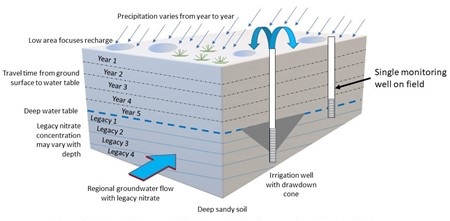
Typical groundwater monitoring for nitrate concentrations in single monitoring wells and monitoring- well networks cannot always correctly explain the nitrate distribution in groundwater at the field level. Nitrate can originate from various sources (e.g., chemical fertilizers, manure, etc.) and at various times (e.g., current practice versus legacy nitrate). Nitrate in groundwater can also vary spatially, temporally, and with groundwater flow direction. Figure 1 illustrates some of the causes of spatial and temporal nitrate variations at the field level related to water and dissolved nitrate movement. Figure 2 is one example of how complex geology (e.g., stream meanders) can affect, and complicate, groundwater and nitrate movement.

Figure 1. Factors that can contribute to spatial and temporal variations in nitrate in groundwater at the field level (with permission from the Journal of Nutrient Management).
Figure 2. Common example of a complex hydrogeology that can affect groundwater flow and nitrate concentrations at the field level.

This presentation discusses a case study where we used high resolution and advanced methods to help identify the source(s) of nitrate in groundwater at the field level. These approaches can help in permitting and other issues that center around the reporting of elevated nitrate concentrations in groundwater.

What Did We Do?

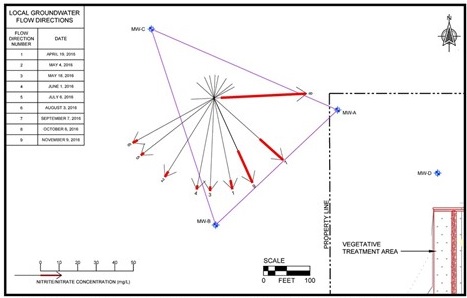
This case study involves the “upgradient” monitoring well (MW-D) in a “simple,” sandy, water table aquifer at a commercial dairy. The regulators initially considered the nitrate concentration observed at the upgradient monitoring well, MW-D in Figure 3, which was well below the drinking water criterion of 10 milligrams per liter (mg/L) to be representative of the regional groundwater (background) entering the site. However, the literature indicated the regional groundwater already contained very high nitrate concentrations that originated over many decades of chemical fertilizer applications (“legacy nitrate”). We used both high resolution and advanced approaches to unravel the cause of the anomalous nitrate concentration in groundwater at “upgradient” monitoring well MW-D so we could help negotiate an appropriate and reasonable background nitrate concentration for the dairy’s permit.

Figure 3. Case study – unraveling changes in local groundwater flow directions and nitrate concentrations using continuous groundwater level monitoring.

First, we suspected that MW-D, which is located close to the vegetative treatment area (VTA), was not a representative well for groundwater quality due to large, episodic recharge events caused by ponding on the VTA. To test this hypothesis, we installed three monitoring wells just upgradient from MW-D (MW-A, -B, and -C in Figure 3), equipped all four monitoring wells with water-level data loggers, and used these data to calculate continuous groundwater flow direction changes with time. Monitoring wells MW-A, -B, -C, and –D are screened between 28-38, 28-38, 26-36, and 22-32 feet below ground level, respectively, to monitor the water table. The groundwater elevation data and monthly nitrate monitoring (Figure 3) indicated (1) the water table fluctuated significantly and episodically in response to precipitation and ponding on the VTA, (2) the groundwater flow direction changed significantly when ponding occurred (so what is “upgradient”?), and (3)  the nitrate concentration changed at upgradient monitoring well MW-A from more than 40 mg/L when regional groundwater flowed onto the site to about 2 mg/L when ponding caused an episodic reversal of the groundwater flow direction.

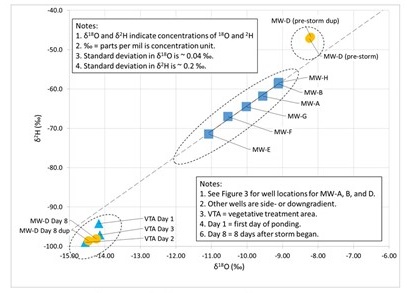
Second, we tested groundwater from selected monitoring wells and ponded water on the VTA for natural isotopes in water molecules (18O and 2H). The water table monitoring wells were screened across the water table with top of screen tops ranging between 22 and 50 feet below ground level, depending on ground elevation. Two of the monitoring wells were deep wells with screen depths of 80 to 85 and 52 to 57 feet below ground level. The 18O and 2H concentrations in precipitation vary with temperature and therefore can vary from storm to storm and season to season. Groundwater acquires a “uniform” 18O and 2H signature which approximates the weighted average of the precipitation over the year(s) and therefore, can be different from that of an individual storm. Figure 4 shows that the 18O and 2H signature of groundwater at the presumptive background well (MW-D) changed from its groundwater signature before the storm to the signature of the ponded water in the VTA, due to a large spring storm that caused flooding on the VTA. The changes in 18O and 2H in groundwater at MW-D are consistent with the rapid groundwater mounding at MW-D. Furthermore, the low nitrate concentration in groundwater at MW-D was consistent with the low nitrate concentration observed in the ponded water on the VTA; the ponded water on the VTA diluted the legacy nitrate from the regional groundwater.

Figure 4. Case study – unraveling changes in groundwater nitrate concentrations due to episodic groundwater mounding using water isotopes.

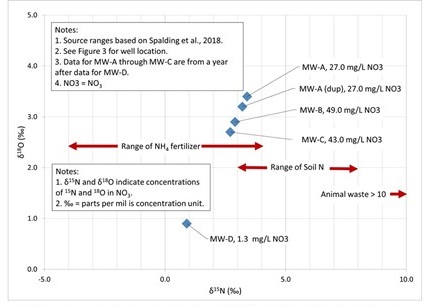
Finally, we tested nitrate (NO3) ions in the groundwater for their 15N and 18O signatures. Nitrate isotopes have been used to distinguish between nitrate sources, such as chemical fertilizer and manure, for more than 20 years. Figure 5 shows the chemical and manure nitrate source fields based on nitrate isotopes. The groundwater at monitoring wells MW-A through MW-C had both isotopic signatures indicative of chemical fertilizer (legacy nitrate) and elevated nitrate concentrations consistent with those reported for the regional groundwater.

Figure 5. Case study – unraveling the source of legacy nitrate using nitrate isotopes.

What Have We Learned?

For this case study, we needed to demonstrate that the presumptive background monitoring well nitrate was not truly representative of background groundwater nitrate and explain why. Otherwise, the dairy would have been encumbered by an unfairly low background concentration in its permit. Data from typical groundwater monitoring well networks and monitoring plans may not be sufficient for either of these requirements.

High resolution and advanced monitoring approaches, such as using data loggers for continuous water level monitoring and groundwater flow maps and isotopic tracers for sourcing water and nitrate, have been around for decades. Using these approaches to unravel puzzling agricultural problems can be very helpful.

Future Plans

We will continue to use these and other high resolution and advanced investigative techniques, honed in the field of contaminant hydrogeology, to solve agricultural surface water and groundwater issues.

Authors

Michael Sklash, Ph.D., Senior Hydrogeologist, Dragun Corporation, Farmington Hills, MI. Msklash@dragun.com

Additional author

Fatemeh Vakili, Ph.D., Hydrogeologist, Dragun Corporation, Windsor, ON

Additional Information

See Journal of Nutrient Management, 2020 and 2021


The authors are solely responsible for the content of these proceedings. The technical information does not necessarily reflect the official position of the sponsoring agencies or institutions represented by planning committee members, and inclusion and distribution herein does not constitute an endorsement of views expressed by the same. Printed materials included herein are not refereed publications. Citations should appear as follows. EXAMPLE: Authors. 2022. Title of presentation. Waste to Worth. Oregon, OH. April 18-22, 2022. URL of this page. Accessed on: today’s date.

Improving Production and Minimizing Nutrient Loss in Grazing Systems through the Use of Grass-Legume Mixtures

Purpose

Feed costs are typically one of the largest costs of dairy and beef cattle production. Grazing is an option that can greatly reduce the need for, and cost of, hay production.  The addition of legumes into the pasture can reduce the need for additional fertilizer.Unfortunately, grazing can also accelerate nutrient cycling and increase nitrogen (N) leaching.  This study examines the effect of adding birdsfoot trefoil (Lotus corniculatus L.), a legume with condensed tannins (CT), to the grazing system. Condensed tannins are noted for their ability to improve nutrient utilization and shift N excretion from the urine to the feces.  Nutrient cycling under the grass-legume mixtures and grass monocultures were evaluated.  The nitrogen content in urine and feces of cattle grazing forages with, and without CT, was also examined and compared to a traditional total mixed ration (TMR) diet.

What Did We Do?

Four grasses, tall fescue (Schedonorus arundinaceus Schreb.), meadow bromegrass (Bromus biebersteinii Roem. & Schult.), orchardgrass (Dactylis glomerata L.), and perennial ryegrass (Lolium perenne L.) in monocultures, and in binary mixtures with birdsfoot trefoil (Lotus corniculatus L.) were evaluated. The study was conducted at the Utah State University Intermountain Irrigated Pasture facility in Lewiston, Utah.  Jersey dairy heifers (~450 lbs) were used to rotationally graze the paddocks with heifers being moved to a new paddock every seven days for a 35-day rotation cycle. Pastures were irrigated every two weeks.  All pastures were fertilized with Chilean nitrate (25 lbs N/acre) in April.  Grass monocultures also received Feathermeal (31 lbs N/acre) in the late spring/early summer, and an additional dose of Chilean nitrate (25 lbs N/acre) in July.  Body weight, and urine and fecal (grab) samples were collected before each grazing event, and at the end of the grazing season.  Urine samples were analyzed for urea-N on a Lachat FIA analyzer.  Fecal samples were analyzed for total N and total carbon by combustion analysis using an Elementar varioMAX CN elemental analyzer, and ammonia-N on a FIAlab 2500 instrument. Soil samples were collected at the beginning and end of each grazing season, and analyzed for available N (nitrate and ammonia) on a Lachat FIA analyzer.  Soil water (leachate) N was monitored by means of zero-tension lysimeters bi-weekly during the growing season, and as much as possible in the spring and fall.  Leachate samples were analyzed for nitrate-nitrite concentration on a Lachat FIA analyzer. The amount of leachate produced from each lysimeter was measured, and total Leachate N determined. Forage protein levels were determined using NIR. Nutrient cycling in the urine and feces were analyzed and compared to the overall protein levels in the forage.

What Have We Learned?

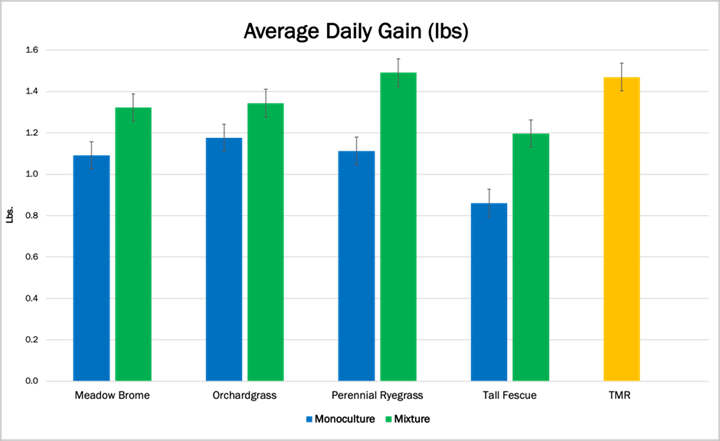
Average daily gains were greater with the grass-legume mixtures than the monocultures (Figure 1). This is most likely due to the higher protein content of the grass-legume mixtures versus the grass monocultures (data not shown).

Figure 1. Average Daily Gain under grass-legume mixtures versus grass monocultures versus a total mixed ration in a feedlot setting

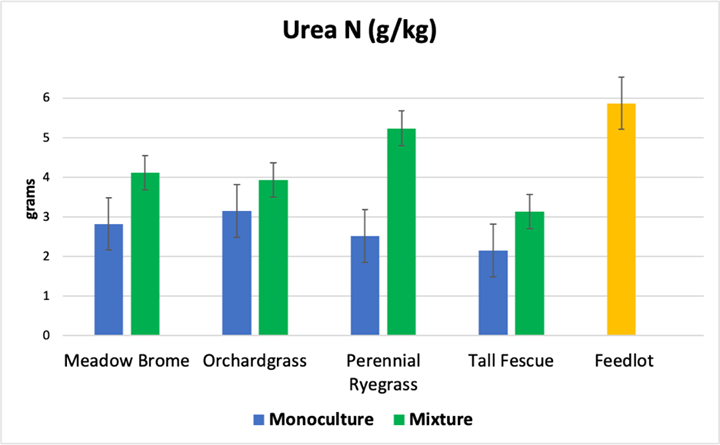
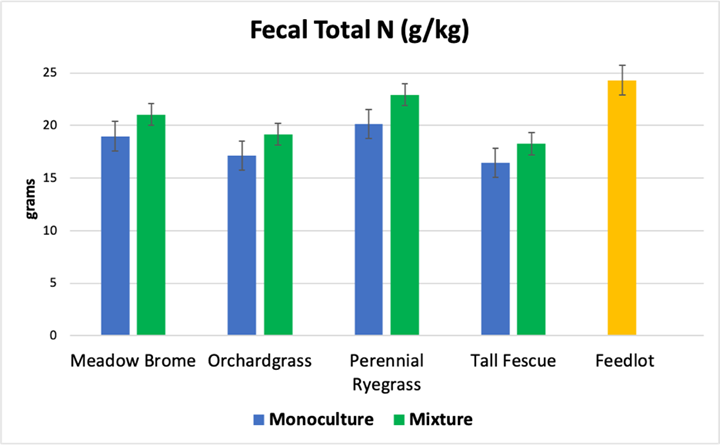
Both the urea-N concentration in the urine (Figure 2), and the fecal N content (Figure 3) were higher in the grass-legume mixtures than the grass monocultures.  This is most likely the result of being fed a higher protein content diet in the grass-legume mixtures.

Figure 2. Urea-N content in urine when grazing grass-legume mixtures versus grass monocultures versus a total mixed ration in a feedlot setting
Figure 3. Fecal Total N content when grazing grass-legume mixtures versus grass monocultures versus a total mixed ration in a feedlot setting

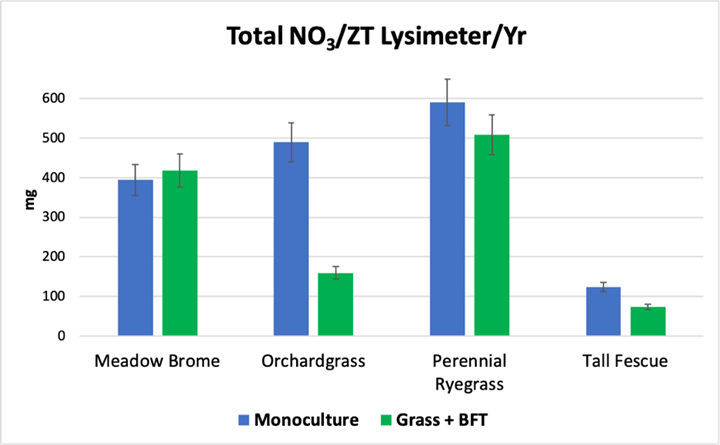
Although the grass monocultures were not heavily fertilized, and the protein content of the monocultures was lower than that of the grass-legume mixtures, nitrogen leaching observed in the leachate was generally higher under the grass monocultures.

Figure 4. Total NO3 lost in leachate per zero-tension lysimeter per year

Grass-legume mixtures may be able to more effectively capture nitrogen due to the differences in the rooting structure and the microbial populations. The grass-legume mixtures were also better economically.

Future Plans

The forage type explains approximately 40% of the variability. We plan to examine the impact of breed on the rates of gain and nutrient cycling next.

Authors

Rhonda Miller, Ph.D., Agricultural Environmental Quality Extension Specialist, Utah State University

Corresponding author email address

rhonda.miller@usu.edu

Additional authors

Blair Waldron, ARS Forage & Range Research Lab; Clay Isom, Utah State University; Kara Thornton – Kurth, Utah State University; Kerry Rood, Utah State University; Earl Creech, Utah State University; Mike Peel, ARS Forage & Range Research Lab; Jacob Hadfield, Utah State University; Ryan Larson, Utah State University, and Marcus Rose, Bureau Land Management

Additional Information

Hadfield, J., B. Waldron, S. Isom, R. Feuz, R. Larsen, J. Creech, M. Rose, J. Long, M. Peel, R. Miller, K. Rood, A. Young, R. Stott, A. Sweat, and K. Thornton. 2021. The effects of organic grass and grass-birdsfoot trefoil pastures on Jersey heifer development: Heifer growth, performance, and economic impact. J. Dairy Sci. 104(10): 10863-10878. DOI: 10.3168/jds.2020-19524.

Rose, M., B. Waldron, S. Isom, M. Peel, K. Thornton, R. Miller, K. Rood, J. Hadfield, J. Long, B. Henderson, and J. Creech.  2021. The effects of organic grass and grass-birdsfoot trefoil pastures on Jersey heifer development: Herbage characteristics affecting intake.  J. Dairy Sci. 104(10): 10879-10895. DOI: 10.3168/jds.2020-19563.

Acknowledgements

Funding for this project was provided by OREI, Western SARE, and Utah State University Experiment Station.


The authors are solely responsible for the content of these proceedings. The technical information does not necessarily reflect the official position of the sponsoring agencies or institutions represented by planning committee members, and inclusion and distribution herein does not constitute an endorsement of views expressed by the same. Printed materials included herein are not refereed publications. Citations should appear as follows. EXAMPLE: Authors. 2022. Title of presentation. Waste to Worth. Oregon, OH. April 18-22, 2022. URL of this page. Accessed on: today’s date.

The Role of Manure for Dairy Carbon Neutrality Targets: An Environmental Assessment of Organic Farms

Purpose

Different dairy associations and cooperatives have been establishing aggressive environmental goals, including reaching carbon neutrality. Carbon sequestration has been largely absent from environmental dairy studies as it is challenging to estimate. The daily feed intake of dairy cows under organic management is composed mainly of pasture and forages, which have a significantly more developed root system than many other grain cropping systems usually included in conventionally managed feed rations. Moreover, manure is also an important source of carbon, that could be sequestered in the long-term depending on the farm’s management practices. This paper quantifies GHG emissions from organic dairy farms in the U.S., including the benefits of carbon sequestration from above and below ground residues.

What Did We Do?

The U.S. was divided into eight regions based on U.S. climate categories and management practices of the organic dairy farms that participated in the study. This paper presents the results for the Midwest-Great Lakes, New England, California, and the Northwest, where representative organic farms and management practices for each region are modeled with life cycle assessment (LCA) techniques to estimate GHG emissions (kg CO2-eq). The model keeps track of key constituents in milk, meat, and manure based on the defined feed ration and animal characteristics. All inputs and outputs at the farm level during feed production, herd management, milking, and manure management are included in the analysis. Results are expressed per 1 kg of fat and protein corrected milk (FPCM), adjusted to 4% fat and 3.3% protein.

A novel approach has been developed to estimate carbon sequestration from carbon staying in the field that considers environmental factors such as temperature and farm management practices that affect the carbon content of manure reaching the soil and posterior sequestration. Three major steps are used to estimate C sequestration from the pasture and crops portion of dairy feed in the modeled organic systems: i) estimate the C added to the soil from biomass in above ground residues, below ground residues, and manure; ii) estimate the change in C above and below ground as a result of crop and grassland management practices, iii) determine the amount of C from the first steps that will be sequestered long-term.

What Have We Learned?

Average GHG emissions for the modeled farms and regions range from 0.76 – 1.08 kg CO2-eq/kg FPCM after accounting for C sequestration. Enteric methane (CH4) represents more than half of total GHGs and is closely related to the efficiency of conversion of feed to milk by the cow. Carbon sequestration benefits reduce overall emissions by 7 – 20% in the modeled farms and regions. Farms in the Midwest and New England rely heavily on pasture during the grazing season and on grass forages produced on-farm during the non-grazing season, meaning that most of the C is sequestered through residue that stays in the soil system (42 – 49% from below ground residue vs. 35 – 42% from manure). The addition of carbon in manure is also significant, contributing more carbon to the soil than below ground residue in some farms, especially in those relying on imported feeds (43 – 47% from manure in California and the Northwest).

Future Plans

GHG emissions, ammonia emissions, resource depletion (energy, land, and water) and eutrophication potential of organic dairy farms will be estimated for the remaining regions in the U.S. The effect of alternative management practices, key to organic practices, will also be modeled to identify mitigation strategies. Finally, different LCA modeling decisions, such as allocation and use of enteric CH4 predictive equations, will be evaluated to determine their effect on final results.

Authors

Horacio Andres Aguirre-Villegas, Associate Scientist, Department of Biological Systems Engineering, University of Wisconsin-Madison

Corresponding author email address

Aguirreville@wisc.edu

Additional authors

Rebecca A. Larson, Associate Professor. Department of Biological Systems Engineering, University of Wisconsin-Madison

Nicole Rakobitsch, CROPP, Organic Valley.

Michel A. Wattiaux, Professor, Animal and Dairy Sciences, University of Wisconsin-Madison

Erin, Silva, Associate Professor, Plant Pathology, University of Wisconsin-Madison

Acknowledgements

This work was funded by the Cooperative Regions of Organic Producers Pools (CROPP) Cooperative – Organic Valley


The authors are solely responsible for the content of these proceedings. The technical information does not necessarily reflect the official position of the sponsoring agencies or institutions represented by planning committee members, and inclusion and distribution herein does not constitute an endorsement of views expressed by the same. Printed materials included herein are not refereed publications. Citations should appear as follows. EXAMPLE: Authors. 2022. Title of presentation. Waste to Worth. Oregon, OH. April 18-22, 2022. URL of this page. Accessed on: today’s date.

Using COMET Tools to Help Farms Plan for the Future

Purpose

Climate change presents real threats to U.S. agricultural production, forest resources and rural economies. Producers and land managers across the country are experiencing climate impacts on their operations through shifting weather patterns and increasingly frequent and severe storms, floods, drought and wildfire. However, producers and land managers also have an opportunity to help address climate change by mitigating greenhouse gas emissions and sequestering soil carbon.

NRCS Conservation Practice Standards have been used for decades by farmers and ranchers to enhance agricultural lands by reducing soil erosion, improving water quality, creating habitat for wildlife and a number of other benefits. In addition to these benefits, many of these practices may reduce greenhouse gas emissions and sequester carbon in woody biomass and soils. As farms look to the future, USDA’s CarbOn Management Evaluation Tools (COMET) can help estimate climate benefits of adopting certain conservation practices for cropland, pasture, rangeland, livestock operations and energy.

What Did We Do?

COMET-Farm provides a complete analysis for site-specific assessment of greenhouse gas emissions and carbon sequestration. COMET-Farm utilizes peer-reviewed greenhouse gas inventory methods sanctioned by the U.S. Department of Agriculture. Results are provided for carbon dioxide, nitrous oxide, methane and soil carbon. COMET-Planner is a web-based tool designed to provide approximate greenhouse gas mitigation potentials of implementing NRCS conservation practice standards.

The COMET tools were developed through a partnership between USDA NRCS and Colorado State University. There is more than a decade of model development experience reflected in COMET. COMET-Farm uses information on management practices on an operation together with spatially-explicit information on climate and soil conditions from USDA databases (which are provided automatically in the tool) to run a series of models that evaluate sources of greenhouse gas emissions and carbon sequestration. By integrating NRCS SSURGO database and site-specific climate data, locality-specific results are presented to COMET-Farm users. There are several modules nested within the model (i.e., Croplands, Livestock, Agroforestry, Energy), and the model relies on biogeochemical process models, IPCC methodologies, and a number of peer reviewed research results.

What Have We Learned?

Put generally, farmers, ranchers, and others can use COMET to easily estimate farm-scale GHG emissions and to explore the impacts of alternative management strategies on their net emissions. The COMET tools have a variety of additional stakeholders and users, including USDA, state governments, companies, carbon finance groups, non-governmental organization and educational institutions. There are many ways the tools can advance climate smart farming for individual farms, such as: use as part of traditional NRCS conservation planning assistance, evaluation of opportunities for farms to participate in carbon markets, as part of development of a carbon farm plan, or to quantify climate benefits for use in direct consumer marketing of farm products. Additionally, other organizations have advanced climate smart farming principles through the use of COMET, both via private industry and state government programs to incentivize conservation practices based on GHG emission reductions quantified with the tool. For examples of success stories using the COMET tools, see the links under Additional Information.

Future Plans

We look forward to continued use of the COMET tools to advance implementation of climate smart agriculture and forestry practices across the U.S.

Authors

Allison Costa, Air Quality Engineer, United States Department of Agriculture

Corresponding author email address

allison.costa@usda.gov

Additional Information

The COMET tools are available online at:  https://comet-farm.com/ and http://comet-planner.com/.

The COMET help desk, YouTube training videos, a calendar of upcoming training events and other resources can be accessed at http://comet-farm.com/HelpPage.

Example of COMET-Planner use by Ben & Jerry’s: https://www.usda.gov/media/blog/2016/12/21/climate-smart-conservation-partnership-serves-two-scoops-farm-solutions

Example of COMET-Planner use by the California Healthy Soils Program: https://www.theclimategroup.org/our-work/news/californias-healthy-soils-program-interview-dr-amrith-gunasekara


The authors are solely responsible for the content of these proceedings. The technical information does not necessarily reflect the official position of the sponsoring agencies or institutions represented by planning committee members, and inclusion and distribution herein does not constitute an endorsement of views expressed by the same. Printed materials included herein are not refereed publications. Citations should appear as follows. EXAMPLE: Authors. 2022. Title of presentation. Waste to Worth. Oregon, OH. April 18-22, 2022. URL of this page. Accessed on: today’s date.

Reporting 15 year’s of experience in WISE Aeration at manure and wastewater treatment ponds (updated)

Purpose

This presentation offers information about a low-energy high-performance manure and/or wastewater aeration technology.  Referred to as “Widespreading Induced Surface Exchange” (WISE) aeration, its performance is from 4 to 10 times more efficient per watt of energy used compared to traditional bubble blower technology for aeration.  Even though Aeration is well known to provide extensive odor reduction or elimination, its use has not been implemented because of the high energy costs associated with running blowers.  This explains why very little is published about other value offered by aeration.  The presentation discusses WISE aeration, many unexpected benefits, and unstudied results.

This presentation will quickly review the 2019 Waste to Worth presentation previously offered and will then offer additional information learned in the past 3 years, including approximately 20 key points.    For those wanting to visit an actual working site before or after the conference, equipment is installed at a regional composting facility approximately 1 hr away from the Waste to Worth facility, near Wauseon OH.

What Did We Do?

Different manufacturers have created “floating aerators” over the past decades. Some have different issues than others, but all are installed in one of the most hostile environments at any enterprise.  PondLift brand equipment has been installed at various farms, domestic wastewater treatment sites, and composting facilities to bring their ponds into full aerobic treatment, with most sites desiring odor elimination, while also allowing their effluent to be sent to growing crops through irrigation equipment, lowering their effluent handling costs while increasing the value of their effluent since it is often foliar fed, offering as much as 70% yield increase per unit of fertilizer.   The author has been at each site to maintain equipment and learn more of its performance and learn more about results, expected and unexpected.  Among the PondLift equipment installations, there are 3 pond installation sites in Ohio, and another at a dairy farm near Paw Paw MI, easily visited for those who would want to personally visit such sites.  Other sites are further distance from Ohio.

What Have We Learned?

The installations have confirmed that odor elimination is very much possible through low-energy-use WISE aeration, while also preparing the effluent to be used by irrigation equipment for foliar feeding.  Although Odor elimination is valuable, probably the most environmentally valuable result of aeration was the dramatic change in texture of the effluent (in both liquids and solids) so that when applied by traditional means, being “knifed in”, the treated manure was absorbed into the soil much faster than raw manure is absorbed into that soil.  The timeframe is hours instead of days, reducing the potential runoff timeframe significantly, potentially eliminating significant runoff events.  Given this observation at almost every site having WISE aeration, it became obvious that a method for quantifying the phenomena is needed, and this equipment needs to be defined so as to compare aerobically treated effluent to raw manure, preferably in a “side by side” process, while also being able to quantify manure runoff on different soil types, and different slopes of soils.  While the presentation will also offer other phenomena data, the final portion of the presentation defines this equipment and procedures that might be adopted so as to study and quantify runoff, and compare runoff quantities to traditional distribution methods.

And for those who are interested in performing foliar feeding through automated manure nutrient distribution through irrigation equipment, the presentation will expand on several items recently identified, including the stratification that results from WISE Aeration, allowing irrigation without plugging pivot/circle nozzles.  In addition, the presentation includes information about Struvite formation and its harvesting opportunity as well as control methods.

Future Plans

PondLift intends to offer equipment for use in studies focused on any phenomena of interest in manure or liquid waste treatment, as well as commercial use at farms.  The political climate in future years will insist that potential runoff issues be addressed, updating Best Management Practices.  In addition, it is now possible that manure odor be eliminated with a process which is financially feasible for farms.

A short discussion: Automation is valuable at farms.  Bringing WISE Aeration to dairies and other farms which store liquid manure can help automate the manure storage/handling/disposal process.  It is the opinion of the author that the small family dairy farm will continue to survive and thrive, given the advances in feeding/health/genetics at today’s farms, even though such farms offer a small percentage of milk products.

The fact that so many farms have limited potentially useable farm acres at small hilly locations, leads us to focus on improving their automation and reducing equipment and time spent on manure related work.  To this end, work is progressing through PondLift, on a low cost “drop-in-place” sand separator which can easily be placed between the barn and the manure storage pit, allowing operators to remove sand before it gets to storage, which then allows the storage pit to be converted to aerobic treatment, which then allows automated manure nutrient distribution methods to be considered.  Lastly, work continues through an associated enterprise on the SPEWPLI (self-propelled extremely-wide portable linear irrigator) which will be able to attach to a manure pumpers hose at a distant field, and distribute manure nutrients to the crop at the 1,500gpm rate often used by manure pumpers. This is important for farms which are more suited to pumping at high rates to distant fields.

Authors

John Ries, Managing Member PondLift LLC, retired professional engineer

Corresponding author email address

ries@iw.net

Additional Information

PondLift.com


The authors are solely responsible for the content of these proceedings. The technical information does not necessarily reflect the official position of the sponsoring agencies or institutions represented by planning committee members, and inclusion and distribution herein does not constitute an endorsement of views expressed by the same. Printed materials included herein are not refereed publications. Citations should appear as follows. EXAMPLE: Authors. 2022. Title of presentation. Waste to Worth. Oregon, OH. April 18-22, 2022. URL of this page. Accessed on: today’s date.

Greenhouse gas impacts resulting from co-digestion of dairy manure with community substrates

Purpose

The US Dairy industry established a voluntary environmental stewardship goal to achieve greenhouse gas (GHG) neutrality by 2050 among farmers and processors collectively. Manure management and enteric emissions combined account for approximately 70% of the GHG footprint of the US dairy industry, with nearly equal contributions from each (Thoma, 2013). There are multiple manure management systems used by dairy farmers in the Northeast and Upper Midwest that substantially impact GHG emissions. Quantification of GHG emissions for different manure management systems is necessary to compare options and strategies that can be applied to reduce GHG, especially methane, to move toward sustainability and reach the targets set by industry and governments.

Methane is the primary GHG emitted from the long-term storage of dairy manure, a water quality best management practice employed by many dairy farms today. Landfills are also a significant source of methane emission primarily due to degradation of organic waste, notably pre- and post-consumer food wastes (community substrates). Methane is a highly potent GHG that impacts warming by 25 – 28 times as much as carbon dioxide (CO2) on a 100-year global warming potential (GWP) time scale (US EPA). However, because methane has a lifespan in the atmosphere of around 12 years, it has been accounted for on a 20-year GWP scale (84 times the impact of CO2) by the State of New York (Climate Leadership and Community Protection Act). Manure management systems that substantially reduce methane, such as the co-digestion of manure with food waste, can achieve significant reductions of the GHG emissions associated with milk production.

What Did We Do?

The GHG emissions resulting from the anaerobic co-digestion of raw dairy manure and community substrate (i.e., food processing waste mixture diverted from landfilling) in an equal mass of each (total mass basis) were calculated as part of a larger study comparing eight different manure management systems. The community substrate was modeled as 50% ice cream and 50% dog food by mass. Methane and nitrous oxide emissions were calculated with equations that use the mass flow of volatile solids (VS) and nitrogen through the co-digestion manure management system that included digestate solid-liquid separation using a screw press and the long-term storage of separated liquid. Carbon dioxide and methane associated with system energy use and energy production as pipeline-quality renewable natural gas (RNG), as well as landfill organics diversion were also calculated. The parasitic energy use (heat and electricity) of the digester and related manure management and biogas upgrading equipment was supplied on an average annual load basis by a portion of the biogas produced. The total net GHGs were summed using a CO2-equivalent (CO2e) methodology (both GWP100 and GWP20 were computed) and normalized on a per lactating cow per year basis. A sensitivity analysis of eleven variables was conducted to quantify the impact of each on the net GHG result.

What Have We Learned?

The co-digestion system net annual GHG impact was calculated to be −16 metric tons (MT) CO2e cow-1 (GWP100) and −43 MT CO2e cow-1 (GWP20). For the co-digestion mixture analyzed (50% liquid dairy manure, 25% ice cream, and 25% dog food), the anaerobic digester biogas production was 4 times greater than the biogas production for manure alone (on a per lactating cow basis). This significant energy production potential contributed an offset of 3.9 MT CO2 cow-1 year-1, assuming the net RNG after supplying the system’s parasitic energy usage displaced the CO2 emissions from combusting approximately 380 gallons of diesel. In comparison, a methane leakage (or loss) of 2% from the digester to RNG system was equivalent to 18% of the energy offset at GWP100 (0.7 MT CO2e cow-1 year-1) and 62% at GWP20 (2.4 MT CO2e cow-1 year-1). Despite the greater contribution of methane leakage at GWP20 on a CO2e basis, the methane offset from landfilling the community substrate also substantially increased, resulting in just a 5 – 6% increase in the net annual GHG (remaining net negative) when methane leakage was varied from 1 to 3% under both GWP time scales. The methane leakage amount was also the most sensitive variable studied for the co-digestion system and the relatively low impact on total net GHG indicates the effectiveness of this type of manure management system as a tool to reach net GHG neutrality.

Future Plans

A next step in the assessment of co-digestion of dairy manure and food waste diverted from landfills is to continue improvement of our Cornell Dairy Digester Simulation Tool that predicts biogas production from a variety of food wastes combined in different quantities with dairy manure. This tool will also allow for the economic feasibility analysis of different co-digestion system sizes and substrate mixtures, inclusive of tipping fee variation and energy generation options (electricity and RNG) and associated values. This work will help farmers assess the feasibility of implementing or participating in a co-digestion system for manure management.

In future work contingent on funding, we plan to conduct comprehensive field measurements of methane emissions from the long-term storage of raw manure, separated manure liquid, and digested effluent. The equations that calculate methane are gross and depend on volatile solid content and degradability of the stored material, as well as temperature and retention time. Verification of these equations and inputs will give more confidence in utilizing bottom-up calculations of GHGs from manure management practices.

Authors

Lauren Ray, Extension Support Specialist III, Cornell PRO-DAIRY Dairy Environmental Systems Program

Corresponding author email address

LER25@cornell.edu

Additional authors

Curt A. Gooch, Sustainable Dairy Product Owner, Land O’Lakes – Truterra; Peter E. Wright, Extension Associate, Cornell PRO-DAIRY Dairy Environmental Systems Program

Additional Information

More information on related work can be found on the Cornell University PRO-DAIRY website under Environmental Systems: https://cals.cornell.edu/pro-dairy/our-expertise/environmental-systems.

Thoma, G., J. Popp, D. Shonnard, D. Nutter, M. Matlock, R. Ulrich, W. Kellogg, D. S. Kim, Z. Neiderman, N. Kemper, F. Adom, and C. East. (2013). Regional analysis of greenhouse gas emissions from USA dairy farms: A cradle to farm-gate assessment of the American dairy industry circa 2008. Int. Dairy J. 31:S29–S40. https://doi.org/10.1016/j.idairyj.2012.09.010.

US EPA, https://www.epa.gov/ghgemissions/understanding-global-warming-potentials. Accessed 2/24/2022.

Climate Leadership and Community Protection Act. 2020. New York State Senate Bill S6599.

Acknowledgements

The Coalition for Renewable Natural Gas and the New York State Department of Agriculture and Markets provided a portion of the financial resources to support the development of this work.


The authors are solely responsible for the content of these proceedings. The technical information does not necessarily reflect the official position of the sponsoring agencies or institutions represented by planning committee members, and inclusion and distribution herein does not constitute an endorsement of views expressed by the same. Printed materials included herein are not refereed publications. Citations should appear as follows. EXAMPLE: Authors. 2022. Title of presentation. Waste to Worth. Oregon, OH. April 18-22, 2022. URL of this page. Accessed on: today’s date.