An Anaerobic Sequencing Batch Reactor (ASBR) is a high-rate liquid digestion system that retains microflora in the reactor by sequentially feeding influent, mixing the reactor, settling solids, and decanting effluent from the top of the reactor (Figure 1). All operations take place in a single reactor vessel. Since solids are retained in the reactor vessel, Solids Retention Time (SRT) can be managed separately from Hydraulic Retention Time (HRT). Although ASBR digesters are highly efficient at conversion of low-solids high-energy organic liquids to biogas, very few designs have made it out of the laboratory and onto the farm. Two problems have hindered ASBR development: detachment of roofs from reactor vessels and poor settling and retention of solids.
Figure 1. Four phases of an Anaerobic Sequencing Batch Reactor cycle
What did we do?
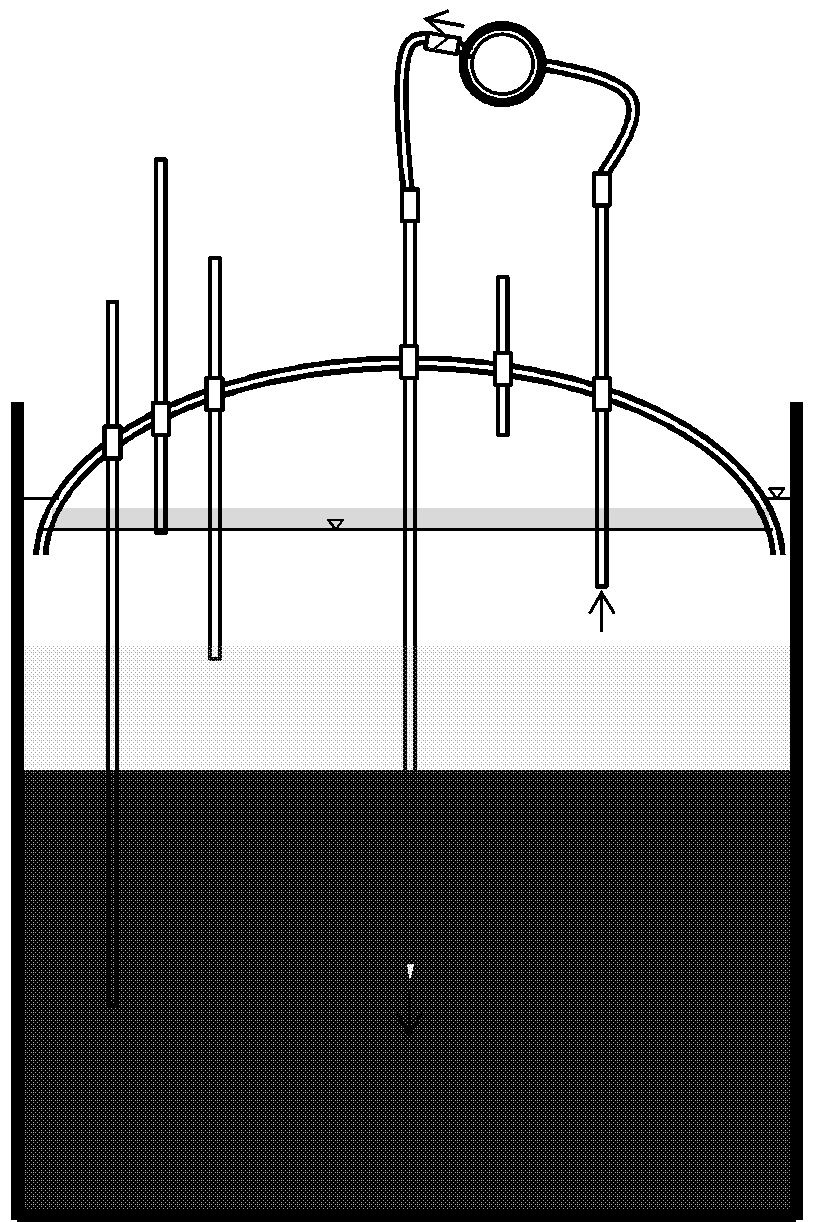
Improvements to ASBR design at Oklahoma State University have led to a patent pending invention that solves both settling roof detachment problems (Figure 2). Roof detachment is alleviated by employing a floating cover. The new design uses a partial mixing system — suspended solids are lifted below the mixing withdrawal point during the react phase of the ASBR cycle. The decanting point is fixed relative to the floating cover, so effluent is decanted from the clear liquid above the cloud of settling solids.
Figure 2. Next generation ASBR design developed at Oklahoma State University (from OSU provisional patent disclosure 2016-040)
What did we learn?
A battery of six, 30L reactors were operated under full and then partial mixing schemes with an HRT of 15 days and an Organic Loading Rate (OLR) of 0.31 g COD L-1 day-1. Partial mixing greatly improved reactor performance as measured in effluent quality and solids retention. Effluent from the reactors operated under the partial mixing scheme had significantly (p = 0.05) lower Total Suspended Solids (TSS) compared to the fully mixed reactors – 129 versus 452 mg L-1. Average SRT of the partially mixed reactors was 760 days versus 72 days for the fully mixed reactors. Biogas production was largely unaffected by switching from fully mixed to partially mixed operation. Average volumetric reactor efficiency (VRE) was 0.23 L biogas L1 reactor day-1 under full mixing and 0.28 L biogas L1 reactor day-1 under partial mixing.
When OLR was increased on the partially mixed reactors to 0.62 g COD L-1 day-1 with an HRT of 7.5 days, TSS concentration of effluent remained below 200 mg L-1 with an average of 183 mg L-1. Average SRT was 440 days, and VRE rose to 0.70 L biogas L1 .reactor day-1. Organic matter removal efficiency measured as Chemical Oxygen Demand (COD) averaged 0.91%.
Future Plans
Prototype testing of reactor at HRT < 5 days and OLR > 1.0 g g COD L-1day-1 is currently underway. After that we plan to construct a 1,000 L mobile reactor for on-farm testing.
Author
Douglas W. Hamilton
Associate Professor and Extension Waste Management Specialist
Biosystems and Agricultural Engineering
Oklahoma State University
The authors are solely responsible for the content of these proceedings. The technical information does not necessarily reflect the official position of the sponsoring agencies or institutions represented by planning committee members, and inclusion and distribution herein does not constitute an endorsement of views expressed by the same. Printed materials included herein are not refereed publications. Citations should appear as follows. EXAMPLE: Authors. 2019. Title of presentation. Waste to Worth. Minneapolis, MN. April 22-26, 2019. URL of this page. Accessed on: today’s date.
DUCTOR Corp. has developed a biological process that separates and captures nitrogen (ammonia) from organic waste streams. The biogas industry is a natural platform for this biotechnology as it solves the problem of ammonia inhibition, which has long bedeviled traditional anaerobic digestion (AD) processes. DUCTOR’s technology allows for stabilized and optimized biogas production from 100% high nitrogen feedstocks (such as poultry manure) and significantly strengthens the economics of biogas facilities: relatively inexpensive inputs, optimized gas production as well as new, higher value revenue streams from the organically produced byproducts—a pure Nitrogen fertilizer and a high Phosphorus soil amendment. DUCTOR’s mission is to promote biogas as a renewable energy source while securing efficient waste management and sustainable food & energy production, supporting the development of circular economies.
Purpose
Figure 1. High Nitrogen Feedstock
High concentrations of ammonia in organic waste streams have been a perpetual challenge to the biogas industry as ammonia is a powerful inhibitor of biogas production. In typical methanogenic communities, as ammonia levels exceed 1500mg/L Ammonia-N, the inhibition of methane production begins until it reaches toxic levels above 3000mg/L. Traditionally, various mechanical and chemical methods have been deployed to lower ammonia concentrations in high nitrogen organic feedstocks prior to or following biodigestion (Figure 1). These methods have proven cumbersome and operationally unstable. They either require dilution with often costly supplemental feedstocks, are fresh water intensive, waste valuable nutrients, or require caustic chemicals injurious to the environment. Without the application of these methods, nitrogen levels will build up in the digester and negatively affect the efficiency of biogas (methane) production. DUCTOR’s proprietary process revolutionizes ammonia removal with a biological approach, which not only optimizes the operational and economic performance of biogas production, it also allows for the ammonia to be recaptured and recycled as an organic fertilizer product (a 5-0-0 Ammonia Water). This biotechnical innovation represents a significant advancement in biogas technology.
What did we do?
DUCTOR’s innovation is the invention of a fermentation step prior to the classic anaerobic digestion process of a biogas facility (Figure 2). During this fermentation step in a pre-treatment tank, excess nitrogen is biologically converted into ammonia/ammonium and captured through a physical process involving volatilization and condensation of the liquid portion of the digestate.
Figure 2. Typical DUCTOR facility layout
We ran a demonstration biogas facility with these two steps in Tuorla, Finland for 2000 hours using 100% poultry litter as fermenter feedstock without experiencing ammonia inhibition of the methanogenesis process. While the control, a single-stage traditional digester, showed increased buildup of toxic ammonia, the fermented material coming out of the first stage of the DUCTOR process (having ~50-60% of its nitrogen volatilized and removed) exhibited uniform levels of nitrogen below the inhibition threshold (Figure 3). This allowed a stable and efficient digestion by the methanogenic microbial community in the second stage digester. The fermentation step effectively eliminates the need for co-digestion of poultry manures with other higher C/N ratio substrates.
Figure 3: Ammonium concentration & Methane quantities in treated and untreated substrates
What we have learned?
In addition to solving the problem of ammonia inhibition, DUCTOR’s innovation realizes the separation of valuable recycled nutrients in a manner that can produce additional revenue streams. The result of the fermentation process in the first stage digestion tank is an organically produced non-synthetic ammonia (NH4OH), which is condensed and collected. This ammonia water product can be marketed and sold as an organic fertilizer as it is the result of a completely biological process with no controlled chemical reactions. The non-synthetic ammonia produced comes from the digestion of poultry litter by ammonifying microorganisms in anaerobic conditions. Furthermore, this ammonia water is in a plant available form that can be metered onto fields based on crop demands and thus reduce the amount of excess nitrates leaching into the water table and surrounding watershed.
The solids byproduct that results from the completion of the anaerobic digestion process has a large fraction of phosphorus and potash. This digestate can be dried and pelleted to produce a high-phosphorus soil amendment. While recognizing demand for this product would vary by region based on existing phosphorus levels in the soil, it offers a transportable & storable way to return these valuable elements to the nutrient cycle.
Finally, the importance of gas production as a form of sustainable, renewable energy cannot be understated. With 2/3rds of the world’s greenhouse gas emissions coming from the burning of fossil fuels for energy or electricity generation,1 biogas derived from anaerobic digestion can displace some of those processes and reduce environmental greenhouse gas emissions.2 Currently, there are many state and federal policies focusing on renewable energy credits and low carbon fuel standards to incentivize this displacement.3 With the ability to unlock poultry litter as an additional AD feedstock, biogas facilities can offer greater volumes of biogas production per ton of manure than either dairy or swine.
Future plans
We have several commercial projects that will feature the DUCTOR technology at various stages of development in North America. The demonstration facility at Tuorla has been disassembled and shipped to Mexico where it will be reassembled as part of a larger commercial project there. In cooperation with our Mexican partner, we will demonstrate successful operations under a new set of conditions, including different climate and a new source of poultry litter from different regional growing practices. We further intend to demonstrate the highly efficient water use of the process in a drought-prone area.
Additionally, we have received approval from the North Carolina Utilities Commission for entry into their pilot program for injecting biomethane into North Carolina’s natural gas pipelines. Our first project there is expected to begin construction in Spring 2019 to be completed and operational by early 2020. These projects, and others in development, will bring a very attractive and new manure management option to poultry farmers, while recycling nutrients from the waste stream and returning them to the soil in a measurable and sustainable manner.
Author
Bill Parmentier, Project Development, DUCTOR Americas
3Methane is a potent greenhouse gas that is over 20 times more damaging on the environment than carbon dioxide. Anaerobic digestion stops the release of methane into the environment by capturing it and using it for energy production or transportation fuel.
Federal incentives include the Rural Energy for America Program (REAP), Alternative Fuel Excise Tax Credit, & Federal Renewable Energy Production Tax Credit to name a few. Examples of state level incentives include various states Renewable Portfolio Standards (RPS) as well as California’s Low Carbon Fuel Standard (LCFS) or Oregon’s Clean Fuels Standard (CFS).
The authors are solely responsible for the content of these proceedings. The technical information does not necessarily reflect the official position of the sponsoring agencies or institutions represented by planning committee members, and inclusion and distribution herein does not constitute an endorsement of views expressed by the same. Printed materials included herein are not refereed publications. Citations should appear as follows. EXAMPLE: Authors. 2019. Title of presentation. Waste to Worth. Minneapolis, MN. April 22-26, 2019. URL of this page. Accessed on: today’s date.
There are over 3.5 million milk cows in the Western United States, making dairy one of the dominant sectors of western agriculture. Organic milk production is the fastest growing segment of U.S. organic agriculture and as a result there has been an increase in pasture-based milk production. To meet this increasing demand, improved grass-legume pastures that require fewer inputs, have high forage production and nutritive value, improve ruminant utilization of nitrogen, and have high dry matter intake are critical to the economic viability of pasture-based organic dairies. While grazing has many benefits, it may accelerate nutrient cycling and potentially increase nitrate leaching along with being a significant contributor of ammonia (NH3) and greenhouse gases (GHG). Dietary changes can impact emissions. This study examines the effect of condensed tannins (CT) on nutrient cycling in the grass-legume versus grass monoculture grazing systems. The nitrogen content in urine and feces of cattle grazing forages with, and without CT, was also examined and compared to a traditional TMR diet.
What did we do?
Four grasses, with and without the addition of a tannin-containing legume, birdsfoot trefoil (Lotus corniculatus), are examined in this study. The treatments include tall fescue (Lolium arundinaceum); meadow bromegrass (Bromus biebersteinii); orchardgrass (Dactylis glomerata); perennial ryegrass (Lolium perenne) planted as monocultures; and each of the four grasses planted with birdsfoot trefoil for a total of eight treatments. Treatments were grazed by Jersey heifers using a rotational grazing system(1 week intervals). All treatments were fertilized with Chilean nitrate in April of 2017 and 2018. Grass monocultures were fertilized with feather meal in June 2017 and March 2018, and Chilean nitrate in July 2017 and 2018.
Grab fecal and urine samples were collected at the beginning of the grazing season and additionally every five weeks at the end of grazing rotations. Fecal samples were analyzed for total nitrogen by combustion method. Leachate was collected weekly by means of suction cup lysimeters and bi-weekly by means of zero-tension lysimeters and analyzed for nitrate-nitrogen using method 10-107-04-1-R on a Lachat FIA analyzer.
What we have learned?
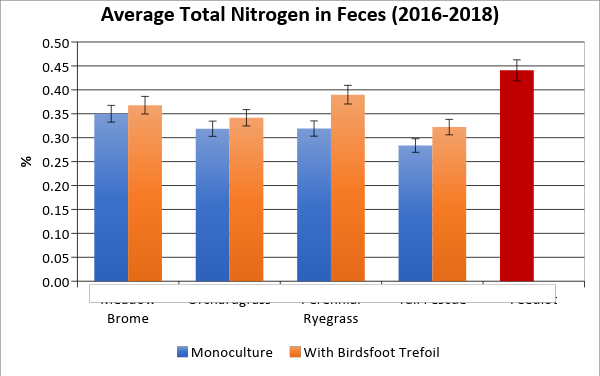
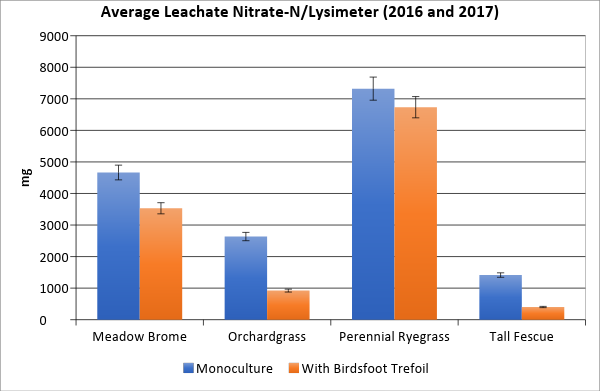
Urea in urine, and fecal nitrogen were highest in the feedlot system (TMR diet). Urea and fecal nitrogen in the grazing systems were higher in the grass-legume mixtures than the grass monocultures even though tannins have been shown to shift nitrogen from the urine to the feces. This is most likely due to the higher protein (nitrogen) content of the grass-legume mixtures compared to the grass monocultures (data not shown). Despite the higher protein content of the grass-legume mixtures, the treatments containing birdsfoot trefoil exhibited less nitrogen loss due to leaching than the grass monocultures. Grass-legume mixtures have the potential to greatly improve the economic viability of a grazing operation while reducing the environmental impacts.
Figure 1. Average total nitrogen (%) in feces.Figure 2. Average urea in urine (mg/L)Figure 3. Average leachate nitrate-N/lysimiter (mg)
Future plans
This study will be repeated for another year using Holstein heifers instead of Jersey heifers to see if there is a difference in nitrogen utilization between breeds. Treatments that are not being grazed will be harvested and fed in a feedlot setting to see if the benefits of birdsfoot trefoil remain when it is fed as silage.
Authors
Jennifer Long, Agricultural Systems Technology and Education Dept.; Utah State University
Jennifer.Long@aggiemail.usu.edu
Rhonda Miller, Ph.D.; Agricultural Systems Technology and Education Dept.; Utah State University
Blair Waldron, Ph.D.; USDA-ARS Forage and Ranger Research Lab
Clay Isom, Ph.D.; Animal, Dairy and Veterinary Sciences Dept.; Utah State University
Kara Thornton, Ph.D.; Animal, Dairy and Veterinary Sciences Dept.; Utah State University
Kerry Rood, Ph.D.; Animal, Dairy and Veterinary Sciences Dept.; Utah State University
Michael Peel, Ph.D.; USDA-ARS Forage and Range Research Lab
Earl Creech, Ph.D; Plants, Soils, and Climate Dept.; Utah State University
Jacob Hadfield; Animal, Dairy and Veterinary Sciences Dept.; Utah State University
Marcus Rose; Plant, Soils, and Climate Dept.; Utah State University
The authors are solely responsible for the content of these proceedings. The technical information does not necessarily reflect the official position of the sponsoring agencies or institutions represented by planning committee members, and inclusion and distribution herein does not constitute an endorsement of views expressed by the same. Printed materials included herein are not refereed publications. Citations should appear as follows. EXAMPLE: Authors. 2019. Title of presentation. Waste to Worth. Minneapolis, MN. April 22-26, 2019. URL of this page. Accessed on: today’s date.
Manure management practices recycle nutrients in animal manures for crop production. Harmful microbes and viruses in the manure are generally reduced in the soil environment over time. The soil properties influencing how long animal virus persistence are poorly understood and may be specific even down to the type of microbe present. Recently, porcine epidemic diarrhea virus (PEDV), which causes nearly 100% mortality in newborn piglets, has become a serious challenge for swine production. An important concern is whether PEDV in manure applied to nearby farmland may be a source for herd reinfection. How long will PEDV persist in the soil and still be infectious? Are some soils better suited to reduce PEDV risk?
What did we do?
A laboratory study was conducted to mimic a standard manure application practice (manure slurry application into soil) to determine if it reduced the potential for PEDV reinfection. In our study, we tested a range of soil types spiked with PEDV-positive manure slurry and evaluated how PEDV detection and potential infectious risk was affected by soil type. Quantitative PCR and live swine bioassays were used to enumerate PEDV and to determine whether manure and soil samples contained infectious PEDV (Stevens et al., 2018).
What have we learned?
Manure Slurry/Soil Incubations. PEDV genomes declined at different rates depending upon the type of soil tested (Figure 1). While PEDV declined rapidly and was not detected by PCR in Soil #1, #2, and #5 in just 24 hours, PEDV genomes in Soil #6 and #7 decreased more slowly the other soils. Soils #3 and #4 displayed an intermediate rate of decline and reached our detection limit at 48 hours. Soil is an important factor on PEDV persistence.
Figure 1. Porcine epidemic diarrhea virus genomes in the manure slurry/soil incubation determined by reverse-transcriptase quantitative polymerase chain reaction.
Swine Bioassay. Several of the samples tested positive for infections PEDV (Table 2) even when PCR indicated no virus was present; PCR molecular detection of the virus did not produce a complete picture of PEDV survival. For instance, the PCR method indicated no virus in soil #1 or #2 at 24 hours, yet the soil-manure mixture caused disease in a swine bioassay test—the gold standard test for infectious PEDV.
Table 2. Outcome of Swine Bioassay
Manure-slurry Soil Composite
Time (hours)
#1
#2
#3
#4
#5
#6
#6
24
Pos
Pos
Neg
Pos
Neg
Neg
Pos
48
Pos
Neg
Neg
Neg
Pos
Neg
Pos
†Animals inoculated by oral gavage of 10 mL of phosphate buffer-diluted sample. A porcine epidemic diarrhea virus positive (Pos) or negative (Neg) score is based on fecal swab molecular diagnostic test (reverse transcriptase quantitative polymerase chain reaction).
Are there any soil environmental factors that can help predict whether/how long infectious PEDV lasts in soils? Anything that would damage or disrupt the membrane or proteins on the outside of PEDV would render the virus non-infectious. Theoretically moist soils with lots of active bacteria would release enzymes to chew up PEDV proteins or alkaline (high pH) soils may denature PEDV proteins and damage membranes to inactivate PEDV. On the other hand, soils where manure rapidly dries would help preserve PEDV. None of these hypotheses could explain the PCR or swine bioassay results. Only one factor seemed related to PEDV persistence—high soil phosphorous seemed to protect the virus. No single factor seemed to destroy the virus.
Future Plans
Additional studies are underway determining where PEDV is found within three production sites and the surrounding environment immediately after an outbreak of PEDV. The sites will be monitored over 18 months to signs of PEDV re-emergence.
Authors
Corresponding author: Dan Miller, Research Microbiologist, USDA Agriculture Research Service; email: Dan.miller@ars.usda.gov
Other authors: Erin Stevens (Department of Animal Science, University of Nebraska – Lincoln); Amy Schmidt (Department of Biological Systems Engineering, University of Nebraska – Lincoln); Sarah Vitosh-Sillman and J. Dustin Loy (School of Veterinary Medicine and Biomedical Sciences, University of Nebraska – Lincoln).
Additional information
Stevens EE, Miller DN, Brittenham BA, Vitosh-Sillman SJ, Brodersen BW, Jin VL, et al. Alkaline stabilization of manure slurry inactivates porcine epidemic diarrhea virus. Journal of Swine Health and Production. 2018;26(2):95-100.
Acknowledgements
Funding for this research was provided by the National Pork Board and USDA Agriculture Research Service operational funds. USDA is an equal opportunity provider and employer.
The authors are solely responsible for the content of these proceedings. The technical information does not necessarily reflect the official position of the sponsoring agencies or institutions represented by planning committee members, and inclusion and distribution herein does not constitute an endorsement of views expressed by the same. Printed materials included herein are not refereed publications. Citations should appear as follows. EXAMPLE: Authors. 2019. Title of presentation. Waste to Worth. Minneapolis, MN. April 22-26, 2019. URL of this page. Accessed on: today’s date.
Much of the antimicrobials (AM) used therapeutically and prophylactically pass through the animal and enter the environment through irrigation with beef runoff wastewater (WW). There are concerns repeated low-level AM loading of soils through irrigation will alter the natural biota resulting in increased resistance; thereby, making AM critical for human and animal health less effective.
What Did We Do?
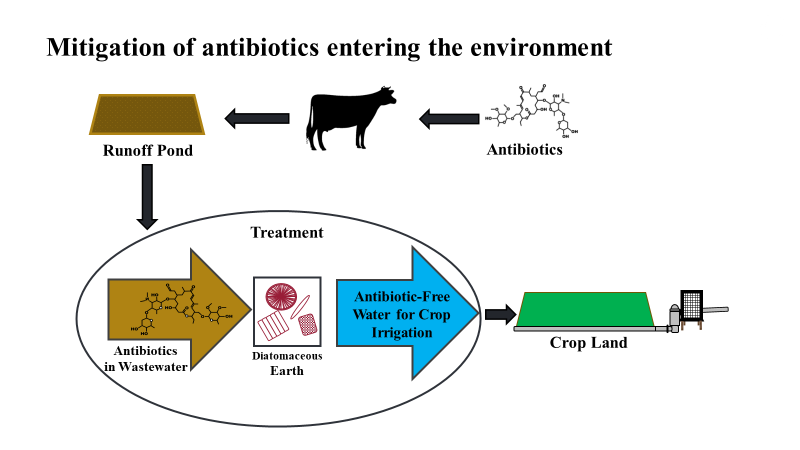
Several studies are summarized describing a cost-effective removal process of AM from beef wastewater before being applied as irrigation. Study 1 investigated three radiolabeled AM, ([14C]-erythromycin (ERY), [3H]-chlortetracycline (CTC), and [3H]-monensin (MON)) to quantify their partitioningin the aqueous and solids fractions of a beef wastewater (WW) containing suspended solids (SS). Following this, several flocculants were evaluated for removing SS with sorbed AM from WW. Study 2 evaluated the sorption properties of tylosin (TYL) with diatomaceous earth (DE) added to WW as a binding agent. Study 3 evaluated the proposed treatment process using pre-treatment of WW with flocculants then adding a binding agent to remove aqueous phase AM before being used an irrigation water.
What Have We Learned?
Study 1) After 48 hours, more ERY sorbed to the SS fraction than the aqueous. CTC partitioning occurred in three phases: a rapid sorption to the SS fraction between 0.5 and 8 hours with desorption into the aqueous fraction at 24 hours followed by short steady state at 48 hours with further desorption at 96 hours. The most lipophilic antibiotic, MON, quickly sorbed into the SS fraction and remained in equilibrium with the aqueous fraction after 48 hours. Calculated partitioning coefficients, Kd, for WW were very different from published soil-water values illustrating wastewater uniqueness. A follow up study determined alum and ferric chloride removed some ceftiofur (CEF) and chlorotetracycline (CTC); however, they were ineffective for removing TYL. Therefore, a process was needed to remove aqueous phase AM (figure 1). Study 2 evaluated three DE sources for binding aqueous TYL in WW. Raw (DER) contained organic carbon (OC) (3% g g-1), clays (20%) and amorphous silica (65%). Kieselguhr (DEK) had no OC (<1% g g-1), no clay (2%) and amorphous silica (96%). had nearly 3.5 times greater maximum sorption capacity when compared to DEK. Sorption of TYL to DEK and DER at different pH values showed cationic and hydrogen bonding interactions are important. Higher sorption of TYL to DER compared to DEK suggested clays-DE matrix was important for TYL sorption. Removing OC improved TYL sorption and decreased the separation time for DE/AM removal to complete treatment. Study 3 found CEF and CTC would bind to DE in controlled, neutral aqueous solution. When AMs were spiked into WW collected from a beef feedlot runoff pond, DE successfully removed TYL and CTC, but not CEF. Wastewater treated with excess alum to remove SS followed by DE treatment showed similar removal rates for TYL. Pretreatment of water with alum also resulted in CEF removal if larger amounts of DE are needed. The reason for change in CEF binding when pretreated WW with alum is still under investigation. Alum treatment appeared to remove most of the CTC spiked into WW and therefore no assessment of how CTC binding to DE after treatment.
Future Plans
Future work will include: evaluating the proposed treatment process on other AM and their metabolites. Development of modified DE matrices specific for non-polar AM and metabolites. These matrices could be combined to remove both polar and non-polar contaminants. Finally, the process needs to be evaluated for effectiveness of contaminant removal with municipal wastewater treatment systems.
Authors
Bryan L. Woodbury, Agricultural Engineer, USDA-U.S. Meat Animal Research Center, Clay Center, NE
Bobbi S. Stromer, Chemist Post Doc., USDA-U.S. Meat Animal Research Center, Clay Center, NE
Clinton. F. Williams, Lead Soil Scientist, USDA-US Arid-Land Agric. Research Center, Maricopa, AZ.
Katherine A. Woodward, Ph.D. Candidate, Tufts University, Civil & Environmental Eng., Medford, MA
Heldur Hakk, Research Chemist, USDA-Edward T. Schafer Agricultural Research Center, Fargo, ND.
Sara Lupton, Research Chemist, USDA-Edward T. Schafer Agricultural Research Center, Fargo, ND.
Additional Information
Stromer, B.S., B.L. Woodbury and C.F. Williams. 2018. Tylosin sorption to diatomaceous earth described by Langmuir isotherm and Freundlich isotherm models. Chemosphere. 193:912-920.
Figure 1. Illustration of a wastewater treatment process to reduce the antimicrobials load applied through irrigation of agricultural wastewater. Loading soils with antimicrobials may cause increased antimicrobial resistance. This resistance may make antimicrobials less effective to treat humans.
Acknowledgements
USDA is an equal opportunity provider and employer.
The authors are solely responsible for the content of these proceedings. The technical information does not necessarily reflect the official position of the sponsoring agencies or institutions represented by planning committee members, and inclusion and distribution herein does not constitute an endorsement of views expressed by the same. Printed materials included herein are not refereed publications. Citations should appear as follows. EXAMPLE: Authors. 2019. Title of presentation. Waste to Worth. Minneapolis, MN. April 22-26, 2019. URL of this page. Accessed on: today’s date.
Anaerobic digestion of swine manure is a treatment process that can be used to reduce odor emissions, generate bioenergy, and reduce methane emissions. Studies and models are available that can be used to quantify methane production, and volatile solids (VS) reduction rates. Few provide information on the plant nutrient contents of digested manure. Such information is needed to develop nutrient management plans to use digester effluent to produce crops, biomass, or as a nitrogen source for making compost in an environmentally responsible manner. The objective of this study was to observe the reductions and transformations of solids (TS, VS), nitrogen, phosphorous, potassium, and sulfur resulting from anaerobic digestion.
What did we do?
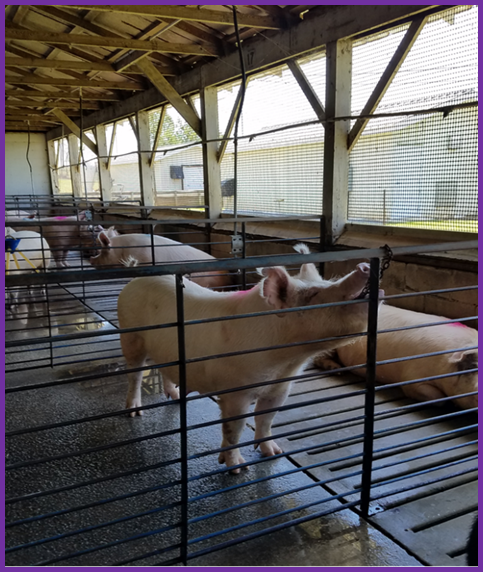
Fresh swine manure was obtained from the gestation barn at the Starkey Swine Center at Clemson University (Figure 1), and large supernatant samples were obtained from the lagoon on-site. The solid manure from the gestation floor was diluted with supernatant from the lagoon to obtain three total solids (TS) concentrations. The target total solids concentrations were 1%, 1.2%, and 2%. Dilutions in this range were selected because they were representative of common ranges of liquid swine manure removed from modern production facilities. This also provided three levels of organic load (OL) that was defined by the VS concentration of the mixtures (g VS/L). The dilutions that were actually achieved were 0.9%, 1.2%, and 1.9% total solids with volatile solids (VS) concentrations of 6.10, 9.05, and 13.75 g VS/L.
Since lagoon water was used for dilution in a manner similar to the operation of a recycled flush system no additional seed material was needed. The microorganisms needed for anaerobic digestion already existed in the manure.
Figure 1. Naturally ventilated gestation barn at the Starkey Swine Center at Clemson University.
Batch Anaerobic Digestion
The three mixtures of swine manure and lagoon water were anaerobically digested using 1.8L batch reactors that were maintained at 35 C in a heated water tank as shown in Figure 2. Three 1.8L bottles were used for each of the three liquid swine manure mixtures to give a total of 9 reactor bottles. Complete details of the batch method used is provided by Chastain and Smith (2015).
Figure 2. Aquarium used to provide a heated water bath (35°C) that held the nine, 1.8-L batch reactors.
The reactor bottles were digested for 56 to 74 days. The pH of the bottles was measured daily and was used as the primary parameter to monitor digestion progress. Biogas production was also monitored by collecting it in 3-L Tedlar® bags, one per reactor bottle. The day on which the gas collection bags were emptied was recorded and provided a secondary parameter to determine when digestion was complete. Anaerobic digestion is a two phase process. During the first phase, called the acid forming phase, microorganisms create volatile fatty acids (VFA) and the pH falls rapidly to 6 or less. During the second phase the methanogens increase in population and consume the VFAs causing the pH to rise. Digestion was complete once the pH hovered around 7.5 for several days, and biogas was no longer produced. A graph of the variation in pH for the reactors is provided in Figure 3.
Figure 3. Variation of pH with respect to process time for three organic loading rates used. Each point is the mean of three 1.8-L batch reactor bottles.
Solids and Plant Nutrients Measured Before and After Anaerobic Digestion
Well-mixed samples of the three liquid swine manure mixtures were obtained before and after anaerobic digestion. Since nitrogen and phosphorous in swine manure exist in soluble and organic forms the reductions and transformations of soluble and organic forms of these nutrients were also observed. The samples were analyzed to determine the following using standard techniques:
The total solids (TS),
The fixed solids (FS) or ash content,
The volatile solids (VS = TS – FS)
Total Kjeldahl nitrogen (TKN = Org-N + TAN)
Total ammonical nitrogen (TAN = NH4+-N + NH3– – N),
Organic nitrogen (Org-N = TKN – TAN),
Nitrate nitrogen (NO3-N),
Mineral nitrogen (Min N = TAN + NO3-N),
Total nitrogen (TN = TKN + NO3-N),
Total phosphorus (TP),
Soluble phosphorous (Sol-P),
Total potassium (TK), and
Sulfur (S).
What did we learn?
The first important observation was related to the completeness of anaerobic digestion. The mean VS reduction ratio (g VS destroyed/g VS added) for all nine reactors was measured, and was 0.62 on the average. This and was in excellent agreement with the literature value of 0.63 for swine manure (Hill, 1991), and indicated that anaerobic digestion was complete. The rate of TS destruction was 0.45 g TS destroyed / g TS added.
The second set of observations were related to the impact of anaerobic digestion on nitrogen. The mass of total N was not changed by anaerobic digestion, but the mass of organic nitrogen was decreased by 36% as it was mineralized to TAN. The TAN was increased by a factor of 1.84, and the mineral N (TAN + NO3-N) was increased by a factor of 1.8 on the average. The initial nitrate-N concentrations were small and evidence of denitrification was observed as indicated by a reduction in nitrate-N by 59%. The impact of N transformations was to increase the fraction of total-N that was in the total ammonical form from 33% before digestion to 59% after digestion which highlights the need to store and land apply anaerobically digested manure so as to reduce ammonia volatilization.
Anaerobic digestion was also observed to have mixed results on the mass of P, K, and S. The mass of total-P was not significantly impacted by anaerobic digestion. On the average, 73% of the soluble-P was converted to organic P by microbial activity, and was believed to remain in the microbial biomass. There was no impact on TK by digestion as expected. The mass of S was reduced by 7% on the average presumably by the formation of small amounts of H2S.
Authors
John P. Chastain, Ph.D. Professor and Extension Agricultural Engineer, Clemson University, Department of Agricultural Sciences, Agricultural Mechanization and Business Program, McAdams Hall, Clemson, South Carolina 29634 USA. jchstn@clemson.edu 1-864-656-4089
Bryan Smith, BSAE, MSCE, Area Extension Agent – Agricultural Engineer, Clemson Extension Service, 219 West Laurens Street, Laurens, South Carolina 29360 USA.
References
Chastain, J.P. and W.B. Smith. (2015). Determination of the Anaerobic Volatile Solids Reduction Ratio of Animal Manure Using a Bench Scale Batch Reactor. Presented at the 2015 ASABE Annual International Meeting. Paper No. 152189216. ASABE, 2950 Niles Rd., St. Joseph, MI 49085-9659
Hill, D.T. (1991). Steady-State Mesophilic Design Equations for Methane Production from Livestock Wastes. TRANSACTIONS of the ASAE, 34(5):2157-2163.
Acknowledgements
This study was supported by the Clemson Extension Confined Animal Manure Managers Program and by a grant from the South Carolina Energy Office.
The authors are solely responsible for the content of these proceedings. The technical information does not necessarily reflect the official position of the sponsoring agencies or institutions represented by planning committee members, and inclusion and distribution herein does not constitute an endorsement of views expressed by the same. Printed materials included herein are not refereed publications. Citations should appear as follows. EXAMPLE: Authors. 2019. Title of presentation. Waste to Worth. Minneapolis, MN. April 22-26, 2019. URL of this page. Accessed on: today’s date.
A number of Idaho dairies use flushing systems that result in large amounts of liquid manure that are applied via irrigation systems to adjacent crop-land during the growing season. Solids and nutrients found in liquid dairy manure pose challenges to manure handling processes. Separating solids and nutrients from liquid dairy manure is a critical step to improve nutrient use efficiency and reduce manure handling costs. To better address issues related to solid/nutrients separation, a critical question needs to be answered: what are liquid dairy manure solid and nutrient distributions? Identifying solid particle distribution and associated nutrients in liquid dairy manure is necessary for designing settling ponds, choosing suitable separation technologies/equipment, and making better manure nutrient management practices.
What did we do?
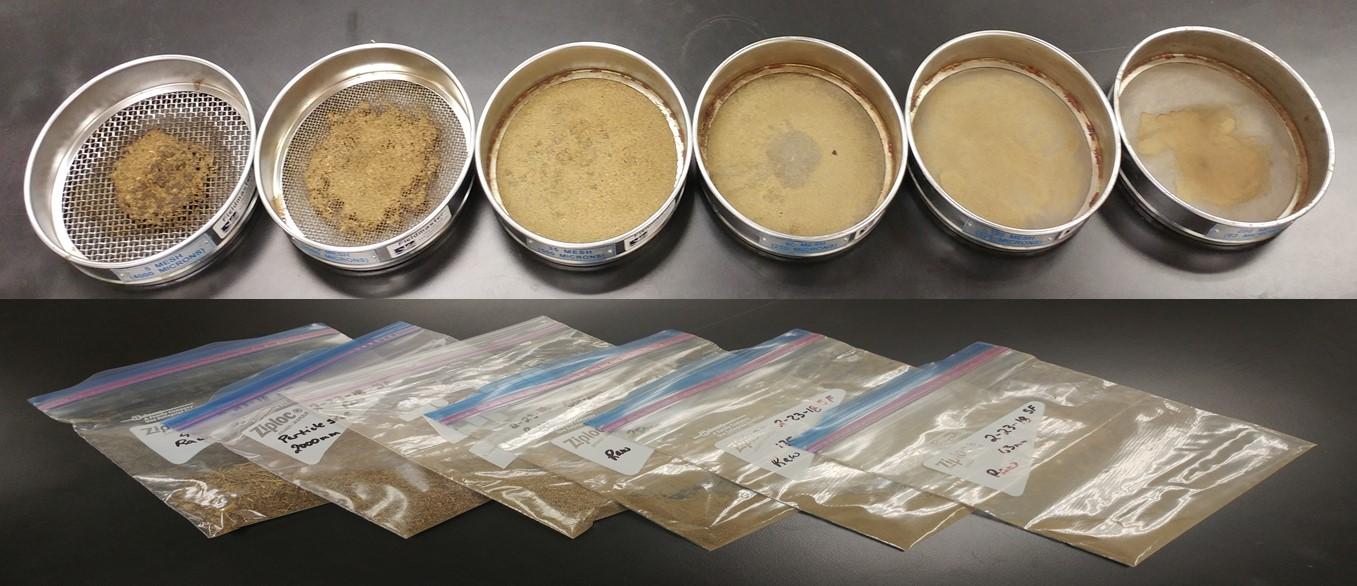
Liquid dairy manure samples were collected from a flushing receiving pit on each of three dairies (Dairy SF, Dairy DD, and Dairy SE) in Southern Idaho. Triplicate samples were analyzed for solid content, particle density, particle size distribution, total nitrogen (TN), and total phosphorus (TP). Solid content was analyzed based on Method 2540B (APHA, 2015). Particle density was analyzed based on the method ASTM D1217-15 (Weindorf and Wittie, 2003) using a pycnometer with a methanol medium for particle sizes of 4, 2, 0.5, 0.25, 0.125, 0.063, and <0.063 mm. Particle size distribution was determined using a set of 6 sieves (4, 2, 0.5, 0.25, 0.125, and 0.063 mm) combined with the hydrometer method ASTM D7928-17 (Days, 2002) for particle sizes less than 0.063mm. Nutrient parameters (TN and TP) were analyzed using a Hach spectrometer (DR 5000) based on Hach methods (Hach, 2005). The Pipette Methods ASTM D6913/D6913M-17 (Hellman and McKelvey, 1941) was used in conjunction with ASTM D7928-17to extract liquid manure samples for analyzing the nutrient parameters. The apparatuses used for the test are shown in Figures 1, 2, and 3.
Figure 1. Sieved particles for density analysis.Figure 2. Stacked sieve set (left) and liquid dairy manure sieve filtration apparatus (right).Figure 3. From left: pycnometer for particle density analysis, pipette method for extracting manure samples, ASTM 152-H hydrometer, hydrometer reading of the meniscus.
What we have learned?
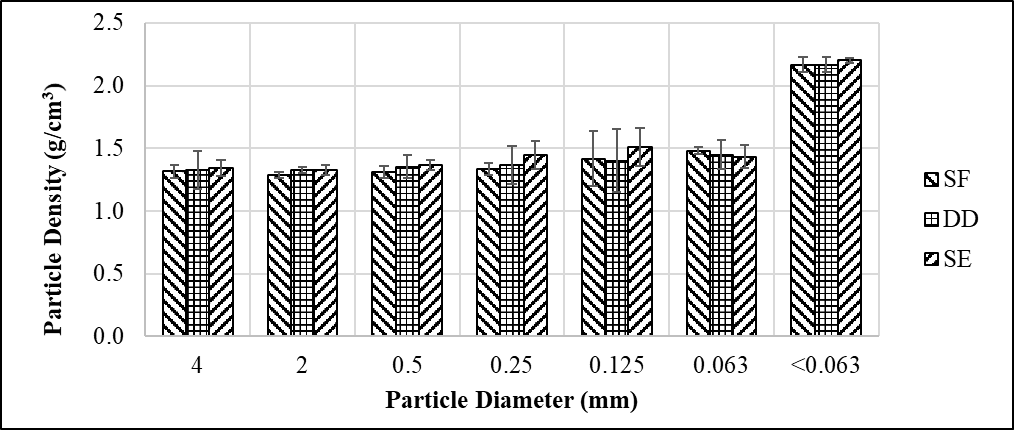
The particle densities of three dairies (Figure 4) were found to be similar ranging from 1.32 g/cm3 for particle sizes larger than 4 mm to 2.20 g/cm3 for particles less than 0.063 mm. The particle densities which are smaller than commonly used soil particle density of 2.65 g/cm3 need to be considered during design of dairy flushing water settling basins.
Figure 4. Flushing dairy manure solid particle density of dairies SF, DD, and SE.
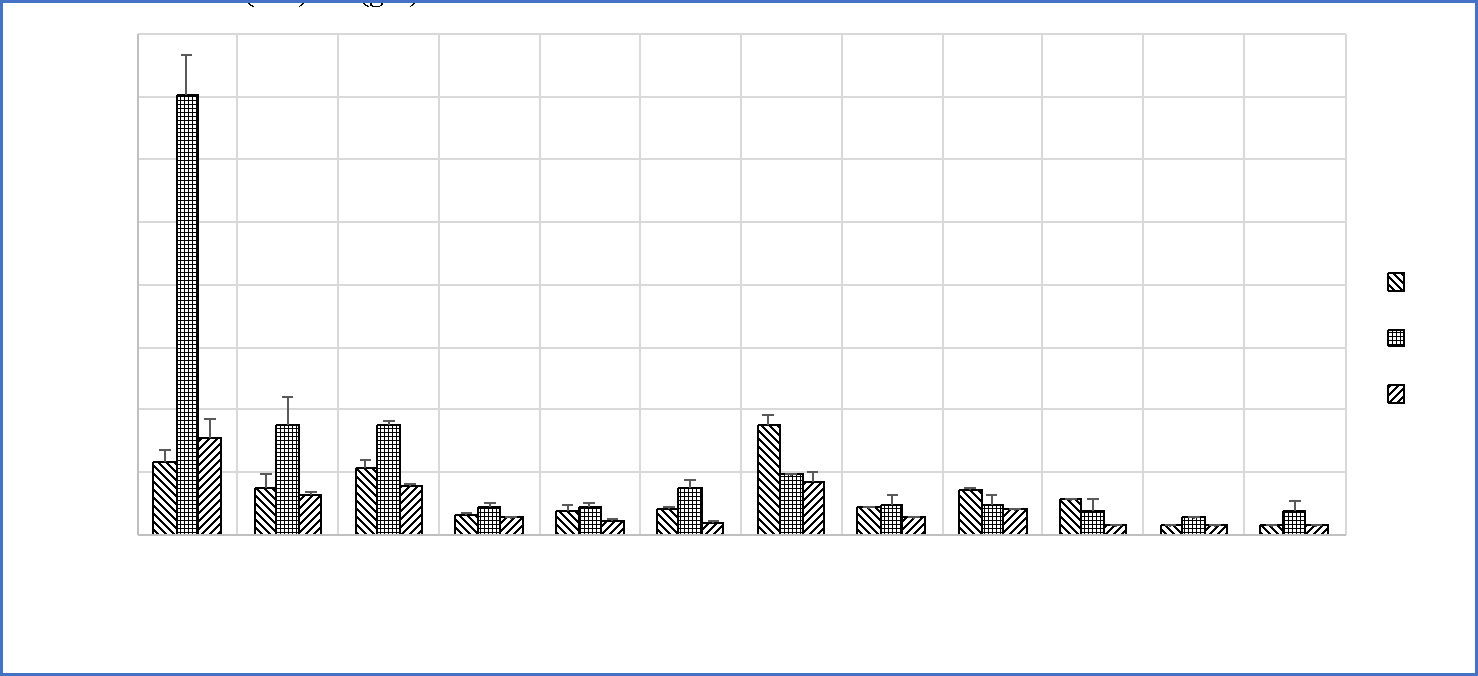
Flushing liquid dairy manure solid particle distributions of three dairies are shown in Figure 5. It was noticed that high bedding fibers were presented in the liquid manure from Dairy DD which resulted in a 32.6% of solids with particle sizes larger than 4 mm. For both Dairy SF and Dairy SE, the percentages of solids (dry weight basis) with particle sizes larger than 4 mm were 8% and 17.2%, respectively.
Figure 5. Flushing dairy manure solid particle distribution of Dairies SF, DD, and SE.
Flushing liquid dairy manure total nitrogen (TN) and total phosphorus (TP) associated with different particle groups are shown in Figures 6 and 7. There were 58.3 g (or 33.6%) and 52.1 g (or 43.9%) of TN associating with particles larger than 0.5 mm in 100 liters of flushing manure for Dairy SF and Dairy SE, respectively. There was 9.1 g (or 6.5%) of TN attaching to particles larger than 0.5 mm in 100 liters of flushing manure for Dairy DD. Most TP was attached to fine particles with sizes less than 0.5 mm for the three dairies. In order to separate more TP out of liquid stream, advanced separation methods beyond inclined screens are needed.
Figure 6. Total nitrogen (TN) associated with each particle diameter group in flushing liquid dairy manure.
Figure 7. Total phosphorus (TP) associated with each particle diameter group in flushing liquid dairy manure.
The test results showed:
flushing dairy manure particle densities ranged from 1.32 g/cm3 to 2.20 g/cm3;
Most TP were associated with fine particles that cannot be screened out by screens;
Advanced separation technologies are needed to capture more TP from flushing liquid dairy manure.
Future plans
We will hold workshops and field days to communicate the results with producers and promote on-farm adoption of advanced separation equipment such as centrifuge.
Authors
Lide Chen, Department of Soil and Water Systems, University of Idaho; email: lchen@uidaho.edu.
Kevin Kruger, Department of Soil and Water Systems, University of Idaho.
Howard Neibling, Department of Soil and Water Systems, University of Idaho.
Additional information
APHA. (2015). Standard Methods for the Examination of Water and Wastewater. Washington D.C. : American Public Heath Assosiation., Pp. 216-217
Das, B. M. (2002). Soil Mechanics Laboratory Manual (6th ed.). New York, NY: Oxford University Press. website: site.iugaza.edu.ps/dsafi/files/2015/02/Soil-Laboratory-Manual-Das.pdf
DR5000 Spectrophotometer: Procedures manual. (2005). Germany: Hach Company
Hellman, H. H., & McKelvey, V. E. (1941). A Hydrometer Method-Pipette Method for Mechanical Analysis. Journal of Sedimentary Petrology,11(1), P. 3-9.
Weindorf, D. C., & Wittie, R. (2003). Determining Particle Density in Dairy Manure Compost. The Texas Journal of Agriculture and Natural Resource, volume 16, Pp.60-63.
Acknowledgements
This study is supported by the USDA NIFA via WSARE project SW18-015.
The authors are solely responsible for the content of these proceedings. The technical information does not necessarily reflect the official position of the sponsoring agencies or institutions represented by planning committee members, and inclusion and distribution herein does not constitute an endorsement of views expressed by the same. Printed materials included herein are not refereed publications. Citations should appear as follows. EXAMPLE: Authors. 2019. Title of presentation. Waste to Worth. Minneapolis, MN. April 22-26, 2019. URL of this page. Accessed on: today’s date.
Anaerobic digestion (AD) is a growing technology that uses a series of microbial activities to breakdown organic material such as food waste and manure, to produce biogas for renewable energy, digestate for nutrient recycling as fertilizer, and large reductions in greenhouse gas (GHG) emissions and odors. Currently there are millions of AD systems in China and India, with a vast majority of these systems operating on a small-scale basis, while European nations such as Germany and Italy, have thousands of agricultural- based AD systems, that are large scale and more technologically advanced. Europe with over 17,000 biogas plants has steady increases in AD adoption each year, as more countries are setting sustainability goals that include increasing renewable energy use and reducing GHG emissions. The US however, has less than 300 agricultural-based AD systems and 1500 AD systems at wastewater treatment facilities. An in depth analysis was performed of US policies related to AD adoption and how these policies compare to policies in other countries with higher AD adoption rates. A survey was developed for farmers, policy makers, and extension associates to understand policy effects on AD adoption rates and identify challenges to increasing AD adoption rates in the US. The survey data, along with the AD policy analysis, was used to compare and contrast policies, programs and overall legislative climate between countries and understand the timeline in which policies were administered. While policy is the product of a multitude of variables, including general perceptions, institutional involvement, legal framework, and societal /economic benefits, the survey and subsequent analyses seek to understand how these variables interact. The results of the survey and policy analysis will be presented to detail the general perceptions around AD policies, challenges with AD adoption, operation, and maintenance, and overall perceptions of the AD field in the US.
Authors
Carlton Poindexter, University of Maryland-College Park, cpoindex@umd.edu
Lansing, Stephanie (University of Maryland-College Park)
The authors are solely responsible for the content of these proceedings. The technical information does not necessarily reflect the official position of the sponsoring agencies or institutions represented by planning committee members, and inclusion and distribution herein does not constitute an endorsement of views expressed by the same. Printed materials included herein are not refereed publications. Citations should appear as follows. EXAMPLE: Authors. 2019. Title of presentation. Waste to Worth. Minneapolis, MN. April 22-26, 2019. URL of this page. Accessed on: today’s date.
The effect of anaerobic digestion (AD) and composting manure management strategies on antimicrobial resistance (AMR) was explored at the farm and bench-scale. At the farm-scale, a collaborative project investigated the fate of antibiotics and antimicrobial resistance genes (ARGs) during manure handling, treatment, and storage at 11 dairy farms. Results showed that antimicrobials were not consistently removed during manure treatment, with most samples below detection limit, yet, others showing concentrations up to 34,000 ng/g DW in the AD effluent, for example. Antimicrobials also did not degrade significantly during field-scale composting. The farm-scale results illuminated limitations of tracking antimicrobials in complex manure treatment systems with varying manure treatment practices, retention times, and heterogeneous manure substrates. At the bench-scale, triplicate reactors with tetracycline (TC) and sulfadimethoxine (SDM) additions of 1 and 10 mg/L were digested with dairy manure and inoculum for 44-days. The AD process degraded 85% of antimicrobials at the bench-scale. There was a 99% reduction of SDM during AD. The AD reactors with TC additions showed more variability in degradation products. The ARG analysis showed that TetM gene copies decreased during AD and correlated with declines in TC, however, reductions in SDM did not correlate with decreases in Sul1 gene copies. Overall, our results showed that dairy farm antibiotics usage varies significantly from farm to farm, with occasional short-term spikes in usage in response to the treatment of illness/infection outbreaks, and therefore, tracking these spikes through complex manure handling systems proved challenging. The settling, separation, and differing retention times of solids throughout manure handling processes also made whole-farm analyses challenging, as recovery rates in the extraction process for testing antimicrobials in the laboratory varied with solid-based and liquid-based manure samples.
Schueler, Jenna (University of Maryland); Crossette, Emily (University of Michigan); Naas, Kayla (University of Buffalo); Hurst, Jerod (University of Buffalo); Oliver, Jason (Cornell University); Raskin, Lutgarde (University of Michigan); Wigginton, Krista (University of Michigan); Gooch, Curt, (Cornell University); Aga Diana (University of Buffalo)
The authors are solely responsible for the content of these proceedings. The technical information does not necessarily reflect the official position of the sponsoring agencies or institutions represented by planning committee members, and inclusion and distribution herein does not constitute an endorsement of views expressed by the same. Printed materials included herein are not refereed publications. Citations should appear as follows. EXAMPLE: Authors. 2019. Title of presentation. Waste to Worth. Minneapolis, MN. April 22-26, 2019. URL of this page. Accessed on: today’s date.
To better understand the state of the science and to lessen the present risk of winter manure application, a literature review was conducted that examined a wealth of studies dating back to 1945. Interest in winter manure application has increased, in part, due to the high-profile nutrient impacts to the Great Lakes and the several resulting new policies that have been implemented within the surrounding states. Based on this literature review, research needs and future directions were identified.
What did we do?
A comprehensive literature review was conducted that included scientific, technology transfer, and regulatory documents. Contaminants of concern, emerging pollutants, case studies, existing best management practices, state level policy, and key data gaps were identified.
What we have learned?
The US Environmental Protection Agency (EPA) and the Natural Resource Conservation Service (NRCS) discourages the application of manure in winter because of the elevated risk of nutrient loss to the environment as demonstrated by several field, laboratory, and modeling studies (Srinivasan et al., 2006). The emergence of environmental issues downstream of livestock operations such as algae blooms and fish kills has led some States to ban winter manure application all together, although some states still allow emergency applications and exempt smaller farms from the regulations. Additionally, the loss of nutrients during spring thaws means a loss of soil productivity for farmers and added expense to purchase soil amendments. There are several parameters that ultimately determine the impact winter manure spreading will have on the environment and the nutrient content that remains in the soil after application. Included, but not limited to, are slope, soil type, depth of freeze, rate of thaw, depth of snow, presence of cover crops, tilling practices, manure moisture content, and timing of application. Several are interdependent, often resulting in difficulty isolating the relative effects of any particular parameter compared to another and, in some cases, contradictory research results are found. However, several general findings may still be derived, as discussed below.
Nutrients
Runoff from winter-applied manure can be an important source of annual nutrient loadings to water bodies, with nitrogen and phosphorous being the most often reported. In a 1985 study, Moore and Madison (1985) estimated that 25% of annual phosphorus load to a Wisconsin lake was directly attributable to winter spreading of animal wastes. Brown et al. (1989) investigated the Cannonsville Reservoir in New York and determined that snowmelt runoff from winter manured cropland contributed more phosphorus to the reservoir than runoff from barnyards. Clausen and Meals (1989) estimated that 40% of Vermont’s streams and lakes experienced significant water quality impairments from the addition of just two winter-spread fields in their watersheds. Plot studies of winter-applied manure found 23.5 to 1,086 mg/L of total Kjeldahl nitrogen (TKN) and 1.6 to 15.4 mg/L of phosphorus in runoff (Lorimor and Melvin, 1996; Thompson et al., 1979). In two Vermont field studies, Clausen (1990; 1991) reported 165 to 224% increases in total phosphorus concentration, 246 to 1,480% increases in soluble phosphorus, 114% increases in TKN, and up to a 576% increase in NH3-N following winter application of dairy manure. Mass losses of nutrients are highly variable across studies. Several studies have noted elevated, though moderate, mass losses of nitrogen ranging from 10-22% of applied nitrogen (Converse et al., 1976; Hensler et al., 1970; Klausner et al., 1976; Lorimor and Melvin, 1996; Midgley and Dunklee, 1945; Phillips et al., 1981). However, Owens et al. (2011) reported total nitrogen losses of 35-94%, by mass. These numbers are highly variable due the extreme variance in weather conditions, with flash events contributing more nutrient loss than slower melt events. Authors noted that it is possible for nearly all loss to occur in a single storm event (Klausner et al., 1976; Owens et al., 2011).
Steenhuis et al., (1979) reported decreases in ammonia volatilization rates for winter spread manure relative to spring due to lower temperatures. Lauer et al. (1976) showed that manure covered by snow had no signs of ammonia volatilization. These results suggested that limiting ammonia volatilization may be critical to nutrient retention in soil. However, Williams et al. (2010) showed that manure applied under snow did not truly maintain this ammonia but lost it through runoff. No case studies have quantified the reduction of other odor causing compounds such as di-hydrogen sulfide in winter applied manure relative to other seasonal applications.
Losses are contingent upon fields exhibiting certain risk factors (Klausner et al., 1976; Young and Holt, 1977; Young and Mutchler, 1976). Important are variations in local weather conditions, depth and type of soil freeze, the position of manure relative to the snowpack, and the timing of application relative to snow melt. Because of the large number of unconstrained variables in the natural environment, there continue to be disagreements on best management practices to limit nutrient movement. Additionally, the form of nutrient is critical. All of these factors impact the mechanisms of nutrient loss: plant uptake, sorption, polymerization, microbial degradation, volatilization, advective movement, and dispersive transport. Consequently, the fate of particulate forms may be very different than soluble, depending on the site and management-specific conditions.
As such, the industry will benefit from continued experiment and field research in an effort to account for very specific, definable variables and nutrient form. Further, because of the extensive list of relevant variables, the development of precise and accurate mathematical models is essential as experimentally modeling the infinite number of site and management-specific conditions is impossible.
Pathogens
Several varieties of pathogens are common in livestock excrement, though not all pose human health risks. Pathogens of concern include the following (USEPA 2004; Rogers and Haines 2005; Sobsey et al. 2006; Pappas et al. 2008; Bowman 2009).
Bacteria: Escherichia coli (E. coli) O157:H7 and other shiga-toxin producing strains, Salmonella spp., Campylobacter jejuni, Yersinia enterocolitica, Shigella sp., Listeria monocytogenes, Leptospira spp., Aeromonas hydrophila, Clostridium perfringens, Bacillus anthraxis (in endemic area) in mortality carcasses.
Parasites: Giardia lamblia, Cryptosporidium parvum, Balantidium coli, Toxoplasma gondii, Ascaris suum and lumbricoides, Trichuris trichuria.
Viruses: Rotavirus, hepatitis E virus, influenza A (avian influenza virus), enteroviruses, adenoviruses, caliciviruses (e.g., norovirus).
As with nutrients, application of animal manure to impervious surfaces such as frozen ground can increase the risk of pathogen loss through runoff events relative to application in other seasons (Reddy, et al., 1981). Cool temperatures have been shown to improve the survival of fecal bacteria (Reddy et al., 1981; Kibbey, et al., 1978). However, field studies found that freezing conditions can be lethal to fecal bacteria (Kibbey, et al., 1978). While these reports hint at fecal bacteria being able to survive cool but not freezing conditions, Kudva, et al. (1998) reported E. coli surviving more than 100 days in manure frozen at minus 20°C. Conversely, freezing and thawing of a soil manure mixture was found to reduce E. coli levels by about 90% (Bicudo, 2003).
More research on this topic is needed to identify conflicting results. Of particular interest is the impact of warming soil temperatures. Slight variations can result in substantial microbial ecological changes. Further, it is well understood that the use of fecal coliform as a pathogen indicator is flawed. New microbial genetics techniques enable the identification of pathogens of greatest risk. Research should monitor for these specific, likely pathogens and their fate during freeze-thaw cycles.
Emerging Pollutants
Land application of both solid and slurry excrement has been cited as a vector for introduction of antimicrobials into the environment (Boxall 2008; Klein et al. 2008). In the early 2000s, it was estimated that approximately 60% to 80% of livestock and poultry routinely received antimicrobials through feed or water, injections, or external application (NRC 1999; Carmosini and Lee 2008). Though new best management practices involving non-therapeutic use of antibiotics in livestock are likely to decrease these percentages, estimated changes are not available. Livestock animals are estimated to discharge 70-90% of antibiotics administered through excrement (Massé et al., 2014). Approximately 55% of antimicrobial compounds administered to livestock and poultry are also used to treat human infections (Benbrook 2001; Kumar et al. 2005; Lee et al. 2007). The utilization of such overlapping antibiotics has been cited as a potential cause of antimicrobial resistance (Sapkota et al. 2007), a grave concern in modern medicine (Levy and Marshall 2004; Sapkota et al. 2007).
Antimicrobials are hydrophilic and do not readily break down in the environment and are, consequently, at high risk of introduction into water bodies through runoff events (Chee-Sanford et al. 2009; Zounková et al. 2011). Critically, these compounds show high adsorptive tendencies in soils and clays (Chee-Sanford et al. 2009), thus providing a potential for interception by soil.
Because antibiotics are highly hydrophilic, movement with melt water results, similar to soluble nutrients. Although this mechanism seems clear, movement during winter application is poorly understood. The mechanisms that determine their fate are the same as those listed for nutrients. However, this fate is poorly understood, especially regarding the amount that will reach the field and streams when comparing different seasonal applications. Further, some studies suggest prolonged storage in aerobic manure environments helps facilitate breakdown particularly at higher temperatures (Kumar et al. 2005; Lee et al. 2007; Boxall et al. 2008). However, the question remains whether these effects are present in winter storage.
Fate studies under diverse farm field conditions are essential. Further, the original compound may be broken down into metabolites, some of which may be even more dangerous. All original and breakdown products should be reviewed.
Benefits of Winter Manure Application
The soil health benefits of winter manure application appear to be limited. However, the literature suggests that soil compaction and nitrogen volatilization can be reduced when applying to frozen soil, but at the potential expense of nutrient runoff. There are also many benefits to agriculturalists, as Fleming and Fraser (2000) noted:
Reducing size and number of manure storage structures.
Spreading the manure when logistics suite the farmer.
Reducing soil compaction by avoiding equipment use during compressible soil conditions.
Management Practices
There is little standardization in regard to winter manure application and most states cite the NRCS conservation practice standard 590 for nutrient management (NRCS, 2013). In regard to winter manure application, this standard states the following. “Nutrients must not be surface-applied if nutrient losses offsite are likely. This precludes spreading on: frozen and/or snow-covered soils, and when the top two inches of soil are saturated from rainfall or snow melt. Exceptions for the above criteria can be made for surface-applied manure when specified conditions are met and adequate conservation measures are installed to prevent the offsite delivery of nutrients” (NRCS, 2013). As a continuation of standard 590, the NRCS states that at a minimum the following factors should be considered before winter manure application (NRCS, 2013):
Field slope
Organic residue and living covers
Amount and form of nutrients to be applied
Setback distances to protect local water quality
Application timing
The ambiguity in standard practices for winter manure application has led to several different State policies. States with winter manure application guidelines include Ohio, Pennsylvania, Michigan, and Illinois. States that have some form of bans include Vermont, Iowa, Maryland, Indiana, Minnesota, and Wisconsin. States not listed have policies that are identical to the NRCS standard 590.
Future Plans
Based on this literature review, needed research has been identified:
Review the incidences of emergency spreading on frozen ground versus incorporation during cold weather. Understanding the frequency and timing of emergency spread events is critical to crafting policy and best management practices.
Evaluate compliance with new rules and if intended impacts are realized, including comparing watershed level of target pollutants across state lines and time lines to view the impacts of this policy change.
Determine if application in early spring, when soil is saturated and precipitation events are frequent, is more desirable than in winter application before a deep freeze allows for incorporation. Related is the impact of soil moisture content on the fate of target pollutants during thaw events.
Determine the economic impact on producers and the potential loss of small to medium sized farms. One of the most often cited criticisms of unconditional winter manure application bans is that it can disproportionately disadvantage smaller producers. In a Michigan survey of small producers, 27% of non-CAFO dairy farmers suggested that they would need to suspend operations if such a ban were instituted (Miller et al., 2017). This same survey found that a total ban on winter application in Michigan would collectively cost small farms in that state an estimated $30 million dollars (Miller et al., 2017). An important task is to survey, with time, states that have banned winter manure application to determine if significant shift with regard to average producer size occurred. If so, it is important to consider the resulting economics of the environmental benefits and if national biosecurity decreased with a reduction in producers.
Verify the effectiveness of risk indices such as the Manure Application Risk Index (MARI), Wisconsin’s Online Manure Advisory System, and other individual states’ P-indices. Many of these indices were developed based on recommendations from research and the practical experience of experts, but literature verifying this is scarce.
Determine the impact of climate change on winter manure application policies. Climate change effects the duration and intensity of winter temperatures and the frequency and intensity of precipitation events. Such conditions may require more adaptable metrics such as frost depth, depth of snow, ability to incorporate, and forecasted thaw events.
Authors
Steven I. Safferman1, Jason S. Smith2, and Rachelle L. Crow3
1Associate Professor; Michigan State University, Biosystems and Agricultural Engineering; Corresponding Author: SteveS@msu.edu
2Teaching Specialist, Michigan State University, Engineering CoRe
3Undergraduate Research Assistant, Michigan State University, Biosystems and Agricultural Engineering
Additional information
Benbrook, C.M. 2001. Quantity of antimicrobials used in food animals in the United States. American Society for Microbiology 101st Annual Meeting. May 20-24, 2001. Orlando, FL.
Bicudo, J. R., Goyal, S.M. 2003. Pathogens and manure management systems: a review. Environmental technology 24.1 (2003): 115-130.
Bowman, J. 2009. Manure pathogens: manure management, regulations, and water quality protection. p. 562.Water Environmental Federation, McGraw-Hill, New York.
Boxall, A. 2008. Fate and transport of veterinary medicines in the soil environment. p 123-137. In D.S. Aga (ed.) Fate and transport of pharmaceuticals in the environment and water treatment systems. 1st ed. CRC Press, Boca Raton, FL.
Brown, M.P., Longabucco, P., Rafferty, M.R., Robillard, P.D., Walter, M.F., Haith, D.A. 1989. Effects of animal waste control practices on nonpoint-source phosphorus loading in the West Branch of the Delaware River watershed. J. Soil Water Conserv. 44, 67–70.
Carmosini, N., Lee, L.S. 2008. Sorption and Degradation of selected pharmaceuticals in soil and manure. p 139-165. In D.S. Aga (ed.) Fate and transport of pharmaceuticals in the environment and water treatment systems. 1st ed. CRC Press, Boca Raton, FL.
Chee-Sanford, J.C., Mackie, R.I., Koike, S., Krapac, I.G., Lin, Y., Yannarell, A.C., Maxwell, S., Aminov. R.I. 2009. Fate and transport of antibiotic residues and antibiotic resistance genes following land application of manure waste. Journal of Environmental Quality. 38(3):1086-1108.
Clausen, J.C. 1990. Winter and Fall application of manure to corn land. Pages 179 – 180 invMeals, D.W. 1990. LaPlatte River Watershed Water Quality Monitoring and AnalysisProgram: Comprehensive Final Report. Program Report No. 12. Vermont WatervResource Research Center, University of Vermont, Burlington.
Clausen, J.C. 1991. Best manure management effectiveness. Pages 193 – 197 in Vermont RCWP Coordinating Committee. 1991. St. Albans Bay Rural Clean Water Program, Final Report. Vermont Water Resources Research Center, University of Vermont, Burlington
Clausen, J.C., Meals, D.W. 1989. Water quality achievable with agricultural best management practices. J. Soil Water Conserv. 44, 593–596.
Converse, J.C., Bubenzer, G.D., Paulson, W.H. 1976. Nutrient losses in surface runoff from winter spread manure. Trans. ASAE 19, 517–519.
Fleming, R., Fraser, H. 2000. Impacts of winter spreading of manure on water quality: Literature review. Ridgetown, Ontario, Canada Ridget. Coll. Univ. Guelph.
Hensler, R.F., Olsen, R.J., Witzel, S.A., Attoe, O.J., Paulson, W.H., Johannes, R.F. 1970. Effect of method of manure handling on crop yields, nutrient recovery and runoff losses. Trans. ASAE 13, 726–731.
Kibbey, H.J., Hagedorn, C., and McCoy, E.L. 1978. Use of fecal streptococci as indicators of pollution in soil. Applied Environmental Microbiology. 35:711-717.
Klausner, S.D., Zwerman, P.J., Ellis, D.F. 1976. Nitrogen and phosphorus losses from winter disposal of dairy manure. J. Environ. Qual. 5, 47–49.
Klein C., O’Connor, S., Locke, J., Aga, D. 2008. Sample preparation and analysis of solid-bound pharmaceuticals. p. 81-100. In D.S. Aga (ed.) Fate and transport of pharmaceuticals in the environment and water treatment systems. 1st ed. CRC Press, Boca Raton, FL.
Kudva, I. T., Blanch, K., Hovde, C. J. 1998. Analysis of Escherichia coli O157: H7 survival in bovine or bovine manure and manure slurry. Applied and environmental microbiology, 64(9), 3166-3174.
Kumar, K., Gupta, S.C., Chander, Y., Singh, A.K. 2005. Antibiotic use in agriculture and its impact on the terrestrial environment. Advances in Agronomy. 87:1-54.
Lauer, D.A., Bouldin, D.R., Klausner, S.D. 1976. Ammonia volatilization from dairy manure spread on the soil surface. J. Environ. Qual. 5, 134–141.
Lee, L.S., Carmosini, N., Sassman, S.S., Dion, H.M., Sepúlveda, M.S. 2007. Agricultural contributions of antimicrobials and hormones on soil and water quality. Advances in Argronomy.93:1-68.
Levy, S.B., Marshall, B. 2004. Antibacterial resistance worldwide: causes, challenges and responses. Nature Medicine Supplement. 10(12):S122-S129.
Lorimor, J.C., Melvin, J.C. 1996. Nitrogen losses in surface runoff from winter applied manure. Final Report. Univ. Iowa, Ames, Iowa.
Massé, I.D., Saady, M.N., Gilbert, Y. 2014. Potential of Biological Processes to Eliminate Antibiotics in Livestock Manure: An Overview. Anim. . doi:10.3390/ani4020146
Midgley, A.R., Dunklee, D.E. 1945. Fertility runoff losses from manure spread during the winter. Agricultural Experiment Station; Burlington.
Miller, S.R., Mann, J.T., Leschewski, A., Rozeboom, D., Safferman, S., Smith, J. 2017. Survey of Small Michigan Livestock Winter Manure Handling and Economic Assessment of Policy Change, in: 2017 ASABE Annual International Meeting. American Society of Agricultural and Biological Engineers, p. 1.
Moore, I.C., Madison, F.W. 1985. Description and application of an animal waste phosphorus loading model. J. Environ. Qual. 14, 364–369.
NRC. 1999. The use of drugs in food animals: benefits and risks. Food and Nutrition Board, Institute of Medicine. National Academy Press, Washington, DC.
NRCS. 2013. Conservation Practice Standard 590: Nutrient Management [WWW Document]. URL https://www.nrcs.usda.gov/Internet/FSE_DOCUMENTS/stelprdb1192371.pdf (accessed 1.8.17).
Owens, L.B., Bonta, J. V, Shipitalo, M.J., Rogers, S. 2011. Effects of winter manure application in Ohio on the quality of surface runoff. J. Environ. Qual. 40, 153–165.
Pappas, E. A., Kanwar, R. S., Baker, J. L., Lorimor, J. C., Mickelson, S. 2008. Fecal indicator bacteria in subsurface drain water following swine manure application. Transactions of the ASABE, 51(5), 1567-1573.
Phillips, P.A., Culley, J.L.B., Hore, F.R., Patni, N.K. 1981. Pollution potential and corn yields from selected rates and timing of liquid manure applications. Trans. ASAE 24, 139–144.
Reddy, K. R., Khaleel, R., Overcash, M. R. 1981. Behavior and transport of microbial pathogens and indicator organisms in soils treated with organic wastes. Journal of Environmental Quality, 10(3), 255-266.
Rogers, S., and J. Haines. 2005. Detecting and mitigating the environmental impact of fecal pathogens originating from confined animal feeding operations: review. EPA-600-R-06-021. USEPA, Office of Research and Development, National Risk Management Research Laboratory. Cincinnati, OH.
Sapkota, A.R., F.C. Curriero, K.E. Gibson, and K.J. Schwab. 2007. Antibiotic-resistant enterococci and fecal indicators in surface water and groundwater impacted by a concentrated swine feeding operation. Environmental Health Perspectives. 115(7):1040-1045.
Sobsey, M.D., Khatib, L.A., Hill, V.R., Alocilja, E., Pillai, S. 2006. Pathogens in animal wastes and the impacts of waste management practices on their survival, transport and fate. p. 609-666. In J.
Srinivasan, M.S., Bryant, R.B., Callahan, M.P., Weld, J.L. 2006. Manure management and nutrient loss under winter conditions: A literature review. J. Soil Water Conserv. 61, 200–209.
Steenhuis, T.S., Bubenzer, G.D., Converse, J.C. 1979. Ammonia volatilization of winter spread manure. Trans.of ASAE. p 152-157, 161.
Thompson, D.B., Loudon, T.L., Gerrish, J.B. 1979. Animal manure movement in winter runoff for different surface conditions, in: Best Management Practices for Agriculture and Silviculture Proceedings of the 1978 Cornell Agricultural Waste Management Conference, P 145-157, 1979. 1 Fig, 4 Tab, 16 Ref.
USEPA. 2004. Risk management evaluation for concentrated animal feeding operations. EPA-600-R-04-042.USEPA, Office of Research and Development, National Risk Management Research Laboratory, Cincinnati, OH.
Williams, M.R., Feyereisen, G.W., Beegle, D.B., Shannon, R.D., Folmar, G.J., Bryant, R.B. 2010. Manure application under winter conditions: Nutrient runoff and leaching losses, in: 2010 Pittsburgh, Pennsylvania, June 20-June 23, 2010. American Society of Agricultural and Biological Engineers, p. 1.
Young, R.A., Holt, R.F. 1977. Winter-applied manure: Effects on annual runoff, erosion, and nutrient movement. J. Soil Water Conserv.
Young, R.A., Mutchler, C.K. 1976. Pollution potential of manure spread on frozen ground. J. Environ. Qual. 5, 174–179.
Zounková, R., Klimešová, Z., Nepejchalová, L., Hilscherová, K., Bláha, L. 2011. Complex evaluation of ecotoxicity and genotoxicity of antimicrobials oxytetracycline and flumequine used in aquaculture. Environmental Toxicology and Chemistry, 30(5), 1184-1189.
Acknowledgements
This project was funded by the North Central Regional Water Network Manure and Soil Heath Working Group and the Soil Health Institute.
The authors are solely responsible for the content of these proceedings. The technical information does not necessarily reflect the official position of the sponsoring agencies or institutions represented by planning committee members, and inclusion and distribution herein does not constitute an endorsement of views expressed by the same. Printed materials included herein are not refereed publications. Citations should appear as follows. EXAMPLE: Authors. 2019. Title of presentation. Waste to Worth. Minneapolis, MN. April 22-26, 2019. URL of this page. Accessed on: today’s date.
Manage Cookie Consent
To provide the best experiences, we use technologies like cookies to store and/or access device information. Consenting to these technologies will allow us to process data such as browsing behavior or unique IDs on this site. Not consenting or withdrawing consent, may adversely affect certain features and functions.
Functional
Always active
The technical storage or access is strictly necessary for the legitimate purpose of enabling the use of a specific service explicitly requested by the subscriber or user, or for the sole purpose of carrying out the transmission of a communication over an electronic communications network.
Preferences
The technical storage or access is necessary for the legitimate purpose of storing preferences that are not requested by the subscriber or user.
Statistics
The technical storage or access that is used exclusively for statistical purposes.The technical storage or access that is used exclusively for anonymous statistical purposes. Without a subpoena, voluntary compliance on the part of your Internet Service Provider, or additional records from a third party, information stored or retrieved for this purpose alone cannot usually be used to identify you.
Marketing
The technical storage or access is required to create user profiles to send advertising, or to track the user on a website or across several websites for similar marketing purposes.