
Silage Management Considerations

Introduction

This fact sheet has been developed to support the implementation of the Natural Resources Conservation Service Feed Management 592 Practice Standard. The Feed Management 592 Practice Standard was adopted by NRCS in 2003 as another tool to assist with addressing resource concerns on livestock and poultry operations. Feed management can assist with reducing the import of nutrients to the farm and reduce the excretion of nutrients in manure.

The Natural Resources Conservation Service has adopted a practice standard called Feed Management (592) and is defined as “managing the quantity of available nutrients fed to livestock and poultry for their intended purpose”. The national version of the practice standard can be found in a companion fact sheet entitled “An Introduction to Natural Resources Feed Management Practice Standard 592”. Please check in your own state for a state-specific version of the standard.

Regardless of the size of a dairy operation, producers know problems can occur in every silage program. This fact sheet describes possible causes and solutions for nine potential problems in managing silage in bunker silos, drive-over piles, and bags.

The nine potential problems include:

  • High ‘forage in’ versus ‘silage out’ loss in bunker silos, drive-over piles, and silage bags
  • Large variation in DM content and/or nutritional quality of the ensiled forage
  • Missing the optimum harvest window for whole-plant corn
  • High levels of butyric acid and ammonia-nitrogen, particularly in ‘hay-crop’ silage
  • High levels of acetic acid in wet corn silage
  • Aerobically unstable corn silage during feedout
  • Excessive surface-spoiled silage in bunker silos and drive-over piles
  • Poorly managed bagged silage
  • Safety issues for bunker silos and drive-over piles.

Dairy producers should discuss these problems and solutions with everyone on their silage team, including their nutritionist and custom operator, as a reminder to implement the best possible silage management practices.

Four Excel spreadsheets to help producers make decisions about bacterial inoculants, packing density, and sealing strategies for bunker silos and drive-over piles are discussed.

Please check this link first if you are interested in organic or specialty dairy production

High ‘Forage In’ versus ‘Silage Out’ Loss in Bunker Silos, Drive-over Piles, and Silage Bags

Solutions

  • Select the right forage hybrid or variety.
  • Harvest at the optimum stage of maturity and DM content.
  • Use the correct size of bunker or pile, and do not over-fill bunkers or piles.
  • Employ well-trained, experienced people, especially those who operate the forage harvester, pack tractor, or bagging machine. Provide training as needed.
  • Apply the appropriate lactic acid bacterial (LAB) inoculant.
  • Achieve a uniform packing density in bunkers and piles (a minimum of 15 lbs of DM per ft3).
  • Provide an effective seal to the surface of bunkers and piles and consider using double polyethylene sheets or an oxygen barrier (OB) film.
  • Follow proper face management practices during the entire feedout period.
  • Schedule regular meetings with your forage team.

Large Variation in DM Content and/or Nutritional Quality of the Ensiled Forage

Causes

  • Interseeded crops that are not at the optimum stage of maturity at harvest.
  • Multiple cuttings or multiple forages ensiled in the same silo.
  • Delays in harvest activities because of a breakdown or shortage of machinery and equipment.
  • Seasonal or daily weather that affects crop maturing and field-wilting rates.
  • Variation among corn hybrids.

Solutions

  • Use multiple silos and smaller silos that improve forage inventory control.
  • Ensile only one cutting and/or variety of ‘hay-crop’, field-wilted forage per silo.
  • Minimize the number of corn and/or sorghum hybrids per silo.
  • Shorten the filling-time, but do not compromise packing density.
  • Harvest during stable weather, especially for ‘hay-crop’ forages.

Missing the Optimum Harvest Window for Whole-plant Corn

Causes

  • Harvest equipment capacity is inadequate and/or the crop matures in a narrow harvest window.
  • Warm, dry weather can speed the maturing process and dry-down rate of the crop.
  • Wet weather can keep harvesting equipment out of the field.
  • Sometimes it is difficult to schedule the silage contractor.

Solutions

  • Plant multiple corn hybrids with different season lengths.
  • Improve the communication between the dairy producer, crop grower, and silage contractor.
  • Change harvest strategy, which might include kernel processing, shorter theoretical length of cut (TLC), or adding a pack tractor.

High Levels of Butyric Acid and Ammonia-nitrogen, particularly in ‘Hay-crop’ Silage

Causes

  • The forage is ensiled too wet, and clostridia dominate the final fermentation process.
  • Alfalfa and other legumes, which experience a rain event in the field after mowing, are at a higher risk because rain leaches soluble sugars from the forage.

Solutions

  • Chop and ensile all forages at the correct DM content for the type and size of silo.
  • Proper packing to achieve a minimum density of 15 lb of DM per ft3 excludes oxygen and limits the loss of plant sugars during the aerobic phase (Visser, 2005; Holmes, 2006).
  • Apply a homolactic LAB inoculant to all forages to ensure an efficient conversion of plant sugars to lactic acid.
  • Do not contaminate the forage with soil or manure at harvest, and put the forage on a concrete or asphalt base.
  • If it is not possible to control the DM content by wilting in the field, the addition of dry molasses, beet pulp, or ground grain can reduce the chance of a clostridial fermentation and the problems associated with butyric acid silages.

High Levels of Acetic Acid, particularly in wet Corn Silage

Causes and symptoms

  • If the whole-plant has a low DM content, it is predisposed to a long, heterolactic fermentation.
  • This silage has a strong ‘vinegar’ smell, and there will be a 1- to 2-foot layer of bright yellow, sour smelling silage near the floor of a bunker silo or drive-over pile.

Solutions

  • Ensile all forages at the correct DM content, and especially not too wet.
  • Apply a homolactic LAB inoculant to ensure an efficient conversion of plant sugar to lactic acid.

Aerobically Unstable Corn Silage during Feedout

Research has not explained why corn silages differ in their susceptibility to aerobic deterioration. Microbes, primarily lactate utilizing yeast, as well as forage and silage management practices contribute to aerobic stability of an individual corn silage. Nevertheless, there are several practical steps dairy producers need to be aware of, which can help minimize feedout problems.

Solutions: At harvest and filling time.

  • Harvest at the correct stage of kernel maturity, and especially not too mature.
  • Ensile at the correct DM content, and especially not too dry.
  • In normal conditions, do not chop longer than ¾-inch TLC if the crop is processed or ½-inch, if not processed.
  • Achieve a uniform packing density of at least 15 lbs of DM per ft3.
  • If aerobic stability continues to be a problem, consider using a LAB inoculant that contains the heterolactic bacteria, Lactobacillus buchneri (Kung et al., 2003).

Solutions: At feedout.

  • Maintain a rapid progression through the silage during the entire feedout period.
  • The feedout face should be a smooth surface that is perpendicular to the floor and sides in bunker or pile.
  • Proper unloading technique includes shaving silage down the feedout face and never ‘digging’ the bucket into the bottom of the silage feedout face.
  • Remove 6 to 12 inches per day in cold weather months; 12 to 18 inches per day in warm months.
    • Feed from ‘larger feedout faces’ in cold weather months.
    • Feed from ‘smaller feedout faces’ in warm weather months.
  • Minimize the time corn silage stays in the commodity area before it is added to the ration.
  • It might be necessary to remove silage from a bunker or pile and move it the commodity area two times per day.
  • When building new silos, size them correctly to allow adequate feedout rates.
  • Consider using a silage facer as an alternative to a front-end loader.

A ‘Facer Cost Analysis’ Excel spreadsheet by Holmes (2003) calculates the breakeven cost of a facer for silage removal compared to a front-end loader.

The breakeven cost of the facer, when converted to an annual cost, equals the sum of improvement in DM recovery value and additional labor, equipment, and fuel use costs. The labor, equipment, and fuel use could actually be savings if the facer operates at a faster rate than the front-end loader. The spreadsheet and a complete discussion of the topic are available on the UW-Extension Team Forage web site.

Excessive Surface-spoiled Silage in Bunker Silos and Drive-over Piles

Solutions

  • Achieve a uniform density (minimum of 12 to 14 lbs of DM per ft3) within the top 3 ft of the silage surface.
  • Shape all surfaces so water drains off the bunker or pile, and the back, front, and side slopes should not exceed a 3 to 1 slope.
  • Seal the forage surface immediately after filling is finished.
  • Two sheets of polyethylene or a single sheet of OB film is preferred to a single sheet of plastic (Berger and Bolsen, 2006; Bolsen and Bolsen, 2006b).
  • Overlap the sheets that cover the forage surface by a minimum of 3 to 4 feet.
  • Arrange plastic sheets so runoff water does not contact the silage.
  • Sheets should reach 4 to 6 feet off the forage surface on the perimeter of a drive-over pile.
  • Put uniform weight on the sheets over the entire surface of a bunker or pile, and double the weight placed on overlapping sheets.
    • Bias-ply truck sidewall disks are the most common alternative to full-casing tires.
    • Sandbags, filled with pea gravel, are an effective way to anchor the overlapping sheets, and sandbags provide a heavy, uniform weight at the interface of the sheets and bunker wall.
    • Sidewall disks and sandbags can be stacked, and if placed on pallets, they can be moved easily and lifted to the top of a bunker wall when the silo is being sealed and lifted to the top of the feedout face when the cover is removed.
    • A 6- to 12-inch layer of sand or soil or sandbags is an effective way to anchor sheets around the perimeter of drive-over piles.
  • Prevent damage to the sheet or film during the entire storage period.
    • Mow the area surrounding a bunker or pile and put up temporary fencing as safe guards against domesticated and wild animals.
    • Store waste polyethylene and cover weighting material so it does not harbor vermin.
    • Regular inspection and repair is recommended because extensive spoilage can develop quickly if air and water penetrate the silage mass.
  • Discard all surface-spoiled silage because it has a significant negative effect on DM intake and nutrient digestibility (Whitlock et al., 2000; Bolsen, 2002).
  • Full casing discarded tires were the standard for many years to anchor polyethylene sheets on bunker silos. These waste tires are cumbersome to handle, messy, and standing water in full casing tires can spread the West Nile virus, which is another reason to avoid using full casing tires on beef and dairy operations (Jones et al., 2004).

Poorly Managed Bagged Silage

The bag silo has become a popular storage system on many farms in the USA. While bagged silage requires specialized equipment, bagging machines can be rented or many silage custom operations provide them. Bags are also used to store extra silage when forage yields exceed the capacity of existing silo structures. Nevertheless, bagged silage is not trouble-free. Bolsen and Bolsen (2006a) surveyed 15 nutritionists, dairy producers, and silage contractors and asked, ‘better bagged silage: what is important?’. Selected responses from participants are presented here.

Better bagged silage: what is important?

  • Bags should be located on a well-drained, firm surface and preferably on concrete or asphalt.
    • Keep bags out of the mud.
    • Provide feeders easy access to all bags.
  • Low silage DM densities are a problem in bags (Visser, 2005). A skilled bagging machine operator is essential to insure a consistent, uniform fill and achieve an acceptable density.
  • Mark (paint) bags with a number, date, crop, farm/field, use description (i.e., which cattle to feed).
  • Record the DM content of all forage going into a bag, especially field-wilted, hay-crop silage, and mark the location of potentially ‘problematic silage’ (i.e., too wet, too dry, too mature, etc.).
  • Do not bag alfalfa ‘too wet’. The DM target should always be 35 to 45 percent.
  • Check all bags at least three times per week and mend/patch the punctures and holes.
  • The silage removal rate at feedout must be sufficient to prevent the exposed silage from heating and spoiling, especially if multiple bags are open at same time.
    • Caution: The first bags used in the 1970s had diameters of 8 to 9 feet, but some :*Remove only enough plastic for silage needed daily.
  • Monitor the DM content of all silages and make appropriate changes in the ration when DM content changes more than two percentage units.
  • Remember: Good bagged silage is no accident; it takes sound management and attention to detail!

Safety Issues for Bunker Silos and Drive-over Piles: Major Hazards and Preventive Measures

Consistently protecting workers, livestock, equipment, and property at harvest, filling, and feeding does not occur without thought, preparation, and training (Murphy and Harshman, 2006).

Tractor roll-over

  • Roll-over protective structures (ROPS) create a zone of protection around the tractor operator. When used with a seat belt, ROPS prevent the operator from being thrown from the protective zone and crushed by the tractor or equipment mounted on or drawn by the tractor.
  • Install sighting rails on above ground walls. These rails indicate the location of the wall to the pack tractor operator but are not to hold an over-turning tractor.
  • Form a progressive wedge of forage when filling bunkers or piles. The wedge provides a slope for packing, and a minimum slope of 3 to 1 reduces the risk of a tractor roll-over.
  • Use low-clearance, wide front end tractors and add weights to the front and back of the tractors to improve stability.
  • When two or more pack tractors are used, establish a driving procedure to prevent collisions.
  • Raise the dump body only while the truck is on a rigid floor to prevent turnovers.

Entangled in machinery

  • Keep machine guards and shields in place to protect the operator from an assortment of rotating shafts, chain and v-belt drives, gears and pulley wheels, and rotating knives on tractors, pull-type and self-propelled harvesters, unloading wagons, and feeding equipment.

Run-over by machinery

  • Never allow people (especially children) in or near a bunker or pile during filling.
  • Properly adjust rear view mirrors on all tractors and trucks.

Fall from height

  • It is easy to slip on plastic when covering a bunker, especially in wet weather, so install guard rails on all above ground level walls.
  • Use caution when removing plastic and tires, especially near the edge of the feeding face.
  • Never stand on top of a silage overhang in bunkers and piles, as a person’s weight can cause it to collapse.

Crushed by an avalanche/collapsing silage

  • The number one factor contributing to injuries or deaths from silage avalanches is overfilled bunkers and drive-over piles!
  • Do not fill higher than the unloading equipment can reach safely, and typically, an unloader can reach a height of 12 to 14 feet.
  • Use proper unloading technique that includes shaving silage down the feeding face and never ‘dig’ the bucket into the bottom of the silage. Undercutting, a situation that is quite common when the unloader bucket cannot reach the top of an over-filled bunker or pile, creates an overhang of silage that can loosen and tumble to the floor.
  • Never allow people to stand near the feeding face, and a rule-of-thumb is never being closer to the feeding face than three times its height.
  • Fence the perimeter of bunkers and piles and post a sign, “Danger: Do Not Enter. Authorized Personnel Only”.

Complacency

  • Think safety first! Even the best employee can become frustrated with malfunctioning equipment and poor weather conditions and take a hazardous shortcut, or misjudge a situation and take a risky action (Murphy, 1994).

Achieving a Higher Silage DM Density in Bunker Silos and Drive-over Piles

A high DM density in the ensiled forage is important (Holmes, 2006). Why? First, density determines the porosity of the silage, which affects the rate at which air can enter the silage mass during the feedout phase. Second, achieving a higher density increases the storage capacity of a silo.

Thus, a higher DM density typically decreases the annual storage cost per ton of crop by increasing the tons of crop that can be put in a given silo volume and decreasing the ‘forage in’ vs. ‘silage out’ loss that occurs during the fermentation, storage, and feedout periods.

Case Study Dairy

The Holmes-Muck Excel spreadsheet calculations for the average silage density in a drive-over pile of corn silage at a case study dairy are in Table 1. The actual 2003 pile of corn silage had a DM density of 11.5 lbs per ft3 and an estimated silage DM recovery of 77.5% (i.e., a 22.5% ‘shrink’ loss).

The following changes were made for the 2004 corn silage: 1) the maximum pile height was lowered from 16 to 14 feet, 2) the forage delivery rate increased from 75 to 90 tons per hour, 3) the average forage DM content increased from 32 to 34%, 4) a second tractor was added to assist in packing, and 5) the estimated forage layer thickness decreased from 8 to 5 inches. These changes resulted in a predicted silage DM density of 15.8 lbs per ft3. The estimated silage DM recovery was 85.0% (i.e., a 15.0% ‘shrink’ loss) for the 2004 silage, which was based on the data by Ruppel (1992).

Profitability of LAB inoculated Corn Silage for Lactating Dairy Cows

Dairy producers, dairy nutritionists, and custom silage operators are sometimes concerned about whether it is economical to use an LAB inoculant when making whole-plant corn silage. Presented in Table 2 is an example from an Excel spreadsheet, which shows the profitability of inoculating whole-plant corn silage with LAB for lactating dairy cows. The dairy herd in this example had an average milk production of 75 lbs per cow per day and a ration DM intake of 52 lbs. The increase in net income with LAB-treated corn silage, calculated on a per cow per day and per cow per year basis, comes from improvements in both forage preservation and silage utilization. The additional ‘cow days’ per ton of crop ensiled from an increased silage recovery (1.5 percentage units) and an in¬creased milk per cow per day (0.25 lbs) gave an added net income of 13.0¢ per cow per day and $39.53 per cow per year. The increase in net return per ton of whole-plant corn ensiled with an LAB inoculant was $5.73. The Excel spreadsheet is on the Kansas State University silage web site.

Profitability of LAB inoculated Corn Silage for Growing Cattle

Presented in Table 3 is an example from an Excel spreadsheet, which shows the profitability of inoculating corn silage with LAB for growing cattle.

The cattle in this example had an average weight of 650 lbs, a DM intake of 2.62% of body weight, a ration DM intake to gain ratio of 7.1, and an average daily gain of 2.39 lbs. The cattle performance responses to LAB-treated corn silage were a 0.06 lb increase in avg. daily gain (2.39 vs. 2.45 lbs) and an improved ration DM to gain ratio of 0.15 (6.95 vs. 7.1). The DM recovery response was 1.5 percentage units for LAB-treated silage compared to the untreated silage (84.0 vs. 82.5). The gain per ton of ‘as-fed’ whole-plant corn ensiled was 92.0 lbs for the LAB-treated vs. 88.45 lbs for untreated corn silage, which was an increase of 3.55 lbs. With a cattle price of $1.20 per lb and a LAB cost of $0.75 per ton of crop ensiled, the net benefit per ton of crop ensiled was $3.51. The Excel spreadsheet is on the Kansas State University silage web site.

Spreadsheet: Profitability of Sealing Bunker Silos and Drive-over Pile

An Excel spreadsheet to calculate the profitability of sealing corn silage and alfalfa haylage in bunker silos and drive-over piles was developed from research conducted at Kansas State University between 1990 to 1995 and equations published by Huck et al. (1997). The authors noted that about 75% of the total tons of corn and sorghum silage made in Kansas from 1994 to 1996 were not sealed, and the value of silage lost to surface spoilage was between 7 and 9 million dollars annually.

Presented in Table 4 are examples from the spreadsheet. The profitability of properly sealing bunkers and piles with standard 5- or 6-mil plastic or an improved oxygen barrier film makes it clear that producers should pay close attention to the details of this ‘highly troublesome’ task. Further information about the improved OB film is at http://www.silostop.com.

Table 1. Spreadsheet calculations of the average silage densities in a drive-over pile of corn silage on a case study dairy (Intermediate calculations not shown.)1, 2
Component Actual: 2003 corn silage Predicted: 2004 corn silage
Bunker silo wall height, ft (0 for drive-over pile) 0 0
Bunker silo maximum silage height, ft 16 14
Forage delivery rate to the pile, fresh tons/hr 75 90
Forage DM content, % (note:decimal) 0.32 0.34
Estimated forage packing layer thickness, inches 8 5
Tractor #1 weight, lbs3 35,000 (80) 35,000 (80)
Tractor #2 weight, lbs3 0 35,000 (95)
Estimated average DM density, lbs/ft3 11.5 15.8
1From B. J. Holmes, UW-Madison, and R. E. Muck, US Dairy Forage Research Center, Madison. Available at: http://www.uwex.edu/ces/crops/uwforage/storage.htm
2Numbers in bold are user inputs.
3Estimated packing time as a percent of filling time is in parenthesis.
Table 2. Profitability of LAB-treated corn silage for lactating dairy cows.1
Corn silage, other forage, and grain/supplement inputs:
Ration ingredient DM intake, lb DM, % As-fed, lb/day $/lb Feed cost, $/day
Corn silage 15.0 33.3 45.0 0.0175 0.79
Other silage/haylage 9.0 45.0 20.0 0.030 0.60
Other forage/hay 4.0 88.0 4.6 0.060 0.27
Grain/supplement 24.0 88.0 27.3 0.095 2.59
Total 52.0   96.9   4.25
Corn silage inventory and inoculant cost:
Corn silage required/cow/year, ton 7.94
LAB cost/ton of crop ensiled, $ 0.75
1Numbers in bold are user inputs.


Table 2 (cont.).Profitability of LAB-treated corn silage for lactating dairy cows.1
Component Untreated corn silage LAB corn silage
Preservation efficiency:
Silage recovery, % of crop ensiled2 85.0 (1.5) 86.5
Silage recovered/ton of crop ensiled, lb 1,700 1,730
Amount of corn silage fed/cow per day, lb 45.0 45.0
Cow days/ton of crop ensiled 37.74 38.41
Extra cow days/ton of crop ensiled   0.67
Milk production/cow/day, lb   75.0
Milk gained/ton of crop ensiled, lb   49.9
Milk price, $/lb   0.135
Increased milk value/ton of crop ensiled, $   6.74
Utilization efficiency:
Increased milk/cow/day, lb   0.25
Increased milk value/ton of crop ensiled, $   1.30
Preservation + utilization efficiency:
Extra milk value/ton of crop ensiled, $   8.04
Increased feed cost/extra cow day, $   3.46
Increased feed cost/ton of crop ensiled, $   2.31
Increased net return/ton of crop ensiled, $   5.73
Added cost of LAB:per cow/day, $   0.02
Added cost of LAB:per cow/year, $   5.96
Added income as milk:per cow/day, $   0.15
Added income as milk:per cow/year, $   45.53
Net benefit with LAB:per cow/day, $   0.13
Net benefit with LAB:per cow/year, $   39.53
1Numbers in bold are user inputs.
2Shown in parenthesis is the response to LAB inoculant expressed in percentage units.


Table 3. Profitability of LAB-treated corn silage for growing cattle.1
Ration ingredients DM basis Untreated ration LAB ration Untreated ration LAB response2 LAB ration
   % DM, % DM, % lb/day   lb/day
Corn silage 87.5 0.333 0.333 14.88   14.88
Grain or supplement 12.5 0.90 0.90 2.12   2.12
Total 100     17.0   17.0
Avg. cattle wt., lb 650          
Cattle price, $/lb 1.20          
Avg. daily gain, lb       2.39   2.45
DM intake, lb/day       17.0   17.0
Ration DM/lb of gain, lb       7.1 -0.15 6.95
Silage/lb of gain, lb as-fed       18.7   18.3
DM recovery, % of the ensiled crop       82.5 +1.5 84.0
Gain/ton of as-fed crop ensiled, lb       88.45   92.0
Increased gain/ton of as-fed crop ensiled, lb         3.55
Value of the extra gain/ton of crop ensiled, $         4.26
Cost of LAB/ton of crop ensiled, $         0.75
Net benefit/ton of LAB-treated crop ensiled, $         3.51
1Numbers in bold are user inputs.

2From Bolsen et al. (1992).


Table 4. Profitability of sealing corn silag and alfalfa haylage in bunker silos and drive-over piles with standard 5- or 6-mil plastic and OB film.1
Inputs and calculations Bunker 1 corn standard Bunker 2 corn OB film Bunker 3 alfalfa standard Bunker 4 alfalfa OB film Pile 1 alfalfa OB film
Silage value, $/as-fed ton 32.50 32.50 60.00 60.00 60.00
Density in the top 3 ft, lb as-fed, ft3 39 39 35 35 40
Silo width, ft 40 40 40 40 100
Silo length, ft 120 120 120 120 250
Silage lost in the original top 3 feet:
unsealed, % of the crop ensiled 50 50 50 50 50
sealed, % of the crop ensiled 22.5a 12.5a 20a 10a 10a
Cost of covering sheet, ¢/square ft 4.0 10.0 4.0 10.0 10.0
Silage in the original top 3 ft, ton 280 280 250 250 1,500
Value of silage in original top 3 ft, $ 9,125 9,125 15,120 15,120 90,000
Value of silage lost if unsealed, $ 4,565 4,565 7,560 7,560 45,000
Value of silage lost if sealed, $ 2,055 1,140 3,025 1,510 9,000
Sealing cost, $ 670 960 670 960 5,900
Net value of silage saved by sealing, $ 1,840 2,460 3,860 5,090 30,100
1Numbers in bold are user inputs.
aAdapted from Bolsen and Bolsen (2006b).


References

Berger, L.L. and K.K. Bolsen. 2006. Sealing strategies for bunker silos and drive-over piles. In: Proc. Silage for Dairy Farms: Growing, Harvesting, Storing, and Feeding. NRAES Publ.181. Ithaca. NY.

Bolsen, K. K. 2002. Bunker silo management: four important practices. Pg. 160-164. In: Proc. Tri-State Dairy Nutrition Conference. Ft. Wayne, IN. The Ohio State University, Columbus.

Bolsen, K.K., R.N. Sonon, B. Dalke, R. Pope, J.G. Riley, and A. Laytimi. 1992. Evaluation of inoculant and NPN additives: a summary of 26 trials and 65 farm-scale silages. Kansas Agric. Exp. Sta. Rpt. of Prog. 651:102.

Bolsen, K.K. and R.E. Bolsen. 2006a. Better bagged silage: what is important? Presentation at the Penn State Dairy Nutrition Workshop. http://www.das.psu.edu/research-extension/dairy/nutrition/pdf/bolsen-bag-silageppt.pdf/

Bolsen, K.K. and R.E. Bolsen. 2006b. Common silage pitfalls. Pg. 5-13. In: Proc. of the Penn State Dairy Nutrition Workshop: http://www.das.psu.edu/research-extension/dairy/nutrition/pdf/bolsen-silage-pitfalls.pdf/

Holmes, B.J. 2003. Bunker silo facer: why invest? UW-Extension Team Forage web site: http://www.uwex.edu/ces/crops/uwforage/storage.htm

Holmes, B.J. 2006. Density in silage storage. Pg. 214-238. In: Proc. of Silage for Dairy Farms: Growing, Harvesting, Storing, and Feeding. NRAES Publ. 181. Ithaca, NY.

Huck, G.L., J.E. Turner, M.K. Siefers, M.A. Young, R.V. Pope, B. E. Brent, K.K. Bolsen. 1997. Economics of sealing horizontal silos. Kansas Agric. Exp. Sta. Rpt. of Prog. 783:84.

Jones, C.M., A.J. Heinrichs, G.W. Roth, and V.A. Isher. 2004. From harvest to feed: understanding silage management. Publ. Distribution Center, The Pennsylvania State University, 112 Agric. Admin. Bldg, University Park, PA 16802.

Kung, L., Jr., M.R. Stokes, C.J. Lin. 2003. Silage additives. Pg. 305-360. In: Silage Science and Technology. D. Buxton, R. Muck, and J. Harrison, eds. ASA, CSSA, and SSSA Publ., Madison.

Murphy, D.J. 1994. Silo filling safety. Fact sheet E-22. Agric. and Biol. Engineering Dept, The Pennsylvania State University, University Park, PA.

Murphy, D.J. and W.C. Harshman. 2006. Harvest and storage safety. Pg. 171-187. In: Proc. of Silage for Dairy Farms: Growing, Harvesting, Storing, and Feeding. NRAES Publ. 181. Ithaca, NY.

Ruppel, K.A. 1992. Effect of bunker silo management on hay crop nutrient management. M.S. Thesis, Cornell University, Ithaca, NY.

Visser, B. 2005. Forage density and fermentation variation: a survey of bunker, piles and bags across Minnesota and Wisconsin dairy farms. Four-state Dairy Nutrition and Management Conference. MWPS-4SD18. Ames, IA.

Whitlock, L.A., T. Wistuba, M.K. Siefers, R. Pope, B.E. Brent, and K.K. Bolsen. 2000. Effect of level of surface-spoiled silage on the nutritive value of corn silage-based rations Kansas Agric. Exp. Sta. Rpt. of Prog. 850:22.

“Extension programs and policies are consistent with federal and state laws and regulations on nondiscrimination regarding race, sex, religion, age, color, creed, national or ethnic origin; physical, mental or sensory disability; marital status, sexual orientation, or status as a Vietnam-era or disabled veteran. Evidence of noncompliance may be reported through your local Extension office.”


Disclaimer

This fact sheet reflects the best available information on the topic as of the publication date. Date 6-20-2007

This Feed Management Education Project was funded by the USDA NRCS CIG program. Additional information can be found at Feed Management Publications.
Image:Feed mgt logo4.JPG

This project is affiliated with the LPELC.

Image:usda,nrcs,feed_mgt_logo.JPG

Project Information

Detailed information about training and certification in Feed Management can be obtained from Joe Harrison, Project Leader, jhharrison@wsu.edu, or Becca White, Project Manager, rawhite@wsu.edu.

Author Information

Keith Bolsen
Professor Emeritus
Cattle Nutrition and Forage Management
Kansas State University
keithbolsen@hotmail.com

Twig Marston
Associate Professor, Beef Extension Specialist
Kansas State University
twig@k-state.edu

Reviewer Information

Bill Weiss – The Ohio State University

Dwight Roseler – Consulting Nutritionist

Partners

Image:Logos2.JPG


Strategies to Reduce the Crude Protein (Nitrogen) Intake of Dairy Cows for Economic and Environmental Goals

Contents


Introduction

This fact sheet has been developed to support the implementation of the Natural Resources Conservation Service Feed Management 592 Practice Standard. The Feed Management 592 Practice Standard was adopted by NRCS in 2003 as another tool to assist with addressing resource concerns on livestock and poultry operations. Feed management can assist with reducing the import of nutrients to the farm and reduce the excretion of nutrients in manure.

Of the nitrogen (N) fed to dairy cows, only 21 to 38% actually is exported as milk or meat. That means 62 to 79% of the N fed to cows is for the most part excreted via urine and feces of cows. Most N voided in urine is quickly emitted as ammonia whereas the percent of fecal N converted to ammonia is quite variable depending upon storage management and land application method. Because most N consumed in excess of requirement is excreted in urine, to improve efficiency of N use, urinary N needs to be reduced. Changes in diet formulation can improve efficiency of N use on dairies.

Please check this link first if you are interested in organic or specialty dairy production

Definitions

N = nitrogen; CP = crude protein = N X 6.25; NPN = nonprotein N; TDN = total digestible nutrients; RDP = ruminally degraded protein; LYS = lysine; MUN = milk urea N; MCP = microbial crude protein; RUP = ruminally undegraded protein; MET = methionine; FCM = fat-corrected milk; IOFC = income over feed costs

Historical Diet Formulations For Cows

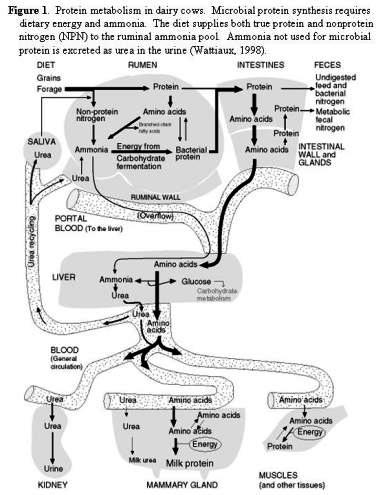
Protein nutrition of dairy cows has evolved over the decades. Initially, the approach was to determine the % or amount of dietary CP that cows needed for milk production. However, any CP consumed in excess of the cows’ requirements is excreted via urine. Thus, by feeding the cow to meet, and not exceed, her CP requirement, N excretion is reduced. The major weakness of formulating diets on a CP basis is that it ignores the type of CP consumed. For example, under this system all N in NPN sources (urea for example) is treated the same as the N in soybean meal, and clearly they are much different. The N in NPN does not include long chains of amino acids in the form of “true” protein whereas most of the N in soybean is amino-acid bound. Therefore, soybean meal contributes amino acids to both the ruminal micro-organisms and to intestinal amino acid absorption whereas NPN contributes only to the latter (Figure 1).

The goal of feeding protein to lactating cows is to support milk protein synthesis while meeting the needs for maintenance, growth and replacement of lost body protein. All proteins synthesized in the body have set amino acid patterns, so if a particular amino acid is lacking during protein synthesis, formation of that protein stops. Thus, we are not really trying to supply dietary protein to cows, we are trying to supply enough of each amino acid such that no single amino acid limits protein synthesis.

Another approach to improve upon balancing diets on a CP basis was the Burrough’s metabolizable protein system (Burroughs et al., 1975). This system considered the amount of dietary N that was solubilized in the rumen and could be used for microbial protein synthesis, a calculation that also involved the amount of TDN available to support microbial growth. To the calculated microbial protein was added the amount of dietary protein that escaped ruminal degradation. Use of ammonia and fermentable carbohydrate for microbial protein synthesis is illustrated in Figure 1. Finally, adjustment factors for digestibility and unavoidable fecal losses were applied to yield a Metabolizable Protein value. This system required knowing the amount of protein in feeds that was converted to ammonia in the rumen, the amount of feed protein that escaped ruminal breakdown, and the TDN value for the feeds. The concept was excellent but the system needed refinement.

The amount of dietary protein that is degraded in the rumen is primarily determined by characteristics of the N-containing compound (e.g., solubility and linkages) and how long it resides in the rumen (Figure 1). Residence time in the rumen, i.e. ruminal passage rate, is determined by total feed intake (the more the cow eats the faster the feed tends to move through the rumen), particle size and specific gravity (smaller, heavier particles move faster than large, light particles through the rumen), and other factors such as how quickly the microbes ferment the feed. Certain feeds are fermented faster than others (barley is fermented faster than sorghum), and feeds can be treated to reduce their rate of protein breakdown (most treatments involve lowering the protein solubility). Obviously the calculations to determine the amount of dietary protein that is degraded, or conversely undegraded, in the rumen get complicated, hence computer models tremendously speed the calculations.

Current approaches to meeting the amino acid needs of cows

First, we try to maximize microbial protein synthesis in the rumen. Microbial protein is high in LYS, and LYS is often the most limiting amino acid for milk production in feeding situations commonly found in the confined operations. Maximizing microbial protein synthesis involves supplying fermentable carbohydrates and soluble N sources to enable rapid bacterial growth. We need ammonia and other forms of soluble N to be available to the bacteria simultaneously with the fermentation of the carbohydrates so the bacteria have everything they need for growth, which includes protein synthesis (Figure 1). If the N is solubilized and degraded too quickly, much is absorbed as ammonia and subsequently excreted as urea N in urine or MUN. If too little N is solubilized in the rumen, the ammonia concentration in the ruminal fluid is too low to maximize microbial protein synthesis (Stokes et al., 1991; Clark et al., 1992). Generally, the amount of fermentable carbohydrate in the rumen is most limiting to microbial protein synthesis. Hence, the NRC (2001) predicts the yield of MCP as 0.13 x TDN (discounted), i.e., 130g MCP/kg of TDN (discounted) when RDP exceeds 1.18 x MCP yield. If the RDP intake is < 1.18 x TDN predicted MCP, then MCP is 0.85 of RDP intake. Thus, if a cow consumes 15 kg of TDN (discounted), MCP flowing to the intestine is estimated as: 15 x 0.13 = 1.95 kg.

Secondly, diets are formulated to supply amino acids for milk production by including dietary proteins that will not be completely degraded in the rumen and have a high content of the amino acids believed to be most limiting for milk production. Some feed proteins have relatively high LYS concentrations (porcine blood meal), some have relatively high MET concentrations (corn gluten meal), and some have a good balance of LYS and MET (fish meal). Thus, diets contain multiple proteins, all of which degrade at different rates in the rumen. In addition, the ruminal degradation rates for the 20 amino acids found in proteins vary substantially. Fortunately, all these data are contained in software programs so the estimated flow of feed amino acids into the small intestine is quickly calculated. Use of computer models allows us to take advantage of complementary protein and other N sources to achieve lower CP diets to achieve comparable milk yields.

Case I.

Using RDP/RUP feed data to achieve diets with a lower % CP.
Reynal and Broderick (2005) fed four diets that varied in RDP. Their diet description and results are given in Table 1. Urinary N excretion decreased about 60 g/cow/day as the % CP and % RDP decreased in the diet, however, the % milk protein also decreased. Their data suggest 11.7% RDP in ration DM as the best compromise between profitability and environmental quality.


Table 1. Effect of Percent Ruminal Degradable Protein on Dietary Components and Cow Responses
Dietary Treatments
A B C D
CP, % 18.8 18.3 17.7 17.2
RDP, % DM1 13.2 12.3 11.7 10.6
RDP, % of CP 70.2 67.2 66.1 61.6
RDP, % DM2 12.5 10.9 9.2 7.7
RUP, % DM1 5.8 6.2 6.0 6.6
RUP, % of CP 30.8 33.9 33.9 38.4
RUP, % DM2 6.3 7.4 8.5 9.5
NEL2, Mcal/lb DM 0.709 0.704 0.704 0.704
3.5% FCM, lb/d 93.1 94.2 93.3 91.3
Milk true protein, % 3.14a 3.14a 3.07b 3.04b
MUN, mg/dL 15.9a 15.6a 13.6b 12.8b
BUN, mg/dL 13.8a 14.0a 11.8b 12.4b
Ruminal NH3-N, mg/dL 12.33a 11.76a 8.68b 5.71c
Urinary N excretion, g/d 295a 293a 237b 239b
Fecal N excretion, g/d 222 220 219 197
N Efficiency
Milk N, % of N intake 29.6 29.5 30.4 30.4
lb of milk/lb of N excreted 84.5a 87.2a 94.3b 99.8b
1Measured in vivo.
2Predicted by NRC (2001) model.
abcMeans within the same row without a common superscript differ P < 0.05.


Case II.

Formulations using RUP/RDP and specific amino acids to reduce CP intake.
This concept applies RDP/RUP in predicting amino acid flows to the small intestinal tract, then adding specific amino acids to meet the cow’s requirements. The advantage is to reduce total N intake and hence, N excretion, while reducing total feed costs. Examples of using amino acid formulation to reduce CP and maintain milk yield are given below.

Example 1. VonKeyserlingk et al. (1999) formulated two diets for cows that were primarily in early lactation. The control diet was formulated according to the 1989 NRC recommendations. A second diet was formulated with the CNCPS system and included a commercial protein source and intestinally available MET source. Using a commercial protein source and “rumen by-pass” MET allowed the CP level in the grain mix to be reduced by 2.9% units and total TMR by 1% unit (Table 2).


Table 2. Diets formulated using NRC (1989) guidelines or CNCPS program.
Item NRC (1989) CNCPS
CP, % DM 18.7 17.7
ADF1, % DM 21.1 21.8
NEL, Mcal/lb 0.82 0.86
1Acid detergent fiber.

No difference was observed in DM intake or milk production between cows fed the diets formulated by the two methods (Table 3). The authors concluded that the CNCPS afforded the opportunity balance rations for reduced CP level without loss in milk production.


Table 3. Performance of dairy cows fed rations formulated by NRC (1989) guidelines or CNCPS formulation program.
Item NRC (1989) CNCPS
All cows
DMI, lb 47.4 46.6
Milk, lb 82.8 81.5
Multiparous Cows
Milk, lb 96.5 94.3
Milk fat, % 2.88 3.12
Milk protein, % 3.12 3.11
Primiparous Cows
Milk, lb 69.0 68.8
Milk fat, % 3.17 3.31
Milk protein, % 3.22 3.20

Example 2. Harrison et al. (2000) used the CPM (Cornell, Penn State, and Miner Institute) model to formulate two diets containing undegraded protein sources in the form of canola derivative or animal-marine blend. Each of these diets was estimated to be slightly deficient in LYS and MET. Two additional diets were formulated that were supplemented with a MET source and free LYS-HCl to improve the dietary supply of MET and LYS. The postpartum levels of MET and LYS in the non-supplemented diets were targeted to be at ~ 100% of the requirements (1.9% MET/MP and 6.4% LYS/MP) and 116% of MET (2.2% MET/MP) and 106% of LYS (6.6% LYS/MP) for supplemented diets. When formulating the diets, it was considered that 20 g of the commercial MET source provided 7 g of ruminal escape MET (Koenig et al.,1998) and 40 g of free LYS-HCl provided 8 g of ruminal escape LYS (Velle et al., 1998). Cows were fed the experimental diets from ~28 days before calving through week 17 postpartum. At 9 weeks post-partum, cows received rBST per label.

There tended to be increased yield of 3.5 FCM for cows fed the diet containing animal-marine bypass protein (Table 4). In early lactation, and at 14 to 17 weeks of lactation, there was an improvement in milk that appeared to be related to supplemental MET and LYS-HCl. In the early weeks of lactation (weeks 1 to 4) the MET supplemented cows fed the animal-marine blend protein source diet produced the most milk. After the beginning of rBST use (week 5), cows fed both un-supplemented diets (canola derivative and the animal-marine blend) produced more milk when supplemented with MET and LYS-HCl. A trend (P<0.14) was observed for increased milk fat percentage when the diets were supplemented with MET and LYS-HCl. These observations support the use of supplemental MET and LYS particularly during the critical need periods of early lactation and post rBST administration.


Table 4. Performance of cows fed diets containing supplemental sources of rumen undegraded amino acids.
P <
Item Treated canola protein Treated canola protein + Lys & Met Animal-marine blend protein Animal-marine blend protein + Lys & Met Pro-
tein
Suppl-
ement
Pro-
tein x Suppl
DMI, lb 48.2 48.0 48.8 47.7 NS NS NS
Milk, lb 85.4 85.6 87.1 87.3 NS NS NS
3.5 FCM, lb 86.9 87.6 89.3 91.1 0.08 NS NS
Milk fat, lb 3.08 3.12 3.19 3.28 0.03 NS NS
Milk fat, % 3.65 3.71 3.68 3.80 NS 0.14 NS
Milk protein, % 3.09 3.13 3.12 3.36 NS NS NS
Milk protein, lb 2.62 2.62 2.68 2.86 0.22 NS NS

Case III.

The importance of formulating for desired ratios of MET to LYS.
In another study (Harrison et al., 2003), researchers employed the CPM formulation model to reduce dietary CP from 18% to 16% by replacing alfalfa silage with corn silage and undegraded protein sources (Tables 5 & 6). Diet #3 was predicted to have the best ratio and supply of MET and LYS, and resulted in the highest milk yield, and ratio of milk true protein to diet protein (Table 7). The reduced milk yield of cows fed diet #2 emphasizes the need to ensure the ratio of LYS to MET is ~ 3.2 to 1. Total N import (as feed N) onto the dairy was reduced by nearly 9% and IOFC was increased 6.5% by diet #3.


Table 5. Chemical Analysis of Total Mixed Rations (% DM).
Item Diet 1 Diet 2 Diet 3 SE
CP 18.6 16.0 16.0 0.35
NDF1 38.9 41.2 44.7 1.88
Soluble CP 7.53 5.1 5.4 0.38
Soluble CP, % of CP 40.5 31.9 33.8
NFC2 31.9 34.4 30.7 2.16
1Neutral detergent fiber
2Nonfiber carbohydrate


Table 6. Diet Formulation Results from CPM
Item Diet 1 Diet 2 Diet 3
Lysine, % required 89 99 116
Methionine, % required 91 116 109
Ratio of Lys/Met 3.32 2.89 3.16
MP1 balance, g -477 -104 -117
1Metabolizable protein


Table 7. Response of cows to diets that differ in crude protein and ratio of lysine to methionine
Item Diet 1 Diet 2 Diet 3 SE P <
DMI, lb 44.9 45.1 45.1 2.97 NS
Milk, lb 78.8 77.9 82.5 5.10 NS
Milk Fat, % 3.80a 3.24b 3.79a 0.151 0.01
Milk Protein, % 3.08 3.08 3.07 0.071 NS
MUN, mg/dL 18.8a 13.0b 14.4b 0.92 0.01
CP Intake, lb/d 8.34 7.22 7.22
Milk True Protein/Feed CP 0.29 0.33 0.34
Reduction in CP imports, % 8.6 8.6
IOFC1, $/d/cow 5.49 4.64 5.85
1Income over feed costs


Case IV.

Impact of reduced dietary % CP on N excretion on a commercial dairy. A field study (Harrison et al., 2002) was conducted with a high producing herd to compare the general herd diet formulated at ~18% CP to a diet that was reformulated at ~17% (Table 8). Milk production was maintained while N imports to the farm (Tables 9 & 10) were decreased. In addition, the reformulated diet increased IOFC (Table 11). These results agree with those of Wattiaux and Karg (2004) who reported a 16% drop in urinary N when a diet with 18% CP was reformulated to 16.5% CP.


Table 8. Chemical compositions of a control diet and a reformulated diet containing supplemental amino acids.
Item Control Reformulated
CP, % DM 17.8 17.0
Soluble Protein, % DM 6.4 6.0
Soluble Protein, % CP 35.7 37.0
NDF<suo>1</sup>, % DM 32.4 32.7
NFC2, % DM 39.0 39.8
1Neutral detergent fiber
2Nonfiber carbohydrate


Table 9. Treatment response to a diet reformulated on the basis of metabolizable methionine and lysine.
Item Control Reformulated SE P <
DMI, lb 56.7 55.2
CP Intake, lb 10.1 9.4
Milk, lb 99.9 101.9 0.53 0.007
3.5 FCM, lb 96.0 96.6 0.46 0.32
Milk fat, % 3.28 3.21 0.014 0.001
Milk protein, % 2.90 2.93 0.006 0.0009
MUN, mg/dL 17.5 14.5
Milk True Protein: Intake Protein Ratio 0.285 0.316


Table 10. Effect on nitrogen excretion when a diet was reformulated on the basis of metabolizable lysine and methionine
Item Control Reformulated % Change
N intake, g/d 734 680 -7.4
Milk total N, g/d1 240 246 +2.5
Predicted Urinary N, g/d2 289 239 -17.3
Calculated Fecal N, g/d3 205 195 -5.0
1(Milk True Protein/6.38) X 1.17
2Urinary N (g/d) = 0.026 x BW (kg) X MUN (mg/dL); J Dairy Sci. 85:227-233.
3Fecal N = Intake N – Milk N – Urine N


Table 11. Economic impact of reformulating a diet on the basis of metabolizable lysine and methionine
Item Control Reformulated
Feed Costs, $/d/cow 4.82 4.88
Milk Income, $/d/cow 11.92 12.10
IOFC1, $/d/cow 7.10 7.22
1IOFC = Income over feed costs


Summary

Reducing CP intake of high-producing cows can be achieved by strategic use of undegraded protein sources and amino acids (LYS and MET) under a variety of diet conditions. Diet reformulations can reduce N excretions by ~10% without negatively affecting milk yield or IOFC. These successes require the use of ration balancing software that estimate the amino acid (MET and LYS especially) needs of the lactating cow. Use of undegraded protein sources that have dependable concentrations of amino acids is critical to achieve consistent production responses.


RUP Fig 1.jpg


Selected References

Burroughs, W., D.K. Nelson, and D.R. Mertens. 1975. Evaluation of protein nutrition by metabolizable protein and urea fermentation potential. J. Dairy Sci. 58:611-619.

Clark, J.H., T.H. Klusmeyer, and M.R. Cameron. 1992. Symposium: Nitrogen metabolism and amino acid nutrition in dairy cattle: Microbial protein synthesis and flows of nitrogen fractions to the duodenum of dairy cows. J. Dairy Sci. 75:2304-2323.

Harrison, J.H., D. Davidson, L. Johnson, M.L. Swift, M. VonKeyserlingk, M. Vazquez-Anon, and W. Chalupa. 2000. Effect of source of bypass protein and supplemental Alimet and lysine-HCl on lactation performance. J. Dairy Sci. 83(suppl 1):268.

Harrison, J.H., D. Davidson, J. Werkhoven, A. Werkhoven, S. Werkhoven, M. Vazquez-Anon, G. Winter, N. Barney, and W. Chalupa. 2002. Effectiveness of strategic ration balancing on efficiency of milk protein production and environmental impact. J. Dairy Sci. 85(suppl.1):205.

Harrison, J.H., R.L. Kincaid, W. Schager, L. Johnson, D. Davidson, L.D. Bunting, and W. Chalupa. 2003. Strategic ration balancing by supplementing lysine, methionine, and Prolak on efficiency of milk protein production and potential environmental impact. J. Dairy Sci. 86(Suppl 1):60.

Koenig, K.M., L.M. Rode, C.D. Knight, and P.R. McCullough. 1999. Ruminal escape, gastrointestinal absorption, and response of serum methionine to supplementation of liquid methionine hydroxyl analog in dairy cows. J. Dairy Sci. 82:355.

NRC. 1989. National Research Council. Nutrient Requirements of Dairy Cattle. Vol. 6th rev. ed. Natl. Acad. Sci., Washington, DC.

NRC. 2001. National Research Council. Nutrient Requirements of Dairy Cattle. Vol. 7th rev. ed. Natl. Acad. Sci., Washington, DC.

Reynal, S.M. and G.A. Broderick. 2005. Effect of dietary level of rumen-degraded protein on production and nitrogen metabolism in lactating dairy cows. J. Dairy Sci. 88:4045-4064.

Stokes, S.R., W.H. Hoover, T.K. Miller, and R. Blauweikel. 1991. Ruminal digestion and microbial utilization of diets varying in type of carbohydrate and protein. J. Dairy Sci. 74:871-881.

Tamminga, S. 1992. Nutrition management of dairy cows as a contribution to pollution control. J. Dairy Sci. 75:345-357.

Velle W., T.I. Kanui, A. Aulie, and O.C. Sjaastad. 1998. Ruminal escape and apparent degradation of amino acids administered intraruminally in mixtures to cows. J. Dairy Sci. 81:3231-3238.

VonKeyserlingk, M.A.G., M.L. Swift, and J.A. Shelford. 1999. Use of the Cornell Net Carbohydrate and Protein System and rumen-protected methionine to maintain milk production in cows receiving reduced protein diets. Can. J. Anim. Sci. 79:397-400.

Wattiaux, M. A. 1998. Protein metabolism in dairy cows. In: Technical Dairy Guide—Nutrition, 2nd edition. The Babcock Institute for International Dairy Research and Development. The University of Wisconsin.

Wattiaux, M.A and K.L. Karg. 2004. Protein level for alfalfa and corn silage-based diets: II. Nitrogen balance and manure characteristics. J. Dairy Sci. 87:3492-3502.

“Extension programs and policies are consistent with federal and state laws and regulations on nondiscrimination regarding race, sex, religion, age, color, creed, national or ethnic origin; physical, mental or sensory disability; marital status, sexual orientation, or status as a Vietnam-era or disabled veteran. Evidence of noncompliance may be reported through your local Extension office.”


Disclaimer

This fact sheet reflects the best available information on the topic as of the publication date. Date 6-20-2006

This Feed Management Education Project was funded by the USDA NRCS CIG program. Additional information can be found at Feed Management Publications.

Image:Feed mgt logo4.JPG

This project is affiliated with the Livestock and Poultry Environmental Learning Center.

Image:usda,nrcs,feed_mgt_logo.JPG

Project Information

Detailed information about training and certification in Feed Management can be obtained from Joe Harrison, Project Leader, jhharrison@wsu.edu, or Becca White, Project Manager, rawhite@wsu.edu.

Author Information

R. L. Kincaid rkincaid@wsu.edu
J. H. Harrison
R. A. White
Washington State University

Reviewer Information

Floyd Hoisington – Consulting Nutritionist

Michael Wattiaux – University of Wisconsin

Partners

Image:Logos2.JPG

Grouping Dairy Cows

Introduction

This fact sheet has been developed to support the implementation of the Natural Resources Conservation Service Feed Management 592 Practice Standard. The Feed Management 592 Practice Standard was adopted by NRCS in 2003 as another tool to assist with addressing resource concerns on livestock and poultry operations. Feed management can assist with reducing the import of nutrients to the farm and reduce the excretion of nutrients in manure.

The trend over the past 15 years has been to feed a single total mixed ration to the dairy herd. Higher producing cows have a greater dry matter intake and, therefore, receive more nutrients daily. Unfortunately, most feeding systems consequently over-feed lower producers to assure that higher producers receive enough feed of the correct concentration of nutrients. Feeds are usually inexpensive compared to the return generated by milk sales, and the results of this feeding practice were higher production at a moderate cost.

Surveys of milk production versus nutrient consumption done regionally around the United States have shown significant over-feeding of protein and phosphorus on dairy farms. In some cases, rations provided as much as 50% more phosphorus than needed for the herd’s production level. Certainly, these high levels can be reduced through the choice of feed ingredients and more precise mineral feeding, however producers want assurance their cows have adequate nutrients for optimum milk production. There is a middle ground where producers can feed for optimum performance while meeting the demands of changing environmental constraints.

Dividing the herd into two or three feeding groups allows tailoring rations more closely to the production level and nutrient requirements of the group. By feeding more cows more closely to their requirements, a producer can reduce waste and the excretion of excess nitrogen and phosphorus.

Please check this link first if you are interested in organic or specialty dairy production

The Basics of Grouping Cows

Obviously, a dairy farm must have facilities so cows can be divided into multiple groups. The size of the groups are influenced by the size of the milking parlor, the barns or corrals available for housing the cows, other grouping currently done (dry cows, heifers), and the ability to deliver different rations to different groups of cows. Furthermore, the average age of the herd, average days in milk, and reproductive goals (AI, bull bred, etc.) are all factors that must be considered.

There are many schemes for deciding which cows to group together. Some producers group cows by days in milk or where they are in the production curve. This method is roughly equal to grouping by daily milk production, but some cows produce twice as much daily milk as other cows at the same point in the lactation cycle. Other farms group according to the cows’ reproductive status. Higher producing, early lactation cows are usually not bred so putting them together in a group allows feeding for the higher production and for more efficient heat detection and artificial insemination. However, not all early lactation cows produce at the same level. The most successful way to group cows has been shown to be selecting cows based on the nutrients required per pound of feed; for example nutrients such as crude protein, starch, sugar, fiber, fat, vitamins, and minerals. While directly related to daily milk production, it is a more precise way to feed cows what they need without waste and over-excretion of nutrients (Williams, 1992).

It appears that feeding in three groups produces higher income over feed costs than feeding two groups and group feeding in two groups results are better than one group feeding (Williams, 2002). A California survey showed feeding three groups reduced nitrogen excretion by 15% over herds feeding a one-group TMR (Castillo, 2000).

Why not then?

There are some important considerations when grouping cows for more efficient use of feed nutrients. It takes professional help to formulate rations for and to monitor the performance of different production groups. A nutritionist can also help monitor the quality of feed ingredients used in rations.

All feeds vary in nutrient content load to load and throughout storage. Table 1 shows the mean content of protein and net energy-lactation of common feeds in the northeastern U.S. It also shows the standard deviation derived from the group of feed samples. Adding and subtracting the standard deviation from the mean shows the range in nutrient content for two-thirds of the samples. The other third of the samples tested outside of this range. For example, the mean corn silage contained 7.9% crude protein, and had a standard deviation of 1.3%. This means that two-thirds of the samples tested between 6.6% and 9.2% CP, so one-third tested either greater or less than that range. A ration formulated to supply 6.1 pounds of protein to support the average milk production of the group could be as low as 5.5 pounds and this would result in a loss of almost 7 pounds of milk per day.

Table 1. Mean composition and standard deviation of Crude Protein and Net Energy Lactation of some feedstuffs used in the northeastern US.
  Crude Protein % NEL (Mcal/kg)
Ingredients Mean S.D. Mean S.D.
  ———-% of dry matter———-
Mixed hay 15.9 2.9 1.25 0.18
Mixed haylage 15.6 3.2 1.15 0.20
Corn silage 7.9 1.3 1.50 0.15
Ground ear corn 9.4 1.6 1.85 0.07
  ————% as fed————-
Brewers dried grains 25.4 2.0 1.47 0.07
Corn gluten feed 20.9 1.3 1.72 0.08
Corn gluten meal 63.5 4.1 1.81 0.09
Corn grain 9.1 0.5 1.78 0.04
Distillers dried grains 27.5 2.5 1.86 0.11
Feather meal 85.3 1.8 1.48 0.02
Meat and bone meal 50.8 2.9 1.51 0.09
Molasses 3.2 0.3 1.23 0.02
Soybean meal (Solvent) 49.5 1.2 1.81 0.05
Wheat Grain 15.3 0.9 1.81 0.04

How can the risk of nutrient variation be controlled? Nutrients can be over-fed, but that defeats the point of grouping for more efficiency and results in more nutrients excreted. Formulating rations with multiple sources of protein and energy can reduce the risk because it is unlikely that all sources would vary on the low side at one time. Blending single commodities can help as well. One truck load of corn taken from storage containing multiple loads of corn will vary less than a single source. (St. Pierre, 1999). Therefore, receiving larger quantities (train car load vs. truck load) of a single ingredient is best if inventory control, purchasing, and transportation will allow.

Testing all feeds is important in managing the variation of feedstuffs. Notice that forages vary the most so they must be monitored closely. Experienced managers and researchers suggest the following testing schedule (St. Pierre, 1999):

All feeds – Protein, fat, fiber, minerals at purchase or harvest
Forages – weekly for moisture, monthly for protein, fiber (more often if fed quickly)
TMRs – monthly for particle size before and after eating
All feeds – four times a year for macrominerals
Silages – twice a year for VFAs and pH

One obvious way to control variation in the quality of feedstuffs is to reduce or eliminate the use of the feeds most prone to large variations.

Group Feeding Strategies

When feeding groups of cows, nutrients are provided to the average daily production of the group. The average cow in each of three groups is closer in production to her group-mates than the average cow is to the entire herd. However, by feeding the average cow in the group, rations will be inadequate for the higher producing cows in the group. Higher dry matter intake will make up for some of the shortage, but most managers will “lead feed” the group to supply necessary nutrients to the top half of the group. Lead feeding factors have been developed through trial and error and by research using commercial dairy herds. One rule of thumb to lead feeding was to feed the average cow plus one standard deviation of the variation in the group. If the average for a group is 70 pounds/cow-day and the standard deviation in the group is 5 pounds; the herd would be fed for 75 pounds per day. This works when production variation is small due to many production groups. When feeding two or three groups, researchers in Virginia and Ohio have developed lead factors as shown in Table 2.

Table 2. Optimum ration lead factors for energy and protein proposed by The Ohio State University and those proposed by McGilliard et al. at V. P. I.
    Lead factors
Number of Groups Group # NE1% CP% V. P. I.%
1 Group   133 126 132
2 Groups 1 Highs 119 113 117
2 Lows 130 125 123
3 Groups 1 Top 115 111 114
2 Middle 121 117 110
3 Lows 129 124 121

Notice two things: 1.) Lead factors are different for protein and energy in the Ohio work, 2.) The level of lead feeding over the entire herd can be reduced when feeding more production groups. In a three group dairy, the top string would be fed 115% of the average nutrient requirement based on energy in the Ohio system or 114% of average in the VPI system.

In summary, grouping cows can be part of a total feed management program to reduce waste and the excretion of unused nutrients. Grouping cows by production level or stage of lactation is most common. In addition, grouping cows is beneficial for dairy producers because it helps control feed costs. It promotes feeding valuable nutrients to benefit cows at different stages of lactation and results in optimum efficiency, productivity, and profitability.

References

Castillo A.R., E. Kebreab , D.E.Beever and J. France. 2000. A review of efficiency of nitrogen utilization in dairy cows and its relationship with the environmental pollution. J. Anim. and Feed Sci. 9:1-32.

Castillo. A.R., E. Kebreab, D.E. Beever, J.H. Barbi, J.D. Sutton, H.C. Kirby and J. France. 2001. The effect of protein supplementation on nitrogen utilization in lactating dairy cows fed grass silage diets. J. Anim. Sci. 79:247-253.

Dou, Z., R.A. Kohn, J.D. Ferguson, R.C. Boston, and J.D. Newbold. 1996.Managing nitrogen on dairy farms: an integrated approach I. Model description. J. Dairy Sci. 79:2071-2080.

Grant, R.J. and J.L. Albright. 2001. Effect of Animal Grouping on Feeding Behavior and Intake of Dairy Cattle. J. Dairy Sci. 84(E.Suppl.):E156-E163. McGilliard, M.L, J.M. Swisher, and R.E. James. 1983. Grouping lactating cows by nutritional requirements for feeding. J.Dairy Sci. 66:1084-1093.

Sniffen C.J., R.W. Beverly, C.S. Mooney, M.B. Roe and A.L. Skidmore. 1993. Nutrient requirement versus supplied in the dairy cow: strategies to account for variability. J. Dairy Sci. 76:3160-3169.

Sniffen C.J. 1991. Grouping management and physical facilities. Vet. Clin. North Am. Small Anim. Pract. 7:465-478.

St-Pierre, N.R. and C.S. Thraen. 1999. Animal Grouping Strategies, Sources of Variation, and Economic Factors Affecting Nutrient Balance on Dairy Farms. J. Dairy Sci. 82 (Suppl. 2):72-83.

Williams, C.B. and P.A. Oltenacu. 1992. Evaluation of Criteria Used to Group Lactating Cows Using a Dairy Production Model. J.Dairy Sci. 75:155-160.

“Extension programs and policies are consistent with federal and state laws and regulations on nondiscrimination regarding race, sex, religion, age, color, creed, national or ethnic origin; physical, mental or sensory disability; marital status, sexual orientation, or status as a Vietnam-era or disabled veteran. Evidence of noncompliance may be reported through your local Extension office.”


Disclaimer

This fact sheet reflects the best available information on the topic as of the publication date. Date 6-20-2006

This Feed Management Education Project was funded by the USDA NRCS CIG program. Additional information can be found at Feed Management Publications.

Image:Feed mgt logo4.JPG

This project is affiliated with the LPELC.

Image:usda,nrcs,feed_mgt_logo.JPG

Project Information

Detailed information about training and certification in Feed Management can be obtained from Joe Harrison, Project Leader, jhharrison@wsu.edu, or Becca White, Project Manager, rawhite@wsu.edu.

Author Information

Mike Gamroth
Extension Dairy Specialist
Oregon State University

Reviewer Information

Tamilee Nennich – Texas A & M

Vince Waters – Consulting Nutritionist

Partners

Image:Logos2.JPG


An Introduction to Natural Resources Conservation Service (NRCS) Feed Management Practice Standard 592

Printer friendly version

Introduction

This factsheet has been developed to support the implementation of the Natural Resources Conservation Service (NRCS) Feed Management 592 Practice Standard. The Feed Management 592 Practice Standard was adopted by NRCS in 2003 as another tool to assist with addressing resource concerns on livestock and poultry operations. Feed management can assist with reducing the import of nutrients to the farm and reduce the excretion of nutrients in manure.

Please check this link first if you are interested in organic or specialty dairy production

Why Is Feed Management Important?

Feed represents the largest import of nutrients to the farm, followed by commercial fertilizer CAST Issue Paper # 21 – Animal Diet Modification to Decrease the Potential for Nitrogen and Phosphorus Pollution. Feed management practices impact the amount of nutrients that are imported to the farm and excreted in manure. The excreted nutrients are subsequently available for volatile loss (nitrogen) to the atmosphere and are potentially lost via surface runoff (nitrogen and phosphorus) or leached to groundwater (nitrogen and phosphorus).

Feed management opportunities currently exist to reduce imports of nutrients (particularly nitrogen and phosphorus) to most animal livestock and poultry operations. Because consulting nutritionists play such a key role with regard to importation of nutrients to the farm, a systematic approach to evaluate the role that feed management has on whole-farm nutrient management is warranted.

What Is the NRCS Standard 592?

The NRCS Feed Management Practice Standard is defined as “managing the quantity of available nutrients fed to livestock and poultry for their intended purpose.” The purposes of the 592 standard are:

  • To supply the quantity of available nutrients required by livestock and poultry for maintenance, production, performance, and reproduction, while reducing the quantity of nutrients, especially nitrogen and phosphorus, excreted in manure by minimizing the overfeeding of these and other nutrients
  • To improve net farm income by feeding nutrients more efficiently

The ultimate goal of utilizing the Feed Management Practice Standard 592 is to develop a farm-specific Feed Management Plan, or FMP. A five-step process has been adopted for the development and implementation of a FMP.

Implementing a FMP as outlined in NRCS Feed Management Practice Standard 592 can be expected to have the following environmental benefits:

  1. Reduce on-farm import of nutrients
  2. Reduce nutrients in manure for subsequent land application and potential loss to ground and surface water
  3. Reduce nutrients in manure and subsequent volatile losses
Feed mgmt flow.jpg


A complete copy of the national version of NRCS Feed Management 592 Practice Standard can be found at the end of this publication. Please check your state-specific version of the standard.


Ten Reasons to Implement a Systematic Approach to Feed Management

There are a number of reasons for consulting nutritionists and ARPAS members to consider the adoption of a systematic approach to feed management. Following are our Top 10:

  1. Society demands animal agriculture to be environmentally responsible.
  2. Many farms are in a positive import-export balance for nitrogen and phosphorus, even when losses of nitrogen are considered.
  3. Feed is the primary import of nutrients on most livestock and poultry farms.
  4. Adopting feed management practices is proactive toward becoming sustainable.
  5. Feed management is an additional practice that can assist in the mitigation of nutrient buildup.
  6. There is an ethical obligation for nutritionists to consider a systematic feed management program to reduce import of nutrients to the farm.
  7. Agriculture should get credit for practices already implemented. Adoption of NRCS feed management is an option, not mandated.
  8. Adopting Feed Management 592 can likely increase profitability.
  9. Adopting Feed Management 592 can result in incentive payments to the producer and consultant.
  10. Adopting Feed Management 592 provides a nutritionist the opportunity to increase his or her suite of services to producers.


Text of the 592 Standard

Natural Resources Conservation Service Conservation Practice Standard
Feed Management
(No. of Systems and AUs Affected)
CODE 592

Definition

Managing the quantity of available nutrients fed to livestock and poultry for their intended purpose.

Purpose

  • To supply the quantity of available nutrients required by livestock and poultry for maintenance, production, performance, and reproduction, while reducing the quantity of nutrients, especially nitrogen and phosphorus, excreted in manure by minimizing the over-feeding of these and other nutrients
  • To improve net farm income by feeding nutrients more efficiently

Conditions Where Practice Applies

  • Confined livestock and poultry operations with a whole-farm nutrient imbalance, with more nutrients imported to the farm than are exported and/or utilized by cropping programs
  • Confined livestock and poultry operations that have a significant buildup of nutrients in the soil due to land application of manure
  • Confined livestock and poultry operations that land apply manure and do not have a land base large enough to allow nutrients to be applied at rates recommended by soil test and utilized by crops in the rotation
  • Livestock and poultry operations seeking to enhance nutrient efficiencies

Criteria

General Criteria Applicable to All Purposes

The diets for specific species of animals shall be developed in accordance with recommendations from one of the following:

  • Standards outlined in the most current recommendations of the National Research Council (NRC).
  • Recommendations of the land-grant university.
  • Standards developed by the professional nutritionists of livestock and poultry production companies, feed companies, and/or feed suppliers. Laboratory analysis shall be done on the formulated diet or on the feed ingredients used to formulate the diet, to determine its nutrient content.
  • Feed analyses by laboratories whose tests are accepted by the land-grant university in the state in which the feeding strategy will be implemented. Data from analyzed feed ingredients and/or appropriate historic feed analysis. information for the operation will be used for adjustments of ration formulation.
  • Diets and feed management strategies developed by professional animal scientists, independent professional nutritionists, or other comparably qualified individuals. When required by state policy or regulation, animal nutritionists shall be certified through any certification program recognized within the state.
  • Diets shall be formulated to provide the quantities and correct relative ratios of available nutrients required by the animal species to meet species goals for which the plan is being developed.
  • Adjustments to nutrient levels shall be provided to meet specific genetic potential, environmental demands, and/or requirements to insure health, well-being and productivity.

One or more of the following feed management practices and/or diet manipulation technologies shall be used to reduce nitrogen, phosphorus, and other excreted nutrients while maintaining the health, well-being and productivity of the animal:

  • Formulating diets closer to animal requirements
  • Reducing protein and supplementing with amino acids (nonruminants)
  • Manipulating the crude protein and energy (carbohydrate and fat) content of the diet to enhance the availability of amino acids (ruminants)
  • Using highly digestible feeds, as appropriate, in the diet
  • Using phytase and reducing the supplemental phosphorus content of the diet (nonruminants)
  • Reducing the phosphorus content of the diet of ruminants when it is being overfed
  • Using selected enzymes or other products to enhance feed digestibility or feed use efficiency
  • Using growth promotants as allowed by law
  • Implementing phase feeding
  • Implementing split-sex feeding
  • Using other feed management or diet manipulation technologies that have demonstrated the ability to reduce manure nutrient content

When analysis of manure is done to determine manure nutrient content, the analysis shall be performed by laboratories whose results are accepted by the land-grant university in the state in which the feeding strategy was implemented.

Considerations

Consider nutrient requirements for production based upon stage of growth, intended purpose of the animal, and the type of production (e.g., meat, milk, eggs) involved.

  • Use management practices described in the NRCS Nutrient Management (Feed Management) Technical Notes for the specific animal species.
  • Analyze the drinking water consumed by the animals to determine its nutrient content, and adjusting the diet to account for this source of nutrients.
  • Different feed ingredients (e.g. by- products) and their potential impacts on the nutrient content of excreted manure.
  • The potential impact of feed management on the volume of manure excreted and on manure storage requirements.
  • The impact of feed management practices, animal management practices, and diet manipulation on manure odors, pathogens, animal health and well-being.
  • Using concentrates and forages grown on the farm to minimize the quantity of nutrients imported to the farm, and to maximize the recycling of nutrients on the farm.
  • Analyzing excreted manure or manure from storage facilities to determine manure nutrient content and to estimate the impact of the feeding strategy.

Plans and Specifications

Plans and specifications for feed management shall be in keeping with the requirements of this standard. They shall describe the specific feed management practices and/or technologies that are planned for the operation. The following components shall be included in the feed management plan:

  • The type of technology, or technologies, and/or feeding practices that will be used on the operation
  • Feed analyses and ration formulation information prior to and after implementation of feed management on the operation
  • The estimated, or measured, nutrient content of the manure prior to the implementation of feed management on the operation
  • The estimated impact that feed management will have on manure nutrient content
  • Guidance for how often the feed management plan shall be reviewed and potentially revised
  • The quantities and sources of nitrogen and phosphorus that will be fed
  • Identification of the qualified feed management specialist who developed the plan.

Operation and Maintenance

The producer/client is responsible for the operation and maintenance of the feed management plan. Operation and maintenance activities address the following:

  • Periodic plan review to determine if adjustments or modifications are needed
  • Routine feed analysis to document the rates at which nitrogen and phosphorus were actually fed; when actual rates fed differ from or exceed the planned rates, records will indicate the reasons for the differences.
  • Maintaining records to document plan implementation. As applicable, records include:
    • Records of feed analysis and ration formulation, including the record of ration formulation used prior to implementing the feeding strategy
    • Records of the initial estimate of the impact the feeding strategy was expected to have on reducing manure nutrient content
    • Records of any manure analysis that was done after the feeding strategy was implemented to determine manure nutrient content
    • Dates of review and person performing the review and any recommendations that resulted from the review.

Records of plan implementation shall be maintained for five year, or for a period longer than five years if required by other federal, state, or local ordinances, program, or contract requirements.


Disclaimer

This factsheet reflects the best available information on the topic as of the publication date. Date 4-12-2007

This Feed Management Education Project was funded by the USDA NRCS CIG program. Additional information can be found at Feed Management Publications. Image:Feed mgt logo4.JPG

This project is affiliated with the Livestock and Poultry Environmental Learning Center.

Image:usda,nrcs,feed_mgt_logo.JPG

Project Information

Detailed information about training and certification in feed management can be obtained from Joe Harrison, project leader, jhharrison@wsu.edu, or Becca White, project manager, rawhite@wsu.edu.

Author Information

J. H. Harrison, Washington State University, jhharrison@wsu.edu
R. A. White, Washington State University
A. Sutton and Todd Applegate, Purdue University
Galen Erickson, University of Nebraska
R. Burns, Iowa State University

Partners

Logos2.JPG


Acknowledgements

This Feed Management Education Project was funded by the USDA NRCS CIG program. Additional information can be found at Feed Management Publications.
This project is affiliated with the Livestock and Poultry Environmental Learning Center

usda,nrcs,feed_mgt_logo.JPG


“Extension programs and policies are consistent with federal and state laws and regulations on nondiscrimination regarding race, sex, religion, age, color, creed, national or ethnic origin; physical, mental or sensory disability; marital status, sexual orientation, or status as a Vietnam-era or disabled veteran. Evidence of noncompliance may be reported through your local Extension office.”


Direct Fed Microbial Products (DFM)

Printer friendly version

Introduction

This fact sheet has been developed to support the implementation of the Natural Resources Conservation Service Feed Management 592 Practice Standard. The Feed Management 592 Practice Standard was adopted by NRCS in 2003 as another tool to assist with addressing resource concerns on livestock and poultry operations. Feed management can assist with reducing the import of nutrients to the farm and reduce the excretion of nutrients in manure.

The concept of Direct Fed Microbial (DFM) involves the feeding of beneficial microbes to dairy cattle when they are under periods of stress (disease, ration changes, environmental, or production challenges). Probiotics is another term for this category of feed additives. Probiotics or DFM have been shown to improve animal performance in controlled studies. In this section, we will evaluate bacterial additives (not fungal or yeast-based products).

Please check this link first if you are interested in organic or specialty dairy production

Role of Direct Fed Microbials

The proposed mechanisms for improvement in dairy cattle performance when feeding DFM are outlined below.

  • Produce of anti-bacterial compounds (acids, bacteriocins, or antibiotics)
  • Compete against undesirable (pathogenic) organisms for nutrients and/or colonization of the digestive tract (competitive exclusion)
  • Produce nutrients or other growth factors
  • Stimulate production of enzymes and/or stimulate growth of natural bacteria
  • Metabolize or detoxify undesirable compounds (such lactic acid, mycotoxins, etc.)
  • Stimulate the immune system

Several studies the have reported positive animal performance when using a combination of several microbial species listed in Table 1.

The mode action and dosages of many bacterial species are given in Table 2. For example, Lactobacillus acidophilis produces lactic acid that may lower the pH in the small intestine thereby inhibiting the growth of undesirable microbes (pathogens). Calves that have been stressed (i.e. weaning, scouring, and shipping challenges) have responded quite favorability to large doses of Bifidobacterium, Enterococcus, Bacillus, and Lactobacillus. Megasphaera elsdenii is a major lactate utilizing organism found in the rumen of cattle fed high grain diets. Feedlot producers have used DFM when adapting cattle to high energy diets thereby reducing lactic acidosis. Applications in high producing cows are being explored in the field. Propionibacteria have the ability to convert lactic acid and glucose to acetic and propionic acid thereby potentially improving the energy status of early lactation cows. Similar results have been demonstrated in beef cattle through improved feed efficiency. Certain species of bacteria can reduce/detoxify nitrates in the ration.

Practical Considerations

The bacteria in DFM products must be alive to impact ruminal fermentation or lower gut responses. Thus, the viability and number of organisms fed must be ensured at the time of feeding to ensure performance responses. The use of DNA figure printing offers an approach to select the optimal strain(s) of bacteria to ensure optimal animal performance. Some products have guaranteed levels (i.e. 1 x 10⁶ – 10 CFU/g) of micro-organisms in the product to achieve animal performance.

The method of delivery of these products can vary from powders, pastes, boluses, to capsules using feed or water as carriers. If water is used, chlorination, temperature, minerals, flow rates, ionophores, and antibiotics must be considered to avoid killing or reducing the effectiveness of the DFM product. For example, the approval of monensin, which targets gram positive bacteria in the rumen, may result in certain DFM products being less effective due to the microbials being affected by monensin. Producers and nutritionists need to ask for controlled studies demonstrating the use of a particular DFM product in combination with monensin. Some DFM products may require a higher feeding rate or dosage to “seed down” the digestive tract for several days to out compete pathogenic bacteria followed by reducing the feeding rate to achieve a maintenance rate.

The ability of DFM to survive feed processing, especially pelleting, should be requested for each product. In addition, viability data during prolonged feed storage and stability when mixed with low pH silages in the bunk for several hours should be requested. The viability of DFM products in the market place has improved over the years, but follow manufacturers directions concerning heat, oxygen exposure, and moisture to ensure product performance and ultimately animal performance.

Summary

At this time, most nutritionists are “cautious” when adding DFM. However, the success in controlled and field studies has demonstrated improvements in animal performance. The use of DFM’s in milk fed calves seems to warrant the inclusion of a DFM product until dry matter intake of starter is over two pounds per calf per day. The inclusion of DFM products in drench products administered to off-feed cows, cows treated with high levels of antibiotics for various diseases, and those cows under stress would appear to be warranted. At this point, ask for data on animal performance responses to DFM products, evaluate the type and number of microbes added, and follow handling guidelines to ensure product performance and ultimately animal performance.

Table 1. Effects of bacterial DFM on dry matter intake, milk yield, and milk composition in lactating dairy cows in five studies (Krehbiel et al.).
Treatment number Milk (lb/day) Fat (%) Protein (%) DMI (lb)
Control
L. acidophilis (BT1386)
16
16
64.0a
68.0b
3.81
3.75
3.34
3.36
na
na
Control
L. acidophilis (BT1386)
550
550
70.0a
73.9b
3.64
3.63
na
na
46.6
47.1
Control**
Yeast culture
L. acidophilis + yeast culture
6
6
6
18.0a
20.5b
20.4b
3.30a
3.96b
3.57b
3.09
3.15
3.13
na
na
na
Control
Yeast + L. plantarum and E. faecium
32
32
106.0
108.0
na
na
3.01a
3.27b
54.1
55.2
Control
L. acidophilis, L. casei, E. faecium + Mannanoligosaccharide
100
100
85.4
87.1
4.24
4.34
3.02
3.04
55.0
54.1
abMeans in columns differ (P < 0.05)
**Tropical feeding conditions


Table 2. Bacteria with potential use as DFM (Kung, 2001).
Source Strain Dose Effect
Megashrera
elsdenii
B1459
407A
8.7 x 10⁶ Prevent lactic acidosis when diets change to higher fermented CHO
Lactobacillus
acidophilis
na 1 x 10⁹ Increase milk yield when feed intake depressed and under stress
Propionibacteria
and L. acidophilis
P-63
5345
1 x 10⁹
1 x 10⁸
Improve feed efficiency during adaption to higher CHO diet
Propionibacterium
Freudenrechii and L.
acidophilis (B2FFO4)
na 1 x 10⁹
1 x 10⁸
Improve feed efficiency
Propionibacterium
acidipropionic
DH42 1 x 10⁹ Increased propionic acid
Propionibacterium
Freudenrechii plus lactobacilli
na na Improve weight gain in calves

Selected References

  • Hutjens, M.F. 2005. Feed additives in dairy nutrition, an industry and farm perspective. New England Nutrition Conf. Proc. p. 82-88.
  • Hutjens, M. F. 1991. Feed additives. Vet Clinics North Am.: Food Animal Practice. 7:2:525.
  • Krehbiel, C.R., S.R. Rust, G.Zhand, and S.E. Gilliand. 2003. Bacterial direct-fed microbials in ruminant diets: Performance response and mode of action. J. Anim Sci (E.Suppl.2):E120-E132.
  • Kung, L. Jr. 2001. Direct-fed microbials for dairy cows and enzymes for lactating dairy cows: New theories and applications. Penn State Dairy Cattle Workshop Proc. Pp. 86-102.
  • National Research Council. 2001. Nutrient Requirement of Dairy Cattle, 7th edition. National Academy Press. Washington, D.C. p. 192.
  • Yoon, I.K. and M.D. Stern. 1995. Influence of direct-fed microbials on rumenal microbial fermentation and performance of ruminants: A review. J. Animal Sci. 8:6:533

“Extension programs and policies are consistent with federal and state laws and regulations on nondiscrimination regarding race, sex, religion, age, color, creed, national or ethnic origin; physical, mental or sensory disability; marital status, sexual orientation, or status as a Vietnam-era or disabled veteran. Evidence of noncompliance may be reported through your local Extension office.”


Disclaimer

This fact sheet reflects the best available information on the topic as of the publication date. Date 5-27-2007

This Feed Management Education Project was funded by the USDA NRCS CIG program. Additional information can be found at Feed Management Publications.

Image:Feed mgt logo4.JPG This project is affiliated with the Livestock and Poultry Environmental Learning Center.

Image:usda,nrcs,feed_mgt_logo.JPG

Project Information

Detailed information about training and certification in Feed Management can be obtained from Joe Harrison, Project Leader, jhharrison@wsu.edu, or Becca White, Project Manager, rawhite@wsu.edu.

Author Information

Michael F. Hutjens
Department of Animal Sciences
University of Illinois, Urbana
hutjensm@uiuc.edu

Reviewer Information

Dave Casper – Agri-King, Inc.
Jim Drackley – University of Illinois

Partners

Logos2.JPG


Five Steps to the Development and Implementation of a Feed Management Plan

Printer friendly version

Introduction

This fact sheet has been developed to support the implementation of the Natural Resources Conservation Service Feed Management 592 Practice Standard. The Feed Management 592 Practice Standard was adopted by NRCS in 2003 as another tool to assist with addressing resource concerns on livestock and poultry operations. Feed management can assist with reducing the import of nutrients to the farm and reduce the excretion of nutrients in manure.

The Natural Resources Conservation Service has adopted a practice standard called Feed Management (592) and is defined as “managing the quantity of available nutrients fed to livestock and poultry for their intended purpose”. The national version of the practice standard can be found in a companion fact sheet entitled “An Introduction to Natural Resources Feed Management Practice Standard 592”. Please check in your own state for a state-specific version of the standard.

The national Feed Management Education team has developed a systematic 5-step development and implementation process for the Feed Management Practice Standard as shown in figures 1 and 2. The steps of the flow diagram were chosen to coincide with the sections of the Feed Management Practice Standard. The first step focuses on defining the purpose(s) for considering the Feed Management Standard on a particular farm, either to: 1) feed to minimize excess nutrients in manure while maintaining production, performance, and reproduction, or 2) feed to improve net farm income by feeding more efficiently.

Please check this link first if you are interested in organic or specialty dairy production

Why Consider Feed Management?

The first step focuses on defining the purpose(s) for considering the Feed Management Standard on a particular farm, either to: 1) feed to minimize excess nutrients in manure while maintaining production, performance, and reproduction, or 2) feed to improve net farm income by feeding more efficiently.

Key participants at step 1 would be the producer, the nutrient management planner, and NRCS staff.

Where Does the Practice Apply?

The second step of the flow diagram focuses on identifying the conditions where the practice applies and making an initial assessment of the opportunity for the full development of a Feed Management Plan. The conditions where the practice applies as noted the in 592 standard include:

  1. Whole farm imbalance
  2. Soil nutrient build-up
  3. Land base not large enough, or
  4. Seeking to enhance nutrient efficiencies.

After defining the condition(s) for use of the 592 standard, an opportunity checklist is then used make an initial assessment of developing a complete feed management plan. The opportunity checklist can be found in a companion fact sheet entitled “Use of the Opportunity Checklist in Feed Management Plan Development”. The Opportunity Checklist can be found in species specific versions for beef, dairy, poultry and swine.

Key participants at step 2 would be the producer, the nutrient management planner, and NRCS staff.

How Do We Reduce Manure Nutrients?

The third step of the flow diagram focuses on the question of “how to reduce nutrients on manure used on the farm”. This step will not be considered by all farms. Two major ways that a reduction in on-farm manure nutrients can be achieved is through feed ingredient and exporting manure off-farm. Making the decision to make a ration change vs. moving manure off-farm has major economic implications.

An electronic decision aid tool has been developed to assist with this decision. The tool is called FNMP$ and a description and set of instructions can be found in a companion fact sheet entitled “Feed Nutrient Management Planning Economics (FNMP$)…Connecting Feed Decisions with Crop Nutrient Management Plans”. This spreadsheet tool estimates the quantity of manure nitrogen, phosphorus, and solids excreted based upon user inputs of feed program and animal performance (based upon procedures contained within ASABE Standard D384.2). In addition, using procedures defined in USDA Natural Resources Conservation Service publication “Agricultural Waste Management Field Handbook”, an estimate of harvested and crop available nutrients are estimated. This information is then used to develop an estimate of:

  1. land requirements for agronomic utilization of the manure
  2. time requirements for land application
  3. costs associated with land application and potential nutrient value (N and P only) of manure.

Key participants at step 3 would be the producer, the nutrient management planner, and the nutritionist.

Develop the Feed Management Plan

The fourth step of the flow diagram focuses on the development of the feed management plan. The key tool to assist with the writing of the plan is the Feed Management Plan (FMP) Checklist. The FMP checklist can be found in a companion fact sheet entitled “Use of the Feed Management Plan Checklist in Feed Management Plan Development”. The Feed Management Plan Checklist can be found in species specific versions for beef, dairy, poultry and swine.

A national Feed Management Plan template has been developed and can be found in the companion fact sheet entitled “National Feed Management Plan Template”.

Key participants at step 4 would be the producer and the nutritionist.

Implement and Monitor the Plan

The fifth and final step of the flow diagram focuses on Feed Management Plan implementation and monitoring. This step focuses on implementing those practices that will help achieve the purpose(s) that were selected at step 1. In addition, review dates are established so that the FMP will be utilized as an active management tool.

It is important that the outcomes of the feed management plan as it relates to manure volume and nutrient composition are communicated to the nutrient management planner as this may affect cropping recommendations.

Key participants at step 5 would be the producer and the nutritionist.

Summary

Following the five steps to the development and implementation of a feed management plan, can provide the basis for thoroughly evaluating the merits of feed management in relation to nutrient management at the whole farm level. Clear and frequent communication with everyone managing nutrients on the farm will be a key factor to the success of the feed management plan.

“Extension programs and policies are consistent with federal and state laws and regulations on nondiscrimination regarding race, sex, religion, age, color, creed, national or ethnic origin; physical, mental or sensory disability; marital status, sexual orientation, or status as a Vietnam-era or disabled veteran. Evidence of noncompliance may be reported through your local Extension office.”

Feed Management Plan Implementation and Development Flow Charts


Disclaimer

This fact sheet reflects the best available information on the topic as of the publication date. Date 5-25-2007

This Feed Management Education Project was funded by the USDA NRCS CIG program. Additional information can be found at Feed Management Publications.

Image:Feed mgt logo4.JPG This project is affiliated with the Livestock and Poultry Environmental Learning Center.

Image:usda,nrcs,feed_mgt_logo.JPG

Project Information

Detailed information about training and certification in Feed Management can be obtained from Joe Harrison, Project Leader, jhharrison@wsu.edu, or Becca White, Project Manager, rawhite@wsu.edu.

Author Information

J. H. Harrison jhharrison@wsu.edu, and R. A. White, Washington State University
A Sutton and Todd Applegate, Purdue University
Galen Erickson and Rick Koelsch, University of Nebraska
R. Burns, Iowa State University

Partners

Logos2.JPG


Becoming A Certified Nutritionist to Develop a Feed Management Plan – Natural Resources Conservation Service (NRCS) Feed Management Practice Standard 592

Printer friendly version

Introduction

This factsheet has been developed to support the implementation of the Natural Resources Conservation Service Feed Management 592 Practice Standard. The Feed Management 592 Practice Standard was adopted in 2003 as another tool to assist with addressing resource concerns on livestock and poultry operations. Feed management can assist with reducing the import of nutrients to the farm and reduce the excretion of nutrients in manure.

During the early 2000s the USDA Natural Resources Conservation Service (NRCS) and the American Registry of Professional Animal Scientists (ARPAS) developed a memorandum of understanding “that provides an opportunity for qualified ARPAS members to become Technical Service Providers for NRCS programs in the category of feed management.” Put simply, this means that consulting nutritionists are the most appropriate advisers to develop and implement a Feed Management Plan (FMP).

Please check this link first if you are interested in organic or specialty dairy production

The NRCS Feed Management 592 Practice Standard

The NRCS Feed Management Practice Standard is defined as “managing the quantity of available nutrients fed to livestock and poultry for their intended purpose.” The purposes of the 592 standard are:

  • To supply the quantity of available nutrients required by livestock and poultry for maintenance, production, performance, and reproduction, while reducing the quantity of nutrients, especially nitrogen and phosphorus, excreted in manure by minimizing the overfeeding of these and other nutrients
  • To improve net farm income by feeding nutrients more efficiently.

The ultimate goal of utilizing the Feed Management Practice Standard 592 is to develop a farm-specific FMP.

Becoming a Certified Nutritionist to Develop a Feed Management Plan

There are two options for becoming certified to write an FMP, depending on whether one chooses to be an ARPAS member and following Option 1 or choosing Option 2, which does not require membership in ARPAS (Figure 1).

Figure 1

ARPAS Member Certification Process (Option 1)

Information about becoming certified can be accessed at ARPAS. The process under Option 1 for becoming certified with NRCS as a Technical Service Provider in the area of feed management is a multistep process that should start with attending a Feed Management Workshop to gain knowledge in the process of development and implementation of an FMP. Workshops for 2008 are scheduled for June 14 in Dubuque, Iowa, and Nov. 12 near Harrisburg, Penn.

A second step is to pass the feed management exam for the species of interest. The exam will be available in the summer of 2008 (Figure 2).

The third step is to have completed an FMP at two farms (Figure 3).

Figure 2

The fourth step is to complete a NRCS Technical Service Provider Application form with ARPAS. This form can be found at NRCS Technical Service Provider Program. ARPAS will keep a record of those who have completed the NRCS Technical Service Provider Application form with ARPAS (Figure 4).

Figure 3

Figure 4

The fifth step of the process is to complete a Technical Service Agreement with NRCS. The agreement form will need to be completed in the state in which the work is done. The TechReg Step by Step Guide can be found at TechReg(Figure 5).

Non-ARPAS Member Certification Process (Option 2)

For those who choose not to be members of ARPAS, the four steps are required to become certified to write an FMP (Figure 6). These include: showing proficiency in using techniques described in Feed Management 592 Practice Standard; providing two references from where the 592 practice standard has been used; acquiring 15 hours of CEUs in feed management-related subjects every three years; and demonstrating knowledge and understanding of the NRCS National Planning Procedures Handbook – Part 600.5, Comprehensive Nutrient Management Planning Technical Guidance.

Figure 5

Figure 6

Disclaimer

This factsheet reflects the best available information on the topic as of the publication date. Date 4-12-2007

This Feed Management Education Project was funded by the USDA NRCS CIG program. Additional information can be found at Feed Management Publications.

Image:Feed mgt logo4.JPG

This project is affiliated with the Livestock and Poultry Environmental Learning Center.

Image:usda,nrcs,feed_mgt_logo.JPG

Project Information

Detailed information about training and certification in feed management can be obtained from Joe Harrison, project leader, jhharrison@wsu.edu, or Becca White, project manager, rawhite@wsu.edu.

Author Information

J. H. Harrison, Washington State University, jhharrison@wsu.edu
R. A. White, Washington State University
A. Sutton and Todd Applegate, Purdue University
Galen Erickson, University of Nebraska
R. Burns, Iowa State University
Glenn Carpenter, Natural Resources Conservation Service

Partners

Logos2.JPG

Acknowledgments

This Feed Management Education Project was funded by the USDA NRCS CIG program. Additional information can be found at Feed Management Publications.
This project is affiliated with the Livestock and Poultry Environmental Learning Center.

usda,nrcs,feed_mgt_logo.JPG

“Extension programs and policies are consistent with federal and state laws and regulations on nondiscrimination regarding race, sex, religion, age, color, creed, national or ethnic origin; physical, mental or sensory disability; marital status, sexual orientation, or status as a Vietnam-era or disabled veteran. Evidence of noncompliance may be reported through your local Extension office.”

Figures/images CC 2.5 Joe Harrison

Feeding Dairy Cows: In Vitro NDF Digestibility


Introduction

This fact sheet has been developed to support the implementation of the Natural Resources Conservation Service Feed Management 592 Practice Standard. The Feed Management 592 Practice Standard was adopted by NRCS in 2003 as another tool to assist with addressing resource concerns on livestock and poultry operations. Feed management can assist with reducing the import of nutrients to the farm and reduce the excretion of nutrients in manure.

The Natural Resources Conservation Service has adopted a practice standard called Feed Management (592) and is defined as “managing the quantity of available nutrients fed to livestock and poultry for their intended purpose”. The national version of the practice standard can be found in a companion fact sheet entitled “An Introduction to Natural Resources Feed Management Practice Standard 592”. Please check in your own state for a state-specific version of the standard.

Conclusions reached regarding in vitro neutral fiber digestibility (IVNDFD) and its impact on lactation performance in a literature review for a symposium presentation at the 2006 ADSA/ASAS Annual Meeting (Shaver, 2006) were as follows:

  • IVNDFD has been related to > milk production across an array of different forages.
  • Milk production response to IVNDFD is thru DMI, and not energy density.
  • DMI and milk production responses to IVNDFD > in higher producing cows.
  • Benefits of brown midrib corn & sorghum silages for IVNDFD, DMI, and milk production have been observed consistently.
  • More IVNDFD/in vivo research is needed with legumes & other grasses.
  • Increased IVNDFD has not been fully exploited by researchers in trials attempting to maximize dietary forage or optimize forage mixtures, or by field nutritionists feeding higher forage diets with the aim of improving cow health.

Please check this link first if you are interested in organic or specialty dairy production

IVNDFD Analysis

Several commercial testing laboratories offer wet chemistry IVNDFD measurements. Ranges for IVNDFD of forages are presented in Table 1. The IVNDFD values are highly variable among and within forage types. Introduction of low-lignin, brown midrib hybrids for production of corn and sorghum silages has widened the variation in IVNDFD for these forage types (Oba and Allen, 1999b). NIRS calibrations for predicting IVNDFD on hay-crop forage and corn silage samples are available at some commercial forage testing laboratories. However, Lundberg et al. (2004) found poor prediction by NIRS of legume-grass silage and corn silage IVNDFD. It is hoped that NIRS calibration equations can be improved upon in the future.

The NRC (2001) recommended a 48-h IVNDFD for use in the NRC (2001) model, and for that reason we used 48-h IVNDFD measurements in MILK2000 (Schwab et al., 2003). However, debate continues within the industry about the appropriateness of 48-h vs. 30-h IVNDFD measurements. Some argue that the 30-h incubation better reflects ruminal retention time in dairy cows (Oba and Allen, 1999a) and that most of the in vivo trials that have evaluated effects of varying IVNDFD on animal performance also performed 30-h IVNDFD measurements (Oba and Allen, 2005). Labs and their customers also like the faster sample turn around that is afforded by the 30-h incubation time point. For that reason, and also for improved lab operation efficiency, a 24-h incubation time point is being employed by some labs. However, some argue that the 48-h incubation time-point is less influenced by lag time and rate of digestion, and thus is more repeatable in the laboratory (Hoffman et al., 2003). Hoffman et al. (2003) provided data on the relationship between 30- and 48-h IVNDFD measurements that showed a strong positive relationship (r-square = 0.84). But, the lab average at a specific incubation time point and the relationship between incubation time points within a lab can be highly variable among labs making the development of a universal incubation time point adjustment equation difficult. The average lignin-calculated corn silage NDF digestibility in the NRC (2001) is 59%. This reference point is important for adjustment of IVNDFD values from different labs and varying incubation time points so that the resultant TDN and NEL values are comparable to NRC (2001) values.

Average IVNDFD values for selected high-fiber by-product feeds (Peter Robinson, CA-Davis, personal communication) are presented in Table 2. The IVNDFD values are highly variable among these high-fiber by-product feeds. The IVNDFD values for these high-fiber by-product feeds were poorly related to lignin-calculated (NRC, 2001) NDF digestibility. High digestible NDF (dNDF; % of DM) for soy hulls and beet pulp relative to other high-fiber by-products suggest a high potential for using these ingredients at reasonable inclusion rates to partially replace forage with low fiber digestibility to increase diet dNDF. Monitoring and maintaining effective NDF in the diet is critical when employing this feeding strategy.

The distribution of 48-h IVNDFD for high-group TMR samples from commercial dairies analyzed at the University of Wisconsin Forage Testing Laboratory (Marshfield, WI; Hoffman, 2003) is presented in Figure 1 with an average IVNDFD of 57.2% of NDF. The IVNDFD range for these high-group TMR samples is wide and raises concern over intake limitations on the low end and lack of effective fiber on the high end. Analyzing for IVNDFD offers another tool for troubleshooting fiber status of dairy cattle diets.

Table 1. Variation within forages for neutral detergent fiber digestibility measured in situ or in vitro.
Forage IVNDFD (% of NDF)
Nocek and Russell, 1998 Legumes 31-63
Grasses 41-77
Corn Silage 32-68
Allan and Oba, 1996 Alfalfa 25-60
Whole-Plant Corn 30-60
Hoffman, 2003 (UWFTL) Legumes 35-65
Grasses 25-75
Corn Silage 40-75
Chase, 2003 (Dairy One) Legumes 34-57
Grasses 25-75
Corn Silage 45-64


Table 2. Content and digestibility of NDF for selected high-fiber by-product feeds.
Ingredient NDF, % DM1 IVNDFD, % NDF2 dNDF, % DM
Forages 40-60 30-60 10-35
Corn gluten feed 36 80(1)3 29
Distillers grains 39 75 (14) 29
Brewers grains 47 50(2) 24
Wheat midds 37 50(3) 19
Beet pulp 46 85(10) 39
Citrus pulp 24 85(2) 20
Soy hulls 60 90(2) 54
Whole cottonseed 50 50(36) 25
Cottonseed hulls 85 20(4) 17
Almond hulls 37 40(5) 15
1NRC, 2001.
230-h IVNDFD (% NDF) adapted from Dr. Peter Robinson, CA-Davis.
3(n).


Figure 1. Distribution of 48-h IVNDFD (% of NDF) in data set of 377 high-group TMR samples from commercial dairies analyzed at UW Soil & Forage Analysis Lab, Marshfield, WI (Hoffman, 2003).


References

  • Allen, M., and M. Oba. 1996. Fiber digestibility of forages. Pages 151-171 in Proc. MN Nutr. Conf. Bloomington, MN.
  • Arieli, A., and G. Adin. 1994. Effect of wheat silage maturity on digestion and milk yield in dairy cows. J. Dairy Sci. 77: 237-243.
  • Aydin, G., R. J. Grant, and J. O’Rear. 1999. Brown midrib sorghum in diets for lactating dairy cows. J. Dairy Sci. 82: 2127-2135.
  • Bal, M. A., R. D. Shaver, H. Al-Jobeile, J. G. Coors, and J. G. Lauer. 2000. Corn silage hybrid effects on intake, digestion, and milk production by dairy cows. J. Dairy Sci. 83: 2849-2858.
  • Chase, L. E. 2003. Update on forage digestibility. Page 25 in Proc. 2003 Dealer Seminars. Cornell Univ. Coop. Ext. Anim. Sci. Mimeo Series. No. 223.
  • Chow, L., M. Oba, V. Baron, and R. Corbett. 2006. Effects of advanced in vitro fiber digestibility of barley silage on dry matter intake and milk yield of dairy cows. J. Dairy Sci. 89(Suppl.1):263(Abstr.).
  • Dado, R. G., and M. S. Allen. 1996. Enhanced intake and production of cows offered ensiled alfalfa with higher neutral detergent fiber digestibility. J. Dairy Sci. 79: 418-428.
  • Dhiman, T. R., and L. D. Satter. 1997. Yield response of dairy cows fed different proportions of alfalfa silage and corn silage. J. Dairy Sci. 80: 2069-2082.
  • Grant, R. J., S. G. Haddad, K. J. Moore, and J. F. Pedersen. 1995. Brown midrib sorghum silage for midlactation dairy cows. J. Dairy Sci. 78: 1970-1980.
  • Hoffman, P. C. 2003. New developments in analytical evaluation of forages and total mixed rations. Proc. Symposium & Joint Mtg. Of WI Prof. Nutrient Applicators, WI Custom Operators, and WI Forage Council. WI Dells, WI.
  • Hoffman, P. C., Lundberg, K. L., L. M. Bauman, and R. Shaver. 2003. In vitro NDF digestibility of forages: The 30 vs. 48 hour debate. Univ. of WI Extension Focus on Forage Series. Vol. 5, No. 16. http://www.uwex.edu/ces/crops/uwforage/30vs48-FOF.htm.
  • Hoffman, P. C., S. J. Sievert, R. D. Shaver, D. A. Welch, and D. K. Combs. 1993. In situ dry matter, protein, and fiber degradation of perennial forages. J. Dairy Sci. 76: 2632-2643.
  • Kendall, C., and D. K. Combs. 2004. Intake and milk production of cows fed diets that differed in dietary NDF and NDF digestibility. J. Dairy Sci. 87(Suppl.1):340(Abstr.).
  • Ivan, S. K., R. J. Grant, D. Weakley, and J. Beck. 2005. Comparison of a Corn Silage Hybrid with High Cell-Wall Content and Digestibility with a Hybrid of Lower Cell-Wall Content on Performance of Holstein Cows. J. Dairy Sci. 2005 88:244-254.
  • Llamas-Lamas, G., and D. K. Combs. 1990. Effect of Alfalfa Maturity on Fiber Utilization by High Producing Dairy Cows. J. Dairy Sci. 73: 1069-1080.
  • Lundberg, K. L., P. C. Hoffman, L. M. Bauman, and P. Berzaghi. 2004. Prediction of forage energy content by near infrared reflectance spectroscopy and summative equations. Prof. Anim. Sci. 20:262-269.
  • Mertens, D. R., H. G. Jung, M. L. Raeth-Knight, and J. G. Linn. 2005. Impact of alfalfa hay neutral detergent fiber concentration and digestibility on Holstein dairy cow performance: I. Hay analyses and lactation performance – USDFRC. J. Dairy Sci. 88(Suppl.1):250(Abstr.).
  • National Research Council. 2001. Nutrient Requirements of Dairy Cattle. 7th rev. ed. Natl. Acad. Sci., Washington, DC.
  • Oba, M. and M. S. Allen. 2000. Effects of brown midrib 3 mutation in corn silage on productivity of dairy cows fed two concentrations of dietary neutral detergent fiber: 1. Feeding behavior and nutrient utilization. J. Dairy Sci. 83:1333-1341.
  • Oba, M. and M. S. Allen. 1999a. Effects of brown midrib 3 mutation in corn silage on dry matter intake and productivity of high yielding dairy cows. J. Dairy Sci. 82:135-142.
  • Oba, M. and M. S. Allen. 1999b. Evaluation of the importance of the digestibility of neutral detergent fiber from forage: effects on dry matter intake and milk yield of dairy cows. J. Dairy Sci. 82:589-596.
  • Oliver, A. L., R. J. Grant, J. F. Pedersen, and J. O’Rear. 2004. Comparison of brown midrib-6 and -18 forage sorghum with conventional sorghum and corn silage in diets of lactating dairy cows. J. Dairy Sci. 87: 637-644.
  • Raeth-Knight, M. L., J. G. Linn, H. G. Jung, D. R., Mertens, and P. R. Peterson. 2005. Impact of alfalfa hay neutral detergent fiber concentration and digestibility on Holstein dairy cow performance: II. Lactation performance – St. Paul. J. Dairy Sci. 88(Suppl.1):250(Abstr.).
  • Ruiz, T. M., E. Bernal, C. R. Staples, L. E. Sollenberger, and R. N. Gallaher. 1995. Effect of dietary neutral detergent fiber concentration and forage source on performance of lactating cows. J. Dairy Sci. 78: 305-319.
  • Schwab, E. C., R. D. Shaver. J. G. Lauer, and J. G. Coors. 2003. Estimating silage energy value and milk yield to rank corn hybrids. J. Anim. Feed Sci. Technol. 109:1-18.
  • Shaver, R. D. 2006. Forage intake, digestion and milk production by dairy cows. J. Dairy Sci. 89(Suppl.1):298(Abstr.).
  • Tessmann, N. J., H. D. Radloff, J. Kleinmans, T. R. Dhiman, and L. D. Satter. 1991. Milk production response to dietary forage:grain ratio. J. Dairy Sci. 74: 2696-2707.
  • Tine, M. A., K. R. Mcleod, R. A. Erdman, and R. L. Baldwin, VI. 2001. Effects of brown midrib corn silage on the energy balance of dairy cattle. J. Dairy Sci. 84: 885-895.

“Extension programs and policies are consistent with federal and state laws and regulations on nondiscrimination regarding race, sex, religion, age, color, creed, national or ethnic origin; physical, mental or sensory disability; marital status, sexual orientation, or status as a Vietnam-era or disabled veteran. Evidence of noncompliance may be reported through your local Extension office.”

Disclaimer

This fact sheet reflects the best available information on the topic as of the publication date. Date 5-25-2007

This Feed Management Education Project was funded by the USDA NRCS CIG program. Additional information can be found at Feed Management Publications.

Image:Feed mgt logo4.JPG This project is affiliated with the Livestock and Poultry Environmental Learning Center.

Image:usda,nrcs,feed_mgt_logo.JPG

Project Information

Detailed information about training and certification in Feed Management can be obtained from Joe Harrison, Project Leader, jhharrison@wsu.edu, or Becca White, Project Manager, rawhite@wsu.edu.

Author Information

Randy Shaver
Professor and Extension Dairy Nutritionist
Department of Dairy Science
College of Agricultural and Life Sciences
University of Wisconsin – Madison
University of Wisconsin – Extension

Reviewer Information

Jim Barmore – Nutrition Consultant
Pat Hoffman – University of Wisconsin

Partners

Logos2.JPG


Use of the Dairy Opportunity Checklist in Feed Management Plan Development

Introduction

This fact sheet has been developed to support the implementation of the Natural Resources Conservation Service Feed Management 592 Practice Standard. The Feed Management 592 Practice Standard was adopted by NRCS in 2003 as another tool to assist with addressing resource concerns on livestock and poultry operations. Feed management can assist with reducing the import of nutrients to the farm and reduce the excretion of nutrients in manure.

Please check this link first if you are interested in organic or specialty dairy production

The Natural Resources Conservation Service has adopted a practice standard called Feed Management (592) and is defined as “managing the quantity of available nutrients fed to livestock and poultry for their intended purpose”. The national version of the practice standard can be found in a companion fact sheet entitled “An Introduction to Natural Resources Feed Management Practice Standard 592”. Please check in your own state for a state-specific version of the standard.

The national Feed Management Education team has developed a systematic 5-step development and implementation process for the Feed Management Practice Standard. A complete description of the 5-steps can be found in a companion fact sheet entitled “Five Steps to the Development and Implementation of a Feed Management Plan”.

The second step of this process focuses on identifying the conditions where the practice applies and making an initial assessment of the opportunity for the full development of a Feed Management Plan. Key participants at step 2 would be the producer, the nutrient management planner, and NRCS staff.

The conditions where the practice applies as noted the in NRCS 592 standard include:

  1. Whole farm imbalance
  2. Soil nutrient build-up
  3. Land base not large enough, or
  4. Seeking to enhance nutrient efficiencies.

After defining the condition(s) for use of the 592 standard, an opportunity checklist (see pages 3-6) is then used make an initial assessment of developing a complete feed management plan.

The Opportunity Checklist is organized to first identify the resource concerns of:

  • Soil Condition – Animal Waste and other organics
  • Water Quality – Excessive Nutrients and Organics in Groundwater
  • Water Quality – Excessive Nutrients and Organics in Surface Water

If one or more of these conditions exist on an operation, then a FMP should be considered by completing the Opportunity Checklist.

The Opportunity Checklist is designed to determine the relative opportunity for feed management to impact Whole Farm Nutrient Management. The Opportunity Checklist is the first step in making a decision on whether to complete a FMP.

The checklist is meant to be used as an initial, quick, on-farm assessment tool. If the decision is made to complete a FMP, numerous additional feed management practices will be assessed in more detail with the use of the Feed management Plan Checklist.

The items shown in the Opportunity Checklist are the management practices which have the greatest opportunity for feed management to impact Whole Farm Nutrient Management. The ‘Benefit to the Environment’ column provides the possible impact the practice could have on whole farm nutrient management. It is meant to be informative and should not be answered for each farm.

If one or more of the Opportunity Checklist items are noted in the category of “moderate or lots of opportunity for improvement”, then the next evaluation step should be completed: Economic Evaluation (manure transport vs feed management change) or FMP Checklist.

Following on this fact sheet you will find a completed Opportunity Checklist as an example.

Dairy Opportunity Checklist:

Identify resource concerns and/ or conditions where practice applies and assess the Opportunities

Feeding management is one of six components of a Comprehensive Nutrient Management Plan (CNMP) as defined by the Natural Resource Conservation Service. Feeding management as part of a CNMP should be viewed as a “consideration” but not a “requirement” as some practices will not be economical on some dairies.

Resource concerns and the conditions where practice applies

Field specific resource concerns that may be impacted by feed management (but not limited too) are soil and water quality. For example, nutrients may build-up in the soil or leach into ground water due to manure application. Feed management practices with or without several other practices may reduce the volume and nutrient content of manure. If one or both of these resource concerns exist on an operation, then a Feed Management Plan (FMP) should be considered by completing the Opportunity Checklist.

Conditions where practice applies are whole farm imbalance, soil build-up of nutrients, land base not large enough, or operation seeking to enhance nutrient efficiencies. Feed management practices with or without several other practices may reduce the volume and nutrient content of manure and may be an effective approach to minimizing the import of nutrients to the farm. If one or more of these conditions exist on an operation, then a FMP should be considered by completing the Opportunity Checklist.

Opportunity Checklist

The Opportunity Checklist is designed to determine the relative opportunity for feed management to impact Whole Farm Nutrient Management. The Opportunity Checklist is the first step in making a decision on whether to complete a FMP. The checklist is meant to be used as an initial, quick, on-farm assessment tool. If the decision is made to complete a FMP, numerous additional feed management practices will be assessed in more detail.

The items shown in the Opportunity Checklist are the management practices which have the greatest opportunity for feed management to impact Whole Farm Nutrient Management. The ‘Benefit to the Environment’ column provides the possible impact the practice could have on whole farm nutrient management. It is meant to be informative and should not be answered for each farm. If one or more of the Opportunity Checklist items are noted in the category of “moderate or lots of opportunity for improvement”, then the next evaluation step should be completed: Economic Evaluation (manure transport vs feed management change) or FMP Checklist.

Dairy Information
Dairy Name
Date Completed
Producer Signature
Adviser Signature
Identify resource concern(s) and/ or the condition(s) where practice applies:
Resource Concern(s)
Soil Condition: Contaminants – Animal Waste and Other Organics

  • Nutrient levels from applied animal waste and other organics restrict desired use of the land.
Water Quality: Excessive Nutrients and Organics in Groundwater

  • Pollution from natural or human induced nutrients such as N, P, and organics (including animal and other wastes) degrades groundwater quality.
Water Quality: Excessive Nutrients and Organics in Surface Water

  • Pollution from natural or human induced nutrients such as N, P, and organics (including animal and other wastes) degrades surface water quality.
Conditions Where Practice Applies
Whole Farm Imbalance: Confined Dairy operations with a whole farm nutrient imbalance, with more nutrients imported to the farm than are exported and/or utilized by cropping programs.
Soil nutrient build-up: Confined Dairy operations that have a significant build up of nutrients in the soil due to land application of manure.
Land base not large enough: Confined Dairy operations that land apply manure and do not have a land base large enough to allow nutrients to be applied at rates recommended by soil test and utilized by crops in the rotation.
Dairy operations seeking to enhance nutrient efficiencies

Determine the Feed Management opportunities for addressing Resource Concerns:

On the following pages is a list of feeding management practices that can affect nutrient balance. Please read through each feeding management consideration and record your answer. If one or more of the Opportunity Checklist items are noted in the category of “moderate or lots of opportunity for improvement”, then the next evaluation step should be completed; economic evaluation or FMP Checklist.

Dairy Opportunity Checklist

Click here to view the Dairy Opportunity Checklist, example of the Dairy Information worksheet and an example Dairy Opportunity Checklist (PDF).

“Extension programs and policies are consistent with federal and state laws and regulations on nondiscrimination regarding race, sex, religion, age, color, creed, national or ethnic origin; physical, mental or sensory disability; marital status, sexual orientation, or status as a Vietnam-era or disabled veteran. Evidence of noncompliance may be reported through your local Extension office.”

Disclaimer

This fact sheet reflects the best available information on the topic as of the publication date. Date 5-25-2007

This Feed Management Education Project was funded by the USDA NRCS CIG program. Additional information can be found at Feed Management Publications.

Image:Feed mgt logo4.JPG

This project is affiliated with the LPELC.

Image:usda,nrcs,feed_mgt_logo.JPG

Project Information

Detailed information about training and certification in Feed Management can be obtained from Joe Harrison, Project Leader, jhharrison@wsu.edu, or Becca White, Project Manager, rawhite@wsu.edu.

Author Information

J. H. Harrison jhharrison@wsu.edu, and
R. A. White, Washington State University
A Sutton and Todd Applegate, Purdue University
Galen Erickson and Rick Koelsch, University of Nebraska
R. Burns, Iowa State University
D Wilks – Standard Nutrition

Partners

Image:Logos2.JPG

Silage and Dry Hay Management

Introduction

This fact sheet has been developed to support the implementation of the Natural Resources Conservation Service Feed Management 592 Practice Standard. The Feed Management 592 Practice Standard was adopted by NRCS in 2003 as another tool to assist with addressing resource concerns on livestock and poultry operations. Feed management can assist with reducing the import of nutrients to the farm and reduce the excretion of nutrients in manure.

Forages stored as silage and dry hay crops can be in excess of 50% of the total dry-matter in a ration, and must have maximum nutrient availability in the tightly balanced rations fed to high-production dairy cows. Feeding high quality forages minimizes nutrient loss of the livestock enterprise through nutrient conservation either in the hay bale or in the silo, and by how well the animal utilizes nutrients from preserved forages during digestion.

Please check this link first if you are interested in organic or specialty dairy production

Ensiled Forages

Oxygen consuming aerobic and non-oxygen consuming anaerobic bacteria are involved in silage fermentation. Aerobic activity occurs while the silo is being filled and at feedout and are the primary times when dry matter losses occur in the silo. Good silo management minimizes aerobic activity, thus reducing dry-matter losses and maximizes the anaerobic conversion of water-soluble carbohydrate to silage acids, reducing pH to a range that is inhospitable to spoilage organisms. Silage fermentation can be divided into six phases.

Forage Quality Fig 1.jpg

Phase 1

The first phase begins when the plant is harvested. During this phase, aerobic micro-organisms coming in with the crop cause nutrient loss by converting water-soluble carbohydrates to carbon dioxide, water, and heat. In addition, other gases are produced, due to the enzymatic proteolysis of protein, that have environmental concerns such as ammonia nitrogen and various forms of nitrogen oxides. Phase 1 fermentation continues until either oxygen is depleted or water-soluble carbohydrate is exhausted. Aerobic activity should last only a few hours if ideal ensiling moisture, chop length, compaction, and covering management guidelines are practiced by the silage management team.

Phase 2

Depletion of trapped oxygen during the initial aerobic phase triggers the second anaerobic phase of fermentation with the production of several fermentation end-products. These bacteria produce short-chain volatile fatty acids (acetate, lactate, propionate, and butyrate), ethanol, and carbon dioxide. In addition, more nitrogenous end-products can be generated due to continued enzymatic proteolysis of protein as described during the aerobic phase. The phase 2 bacteria tend to be inefficient fermenters, contributing to dry matter losses of forages stored in silos. The proportions of fermentation end-products produced depend on crop maturity, moisture, and epiphytic bacterial populations of the harvested forage.

The 2nd phase bacteria create an environment for another more efficient class of anaerobic bacteria, commonly known as lactic acid bacteria (LAB). An initial drop in pH signals the end of the early anaerobic phase, which generally lasts no longer than 24 to 72 hours.

Phases 3-4

Phases three and four of fermentation occur when LAB convert water-soluble carbohydrate to lactic acid. As the heat generated in phase 1 starts to dissipate and pH becomes lower, other LAB will become active in the production of lactic acid. This acid is the strongest and most efficient volatile fatty acid for rapidly reducing pH. Lactic acid generally predominates in the best-quality silage (more than 60% of the total volatile fatty acids) and can be present at levels as high as 3% to 6% of dry matter. A predominance of LAB relative to other silage acid producing bacteria creates a faster fermentation, conserving more nutrients in the form of water-soluble carbohydrate, peptides, and amino acids. Anaerobic phases continue until forage pH is sufficiently low to inhibit, but not destroy, the growth potential of all organisms. Natural fermentation accomplished solely by epiphytic organisms and unassisted by any type of silage additive takes 3-7 days in corn silage and 7-14 days with legume silages. This time span depends on the buffering capacity, moisture, and maturity of the crop to be ensiled. The rate and end-point of the final pH drop in the ensiled crop depends largely on the type and moisture of forage being ensiled. Corn silage pH terminates at or below pH 4. Legumes, which have less water-soluble carbohydrate content and a higher buffering capacity, generally reach a terminal pH of approximately 4.5. When terminal pH is reached, the forage is in a preserved state.

Phase 5

The fifth stage of fermentation, the stable phase, lasts throughout storage. This phase is not static because other anaerobic bacteria become active during this period producing end-products that: 1) are anti-mycotic and will be conducive to bunklife stability and 2) will enhance starch and fiber digestibility of silages during feedout. Silage management practices resulting in high silage densities, maintaining silo structure integrity, and face management dictates the efficiency of phase 5 fermentation.

Phase 6

The final fermentation phase, occurs when silage is fed from the storage structure. This phase is as important as the others but is often neglected. Up to 50% of dry-matter losses result from secondary aerobic spoilage on the surface of the silage in storage and in the feedbunk. Aerobic microbial activity is stimulated because oxygen is introduced into the silo. The aerobic activity produces heat and reduces the palatability and nutrient availability of silage. Bunklife challenges increase with high application of manure that may have inoculated the crop with mold and yeast spores. Forages wilting in swaths and windrows can become contaminated with soil-borne organisms through raking or by rain splashing soil onto the swaths. Aerobic stability of silage is more of a problem if the crops had been exposed to environmental stresses.

Harvesting, Ensiling, and Feedout

There are nine rules for successful fermentation. First, the storage structure must be of the correct size so that silage removal rates can be maintained at least 6 inches per day for bunker and piled silos. The feedout rate for upright silos is 4 to 6 inches/day in summer and 2 to 4 inches/day in the winter.

The second and third management rules are to harvest at proper maturity and moisture level. Table one lists recommendations based on crop and type of storage structure. Proper maturity and moisture provides optimal nutrition for dairy production, more water-soluble carbohydrates, and promotes the elimination of oxygen to maximize anaerobic fermentation.

Forages ensiled at moisture levels greater than 70% may undergo undesirable secondary clostridial fermentation. Wet forages have a low concentration of water-soluble carbohydrate. Thus, anaerobic bacteria may not have enough sugar to produce sufficient volatile fatty acids to achieve a pH below 5. A pH over 5 creates an environment suitable for secondary fermentation by clostridia. These anaerobes degrade lactate and amino acids and produce butyric acid (which is a weaker acid). They also consume lactate (thus causing terminal pH to rise) and yield an unpalatable, rancid silage.

Clostrial fermentation can produce silage with extended aerobic stability, it is nevertheless undesirable because it can break down amino acids and reduce palatability, which can reduce intake. Unwilted silages may require a pH near 4.0 to completely inhibit clostridial fermentation. Alfalfa and grasses are swathed at 80% to 85% moisture and require wilting to less than 70% before ensiling. Corn forage, in contrast, is chopped at the proper moisture and requires no wilt time.

Legumes and grasses must have proper wilt time between cutting and harvesting to permit evaporation of moisture. Wilting concentrates plant sugars essential for fermentation. Creating wide swaths during harvest permit a faster wilt time and conserves valuable plant sugars and protein nutrients. The following table from University of Wisconsin research shows that wide swaths conserves non-fiber carbohydrates (NFC) and results in higher relative forage quality (RFQ). Merging equipment is then used to build windrows just before chopping the crop.

Difference in composition of alfalfa haylage made from narrow and wide swaths, UW Arlington, 2005
Undersander, University of Wisconsin
Factor Wide Narrow Difference
NDF, % 37.8 40.1 -2.3
NFC, % 38.4 36.5 1.8
Ash, % 9.3 9.9 -0.6
TDN, 1x 63.5 62.6 0.9
Lactic acid, % 5.6 4.6 1.0
Acetic acid, % 2.4 1.9 0.5
RFQ 166 151 15

The fourth rule is that chopper knives must be sharp and the shearbar properly adjusted for desired theoretical length of cut (TLC). Sharp knives ensure a clean chop and prevent shredding, decreasing chances of effluent production. Table one suggests lengths of cut for various forages. This adjustment is critical to maximize forage compaction for efficient fermentation while providing sufficient particle length for proper rumination. If corn forage crops are kernel processed, the roller mill settings must be adjusted so that all corn kernels are fractured during harvest. The shearbar TLC is usually longer with processed corn silage compared to non-processed for providing better source of effective fiber to the dairy or beef animal.

The fifth rule is that the structure must be filled as rapidly as possible to diminish phase 1 losses. Bunker silos and piles should not have more than a 3:1 slope on sides and ends so that proper packing is achieved during silo filling.

The sixth rule is to pack silage bunkers and piles so that at least 800 lbs of tractor weight is used per hour per ton. For example, if 100 tons of forage is delivered to the silo/hr, then a tractor with 80,000 lbs (100 X 800) of pack weight or 40 tons needed to meet packing needs. No more than 6 inches of forage should ever be packed at any given time. Tractor weight delivered to forage is drastically lessened when silage depths are in excess of 6 inches. The person on the pack tractor has the most important role in filling bunker silos. Packing ensures the elimination of oxygen, thus minimizing aerobic activity and maximizing anaerobic fermentation.

The seventh rule is to seal the silo properly. A plastic tarp is usually used to cover the entire bunker surface, and a net of tires holds the tarp in place. Double sheets of tarp and lining the bunker walls with tarp will further reduce dry matter losses during fermentation. A new “saran wrap” cling type plastic known as Silo-Stop® is available for placement between the silage surface and tarp, which will further mitigate surface spoilage losses. Kansas State research shows that dry matter losses in the top four feet of uncovered horizontal silos can be in excess of 33% while normal dry matter losses are about 15%. A favorable return on investment for covering exists by minimizing the amount of surface dry-matter losses.

The eighth rule is to maintain a proper feedout rate. Losses resulting from slow removal account for up to 50% of dry-matter losses, which will be in the form of plant sugars, not fiber. Aerobic organisms consume water-soluble carbohydrate, thus reducing the energy content of the forage.

Silages should be removed from bunker and pile faces by shaving the silage face from top to bottom with the loader bucket rather than by lifting the bucket from the bottom to the top. Lifting creates fracture lines in the stored mass, thus allowing oxygen to enter and sustain aerobic activity. Even if farmers remove a desirable 6 inches from the silo face every day, oxygen may penetrate several feet into the stored mass allowing aerobes to generate heat. Consequently, farmers cannot get ahead of aerobic instability.

Silage additives should only be used as the ninth rule if the other conditions for producing high-quality silage can be met. The most common additives are bacterial inoculants, enzymes, acids, and nutrients. Good silage can be made better through the proper use of effective silage additives.

Dry Haycrop Forages

Haycrop preservation is a result of moisture reduction, which creates an environment unsuitable to spoilage from microbial activity. Haycrops dry in 3 phases. Phase 1 is very rapid loss of moisture down to 60-65% moisture. Phase 2 is a slower process down to about 40% moisture. Phase 3 is the longest phase reaching moistures levels that can be safe for storing dry hay. Hay does not become static until it reaches about 12% moisture and the equilibrium humidity is below 65% at which time most fungi will not grow.

If hay is baled at higher moistures and not protected by a preservative or inoculant, several peaks of heating may occur. The first temperature peak will generally occur within a few days and can be the result of aerobic bacterial growth, fungal growth and/or plant respiration. If oxygen and a favorable moisture level are available, microorganisms begin to multiply, generating heat up to 130 to 140 F. The rise in temperature tends to kill most microorganisms resulting in the gradual decline in internal bale temperatures. The initial heating in hay baled at lower moistures typically drives off moisture. However, in higher moisture bales, the hay moisture combines with water generated in the respiration process, allowing for unusually prolonged conditions that prove optimum for bacterial and fungal growth. The magnitude of peak temperatures will usually be lower each time. Eventually the temperature will stabilize near ambient temperature. These secondary temperature peaks are generally the result of fungal growth. Aerobic fungi are the primary microbes responsible for the breakdown of complex carbohydrates and subsequent generation of heat.

Harvest and Storage Losses

Storage losses are directly related to microbial growth and to subsequent heating. The extent of heating depends largely on: (1) the moisture of the hay, (2) the density and size of the bale, (3) the rate of bale dry-down and (4) the microbial populations that came in with the crop. Microbial activity in hay does not terminate at baling, especially when baling at higher moistures (20-30%) to reduce leaf shatter losses.

Respiration Losses

Cells of cut forages are alive and functioning until the moisture content reaches about 47-48%, below which the cells die. If drying conditions are poor and the cells live a relatively long time, carbohydrates will be depleted and forage quality is diminished. Under good drying conditions, respiration accounts for 2-8% loss in dry matter with losses up to 16% under slow drying conditions.

Management practices that shorten drying time resulting in reduced respiration and harvest losses include: 1) cutting early in the day to maximize solar drying (although plant sugars are lower during morning hours), 2) cutting when anticipated weather will allow for relative humidity of the air to be below the equilibrium humidity of the forage, 3) mechanical or chemical conditioning to crush stems for water escape and 4) maximizing hay exposure to wind and sunlight by creating wide and thin windrows.

Weather Losses

Rain lowers the quality of hay through leaching of water-soluble carbohydrates and prolonging respiration losses. The extent of leaching loss is influenced by several factors including type of forage, stage of maturity, moisture content at the time of rainfall, amount of rainfall, frequency of rain and mowing/conditioning treatments. Alfalfa harvested in the bud stage undergoes more extensive leaching loss than hay harvested in full bloom presumably because the amount of soluble nutrient decrease as the alfalfa plant matures.

Mechanical Losses

Mechanical losses can range from 8-45% and is due to “leaf shatter”. Alfalfa leaves dry down 2-1/2 to 5 times faster than stems and as plant moisture decreases to below 30%, leaves become extremely brittle. Leaf loss is nutritionally important because alfalfa leaves comprise approximately 50% of the crop dry matter and contain over 70% of the plant protein, and 65% of the digestible energy. The extent of mechanical leaf loss is dependent upon crop maturity, moisture content, and rake or baler design. Nearly 50% of the total mechanical losses occur during mowing-conditioning and raking. The final field operation also causes reduction in dry matter yields. Losses from conventional, small rectangular balers range from 3-8% while large baler losses may be as high as 15 percent.

Storage Losses

Hay stored at less than 15% moisture and stored under cover will have up to 10% dry matter losses. When baling moisture exceeds 20%, excessive heating due to spoilage microorganisms result in a browning reaction which reduces the nutritive value of the hay. Excessive heat damage can reduce protein and energy digestibility of the hay.

Mold growth in improperly cured hay can adversely affect palatability and feed intake, although less than 5% of the molds commonly found in hay produce any mycotoxin. Feeding moldy alfalfa hay results in significantly lower dry matter intake, reduced weight gains and poorer feed conversion compared to feeding mold-free hay.

Table 1. Harvest and Moisture Recommendation Table
—–Silo Type—–
Crop Maturity Horizontal Stave Sealed Length of Cut
Silage Crops ……..% moisture…….. inches
Corn Silage Milk line 1/2 – 3/4 Down the kernel (Verify with whole plant DM determination)
Non-Processed 65-72 63-68 50-60 3/8 – 1/2
Processed 62-70 62-68 50-60 3/8 – 3/4
Alfalfa Mid-bud 1/10 bloom and wilt to –> 60-70 63-68 40-60 1/4 – 1/2
Cereal silage Milk or soft dough and wilt to –> 67-72 63-68 55-60 1/4 – 1/2
Grasses When first stems head out 60-70 63-68 40-60 1/4 – 1/2
Forage sorghum Grain medium to hard dough or as leaves begin to lose color 62-72 63-70 60-70 3/8 – 1/2
Dry Hay Crop Bale Type Moisture Range
Alfalfa Mid-bud 1/10 bloom Large Round/
Mid-Square
Preser-
ative
No Treatment
Grass When first stems head out Large, Square Bales 13 – 20% <13%
Cereal Milk or soft dough Small, Square Bales 13 – 18% <13%

Selected References

Mahanna, W.C. 1994. Hay Additive Review: Where We’ve Been, Where We’re Going. 24th National Alfalfa Symposium. Feb. 24-25, 1994, Springfield , IL.

Seglar, W.J. 1997. Dairy Production Management-Silage Management. Veterinary Compendium-Food Animal Medicine and Management, Feb. 97.

“Extension programs and policies are consistent with federal and state laws and regulations on nondiscrimination regarding race, sex, religion, age, color, creed, national or ethnic origin; physical, mental or sensory disability; marital status, sexual orientation, or status as a Vietnam-era or disabled veteran. Evidence of noncompliance may be reported through your local Extension office.”

Disclaimer

This fact sheet reflects the best available information on the topic as of the publication date. Date 2-2007

This Feed Management Education Project was funded by the USDA NRCS CIG program. Additional information can be found at Feed Management Publications.

Image:Feed mgt logo4.JPG

This project is affiliated with the LPELC.

Image:usda,nrcs,feed_mgt_logo.JPG

Project Information

Detailed information about training and certification in Feed Management can be obtained from Joe Harrison, Project Leader, jhharrison@wsu.edu, or Becca White, Project Manager, rawhite@wsu.edu.

Author Information

William J. Seglar DVM, PAS
Nutritional Sciences
Pioneer Hi-Bred International, Inc.
7100 NW 62nd Ave, PO Box 1100
Johnston, Iowa 50131-1100
Bill.Seglar@pioneer.com

Reviewer Information

Brad Harman – Pioneer Hi-Bred International

Greg Zuver – Nutrition Consultant

Partners

Image:Logos2.JPG