Sidedressing corn with liquid manure is a better application timing to utilize manure nitrogen efficiently. A percentage of fall-applied nitrogen is converted to nitrate-N. The amount converted depends upon soil temperatures and days to incorporation after land application. This nitrate is environmentally lost through leaching or denitrification before corn planting and nutrient uptake. While the total corn nitrogen application rate is reduced by an N credit or measure of soil nitrate through a pre-sidedress nitrogen test, commercial fertilizer will often be applied at corn sidedress time. The combined fall manure and fertilizer N applied results in increased total nitrogen, increasing environmental N loss potential. In-crop manure application has the advantage that any ammonium N applied can offset the total N requirement of the corn crop.
The experimental objectives were to determine the economic, agronomic, and environmental outcomes of in-crop manure application versus a traditional fall manure application.
What Did We Do?
A trial comparing fall to in-crop liquid manure application to corn was established in the fall of 2019 at a USDA-ARS paired Edge-of-Field monitoring site in the Western Lake Erie Watershed. The trial used a before/after impact experimental design. Field one had fall-applied manure, then used UAN at corn sidedress time. The second field had only swine manure applied at corn sidedress timing. Data collected included corn yield, soil test, tissue test, imagery, and nutrient loss through tile and surface runoff. Aerial imagery utilized Normalized Differential Red Edge (NDRE) imagery measure on a 0-1 scale to quantify plant heath.
What Have We Learned?
The total applied nitrogen with fall manure/UAN application was 516 pounds per acre compared to 341 pounds per acre for in-crop manure application. Corn yield was improved by 17 bushels per acre with the in-crop manure application despite a dryer than normal production year where the treatment total yield was 136 bushels per acre. Tissue tests taken at R1 were similar between the two treatments with %N and %P lower than desired ranges. In-crop manure application resulted in a 0.63 NDRE index compared to a 0.60 NDRE index for fall manure/UAN application, indicating better plant health. The in-crop manure application had higher equipment and labor costs that were offset by reduced nutrient cost, plus higher yields improving net return by $95 per acre.
The applied nitrogen not recovered in the grain was 437 and 250 pounds per acre for the fall manure/UAN and in-crop manure application, respectively. Soil samples using a 0-12 core depth were taken after application (June), after harvest (November), and spring of the following year (March and May). Nitrate and phosphorous levels were higher for the in-crop application for all sampling periods prior to the May sampling. By May soil test levels were equal for both nutrients. Both nitrate and phosphorous levels in the 0-12 zone were within expected ranges. The estimated in-crop manure application effects had mixed results for tile and surface water quality outcomes measured in pounds per acre. For tile water DRP (-5%), Nitrates (-35%) were reduced while Total P (7%) increased. The surface water had lower nitrate (73%) but higher DRP (148%) and Total P (43%). Tile water is a greater pathway for offsite water movement.
Future Plans
Wheat was planted after soybean in fall 2021. The anticipated comparison is in-crop manure application compared to fall-applied manure/topdress fertilizer to supply needed N. A second corn in-crop to fall-applied manure/commercial fertilizer comparison is planned for the 2023 crop year. These projects are cooperation with USDA-ARS Soil Drainage Unit and Blanchard Valley Demo Farms.
An Ohio State University Extension initiative is looking at fall applied versus in-crop manure application at 10 paired field sites in 2022 and 2023. A second set of field trials are N rate trials 0-250 pounds of N in manured fields with 5 sites in 2022 and 2023.
Authors
Greg LaBarge, Field Specialist, Agronomic Systems, Professor, Ohio State University Extension
Corresponding author email address
labarge.1@osu.edu
Additional authors
Kevin King, Research Leader and Agricultural Engineer, USDA-ARS Soil Drainage Unit, and Jed Stinner, Hydrologic Technician, USDA-ARS Soil Drainage Unit
Sound management of manure is essential to optimize its benefits for soil health and crop production, and to minimize costs and environmental risks. Along with changes in farm scale and practices, modern farms are increasingly looking to process or treat manure to address problem areas and to take advantage of market opportunities on their operations. A variety of manure treatment technologies are available and new technologies continue to be developed for managing nutrients, solids, energy, water, and other components of manure. But, while these new treatment technologies hold potential to improve the environmental, economic, and social sustainability of livestock and poultry production, questions remain regarding producer adoption of treatment systems on their operations. To improve our understanding of decision-making processes employed when producers evaluate and adopt manure treatment technologies, the authors conducted a survey aimed at dairy and swine producers in the Midwest.
What did we do?
Two surveys were developed, one tailored to dairy producers and one for swine producers. All operation sizes and production systems were included. The surveys were administered using Qualtrics, an online survey platform. Questions asked covered manure-related practices in animal facilities, manure handling, and land application. Additional questions asked producers to prioritize their needs for manure treatment, factors influencing technology selection, current technologies being utilized, and principal barriers for adoption. Respondents were asked to select up to three critical outcomes for their farms’ manure treatment technologies, the most influential factors (or technology characteristics) for manure treatment adoption, and the main barriers for technology adoption. The authors collaborated with Nebraska Extension and with state producer associations to reach swine and dairy producers in Nebraska and other Midwest states, with the survey first launched in the fall of 2021. Magazine articles, radio programs, listservs, and social media were used to promote the surveys.
Responses were analyzed using descriptive methods. Eighteen respondents provided information to characterize seven swine farms and ten dairy operations. Swine respondents had farms in Nebraska (7), Iowa (2), and Ohio (1). For dairy, 7 of the farms were in Nebraska and 1 was in Minnesota. Swine farm systems were divided between the ones that had farrowing (farrow-to-finish and farrow-to-wean systems) and the ones without it (grow-to-finish and wean-to-finish systems) (Table 1). Respondents were asked to provide insights for their farms’ primary manure management systems. A dairy operation’s primary manure management system was defined as the one receiving manure from the lactating cows. For swine, the primary manure management system received manure from the gestation sows or the finishing herd. For both swine and dairy, secondary systems were defined as utilizing separate storage and handling facilities.
Table 1. Herd size information of dairy and swine farms represented in the survey responses.
Species and herd type
Number of farms
Herd size – average
Herd size – range
Dairy – lactating cow herd
8
933
30 to 2,150
Swine (farrowing) – sow herd
4
2,762
250 to 7,500
Swine (finishing) – finisher herd
5*
23,600
1,200 to 70,000
Note: *One finishing farm did not share its herd size information.
What have we learned?
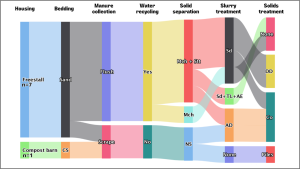
The dairy and swine farms demonstrated differences in manure treatment needs and consequently adopted different treatment technologies (Figures 1 and 2).
Figure 1. Farm characterization and manure management of ten swine farms. FTF = farrow-to-finish PSOP = partially slotted open pens PP = pull-plugs FTW = farrow-to-wean ISWPSF = individual stalls w/partial slotted floor DP = deep pits GF-F = grow-finish or finishing ASFB = all slotted-floor building FL = flushing WTF = wean-to-finish CH = chemicals AE = aeration LA = lagoons AD = anaerobic digestion CO = compostingFigure 2. Farm characterization and manure management of eight dairy farms. CS = corn stalks Sd = sedimentation DD = direct drying Mch = mechanical TL = treatment lagoon Co = composting Stt = sand settling lane or basin AE = aeration NS = no separation AD = anaerobic digestion
The most-used technologies in the primary manure management system for each industry were: mechanical separation, sand settling lanes, and sedimentation basins for dairy farms; and addition of chemicals, treatment lagoons, and composting for swine operations (Figure 3).
Figure 3. Manure treatment technologies being used in primary manure management systems.
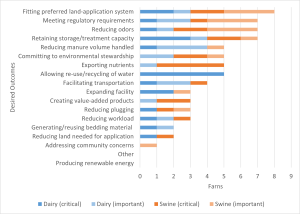
Allowing water to be reused and exporting nutrients were the primary desired outcomes of implementing manure treatment technologies for dairy and swine farms, respectively (Figure 4). Accordingly, 6 of 7 dairy farms were recycling water in their operations, while only 1 out of 10 was doing so on the swine side.
Figure 4. Primary desired outcomes of the implementation of manure treatment technologies in swine and dairy farms.
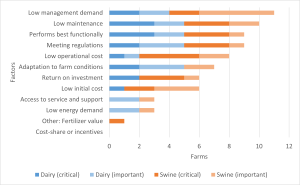
Diverse factors influenced the selection of the implemented technologies in both livestock operations. Low management demand, low maintenance, “performs best functionally” (best performance achieving the desired goals of manure treatment), and low initial cost are among the most-mentioned factors (Figure 5).
Figure 5. Factors that most influenced the selection of implemented manure treatment technologies.
Swine and dairy farmers identified initial cost, operational cost, and return on investment as the primary barriers to future technology adoption (Figure 6). Management demand was another important barrier among swine producers.
Figure 6. Barriers of highest concern when upgrading manure management systems on farms, especially through the adoption of manure treatment technology.
None of the survey respondents used membranes, electrochemical precipitation, or gasification technologies, demonstrating that cutting-edge manure treatment technologies are being more slowly adopted by regional livestock producers. The high cost and potential high management demand of these technologies could be barriers for their adoption.
Future plans
Our research work has moved into qualitative exploration. Focus groups will be held with swine and dairy producers, where they will discuss and share their manure treatment needs and desired outcomes from new treatment options. These activities will be organized online and will allow producers to share their manure management perspectives for the present and future. The results of our surveys and focus groups are being used to inform a decision-support tool being developed as part of the Management of Nutrients for Reuse (MaNuRe) project. Our findings will also be used to help develop extension programs that meet the needs of producers for manure management in Nebraska and neighboring states.
Authors
Juan Carlos Ramos Tanchez, Graduate Research Assistant, University of Nebraska-Lincoln.
Corresponding author email address
jramostanchez2@huskers.unl.edu
Additional authors
Richard Stowell, Professor of Biological Systems Engineering, University of Nebraska-Lincoln.
Amy Schmidt, Associate Professor of Biological Systems Engineering, University of Nebraska-Lincoln.
Acknowledgements
Funding for this effort came from the USDA NIFA AFRI Water for Food Production Systems program, grant #2018-68011-28691. The authors would like to express gratitude to Dr. Teng Lim and Timothy Canter (University of Missouri), Mara Zelt, and Lindsey Witt-Swanson (University of Nebraska-Lincoln) for their relevant support to this study. We would also like to thank the staff at the Nebraska Pork Producers Association and the Nebraska State Dairy Association for their collaboration on our research.
A mass balance approach to estimate gas emissions is based on tracking inflows and outflows from the barn boundary with losses assumed to be aerial emissions from the barn. This method is reliant on high-quality data to obtain representative emission values. Some considerations for this include spatial and temporal variability of manure composition in a turkey barn. Farm management styles and bird behavior may influence the location of manure accumulation and distribution. Thus, our objective for this work was to identify spatial and temporal differences of manure composition in the barn. The results from this work may have implications for sampling procedures for emission estimation using a mass balance approach.
What Did We Do?
The system in this study was a commercial turkey finishing barn that housed between 13,000 to 18,000 birds and used wood shavings as bedding. Birds were moved into the barn at 5-weeks old and were 13 weeks old by the end of the sampling period. There were no birds in the barn during the first week of sampling. Bird growth was constantly changing as birds matured, which would affect manure production and possibly manure composition. For this reason, weekly samples were taken over a one-month period, with one additional sampling day one month after to capture these changes.
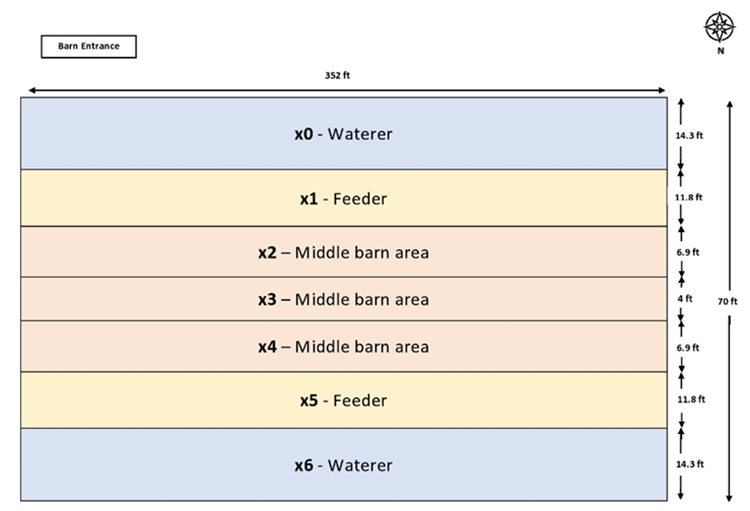
For sampling purposes, the barn area was divided into seven different lanes based on locations of feeder and waterer lines, as well as existing “lanes” implemented by the farm staff in their distribution of litter. Litter samples were aggregated from cores at seven different locations along an individual lane. Manure samples were analyzed for moisture, volatile solids (VS), ash, and nitrogen (N) content. Manure density and depth measurements were also recorded during sampling to track manure accumulation over time.
Figure 1: Barn layout depicting the seven lanes from which aggregated litter samples were collected.
What Have We Learned?
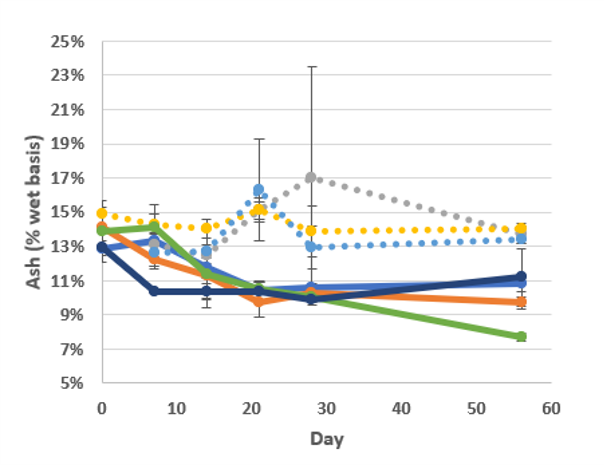
Moisture, volatile solids (wet basis), and ash content (wet basis) differed by position in the barn. Higher moisture content was observed at the waterer and feeder lines (shown in solid lines) compared to the middle barn area (shown in dashed lines). Water spillage and defecation occurred most frequently at these lanes, which aligns with results shown in Figure 1.
Figure 2. Measured litter moisture content in the middle barn areas compared to the waterer and feeder lanes.Figure 3. Measured ash content in the middle barn areas compared to the waterer and feeder lanes. A similar trend was observed for volatile solids content.
Ash (Figure 3) and volatile solids (not pictured) concentrations shared the same trend, where litter in the middle barn area had higher ash and VS concentrations compared to the waterer and feeder lanes. Areas with higher moisture content should have lower ash and volatile solids concentrations, and so this result was expected. These results are shown in Figure 2.
The N content in the middle barn area was generally higher than N at the waterer and feeder lanes, except for x2. This was unexpected as birds were observed to defecate most frequently around the waterer and feeder lanes, and so a higher N content was expected at these lanes, compared to the middle of the barn. The range of results, however, was comparable to literature and standard values, as well as results from a commercial lab test, as shown in Figure 4. This value was determined using the Dumas method at a commercial lab and describes the N content of a manure sample taken shortly after barn cleanout.
Figure 4. N content at different locations in the barn.
Temporal changes in manure composition were observed in the first two weeks of sampling for ash and volatile solids which were around the time the birds were first moved into the barn. Shortly after, ash and volatile solids concentrations stayed the same. For nitrogen, a general decrease was observed over time for all lanes during the weekly sampling period. Litter was also added between days 28 and 56 which may explain the general increase in N content between days 28 and 56. Overall, these results suggest that weekly sampling over a one-month period may be too frequent to discern any changes in manure composition. The one-month sampling period may also be too short. Manure management decisions such as barn clean-out schedules, litter additions, and removals may reveal more discernable changes in manure composition.
Future Plans
This data will be used to calculate N, volatile solids and ash mass from the manure, and applied to a mass balance for N and CH4 emission calculation from the turkey barn. Knowledge of spatial differences in manure composition would be useful for emission estimation from specific areas in the barn. It can also be used for overall barn emission estimation, with possibility of calculation of emission contributions from different areas in the barn.
Authors
Presenting author
Noelle Soriano, MS Student, University of Minnesota – Twin Cities
Corresponding author
Erin Cortus, Associate Professor, University of Minnesota-Twin Cities
Corresponding author email address
ecortus@umn.edu
Additional Authors
Anna Warmka, Undergraduate student, University of Minnesota- Twin Cities
Melissa Wilson, Assistant Professor, University of Minnesota- Twin Cities
Bo Hu, Professor, University of Minnesota- Twin Cities
Kevin Janni, Professor, University of Minnesota -Twin Cities
Acknowledgements
This research was supported by the Rapid Agricultural Response Fund. We also want to express appreciation to farmer cooperators who allowed us to collect data and shared their observations with us.
A large percentage of the carbon (C), nitrogen (N), and phosphorus (P) cattle consume is released or deposited as cattle dung and urine. If we can develop grazing systems that retain these nutrients within the grazing system that is a first step in turning cattle manure into a resource rather than a waste. The second step is distributing the nutrients to the whole of the pasture. The third step is making the complex molecules of N and P plant available. The final step is keeping cattle manure in the grazing system to rebuild soil health. We explored the impact of two grazing systems we named 1) conventional with hay distribution (CHD) and 2) strategic grazing (STR) on soil C, N, P, bulk density (soil compaction, BD), and cattle density (CD) with the hypothesis that grazing systems can improve soil health and thereby retain and recycle C, N and P. Said more plainly rather than sacrificing areas of the pasture we hoped to regenerate areas that were less productive (cattle camping areas) and make them more productive.
What Did We Do?
We compared a conventional grazing system, baseline (year 2015) factors: C, N, P, BD, and CD to the same factors after two years of CHD and STR. We took soil samples every 50 m at three soil depths (0-5, 5-10 and 10-20 cm) in 2015 (Baseline) and in 2018 (post treatment). Project design follows:
Year 1 – Continuous Grazing in eight ~40 ac (16 ha) pastures
Waterers, shade, hay and mineral provided in same location
Year 2 and 3 – Improved Grazing systems applied:
CHD – 4 of eight in continuous with hay distribution and
STR – 4 of eight in strategic grazing Mixture of better grazing practices
Manure distribution through Lure management of cattle
Portable shades, Portable waterers, Portable hay rings
Exclusion of compacted areas vulnerable to nutrient loss
Over seeding of exclusions with forage mix
Flash/Mob grazing of excluded areas for short time
Moderate rotational grazing in the sub-paddocks
What Have We Learned?
We found that both the CHD and the STR significantly increased the amount of N and P in the top 5 cm of soil Figure 1. The increase in plant available N in 2018 (sum of ammonium and nitrate) in the top five cm of soil was 5.6 times more in CHD and 5.8 times more in STR when compared to Baseline (2015) (Dahal et al., 2020). The 2018 increase in plant available P was 6.1 times more in CHD and 4.9 times more in STR compared to 2015. We attribute the greater increase in P in CHD to the greater number of hay bales needed during an extensive drought in 2016 (Subedi et al., 2021).
Figure 1. Plant available P (Mehlich-1, left), plant available N (inorganic N, middle), and carbon (loss-on-ignition, right) during Baseline in black and two years after treatments in red.
The impact of cattle management on bulk density varied greatly depending on where you were in the pasture which depended on improved management system. While there was a slight increase in bulk density in 0-5 cm soil layer from 2015 to 2018 for both CHD and STR the increases were not significant and would not cause any restrictions on forage growth (Figure 2). In the 5-10 cm soil layer, BDs in both the CHD and STR were significantly reduced. The STR did reduce BD slightly more than in the CHD pastures. Percent change in 2018 BD for STR was -10.5 and for CHD was -8.6.
Figure 2 Bulk density (BD) for the 0-5 cm soil layer (left) and the 5-10 cm soil layer (right).
The reduced compaction in the improved pasture management systems is important for several reasons but here we will discuss only the importance on root growth and nitrogen availability. Bulk density or compaction can restrict forage root growth. During Baseline pastures had median BD values of greater than 1.6 g cm-3 (Hendricks et al., 2019) which can restrict forage growth. After two years of the improved grazing systems BD was reduced to below 1.45 g cm-3 a value which is usually not restrictive to plant growth. We believe that the decrease in compaction allowed rainfall to move manures into the soil and allow for greater microbial activity. Above we noted the increase in nitrogen and phosphorus but we did not as yet mention the decrease in the Loss-on-ignition (LOI) carbon. The LOI carbon is composed of larger molecules and requires a great amount of microbial activity to break down and release the plant available nutrients within the molecule. We speculate with the reduced bulk density and associated greater ability of rainfall to move nutrients into the soil, the N and P associated with the cattle manure was able to be decomposed into plant available forms of nitrogen and phosphorus. These assumptions are supported with two indicators of soil microbial activity: greater CO2 emissions and an increase in a labile form of carbon (permanganate oxidizable carbon, in 2018 compared to 2015 (Dahal et al., 2020). The labile form of carbon was also found to increase with depth to 20 cm of soil which suggests that the carbon may not be lost to the atmosphere but maybe moving down in the soil profile.
Take-home messages
Cattle grazing can increase nitrogen and phosphorus soil content with improved grazing managements practices: hay distribution and strategic grazing practices designed to distribute cattle dung throughout the pasture and away from areas that are vulnerable to erosion.
Improved grazing practices can reduce soil compaction when cattle grazing is well distributed throughout the whole pasture.
Future Plans
We were greatly concerned with the decrease in carbon in both improved grazing systems. However, upon greater analysis of our data (in press) we have found additional information to indicate that carbon (LOI and the labile) is moving down the soil profile. We are in process of studying the C, N, P movement to greater depths and the impact this could also have on the grazing system to also capture and retain rainfall.
Anish Subedi; Department of Crop and Soil Sciences; University of Georgia; as07817@uga.edu
Additional Authors
Dr. Miguel Cabrera; Professor; Department of Crop and Soil Sciences; University of Georgia; mcabrera@uga.edu
Dr. Subash Dahal; Department of Crop and Soil Sciences; University of Georgia; dahal.green@gmail.com
Amanda McPherson; Department of Crop and Soil Sciences; University of Georgia; Amanda.McPherson@uga.edu
Additional Information
Dahal, S., Franklin, D., Subedi, A., Cabrera, M., Hancock, D., Mahmud, K., Ney, L., Park, C., & Mishra, D. (2020). Strategic grazing in beef-pastures for improved soil health and reduced runoff-nitrate-a step towards sustainability. Sustainability, 12(2), 558.
Subedi, A., Franklin, D., Cabrera, M., McPherson, A., & Dahal, S. (2020). Grazing Systems to Retain and redistribute soil phosphorus and to reduce phosphorus losses in runoff. Soil Systems, 4(4), 66.
Hendricks, T., Franklin, D., Dahal, S., Hancock, D., Stewart, L., Cabrera, M., & Hawkins, G. (2019). Soil carbon and bulk density distribution within 10 Southern Piedmont grazing systems. Journal of Soil and Water Conservation, 74(4), 323-333.
Acknowledgements
Funding: This research was funded by NRCS-USDA, Conservation Innovation Grant. Grant number 69-3A75-14-251.
Acknowledgments: The authors are grateful to USDA-NRCS for their assistance with the first-order soil survey, and to the Sustainable Agriculture Laboratory team, John Rema, and Charles T. Trumbo at the University of Georgia for their endless help in the laboratory and the field.
The right amount of animal manure in the right location can benefit crops, soil, and water resources. However, too much manure or manure in the wrong place is an environmental concern. A recent survey of attitudes from farmers and their advisors on the benefits and barriers for manure use indicates that there is widespread knowledge of manure value for cropping systems, but logistical and community barriers remain. The survey also found that all respondents rated peer-to-peer interactions as the most influential on their decision-making for these topics. Thus, more extension efforts should be focused in assisting AFO managers and advisors to communicate messages on the value of manure and strategies for overcoming barriers, among their specific networks. For example, knowledge of the relationship of manure and soil health benefits is low among some segments. Farmers and their advisors all have very low opinions and understanding of manure’s benefits to environmental quality. Helping farmers, educators, and advisors articulate among themselves and to their rural communities the water quality benefits of organic fertilizers when applied to only meet agronomic needs of the crop may need expanded investments. With these needs in mind a team from the Universities of Nebraska, Minnesota, and Iowa State, and the assistance of the North Central Region Sustainable Agricultural Research and Education program developed a library to provide educators and advisors with access to recommended resources that will assist in the discussion of manure’s benefits and challenges.
What Did We Do?
Consultation among the team identified the following categories of interest for readily accessible educational or outreach materials for manure impacts on:
Soil health and soil quality
Economics of production and yield
Crop fertility
Water quality
On-farm research
And guidance to navigating barriers such as:
Direct costs associated with manure use
Odor and other community issues
Agronomic challenges (such as imbalance nutrients)
Regulations
Logistical issues of application
Using manure in specialty systems (such as organic production)
With the categories for materials established, the team conducted an initial survey of extant educational and outreach materials via general internet searches and review of content available through the Livestock and Poultry Environmental Learning Community. The types of content thus assembled were varied: social media content, video, summaries of research, published extension and scientific journal articles, websites, and other content such as podcasts and decision support tools. All were included since it was intended that these resources be helpful for educators, producers, or others to converse with their own networks easily and confidently on the manure topics identified. The team anticipated that users could use the library to expand their social media activity, and thus their communication networks, or to prepare more confidently to discuss manure via a local radio presentation or discussion with a county board. Or even to add an article to local print media or a blog or personal website. All items included in the library were free to repurpose (with attribution) in local outlets or personal sites.
After consultation, the library was built using Airtable ™, a platform to create low-code databases, tools, or other apps. This platform allows the team to internally build a flexible database of content which can be sorted easily into pre-set categories (for example, topics of specific seasonal relevant), and arrange content into easily perused views to improve the user experience on a platform that could be easily embedded into existing team sites, such as lpelc.org (Figure 1).
Figure 1. The user interface for the merits of manure library, several such sorted views are embedded on the LPELC website for audience exploration by topic, media type, or seasonal relevance. Within each view individual entries can be further searched or sorted to further narrow exploration.
Each entry (Figure 2) in the library has an individual entry card, which includes keywords and text descriptions to improve searchability as well as a downloadable file, or links to the resource where appropriate, and a short example of how this material could be shared in the user’s social media network (recommended twitter text). The team intended to provide library users with not only the educational content, but also the means to improve their own in-network communication on manure topics. Accordingly, when posting to social media, hashtags, mentions and links to other content help (a) reach users who are following a specific topic (e.g., #manure), (b) recognize someone related to the post (e.g., @TheManureLady) and (c) direct users to more content related to the graphic (e.g., URL to online article). For our content library, each item is accompanied by recommended text that can be copied and pasted into the post of a social media engine if desired.
Figure 2. A single-entry page for the library.
What Have We Learned?
Since its launch in 2021 the library has had 343 unique users, average time that each user spends interacting with the library is 129 seconds, a solid interaction time for a website – industry standard is 120-180 seconds. However, we do not have any measure for how time spent on the library page is transformed into use of the library content. It is evident that more work is needed to improve awareness of the tool among audiences of interest. To this end, the team decided to develop a recognizable brand for library materials which might help other potential users to find their way to the site (Figure 3).
Figure 3. Library logo.
Future Plans
Library administrators continue to look for ways to improve the library content, user experience, and awareness of the tool among potential users. An overview of content, accessibility, re-purposing, and submission of relevant material will be shared to publicize the resource, encourage utilization of available materials, and invite submissions of new content relevant to the manure management community.
Authors
Amy Schmidt, Associate Professor, University of Nebraska
Leslie Johnson, Associate Extension Educator, Mara Zelt, Schmidt Lab Project Director, Amber Patterson, Schmidt Lab Media Communications Specialist, and Rick Koelsch, Professor Emeritus, University of Nebraska-Lincoln; Erin Cortus, Associate Professor, and Melissa Wilson, Assistant Professor, University of Minnesota; and Dan Andersen, Associate Professor, Iowa State University
This product was assembled with financial assistance from the North Central Region Sustainable Agricultural Research and Education program. NCR-SARE is one of four regional offices that run the USDA Sustainable Agriculture Research and Education (SARE) program, a nationwide grants and education program to advance sustainable innovation to American agriculture.
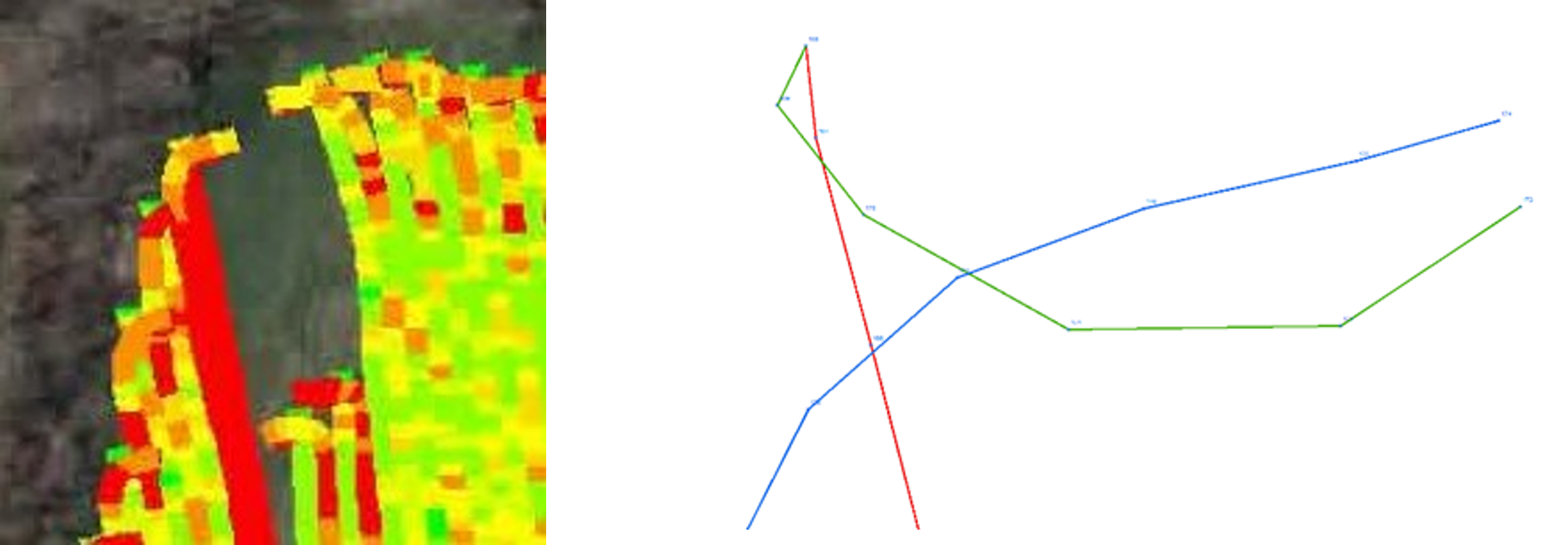
Manure, fertilizer, and other commercially available precision ag maps are not accurately calculating application rates in turns and turnarounds. This is significant in turn areas, such as field borders or in small fields. In areas where equipment turns or reverses with a k-turn, more product is applied to the inside turn than the outside turn, resulting in more time and application, and significantly changing the application rates in the turn area. The current version of software supplied with GPS equipment UConn Extension purchased in 2020 does not sum material application rates vertically when overlap occurs. The software also does not adjust application rates on the inside and outside of turns to reflect the change in application area covered during a discrete-time interval. The photo on the left is an example of an as-applied map from the commercial software. The line drawing on the right in the callout box displays the order of the tractor’s movement during the application. The lines represent the path of the tractor using a dragline to apply manure as it performs a K-turn at the end of the pull. The lines are formed by connecting the GPS coordinates recorded each second. The red line represents the tractor traveling North until it reached the end of the pass. The green line represents the travel path as the tractor backs up to make the K turn. The blue line is the path of the tractor as it again travels forward to complete the turn and head South again. The blue and green lines do not connect because a tractor backed up to some point northeast of the end of the green line, stopped and resumed moving forward again, all during the one-second interval between the ends of the green and blue lines.
The graphic below is the complete map for the field in the example above. If you look closely, you will see a large number of overlaps where a yellow or orange color passes over a darker red color. This should result in the overlapped region changing to one of the green colors if the rates were being summed vertically by the software.
What Did We Do?
When we realized the maps created by the software were inaccurately representing the results, we began by contacting the company’s tech support center. After exchanging emails and several phone conversations with different individuals, the company indicated that their software was unable to calculate the values we needed. Since the software we had purchased didn’t do what we needed we started asking around to all of the commercial applicators of manure and fertilizer that we knew in the region to see if the software they used provided the functionality we needed in New England. We could find no commercial software package that included the calculations needed to allocate the material correctly in our small fields.
Finding no commercially available software we embarked on what turned out to be a long and arduous process to develop a methodology to create adequate spreading maps ourselves. As faculty members, we have access to ESRI ArcMap which we have used for years to generate field boundary maps, calculate hauling distances between fields and storages, and map farmstead layouts for projects. We incorrectly assumed that ArcMap would have a ready-made solution for our problem. The process wasn’t as simple as playing connect the dots of the GPS coordinates. The GPS antennas on farm equipment are usually located on the cab of the truck or tractor to protect the antenna and in the case of the tractors to make the GPS available to other pieces of equipment such as planters. The material being applied usually comes out of the back, or side of the spreader some distance from the antenna. Then most application equipment throws the material even further behind the equipment with spinning disks or through pressure pumps, adding even more distance between the antenna and where the material actually hits the ground. To determine these distances accurately we measured numerous pieces of equipment and took a series of measurements between the equipment itself and where the material lands. In the case of manure spreaders, this can be a messy proposition. Once these measurements were completed, it was back to the computer to try to put these on a map. After hand digitizing a couple of hundred data points by drawing reference lines and using measuring tools in ArcMap to generate new points representing the distances behind and to the left and right of the equipment centerline, we finally had polygons to work with. Since we knew the amount of material applied each second, and ArcMap has the necessary tools to calculate the areas of the individual polygons, we could now divide the weight by the area to provide a weight or gallons per square foot of application area. ArcMap also has the tools needed to calculate the cumulative applied material for the overlapped areas by summing vertically through the polygons and summing the rate per square foot value of each layer.
Turns present a different challenge, but the turns cause extreme differences in application rates, so accurate maps require calculating the different application rates on the inside versus the outside of turns. The drawing above illustrates the path of a spreader, in this case a dragline moving North on the right side of the figure, making a 180 degree turn at the end of the row, and heading back south. The numbers in the section of the curve on the upper right reflect the application rates per acre for a fictional piece of equipment with the following characteristics. The descriptive data is real, but it comes from multiple equipment companies. For this example, we used a dragline toolbar that is 60 feet wide with the left and right halves represented by the three arrows on the lines pointing north and south. The dragline has 16 injectors and is fed by a pump capacity of 5,500 gallons per minute. We spent some time watching videos of spreaders at equipment company websites and timing, with a stopwatch, different spreaders as they made turns. This example uses 13 seconds for the toolbar, to make a 180-degree turn. A 5,500 gallon per minute pump pumps 91.7 gallons per second, or a total of 1192 gallons as the vehicle turns around. We divide 1192 in half to separate the left and right sides of the toolbar and you have 596 gallons applied inside and outside the centerline during the turn. Now we need to turn our attention to the area that was covered. The area of a circle is given by the formula Pi times the square of the radius. The area of the 180-degree turn for the inside of a 60-foot toolbar is given by the formula (3.141593 X (30X30))/2 or 1,414 square feet. Using the same formula, the area of the larger 60-foot radius is 5655. To get the actual area covered by the outside half of the toolbar we need to subtract the area of the 30-foot radius half-circle from the 60-foot radius half circle which comes out to 5,655-1,414 = 4,241. Now that we have the areas, we can divide the left and right areas into gallons.
596/1,414 = 0.421 to convert that to gallons per acre multiply by 43,560 = 18,339
596/4,241 = 0.141 X 43,560 = 6,142 or almost exactly 1/3 the amount per acre applied to the inside of the curve.
Given the spreading patterns of modern farm equipment and farmers wanting to ensure complete coverage in a field, overlaps are inevitable. If we are really going to follow the 4R’s of nutrient management, we need better as applied maps that will allow us to know where the manure went, and better more agile fertilizing equipment to only apply fertilizer in the areas of fields that truly need the fertilizer – now that we can identify them on accurate maps. This includes the ability of equipment to lower flow rates on the inside of turns and increase the flow rates on the outside of turns automatically to provide more even spreading rates across the entire field.
What Have We Learned?
Current spreading maps are inadequate for small New England farms. Application overlaps and spreading differentials on the inside and outside of turns result in inaccurate application rates. Current equipment does not account for these differing rates along the turn radii. We have worked out an algorithm and a process to correct for both the turn issue and the overlap issue for straight application such as self-propelled spreaders or toolbars attached to the 3-point hitch of a tractor. The algorithm still needs to be adjusted to connect the polygons representing turns with curved lines rather than the straight lines we currently use. This will improve accuracy incrementally, albeit measurably, since the turn radiuses and the distances involved will only add or remove a few square feet from each polygon which in our hand calculation doesn’t affect the rate per acre more than a few hundred gallons at a time. We understand the math involved to calculate accurate spreading locations and areas for towed equipment if we have adequate measurements of that equipment and with the caveat that the spreader being towed is always moving forward. In certain cases, such as semi-tractor trailers it is possible for the truck cab, with the GPS attached, to be moving in a circular path – while the rear bogey of the trailer spins in place – which can cause the rear wheels on the trailer to back up during a tight turn. We haven’t worked out the math on this, and so far, we have found no practical way to calculate this given the state of the equipment. For semi-trailers we would recommend that GPS antennas be mounted at the front and the rear of the trailers. We need two points to determine the straight line between the points so we can calculate the left and right application distances for where the material hits the ground.
The as-applied map on the next page shows how the current version of our software creates a much more accurate application map from GPS data. This is the same section of the field shown in the first graphic from the commercial software. As you can see our solution calculates the areas of overlap and sums the application rates vertically through the layers. If you look closely at the figure, you will see 3-digit numbers representing the calculated positions of the Left, Right, and Center XY coordinates of the points where the material is hitting the ground each second. The single-digit numbers reflect the number of times that an individual polygon was applied with manure during the turn maneuver.
<7,500
7,500 – 12,500
12,500 – 25,000
25,000 – 100,000
>100,000
gal/ac
880
2060
6600
2211
1427
ft2
7
16
50
17
11
percent
13,177
Sum ft2 Applied
2350
Total ft2
The table above is calculated using the application rates and the areas of the polygons in the as-applied map. It basically provides a report card of the application. The farm intended to apply 10,000 gallons per acre to meet the fertilizer needs of the crop. We placed an arbitrary interval of 2,500 gallons above or below the target rate as an acceptable variation in the application rate. This allowed us to calculate that ~15.6% of the area applied received the “correct” rate. Approximately 6.7% of the area received too little manure and 77.7% of the area received too much manure. In addition, we calculated that the small area on the inside of the turn that received the most manure per acre received 103,383 gallons per acre, rather than the desired 10,000 gallons per acre.
Future Plans
This year we plan to validate our algorithms for the self-propelled and the farm tractor 3-point hitch mounted spreaders. We hope to expand the algorithm to tractor towed combinations when we receive data from 2 more farms that installed equipment this winter on their equipment. We will validate our algorithm’s accuracy by applying manure to fields that have had collection pans pre-located throughout the field. Once we have the spreading map, we can overlay it onto the data from the collection pans that we will geolocate with handheld RTK GPS equipment before applying the manure. We would also like to rent a pair of RTK GPS loggers to mount on the front and the rear of a semi tanker to verify the movement of the trailer during extreme turns.
Hopefully, we can develop a mathematical model for the semi turns because the alternative – putting 2 farm equipment type GPS antennas on a trailer, will get expensive.
Authors
Richard A. Meinert, Cooperative Extension Educator, University of Connecticut
Corresponding author email address
Richard.Meinert@uconn.edu
Additional author
Qian Lei-Parent, Research Associate, Department of Extension, University of Connecticut
Acknowledgements
Funding to purchase the GPS equipment provided by a USDA NRCS CT CIG Grant.
Broiler litter is a valuable fertilizer but can also be a source of odorous and GHG emissions during production, storage, and land application. Impacts of these emissions are felt by local communities, posing respiratory health impacts and decreased quality of life, as well as increased deposition into soil and water systems. This study seeks to quantify the magnitude of emissions associated with in-house broiler litter and estimate variability across farms. Finally, the study evaluates litter parameters, such as litter age and chemical composition, for gas emission predictors.
What Did We Do?
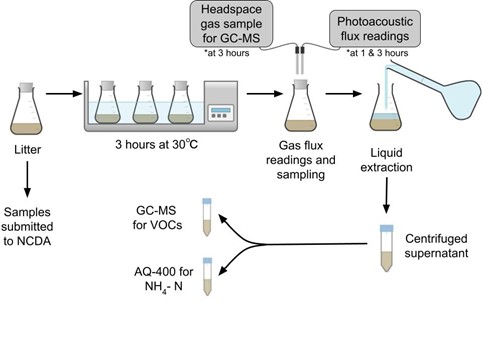
A set of five active broiler houses in North Carolina were sampled to measure gaseous emissions (NH3, H2S, CH4, N2O, CO2, and VOCs) using headspace flux measurement gas samples. Headspace gas concentrations were measured at 1 hour and 3 hours after incubation at 30°C using a photoacoustic analyzer (Innova 1412) for NH3, CH4, N2O, and CO2 and Jerome 631-X was used to measure H2S, concentration. The headspace was also sampled to quantify VOCs associated with odorous emissions. After incubation, water extraction was used to quantify less volatile organic species that are associated with odorous emissions in the litter. Experimental setup is described in Figure 1. Statistical software, JMP, was utilized for analysis of litter composition on NH3, H2S, CH4, N2O, CO2, and VOC gaseous emissions.
Figure 1. Broiler emission experimental setup
What Have We Learned?
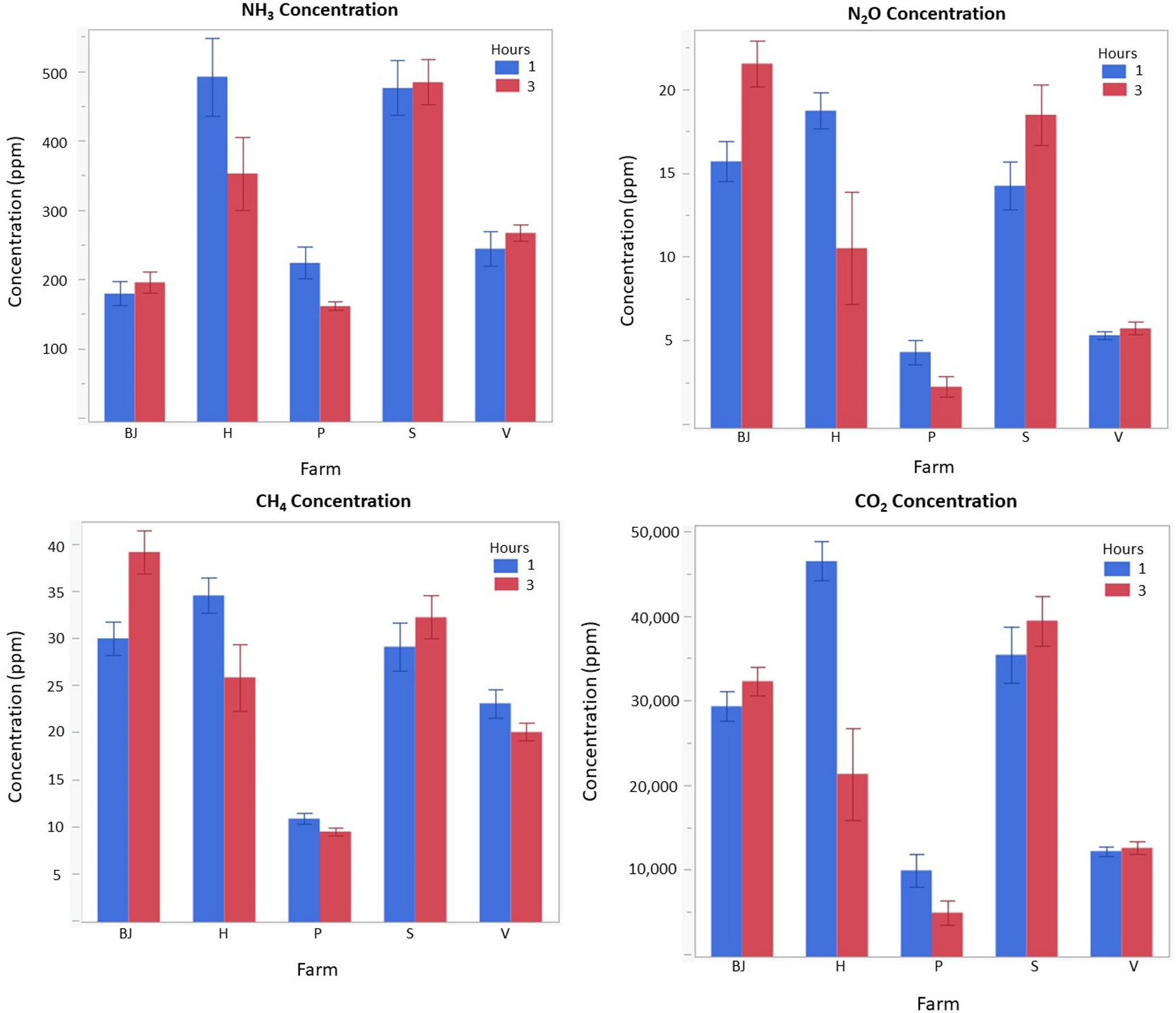
H2S emissions were very low (< 0.01 ppm) and did not produce statistically significant observations. There was a wide range of emissions from the litter samples for different gases as shown in Figure 2: 146-555 ppm NH3, 1.5-22 ppm N2O, 4,077-50,835 ppm CO2, and 9.1-43.3 ppm CH4. The differences between farms accounted for 86%, 81%, 76%, and 84% of the variability in NH3, N2O, CO2, CH4 observations, respectively. This could be attributed to differences in integrator and management strategies. Moisture content and age of the litter were the primary contributing factors to increased gaseous emissions from all samples. More specifically, NH3 was largely impacted by pH (p < 0.01), while N2O, CO2, and CH4 were largely impacted by C:N (p < 0.01). Quantitative VOC analysis was difficult due to the number of gases detected by the GC-MS (20+), however the most common species present in the litter samples were a variety of volatile fatty acids, alcohols, phenol, as well as a few amines, ketols, and terpenes.
Figure 2. Photoacoustic flux measurements of litter samples at 1 and 3 hour intervals.
Future Plans
These results will serve as baseline emission readings for odor and emission control strategies. We are currently developing Miscanthus-derived biochar as a poultry litter amendment for emission mitigation in poultry houses. This dataset will inform our decision making to help target gaseous species of top concern in NC broiler litter by methods of physical and chemical biochar modification.
Authors
Presenting author
Carly Graves, Graduate Research Assistant, North Carolina State University
Corresponding author
Dr. Mahmoud Sharara, Assistant Professor & Waste Management Extension Specialist, North Carolina State University
Corresponding author email address
msharar@ncsu.edu
Acknowledgements
Funding for this project is through Bioenergy Research Initiative (BRI)- NC Department of Agriculture and Consumer Services (NCDA&CS): Miscanthus Biochar Potential as A Poultry Litter Amendment
The “manureshed” refers to the land base needed to assimilate the nutrients produced by a livestock operation without presenting a danger to water, land, and air resources. Trends toward large dairies in many regions of the US, often with high density of livestock relative to the amount of land available for nutrient application, have increased in recent decades. Consequently, import of feed and forage often leads to nutrient surpluses and the need to transport manure off farm for land application. Our purpose was to evaluate the status of dairy manuresheds across the US to highlight challenges and opportunities to improve nutrient balances and facilitate manure nutrient redistribution when needed.
What Did We Do
Our group produced case-studies of manureshed management from four major dairy producing states across the US. We reviewed the predominate structure of dairies in those states and analyzed the primary challenges that must be addressed to safely assimilate nutrients. We focus on reviewing the extent of off-farm redistribution of manure that is needed in each of those states, limitations to redistribution, and approaches that can be built upon to facilitate redistribution. In the Minnesota case-study, where nutrient management data is publicly available for Confined Feeding Operations, GIS software was used to estimate manure transport distances for varying cropping systems and dairy cattle breeds. For Idaho, New Mexico, and Pennsylvania, whole-farm modelling is referenced to understand nitrogen (N) and phosphorous (P) balances on a range of dairies.
What Have We Learned
Soil P assimilation capacity was the predominate factor constraining manureshed land requirements in three of the four states studies. However, nitrate leaching potential was the largest constraint in New Mexico, where dairy forages were largely grown on irrigated lands near rivers. GIS analysis in Minnesota estimated that an average travel distance of 4.1 km for manure transport was required for dairy with 1000 or more cows. The Minnesota case-study also revealed smaller manuresheds were required, per unit of energy-corrected milk, for Jersey cattle compared to the larger Holsteins. Modelled nutrient budgets for Idaho indicated a greater need for off-farm transport, suggesting that expanded application of dairy manures on alternative crops (such as potatoes, sugar beets, and barley) should be considered. In New Mexico, large dairies and limited cropland has caused extensive import of feed from other states and Mexico, with informal nutrient brokering networks developing. In Pennsylvania, dairy producing counties are largely overall sinks for nutrients, but historic heavy manure applications on fields near dairy barns often necessitates greater redistribution of manure nutrients within individual dairies or transfer to local crop farms.
Multiple approaches for improving nutrient balances and distribution of manure were identified in the case studies. Continuing advances in dairy nutrition and cattle genetics are helping to improve nutrient balances and reduce quantities of N and P excreted. When nutrient surpluses necessitate off-farm transport, informal networks for connecting dairies with surplus nutrients with crop farms that have nutrient assimilation capacity, described in New Mexico, provide a basis for development of similar networks elsewhere. Manure processing developments also provide possibilities for more economical transport or reuse of manure nutrients from farms with liquid handling.
Future Plans
The current work provides an overview of the current status of manureshed management in dairy regions. Continuing work is needed to refine nutrient balances for individual farms and to continue to develop tools that assist farmers in understanding nutrient balances and manureshed requirements on their farms. Involvement of social scientists and economists is needed to further develop networks for manure redistribution. Our work also points to the need for greater federal and state cost sharing and more technical support from government, universities, and farm organizations to facilitate more intensive evaluation of manureshed requirements and transport of manure when needed.
Authors
Curtis Dell, Soil Scientist, USDA-ARS, Pasture Systems and Watershed Management Research Unit, University Park, PA Curtis.Dell@usda.gov
Additional Authors
John Baker, USDA-ARS, St. Paul, MN
Sheri Spiegal, USDA-ARS, Las Cruces, NM
Sarah Porter, Environmental Working Group, Minneapolis, MN
April Leytem, USDA-ARS, Kimberly, ID
Colton Flynn, USDA-ARS, Temple, TX
Alan Rotz, USDA-ARS, University Park, PA
David Bjornberg, USDA-ARS, Kimberly, ID
Ray Bryant, University Park, PA
Robert Hagevoort, New Mexico State Univ., Clovis, NM
Jeb Williamson, New Mexico State Univ., Las Cruces, NM
Amalia Slaughter, USDA-ARS, Las Cruces, NM
Peter Kleinman, USDA-ARS, Fort Collins, CO
Additional Information
C.J. Dell et al., 2022. Challenges and opportunities for manure management across US Dairy systems: Case Studies from four regions. Journal of Environmental Quality. (In press in pending special edition on manureshed management).
Acknowledgements
USDA Agricultural Research Service and the Dairy Agroecosystems Workgroup (DAWG, USDA-ARS)
The authors are solely responsible for the content of these proceedings. The technical information does not necessarily reflect the official position of the sponsoring agencies or institutions represented by planning committee members, and inclusion and distribution herein does not constitute an endorsement of views expressed by the same. Printed materials included herein are not refereed publications. Citations should appear as follows. EXAMPLE: Authors. 2022. Title of presentation. Waste to Worth. Oregon, OH. April 18-22, 2022. URL of this page. Accessed on: today’s date.
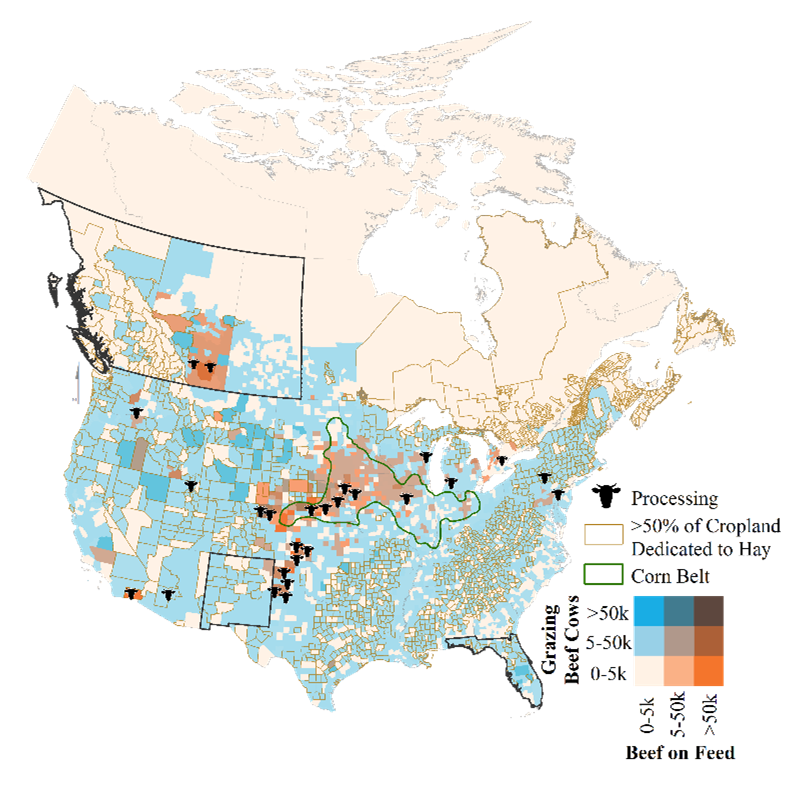
Figure 1. Geography of grazing cattle, hay production, and the Corn Belt – major components of the U.S. and Canadian beef supply chains. The grazing systems that send cattle to feedlots and could potentially use surplus feedlot manure instead of fertilizer for hay production are symbolized with blue shading and brown boundary lines. A geographic unit in the 0-5000 range may represent a US county or Canadian Consolidated Census Unit with no data available.
Expectations of the beef industry are multiplying as communities seek to build sustainable agri-food systems for the long term. Nutrient circularity – recovering nutrients from manures and post-harvest byproducts and reusing them for agricultural production – is a promising yet complex strategy for achieving sustainability goals from grazing pasture to dinner plate. In the United States and Canada, flows of cattle from land-based systems to feedlots in the built environment provide opportunities for circular management, in which concentrated feedlot manure is cycled back onto either corn fed to cattle in the feedlot phase or the hay fed to grazing cattle in “earlier” links of the cattle supply chain. However, such flows can span great distances because feedlots that produce large volumes of manure tend to be concentrated in particular regions, but the Corn Belt that could use much of their nutrient loads is in the Upper Midwest and the hay-grazing systems that send cattle to feedlots are widely distributed (Figure 1).
Systematically recycling manure from concentrated feedlots back to the land-based systems where cattle originated can help the US and Canadian beef industries meet their goals, but such efforts would require initial investments to transform management practices, trade structures, and social networks. With these major societal investments at stake, a reliable understanding of the tradeoffs of various approaches is needed. In turn understanding tradeoffs requires reliable data about geographically-specific flows coupled with expertise from multiple disciplines to interpret the data. Yet this sort of knowledge is rare. We sought to help fill this knowledge gap by comparing three manure recycling strategies using the conceptual framework of the ”manureshed” – the lands where surplus manure nutrients from concentrated animal feeding sites can be recycled to meet production, environmental, and socio-economic goals.
What Did We Do
We used a diversity of data — agricultural censuses, interviews of manure managers, and nutrient concentrations in manure and crops at multiple scales — to estimate the environmental and socio-economic performance of three different manureshed management approaches with different degrees of nutrient circularity:
Figure 2. Three types of manuresheds explored in our analysis
Local recycling where surplus manure from individual feedlots is transported to nearby crop farms within local networks, with little coordination or incentive from the beef industry or public programs (Figure 2a);
Regional-scale recycling where surplus manure nutrients from a major beef-feeding hotspot (many feedlots close to each other) are distributed onto croplands of adjacent nutrient “sink” counties that could use the nutrients for crop production, in a systematic fashion supported by community and programmatic coordination (Figure 2b);
National- or international-scale recycling where surplus manure from individual feedlots is transported back to the hay-grazing systems where cattle in the feedlots originated (as envisioned in Purpose above), with systematic coordination among links of the geographically extensive beef supply chain (Figure 2c). We used New Mexico, Florida, and western Canada as three “cattle origination areas” (Figure 1).
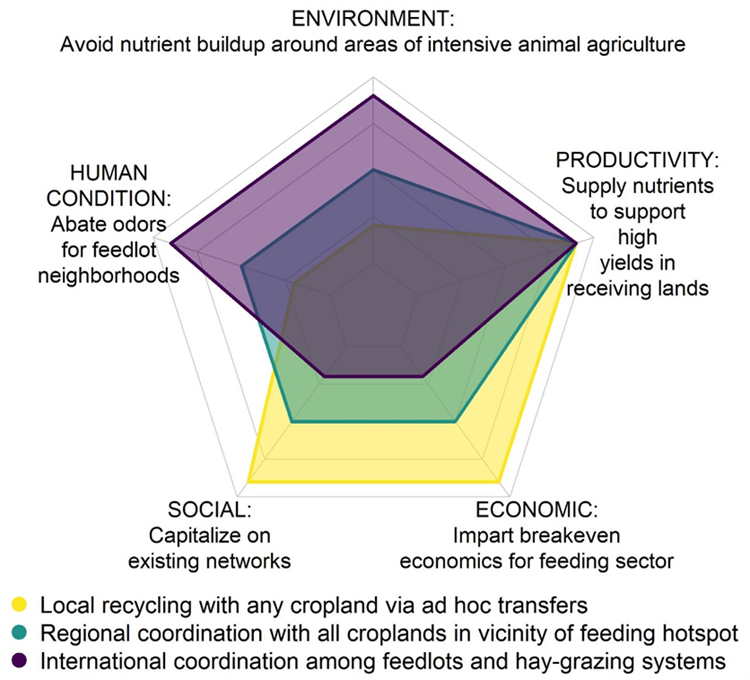
To illuminate the tradeoffs of the three manureshed approaches, we “scored” each in terms of their performance regarding goals in five domains of sustainability. We used input from literature reviews, interviews of manure managers, and knowledge of the complex structure of the North American beef supply chain. With each domain, we identified the investments needed to overcome the shortcomings in scores, as appropriate.
What Have We Learned
The manureshed concept helps stakeholders to weigh pros and cons of different management and policy approaches to nutrient circularity, because the concept can highlight the many barriers that must be removed for manure export from feeding sites to be sustainable. The concept also provides spatially explicit information and knowledge about where and how such recycling would actually work.
All three manureshed management approaches promote a form of nutrient circularity. The international, extensive approach (Figure 2c) was explicitly designed to cycle nutrients between feedlots and land-based systems of cattle production, but the other two also granted some circularity to the general agri-food system – especially when manure nutrients are prioritized to be spread on farms that supply part of the feed ration to nearby feedlots. For context, the top feedlots of the US import around 35% of their feed from local sources.
The three approaches “scored” differently with respect to goals in five domains of sustainability, resulting in different shapes of tradeoffs among environmental and socioeconomic goals for each approach (Figure 3). Importantly, these scores reflect the performance of the three management systems in the current agri-food system. If we, as a society, seek to promote nutrient circularity and its potential benefits in the future, alternatives such as the international approach – which seem economically infeasible now – may ultimately prove to be the most favorable, all things considered. The expense of transporting manure from beef feedlots to productive hayfields telecoupled to feedlots is now a major barrier to this approach (low score in Economic domain in Figure 3). However, redesigning systems so that hay-grazing agroecosystems receive feedlot manure may ultimately improve overall adaptive capacity during times of drought, reducing instances of herd destocking when appropriate and supporting the working landscapes valued by North Americans now and in the future (not pictured on Figure 3).
Figure 3. Performance of three approaches to beef manureshed management in the current agri-food system, with respect to one goal in each of five domains of sustainability. High scores are represented on the outer edges of the diagram. Comparing scores within and among approaches illustrates tradeoffs and co-benefits among the domains.
Future Plans
We plan to conduct a full life cycle analysis of the three manureshed approaches, with attention to environmental, productivity, and economic outcomes, including the role of manures in emerging Carbon markets. We plan to conduct the assessments within current and projected future conditions of the agri-food system, with special attention to future scenarios of climate change and rock-based Phosphorus scarcity.
We will also encourage collaborative science and management. Effective nutrient circularity for sustainability requires coordinated, comprehensive collaborations and partnerships across systems that are sometimes located far apart, beyond any one producer, consumer, or policy maker. To understand our options, a wealth of data, information, and knowledge is needed, especially that which prioritizes co-production among researchers, practitioners, and agri-food consumers.
Authors
Sheri Spiegal, Range Management Specialist, USDA-ARS Range Management Research Unit sheri.spiegal@usda.gov
Additional Authors
Gwendwr Meredith, Social-Ecological Rangeland Scientist, University of Nebraska
Shabtai Bittman, Research Scientist, Agriculture and AgriFood Canada
Maria Silveira, Professor, Soil Fertility and Water Quality, Range Cattle Research Experiment Station, University of Florida
JV Vendramini, Professor of Agronomy & Forage Specialist, Range Cattle Research Experiment Station, University of Florida
C Alan Rotz, Agricultural Engineer, USDA-ARS-Pasture Systems and Watershed Management Research Unit
K Colton Flynn, Soil Scientist, USDA-ARS Grassland Soil and Water Research Laboratory
Mark Boggess, Center Director, USDA-ARS U.S. Meat Animal Research Center
Peter JA Kleinman, Soil Scientist and Research Leader, USDA-ARS, Soil Management and Sugar Beet Research Unit
Spiegal, S., J. Vendramini, S. Bittman, M. Silveira, C. Gifford, C. Rotz, J. Ragosta, and P. Kleinman. 2022. Data to explore circular manureshed management in beef supply chains of the United States and western Canada ver 3. Environmental Data Initiative. https://doi.org/10.6073/pasta/a81b6a2dd23a8b12360412c492fe8040 (Accessed 2022-03-05).
This research was a contribution from the Long-Term Agroecosystem Research (LTAR) network. LTAR is supported by the United States Department of Agriculture, which is an equal opportunity provider and employer. Additional support for this effort was from USDA-NIFA AFRI’s Sustainable Southwest Beef Coordinated Agricultural Project grant #12726269. We thank AAFC and Canadian Cattlemen’s Association (CANFAX), New Mexico Livestock Board, and Florida Department of Agriculture and Consumer Services for their data and assistance.
The authors are solely responsible for the content of these proceedings. The technical information does not necessarily reflect the official position of the sponsoring agencies or institutions represented by planning committee members, and inclusion and distribution herein does not constitute an endorsement of views expressed by the same. Printed materials included herein are not refereed publications. Citations should appear as follows. EXAMPLE: Authors. 2022. Title of presentation. Waste to Worth. Oregon, OH. April 18-22, 2022. URL of this page. Accessed on: today’s date.
Scientists from across the Long-Term Agroecosystem Research (LTAR) network are working to address nutrient management challenges that confront the poultry industry (broilers, layers, pullets, and turkeys) in the context of a “manureshed” – the geographic area surrounding one or more livestock and poultry operations where excess manure nutrients can be recycled for agricultural production. This study focuses on poultry manuresheds identified east of the Mississippi across the Southeast and Mid-Atlantic regions where over 55% of the U.S. poultry production is located. Poultry manure has been used as a fertilizer most extensively on forage and pasture crops grown near poultry houses. Poultry is a highly specialized production system, with a portion of feed grains grown at substantial distance from where the animals are raised. Consequently, nutrients excreted in manure often exceed the nutrient requirements for local crop production. This situation results in surpluses in local soils that receive manure. The surpluses in turn lead to eutrophication of water bodies; that is, the biological enrichment of water bodies derived from nutrient pollution. Without a mechanism to redistribute manure nutrients more widely, the production and manure management system is unsustainable.
What Did We Do
Central to the concept of the manureshed are sources and sinks, which represent spatial extents where the nutrients in livestock and poultry manure produced exceeds the nutrient needs of crops in the area (sources) or falls short of crop needs (sinks). Although manure nitrogen (N) and phosphorus (P) must be co-managed, we focus our analysis on P since the ratio of plant-available N:P in poultry manure is low (< 4:1) relative to crop needs (~ 10:1). We used data from the U.S. Census of Agriculture and estimates from the International Plant Nutrition Institute’s (IPNI) Nutrient Use Geographic Information System (NuGIS) to identify manure-based P produced annually by poultry production, crop nutrient needs for all crops, and fertilizer applied to farmland in each of the 3109 U.S. counties of the 48 conterminous U.S. states in 2012. A classification approach was then used to determine whether each county was a source or a sink. The next step was a step-wise spatial analysis to identify the nearest sink counties available for redistribution of manure-based P from each source county cluster. The result was a “mega-manureshed,” the largest contiguous area of source and sink counties in the United States.
What Have We Learned
The poultry mega-manureshed extends from the Mid-Atlantic, across the southeast to the Mississippi River and beyond (Figure 1). In the Georgia Coastal Plain manureshed, a component of the megamanureshed, the maximum distance that manure would need to be hauled from source area to sink area is only nine miles. However, in the Southern Piedmont and the Shenandoah manuresheds, the maximum distance that manure would have to be hauled is 65 and 146 miles, respectively. These are conservative estimates. Our analysis does not account for the presence of a large swine manure source area in North Carolina. If those manure nutrients are to be land applied, then additional sink areas would be needed. Additionally, we do not have data on soils that allow us to identify areas where P levels are already excessively high such that additional P should not be added. Both factors would greatly expand the size of the manureshed and increase the maximum hauling distance. Since hauling manure a hundred miles or more is not economically feasible, alternatives, such as pelletizing; use as feedstock for bioenergy and biochar production; and biological, physical, or chemical removal and recovery of nutrients, are needed in order to sustain the poultry industry.
Figure 1. Poultry mega-manureshed: Sources and sinks for P from the Mid-Atlantic across the southeast. Counties shown in white are neither sources nor sinks; P inputs are roughly in balance with crop uptake. The blue area in North Carolina is a P source area from swine
The vertical integration that is characteristic of meat and egg production components of the poultry industry lends itself well to the infrastructure requirements and collective decision making needed to achieve manureshed management. As manure treatment innovations evolve, the U.S. poultry industry is poised to take advantage of insights gained from the manureshed approach to target manure nutrient redistribution efforts.
Future Plans
Over the next 10 years, LTAR researchers will be working with producer partners to conduct long-term field research on the economic and environmental costs and benefits of importing manure nutrients to cropland and grazing land in different climates. Beyond traditional land management and technology research, we will also be working to build societal awareness of the benefits and challenges of the manureshed approach and determine what is needed for widespread support of the concept. LTAR scientists will work to improve or develop new manure treatment technologies. We plan to conduct economic research on the cost effectiveness of different types of management practices, as well as the need for economic incentives.
Authors
Ray B. Bryant, Research Soil Scientist, USDA ARS Pasture Systems and Watershed Management Research Unit, University Park, PA Ray.Bryant@usda.gov
Additional Authors
Dinku M. Endale, USDA-ARS Southeast Watershed Research Laboratory, Tifton, GA (Retired)
Sheri A. Spiegal, USDA-ARS Jornada Experimental Range, Las Cruces, NM
-K. Colton Flynn, USDA-ARS Grassland Soil and Water Research Laboratory, Temple, TX
Robert J. Meinen, Senior Extension Associate, Dept. Animal Science, The Pennsylvania State University
Michel A. Cavigelli, USDA-ARS Sustainable Agricultural Systems Laboratory, Beltsville, MD
Peter J.A. Kleinman, USDA-ARS Soil Management and Sugar Beet Research Unit, Fort Collins, CO
Additional Information
Bryant RB, Endale DM, Spiegal SA, Flynn KC, Meinen RJ, Cavigelli MA, Kleinman PJA. Poultry manureshed management: Opportunities and challenges for a vertically integrated industry. J Environ Qual. 2021 Jul 26. doi: 10.1002/jeq2.20273. Epub ahead of print. PMID: 34309029.
Spiegal, S., Kleinman, P. J. A., Endale, D. M., Bryant, R. B., Dell, C., Goslee, S., … Yang Q. (2020). Manuresheds: Recoupling crop and livestock agriculture for sustainable intensification. Agricultural Systems. 181: 1-13. 102813. Doi: 10.1016/j.agsy.2020.102813.
This research was a contribution from the Long-Term Agroecosystem Research (LTAR) network. LTAR is supported by the U.S. Department of Agriculture, which is an equal opportunity provider and employer.
The authors are solely responsible for the content of these proceedings. The technical information does not necessarily reflect the official position of the sponsoring agencies or institutions represented by planning committee members, and inclusion and distribution herein does not constitute an endorsement of views expressed by the same. Printed materials included herein are not refereed publications. Citations should appear as follows. EXAMPLE: Authors. 2022. Title of presentation. Waste to Worth. Oregon, OH. April 18-22, 2022. URL of this page. Accessed on: today’s date.
Manage Cookie Consent
To provide the best experiences, we use technologies like cookies to store and/or access device information. Consenting to these technologies will allow us to process data such as browsing behavior or unique IDs on this site. Not consenting or withdrawing consent, may adversely affect certain features and functions.
Functional
Always active
The technical storage or access is strictly necessary for the legitimate purpose of enabling the use of a specific service explicitly requested by the subscriber or user, or for the sole purpose of carrying out the transmission of a communication over an electronic communications network.
Preferences
The technical storage or access is necessary for the legitimate purpose of storing preferences that are not requested by the subscriber or user.
Statistics
The technical storage or access that is used exclusively for statistical purposes.The technical storage or access that is used exclusively for anonymous statistical purposes. Without a subpoena, voluntary compliance on the part of your Internet Service Provider, or additional records from a third party, information stored or retrieved for this purpose alone cannot usually be used to identify you.
Marketing
The technical storage or access is required to create user profiles to send advertising, or to track the user on a website or across several websites for similar marketing purposes.







 movement during the application. The lines represent the path of the tractor using a dragline to apply manure as it performs a K-turn at the end of the pull. The lines are formed by connecting the GPS coordinates recorded each second. The red line represents the tractor traveling North until it reached the end of the pass. The green line represents the travel path as the tractor backs up to make the K turn. The blue line is the path of the tractor as it again travels forward to complete the turn and head South again. The blue and green lines do not connect because a tractor backed up to some point northeast of the end of the green line, stopped and resumed moving forward again, all during the one-second interval between the ends of the green and blue lines.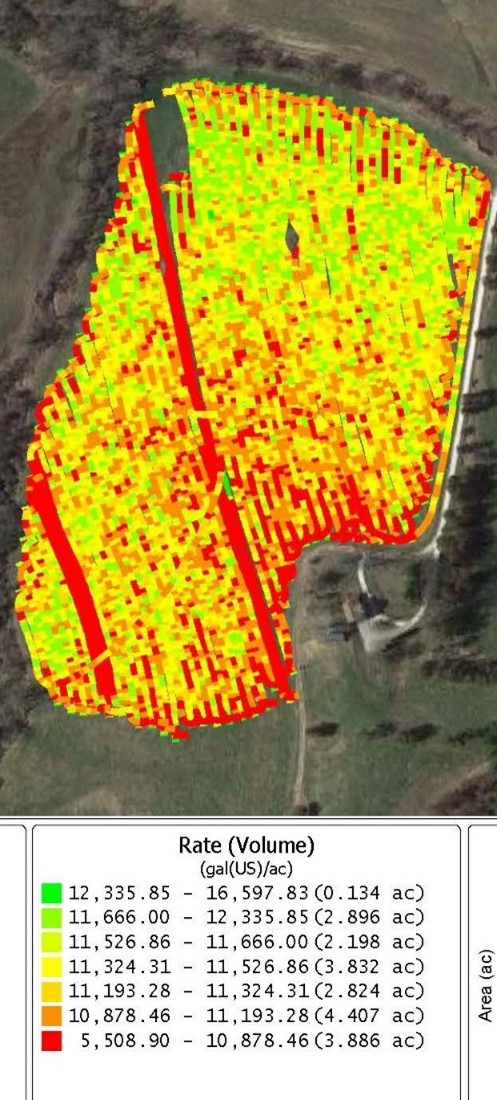
 North on the right side of the figure, making a 180 degree turn at the end of the row, and heading back south. The numbers in the section of the curve on the upper right reflect the application rates per acre for a fictional piece of equipment with the following characteristics. The descriptive data is real, but it comes from multiple equipment companies. For this example, we used a dragline toolbar that is 60 feet wide with the left and right halves represented by the three arrows on the lines pointing north and south. The dragline has 16 injectors and is fed by a pump capacity of 5,500 gallons per minute. We spent some time watching videos of spreaders at equipment company websites and timing, with a stopwatch, different spreaders as they made turns. This example uses 13 seconds for the toolbar, to make a 180-degree turn. A 5,500 gallon per minute pump pumps 91.7 gallons per second, or a total of 1192 gallons as the vehicle turns around. We divide 1192 in half to separate the left and right sides of the toolbar and you have 596 gallons applied inside and outside the centerline during the turn. Now we need to turn our attention to the area that was covered. The area of a circle is given by the formula Pi times the square of the radius. The area of the 180-degree turn for the inside of a 60-foot toolbar is given by the formula (3.141593 X (30X30))/2 or 1,414 square feet. Using the same formula, the area of the larger 60-foot radius is 5655. To get the actual area covered by the outside half of the toolbar we need to subtract the area of the 30-foot radius half-circle from the 60-foot radius half circle which comes out to 5,655-1,414 = 4,241. Now that we have the areas, we can divide the left and right areas into gallons.