
Manuresheds: Pennsylvania Case Study of Strategic Expansion of the Swine and Poultry Industries

Purpose

The manureshed concept considers manure nutrients produced by livestock or poultry and the associated cropland which is needed to assimilate the nitrogen and phosphorus in that manure. An area of surplus manure nutrient production is considered a ‘source’ and the cropland that can accommodate the surplus is termed a ‘sink’. Manuresheds are managed on several scales from farm to county to regional levels. A large group of scientists, led by the USDA-ARS Long-Term Agroecosystem Research Network (LTAR), has explored the manureshed concept for all major animal industries of the US, while considering a wide array of aspects that influence manureshed characteristics and management.

Several manuscripts of the manureshed research team will be consolidated in a special edition of the Journal of Environmental Quality in 2022. Here we present findings from the manuscript focused on the swine industry (Meinen et al., 2022), which evaluates how interactions between manuresheds of different species occur in areas where species inventory overlap occurs. Although in the manuscript we explore dynamics in Iowa, North Carolina, and Pennsylvania, here we focus only on Pennsylvania’s interactions of drivers of expansion of the swine and poultry industries from the years 2000 to 2020. A diversity of factors influenced expansion and therefore the manureshed areas associated with these industries, including social, animal welfare, product quality, and nutrient management forces.

What Did We Do

We explored factors that influenced manureshed shifts for swine and poultry in Pennsylvania over two decades. Historical manureshed source counties for both industries were interconnected and located in the southeastern region of the state.

When siting a new on-farm animal housing facility for swine or poultry, integrators in Pennsylvania often consider the potential impact of odor before contracting with a farm. This places social considerations as a priority, and ahead of nutrient impact considerations in the siting protocol. Since 1999, the Pennsylvania State University has provided a no-cost Odor Site Evaluation Service for any proposed swine or poultry animal farm. The service uses maps, a site visit, and landscape characteristics to predict the potential for odor conflict with neighbors should a proposed animal housing facility be constructed. One swine integrator and one poultry integrator in particular utilized the service before signing contracts with landowners. A favorable Odor Site Evaluation report can assist with local permitting while a negative assessment may lead to site changes or the integrator not signing the contract for public image reasons. Locations of Odor Site Evaluations for swine and poultry were mapped over time at a county level for each industry, to demonstrate differences in locations in which each industry sought to expand (Figure 1). Over time, swine farm locations shifted north and west to where human populations and odor conflict potential were lower, while poultry siting locations remained near historic poultry locations. These north and west locations also coincide with manureshed sink counties where previous commercial swine operations were not historically located. Agricultural survey data (NASS, 2017) demonstrated that swine inventory (Figure 2) mirrored the trends in the Odor Site Evaluation data (Figure 1).

Figure 1. Location of Pennsylvania Odor Site Assessments for swine and poultry by county and over time. Maps show county-level locations of Pennsylvania Odor Site Assessments conducted for swine and poultry farms over five-year periods. The Odor Site Assessment evaluates potential odor conflict risk to neighbors from a proposed farm. From 1999 to 2020 the program assessed 254 swine sites (most for Country View Family Farms) and 275 poultry sites (most for Bell & Evans). Two assessments conducted in 1999 were moved to the year 2000 for graph continuity.


Figure 2: Locations of swine and poultry farms by county in Pennsylvania. Size of circle indicates animal units (1,000 lbs. of animals) of swine plus poultry based on county level inventory (NASS, 2017). Counties with less than 2,000 animal units of swine plus poultry did not receive an animal unit circle. Color represents relative contribution of each species to the total animal units.

What Have We Learned

Evaluation of the expansion of swine and poultry in Pennsylvania over the last 20 years demonstrates that the industries impact manuresheds differently. The swine industry has expanded west and north from historically dense swine manureshed source areas, while poultry industry expansion occurred close to its traditional home.

Contemporary expansion of facilities in the Pennsylvania swine industry is often driven by vertically integrated companies emphasizing animal health as a priority by seeking farm locations that are isolated from other swine facilities, to enhance efficiencies that high herd health status provides to production. Movement of the Pennsylvania swine industry to rural areas with lower densities of human populations assists with the industry’s objective to avoid odor conflict with neighbors, thus suggesting that social forces also shape manuresheds. Swine integrators seek producers that also farm nearby land that can accept manure, since the liquid nature of swine manure inhibits economics of transporting manure nutrients long distances in the current agri-food system. In turn, farmers that desire manure nutrients for cropping operations are expected to be better stewards of manure resources. The resulting impact on swine manuresheds is that expansion favors locally balanced manuresheds associated with each swine operation and shifts new manure sources into sink areas within the state.

Transportation distances to harvest facilities are very different for swine and poultry (Figure 3). A large driver of locating farms of a participating poultry integrator includes the desire to have broilers located within a 90-minute transport distance from the harvest facility to assure animal welfare and product quality. Expansion of the poultry industry has not shifted manure generation away from source counties of the Pennsylvania manureshed. However, poultry’s solid manure is routinely exported from manure nutrient source areas to sink areas through Pennsylvania’s certified manure brokering industry (Meinen et al., 2020).

Figure 3. Transportation distances to harvest for integrators that participated the most in the Pennsylvania Odor Site Assessment Program. Swine travel distances to slaughter are longer than poultry broilers. Blue arrows were arbitrarily placed on the graphic from Figure 2 for illustrative purposes

Future Plans

Smart expansion of animal industries should consider manureshed concepts, which place nutrients in sink areas, but recognize that expansion cannot be influenced by manureshed nutrients alone. Expansion should also consider social forces associated with potential odor conflict, animal health, animal welfare, and animal products. Stakeholders that include producers, integrators, universities, and agencies should work together to strategically influence future manureshed locations and impacts.

On a simple level, and assuming static field-level nutrient use efficiencies, manureshed shifts with expanding industries can occur by 1) relocating animals in nutrient sink areas or 2) transporting manure nutrients out of a source area and to a sink area. The Pennsylvania case study demonstrated that swine industry expansion performed the first strategy and the poultry industry the second strategy. Policies that understand manureshed influences, remove barriers to manure nutrient transport, and facilitate smart expansion can assist with beneficial manureshed management.

Authors

Presenting Author

Robert J. Meinen, Senior Extension Associate, The Pennsylvania State University, University Park, PA.
rjm134@psu.edu

Additional Authors

    • Sheri Spiegal, Range Management Specialist, USDA-ARS, Jornada Experimental Range, Las Cruces, NM.
    • Peter J.A. Kleinman, Research Leader/Soil Scientist, USDA-ARS, Soil Management and Sugar Beet Research Unit, Fort Collins, CO.
    • K. Colton Flynn, Research Soil Scientist, USDA-ARS, Grassland Soil and Water Research Laboratory, Temple, TX.
    • Sarah C. Goslee, Ecologist, USDA-ARS, Pasture Systems and Watershed Management Research Unit, University Park, PA.
    • Robert E. Mikesell, Teaching Professor and Undergraduate Program Coordinator of Animal Science, The Pennsylvania State University, University Park, PA.
    • Clinton Church, Research Chemist, USDA-ARS, Pasture Systems and Watershed Management Research Unit, University Park, PA.
    • Ray B. Bryant, Research Soil Scientist, USDA-ARS, Pasture Systems and Watershed Management Research Unit, University Park, PA.
    • Mark Boggess, Center Director, USDA-ARS, US Meat Animal Research Center, Clay Center, NE.

References

Meinen, R.J., Spiegal, S., Kleinman P.J.A., Flynn K.C., Goslee S.C, Mikesell, R.E., Church, C., Bryant, R.B., and Boggess, M. 2022. Opportunities to Implement Manureshed Management in the Iowa, North Carolina, and Pennsylvania Swine Industry. Journal or Environmental Quality. Published March 2022 for upcoming Special Edition of JEQ. https://doi.org/10.1002/jeq2.20340

Meinen, R.J., D. A. Wijeyakulasuriya, M. Aucoin, and J. E. Berger. 2020. Description and Educational Impact of Pennsylvania’s Manure Hauler and Broker Certification Program. J. Extension 58: 2, v58-2rb4. https://archives.joe.org/joe/2020april/rb4.php

NASS. USDA, National Agricultural Statistics Service. 2017. 2017 United States Census of Agriculture. Census Full Report. National Agriculture and Statistics Service Database. United States Department of Agriculture Agricultural Statistics Board, Washington, DC. Available online: https://www.nass.usda.gov/Publications/AgCensus/2017/index.php

Acknowledgements

This research was a contribution from the Long-Term Agroecosystem Research (LTAR) network. LTAR is supported by the United States Department of Agriculture, which is an equal opportunity provider and employer.


The authors are solely responsible for the content of these proceedings. The technical information does not necessarily reflect the official position of the sponsoring agencies or institutions represented by planning committee members, and inclusion and distribution herein does not constitute an endorsement of views expressed by the same. Printed materials included herein are not refereed publications. Citations should appear as follows. EXAMPLE: Authors. 2022. Title of presentation. Waste to Worth. Oregon, OH. April 18-22, 2022. URL of this page. Accessed on: today’s date.

Characterization of General E. coli and Salmonella in Pre- and Post-Anaerobically Digested Diary Manure

Purpose

Anaerobic digestion (AD) speeds up natural degradation of manure during storage, reduces odor, and produces energy by capturing methane. After AD, wastewater can be utilized on farms as a crop fertilizer and irrigation, and solids can be used for animal bedding.

Manure can be environmentally problematic and a reservoir of infectious agents (Guan et al., 2003). Previous studies have shown that anaerobic digestion of dairy manure decreases concentrations of viable fecal bacteria known to cause zoonotic diseases, notably E. coli and Salmonella (Aitken et al., 2007; Frear et al., 2011; Pandey and Soupir, 2011; Manyi-Loh et al., 2014; Chiapetta et al., 2019)

This study’s objective was to characterize and compare genetic changes in pathogens pre- and post-AD as evaluated by metabolic changes (sugar fermentation) or antimicrobial resistance to antibiotics. Generic E. coli (GEC) and Salmonella were selected for evaluation in this study as both are known to cause food borne and zoonotic disease. While a limited number of specific bacteria have been studied, AD has shown efficacy in pathogen reduction for both GEC and Salmonella. Characterizing these bacteria in AD influent and effluent can more firmly establish the efficacy of AD for reducing potential risks to human and animal health posed by these pathogens. We hypothesized that GEC and Salmonella would meet the 75% threshold of genetic similarity (post-AD vs pre-AD), suggesting limited mutation and lowered risk of AD creating resistant strain.

What Did We Do

An anaerobic digester (AD) in Monroe, WA was utilized from December 2008 through March 2010 to assess its effects on the survival and adaptation of pathogens in dairy manure (Chiapetta et al., 2019). The AD was a plug-flow design with a capacity of approximately 6.1million liters that was operated at ~38°C for a 17-day retention time. Inputs to the AD were comprised of 70% dairy cow manure and 30% pre-consumer food wastes from the dairy farm where the AD was located and from local food processors, respectively. Salmonella and general E. coli (GEC) were isolated from samples collected before and after AD. GEC isolates were characterized by sugar fermentation profiles (adonitol, dulcitol, melibiose, raffinose, rhamnose, salicin, sorbose, sucrose and the indicator medias MAC and MUG) and genetically compared using repetitive extragenic palindromic chain reaction (REP-PCR) followed by Ward’s cluster analysis. Salmonella were separated into serogroups. The Kirby Bauer disk diffusion method was used to identify antibiotic resistance (AMR). Antibiotics used were: ampicillin, chloramphenicol, gentamycin, amikacin, kanamycin, sulfamethaxazole/triemthroprim, streptomycin, tetracycline, amoxicillin/clavulanic acid, nalidixic, sulfisoxazole, and ceftazidime.

What Have We Learned

Antibiotic resistant GEC isolates were isolated from 22.3% and 19.1% of pre- and post-AD samples, respectively, and were observed to be genetically similar after clustering for sugar fermentation. Analysis of genetic similarity using the Pearson’s chi square method (e.g. likelihood–ratio) revealed that AD status (pre- vs. post AD) antibiotic resistance was not statistically significantly associated with AD (Figure 1, Table). Any effect of AD on AMR was dependent on grouping based on % genetic similarity.

Genetic analysis (REPPCR for GEC) yielded similar results, following a Pearson’s Chi Square test of log likelihood it was determined that AD status (pre- vs. post AD) and AMR were not significantly associated (Figure 1). Any effect of AD on AMR was dependent on grouping (Table 1).

Salmonella predominant serogroups (Table 2) (B, C1, and E1) remained at 23%, 9%, and 2% AMR pre- and post-AD. Analyses showed a significant interaction between Salmonella serogroup vs. source (p=0.0004) and serogroup vs. AMR (p<0.0001). No interaction was observed between source (pre- or post-AD) and AMR for Salmonella, p=0.12. There was no uniform effect for Salmonella as a group based on AD.

In summary, GEC sampled pre- and post-AD showed no difference in sugar fermentation, nor significant genetic dissimilarity, nor antibiotic resistance. Salmonella serotypes were observed to be equally or inconsistently effected by AD. Overall, the evidence suggests that anaerobic digestion does not create antibiotic resistant GEC and Salmonella.

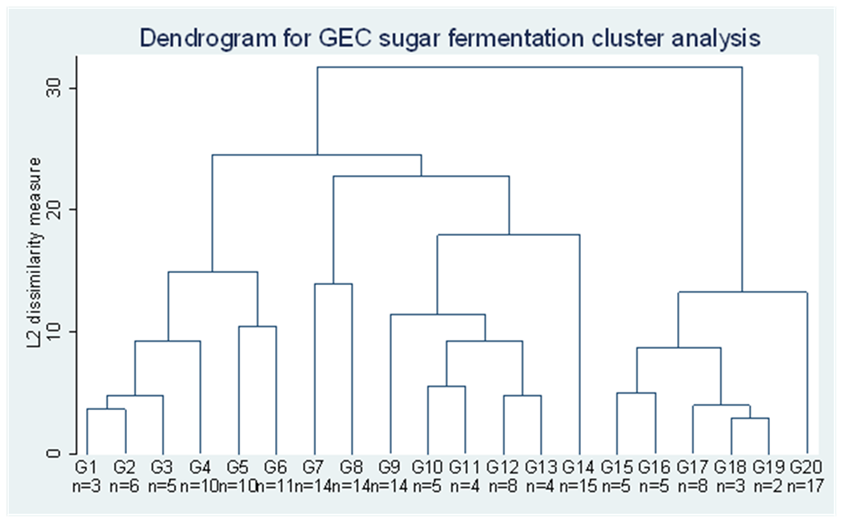
Figure 1. Dendrogram of the sugar fermentation cluster analysis of generic E. coli. G= group based on sugar fermentation similarity, and n= number of isolates within each group.

Running a Chi Square on that: AD status (pre- vs. post AD) antibiotic resistance was not statistically significantly associated with this set of fermentation cluster memberships.

Pearson chi2(19) = 25.5411 Pr = 0.143

Table 1 – Data distribution of REPPCR GEC data
Pre-AD Post-AD
Grouping Susceptible Resistant Susceptible Resistant
1 2 2 3 (Am*)
2 2 5 (2 – Am, Cf, S, G, Te) (Am, S, Te) (Te)
(Amc, Am, Cf)
1 3 (Cf)
(2 – C, S, G, Te)
3 6
4 5 3 (2 – G, Te)
(Cf, C, S, G, Te)
9
5 1 2 1 (Amc, Am, Cf,  S, G, Te)

*Am = Ampicillin, C= Chloramphenicol, CF = Ceftiofur, S = Streptomycin, G = Sulfasoxizole, Te = Tetracycline, Amc = Amoxycillin clavulanic acid

(fisher.test(tbl, simulate.p.value = TRUE, B = 1e5)

Fisher’s Exact Test for Count Data with simulated p-value (based on 1e+05 replicates)

p-value = 0.104

If no selection is occurring, output equals input, so at P < 0.1 is a trend for a selective process.

Table 2 – Salmonella – Number of susceptible or resistant bacteria
Serogroup Pre-AD Susceptible Pre-AD Resistant Post-AD Susceptible Post-AD Resistant
B 6 1 1 10
C1 12 4 14 0
C2 1 8 0 0
E1 34 0 50 0
K 4 2 2 2
Total 57 65 29 12
% 47 53 71 29

Configuration 1 SeroGrp*ABResist = best fits – association (interaction) of serogroup and resistance

Configuration 2 SeroGrp*PrePost = best fits – association (interaction) of serogroup and pre- post AD, but is conditioned by whether it is resistant

Goodness-of-fit Summary Statistics

Statistic Chi-Sq DF P
Pearson 6.91 5 0.2276
Likelihood 8.67 5 0.1230
Freeman-Turkey 8.28 5 0.1416

Number of Near Zero Expected Cells     4

Three observations were made:

      • a serotype may become more resistant as it goes through the AD
      • a serotype may become less resistant, or
      • a serotype may not survive.

Authors

J. H. Harrison – Livestock Nutrient Management Specialist, Department of Animal Sciences, Washington State University Puyallup Research and Extension Center
jhharrison@wsu.edu

Additional Authors

J. Gay – Department of Veterinary Clinical Medicine, Washington State University, Pullman, WA
R. McClannahan – Facility Manager – Integrated Research and Innovation Center – University of Idaho, Moscow, ID
E. Whitefield – Research and Outreach Specialist Department of Animal Sciences, Washington State University Puyallup Research and Extension Center

References

Aitken M. D., M. D.Sobsey, M. D., N. A.Van Abel, K. E.Blauth, D. R.Singleton, P. L.Crunk, C.Nichols, G. W.Walters, and M.Schneider. 2007. Inactivation of Escherichia coli O157:H7 during thermophilic anaerobic digestion of manure from dairy cattle. Water Res. 41:1659-1666. doi:10.1016/j.watres.2007.01.034.

Chiapetta, H., Harrison, J. H., Gay, J., McClanahan, R., Whitefield, E., Evermann, J., Nennich, T., Gamroth, M. (2019). Reduction of pathogens in bovine manure in three full scale commercial anaerobic digesters. Water, Air, and Soil Pollution, 230:111.

Frear C., W.Liao, T.Ewing, and S.Chen. 2011. Evaluation of co-digestion at a commercial dairy anaerobic digester. Clean—Soil, Air, Water. 39:697-704. doi:10.1002/clen.201000316.

Guan T. Y., and R. A.Holley. 2003. Pathogen survival in swine manure environments and transmission of human enteric illness—a review. J. Environ. Qual. 32:383-392.

Manyi-Loh C. E., S. N.Manphweli, E. L.Meyer, A. I.Okoh, G.Makaka, and M.Simon. 2014. Inactivation of selected bacterial pathogens in dairy cattle manure by mesophilic anaerobic digestion (balloon type digester). Int. J. Environ. Res. Public Health. 11:7184-7194. doi:10.3390/ijerph110707184.

Pandey P. K., and M.L.Soupir. 2011. Escherichia coli inactivation kinetics in anaerobic digestion of dairy manure under moderate, mesophilic, and thermophilic temperatures. AMB Express. 1:18. doi:10.1186/2191-0855-1-18.


The authors are solely responsible for the content of these proceedings. The technical information does not necessarily reflect the official position of the sponsoring agencies or institutions represented by planning committee members, and inclusion and distribution herein does not constitute an endorsement of views expressed by the same. Printed materials included herein are not refereed publications. Citations should appear as follows. EXAMPLE: Authors. 2022. Title of presentation. Waste to Worth. Oregon, OH. April 18-22, 2022. URL of this page. Accessed on: today’s date.
Antimicrobial Resistance From a One-Health Perspective: A Multi-Disciplinary University Instruction from Extension Professionals

Purpose

Contemporary issues faced by Extension professionals are often technically and politically complex, crossing a range of subjects, academic disciplines, and value systems. Addressing complex social issues to achieve desired impacts across disparate audiences requires collaborative efforts that engage multiple disciplines, represent unique geographic regions and cultural settings, and implement varying outreach methods. For example, antimicrobial resistance (AMR) is truly a “wicked problem” as it is global, complex, and difficult to solve. It is a “big picture” issue that must be addressed at multiple smaller scales where values, beliefs, cultural norms, and habits collide with science, innovation, public policy, and behavioral science, all forming a complicated intersection of separate, yet linked, continuous feedback loops.

The iAMResponsibleTM Project, is a nationwide extension program working on outreach and education on AMR within agriculture, food production, and food safety systems. In 2019, the team prioritized two approaches to promote cross-disciplinary collaborations on AMR research and increase AMR-related outreach to disparate audiences: a) greater engagement of graduate students in understanding AMR and the value of their area of study to approaching this issue from a One Health perspective; and b) improved science communication skills among graduate students. To that end, we proposed the development of a web-based, graduate-level university course to expand the impact of iAMResponsibleTM programming by engaging students in learning about the scientific, cultural, and political aspects of AMR across relevant disciplines.

The primary objectives in offering this novel, web-based university course that integrates research-based learning with science communication were to:

    1. Facilitate optimal distribution and utilization of research-based, AMR-related food safety information and resources at the state, regional and national levels among future and current food producers and consumers; and
    2. Develop AMR/Food Safety content to fill existing gaps or emerging areas of significant needs that are not being addressed regionally, nationally, and globally.

What Did We Do

Multi-university instruction

Spring 2020

A one-credit, graduate-level seminar course exploring U.S. and global challenges related to AMR in food systems, research-based strategies to mitigate potential risks associated with AMR, and successful methods of communicating this complicated scientific topic to food producers and consumers was first taught simultaneously at the University of Nebraska–Lincoln and the University of Maryland. Instructors on site at each participating institution facilitated listing of the course in their course catalog to allow students to enroll for credit at the university where they are studying. Each meeting of the class featured invited presentations by experts from across the U.S. sharing research, policy, and communication perspectives on AMR.

Spring 2021

Following the same format as the initial offering, the course was taught simultaneously at the University of Nebraska-Lincoln, University of Maryland, North Carolina State University, University of Minnesota, and Washington State University.

Based on experiences and student feedback from the 2020 and 2021 offerings of the course, lecture topics for the 2022 offering include:

Topic Presenter
Introduction to antibiotic resistance one-health Dr. Amy Schmidt, University of Nebraska – Lincoln and Dr. Stephanie Lansing, University of Maryland
Principles of extension programming and outreach Dr. Joe Harrison, Washington State University
First fully live session: Introduction to the course and student expectations All Instructors
Impact of AMR on medical practice and human health Dr. Rosa Helena Bustos – head of clinical pharmacology at Universidad de la Sabana
Challenge of AMR for animal health care Dr. Paul Morley, Texas A&M University
The natural occurrence and current state of the AMR challenge for environmental pollution Dr. Thomas Ducey (USDA-ARS)
Guided panel: Environmental mitigations for AMR Panelists: Carlton Poindexter, University of Maryland; Dr. John Schmidt, USDA-ARS; Dr. Shannon Bartelt-Hunt, University of Nebraska;

Moderators: Dr. Stephanie Lansing and Dr. Mahmoud Sharara

Intervention and tracing of AMR in the food supply Aaron Asmus – Hormel Foods

Julie Haendiges, US-FDA

History of public attitudes towards microbiology and what it tells us about how to approach AMR Dr. Kari Nixon, Whitworth University
Alternating Spring Break Class activity on identifying and evaluating science communication
Worldwide Implications of AMR Student led examination of AMR as it is experienced around the world
Challenges in development of antibiotics and alternatives for antibiotics Dr. Glenn Zhang, Oklahoma State University
How to assign risk to AMR found in non-clinical settings Dr. Bing Wang, University of Nebraska
Dead week workday – students work time. Submit reports and recorded presentations by the end of the workday on Friday, April 22. Zoom rooms will be available as needed. Led by Dr. Noelle Noyes
Final project review Student project Q&A sessions

Science Communication

As a joint offering by several extension faculty, this course was designed not only to cover the fundamentals of AMR but also as an opportunity to introduce STEM students to important skills and concepts used by extension professionals. As a part of this multi-institution collaboration, students worked together with their peers across the country to review and develop research-based resources and methods for communicating scientific information about AMR to non-academic audiences. These efforts were facilitated by the inclusion of lectures on extension principles and science communication, and team-based outreach projects, to support development of outreach and educational thinking and skill development within students in STEM fields. Moreover, content created by students through team projects that produced well-designed outreach content were intended for dissemination by the iAMResponsibleTM Project. The result was the production of outreach materials that transcended expertise represented by project team members.

Evaluation methods

Methods for evaluating the content and delivery of this course have been adjusted with each subsequent offering. During the first year an informal focus group discussion was conducted with students at the end of the term to solicit feedback and suggestions for future iterations. Throughout the second session (2021) students filled out weekly surveys following each lecture, as well as a survey assessment of the course. Instructors were also asked to evaluate the course content and delivery following the 2021 offering.

Students are evaluated on a combination of participation in the course discussion (during the lecture period or online following the lecture) and on evaluation of student projects. The student projects include a large emphasis on teams cooperating to identify a target audience for their shared topic, establishing a shared goal for their audience, and creating impactful outreach products to achieve their intended outcomes. Moreover, as a part of their participation and evaluation for this course, students are asked to review the effectiveness of their peers’ outreach products and the peer critiques are incorporated into the final student evaluation for the course.

What Have We Learned

Feedback from the students

Results from the student focus group in 2020 were highly influential on the expanded instruction for science communication strategies and addition of international emphasis on AMR discussions in subsequent years. Survey results following the second session again highlighted the value the students placed in the instruction on science communication, audience identification, and navigating public attitudes toward AMR, science, and disease. Student participation in Spring 2020 (two institutions) and 2021 (five institutions) totaled 28 students. Evaluations by students revealed the following outcomes:

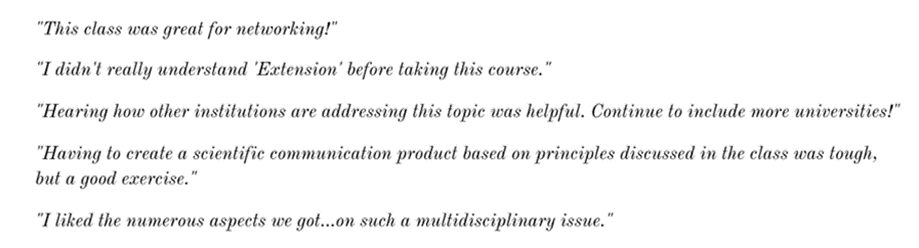
Student comments included:

Student surveys also indicated that the logistical issues surrounding the expectation for students to work with colleagues cross-institutionally on class assignments was the most significant challenge encountered. Accordingly, the syllabus for the current (Spring 2022) offering allocates more discussion time during lectures for students to grow more comfortable with one another and provides the students with a cross-institutional work environment on Slack to facilitate discussion outside of class time. We await the student evaluations from 2022 to provide a more detailed understanding of how these changes will affect student experience but, after 4 weeks of the course, the average weekly participation on Slack is holding at about 70% of participants who regularly check-in, read, or respond to discussion on the platform.

Feedback from the instructors

The development and delivery of this course has had the unintended consequence of providing an opportunity for the instructors of the course to also continue to learn and engage on this dynamic topic. Following delivery of the course in 2021, instructors were asked to evaluate the course content and delivery method, revealing the following data:

Future Plans

Utilization of course materials outside of the course

Lectures, and student projects developed during the first two offerings of the course have been repurposed and made available for a wider audience through the LPELC platform, further linking extension and classroom educational goals and providing the students in the course the opportunity to develop materials for immediate practical application within the national extension community.

How to apply the lessons learned for other extension issues areas

We believe that the results of the students’ evaluations indicate that the next generation of STEM professionals not only values expertise in extension skills but will actively seek to develop those skills for themselves if given the opportunity. Accordingly, we see a value in pursuing similar courses as part of an extension portfolio.

How to assess the long-term impacts

We will also seek to engage former participants in this course in an assessment of how the training received, in systems thinking, multidisciplinary collaboration, and science communication have been effective in their professional work in subsequent years.

Authors

Amy Schmidt, Associate Professor, University of Nebraska – Lincoln
aschmidt@unl.edu

Mara Zelt, Research Technologist, University of Nebraska
Stephanie Lansing, Professor, University of Maryland
Rohan Tikekar, Associate Professor, University of Maryland
Mahmoud Sharara, Assistant Professor, North Carolina State University
Joe Harrison, Professor Emeritus, Washington State University
Noelle Noyes, Assistant Professor, University of Minnesota

Additional Information

Selected course materials are available through the LPELC website

Acknowledgements

Funding for the iAMR Project was provided by USDA-NIFA Award Nos. 2017-68003-26497, 2018-68003-27467 and 2018-68003-27545. Any opinions, findings, conclusions, or recommendations expressed in this publication are those of the author(s) and do not necessarily reflect the view of the U.S. Department of Agriculture.


The authors are solely responsible for the content of these proceedings. The technical information does not necessarily reflect the official position of the sponsoring agencies or institutions represented by planning committee members, and inclusion and distribution herein does not constitute an endorsement of views expressed by the same. Printed materials included herein are not refereed publications. Citations should appear as follows. EXAMPLE: Authors. 2022. Title of presentation. Waste to Worth. Oregon, OH. April 18-22, 2022. URL of this page. Accessed on: today’s date.

Evaluating Full-Scale Greenhouse Systems for Lagoon Sludge Drying and Pathogen Reduction

Purpose

This study aims to assess the performance of solar greenhouse drying as a management strategy for swine lagoon sludge. In North Carolina, swine lagoons are heavily concentrated in a small geographic area (Figure 1), which overlaps with a high concentration of poultry operations. This results in a challenge for identifying suitable acres for sludge application, particularly for nursery operations with high concentrations of zinc (Zn) in the sludge. Drying the sludge creates opportunity for long-distance transportation, further processing to produce marketable granules/pellets, as well as co-firing to produce energy and concentrate minerals in ash form. While a useful strategy, drying is an energy-intensive process and often requires significant capital investment and trained operators, both of which are a barrier for on-farm adoption. Solar drying using greenhouses is a low-cost technology that requires minimal oversight and management. While successfully adopted in wastewater treatment applications, solar drying has not been fully evaluated in manure management contexts.

Figure 1. Distribution of swine operations (red dots) in Eastern North Carolina (Source: NC Department of Environmental Quality)

What Did We Do?

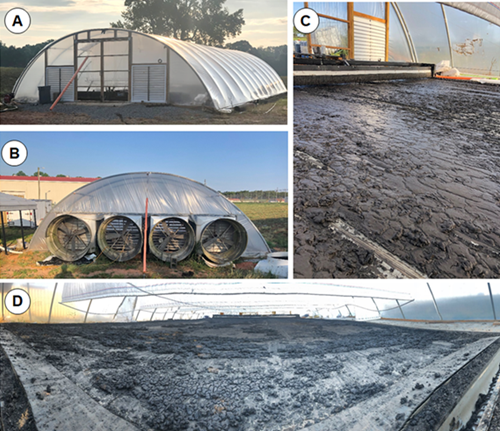
Figure 2. Novel lagoon sludge drying system showing: (A) entrance and air inlet louvers, (B) exhaust fans, (C) sludge layer at beginning of drying test, and (D) panoramic view of drying bed at end of drying test.

We conducted two sludge drying tests in Summer 2021 using a greenhouse structure we built on NC State University campus (Figure 2). The tests utilized freshly dredged sludge with a total solid concentration of 8%. The sludge was in a pumpable state and was applied to the drying bed in a uniform layer. The drying bed consists of a concrete floor (17m long, 6 m wide) with a sweeping mechanism to level the sludge and facilitate removal at the study termination. Two different loading rates were tested in this study: 13.9 kg-m-2 (low loading density test), and 28.3 kg-m-2 (high loading density test). Only the two middle fans for the greenhouse structure were operated continuously during the testing period. Each fan had a nominal flowrate of 20,000 cubic feet per minute. The sweeping mechanism was operated twice daily to mix the material in the drying bed. Temperature and relative humidity were monitored inside the greenhouse structure near the air inlet, at the middle of the building, and near exhaust fans. Ambient conditions were monitored using an on-site weather station. At the completion of each test, the recovered material was analyzed for moisture, nutrient, ash, and energy content.

What Have We Learned?

The daily weather conditions during the two drying tests are summarized in Table 1. Ambient temperature and relative humidity within the greenhouse structure were greater for the high-loading density test than the low-loading density test by around 3℃ and 17% relative humidity points, respectively. This data suggests favorable drying conditions for low loading density. Wide variability in weather conditions during the spring and summer seasons in North Carolina are common and likely to be a significant factor in the performance of similar drying systems.

Table 1. Daily weather conditions during test periods (Source: Lake Wheeler Road Field Laboratory Weather station)

Test Date Temperature (C) Relative Humidity (%) Rain (mm)
Avg. Solar Radiation (W.m-2) ETo* (mm)
Mean Max. Min. Mean Max. Min.
Low Loading Density 5/19 20.2 28.3 11.2 55.5 91.7 25.1 0.0 334.3 5.2
5/20 22.0 29.8 11.4 54.9 91.9 27.5 0.0 318.5 5.5
5/21 20.9 27.8 14.7 47.8 78.2 22.6 0.0 296.4 5.7
High Loading Density 5/25 22.9 29.6 17.6 76.7 92.5 53.0 0.0 211.3 4.2
5/26 26.3 34.3 20.6 65.4 86.4 34.4 0.0 281.4 6.1
5/27 26.5 33.5 18.9 70.4 86.6 42.4 0.0 280.2 5.8
5/28 25.9 33.0 18.7 62.1 91.3 30.5 1.8 267.7 6.4
5/29 20.8 30.3 12.4 76.0 43.0 43.0 1.8 162.8 4.6

*Penman-Monteith Estimated Evapotranspiration at 2-meter height

Cross-greenhouse variability in air temperature and relative humidity was greatest between sunrise and sunset (7AM and 6PM) indicating active drying. Mechanical mixing of the sludge (Figure 3, denoted by vertical yellow lines) appears to have had a positive impact on the drying process as evidenced by the increase in average air temperature and relative humidity after mixing. This effect can be attributed to exposing more water-saturated sludge to drying air, which increases the moisture gradient, thus boosting convective drying. In addition, wet sludge is darker in color, which increases its radiation heat absorption.

Figure 3. Average greenhouse temperature (upper) and relative humidity (lower) during high-loading test. Vertical yellow lines indicate drying bed turning using the mechanical sweeping mechanism.

For the high-loading rate test, observing temperature and relative humidity on Day 4 (Figure 3) during daytime (hours 77 to 80) indicates the drying process has slowed down considerably with average air temperature and relative humidity inside the greenhouse closely matching inlet air. These observations suggest that accessible water in the sludge has been effectively removed.

Moisture content of sludge in the low-loading rate test decreased by 88% over 46 h while the high-loading rate treatment yielded a 91% reduction in moisture over 101 h. Using the starting total solids content of 7.9%, Using the drying bed dimensions and test duration, the average drying rates observed were 0.26 and 0.25 kgH2O.m-2.h-1 for low and high loading density tests, respectively. Over the drying duration, the average evapotranspiration, estimated using Penman-Monteith equation, was 0.23 kgH2O. m-2.h-1 (with a standard deviation of 0.03 kgH2O. m-2.h-1) which is 9% and 13% lower than observed evaporation rates for low and high loading density tests. These observations indicate the depth of material addition had minimal effect on the drying rate. In addition, these observations suggest the combined effect of mechanical ventilation and energy gain due to the greenhouse effect, increased the evaporation rate beyond average evaporation rate estimates. The air use efficiency was estimated as the amount of water removed during the test to the maximum amount of water removable (i.e., resulting in drying air saturation). Air quality at inlet and exhaust were used to estimate moisture ratio at both points. The air use efficiency for low and high sludge loading density were 21.1% and 21.0%, respectively.

Future Plans

These findings suggest opportunities to improve the drying efficiency. We are currently assessing different controllers in terms of their ability to manage mechanical ventilation to minimize energy use in low-drying conditions. Similarly, we are planning a series of tests to capture seasonal weather conditions. Gaseous emissions (ammonia and greenhouse gases (GHG) will be evaluated on full scale operation). Pathogen count for the starting and ending material will be quantified and reported to assess any risk associated with wider distribution of the dewatered material. Currently, a full-scale sludge drying compound (929square meters) has been built and operated on a swine operation in Eastern North Carolina. Our team is collecting data on the system operation and will be reporting system performance and energy use in upcoming meetings.

Authors

Mahmoud Sharara, Assistant Professor and Extension Specialist, North Carolina State University
msharar@ncsu.edu

Christopher Hopkins, Research Associate, Department of Forest Biomaterials, College of Natural Resources, NC State University
Joseph Stuckey, Research Operations Manager, Animal Poultry Waste Management Processing Facility, Prestage Department of Poultry Science, NC State University

Additional Information

https://animalwaste.ces.ncsu.edu/2021/08/drying-sludge-critical-to-improving-nutrient-distribution-and-utilization/

Acknowledgements

  • NC Department of Agriculture and Consumer Services, Bioenergy Research Initiative (BRI) – Contract No #17-072-4015, Potential for Integrating Swine Lagoon Sludge into N.C. Bioenergy Sector
  • Virginia Pork Council, Optimizing Greenhouse Drying of Swine Lagoon Sludge to Support Implementation in NC and VA.


The authors are solely responsible for the content of these proceedings. The technical information does not necessarily reflect the official position of the sponsoring agencies or institutions represented by planning committee members, and inclusion and distribution herein does not constitute an endorsement of views expressed by the same. Printed materials included herein are not refereed publications. Citations should appear as follows. EXAMPLE: Authors. 2022. Title of presentation. Waste to Worth. Oregon, OH. April 18-22, 2022. URL of this page. Accessed on: today’s date.

A Workshop to Review BMPs and BATs for Control of Dust, Ammonia, and Airborne Pathogen Emissions at Commercial Poultry Facilities (Zhao)

Purpose

Poultry production is a significant source of air pollutant emissions including particulate matter (PM), ammonia (NH3), and  pathogens, which negatively impact bird health and performance, human respiratory health, food safety, and local environmental quality. Effective and economically feasible management practices and technologies to mitigate air pollutant emissions and pathogen transmission are urgently needed.

In the past decade, a variety of management practices and control technologies have been developed and preliminarily tested in commercial poultry facilities, with varying degrees of success. Technologies that have been applied for PM control include air filtration, impaction curtains, oil/water spraying, wet scrubbers, electrostatic precipitation, and electrostatic spray scrubbing. Among these, electrostatic methods and wet scrubbing achieve high removal efficiencies for both fine and coarse PM. For NH3 gas mitigation, various forms of scrubbing technologies such as trickling biofilters, acid spray scrubbers, and electrolyzed water spraying have been tested in commercial poultry facilities, alongside management practices such as feed additives and litter amendments. Acid spray scrubbers can be particularly attractive to poultry facilities since the sulfuric acid from the scrubber reacts with NH3 to create ammonium sulfate, which can be used as fertilizer to offset scrubber operating costs. A new technology using artificial floor was recently studied and demonstrated significant reduction in ammonia and PM concentrations and emissions at laying hen housing.

The avian influenza outbreak in 2014/15 and the current spread of the Highly Pathogenic Avian Influenza (HPAI) remind us that pathogen control at poultry facilities is crucial. Technologies such as electrostatic precipitators, electrostatic spray scrubbers, and electrolyzed water spraying systems have been tested to assess their capacities for airborne bacteria reduction.

The technical and economic feasibilities of these methods need to be evaluated for proper consideration by poultry producers and their stakeholders. All the above research results need to be introduced to producers for practical applications.

What Did We Do?

This workshop is organized for the researchers and Extension specialists to review the latest BMPs and BATs on control of dust, ammonia, and pathogens at poultry facilities for improved biosecurity, food safety, environmental quality, and the overall sustainability of poultry production.  We have developed the following presentations and will present them at 2022 W2W.

    1. Manure Drying Methods to Control Ammonia Emissions (Dr. Albert Heber-Professor Emeritus, Purdue University)
    2. A Spray Wet Scrubber for Recovery of Ammonia Emissions from Poultry Facilities (Dr. Lingying Zhao, Professor, Ohio State University)
    3. Electrostatic Precipitation Technologies for Dust and Pathogen Control at Poultry Layer Facilities (Dr. Lingying Zhao, Professor, The Ohio State University)
    4. Field Experiences of Large-Scale PM Mitigation (Dr. Teng Lim, Professor, University of Missouri)
    5. Mitigation of Ammonia and Particulate Matter at Cage-free Layer Housing with New Floor Substrate (Dr. Ji-Qin Ni, Professor, Purdue University)

What Have We Learned?

    1. Newly developed BMPs and BATs can improve air quality in commercial poultry facilities: Manure belt layer houses reduce ammonia emissions by removing manure from the layer houses in 1 to 7 days. Belt aeration using blower tubes is one method that has been used to dry the manure on the belt.  Drying tunnels take manure from layer houses and utilize ventilation exhaust air to further dry the manure before it enters the manure storage or compost facilities or transfers to pelletizing operations.  Manure sheds and compost facilities are ventilated with building exhaust air or fresh air to dry manure in storage.
    2. The use of acid spray scrubbing is promising, as it simultaneously mitigates and recovers ammonia emission for fertilizer. Its low contribution of backpressure on propellor fans makes it applicable on US farms. A full-scale acid spray scrubber was developed to recover ammonia emissions from commercial poultry facilities and produce nitrogen fertilizer. The scrubber performance and economic feasibility were evaluated at a commercial poultry manure composting facility that released ammonia from exhaust fans with concentrations of 66–278 ppmv and total emission rate of 96,143 kg yr−1. The scrubber achieved high NH3 removal efficiencies (71–81%) and low pressure drop (<25 Pa). Estimated water and acid losses are 0.9 and 0.04 ml m−3 air treated, respectively. Power consumption rate was between 90 and 108 kWh d−1. The scrubber effluents containing 22–36% (m/v) ammonium sulphate are comparable to commercial-grade nitrogen fertilizer. Preliminary economic analysis indicated that a break-even of one year is achievable. This study demonstrates that acid spray scrubbers can economically and effectively recover NH3 from animal facilities for fertilizer.
    3. Two types of electrostatic precipitation-based dust control technologies have been developed at the Ohio State University: the electrostatic precipitator (ESP) and the electrostatic spray scrubber (ESS). Field tests of the ESP and ESS conducted at a commercial layer facility indicated that (1) the fully optimized ESP achieved respective mean PM5, PM10, and TSP removal efficiencies of 93.6% ±5.0%, 94.0% ±5.0%, and 94.7% ±4.4% and (2) the ESS exhibited respective mean PM2.5, PM10, and TSP removal efficiencies of 90.5% ±10.0%, 91.9% ±8.2%, and 92.9% ±6.9%.  A system of 88 large ESP units to treat exhaust air from the 4-house poultry facility at the minimum required ventilation rate of 24.8 m3 s-1 would have an initial cost of $757,680 and an annual operating cost of $10,831 ($13.43 per 1,000 birds), increasing annual facility electricity consumption by 54.2%. A system of ESS units designed to treat exhaust air for six exhaust fans in each of the 4 poultry houses that operated continuously year-round for minimum ventilation, is estimated to have an initial cost of $71,280 with an annual operating cost of $21,663 for water consumption and electricity usage. The ESP is more effective, and the ESS is more economically feasible to mitigate PM at a commercial egg production facility.
    4. The field-scale measurements of PM mitigation technologies are usually time-consuming to set up and maintain, and often only limited replications can be obtained. It is important to minimize interference to the routine farm operation. The use of different PM measurements, setup and maintenance required to ensure data quality, and differences between the mitigation technologies are discussed. It is important to consider practicality of the mitigations, along with safety, and long-term use of the different technologies.
    5. A new mitigation approach, using AstroTurf ® as floor substrate, reduced indoor concentrations and emissions of ammonia and PM at cage-free aviary-style layer rooms in a recent study. Results demonstrated that the average daily mean ammonia concentration in the two AstroTurf® floor rooms (7.5 ppm) was significantly lower (p < 0.05) compared with that in the two wood shaving floor rooms (15.2 ppm) with a reduction rate of 51%. Average daily mean large particles (all particles detected above ~2.5 µm) and small particles (all particles detected below ~0.5 µm) in the two AstroTurf® floor rooms were significantly reduced (p < 0.05) by 70% (501,300 vs. 1,679,700 per ft3) and 63% (906,300 vs. 2,481,100 per ft3), respectively, compared with those in the two wood shaving floor rooms. With the controlled and consistent ventilation rates among the rooms in the study, the emissions of ammonia and PM (large and small particles) from the two AstroTurf® floor rooms had similar reduction rates.

Future Plans

More workshops to review BMPs and BATs for mitigation of air emissions and pathogen transmission in poultry facilities will be organized as new research development and findings emerge.  The workshop will target audiences of researchers, farmers, and professionals working with farmers.

Authors

Presenting authors

Lingying Zhao, Professor and Extension Specialist, The Ohio State University

Albert Heber, Professor Emeritus, Purdue University

Teng Lim, Professor, University of Missouri

Ji-Qin Ni, Professor, Purdue University

Corresponding author

Lingying Zhao, Professor and Extension Specialist, The Ohio State University

Corresponding author email address

Zhao.119@osu.edu

Additional authors

Matt Herkins, Graduate Research Associate, The Ohio State University

Albert Heber, Professor Emeritus, Purdue University

Teng Lim, Professor, University of Missouri

Ji-Qin Ni, Professor, Purdue University

Additional Information

Airquality.osu.edu

Hadlocon, L. J., A. Soboyejo, L. Y. Zhao, and H. Zhu. 2015. Statistical modeling of ammonia absorption efficiency of an acid spray scrubber using regression analysis. Biosystems Engineering 132: 88-95.

Hadlocon, L. S., R.B. Manuzon, and L. Y. Zhao. 2015. Development and evaluation of a full-scale spray scrubber for ammonia recovery and production of nitrogen fertilizer at poultry facilities. Environmental Technology 36(4): 405-416.

Hadlocon, L.J. and L.Y. Zhao. 2015. Production of ammonium sulfate fertilizer using acid spray wet scrubbers. Agricultural Engineering International: CIGR Journal. 17 (Special Issue: 18th World Congress of CIGR): 41-51.

Hadlocon, L.J., L.Y. Zhao, B. Wyslouzil, and H. Zhu. 2015. Semi-mechanistic modeling of ammonia absorption in acid spray scrubbers based on mass balances.  Biosystems Engineering 136:14-24.

Heber, A. J., T.-T. Lim, J.-Q. Ni, P. C. Tao, A.M. Schmidt, J. A. Koziel, S. J. Hoff, L.D. Jacobson, Y.H. Zhang, and G.B. Baughman. 2006. Quality-assured measurements of animal building emissions: Particulate matter concentrations. Journal of the Air & Waste Management Association. 56(12): 1642-1648.

Knight, R. M. L.Y. Zhao, and H. Zhu. 2021. Modelling and optimisation of a wire-plate ESP for mitigation of poultry PM emission using COMSOL. Biosystems Engineering 211: 35-49.

Knight, R., X. Tong, L. Zhao, R. B. Manuzon, M. J. Darr, A. J. Heber, and J. Q. Ni. 2021. Particulate matter concentrations and emission rates at two retrofitted manure-belt layer houses. Transactions of the ASABE 64(3): 829-841. (doi: 10.13031/trans.14337)

Knight, R., X. Tong, Z. Liu, S. Hong, and L.Y. Zhao. 2019. Spatial and seasonal variations of PM concentration and size distribution in manure-belt poultry layer houses. Transactions of the ASABE 62(2):415-427. doi: 10.13031/trans.12950

Lim, T. T., H. W. Sun, J.-Q. Ni, L. Zhao, C. A. Diehl, A. J. Heber, and P.-C. Tao. 2007. Field tests of a particulate impaction curtain on emissions from a high-rise layer barn. Transactions of the ASABE 50(5): 1795-1805.

Lim, T.-T., Y. Jin, Ni, J.-Q., and A. J. Heber. 2012. Field evaluation of biofilters in reducing aerial pollutant emissions from commercial finishing barn. Biosytems Engineering 112(3): 192-201.

Lim, T.-T., C. Wang, A. J. Heber, J.-Q. Ni, and L. Zhao. 2018. Effect of electrostatic precipitation on particulate matter emissions from a high-rise layer house. In Air Quality and Livestock Farming, 372 p. T. Banhazi, A. Aland, and J. Hartung, eds. Australia: CRC Press, Taylor and Francis Group.

Ni, J.-Q., A.J. Heber, M. J. Darr, T.-T. Lim, Diehl, and B. W. Bogan. 2009. Air quality monitoring and on-site computer system for livestock and poultry environment studies. Transactions of the ASABE 52(3): 937-947.

Ni, J.-Q., A. J. Heber, E. L. Cortus, T.-T. Lim, B. W. Bogan, R. H. Grant, and M. T. Boehm. 2012. Assessment of ammonia emissions from swine facilities in the U.S. – Application of knowledge from experimental research. Environmental Science & Policy 22(0): 25-35.

Ni, J.-Q., L. Chai, L. Chen, B. W. Bogan, K. Wang, E. L. Cortus, A. J. Heber, T.-T. Lim, and C. A. Diehl. 2012. Characteristics of ammonia, hydrogen sulfide, carbon dioxide, and particulate matter concentrations in high-rise and manure-belt layer hen houses. Atmospheric Environment 57(0): 165-174.

Ni, J.-Q., S. Liu, C. A. Diehl, T.-T. Lim, B. W. Bogan, L. Chen, L. Chai, K. Wang, and A. J. Heber. 2017. Emission factors and characteristics of ammonia, hydrogen sulfide, carbon dioxide, and particulate matter at two high-rise layer hen houses. Atmospheric Environment 154: 260-273. http://dx.doi.org/10.1016/j.atmosenv.2017.01.050.

Tong, X., L.Y. Zhao, A. Heber, and J. Ni. 2020.  Mechanistic modelling of ammonia emission from laying hen manure at laboratory scale. Biosystems Engineering. 192:24-41.

Tong, X., L.Y. Zhao, A. Heber, and J. Ni. 2020. Development of a farm-scale, quasi-mechanistic model to estimate ammonia emissions from commercial manure-belt layer houses. Biosystems Engineering 196, 67-87.

Tong, X., L.Y. Zhao, R. B. Manuzon, M. J. Darr, R. M. Knight, C. Wang, A. J. Heber, and J.Q. Ni. 2021. Ammonia concentrations and emissions at two commercial manure-belt layer housed with mixed tunnel and cross ventilation. Transactions of the ASABE 64(6): 2073-2087. (doi: 10.13031/trans.14634)

Tong, X., S. S. Hong., and L.Y. Zhao 2019. Development of upward airflow displacement ventilation system of manure-belt layer houses for improved indoor environment using CFD simulation. Biosystems Engineering 178:294-308.

Zhao, L.Y., L. J. S. Hadlocon, R. B. Manuzon, M.J. Darr, H. M. Keener, A. J. Heber, and J.Q. Ni. 2016. Ammonia concentrations and emission rates at a commercial manure composting facility. Biosystems Engineering  150: 69-78.

Acknowledgements

The wet scrubber development was supported by National Research Initiative Competitive Grant 2008-55112-1876 from the USDA Cooperative State Research, Education, and Extension Service Air Quality Program. The ammonia emission modelling work was supported by the USDA-NIFA Grant 2018-67019-27803.

The electrostatic precipitation-based dust control work was supported by the USDA National Institute of Food and Agriculture Grant 2016-67021-24434.

The Project funding for the Mitigation of Ammonia and Particulate Matter at Cage-free Layer Housing with New Floor Substrate presentation was provided by the U.S. Poultry & Egg Association. GrassWorx LLC provided the AstroTurf and financed the building of the flooring systems.

Appreciation is also expressed to the U.S. EPA, and participating producers and staff for their collaboration and support.


The authors are solely responsible for the content of these proceedings. The technical information does not necessarily reflect the official position of the sponsoring agencies or institutions represented by planning committee members, and inclusion and distribution herein does not constitute an endorsement of views expressed by the same. Printed materials included herein are not refereed publications. Citations should appear as follows. EXAMPLE: Authors. 2022. Title of presentation. Waste to Worth. Oregon, OH. April 18-22, 2022. URL of this page. Accessed on: today’s date.
Swine manure and cedar woodchip applications improve soil ecological indicators and improve moisture retention

Purpose

Manure application has long been used as a soil amendment to supply nutrients for crop growth. However, the effects of manure on many other aspects of soil health have been less fully explored, especially in on-farm research settings. The health of soil biological communities has been shown to be positively correlated with the addition of organic materials and soil moisture. This study looked to confirm these observations in an on-farm setting using two types of organic treatments: swine manure and cedar woodchips and their impact on arthropod abundance and soil biological quality (QBS), measured through arthropod adaptations to deep soil living conditions (ecomorphological index).

What Did We Do?

12 plots were established (10 ft x 10 ft) on a commercial farm with clay loam soils, near Julian, Nebraska on a field planted in the second year of a corn-corn-soybean rotation. Plots were assigned to one of three treatments: swine slurry, swine slurry + woodchips, and control plots with no amendments with 4 replications per treatment. Swine slurry was applied at a rate of 4200 gal/ac. Woody biomass was applied at a rate of 10 ton/ac. Swine slurry was applied on all plots in April and woodchips were applied roughly 4 weeks later at the time when plots were established (Day 0).

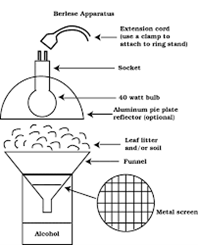
At establishment (Day 0) and at 5 other days during the growing season (25, 54, 81, 99 and 128 days after establishment) roughly 1 gal of soil was collected from each plot by randomly sampling using a 2-in diameter sampler to a depth of 8-in. These samples were then transferred to Berlese-Tullgren funnels (Figure 1) for extraction of arthropods, a commonly used technique to assess microarthropods in the soil (Ducarme et al., 2002). A 70% ethanol solution was used to preserve the organisms for later analysis. Additionally, a 50 g subsample of the collected material was used to determine the moisture content of the soil at the time of sampling.

Figure 1. Berlese funnel uses light and heat to drive arthropods out of soil or litter sample. Photo credit University of Tennessee Extension.

The QBS method of classification was employed to assign an eco-morphological index (EMI) score based on soil adaptability level of each arthropod order or family (Parisi et al., 2005). Preserved arthropods from each soil sample were identified and quantified using light microscopy. For some groups, such as Coleoptera, characteristics of edaphic adaptation were used to assign individual EMI scores for each arthropod. Each sample was then assigned a total QBS score, which is the sum of the EMI values for each category of arthropod found in the sample.

What Have We Learned?

We observed that on days when soil moisture content was higher, QBS differed significantly among treatments, while no differences among treatments were evident during periods of low soil moisture content. This indicates that soil moisture is the most important soil factor for soil arthropods collected from the top 8 in of soil because they tend to migrate away from heat and drying to more favorable conditions (cooler and wetter environment).

Table 1. Differences in QBS index by treatment at different soil moisture content ranges.
Moisture % Treatment p-value
< 3.3 CON vs SS 0.16
CON vs SSW 0.24
SS vs SSW 0.99
3.4-4.0 CON vs SS 0.08
CON vs SSW 0.03
SS vs SSW 0.73
4.1-5.0 CON vs SS <0.0001
CON vs SSW <0.0001
SS vs SSW <0.0001
CON=control, SS=swine slurry, SSW=swine slurry and woodchips; (p-values are shown for each comparison between treatments at different moisture content ranges)

Thus, it was only when soil moisture was higher overall that arthropod populations in the soil were high enough to show a difference between treatments. For example, on day 54, a more variable moisture content of the soil was observed, with SSW, SS and CON having moisture contents of 4.16, 3.92, and 3.75%, respectively (Table 2).

Table 2. Mean soil moisture content by treatment and time since treatment application
Treatment Moisture %
Day 0 Day 25 Day 54 Day 81 Day 99 Day 128
CON 4.65 3.43 3.75a 3.95 4.77ab 4.31
SS 4.63 3.42 3.92ab 3.71 4.38a 4.1
SSW 4.68 3.72 4.16b 4.27 5.54b 4.63
Effect p-value
Moisture level 0.47
Moisture*treatment 0.05
CON=control, SS=swine slurry, SSW=swine slurry and woodchips; values within columns having the same superscript are not significantly different (p>0.05).

On this same day, QBS was also significantly greater for SSW (QBS=1350) compared to SS (110) and CON (97). Similarly, on day 99 the mean moisture content for the SSW treatment (5.54%) was greater than for SS (4.38%) and CON (4.77%; p<0.05) (Table 3).

Table 3. QBS index by treatment and sampling day
Treatment Day
0 25 54 81 99 128 Mean QBS
CON 156 115 97a 141 105a 150 127.17a
SS 125 106 110ab 135 135b 140 125ab
SSW 140 105 135b 160 141b 160 137b
QBS values having the same superscript within each sampling day are not significantly different. Absence of subscript represent no significant difference between treatments on that day (p≥0.05). CON=control, SS=swine slurry, SSW=swine slurry and woodchips.

In general, we observed that the application of swine slurry with woodchips has a positive effect on soil quality biological index, likely because it also had a positive effect on soil moisture. The application of red cedar woodchips seemed to provide with a good habitat for soil arthropods, which in the future may increase microbial activity and soil aggregation through decomposition of organic matter and binding.

Future Plans

Further analysis will be conducted to examine the arthropod classifications and their role on nutrient cycling more closely. Future research should also seek to confirm these observations in different climates and seasons of the year to observe the efficiency of the treatments, especially woodchips, to preserve soil characteristics that are favorable to microbes and arthropods.

Author

Mara Zelt, Research Technologist, University of Nebraska-Lincoln

Corresponding author email address

mzelt2@unl.edu

Additional authors

Karla Melgar Velis, Graduate Research Assistant, University of Nebraska-Lincoln

Amy Schmidt, Associate Professor, University of Nebraska-Lincoln

Agustin Olivo, Graduate Research Assistant, Cornell University

Eric Henning, Graduate Research Assistant, Iowa State University

Additional Information

Parisi, V., Menta, C., Gardi, C., Jacomini, C., & Mozzanica, E. (2005). Microarthropod communities as a tool to assess soil quality and biodiversity: a new approach in Italy. Agriculture, Ecosystems & Environment, 105, 323-333.

Acknowledgements

Funding for this study was provided by the Nebraska Environmental Trust and Water for Food Global Institute at the University of Nebraska-Lincoln. Much gratitude is extended to collaborating members of the On-Farm Research Network, Nebraska Natural Resource Districts, Nebraska Extension Agents and Michael Hodges and family for providing the land, manure, and effort for this research project. Much appreciation to lab and field workers members of the Schmidt Lab: Mara Zelt, Juan Carlos Ramos, Nancy Sibo, Andrew Ortiz, Andrew Lutt, Seth Caines and Jacob Stover