
Fate of Barbiturates and Non-steroidal Anti-inflammatory Drugs During Carcass Composting

Waste to Worth: Spreading science and solutions logoWaste to Worth home | More proceedings….

Why Are We Concerned About Drug Residues in Animal Mortality Compost?

With disease issues, the decline of the rendering industry, a ban on use of downer cows for food, and rules to halt horse slaughter, environmentally safe and sound practices for disposal of horses and other livestock mortalities are limited. Improper disposal of carcasses containing veterinary drugs has resulted in the death of domestic animals and wildlife. Composting of carcasses has been performed successfully to reduce pathogens, nutrient release, and biosecurity risks. However, there is concern that drugs used in the livestock industry, as feed additives and veterinary therapies do not degrade readily and will persist in compost or leachate, threatening environmental exposure to wildlife, domestic animals and humans.

Two classes of drugs commonly used in the livestock and horse industries include barbiturates for euthanasia and non-steroidal anti-inflammatory drugs (NSAID) for relief of pain and inflammation. Sodium pentobarbital (a barbiturate) and phenylbutazone (an NSAID) concentrations in liver, compost, effluent and leachate were analyzed in two separate horse carcass compost piles in two separate years. Horse liver samples were also buried in 3 feet of loose soil in the first year and drug concentrations were assessed over time.

What did we do?

Year 1- On 9/22/09 a 6 x 6 m piece of 10 mil plastic sheeting was laid on bare soil with a 2% slope, at the edge of Cornell University’s compost site in Ithaca, NY. Water was poured on the plastic to check the direction of flow. A hole was dug at the low end of the pad, under the plastic, large enough to fit a 76 l galvanized garbage can. A stainless steel canner was placed in the garbage can to collect effluent. A hole was cut in the plastic over the canner for collection. A 0.6 m high base (3.7 x 3.7 m) of coarse carbon material (woodchips) was laid on the plastic. A 27 year old Appaloosa mare, weighing approximately 455 kg that had been dosed with 1 gram phenylbutazone at midnight on 9/22/09 and again at 8:00 am was led onto the base and euthanized for severe lameness by a qualified veterinarian with 120 ml Fatal Plus® solution (active ingredient 390 mg/ml Pentobarbital Sodium). After the horse had been euthanized and the veterinarian ensured there were no signs of life, the carcass was maneuvered onto the wood chips with the head on the upward slope of the pad. The liver was removed from the horse and cut into 48 pieces, each weighing approximately 100 grams, and nylon mesh bags were then placed in whiffle balls. A 2 m length of nylon twine was attached to each ball. Twenty-three balls were inserted in the horse’s gut cavity and 22 balls were placed in a 1 m hole in the ground (burial hole) which was dug approximately 1.5 m from the pad. Pieces of the intestine and some blood were also placed in the hole to help mimic the presence of a carcass. The remaining 3 nylon mesh bags with liver were packaged for delivery to Cornell University’s Animal Health Diagnostic Center (AHDC) to determine initial NSAID and barbiturates concentrations. Two Hobo U12 data loggers with 4 temperature probes each were set up to record hourly temperatures. Five of the probes were placed in the compost pile: under the horse’s chest, in the horse’s hind gut, in the horse’s chest cavity, under the horse’s spine and under the horse’s right hind quarter. Two of the probes were placed in the burial hole and one probe was left out to record ambient temperature. The hole was covered with loose soil. The horse was covered with woodchips so that the pile was approximately 1.8 m high. The plastic liner was tightened by rolling it over and under wooden fence posts.

Year 2- In year 1, the collection of “leachate” included precipitation that diluted the leachate. In year 2, to target only the liquids that leached out of the horse and through the pile, two 3 m long troughs with a 1% slope were built out of 15 and 10 cm diameter PVC pipe attached to 5 x 15 cm untreated lumber. The troughs were placed on the pad from the centerline to the edge of the pile end-to-end with slopes going toward the outside of the pile. Leachate drained via gravity into 2-liter polyethylene bottles attached to the troughs. The exposed ends of the troughs were covered with 1 m length of aluminum flashing to keep rainwater out of the collection bottles.

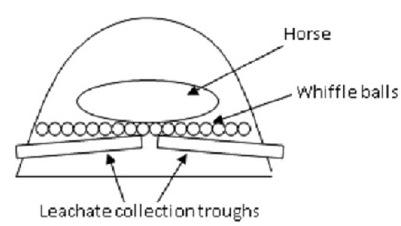
On 8/10/10 the leachate collection troughs were laid on bare soil with a 2% slope at the edge of Cornell University’s compost site in Ithaca, NY. A 0.6 m high base (3.7 x 3.7 m) of coarse carbon material (woodchips) was laid on top of the troughs. A 22 year old horse weighing approximately 590 kg, that had been dosed with 1 gram phenylbutazone at midnight on 08/10/10 and again at 7:30 am, was led onto the base and euthanized by a qualified veterinarian with 300 mg xylazine as a sedative, then with 120 ml Fatal Plus® solution (active ingredient 390 mg/ml Pentobarbital Sodium). After the horse had been euthanized and the veterinarian ensured there were no signs of life, the carcass was maneuvered on the wood chips with the head on the upward slope of the pad. The veterinarian took 4 tubes of blood from a vein in the nose and a vein in the front leg of the horse in heparinized Vacutainer® tubes for initial concentrations of pentobarbital and phenylbutazone. Twenty-six whiffle balls that had been pre-filled with wood chips (the base material of the compost pile) were placed such that they would be under the horse and liquids coming from the horse would be absorbed by the chips inside the balls, as well as in the surrounding base material, while the excess would drain down the leachate collection troughs and be captured in the 2 liter bottles at the end of the troughs (Figure 1). One Hobo U12 data logger with 4 temperature probes was set up to record hourly temperatures. The probes were placed under the horse’s neck and rump, on top of the horse’s abdomen, and one was left out to record ambient temperature. The horse was covered with woodchips so that the pile was approximately 1.8 m high. Additional woodchips were added to the pile on August 13 and the pile was covered with a breathable polyester compost cover to collect only what was leaching from the animal.

Figure 1 Cross-section of horse compost pile showing placement of leachate collection troughs and woodchip-filled whiffle balls.

On 8/10/10 a 0.6 m high base (3.5 x 3.5 m) of coarse carbon material was laid near the horse compost pile. A 455 kg 3 year, 7 month old, 2nd lactation Holstein cow was euthanized, due to a lung abscess, in the same manner as the horse (300 mg xylazine, followed by 120 ml Fatal Plus®). Four tubes of blood were withdrawn from her milk vein as described for the horse. One Hobo U12 data logger with 4 temperature probes was set up to record hourly temperatures. The probes were placed under the cow’s udder and rear leg, on top of the cow’s back, and one was left out to record ambient temperature. The cow was then covered with woodchips so that the pile was approximately 1.8 m high. Additional woodchips were added to the pile the following day before the pile was covered with a compost cover.

What did we learn?

In year one, phenylbutazone concentrations in the liver of the horse were undetectable (< 10 ppb) by 20 days of composting or burial in loose soil and were undetectable in effluent from the pile at the time of first sampling on day 6. Pentobarbital concentrations were undetectable (< 10 ppb) in liver samples retrieved from both the compost pile and loose soil by day 83. Rate of decay was faster in the soil, exponentially decreasing by 18% per day, with a half-life of 3 days, than in the compost pile where there was a 2% decrease per day and a half-life of 31 days, but occurred at the same rate of 1% and a half-life between 55 and 67 mesophilic degree days when calculated on the number of mesophilic degree days to which it was exposed. This suggests that breakdown of pentobarbital is not initiated by the heat of composting, but by the biological degradation that occurs in both soil and compost at mesophilic temperatures. Pentobarbital in the effluent decreased by 20% per day with a half-life of 3.1 days but was still detectable (0.1 ppm) at 223 days of composting.

In year 2, phenylbutazone was not detected in any of the samples analyzed (compost and leachate) other than blood taken from the jugular vein of the horse immediately after euthanasia. Pentobarbital concentrations in the compost were still detectable after 224 days of composting, but had decreased from 79.2 (initial) to 5.8 ppm. Pentobarbital in leachate was 2.2 ppm at day 56 of composting, after which no additional fluids leached into the leachate collection containers.  Rate of decay in the leachate was 35.2% per day with a half-life of 1.6 days. When managed properly, composting will deter domestic and wild animals from scavenging on treated carcasses while they contain the highest drug concentrations providing an effective means of disposal of euthanized and/or NSAID treated livestock. The resulting compost contains either no or very low concentrations of both NSAIDs and barbiturates rendering it safe for use in agriculture.

Barbiturate poisoning in domestic and wild animals has occurred from ingestion of tissue from animals euthanized with pentobarbital. Many of the reported cases have occurred from direct feeding on improperly disposed livestock in which little or no degradation or biotransformation of pentobarbital has occurred.  During the time period in which carcasses would be desirable to domestic and wild animals as a food source, composting creates sufficient heat to deter them from digging in to the pile. In addition, when covered properly, the smell of decomposition is minimized, also reducing attraction. The diverse community of microorganisms in the compost pile aids in the degradation and biotransformation of pentobarbital, especially after the thermophilic phase of composting is over. Properly implemented composting, as a means of disposal of euthanized or NSAID treated livestock, will deter domestic and wild animals from scavenging for carcasses when they contain the highest drug concentrations. The resulting compost contains either no or very low concentrations of either NSAIDs or barbiturates, rendering the compost safe for use in agriculture.

Future Plans

Education and implementation work continues in this area nationally and internationally. A 5th International Symposium on Depopulation and Disposal of Livestock is in the planning stages. A study on the Fate of anthelmintics (drugs that expel parasitic worms from the body) in livestock manure has just been completed.

Authors

Jean Bonhotal,  Mary Schwarz,  Cornell University, Cornell Waste Management Institute, Ithaca, NY

Karyn Bischoff, Joseph G Ebel, Jr. Cornell University, College of Veterinary Medicine, Ithaca, NY

Additional Information

Visit Cornell Waste Management Institute Web site: http://cwmi.css.cornell.edu/mortality.htm

Trends in Animal & Veterinary Sciences Journal article http://cwmi.css.cornell.edu/fate.pdf

The authors are solely responsible for the content of these proceedings. The technical information does not necessarily reflect the official position of the sponsoring agencies or institutions represented by planning committee members, and inclusion and distribution herein does not constitute an endorsement of views expressed by the same. Printed materials included herein are not refereed publications. Citations should appear as follows. EXAMPLE: Authors. 2013. Title of presentation. Waste to Worth: Spreading Science and Solutions. Denver, CO. April 1-5, 2013. URL of this page. Accessed on: today’s date.

Soil Science and Soil Health for Livestock and Poultry Production

This page is part of a series on environmental management topics developed for young or beginning farmer and ranchers. This series focuses on animal agriculture production and will also be useful to established producers as well as teachers and extension agents/educators.

Why is soil science and soil health important to animal agriculture?

Most livestock or poultry operations recycle manure on nearby land as a fertilizer. On grazing operations, this manure is deposited directly on growing plants by animals. For confined operations, manure is collected and stored until it can be land applied (spread) at an appropriate time. Understanding soil science is important for making the best decisions about manure application rate, location, and timing as well as grazing management.

Soil Science Basics

Soil Health

Soil Characteristics

Soil Sampling

Livestock and poultry farms sample soil to look at nutrient levels and use those in calculating the appropriate amount of manure and/or commercial fertilizer to apply to a field. This is an important step in a process called “nutrient management planning”. To find soil sampling recommendations and testing labs in your state, do a web search for “soil sampling” plus your state name. If you are unable to locate soil testing publications from your state, some recommended resources:

Related: Soil Testing

Knowledge and Tools For Management Decisions

Manure Impacts on Soil

Advanced Topics

Tile drainage and subsurface flow

Teacher/Educator Resources

Oregon State activity http://4hwildlifestewards.org/pdfs/soil.pdf

Acknowledgements

This Building Environmental Leaders in Animal Agriculture project was funded by the USDA National Institute for Food and Agriculture (NIFA) Beginning Farmer and Rancher Development Program (BFRDP) under award #2009-49400-05871. This project is a joint effort between University of Nebraska, Montana State University, Livestock and Poultry Environmental Learning Community and the National Young Farmers Educational Association (NYFEA). Meet the Beginning Farmer Project Team. For more information about this project or this web page, contact Jill Heemstra jheemstra@unl.edu

Manure Management 101 Curriculum Materials

For anyone involved in animal agriculture, manure will be an important issue. In the past few years, the perception of manure has gone from a “waste” product to a valuable fertilizer and potential source of renewable energy. These materials cover the basics of manure production, manure storage options, and manure uses.

Farmers, Ranchers, Ag Professionals

A self-study module will be released soon. This module will provide a certificate upon successful completion that can be submitted for continuing education requirements.

Teachers, Educators, Extension

Educators are welcome to use the following materials (download entire module in a single .zip file; 7 MB) in their classrooms and educational programs. Also check out more modules from this project.

Instruction Guide (Lesson Plan): includes links to additional information, connections to national agriculture education standards (AFNR Career Content Cluster Standards), application to Supervised Agricultural Experience (SAE) projects, sample quiz/review questions, and enrichment activities.

Presentation: 38 slides, Annotated, .pptx format (a preview is embedded at the bottom of the page)

Activity/Exercise: 3 exercises, docx. format Download

Preview Presentation Slides

Acknowledgements

Authors: Angie Rieck-Hintz, Iowa State University amrieck@iastate.edu

Reviewers: Rachel Klein, Iowa State University and Ann Ronning, Montana State University

Building Environmental Leaders in Animal Agriculture (BELAA) is a collaborative effort of the National Young Farmers Educational Association, University of Nebraska-Lincoln, and Montana State University. It was funded by the USDA National Institute for Food and Agriculture (NIFA) under award #2009-49400-05871. This project would not be possible without the Livestock and Poultry Environmental Learning Center the National eXtension Initiative, National Association of County Ag Agents (NACAA), National Association of Agriculture Education (NAAE), Farm Credit Services of America, American Registry of Professional Animal Scientists (ARPAS), and Montana FFA Association.

Why Is It Important To Manage Animal Mortalities Properly?

Improperly disposed livestock or poultry carcasses represent a threat to water and air quality.

Proper management of on-farm animal mortalities is vital to every farming operation. Improper disposal of dead animal carcasses can negatively impact surface water and groundwater from carcass leachate. If the animal died of an infectious disease, pathogenic bacteria and viruses may be present within the carcass. These pathogens can be spread by insects, rodents, preda­tors, and subsurface or above ground water movement, as well as through direct contact with other livestock or poultry leading to increased disease transmission risks. Furthermore, many states have rules regulating the proper disposal of livestock and poultry mortalities. Therefore, the purpose of proper mortality disposal is to prevent the spread of infectious, contagious and communicable diseases and to protect air, water and soil quality. Note that regulated AFOs must abide by their animal mortality disposal plan outlined in their nutrient management plan.

Check out the other video FAQs on carcass management

Author: Joshua Payne, Oklahoma State University

Reviewers: Shafiqur Rahman, North Dakota State University and Jean Bonhotal, Cornell University

What Are Common Animal Mortality Disposal Options

Managing dead animals is not pleasant, but is a necessary task for most livestock and poultry farms. This video discusses several options for disposing of carcasses in an environmentally responsible manner.

In most states, commonly approved disposal options include: burial, landfills, incineration, rendering and composting.

Burial

Perhaps the most common method of disposal is burial. Most states have regulatory burial guidelines outlining site location, distance from waterways, depth to groundwater, etc. When proper guidelines are followed, burial is a safe option. However, poor site selection, such as sandy soils or areas with high water tables, may pose a threat to groundwater. Furthermore, burial does not convert the carcass into a valuable by-product. Variable equipment and labor costs will influence the economic viability of this disposal option.

Landfills

Disposing of carcasses at a licensed landfill that accepts animal mortalities is another form of burial. Landfills may require notification before delivery and/or documentation from a licensed veterinarian stating the cause of death. Landfill tipping fees should be assessed and may range from $20 to $30/ton. Other considerations are transportation costs and breeches of biosecurity by moving carcasses off- farm. Similar to burial, a valuable by-product is not produced.

Incineration

Incineration is a safe and effective means of carcass disposal, especially from the standpoint of biosecurity. The carcass is completely consumed by fire and heat within a self-contained incinerator utilizing air quality and emissions controls. Some states may require air quality permits. Incineration is mainly designed for smaller carcasses and fuel costs should be considered. Due to odor and emission concerns, open air incineration (burning) is not recommended and banned in some states. Furthermore, obtaining complete consumption of the carcass in a timely manner is often difficult to achieve. Burning should only be used in emergencies for controlling infectious or contagious diseases with permission from a regulatory body.

Rendering

Another recommended carcass disposal method is rendering. This is a heat driven process that cooks the product while killing pathogens and converting it into a value-added product such as an animal feedstuff. These feedstuffs, such as meat and bone meal, are generally used as pet food ingredients. Although rendering is a very effective method, currently, there are few render­ing services available. The transportation expense of collecting small volumes creates a financial obstacle for most rendering companies. Some rendering facilities require the producer to transport carcasses to the plant and pay a fee. Biosecurity and disease transmission risks should be considered when allowing vehicles on the farm and when transporting carcasses off-farm.

Composting

Composting dead animal mortalities is an inexpen­sive, biosecure and environmentally sound approach to addressing the issue of carcass disposal. By definition, composting is a controlled biological decomposition pro­cess that converts organic matter into a stable, humus-like product. The carcass (nitrogen source) is buried in a bulking agent (carbon source), such as wood shavings, allowing for the proper carbon to nitrogen ratio (C:N) required by microorganisms to successfully decompose the carcass while absorbing excess moisture and filtering odor. The high temperatures achieved through proper composting will destroy most pathogens. Microorganisms will degrade the carcass leaving only a few small bone fragments, which are brittle and break easily. This valuable by-product can then be land-applied as a fertilizer source, adding nutrients and organic matter to the soil or recycled for new compost piles. As with burial, site selection is important. The site should be located in an area that does not pose a risk to surface or groundwater contamination.

Alternative methods:

Alternative methods are not specifically defined. They may include homogenization, digestion or chemical processes and technologies to recover products from mortalities.


Check out the other video FAQs on carcass management

Author: Joshua Payne, Oklahoma State University

Reviewers: Shafiqur Rahman, North Dakota State University and Jean Bonhotal, Cornell University

How Can I Manage Multiple Animal Mortalities?

Sometimes, a disease outbreak or natural disaster results in many livestock or poultry carcasses that must be managed. Disposal of these requires additional planning to ensure this is done in an environmentally responsible manner.

During catastrophic events when multiple livestock losses occur, a producer’s routine mortality disposal plan may be inadequate. In these instances, multiple disposal options may need to be considered. Burial, rendering, landfills, composting and incineration or a combination thereof are recommended options. All catastrophic events should be reported to the appropriate state agency. If a catastrophic mortality event is the result of disease outbreak, bio-security considerations may dictate the method of transportation and disposal.

Check out the other video FAQs on carcass management

Author: Joshua Payne, Oklahoma State University

Reviewers: Shafiqur Rahman, North Dakota State University and Jean Bonhotal, Cornell University

Why Do Animal Carcasses Need Proper Disposal (and Should Not Be Abandoned)?

Abandoning animal carcasses and allowing scavengers to dispose of them is risky.

Though dragging off a carcass to the boneyard has been a historical practice, abandonment is NOT recommended and is likely ILLEGAL in most states. Examples include: carcasses abandoned on the surface, in open pits, ditches, water features and sinkholes or in wells. Abandonment promotes extreme biological and disease hazard, threats to water quality, odors, flies, scavengers, rodents and visual pollution.

Check out the other video FAQs on carcass management

Author: Joshua Payne, Oklahoma State University

Reviewers: Shafiqur Rahman, North Dakota State University and Jean Bonhotal, Cornell University

What Is Animal Mortality Composting?

The need to dispose of livestock or poultry carcasses is an inevitable part of farming and ranching. What is this process and is it environmentally sound?

Composting is a natural process in which microorganisms convert organic matter into a stabilized product termed compost, which can then be used as a beneficial soil amendment.  In the case of livestock mortality composting, the carcass can be placed in a compost bin. At this location, we have used net wire supported by t-posts as our compost bin. The carcass is then covered with a supplemental carbon source. In this case, we have used wood shavings mixed with manure. The carcass is then allowed to decompose through natural microbial activity which breaks down both soft tissue and bones. This process usually takes several months to form a stabilized product.

Check out the other video FAQs on carcass management.

Author: Joshua Payne, Oklahoma State University

Reviewers: Shafiqur Rahman, North Dakota State University and Jean Bonhotal, Cornell University

How Much Does Animal Mortality Composting Cost?

Composting livestock and poultry carcasses is a cost effective way to manage mortalities on a farm or ranch.

The cost of composting livestock depends largely on the cost of your local carbon source. Sometimes wood chips or shavings can be obtained locally for free from tree removing companies or from local county fair barns and arenas. If building a compost bin, a producer can spend around $50 per bin constructing when using tee-posts and net wire construction. Keep in mind that the carbon source and the bin can be reused for future mortalities.

Check out the other video FAQs on carcass management

Author: Joshua Payne, Oklahoma State University

Reviewers: Shafiqur Rahman, North Dakota State University and Jean Bonhotal, Cornell University

Why Should I Consider Composting Animal Mortalities?

Composting livestock and poultry carcasses is becoming a more common way to manage mortalities. There are several reasons for this.

Composting is relatively inexpensive when low cost carbon materials are utilized. The high temperatures generated during composting create a very biosecure process which eliminates pathogens and reduces disease transmission when properly managed.  Composting is also an environmentally sound method for carcass disposal as it reduces odors as well as carcass leachate by surrounding the carcass with a carbon filter. The composting process creates a beneficial by-product rich in nutrients which can be land-applied as a fertilizer. Composting promotes a positive public perception by adequately disposing of animal carcasses in a sustainable manner without negatively affecting the environment.

Check out the other video FAQs on carcass management

Author: Joshua Payne, Oklahoma State University

Reviewers: Shafiqur Rahman, North Dakota State University and Jean Bonhotal, Cornell University