Due to a technical glitch, we did not get this presentation recorded. Please accept our apologies.
Purpose
Manure is a critical resource in livestock production as it contains many essential nutrients required for crop growth. However, as a nutrient source, manure is highly variable, and nutrient composition may fluctuate significantly during emptying of manure storages if not properly agitated. Accounting for this variability requires extensive sampling, which is often cost and time prohibitive for haulers and producers.
The aim of this study is to evaluate a commercially available manure nutrient sensor utilizing near-infrared spectroscopy (NIRS) to provide real-time manure nutrient data. The study investigates the impact of NIRS systems in the field to achieve target nutrient application rates and assess effects on crop nutrient use efficiency (NUE) and yield compared to conventional sampling and fixed-rate application methods.
What Did We Do?
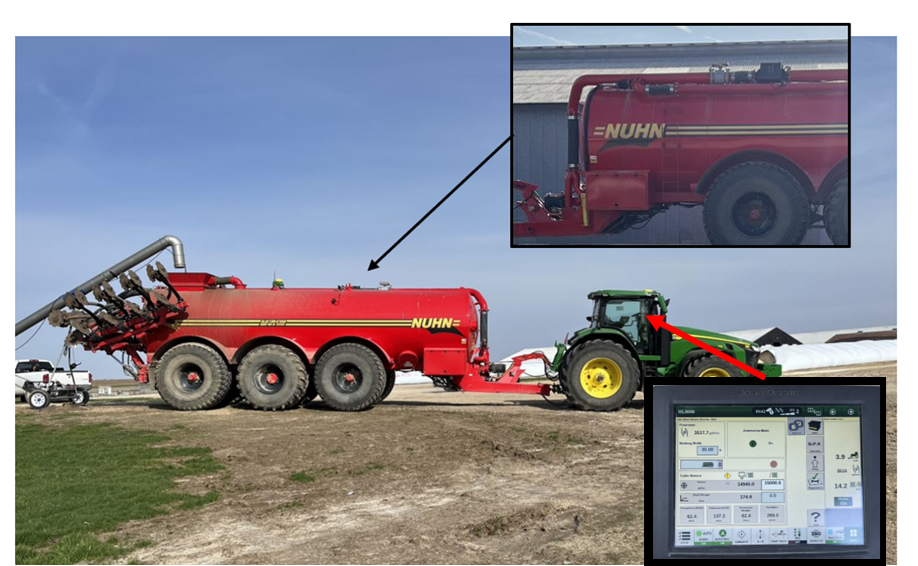
A manure tanker was outfitted with a John Deere HarvestLab 3000 setup for manure nutrient sensing. The setup included the sensor, a Krone flow meter, and a John Deere rate controller (Figure 1). Manure nutrient values from the sensor were recorded in real time. The controller then set specific target rates for a nutrient and the automation system adjusted the tractor speed or manure pump rate to meet the target.
Field trials were conducted in Wisconsin on silt loam soil. Manure was applied to strip plots to meet three specific nitrogen application rates using both the NIRS sensor and conventional sampling and application methods. During application, composite manure samples were collected to assess the sensor’s accuracy. After manure application, the field was planted with corn silage, and following harvest, NUE and yield were evaluated.
Figure 1: Manure tanker setup for sensor trials.
What Have We Learned?
In the first year of the study, the NIRS sensor outperformed conventional sampling methods in achieving target nitrogen rates. Across the application plots, the NIRS sensor delivered manure at a nitrogen rate in the range of 20 to 30 lbs N/ac over the target rate, whereas conventional sampling led to overapplication by 40 lbs N/ac to 95 lbs N/ac. During application, the system also tracked other nutrients, such as phosphorus and ammonium, but laboratory analysis indicated that the sensor was less accurate for these nutrients compared to nitrogen. While manure application rates varied, there was little difference in crop yield or NUE between treatments at harvest.
The NIRS sensor shows promise as a tool to revolutionize manure nutrient accounting in cropland. Its ability to track manure variation in real time could significantly improve nutrient management. Figure 2 demonstrates how the system tracked manure nitrogen, phosphorus, and potassium levels over time following a reduction in agitation. This type of tracking may help reduce the need for excessive agitation and enhance manure utilization efficiency.
Figure 2: Variation of nitrogen (left), phosphorus (center), and potassium (right) over time while applying dairy manure. The right side of the field shows signs of decreased homogeneity when agitation was reduced.
Future Plans
Researchers plan to continue field trials over multiple years to assess long-term impacts on nutrient use efficiency and soil nutrient management. Additionally, with new calibration updates since the original trial, future studies will evaluate the sensor’s accuracy in measuring phosphorus and its ability to meet phosphorus-based manure application targets while simultaneously tracking nitrogen for improved supplemental nitrogen prescriptions. Overall, the goal of the project is to provide producers and haulers with information on how effective the system is and ways in which it can be used to enhance on-farm efficiency.
Authors
Presenting & corresponding author
Joseph R. Sanford, Assistant Professor, University of Wisconsin -Platteville, sanfordj@uwplatt.edu
Additional authors
Rebecca A. Larson, Professor, Nelson Institute for Environmental Studies, University of Wisconsin-Madison; Tyler Liskow, Engineer, Nelson Institute for Environmental Studies, University of Wisconsin-Madison
Acknowledgements
This material is supported by the Wisconsin Dairy Innovation Hub and the National Institute of Food and Agriculture, U.S. Department of Agriculture, under award number 2022-69008-36506. Any opinions, findings, conclusions, or recommendations expressed in this publication are those of the author(s) and do not necessarily reflect the view of the U.S. Department of Agriculture or the Wisconsin Dairy Innovation Hub.
The authors are solely responsible for the content of these proceedings. The technical information does not necessarily reflect the official position of the sponsoring agencies or institutions represented by planning committee members, and inclusion and distribution herein does not constitute an endorsement of views expressed by the same. Printed materials included herein are not refereed publications. Citations should appear as follows. EXAMPLE: Authors. 2025. Title of presentation. Waste to Worth. Boise, ID. April 7-11, 2025. URL of this page. Accessed on: today’s date.
Methane emissions from manure storages significantly contribute to the livestock industry’s carbon footprint. While various manure management strategies are used to reduce greenhouse gas (GHG) emissions on farms, such as anaerobic digestion and composting, many of these strategies are cost-prohibitive for small-to-medium-sized farms. Strategic manure application timing to limit GHG emissions is a practical, scalable option to reduce methane production in manure storages.
Carbon credits are financial incentives for farmers who adopt practices that reduce greenhouse gas emissions, such as cover crops or methane emissions abatement. These credits can then be sold to companies seeking to offset their emissions. This study evaluates the impact of manure application timing on methane emissions from storages and explores how carbon credits could act as an incentive for farms to employ climate-smart manure management practices. By comparing different manure application strategies (fall, spring, in-season sidedress, and split applications), we assess the methane reductions and improved economics of optimized timing.
What Did We Do?
Methane emissions were estimated using data from a lab-based study conducted by Andersen et al. (2015), who measured methane emissions from deep-pit swine manure at various temperatures. From this data, we created a model incorporating manure production rates and ambient temperature dynamics to predict daily methane emissions from a 4800-head slurry storage and 4800-head deep-pit swine production facility.
Seven application scenarios were compared: fall (November 1), spring (April 15), sidedress (June 1), fall-spring, fall-sidedress, spring-sidedress, and fall-spring-sidedress split applications. Total methane emissions were calculated for each scenario, allowing us to determine the GHG emissions abated by shifting from a fall application to an alternate strategy. An economic assessment was conducted using a $30/metric ton carbon dioxide equivalent (MT CO2e) carbon credit valuation to determine the financial implications of these methane mitigation strategies.
What Have We Learned?
For our swine slurry store model, methane emissions were highest in the single fall application scenario due to the full storage attained during peak summer temperatures, with annual emissions totaling nearly 0.5 MT CO2e/pig-space (Figure 1). Shifting application to spring or sidedress reduced emissions by approximately 50%. Split applications showed a further reduction in emissions by maintaining lower storage volumes throughout the year.
Figure 1: Estimated methane emissions in metric tons of carbon dioxide equivalent (MT CO2e) from slurry storage for fall, spring, sidedress, fall-spring split (F-S), fall-sidedress split (F-SD), spring-sidedress split (S-SD), and fall-spring-sidedress split (F-S-SD) applications.
From an economic perspective, carbon credits significantly enhanced the financial viability of the new application strategies. Carbon credits from abated emissions are projected to bring a maximum of $10/pig-space, or about $74/acre, to the farm annually in the F-S-SD scenario (Table 1). The improved manure application timing can also benefit crop yield, making a spring or sidedress manure application even more economically favorable.
Table 1: Projected carbon credit income for a 4800-head wean to finish swine farm with a slurry storage for fall, spring, sidedress, fall-spring split (F-S), fall-sidedress split (F-SD), spring-sidedress split (S-SD), and fall-spring-sidedress split (F-S-SD) applications.
Fall
Spring
Sidedress
F-S
F-SD
S-SD
F-S-SD
Carbon Credit Income
($/acre)
$ –
$ 33.63
$ 33.71
$ 41.95
$ 45.82
$ 45.69
$ 52.06
Carbon Credit Income
($/pig-space)
$ –
$ 6.50
$ 6.51
$ 8.10
$ 8.85
$ 8.83
$ 10.06
Future Plans
Further research should be conducted to refine the temperature aspect of the model. In the slurry store model, we assume that the manure temperature equals the 10-day average temperature. A study to verify the true manure temperature throughout the year would improve the confidence level of the current model. For deep pit barns, we use measured temperature data from 58 barns over 13 months, but manure temperatures were collected from the manure pump out access port and may not represent average manure temperatures in the barn. Future models to assess differences between deep pit and slurry store emissions will highlight the optimal manure management strategies for limiting GHG emissions.
Using specialized high-clearance irrigation equipment, like the 360 RAIN from 360 Yield Center, could enhance the feasibility of more frequent manure applications, reducing methane emissions while maintaining crop nitrogen availability. Additionally, developing standardized carbon credit protocols for manure management could create opportunities for more producers to monetize methane reduction efforts, further incentivizing climate-smart manure application strategies.
Authors
Presenting author
Jacob R. Willsea, Graduate Research Assistant, Iowa State University Department of Agricultural and Biosystems Engineering
Corresponding author
Daniel S. Andersen, Associate Professor, Iowa State University Department of Agricultural and Biosystems Engineering, dsa@isatate.edu
Additional Information
Andersen, D.S., Van Weelden, M.B., Trabue, S.L., & Pepple, L. M. (2015). Lab-assay for estimating methane emissions from deep-pit swine manure storages. Journal of Environmental Management, 159, 18-26. https://doi.org/10.1016/j.jenvman.2015.05.003
The authors are solely responsible for the content of these proceedings. The technical information does not necessarily reflect the official position of the sponsoring agencies or institutions represented by planning committee members, and inclusion and distribution herein does not constitute an endorsement of views expressed by the same. Printed materials included herein are not refereed publications. Citations should appear as follows. EXAMPLE: Authors. 2025. Title of presentation. Waste to Worth. Boise, ID. April 7-11, 2025. URL of this page. Accessed on: today’s date.
Nitrogen (N) application timing is crucial in balancing crop productivity and environmental sustainability. While fall applications are typical among Iowa corn producers due to favorable field conditions, they pose a high risk of N loss through denitrification, volatilization, and leaching. Spring and in-season sidedress applications offer improved nitrogen use efficiency (NUE) by aligning N availability with crop demand.
This study evaluates the effects of different N application timings—fall, spring, and sidedress—on corn yield and NUE. Using data from 65 site-years, we assess how application timing influences yield, economic returns, and environmental impacts. The findings provide insights into best management practices for improving profitability and sustainability in corn production.
What Did We Do?
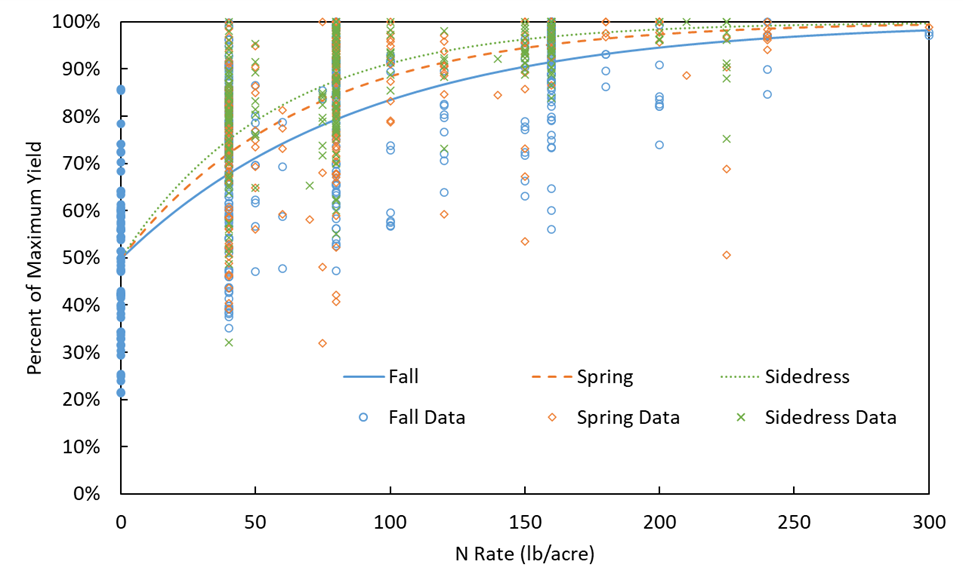
A review of studies comparing N application timing in corn production was conducted, including a long-term experiment from the University of Minnesota (1960-1996) and additional datasets totaling 65 site-years. Treatments were separated into three categories: fall, spring, and sidedress. Relative yield was used to normalize data across years, and yield response was modeled using a Mitscherlich-Baule equation (Figure 1).
Figure 1: Yield response curves for 65 site-years of relative yield response data, categorized by season of N application
Economic impacts were analyzed using maximum return to nitrogen (MRTN), which identifies the N rate that maximizes economic return (Figure 2). Corn prices ($4.62/bu) and anhydrous ammonia prices ($0.45/lb N) were used to estimate profitability in each application scenario. The environmental effects were assessed by examining N-loss pathways and the potential for emission reduction of nitrous oxide (N2O), a greenhouse gas estimated to be 273 times more potent than carbon dioxide.
Figure 2: Net income per acre for fall, spring, and sidedress N application. Maximum return to nitrogen (MRTN) is plotted as a circular point on each curve, with the profitable N rate (low and high) within $1/acre bounded by diamond points.
What Have We Learned?
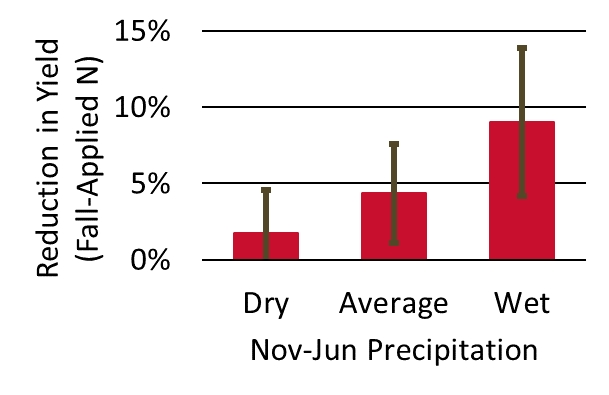
Results show that year-to-year, sidedress applications consistently produce the highest corn yield, followed by spring applications, with fall applications being the least effective. Yield differences are particularly evident in wet years (November to June rainfall > 1 inch above average), where sidedress applications outperform fall by an average of 9% (Figure 3). MRTN analysis shows that sidedress applications require 25% less N than fall applications while achieving higher yields, demonstrating their economic advantage.
Figure 3: Reduction in relative yield between fall and sidedress application in different weather conditions: Dry (greater than 1 inch below average November-to-June precipitation), Average (within ±1 inch of average precipitation), and Wet (greater than 1 inch above average precipitation). Interpreted as the yield loss due to increased exposure of applied N to precipitation.
The environmental analysis indicates that reducing N application rates through improved timing could cut N2O emissions by up to 25%. With a carbon credit of $30/metric ton CO2e abated the reduction in N2O equates to a $2.66/acre credit for a reduced N application rate. Fall-applied N is most susceptible to losses due to prolonged exposure to wet conditions, while spring and sidedress applications minimize the risk of loss by reducing time in the field and matching crop demand.
Future Plans
Further research is needed to refine N application strategies by incorporating real-time weather data and precision agriculture tools. The development of high-clearance application equipment, such as 360 RAIN from 360 Yield Center, offers opportunities for more flexible and targeted in-season applications, potentially enhancing NUE and reducing losses.
Additional studies should assess the risk of spring or sidedress applications from year to year. Weather conditions often limit pre-plant N application, so a thorough analysis of the frequency and financial impact of interrupted field management operations should be conducted.
Future studies should also explore the economic feasibility of split applications, which combine the benefits of multiple timings to reduce risk. Additionally, expanding MRTN models to include seasonal effects would improve decision-making for producers seeking to optimize N application timing while minimizing environmental impact.
Authors
Presenting author
Jacob R. Willsea, Graduate Research Assistant, Iowa State University Department of Agricultural and Biosystems Engineering
Corresponding author
Daniel S. Andersen, Associate Professor, Iowa State University Department of Agricultural and Biosystems Engineering, dsa@iastate.edu
The authors are solely responsible for the content of these proceedings. The technical information does not necessarily reflect the official position of the sponsoring agencies or institutions represented by planning committee members, and inclusion and distribution herein does not constitute an endorsement of views expressed by the same. Printed materials included herein are not refereed publications. Citations should appear as follows. EXAMPLE: Authors. 2025. Title of presentation. Waste to Worth. Boise, ID. April 7-11, 2025. URL of this page. Accessed on: today’s date.
The dairy industry in Idaho has grown substantially over the past 30 years and is the state’s largest agricultural commodity, accounting for $3.7 billion in sales in 2022. Roughly 500,000 of Idaho’s 660,000 dairy cows reside in a six-county region known as the Magic Valley, a name originating in the early 1900s when large canal irrigation projects turned a dry landscape into verdant farmland. The Magic Valley is semi-arid, receiving around 254 mm of precipitation each year and requiring cropland to be irrigated throughout the growing season. Due to a limited amount of water available for irrigation each season cropland area has not expanded since the 1980s.
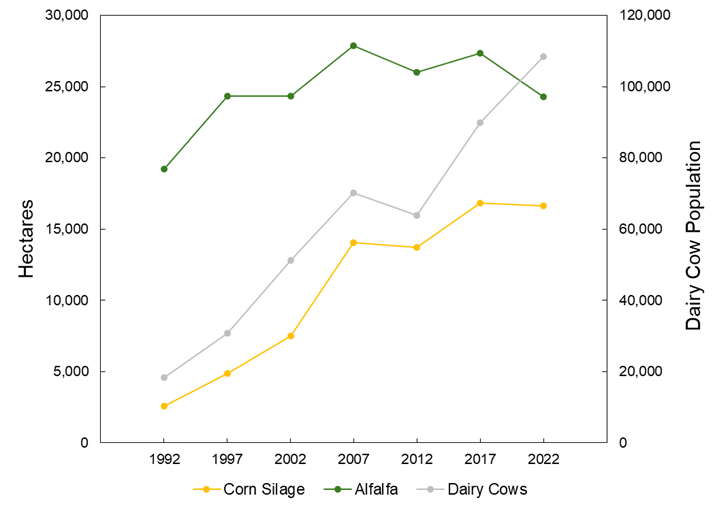
The large number of dairy cows in the Magic Valley has shifted crop production towards forage crops, predominantly silage corn and alfalfa. For example, between 1992 and 2022 the number of dairy cows in Twin Falls County increased from 18,000 to 108,000. During this same timespan corn silage and alfalfa saw a 14,000 and 5,000 hectare increases in land cover, respectively (Figure 1). This change in land cover has potentially increased consumptive water use within the region through the replacement of crops with shorter irrigation seasons (e.g., wheat and beans) with forage crops. In addition to changes in water use, the increase in dairy cattle has resulted in greatly increased manure applications to surrounding fields. It is typical for cropland to receive manure at rates of 52 Mg ha-1 year-1, which can input high amounts of nitrogen and phosphorus beyond what is removed by the crop. Over time, this could result in soil phosphorus enrichment and the leaching of nitrate to groundwater.
Figure 1. Population of dairy cows in Twin Falls County from 1992 to 2022 along with total hectares of corn silage and alfalfa.
What Did We Do?
The study area for this project was the Twin Falls Canal Company, a large irrigation project in southern Idaho. Investigation into potential changes in water quality and quantity brought about by the growing dairy agriculture in southern Idaho was carried out using the Soil and Water Assessment Tool (SWAT) model. SWAT is a physically based geospatial watershed-scale hydrologic model that incorporates climate, topography, soils, land cover, and management practice data. Model scenarios included examining changes in consumptive water use over time, effects of irrigation practices on the leaching of water and nutrients, and the impact of continuous manure applications on the buildup and leaching of nutrients. Nutrient cycling and crop nutrient uptake were calibrated in the model using two USDA-ARS eight-year studies. The first study applied manure under a corn-barley-alfalfa rotation only when soil nutrient concentrations were deficient, and the second study applied manure on a yearly basis in the spring at a rate of 52 Mg ha-1 under a barley-sugar beet-wheat-potato rotation.
Table 1. Crop areas and percentages under the 1992 and 2022 scenarios.
1992 km2 (%)
2022 km2 (%)
Alfalfa
189 (25.3)
244 (32.8)
Barley
104 (13.9)
132 (17.7)
Beans
169 (22.7)
60 (8.0)
Corn Silage
55 (7.4)
191 (25.7)
Potatoes
35 (4.6)
34.5 (4.6)
Sugar Beets
46 (6.2)
26 (3.5)
Wheat
148 (19.8)
57 (7.6)
Table 1. Crop areas and percentages under the 1992 and 2022 scenarios.
Consumptive water use within the Twin Falls Canal Company was compared between two distinct time periods: pre-dairy and present. 1992 was selected as the pre-dairy benchmark due to being before large increases in dairy cattle numbers. Modeled crops were alfalfa, barley, beans, corn silage, potatoes, sugar beets, and wheat, which account for over 95% of irrigated cropland within the TFCC. Land cover in 2022 was used as the present scenario, and crop distributions were altered for the 1992 scenario based on USDA agricultural census data (Table 1). The model was run using climate data from 2002 to 2022 to have consistency between the two scenarios and to allow for year-to-year variability weather patterns. Automatic irrigation routines were used in the model, with a 9.1 mm irrigation event being triggered when soil water content dropped 5 mm below field capacity. 9.1 mm was chosen as the daily irrigation amount because it is roughly equivalent to the flow rate of an 850 gallon per minute center pivot. Irrigation schedules varied by crop within the April 15th – October 31st irrigation season (Table 2).
Table 2. Irrigation seasons for modeled crops.
Irrigation Season
Alfalfa
April 15th – October 9th
Barley
April 15th – July 25th
Beans
June 26th – September 10th
Corn Silage
May 25th – September 18th
Potatoes
May 15th – September 1st
Sugar Beets
April 20th – September 25th
Wheat
April 15th – July 16th
What Have We Learned?
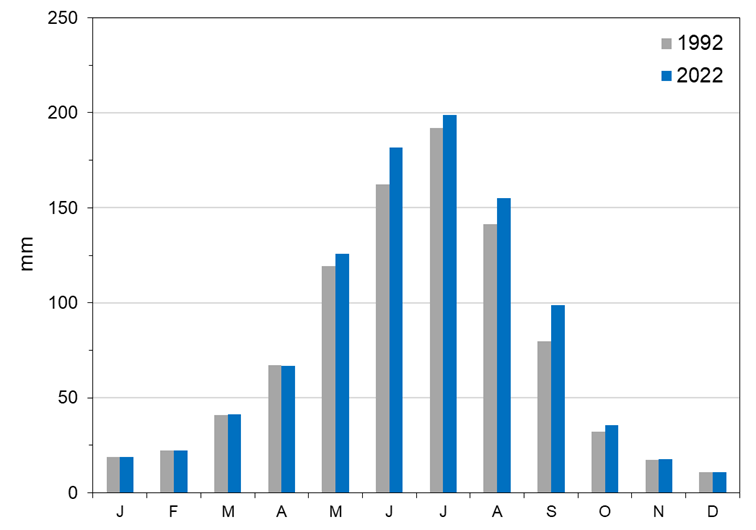
Modeled changes in land use within the Twin Falls Canal Company towards forage crops for dairy cattle have increased consumptive use during the year by 9% on average. June, August and September showed the greatest average increases in evapotranspiration (ET) (Figure 2). Irrigation amounts increased under the 2022 land use scenario for all months except April. Percolation under the 2022 scenario also increased to an average of 155 mm each year, up from 132 mm in the 1992 land use scenario.
Figure 2. Modeled monthly average cropland ET for the pre-dairy (1992) and post-dairy (2022) land cover scenarios.
Typical yearly water diversions for the Twin Falls Canal Company were sufficient to meet the current and future irrigation demand. Diversion reductions in August and September are common depending on reservoir storage and the timing and volume of snowmelt. A shift towards greater cropland area irrigated during those months could require deficit irrigation during extreme drought years, which are likely to become more common given climate change projections indicating reduced snowpack and earlier snowmelt runoff.
SWAT was able to reasonably represent manure nitrification, including the increases in nitrification during the year following sugar beet and potato residue being left on the field (Table 3). Crop nutrient uptake in the two USDA-ARS studies was also able to be accurately modeled after adjusting nutrient uptake parameters. Modeled soil nitrate and plant-available phosphorus concentrations were similar to field samples. Changes to SWAT source code was necessary to better partition “fast” and “slow” organic nitrogen fractions in manure between the two pools and limit mineralization when the air temperature is below 6 degrees Celsius. Under a manure application rate of 52 Mg ha-1 soil plant-available phosphorus levels exceed the allowed maximum of 40 mg kg-1 in just two years. Applying manure only when needed to satisfy crop nutrient requirements did not result in soil plant-available phosphorus approaching or exceeding the 40 mg kg-1 threshold. In addition to high soil phosphorus levels, nitrogen mineralization from yearly applications of manure resulted in high soil nitrate levels. Modeled percolation using actual irrigation amounts over the eight-year study totaled 1,176 mm and resulted in 1,256 kg ha-1 of leached nitrogen. This highlights the risk that yearly manure applications can have to water quality, especially if water is applied in excess of crop needs when also accounting for soil moisture. In addition, high variability in manure nitrogen and phosphorus concentrations suggests yearly fixed-rate applications are not the ideal for managing nutrient budgets.
Table 3. Yearly and in-season manure nitrogen mineralization from the SWAT model output compared to in-season nitrogen mineralization collected from field samples during the long-term manure study. Asterisks denote years in which sugar beet or potato residue was left on the field, resulting in greater N mineralization the following year.
Year
SWAT N Mineralization
SWAT In-Season N
Mineralization
Field In-Season Mineralization
kg ha-1
kg ha-1
kg ha-1
2013
211
117
180
2014*
287
192
110
2015
442
308
280
2016*
321
205
190
2017
399
242
250
2018*
297
197
150
2019
393
285
230
2020
357
145
150
Total
2,707
1,690
1,540
Future Plans
Now that the SWAT model has been fully calibrated, the next step will be to test various scenarios in which yearly manure application amounts, crop rotations, and irrigation schedules are adjusted. Typical regional dairy crop rotations include silage corn, alfalfa, wheat, barley, triticale, and occasionally potatoes or sugar beets. Manure is not applied to alfalfa, possibly allowing for a drawdown of phosphorus that has accumulated over previous years. Changing irrigation schedules will alter the timing and quantity of percolated water which will change nutrient export characteristics. Incorporating these scenarios over a large irrigation district with variable soils should identify areas that are more at risk of nutrient losses through runoff or leaching. Results from this research will be used to inform management agencies on the water use and water quality implications of crop rotations, manure applications, and irrigation schedules in southern Idaho.
Authors
Presenting & corresponding author
Galen I. Richards, PhD Candidate, University of Idaho, grichards@uidaho.edu
Additional authors
Erin Brooks, Professor, Department of Soil and Water Systems, University of Idaho
Linda Schott, Assistant Professor and Nutrient & Waste Management Extension Specialist, Department of Soil and Water Systems, University of Idaho
Kossi Nouwakpo, Research Soil Scientist, USDA-ARS Northwest Irrigation and Soils Research Station
Daniel Strawn, Professor, Department of Soil and Water Systems, University of Idaho
This research was funded under the University of Idaho Sustainable Agriculture Initiative for Dairy (ISAID) grant USDA-NIFA SAS 2020-69012-31871
I would like to thank USDA-ARS researchers April Leytem, Robert Dungan, and Dave Bjorneberg at the Northwest Irrigation and Soils Research Station in Kimberly, ID for providing me with data from their long-term research studies and general assistance in accurately modeling regional agricultural practices.
The authors are solely responsible for the content of these proceedings. The technical information does not necessarily reflect the official position of the sponsoring agencies or institutions represented by planning committee members, and inclusion and distribution herein does not constitute an endorsement of views expressed by the same. Printed materials included herein are not refereed publications. Citations should appear as follows. EXAMPLE: Authors. 2025. Title of presentation. Waste to Worth. Boise, ID. April 7-11, 2025. URL of this page. Accessed on: today’s date.
California’s San Joaquin Valley (SJV) has uniquely “wicked” problems with nitrogen (N) management as it is a highly productive agricultural region where many communities rely on nitrate-contaminated groundwater for drinking. Some of this N loading is attributed to manure from dairies whose N output often exceeds the requirement of forage N, resulting in surplus manure N. The counties in the SJV have the worst groundwater quality and represent the 8 highest dairy populations. But, they also make up 7 of the 10 counties with the highest fertilizer inputs which also contributes to groundwater degradation. There is no doubt that California dairies contribute to N loading, but they also hold unique potential to utilize their surplus manure N to replace a portion of the 550,000 tons of N fertilizer applied to California’s diverse agricultural production. If appropriate measures are taken, the California dairy industry is well positioned to improve water quality in California by limiting its own excess N application while simultaneously replacing its neighbors’ synthetic inputs. The purpose of this preliminary manureshed analysis is to: 1) identify where surplus manure may become a primary N resource in California and 2) quantify its potential to reduce synthetic fertilizer inputs.
Past manureshed analyses have demonstrated manure’s potential to address crop nutrient requirements while acknowledging difficulties with pathogens, lack of spatially available data for CAFOs, and unpredictable manure nutrient variability within and across facilities. A California manureshed is uniquely challenging because of its large proportion of human-consumed crops and surplus dairy manure, which has a low value-to-mass ratio. However, there has been a concerted effort from government entities and the dairy industry to properly account for dairy manure properties to understand the potential expansion of a dairy manure market. Part of this effort has led to reporting requirements, leading to an abundance of facility-level data including location and N generated. These data can be analyzed to understand the economic and environmental potential of using dairy manure beyond its current practices.
What Did We Do?
We applied past manureshed approaches with California-specific data to understand available dairy manure and crop N need in 2021, which was the most recent crop data available to the authors at the time of publishing these proceedings.
To account for N generated on each dairy, we used the herd data from the California Dairy & Livestock Database (CADD), compiled by the California Air Resources Board. We assumed a milk cow produced 70 lbs of milk a day and, per the ASABE standard, that resulted in 0.92 lbs N per milk cow per day. A calf, dry cow, and heifer were assumed to produce 0.14, 0.5, and 0.26 lbs N per animal per day, respectively.
To calculate recoverable plant available N (PAN) (Figure 1) from manure generated on-farm, we assumed that 30% was lost to ammonia before any land application (Chang et al. 2006) and that manure was 21% organic matter (with 30% of that becoming plant available) and 79% inorganic (NH4+). Of the inorganic fraction available for land application, we assumed that 40% was lost to leaching, volatilization, or denitrification (Chang et al. 2006). We acknowledge that these assumptions about manure handling and, therefore, N forms and transformations are highly variable depending on local conditions, but we feel confident that this represents an accepted target “average” as described by Chang et al. 2006. This paper is a result of an expert panel review and informed California’s current regulatory framework for dairies. We also highlight that our “recoverable” manure only includes that year’s plant available portion and does not account for organic N from previous manure applications that may be contributing to actual available N.
Figure 1: Assumptions to calculate recoverable plant available N
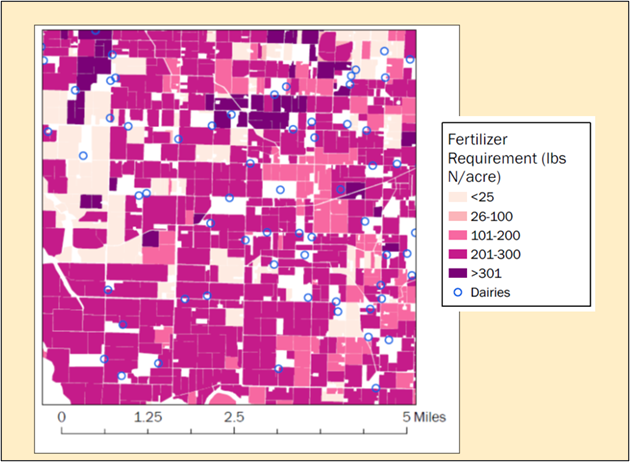
For crop N needs, we first identified farm boundaries and crops grown (up to 4 per year) based on LandIQ data and fertilizer N requirements from the California Crop Fertilization Guidelines and average county yields from USDA NASS. We assigned each LandIQ polygon a value for fertilizer N required (Figure 2). We summed N fertilizer requirements for all land polygons that were within 2, 5, and 10 miles of each dairy. A polygon was considered within a specified distance of a dairy based on the distance from any edge of the field to the latitude/longitude provided in the CADD database. Finally, all fertilizer requirements were multiplied by 1.16 to account for a 60% efficiency for manure and a 70% efficiency for fertilizer.
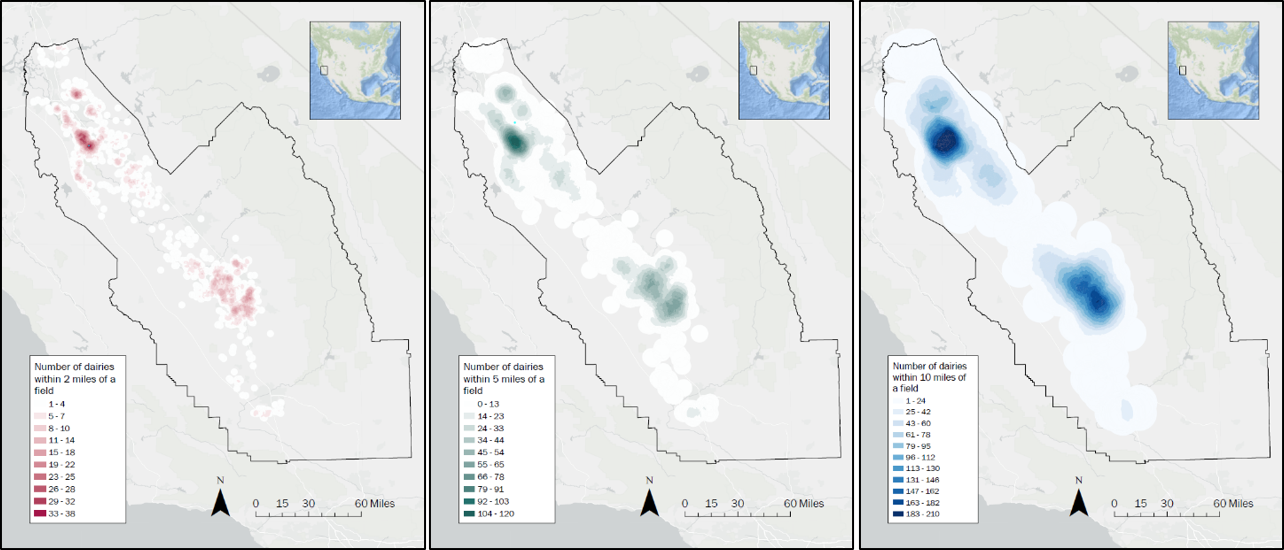
To determine (hypothetically) allocated manure to nearby fields, we used the Ford Fulkerson algorithm to maximize flow. This algorithm was necessary because there are areas with significant concentration of dairies (Figure 3). Therefore, if a dairy is within 2 (or 5 or 10) miles of a field, it would be competing with other dairies to supply the demand. There would be several combinations possible for each dairy (could access multiple fields) and each field (accessible by multiple dairies) (Figure 4). The algorithm maximized the amount of manure used, and prioritized forage fields (wheat/corn/grass). We assumed that a field could supply manure from multiple dairies and that a dairy could supply manure to multiple fields.
Figure 2: (Left) Recoverable Plant Available Nitrogen generated by dairy facility. (Right) N fertilizer requirement by polygon (lbs/acre) for 2021 (up to 4 crops in one year). Calculated via LandIQ (crop classification) and FREP (fertilizer recommendations, mostly pre-plant).Figure 3: Number of dairies within 2, 5, or 10 miles of a field.Figure 4: 5-by-5 mile area with dairies and field boundaries (actual data, chosen arbitrarily).
What Have We Learned?
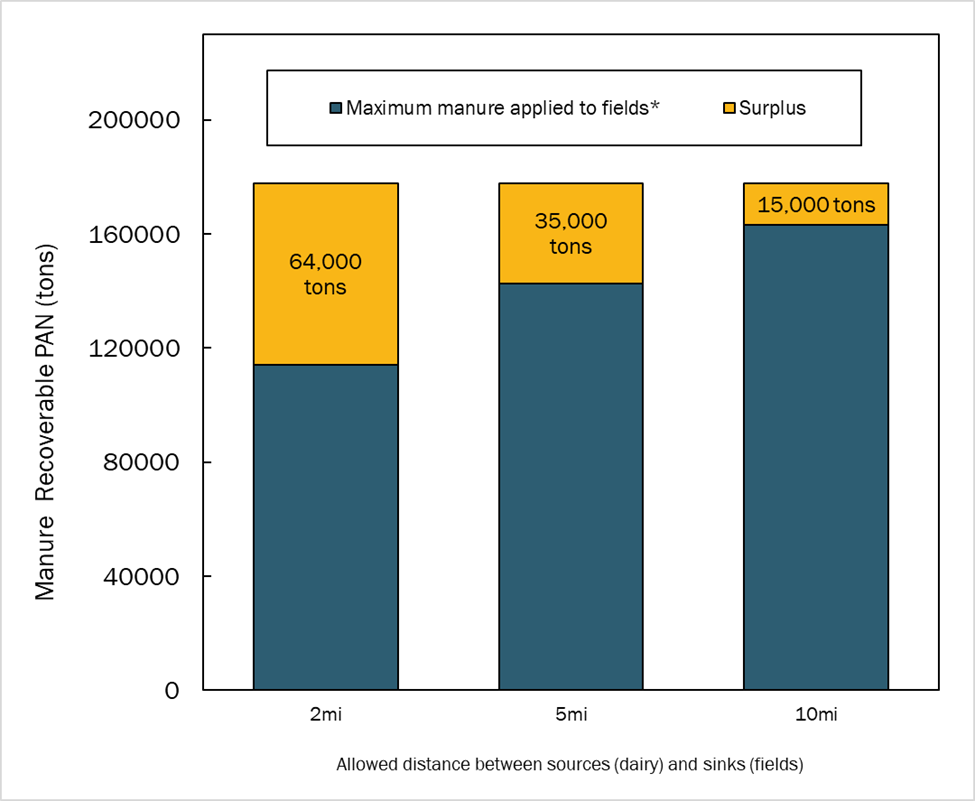
Total manure N generated was 298,000 tons, and we estimate that 178,000 tons of that was plant available N (Figure 4). It should be noted that our assumptions about N loss are aligned with ambitious environmental goals and resulted in much higher recovery rates compared to NuGIS. We also make a blanket assumption about relative organic / inorganic forms. In our hypothetical exercise where this manure could be applied to all fields (prioritizing forage first) within 2 miles of dairies, 114,000 tons were allocated, leaving 64,000 tons of surplus manure N. If the boundary were expanded to 5 miles, 143,000 tons could be allocated leaving 35,000 tons of surplus manure N. Surplus manure N was only 15,000 tons if manure could be applied up to 10 miles away from dairies where 163,000 tons were applied. Note that these simulations assume that manure can be applied to any crop (including human-consumed ones), which is not currently realistic.
Figure 5: Recoverable PAN (tons) summed over 8 counties for the 2021 crop year. *Maximum manure applied to fields is hypothetical and based on the Ford Fulkerson Algorithm where the goal was to maximize flow of manure to fields from dairies within 2, 5, or 10 miles from the field’s edge.
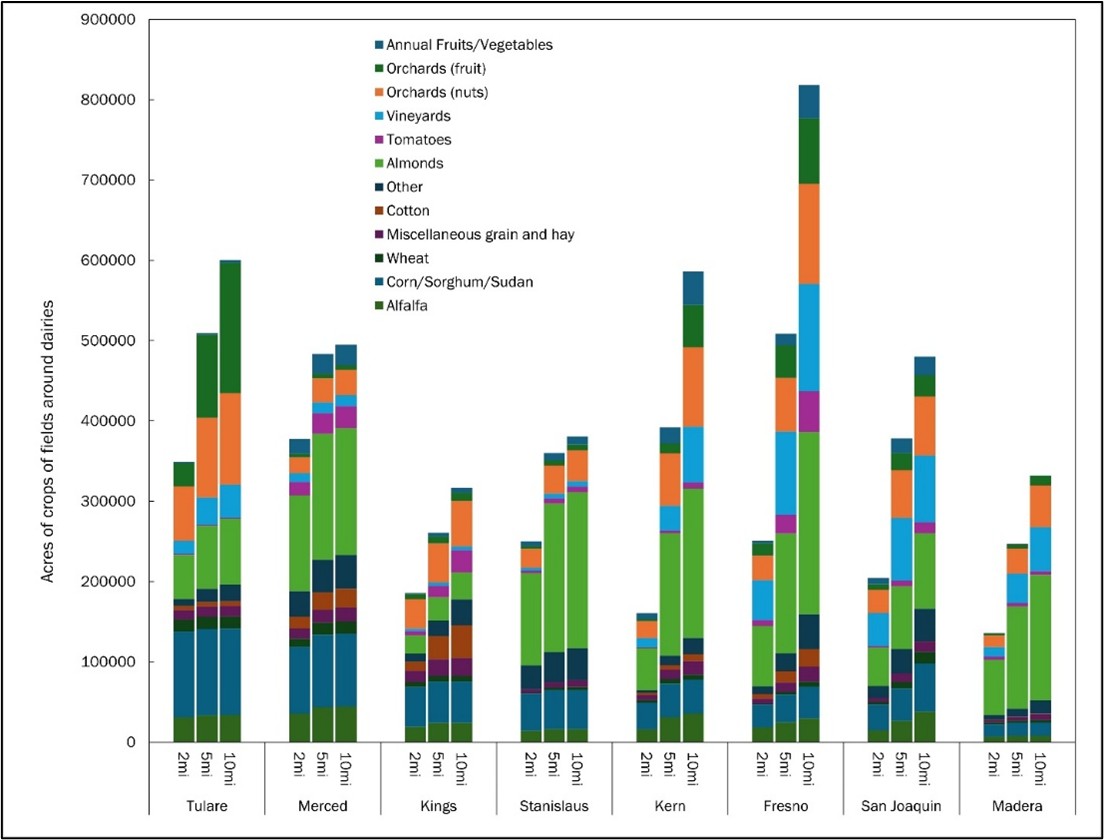
The amount of manure available for application varied by county. In Tulare, there was still a surplus N of 10,500 tons when assuming manure could be applied to all acreage within 10 miles of a dairy (Figure 6). However, in 3 counties (Fresno, San Joaquin, Madera), all hypothetical fertilizer N requirement could be met by applying manure within just 5 miles. Merced, Stanislaus, and Kern had fertilizer requirements met by expanding the allowed distance traveled to 10 miles. The crop types that were fulfilled by manure also differed by county (Figure 7, aggregated by county of field receiving manure).
Figure 6: Recoverable nitrogen (tons) summed by 8 counties for the 2021 crop year. *Maximum manure applied to fields is hypothetical and based on the Ford Fulkerson Algorithm where the goal was to maximize flow of manure to fields from dairies within 2, 5, or 10 miles from the edge.Figure 7: Nitrogen fertilizer requirement fulfilled by manure*, categorized by crop. *Maximum manure applied to fields is hypothetical and based on the Ford Fulkerson Algorithm where the goal was to maximize flow of manure to fields from dairies within 2, 5, or 10 miles from the edge.
The California agricultural landscape, with many fruits and vegetables that go directly to human consumption, makes our hypothetical application rate currently unviable. For example, the only dairy forage crops with substantial acreage that are currently eligible for raw manure application are wheat, alfalfa (which does not receive N), and corn. These make up between 18-44% of area within 2 miles of a dairy, and increasing the distance from a dairy up to 10 miles decreases the percentage of crops that are forage (Figure 8). In other words, the farther away from a dairy, the more likely land use is classified as a crop that would be flagged for pathogen concerns. This highlights that to effectively use manure in the SJV, there will need to be a concerted effort to address logistical issues associated with human-consumed crops. However, these crops are generally high value, and some commodities are concentrated within a county (Figure 7).
Figure 8: Crop acreage of fields around dairies. Fields were included if their edge was within 2, 5, or 10 miles of a dairy.
Future Plans
This phase of the manureshed analysis was intended to demonstrate the potential for manure to reduce fertilizer inputs; however, its practical applications are limited. In the next phase, we hope to improve our analysis by accounting for more details of manure, such as solid vs. liquid (for improved predictions of N content/transformation/transportability) and phosphorus and potassium concentration/stoichiometry. We will work with commodity groups, with a focus on those within 10 miles of dairies, to understand the current level of interest and obstacles for integrating different manure products into their cropping systems. These improvements to our methodology will result in a quantification of environmental and economic opportunity to increase the likelihood of a circular economy by expanding the use of dairy manure.
Authors
Presenting & corresponding author
Emily R Waring, Agricultural Practice Impact Analyst, Sustainable Conservation, ewaring@suscon.org
Additional authors
Ryan Flaherty, Senior Director of Circular Economies, Sustainable Conservation
Sarah Castle, Senior Scientist, Sustainable Conservation
John Cardoza, Project Director, Sustainable Conservation
The authors are solely responsible for the content of these proceedings. The technical information does not necessarily reflect the official position of the sponsoring agencies or institutions represented by planning committee members, and inclusion and distribution herein does not constitute an endorsement of views expressed by the same. Printed materials included herein are not refereed publications. Citations should appear as follows. EXAMPLE: Authors. 2025. Title of presentation. Waste to Worth. Boise, ID. April 7-11, 2025. URL of this page. Accessed on: today’s date.
The Iowa Manure Applicator Certification program has transitioned from a traditional lecture-based format to a multimodal learning approach that integrates lectures, discussion, and hands-on activities. This shift was implemented to create more engaging and memorable training experiences, fostering discussion and peer-to-peer knowledge sharing while improving knowledge retention and practical skill application.
Hands-on learning has been widely recognized as an effective educational strategy. Research indicates that individuals retain more information through active engagement rather than passive listening. However, developing these engaged learning opportunities requires additional time and commitment from educators and a willingness from participants to fully engage in the learning process. Our goal was to transform the training environment from passive listening to an interactive space where participants could explore activities, facilitate discussions, and share personal experiences within groups.
What Did We Do?
To achieve this transformation, we restructured the program to incorporate interactive activities designed to bring real-world challenges into the classroom. Instead of serving solely as lecturers, facilitators became discussion leaders, encouraging participants to actively engage with the material. Starting in approximately 2014, we started adding one module to training based on fostering discussion and participant interaction. As the training occurs annually, with livestock farmers or commercial manure applicators required to attend annually, different modules were created each year with at least a three-year break before an existing module is used again.
Some of the hands-on activities integrated into the program include:
Carousel Exercise – Applicators rotate through stations, responding to questions on environmental impacts and operational challenges, sparking peer-to-peer discussions.
Spill Response Scenario – Groups rank and discuss response steps to manure spills, often incorporating real-world examples shared by applicators and insights from Iowa DNR regulators.
Load Loss Competition – Model trucks are used to visually demonstrate best practices for material containment.
Stockpiling Locations – Hands-on exercises with topographic, soil, and aerial imagery to develop regulatory knowledge and practical application skills.
Application Rate Calibration – Three simulated manures (bed pack [wetted straw], open lot [wetted sand], and turkey litter [wetted wood shavings]) were supplied to each group and a plastic tarp. Each group was asked to apply a prescribed manure application and then to estimate the application rate of other groups. The actual application rate was calculated based on the weight added to the tarp and compared to group estimates.
DOT Compliance Activity – Participants perform checklist inspections on model trucks to identify vehicle issues and understand road rules.
Video-Based Farm Walkthrough – Applicators observe an Iowa DNR site inspection via video before using Google Maps and a farm description to evaluate livestock production sites for compliance readiness.
Biosecurity Bench – Glow germ was placed on at a simulated barn entry and producers went through a Danish style entry. At the end we evaluated how much glow germ made it to the clean side of the entry.
Manure Transport Route Selection – Participants were divided into groups and given a map and worksheet. The map identified the location of the farm with manure and the field to which manure was to be applied. Groups were required to select a route from farm to field with the worksheet providing talking points such as travel time, neighbors, and bridge considerations.
Figure 1. Example of a biosecurity exercise using Glow-Germ to illustrate lines of separation.
Each of these activities was designed to promote critical thinking in manure management and spill prevention while allowing facilitators to assess current knowledge levels among participants.
What Have We Learned?
While some participants and facilitators initially approached this transition with skepticism, feedback has been positive. Evaluations suggest that these engaged learning techniques have resulted in increased participant investment, improved knowledge retention, and greater willingness to discuss challenges and ask questions.
Facilitators also report stronger engagement with applicators, who now feel more comfortable sharing experiences, discussing obstacles, and applying learned concepts in real-world situations. Additionally, peer-to-peer learning has emerged as a significant benefit, with applicators contributing valuable insights that complement the formal curriculum.
Data obtained from the Iowa Department of Natural Resources Hazardous Material Release Database (https://programs.iowadnr.gov/hazardousspills/Reports/EPCManureRelease.aspx) was used to track total incidents of manure releases and surface water impacts from these releases. Within this report, incidents are broken down by species (Hog, cattle, or poultry, by facility type (open lot, confinement), and if they occurred from the facility, because of land application, or during manure transport. A summary of total events is provided in Figure 2. A before and after analysis using 2012 as the break point indicated a statistically lower number of spills (29.9 ± 9.6 compared to 49.9 ± 6.4 spills) after 2014 (p<0.001). However, the number of water quality impacts from spills remained unchanged (10.9 ± 4.6 compared to 10.0 ± 4.8). A breakpoint regression analysis was used to evaluate if the occurrence of spills has changed with time (Figure 2). The breakpoint year was set at 2013 (the year before our first active learning activity was implemented) and results indicated that before 2013 the occurrence of spills was constant with time, while after 2013 we have been decreasing by 3.1 spills per year. Similarly, for water quality impacts the breakpoint year was set at 2013 with results indicating that before 2013 impacts on water (spills reaching a surface water) were constant with time, while after 2013 impacts have been decreasing by 0.3 incidences per year. While other changes certainty played a role in the reduction of manure spills and water impacts (increased adoption of flow meters and automated flow shutoff systems, a change from tanks to umbilical application to reduce road traffic, and regulatory interventions) our program reviews and spill impact assessment suggest the Iowa Manure Applicator training played a role in helping improve industry performance.
Figure 2. Annual manure spills and water quality impacts in Iowa.
Future Plans
We plan to continue refining the program by incorporating additional interactive elements and expanding hands-on learning opportunities. Future initiatives may include:
Enhancing real-world application exercises by integrating on-farm training opportunities.
Collecting and analyzing long-term data to assess the impact of training on manure management practices and environmental outcomes.
Exploring digital and remote learning tools to reach a broader audience while maintaining interactive engagement.
Authors
Presenting & corresponding author
Daniel Andersen, Associate Professor, Iowa State University, Dsa@iastate.edu
The authors are solely responsible for the content of these proceedings. The technical information does not necessarily reflect the official position of the sponsoring agencies or institutions represented by planning committee members, and inclusion and distribution herein does not constitute an endorsement of views expressed by the same. Printed materials included herein are not refereed publications. Citations should appear as follows. EXAMPLE: Authors. 2025. Title of presentation. Waste to Worth. Boise, ID. April 7-11, 2025. URL of this page. Accessed on: today’s date.
The Iowa commercial manure application industry plays a crucial role in advancing nutrient utilization, circularity, and water quality within agricultural systems. Effective programming requires an understanding of the industry’s needs, challenges, and perspectives to tailor information and drive behavior change.
To assess the current state of the industry, we surveyed Iowa’s commercial manure applicators to gather insights into business sizes, application capacity, client demand for manure as a cost-effective fertilizer alternative, and pricing structures. The survey served as a needs assessment, helping to align business goals with state water quality objectives. Specifically, we aimed to understand how the industry navigates market demands, regulatory pressures related to environmental stewardship (particularly water and air quality), labor, and time constraints.
What Did We Do?
A comprehensive electronic survey was sent to all 540 of the 562 commercial manure application businesses in Iowa (22 did not have an email on file). We received a response rate of 20%, providing valuable insights into the industry’s scale and operations. Key findings include:
Commercial applicators handle 62% of Iowa’s 13 billion gallons of liquid manure annually and nearly 60% of its 6 million tons of solid manure.
Manure transport costs and application expenses shape decision-making, influencing equipment selection and service pricing.
Current industry capacity and weather-dependent application constraints affect the feasibility of meeting best management practices, such as applying manure only when the soil is 50°F and cooling to minimize nutrient loss.
By examining these trends, we aimed to identify programming opportunities that could support both industry advancements and water quality improvement goals.
What Have We Learned?
The survey results provided critical context for understanding commercial applicator decisions, including:
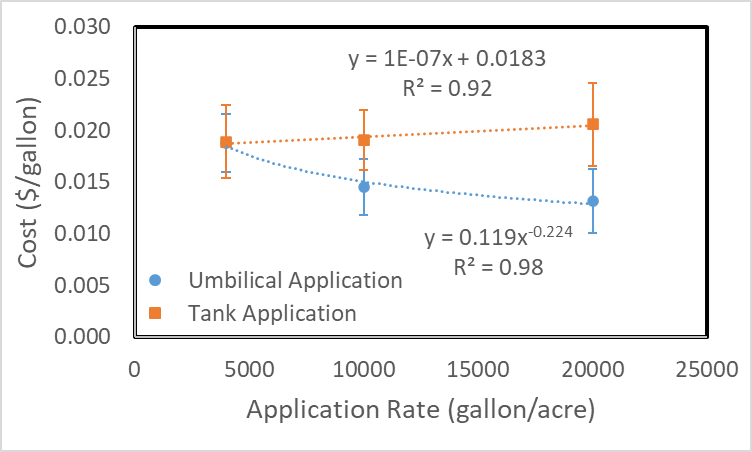
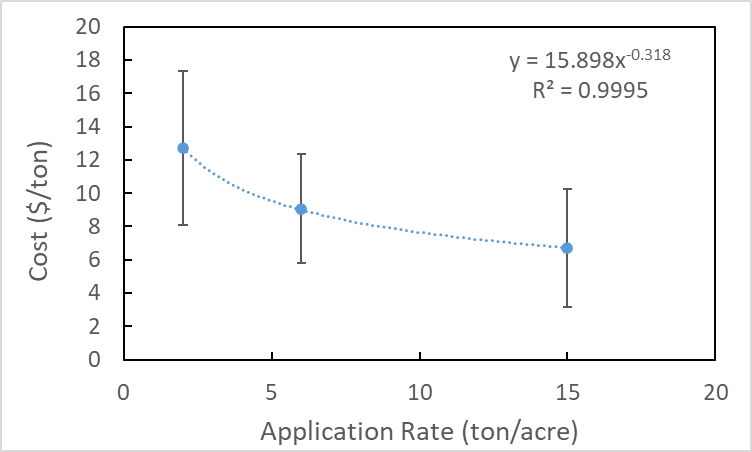
Economic Realities – The manure application industry must remain financially viable while balancing regulatory requirements and customer needs. One of the most common questions asked by manure applicators is what people are charging for manure application. To help address this question we asked applicators what they would charge for application for three liquid manure application rates (4000 gallons/acre, 12,000 gallons/acre and 20,000 gallons/acre) meant to represent finishing swine manure, gestation-farrowing manure, and dairy manure respectively (Figure 1). For solid manure applicators we asked what they charge per ton for application rates of 2, 6, and 15 tons/acre, meant to represent layer manure, turkey litter, and bed pack cattle manure rates (Figure 2). Additionally, we asked what hauling charge was used for transporting either liquid or solid manure. The average charge for liquid manure was $0.0411 per gallon-mile, while for solid manure, the average charge was $0.40 per ton-mile. Agitation of liquid manures was generally included in the manure application price; however, if special agitation services were required (an additional agitation tractor beyond standard practice or the use of an agitation boat) an additional charge of $0.002 per gallon or around $150-300 per hour was reported.
Reported liquid manure application price for umbilical application system (blue circles) and manure tank application (orange squares). Error bars represent the reported standard deviation amount respondents at each application rate.Figure 2. Estimated cost of solid manure application per ton. Error bars represent the reported standard deviation amount respondents at each application rate.
Manure Transport & Industry Size – Understanding how manure moves within the state and the cost of application informs strategic equipment investments. Solid manure transport distances were reported to average 14.5 miles while liquid manure transport was reported at 2.0 ± 1 mile.
Survey responses suggested 2050 people employed in the commercial manure application business, with 920 of these as non-seasonal employees and 1130 as seasonal employees. Overall totals align well with the number of certified commercial manure applicators in Iowa.
Regulatory & Timing Constraints – The number of available application days under various weather conditions and the desired soil temperatures at the time of application limits application days available. It also sets a constraint on the application capacity needed to complete manure application. We surveyed how much manure could be applied daily by each company to evaluate application days needed and to evaluate how much increase in application capacity is required. Expansion could occur through either equipment sizing and employee numbers, needed to meet state water quality goals while maintaining viable businesses. On average, businesses can apply 0.6 million gallons of liquid manure per day, with a standard deviation ranging from 0.25 to 1.6 million gallons. Assuming an application rate of around 4000-gallons and acre this means manure could cover 150-acres per day per company. It would take 50 working days to apply all liquid manure in Iowa. On average, businesses apply 526 tons of solid manure per day, requiring 57 working days to apply all the solid manure in Iowa.
Industry’s Role in Water Quality – Commercial applicators must be strategic partners in achieving water quality objectives by optimizing manure use through best application rates and timing, and incorporation of technology.
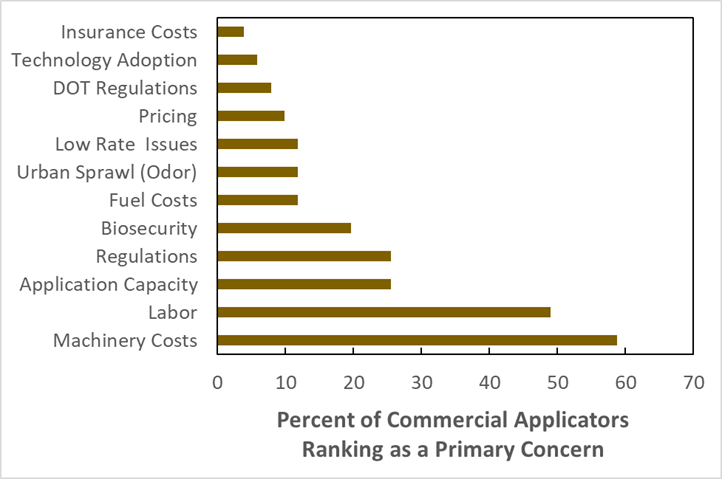
An open-ended question was asked around what challenges were for your application business over the next ten years (Figure 3). As answers were not limited, most businesses chose to list numerous concerns. These were grouped as best possible to provide categories and to help understand where future programming could address these concerns.
The primary concerns listed by most businesses were equipment costs and labor availability. Many noted how as equipment costs have increased it takes more hours of application to justify ownership and find a way to make their business cash flow, and how this has translated into repair costs that add to concerns about maintaining a business. There was an expression of how this could make it difficult for a younger generation to get into the business and make sure the industry stays sustainable. Developing materials to help facilitate those interested in developing a business plan and gallons it takes under different conditions would be a useful tool for facilitating making a business case to a lender.
This study underscores the importance of tailoring educational programs to meet industry needs while collaborating with policymakers to develop strategies that advance manure management practices.
Figure 3. Primary concerns of commercial manure application businesses.
Future Plans
To further support the industry and align with water quality objectives, future efforts will focus on:
Developing strategic policies that support efficient manure application while maintaining business viability.
Expanding educational programming to help applicators navigate regulatory changes and improve application timing strategies.
Assessing infrastructure needs to determine equipment investment and business growth opportunities.
Enhancing industry collaboration with policymakers to balance business sustainability with environmental stewardship.
Authors
Presenting & corresponding author
Daniel Andersen, Associate Professor, Iowa State University, dsa@iastate.edu
The authors are solely responsible for the content of these proceedings. The technical information does not necessarily reflect the official position of the sponsoring agencies or institutions represented by planning committee members, and inclusion and distribution herein does not constitute an endorsement of views expressed by the same. Printed materials included herein are not refereed publications. Citations should appear as follows. EXAMPLE: Authors. 2025. Title of presentation. Waste to Worth. Boise, ID. April 7–11, 2025. URL of this page. Accessed on: today’s date.
To access and quantify the availability of inorganic soil phosphorous following the application of dried non-living Cyanobacteria biofertilizer (CBF) in oats within a greenhouse environment
What Did We Do?
This study examined the operational and environmental effects of integrating Cyanobacteria biofertilizer (CBF) production into livestock manure management systems. Using a combination of system modeling, laboratory analysis, and field trials, the research assessed the life cycle environmental impacts and practical viability of Cyanobacteria biofertilizer (CBF).
What Have We Learned?
This presentation will provide insights into system configuration and modeled environmental impacts, as well as data from ongoing lab and greenhouse experiments. Key findings indicate that genetically modified strains of cyanobacteria (mutants) are capable of increasing manure phosphorus uptake by 10 times compared to existing strains. The shift to mutant cyanobacteria with greater phosphorus uptake results in reduced greenhouse gas emissions, as identified through a partial life cycle assessment, and can serve as a phosphorus fertilizer, as determined in greenhouse trials. Greenhouse trials on oat production using cyanobacteria with typical phosphorus uptake levels and the mutant strains with a 10-fold increase in phosphorus uptake produced similar biomass yields to dairy manure and increased biomass compared to chemical/synthetic fertilizers. Further research will expand to field trials for existing cyanobacteria strains, additional greenhouse trials for mutant strains, and efforts to increase nitrogen uptake in alternative mutant strains. . This study underscores both the potential and challenges of adopting CBF as a sustainable solution in livestock-based cropping systems.
Future Plans
We will be taking learnings from our initial laboratory/greenhouse experiments and modeling to field trials in Spring/Summer of 2025.
Authors
Presenting author
Brian M. Langolf, Researcher, University of Wisconsin Madison
Corresponding author
Rebecca A Larson, Professor and Extension Specialist, University of Wisconsin Madison, rebecca.larson@wisc.edu
Additional authors
Juma Bukomba, Gradúate Research Assistant, University of Wisconsin Madison; Horacio A. Aguirre-Villegas, Scientist, University of Wisconsin Madison; Brenda Casino Loeza, Research Associate, University of Wisconsin Madison; Victor M. Zavala, Professor, University of Wisconsin Madison; Ted Chavkin, Postdoctoral, University of Wisconsin Madison; Brian Pfleger, Professor, University of Wisconsin Madison; Rebecca A Larson, Professor, University of Wisconsin Madison
The authors are solely responsible for the content of these proceedings. The technical information does not necessarily reflect the official position of the sponsoring agencies or institutions represented by planning committee members, and inclusion and distribution herein does not constitute an endorsement of views expressed by the same. Printed materials included herein are not refereed publications. Citations should appear as follows. EXAMPLE: Authors. 2025. Title of presentation. Waste to Worth. Boise, ID. April 7–11, 2025. URL of this page. Accessed on: today’s date.
Animal manure is frequently applied to crop fields to supplement manufactured fertilizers, as manure is rich in many of the nutrients required for plant growth. Most nutrients in manure exist in organic forms, which must first be mineralized to inorganic forms before they can be used by plants. Direct land application of manure relies on in situ mineralization of nutrients by soil microorganisms, which is a slow and difficult-to-control process. In anticipation of limited immediate nutrient availability, manure is often applied to fields in excess of actual agronomic nutrient need. The excess nutrients can leach into water sources, causing accelerated eutrophication and threatening human and ecosystem health. As such, it is advantageous to investigate technologies designed to recover manure nutrients in inorganic forms, which can then be more easily regulated and applied to suit specific agricultural demand. Bioelectrochemical systems (BES) are a novel treatment option employing electrogenic microorganisms to drive operation and recover mineralized nutrients, making them an advantageous resource recovery mechanism.
What Did We Do?
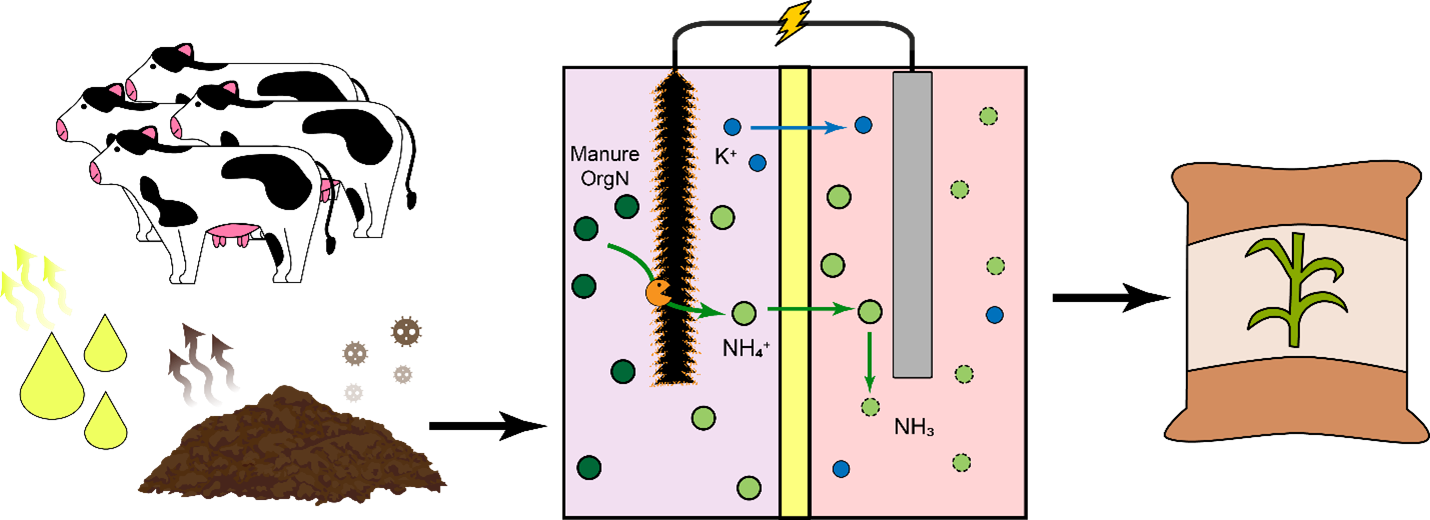
This study investigated a BES for organic nitrogen mineralization and ammonia recovery from synthetic (e.g. prepared solution of organic nitrogen and acetate) and real dairy manure. The BES was custom fabricated and followed a two-chamber design as outlined in Burns and Qin (2023). Briefly, a cation exchange membrane separated a biological anode and chemical cathode in respective chambers. Electrodes were connected via a 10 Ohm resistor to allow for current flow, and synthetic or real dairy manure was fed to the biological anode depending on the experimental condition under investigation. The BES was operated in both fuel cell and electrolysis cell (applied voltage = 0.8 V) modes.
Figure 1. Schematic of the bioelectrochemical system used to treat dairy manure and produce ammonia fertilizer.
System performance was evaluated for organics removal (measured as chemical oxygen demand or COD), nitrogen removal, and total ammoniacal nitrogen production. We also calculate the nitrogen removal efficiency, RN, which measures how current is partitioned to drive nitrogen transport (as NH4+) across the cation exchange membrane. We modeled full-scale implementation of this technology on a theoretical Wisconsin dairy farm based on the experimental results obtained when treating real dairy manure. Results from the model (functional unit: tonne of manure treated, allocation: kg fat-and-protein-corrected milk (FPCM)) were used to investigate environmental impacts including greenhouse gas (GHG) emissions (in kg CO2eq tonne-1 manure), ammonia losses (in kg NH3 tonne-1 manure), and eutrophication potential (kg PO42- tonne-1 manure).
What Have We Learned?
In synthetic manure experiments, the BES consistently achieved excellent organics removal, exhibiting COD removal efficiencies well above 90%. Furthermore, total nitrogen removal efficiency averaged around 40% in electrolysis cell operation, and was seen to reach as high as 60% for some experiments. In fuel cell operation, nitrogen removal efficiency was decreased, averaging around 23%, indicating a slight advantage for nitrogen removal in electrolysis operation. RN exhibited interesting trends before, during, and after electrolysis cell operation. For the same system operational parameters, RN in fuel cell mode was around 1 mol N mol-1 electrons before electrolysis cell operation. However, during electrolysis operation and when the system returned to fuel cell operation after electrolysis cell operation, RN was and remained elevated at nearly 3 mol N mol-1 electrons with much more variability. This variability suggests that the microbial community was less tolerant to applied voltage conditions, and that there was perhaps some significant change during electrolysis operation that was difficult to recover from upon return to fuel cell operation. When treating real dairy manure, the system achieved average removals of 60% of total nitrogen and 58% of organic matter (Burns et al., 2024). The system exhibited similar nitrogen removal across multiple dairy manure feedstocks, however, a decrease in RN was observed with more complex dairy manure feedstock, likely due to the presence of competing ions (Burns et al., 2024).
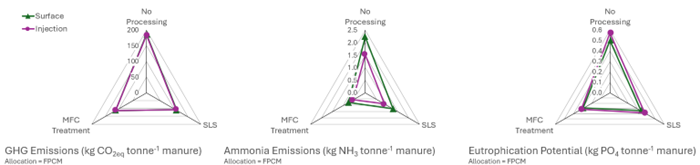
Figure 2. Radar plots showing greenhouse gas emissions, ammonia losses, and eutrophication potential of three manure treatment scenarios: no processing/direct land application, solids-liquids separation (SLS), and microbial fuel cell (MFC) treatment for both surface and injection application of products. Results are reported per tonne of manure treated with an allocation of fat and protein corrected milk (FPCM).
We also investigated the environmental impacts of BES manure treatment when scaled up to a ~730 cow dairy farm. Impacts on greenhouse gas emissions, ammonia losses, and eutrophication potential were compared for surface and injection application of three manure treatment scenarios: (1) no manure treatment or processing, (2) solids-liquids separation (SLS) manure processing, and (3) BES manure treatment. Preliminary results from the model reported that BES manure treatment decreased impacts in all three categories when compared to the no treatment scenarios, and resulted in less ammonia loss when compared to the SLS treatment scenarios (Figure 2). For GHG emissions, BES manure treatment had slightly increased emissions when compared to SLS, mostly due to the added energy and freshwater inputs. However, BES manure treatment received more credits for P and N-based fertilizers than SLS treatment. For eutrophication potential, BES manure treatment had slightly less impact when compared to SLS treatment, despite the added impacts of freshwater, energy, and supplemental chemicals required for the treatment. Based on these results and those from experimental data, BES manure treatment is concluded to be a promising and competitive technology worthy of further development.
Future Plans
The results of this research prove bioelectrochemical systems to be a viable manure treatment alternative to current technologies. Our future work will involve investigating the organic nitrogen degradation kinetics in the BES treating dairy manure. Our goal is to determine reaction rate orders and calculate kinetic constants for degradation of COD, TN, and organic N within the cell, which can be used to develop more accurate full-scale models of the process. This analysis can be extended to investigate differing compositions of dairy manure based on the dairy’s variable feed compositions throughout the year. Additionally, we plan to expand the environmental impact analysis to include two other comparison scenarios which would be realistic at the industrial scale: (1) minimizing freshwater inputs for manure dilution and (2) harvesting electricity produced by the BES towards meeting pumping and aeration demands. Based on the model, BES manure treatment would require approximately 1,700 kWh of electricity per week to meet pumping an aeration demands, some of which can be provided by the microbially-generated electric current in the system. Furthermore, due to reactor size constraints at the lab scale, there is currently a large amount of freshwater used to dilute the manure prior to treatment with the MFC. This work will help to contextualize BES within existing manure treatment frameworks and will help both researchers and practitioners make informed decisions regarding manure treatment options.
Authors
Presenting author
McKenzie Burns, PhD Candidate, the University of Wisconsin—Madison
Corresponding author
Dr. Mohan Qin, Assistant Professor, the University of Wisconsin—Madison, mohan.qin@wisc.edu
Additional authors
Dr. Horacio Aguirre-Villegas, Scientist III, the Nelson Institute for Environmental Studies at the University of Wisconsin—Madison
Dr. Rebecca Larson, Associate Professor, the University of Wisconsin—Madison
Additional Information
Published journal articles (these are also the citations for this conference proceeding):
The authors would like to thank the support from National Science Foundation CBET 2219089. In addition, the authors would like to thank the startup fund from the Department of Civil and Environmental Engineering, College of Engineering, the Office of the Vice-Chancellor for Research and Graduate Education (OVCRGE) at the University of Wisconsin–Madison, and the Wisconsin Alumni Research Foundation (WARF) for the support of this study. The authors gratefully acknowledge support from Jackie Cooper of the Environmental Engineering Core Facility at the University of Wisconsin–Madison for use of facilities and equipment. Finally, the authors thank Andrew Beaudet, Ethan Napierala, Katie Mangus, and David Xiong for their contributions as undergraduate researchers on this project.
The authors are solely responsible for the content of these proceedings. The technical information does not necessarily reflect the official position of the sponsoring agencies or institutions represented by planning committee members, and inclusion and distribution herein does not constitute an endorsement of views expressed by the same. Printed materials included herein are not refereed publications. Citations should appear as follows. EXAMPLE: Authors. 2025. Title of presentation. Waste to Worth. Boise, ID. April 7–11, 2025. URL of this page. Accessed on: today’s date.
As large dairies move into western Minnesota, a consistent supply of manure is available that was not historically present. These dairies are using a new technology to separate solids from liquids in the manure, and the impact on nutrient availability in this region’s climate and soil types is unknown. Understanding this is particularly important for sugarbeet growers in the region as late season N availability in the soil affects sugar content of the crop (high late season soil nitrate levels typical result in reduced sugar production). Where in the crop rotation should this manure be applied to maximize the beneficial properties while minimizing risk?
What Did We Do?
A three-year crop rotation including sugarbeet, corn, and soybean was set up at two locations (west central and northwestern Minnesota) with each crop present each year (Figure 1) and then rotated accordingly in subsequent years. Two rates of liquid separated dairy manure from a nearby commercial dairy were applied in the first year (in the fall prior to planting of each crop) and compared with standard synthetic fertilizer-only practices (fertilizers were applied each spring prior to planting). The two manure application rates were approximately 15,000 gallons per acre, which supplied approximately 195 pounds first-year available nitrogen per acre, or approximately 10,000 gallons per acre, which supplied approximately 150 pounds of first year available nitrogen per acre. In following years, only commercial fertilizer was applied according to soil test phosphorus and potassium levels or state nitrogen guidelines, considering manure nitrogen credits if applicable, for each crop. At the end of each growing season, yield was determined for each crop. Sugarbeet was also evaluated for sugar content and quality.
Figure 1. Aerial photograph taken in July 2021 of the plot setup with each crop labeled. Each crop was replicated four times in a randomized complete block design.
What Have We Learned?
The manured treatments typically resulted in similar or higher yields than synthetic- fertilizer-only for corn and sugarbeet during all three years of the rotation. For soybean, yields were significantly decreased by manure application at one site in the first year and generally unaffected at the second site. In the second and third years, there were no differences in soybean yield across nutrient treatments.
Future Plans
This study was conducted in two fields that did not have a recent history of manure application. Since we know that manure is the “gift that keeps on giving”, we want to repeat this study to see if there are long-term effects of nitrogen release from repeated applications of manure. Thus, manure was applied after the third growing season of the rotation and the rotation will begin again at both sites.
Authors
Presenting & corresponding author
Melissa L. Wilson, Associate Professor and Extension Specialist, University of Minnesota, mlw@umn.edu
Additional Information
Search for manure research: https://www.sbreb.org/research/
Acknowledgements
Thanks to the Sugarbeet Research and Education Board of Minnesota and North Dakota for funding this work.
The authors are solely responsible for the content of these proceedings. The technical information does not necessarily reflect the official position of the sponsoring agencies or institutions represented by planning committee members, and inclusion and distribution herein does not constitute an endorsement of views expressed by the same. Printed materials included herein are not refereed publications. Citations should appear as follows. EXAMPLE: Authors. 2025. Title of presentation. Waste to Worth. Boise, ID. April 7–11, 2025. URL of this page. Accessed on: today’s date.
Manage Cookie Consent
To provide the best experiences, we use technologies like cookies to store and/or access device information. Consenting to these technologies will allow us to process data such as browsing behavior or unique IDs on this site. Not consenting or withdrawing consent, may adversely affect certain features and functions.
Functional
Always active
The technical storage or access is strictly necessary for the legitimate purpose of enabling the use of a specific service explicitly requested by the subscriber or user, or for the sole purpose of carrying out the transmission of a communication over an electronic communications network.
Preferences
The technical storage or access is necessary for the legitimate purpose of storing preferences that are not requested by the subscriber or user.
Statistics
The technical storage or access that is used exclusively for statistical purposes.The technical storage or access that is used exclusively for anonymous statistical purposes. Without a subpoena, voluntary compliance on the part of your Internet Service Provider, or additional records from a third party, information stored or retrieved for this purpose alone cannot usually be used to identify you.
Marketing
The technical storage or access is required to create user profiles to send advertising, or to track the user on a website or across several websites for similar marketing purposes.