Valorization of Manure Treatment for Poultry and Swine Operators


Proceedings Home W2W Home w2w17 logo

Purpose 

Current practices for nutrient removal or recovery of phosphorus focus on chemical precipitation technologies, where the recovered products are low-grade, slow-release, low-value land applied fertilizers. Three significant deficiencies re this process – the cost of recovery is greater than the market value as commercial P fertilizer; the land application of such materials perpetuates the current cycle of pollutant nutrient “leakage” into surface waters; and the approach is not viable to address non-point source pollution or the legacy P present in impaired water bodies. Hence, research was initiated based on commercially available Hybrid Ion Exchange Nanomaterials (HIX-Nano), which remove naturally occurring arsenic from drinking water, and apply it to remove, recover, reconcentrate, reuse and recycle soluble reactive phosphorus from diverse organic waste and wastewaters.

What did we do? 

The infusion of high surface area nano iron oxide into conventional ion exchange resins, HIX-(Fe) Nano makes it possible to remove phosphates from wastewater and this has been proven by Lehigh U., ESSRE Consulting and others. Thus, residual dissolved phosphorus not chemically precipitated is captured and removed to supplement and complement the current P recovery processes or capture all of the dissolved P where nutrient recovery does not occur. The key to nutrient recovery is regeneration of the spent media and the conventional chemistry to achieve this is with a weak alkaline (caustic soda) rinse to desorb captured phosphate. The end product is a phosphate solution with a peak concentration of about 1600 mg/L. However, Na does not add any nutrient value whereas potassium hydroxide or ammonium hydroxide or both will add N and K to desorbed P and allow the custom formulation of N-P-K liquid products for hydroponic growers and greenhouse horticulturists. Moreover, when the source of concentrated N and P is livestock manures, there is a way to impart the micronutrients, Ca, Mg, Fe, etc. into the liquid formulations that will result in an N-P-K Plus product.

What have we learned? 

We know that making liquid fertilizer products from manures will help valorize manure treatment because hydroponic growers will pay a premium for a premixed N-P-K product and such an approach will limit the recycled nutrients “leakage” when direct land application is avoided. We also know that commercial synthetic fertilizer production is energy intensive and that any form of pollutant nutrient recovery/reuse will reduce GHG emissions via avoided fertilizer production.

We have also learned that we can do better in terms of manure valorization, if we take the view that even small amounts of soluble reactive phosphorus serve as a “biocatalyst” for intense and frequent harmful algae blooms in fresh and coastal waters. Hence, why not convert recovered nutrients into non-fertilizer products that are more highly valued in the marketplace. In mind are inorganic chemical catalysts that contain P and happen to be widely used in the Oil & Gas sector and Energy Storage sector, as follows:

1) Fluidized Catalytic Catalysts (FCC) – Phosphate-Zeolites (Oil Refineries)

2) Li-ion Battery Cathode Materials – LiFePO4 (Energy Storage)

Finally, we have also learned of recent advances in HIX-Nano technology, where the oxide of Nano Fe particles are replaced with that of Zirconium (Zr) particles. The HIX-(Zr) Nano resin exhibits enhanced P removal/regeneration potential and concurrent removal/recovery of pollutant nutrient N-Nitrate.

The attributes of the HIX-nanomaterial capabilities in manure treatment manifest in the advancement of 4Rs Nutrient Stewardship for fertilizers including land application of manure – Right type, Right place, Right rate and Right time – into “5Rs” of livestock manure management of the dissolved nutrient losses:  Remove, Recover, Reconcentrate, Reuse and Recycle.

The HIX-Nano can be configured and operated with equal efficiency for wastewater streams with high concentrations of nutrients (direct manure treatment after liquid/solids separation) or dilute runoff concentrations or very dilute legacy concentrations in surface or groundwater sources.  A commercial business model of HIX 5Rs treatment is established as a “hub” and “spoke” system.  The spokes are all of the pollutant nutrient pathways to surface waters shown in Figure 1, adapted from Wind’s version (2007).


Thus, the application of HIX-Nano technology serves as a barrier to pollutant nutrient leakage from all sources.  Hence, each farm, wastewater treatment plant, each urban stormwater runoff source within the watershed is a “spoke”.  Spent HIX-Nano is transported to a nearby Regeneration Center (Hub) and “refreshed” media is sent (i.e., recycled) back to the source (Spoke) for continued removal of nutrients.   At the Regeneration Center, the further processing of recovery via regeneration and reconcentration generates custom liquid fertilizer products and the aforementioned inorganic chemical catalysts and materials.  Hence, the Regeneration Center also serves as a Product Distribution Center – an all-purpose Hub.  Moreover, regardless of the location of the Hub within or outside the watershed, the recycling of nutrients in products that are not land applied fertilizer in essence “export” pollutant nutrients out of the watershed irrespective of the location of use.  Add the quantification of recycled nutrients to manufacture specific formulations, the HIX-Nano Hub-Spoke model becomes an additional revenue stream to producers for nutrient trading credits, where these programs exist, and a useful tool to develop trading credit programs where they do not exist.

Future Plans 

The potential to simultaneously Remove, Recover, Reconcentrate, Reuse and Recycle pollutant nutrients N and P from manures doubles the work ahead. For the reuse/recycle of fertilizer products confirmation is needed that N-P-K products will be free of impurities and commercially accepted after fertilization testing; similar confirmation path for N (NH4+ and N-NO3)-P-K products. Once established for reuse, HIX-Nano filters can be applied to the flushing discharge of spent fertilizer/nutrient solution for capture of N or P, thus closing the pollutant overload loop and recycling recycled pollutant nutrients.

For the reuse/recycle of treated water deficient in P when removing soluble P only, this needs to be tested for spray application onto soils oversaturated with P to assure compliance with the Nutrient Management Plans for N and P and thus safe reuse and reclamation of this water.

For the catalytic products thorough testing of composition (impurities), stability and performance testing needs to be carried out to gain acceptance as “green” catalysts or solution precursors for “green” catalysts. In either case, reconcentration must be carried out (thermal or mechanical) in a cost-effective way and in a way that carries out manure pathogen total destruction when the source of removed nutrients is from livestock manures .Similar research efforts are needed for battery cathode material manufactured from recycled pollutant P.  Moreover for both catalysts and battery materials, if the final disposition of these materials is landfilling, the application of HIX-Nano on landfill leachate containing P will close the nutrient pollution loop by applying 5Rs treatment principles.

Lastly, to address the Food-Energy-Water nexus challenge the future plans will favor HIX-Nano application on manure digestate after liquid/solids separations.  Nutrient recycling using HIX-Nano will also come into play with biomass to energy technologies such as Anaerboic Digestion and Hydrothermal Liquefaction, where the output is biofuels or biofuels and biochemical.

Corresponding author, title, and affiliation       

Ed Weinberg, PE, President, ESSRE Consulting, Inc.

Corresponding author email    

edweinberg_essre@verizon.net

Additional information               

Ed Weinberg can be reached at (215) 630-0546. Additional key people:

Dr. Mark Snyder, Lehigh U.; Dr. Raul Lobo, U of Delaware.

video: https://www.youtube.com/watch?v=g1LYFVS7wY8

Acknowledgements       

Dr. Arup K. SenGupta, Lehigh U.

The authors are solely responsible for the content of these proceedings. The technical information does not necessarily reflect the official position of the sponsoring agencies or institutions represented by planning committee members, and inclusion and distribution herein does not constitute an endorsement of views expressed by the same. Printed materials included herein are not refereed publications. Citations should appear as follows. EXAMPLE: Authors. 2017. Title of presentation. Waste to Worth: Spreading Science and Solutions. Cary, NC. April 18-21, 2017. URL of this page. Accessed on: today’s date.

EPA’s Nutrient Recycling Challenge


Proceedings Home W2W Home w2w17 logo

Purpose 

Come to this session to learn about the Nutrient Recycling Challenge and meet some of the involved partners and experts, as well as some innovators who are competing to develop nutrient recovery technologies that meet the needs of pork and dairy farmers. This session will begin with an overview of the challenge. Next, innovators will provide snapshot presentations about the technology ideas they are working on, followed by live feedback/Q&A sessions on each technology where we can harness the buzzing brainpower at Waste to Worth. Finally, we will move into a “workshop” designed to support innovators participating in the Nutrient Recycling Challenge as they refine their designs before they build prototypes.

What did we do?

Background on the Nutrient Recycling Challenge

At Waste to Worth 2015, the U.S. Environmental Protection Agency (EPA) hosted a brainstorm session about developing technologies that livestock farmers want to help manage manure nutrients. That session sowed the seeds for the Nutrient Recycling Challenge—a global competition to find affordable and effective nutrient recovery technologies that create valuable products farmers can use, transport, or sell to where nutrients are in demand. Pork and dairy producers, USDA, and environmental and scientific experts saw the tremendous opportunity to generate environmental and economic benefits, and partnered with EPA to launch the challenge in November 2015 (www.nutrientrecyclingchallenge.org).

What have we learned? 

There is a tremendous opportunity to generate environmental and economic benefits from manure by-products, but further innovation is needed to develop more effective and affordable technologies that can extract nutrients and create products that farmers can use, transport, or sell more easily to where nutrients are in demand.

In the Nutrient Recycling Challenge, innovators have proposed a range of technology systems to recover nitrogen and phosphorus from dairy and swine manure, including physical, chemical, biological, and thermal treatment systems. Some such systems may also be compatible with manure-to-energy technologies, such as anaerobic digesters. Farms of all sizes are interested in nutrient recovery, and there is demand for diverse types of technologies due to a diversity in end users. To improve the adoptability of nutrient recovery systems, it is critical that innovators are mindful of the affordability of technologies, and work to lower capital and operations and maintenance costs, and improve the potential for returns on investment. A key factor for offsetting the costs of a technology and improving its marketability will be in its ability to generate valuable nutrient-containing products that are competitive in the market.

Future Plans 

The challenge has four phases, in which innovators are turning concepts into designs, and eventually to pilot these working technologies on livestock farms. Thirty-four innovator teams whose concepts were selected from Phase I are refining technology designs in Phase II.  Design prototypes will be built in Phase III. This workshop is designed to help innovators maximize their potential for developing nutrient recovery technologies that meet farmer needs.

Corresponding author, title, and affiliation 

Joseph Ziobro, Physical Scientist, U.S. Environmental Protection Agency; Hema Subramanian, Environmental Protection Specialist, U.S. Environmental Protection Agency

Corresponding author email 

ziobro.joseph@epa.gov; subramanian.hema@epa.gov

Session Agenda

  1. Overview of the Nutrient Recycling Challenge, Hema Subramanian and Joseph Ziobro of EPA
  2. Nutrient Recycling Challenge Partner Introductions, Nutrient Recycling Challenge Partners (including National Milk Producers Federation, Newtrient, Smithfield Foods, U.S. Department of Agriculture Agricultural Research Service and Natural Resources Conservation Service, U.S. Department of Energy, and Water Environment & Reuse Foundation)
  3. Showcase of Innovators’ Technology Ideas
    • Decanter Centrifuge and Struvite Recovery for Manure Nutrient Management, Hiroko Yoshida
    • Manure Solids Separation BioFertilizer Produccion Drinking Water Efluente, Aicardo Roa Espinosa
    • Nutrient Recovery from Anaerobic Digestates, Rakesh Govind
    • Organic Waste Digestion and Nutrient Recycling, Steven Dvorak
    • Manure Treatment with the Black Solder Fly, Simon Gregg
  4. Nutrient Recycling Challenge Workshop for Innovators
    • Developing technologies: From concept to pilot (to full-scale), Matias Vanotti
    • Waste Systems Overview for Dairy and Swine and Innovative Technologies: What Steps Should be Taken (Lessons Learned), Jeff Porter

The authors are solely responsible for the content of these proceedings. The technical information does not necessarily reflect the official position of the sponsoring agencies or institutions represented by planning committee members, and inclusion and distribution herein does not constitute an endorsement of views expressed by the same. Printed materials included herein are not refereed publications. Citations should appear as follows. EXAMPLE: Authors. 2017. Title of presentation. Waste to Worth: Spreading Science and Solutions. Cary, NC. April 18-21, 2017. URL of this page. Accessed on: today’s date.

Spotlight on Manure Management in North Carolina and the Atlantic Coastal Plains


Proceedings Home W2W Home w2w17 logo

Purpose 

To provide information about commonly-found manure management systems and approaches in North Carolina and the Coastal Plains, and discuss opportunities for technological innovation in the areas of manure management and nutrient recovery/utilization. Hear from a diverse panel of researchers, animal agriculture producers, and agency representatives who will provide background on the environmental conditions of the region and discuss specific technical considerations for innovative research and development. Learn about what has and hasn’t worked in past attempts to recover nutrients at animal agriculture farms in the area, and about the exciting possibilities for innovation in the U.S. Environmental Protection Agency’s (EPA’s) Nutrient Recycling Challenge (www.nutrientrecyclingchallenge.org).

What did we do? 

N/A

What have we learned? 

N/A

Future Plans 

N/A

Corresponding author, title, and affiliation 

Joseph Ziobro, Physical Scientist, U.S. Environmental Protection Agency; Hema Subramanian, Environmental Protection Specialist, U.S. Environmental Protection Agency

Corresponding author email 

ziobro.joseph@epa.gov; subramanian.hema@epa.gov

Other authors

Dr. John Classen, Associate Professor and Director of Graduate Programs, College of Biological and Agricultural Engineering at North Carolina State University

Dr. Kelly Zering, Professor of Agricultural and Resource Economics, North Carolina State University

Additional information

Session Agenda

  1. Background, history, and technical information about manure management in North Carolina and the Coastal Plains

Presenter: Dr. John Classen, Associate Professor and Director of Graduate Programs, College of Biological and Agricultural Engineering at North Carolina State University

  1. Lessons Learned from the Smithfield Agreement

Presenter: Dr. Kelly Zering, Professor of Agricultural and Resource Economics, North Carolina State University

  1. Panel: Challenges and Opportunities around Manure Management Systems

Moderator: Hema Subramanian

Panel to include the above speakers plus representatives from the local animal agriculture industry, North Carolina Department of Agriculture and Consumer Services, North Carolina Department of Environmental Quality, and U.S. Environmental Protection Agency. 

Elimination of Equine Streptococci from Soiled Equine Bedding


Proceedings Home W2W Home w2w17 logo

Purpose            

Streptococcus equi subspecies equi (S. equi), causes the potentially fatal respiratory disease in horses known as “strangles”, while the closely related Streptococcus equi subspecies zooepidemicus (S. zooepidemicus) causes potentially fatal infections in humans. A study was undertaken to determine the survival of these 2 organisms in compost and soiled bedding.

What did we do? 

Dacron bags were filled with a feedstock mixture of soiled equine bedding and feed waste at ratios of 3:1 (C:N ratio 40.6), 1:1 (C:N ratio 31.9), and 1:4 (C:N ratio 25.4). The Dacron bags were inoculated with S. zooepidemicus, and placed in 3 compost windrows of the same 3 feedstock ratios 24 h later. Streptococci were quantified at different time points. Next, S. equi was inoculated into Dacron bags then placed into a compost windrow of the same feedstock ratio. Streptococci were quantified. To rule out killing of both Streptococcal species by microflora during the 24 h storage period, samples of soiled equine bedding, both autoclaved and non-autoclaved, were inoculated with S. zooepidemicus and periodically sampled. A repeated study was conducted with S. equi. To determine the role of moisture on the killing of S. equi in equine waste, soiled equine bedding was dried at 37 °C for 48 h and sterile water then added to dried bedding.

What have we learned?             

Microbes in soiled equine bedding may eliminate Streptococci, indicating that normal compost microflora may provide sustainable methods for the control of human and animal pathogens.

Future Plans    

Future studies could assess the role of individual bacterial species in the abatement of Streptococci, and possible additives to a compost pile which might increase numbers of streptocidal organisms. In addition, compost could be examined to discover novel antibiotics or bacteriophages which may be used for disease control.

Corresponding author, title, and affiliation        

Alexandria Garcia, Graduate Student, University of Maine

Corresponding author email    

Alexandria.poulin@gmail.com

Other authors   

Dr. Robert Causey, Associate Professor at University of Maine, Scott Mitchell, Student, Kathleen Harvey, Student, Ashley Myer, Student, Mark Hutchison, Extension Professor, and Martin Stokes, Professor

Additional information               

Garcia, Alexandria, “Abatement of Streptococcus equi in Equine Compost” (2016). Electronic Theses and Dissertations. 2435.

http://digitalcommons.library.umaine.edu/etd/2435

Acknowledgements       

Maine Agricultural Center, Dr. M. Susan Erich, Mark Hutchinson


The authors are solely responsible for the content of these proceedings. The technical information does not necessarily reflect the official position of the sponsoring agencies or institutions represented by planning committee members, and inclusion and distribution herein does not constitute an endorsement of views expressed by the same. Printed materials included herein are not refereed publications. Citations should appear as follows. EXAMPLE: Authors. 2017. Title of presentation. Waste to Worth: Spreading Science and Solutions. Cary, NC. April 18-21, 2017. URL of this page. Accessed on: today’s date.

Recovery of Ammonia and Production of High-Grade Phosphates from Digester Effluents


Proceedings Home | W2W Home w2w17

 

Purpose

Conservation and recovery of nitrogen and phosphorus from animal wastes and municipal effluents are important because of economic and environmental reasons. This paper presents a novel technology for separation and recovery of ammonia and phosphorus from liquid swine manure, which has significant amount of nutrients but also contains relatively high moisture content.

What Did We Do?

Phosphorus recovery via magnesium (MgCl2) precipitation was enhanced by combining it with ammonia recovery through gas-permeable membranes and low-rate aeration. Detailed procedures used in the research are provided in Vanotti et al. (2017).

Graphic of gas-permeable membrane

What Have We Learned?

The combination of low-rate aeration and gas-permeable membrane N recovery destroyed the natural carbonate alkalinity in the wastewater and increased pH values, which accelerated ammonia uptake in the gas-permeable membrane system and improved the phosphate recovery.  The process provided 100% phosphorus recovery efficiencies.   Surprisingly, the magnesium phosphates produced contained very-high phosphate grade (46% P2O5 ) similar to commercial superphosphate fertilizer and consistent with the composition of a rare biomineral called newberyite  that is found in guano deposits.   This is an important finding because we were able to produce from wastes a valuable phosphate product with high P2O5 content favored by the fertilizer industry.

Future Plans

Research will be summarized showing consistent results obtained with municipal side-stream effluents.  Economic considerations are provided in Dube et at. (2016).

Corresponding author (name, title, affiliation) 

Matias Vanotti, USDA-ARS

Corresponding author email address  

matias.vanotti@ars.usda.gov

Other Authors 

M.B. Vanotti, P.J. Dube, A.A. Szogi, M.C. Garcia-Gonzalez

Additional Information

Dube, P. J., Vanotti, M. B., Szogi, A. A., and García-González, M. C. (2016): Enhancing recovery of ammonia from swine manure anaerobic digester effluent using gas-permeable membrane technology. Waste Management 49:372–377.

Vanotti, M.B., Szogi, A.A., and Dube, P.J.  (2016): Systems and methods for recovering ammonium and phosphorus from liquid effluents. U.S. Patent Application 15/170,129. U.S. Patent and Trademark Office.

Vanotti, M.B., Dube, P.J., Szogi, A.A., M.C. Garcia-Gonzalez (2017): Recovery of ammonia and phosphate minerals from swine wastewater using gas-permeable membranes. Water Research 112:137-146

Acknowledgements

This article is part of USDA-ARS Project 6082-12630-001-00D “Improvement of Soil Management Practices and Manure Treatment/Handling Systems of the Southern Coastal Plains.”  We acknowledge the field and laboratory assistance of William Brigman and Chris Brown, USDA-ARS, Florence, SC, and the field sampling assistance of Diana Rashash, North Carolina Extension Service/ North Carolina State University.

The authors are solely responsible for the content of these proceedings. The technical information does not necessarily reflect the official position of the sponsoring agencies or institutions represented by planning committee members, and inclusion and distribution herein does not constitute an endorsement of views expressed by the same. Printed materials included herein are not refereed publications. Citations should appear as follows. EXAMPLE: Authors. 2017. Title of presentation. Waste to Worth: Spreading Science and Solutions. Cary, NC. April 18-21, 2017. URL of this page. Accessed on: today’s date.

Phosphorus Recovery from Anaerobic Swine Lagoon Sludge Using the Quick Wash Process

Proceedings Home W2W Home w2w17 logo

Purpose

Long term and significant accumulation of sludge in anaerobic swine lagoons reduces its storage volume and ability to treat waste. Usually, excess accumulation of lagoon sludge is removed using pump or dredge. The dredged sludge is then land applied at agronomic rates according to its nutrient content.

The accumulation of phosphorus (P) in the sludge requires the largest area of land application based on crop agronomic requirements. Therefore, nutrient management plans may limit application to crop or pastureland near the animal facility to avoid P build up in excess of soil and crop assimilative capacities. Although dewatered sludge can be moved off the farm, transportation becomes less economical with increasing distances. An option is to extract and recover P in a concentrated form for its economical transfer to P-deficient croplands, for use as fertilizer.

What did we do?

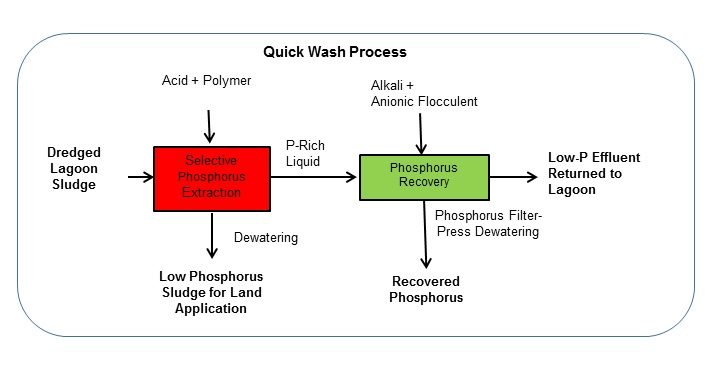
A patented treatment process, called Quick Wash (QW), developed by USDA-ARS for extraction and recovery of P from animal manure solids was tested for recovery of P from anaerobic swine lagoon sludge. With the QW process,Chart of Quick Wash Process P was extracted in solution from dredged sludge by mixing with sulfuric acid prior to dewatering using polymer enhanced mechanical solid-liquid separation. After that, P was recovered by addition of liquid lime and an anionic flocculent to the separated liquid extract to form a calcium-containing P precipitate. The QW process generated two solid products: 1) sludge solids low in P; and 2) a concentrated P material.
What have we learned?

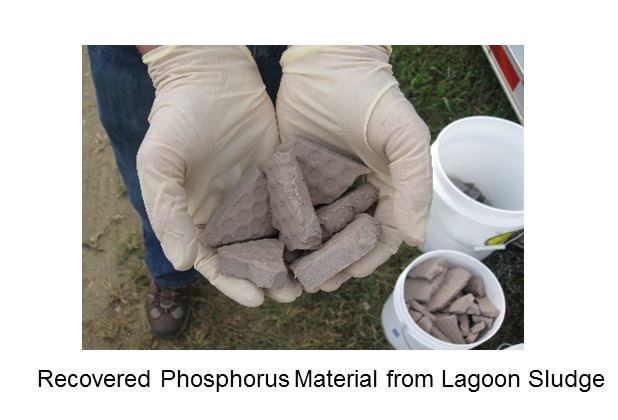
Picture of recovered phophorus material from lagoon sludge

While most of the nitrogen and carbon was left in the washed sludge solids, the QW process extracted and recovered as much as 90 % of the P from sludge. From results of a pilot field test, the P grade of the recovered phosphate was in the range of 24.0% – 30.5 % P2O5. The inclusion of this process in a lagoon sludge management plan offers producers an opportunity to locally land-apply the low-P sludge as a carbon-rich soil amendment and recover P as a valuable product for export from the farm.

Future Plans

USDA granted an exclusive license of the invention to Renewable Nutrients, LLC (Pinehurst, NC) to commercialize in the U.S the process for P recovery from animal and municipal waste streams. Renewable Nutrients is developping commercialization plans for the Quick Wash process that will include the operating and equipment costs of phosphorus recovery from dredged lagoon sludge.

Corresponding author, title, and affiliation

Ariel A. Szogi, Research Leader, USDA-ARS Coastal Plains Soil, Water, and Plant Research Center, Florence, SC.

Corresponding author email

ariel.szogi@ars.usda.gov

Other authors

Matias B. Vanotti; and Paul D. Shumaker – USDA-ARS Coastal Plains Soil, Water, and Plant Research Center, Florence, SC.

Additional information

https://www.renewablenutrients.com/

Acknowledgements

This work is part of USDA-ARS National Program 212; ARS Project 6082-12630-001-00D “Improvement of Soil Management Practices and Manure Treatment/Handling Systems of the Southern Coastal Plain.”

Assessment of Coordinated Anaerobic Digestion of Dairy Manure


Proceedings Home | W2W Home w2w17 logo

Purpose            

Improving the economic feasibility of anaerobic digestion projects for processing dairy manure.

What did we do? 

We completed a study that evaluated the economics of dairy manure granulation as means to export phosphorus from P-sensitive watersheds. To achieve this goal we developed a techno-economic optimization model that considers all dairy farms within the watershed simultaneously to determine the minimum break-even price for the granulated manure.

A second study was developed to assess the economics of anaerobic digestion using a techno-economic optimization model. We incorporated different revenue sources (power sale, methane destruction credits, renewable energy certificates (RECs) and tipping fee (if co-substrate is available). The model evaluated the project feasibility over ranges of values for technical and economic parameters to quantify the project resilience to uncertainty in process conditions.

What have we learned? 

The results from the first study indicated that multi-farm participation can significantly improve feasibility and overall economics of manure granulation. Herd sizes were found to be a critical parameter in deciding whether a farm can economically participate in coordinated management. For manure granulation projects, liquid-solid separation followed by transportation of separated solids was always more economical than transporting raw manure from satellite farm to central processing facility. In the second study, electricity sale price was found to be the key parameter that determines the feasibility of anaerobic digesters. The hub-spoke configuration, where a large central farm hosts the digester and smaller surrounding farms contribute to it was found to be the most favorable arrangement. The size of the hub farm was critical to the feasibility of the project. Similarly, transportation distance was a critical factor that constrained the extent of cooperative digesters.

Future Plans    

The information generated from these studies is being written into peer-review publications and factsheets to share insights of collaborative manure management with a wider audience.We are currently expanding the model by adding the option for manure transportation via pipelines. Furthermore, we are also incorporating additional biogas utilization technologies,i.e., natural gas sale over pipelines and also the utilization of power/heat on-site in manure upgrading and processing.

Corresponding author, title, and affiliation        

Troy M. Runge, Associate Professor, University of Wisconsin-Madison

Corresponding author email    

trunge@wisc.edu

Other authors   

Mahmoud A. Sharara, Rebecca Larson

Additional information

1. http://www.are.wisc.edu/

2. Sharara, Mahmoud, Apoorva Sampat, Laura W. Good, Amanda S. Smith, Pamela Porter, Victor M. Zavala, Rebecca Larson, and Troy Runge. “Spatially explicit methodology for coordinated manure management in shared watersheds.” Journal of Environmental Management 192 (2017): 48-56.

3. Sharara, Mahmoud, Qiang Yang, Thomas L. Cox, and Troy Runge. “Techno-economic assessment of dairy manure granulation.” In 2016 ASABE Annual International Meeting, p. 1. American Society of Agricultural and Biological Engineers, 2016.

Acknowledgements       

This work is based on research supported by the USDA National Institute of Food and Agriculture for its financial support (USDANIFABRDI Grant No. 2012-10006-19423) and funding from Dane County, Wisconsin under Award Number 12486.

Gas-Permeable Membrane Selection Methodology for Wastewater Treatment and Resource Recovery


Proceedings Home W2W Home w2w17 logo

Purpose 

The use of gas-permeable membranes in wastewater treatment and resource recovery has become an increasingly prevalent research topic. Many of the membranes used for such purposes are expanded PTFE (ePTFE or Teflon), but the specifications, characteristics, and performance under certain conditions of these materials vary widely. In spite of these property differences, we found no documented process or suggested membrane specifications by which one membrane product can be selected over another for a given removal or recovery goal in wastewater. Research we reviewed in this area mostly describe examples of different applications.

Collection of ammonia from waste streams, especially with high concentrations such as animal manures, offers several benefits such as reduction of air pollution precursors, prevention of water pollution, and transformation into higher-value products.

What did we do? 

Tests were selected to evaluate the performance and durability of four different hydrophobic, gas-permeable membranes specific to the application under consideration—ammonia recovery from wastewater—but can be used with slight modification for testing recovery of other compounds of interest.

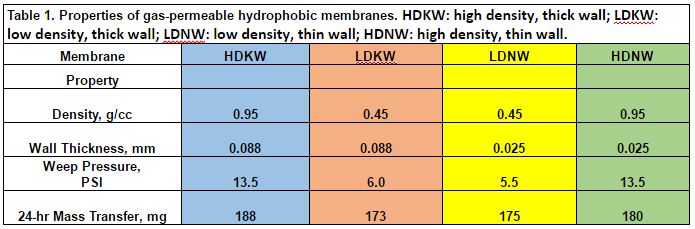
The four Teflon membranes selected differed in material density and wall thicknesses, specifications important for variability in handling, durability, and mass transfer (HDKW: high density, thick wall; LDKW: low density, thick wall; LDNW: low density, thin wall; HDNW: high density, thin wall). Membrane specifications and properties are provided in Table 1. The different membranes were examined in this study spanned across several trials. Experimentation reared data on different membranes’ weep pressure, as well as the airflow rate through the membranes as a function of applied pressure to the membrane. Data were also collected on the rate of transfer of ammonia from the gas phase across the membrane into the aqueous phase over a 24-hour period.

Table 1. Properties of gas-permeable hydrophobic membranes.

I. Weep Pressure Test

The weep pressure is that pressure at which the membrane loses its hydrophobicity and allows liquid to pass. Results are used to estimate the maximum differential pressure the membrane can withstand without compromising membrane integrity. This test of each membrane material was completed in triplicate using prepared sections of each of the four membrane materials. Membranes were first soaked in 0.1 mM sulfuric acid for 24 hours. A section of each membrane material was connected at the end of a column of vinyl tubing and filled with the 0.1 mM H2SO4 solution at a pressure of 0.5 PSI. Pressure was increased by 0.5 psi increments every 24 hours by applying air pressure through a manifold. Pressure was increased until a drop of liquid was found weeping from one or more of the membranes.

II. Air Flow Test

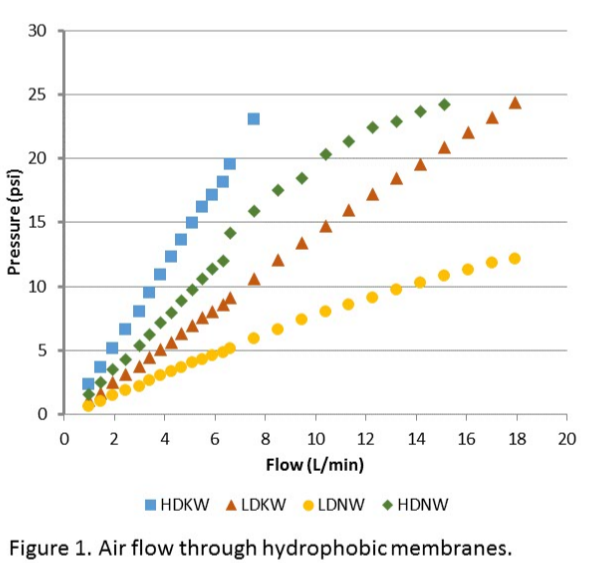
We determined the resistance to airflow through each membrane as an indication of the relative resistance of the various membranes to mass transfer of gas molecules of interest. A section of each of the four materials were connected to a compressed air source through a flow meter and pressure gauge. The pressure was recorded as the airflow rate was increased incrementally to 25 PSI, well past the maximum weeping pressure, or until the flow rate seemed to taper off. The procedure was repeated three times using the same section of each membrane material. The results are shown in Figure 1.

Figure 1. Air flow through hydrophobic membranes

III. Mass Transfer Test (Gas to Liquid Exchange)

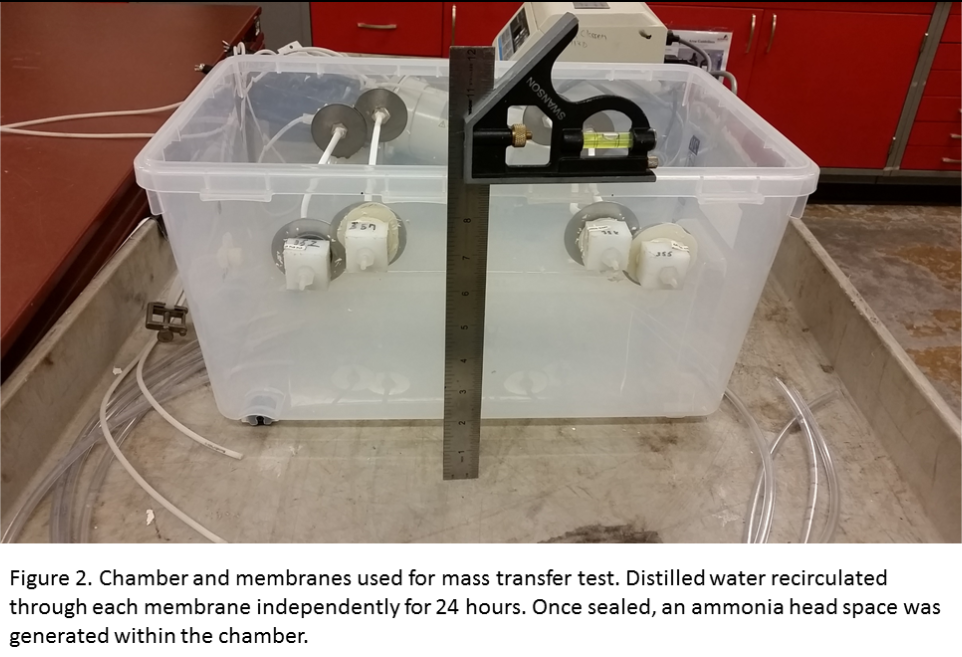
A final test was conducted to estimate if the differences in membrane composition and performance of earlier tests impact the mass transfer of the gas of interest across the membrane. A single section of each of the four membrane materials was installed through bulkhead fittings as shown in Figure 2 into a chamber such that deionized (DI) water could be circulated through each individual membrane while all four membranes were exposed to the same NH3 concentration inside the chamber. NH4Cl was combined with NaOH inside the chamber to produce NH3 gas.

Figure 2. Chamber and membranes used for mass transfer test

What have we learned? 

The results of the mass transfer experiments revealed there are only small differences in ammonia transfer rates among the different membranes, leaving the membrane selection to rely on other results. The weep pressure of the low density membranes was lower than that of the high density membranes but was sufficient to avoid backwards movement of the two fluid phases. The higher airflow rate and lower pressure of the low density thin walled material was the determining factor in selecting this membrane. From these tests, this membrane will survive handling and installation and will provide little resistance to ammonia transfer from wastewater.

Future Plans   

The experiments and conclusions involved in this study are some of the first of their kind for this application, therefore leaving much research to still be done surrounding membrane selection for other material recovery processes. Data gathered in this particular study can serve as a guideline for further research pertaining to optimal membrane characteristics for the recovery of target products from effluent.

Corresponding author, title, and affiliation        

Jacqueline Welles, Undergraduate Research Assistant, Biological and Agricultural Engineering, North Carolina State University

Corresponding author email    

jswelles@ncsu.edu

Other authors   

Elizabeth Gordon, Undergraduate Research Assistant, Biological and Agricultural Engineering, North Carolina State University John J. Classen, Ph.D., Associate Professor, Biological and Agricultural Engineering, North Carolina State University Mark Rice, E

Additional information              

Primary author: Jacqueline Welles – North Carolina State University

Email: jswelles@ncsu.edu

Lead investigator: John Classen, PhD, North Carolina State University

Email: john_classen@ncsu.edu

Acknowledgements       

Funding for this project was provided by NRCS CIG Award Number 69-3A75-12-183. The authors are grateful for the analytical work of the BAE Environmental Analysis Laboratory, Dr. Cong Tu, manager.

Manure Treatment and Natural Inactivation of Porcine Epidemic Diarrhea Virus in Soils

Proceedings Home W2W Home w2w17 logo

Purpose

The porcine epidemic diarrhea virus (PEDv) outbreak in North America has substantially impacted swine production, causing nearly 100% mortality in infected newborn piglets. Because manure may remain a source of reinfection, proper manure management practices to limit outbreaks need to be developed and evaluated. Two laboratory studies simulating manure pit treatment with increasing amounts of quicklime were conducted to determine PEDv susceptibility to increasing pH. Additionally, two laboratory soil incubation studies contrasting manure liming, multiple soil types, and two antecedent soil moistures were conducted over several months with incubation conditions mimicking the climates in Minnesota, Missouri, and Oklahoma to determine whether current manure application practices reduce the potential for PEDv reinfection via manure-amended soil. Quantitative PCR and live swine bioassays were used to enumerate PED virus and to determine whether manure and soil samples contained infectious PEDv.

What did we do?

Quicklime-Manure Slurry Incubations: An initial short-term manure slurry study was conducted on fresh PEDv-positive manure slurry collected in 2015 from the shallow pit of a commercial swine facility in southeast Nebraska. Manure was sampled prior to treatment (0 h) and then distributed among glass beakers (250 mL) to accommodate triplicates of three treatments: liming to pH 10, liming to pH 12, and unlimed manure. Following pH adjustment, aliquots of each sample were collected at 1 and 10 h, immediately neutralized with 10 mM HCl and stored at -80°C for subsequent analysis. In a second manure slurry incubation, triplicate PEDv-positive manure samples collected from a commercial swine operation in south central Nebraska site in December 2016 were mixed in equal portion (w:v) with distilled water to mimic manure slurry consistency observed in swine production pit storages. Quicklime was added stepwise (0.25 g addition) to each manure slurr! y sample with continuous stirring to gradually increase manure slurry pH. After each addition of quicklime, pH was measured and an aliquot of manure slurry was collected for subsequent quantitative PCR PEDv enumeration and infectivity in a pig bioassay.

Long-term manure and soil incubation. Initial tests determined appropriate initial soil moisture contents (representing a ‘dry’ and ‘moist’ soil condition) and manure:soil ratios (1 g slurry:3 g soil) to best represent the manure:soil within an injection furrow when slurry is injected into soil, and appropriate liming source (ag lime vs. quicklime). PEDv-positive manure slurry collected from a commercial swine operation in southeast Nebraska was divided between two 3-L containers, one for limed treatment (LIME) and the other for the control, or no-lime, treatment (CNL). Quicklime (30 g) was added to one 3 L portion (equivalent to an application of 80 lbs. quicklime per 1000 gallons of slurry) to achieve a final pH of 12. Both treated and untreated slurry stocks were incubated at room temperature for 24 hours. Distilled water was added to two soils, a silty clay loam (pH 7.0) and a loamy fine sand (pH 6.9), to attain 10% and 30% water holding capacity! (dry and moist soil condition). Thirty grams (dry weight) of soil was apportioned to multiple 50 mL screw top conical tubes and a cavity was made in the center of the soil by pressing a 10 mL pipet tip into the soil. Ten mL of slurry (LIME or CNL) were then added to each soil tube via pipet. Four replicate tubes were immediately frozen at -80°C for each combination of soil, moisture, and manure treatment to represent initial soil application (day 0). The tubes were loosely capped and placed into one of three incubators operated independently throughout the trial to simulate soil temperatures between November 1 and May 1 at one of three geographic locations: southern Minnesota, northern Missouri, and central Oklahoma (Figure 1). Twenty replicate tubes were created for each combination of soil, moisture, incubation, and manure treatment, and a set of four tubes were collected for each treatment combination on days 30, 60, 90, 120 and 150 of the incubation and immediately transfer! red to a -80°C freezer for storage.

Molecular detection and quantification of PEDv. Prior to analysis, soil and manure samples were removed from -80°C storage and allowed to thaw at room temperature. The RNA in each sample was extracted using the RNA PowerSoil Total RNA Isolation kit (Mo Bio, Carlsbad, CA). PEDv was detected in samples by reverse transcription and quantitative polymerase chain reaction (RT-qPCR).

Swine bioassay. To confirm that conditions yielding a PCR negative result actually inactivated the PED virus and rendered the manure non-infectious, a live pig bioassay was conducted with the limed and non-limed manure slurry samples from the initial short-term manure slurry incubation (quicklime addition). Fifteen pigs, approximately 21 days old, were sourced from a high-health facility whose dams tested negative for PEDv antibodies and virus by PCR. Piglets were tested for PEDv upon arrival and confirmed negative. Piglets were randomly assigned to individual housing in BSL-2 rooms at the University of Nebraska-Lincoln Life Sciences Annex as follows: control (3 piglets), pH 10 (6 piglets), and pH 12 (6 piglets), and allowed to acclimate for three days. Each pig was then administered a 10-mL oral gavage of manure slurry: three piglets in the control room received one of the three un-limed slurry samples; six piglets in the pH 10 room received one of the six limed (pH 10) sl! urry samp les (three limed for 1 h and three limed for 10 h); and six pigs in the pH 12 room received one of the six limed (pH 12) slurry samples (three limed for 1 h and three limed for 10 h). Piglets were monitored for fecal shedding of PEDv for four days until control animals began to demonstrate clinical signs of PEDv infection, at which time all piglets were humanely euthanized. Fecal swabs, and duodenum, ileum, jejunum, and cecum samples were collected from each animal and fixed in formalin. All fecal and tissue samples were analyzed for the presence of detectable PED virus by immunohistochemistry and PCR.

PEDv, log # g soil

What have we learned?

Manure Slurry Incubation: Manure limed to pH 10 and pH 12 for 1 and 10 h yielded no detectable PEDv RNA. Live swine bioassay results confirmed that these samples were not infective while control samples resulted in PEDv infection of piglets. These results indicate that a final manure slurry pH of 10 (equivalent to 50 lbs. of quicklime added to 1000 gallons manure slurry) is sufficient to reduce PEDv RNA to an undetectable concentration after 1 hour of contact time. All pigs receiving limed manure (pH 10 or 12 maintained for 1 or 10 h) during the live swine bioassay tested negative for PEDv infection while control pigs (un-limed treatment) all tested positive for PEDv infection (Figure 1). The pig bioassay results confirmed that the PCR assay is a reliable predictor for the presence of infectious PEDv in these matrices and that lime addition to achieve pH 10 for just one hour is sufficient to deactivate the virus in stored manure.

Soil Incubations: At the completion of the long-term (150-day) soil incubation, a subset of the frozen samples (LIME and CON soil samples collected on day 0 and 30) was selected for RNA extraction and qPCR analysis. The qPCR results from days 0 and 30 yielded no detectable PEDv RNA in either the limed or un-limed manure-amended soils (Figure 1). Furthermore, manure-amended soils did not differ from soil-only controls even though PEDv RNA was still detectable in the original manure slurry at high concentrations. No differences in PEDv abundance were detected on either day when initial soil moisture (10% vs 30% water holding capacity), incubation condition (MN vs. MO vs. OK), or soil type (silty clay loam and loamy fine sand) were varied. For these soils, the concentration of PEDv in limed or un-limed manure decreased immediately to a non-detectable level. These results indicate that manure-amended soil with pH 6.9 or greater is not a vector for transmission of the PED virus.

A consistent finding from all of the studies is that pH of media (slurry or soil) strongly influences PED virus survival.

Future Plans

Additional studies are underway to identify the lowest pH at which the PED virus is rendered non-infectious in slurry manure.

Corresponding author, title, and affiliation

Amy Millmier Schmidt, Assistant Professor, Departments of Biological Systems Engineering and Animal Science, University of Nebraska – Lincoln

Corresponding author email

aschmidt@unl.edu

Other authors

Stevens, E., A. Schmidt, D. Miller, J.D. Loy and V. Jin

Additional information

Dr. Amy Millmier Schmidt, corresponding author, can also be reach at (402) 472-0877.

Acknowledgements

Funding for this research was provided by the National Pork Board. Gratitude is extended to Ashley Schmit for assistance with laboratory activities and animal care. Special thanks to the Nebraska pork producers who granted access to their farms for collection of PEDv-positive manure.

Monetizing Environmental Benefits Associated with Dairy Manure Management Systems that Include Anaerobic Digestion – Challenges, Opportunities, and Values


Proceedings Home W2W Home w2w17 logo

Purpose 

A large agricultural lender reported in August 2016 that the current 20-month milk price low is not part of the typical three-year milk price cycle (which is marked by a year where the milk price is below the cost of production, followed by a year of recovering prices, and ending with a year where prices are well above the cost of production) that has been taking place since the late 1990’s, but rather is a correction of the dairy industry. That same report stated, that at the conclusion of the correction, milk prices will be more in-line with those of the early 2000’s, when the cost of production, on average, was close to the milk price, albeit with some variation. Overall, it is predicted to be a deviation from the recent three-year cycle pattern. To survive, dairy farms of the future will be compelled to even more carefully evaluate capital investments, including advanced manure treatment technologies, to assess their returns, both tangible and non-tangible, as they address regulatory and society-based environmental concerns.

Estimating the value of greenhouse gas reductions will be important to farms anticipating efforts to regulate carbon emissions in the future or to take advantage of carbon credits. Recognizing the value of water quality can also inform manure management system decisions. An economic value may help when comparing alternatives that have off-setting impacts across air and water environments.

What did we do? 

This effort attempted to look at the economic values of the environmental benefits that a manure management system can provide, focusing specifically on greenhouse gas (GHG) reductions (both direct and indirect), air quality improvements, and water quality improvements. The resulting values can then be used as additional inputs in manure management system decisions on the farm. The U.S. EPA has put an economic value on the “Social Cost of Carbon”, which was incorporated into the process of putting a value on a manure treatment system. Careful nutrient recycling impacts GHG emissions and also yields societal benefits from water quality improvements downstream. Reductions of both phosphorous and nitrogen concentrations in water bodies can be valued for the impact on drinking water treatment, habitat changes, and recreational use.

What have we learned?            

Through a rigorous process, we have been able to show the positive impact that anaerobic digestion systems (ADS) in New York State (NYS) can have on GHG reductions; the relevant work is presented in the accompanying paper. We learned that a focused outreach effort is needed to show multiple target audiences the possible GHG reduction values for NYS farms and to explain policy ideas that would help achieve reductions on-farm, therefore contributing to the State’s ambitious renewable energy and GHG reduction goals.

Future Plans  

Future plans in this area include continued work in quantifying the environmental benefits of anaerobic digestion (AD) and in collaborating with our industry and State partners to find ways to monetize those benefits. Immediate plans include 1) a day-long program to expose and educate key NYS legislators and government officials on the benefits of farm-based ADS and the need to find ways to pay for these benefits, and 2) collecting data from additional farm-based ADS for use in further validating or changing the assumptions needed to develop reduction values.

Corresponding author, title, and affiliation      

Curt Gooch, Dairy Environmental Systems and Sustainability Engineer, Cornell University

Corresponding author email 

cag26@cornell.edu

Other authors   

Peter Wright, Cornell University

Additional information               

http://www.manuremanagement.cornell.edu/