Impacts of the Michigan Agriculture Environmental Assurance Program

Waste to Worth: Spreading science and solutions logoWaste to Worth home | More proceedings….

Abstract

The Michigan Agriculture Environmental Assurance Program (MAEAP) is a holistic approach to environmental protection. It helps farmers evaluate their entire operation, regardless of size or commodity, and make sustainable management decisions balancing society’s needs, the environment, and economics. MAEAP is a partnership effort that aims to protect natural resources and build positive communities by working with farmers on environmentally responsible agricultural production practices.

To become MAEAP verified, farmers must complete three comprehensive steps: educational seminars, an on-farm risk assessment, and development and implementation of an action plan addressing potential environmental risks. The Michigan Department of Agriculture and Rural Development (MDARD) conducts an on-farm inspection to verify program requirements related to applicable state and federal environmental regulations, including the Generally Accepted Agricultural and Management Practices (GAAMPs). MAEAP benefits Michigan by helping to protect the Great Lakes by using proven scientific standards to improve air, water, and soil quality. Annual phosphorus reduction through MAEAP is over 340,451 pounds per year which is enough to grow almost 85,104 tons of algae in lakes and streams.  Farming is an environmentally intense practice and the MAEAP-verification process ensures farmers are making choices that balance production and environmental demands. The measures aimed at protecting air, soil, water, and other environmental factors mean that MAEAP-verified farmers are committed to utilizing farming practices that protect Michigan’s natural resources.

Purpose

The Michigan Agriculture Environmental Assurance Program (MAEAP) is an innovative, proactive program that assists farms of all sizes and all commodities voluntarily prevent or minimize agricultural pollution risks. MAEAP is a collaborative effort of farmers, Michigan Department of Agriculture and Rural Development, Michigan Farm Bureau, commodity organizations, universities, conservation districts, conservation groups and state and federal agencies. MAEAP teaches farmers how to identify and prevent environmental risks and work to comply with state and federal environmental regulations. Farmers who successfully complete the three phases of a MAEAP system (Farmstead, Cropping or Livestock) are rewarded by becoming verified in that system.

What Did We Do?

To become MAEAP-verified, farmers must complete three comprehensive steps: educational seminars, a thorough on-farm risk assessment, and development and implementation of an action plan addressing potential environmental risks. The Michigan Department of Agriculture and Rural Development (MDARD) conducts an on-farm inspection to verify program requirements related to applicable state and federal environmental regulations, including the Generally Accepted Agricultural Management Practices. To retain MAEAP verification, a farm must repeat all three steps including MDARD inspection every three years.

Local MAEAP farm verified in the Cropping System

What Have We Learned?

The MAEAP program is positively influencing Michigan producers and the agriculture industry. Annually, an average of 5,000 Michigan farmers attend an educational session geared toward environmental stewardship and MAEAP verification. To date, over 10,000 farms are participating with over 1,500 MAEAP verifications. On a yearly basis, over $1.2 million is spent for practice implementation by producers working towards MAEAP verification. In 2012; the sediment reduced on MAEAP-verified farms could have filled 28,642 dump trucks (10 yards each), the phosphorus reduced on MAEAP farms could have grown 138,056 tons of algae in surface waters, and the nitrogen reduced on MAEAP farms could have grown 45,515 tons of algae in surface waters.
An example of the partnership between MAEAP and Michigan Farm Bureau

Future Plans

Michigan Governor Rick Snyder has taken a vested interest in the value of the MAEAP program. In March of 2011, Governor Snyder signed Public Acts 1 and 2 which codify MAEAP into law. This provides incentives and structure for the MAEAP program. It is a goal of Governor Snyder’s to have 5,000 farms MAEAP-verified by 2015. Most importantly, through forward thinking MAEAP strives to connect farms and communities, ensure emergency preparedness and protect natural resources.

Authors

Jan Wilford, Program Manager, Michigan Department of Agriculture & Rural Development – Environmental Stewardship Division,    wilfordj9@michigan.gov

Shelby Bollwahn, MAEAP Technician – Hillsdale Conservation District

shelby.bollwahn@mi.nacdnet.net

Additional Information

www.maeap.org – MAEAP Website

http://michigan.gov/mdard/0,4610,7-125-1567_1599_25432—,00.html – MDARD MAEAP Website

http://www.facebook.com/mimaeap – MAEAP Facebook Page

Acknowledgements

MDARD MAEAP Program Office Communications Department

Michigan Farm Bureau

Michigan Association of Conservation Districts

Hillsdale County Farm Bureau

Hillsdale Conservation District

Handout version of the poster (8.5 x 11; pdf format)

The authors are solely responsible for the content of these proceedings. The technical information does not necessarily reflect the official position of the sponsoring agencies or institutions represented by planning committee members, and inclusion and distribution herein does not constitute an endorsement of views expressed by the same. Printed materials included herein are not refereed publications. Citations should appear as follows. EXAMPLE: Authors. 2013. Title of presentation. Waste to Worth: Spreading Science and Solutions. Denver, CO. April 1-5, 2013. URL of this page. Accessed on: today’s date.

Livestock GRACEnet

Waste to Worth: Spreading science and solutions logoWaste to Worth home | More proceedings….

Abstract

Livestock GRACEnet is a United States Department of Agriculture, Agricultural Research Service working group focused on atmospheric emissions from livestock production in the USA. The working group presently has 24 scientists from 13 locations covering the major animal production systems in the USA (dairy, beef, swine, and poultry). The mission of Livestock GRACEnet is to lead the development of management practices that reduce greenhouse gas, ammonia, and other emissions and provide a sound scientific basis for accurate measurement and modeling of emissions from livestock agriculture. The working group fosters collaboration among fellow scientists and stakeholders to identify and develop appropriate management practices; supports the needs of policy makers and regulators for consistent, accurate data and information; fosters scientific transparency and rigor and transfers new knowledge efficiently to stakeholders and the scientific community.  Success in the group’s mission will help ensure the economic viability of the livestock industry, improve vitality and quality of life in rural areas, and provide beneficial environmental services. Some of the research highlights of the group are provided as examples of current work within Livestock GRACEnet. These include efforts aimed at improving emissions inventories, developing mitigation strategies, improving process-based models for estimating emissions, and producing fact sheets to inform producers about successful management practices that can be put to use now.

Why Was GRACEnet Created?

The mission of Livestock GRACEnet is to lead the development of livestock management practices to reduce greenhouse gas, ammonia, and other emissions and to provide a sound scientific basis for accurate measurement and modeling of emissions.

What Did We Do?

The Livestock GRACEnet group is comprised of 24 scientists from 13 USDA-ARS locations researching the effects of livestock production on emissions and air quality.

Our goals are to:

  • Collaborate with fellow scientists and stakeholders to identify and develop appropriate management practices
  • Support the needs of policy makers and regulators for consistent, accurate data and information
  • Foster scientific transparency and rigor
  • Transfer new knowledge efficiently to stakeholders and the scientific community

Success in our mission will help to ensure the economic viability of the livestock industry, vitality and quality of life in rural areas, and provide environmental services benefits.

Authors

April Leytem, Research Soil Scientist, USDA-ARS april.leytem@ars.usda.gov

Additional Information

https://www.ars.usda.gov/anrds/gracenet/livestock-gracenet/


The authors are solely responsible for the content of these proceedings. The technical information does not necessarily reflect the official position of the sponsoring agencies or institutions represented by planning committee members, and inclusion and distribution herein does not constitute an endorsement of views expressed by the same. Printed materials included herein are not refereed publications. Citations should appear as follows. EXAMPLE: Authors. 2013. Title of presentation. Waste to Worth: Spreading Science and Solutions. Denver, CO. April 1-5, 2013. URL of this page. Accessed on: today’s date.

Mortality Composting in the Semi-Arid West

Waste to Worth: Spreading science and solutions logoWaste to Worth home | More proceedings….

Why Is Proper Mortality Management Important?

Proper management of animal mortalities has important implications for nutrient management, water quality, animal health, and farm/ranch family and public health.  To best ensure human health and safety, reduce regulatory risks, and protect environmental resources, livestock producers should become familiar with best management practices (BMPs) for dealing with dead animals. Producers should also be aware of state laws related to proper disposal or processing of mortalities. 

Mortality composting is an increasingly popular and viable alternative when compared to other disposal practices because of cost savings, bio-security benefits, and reduced environmental risks.  Static mortality composting differs from traditional composting in both management intervals and carbon to nitrogen ratios.   The objective of this workshop is to provide those who advise livestock producers with the knowledge, tools, and resources to develop a mortality management plan, with specific focus on the static composting option.   

The Rocky Mountain based authors conducted demonstrated research, reviewed pertinent literature, studied USDA-NRCS standards, and documented mortality composting systems already in-use by regional producers. 

Recording of the author’s presenting the workshop
Options for managing dead animals
Principles of mortality composting
Managing animal mortality compost piles
Economics of mortality composting

Curriculum Materials

Data from these activities provided a basis for the following tools:

  1. Decision aid spreadsheet that evaluates the costs of mortality composting against other mortality disposal options (in English and Spanish),
  2. How-to-manual on mortality composting in English and Spanish),
  3. Video illustrating on-the-ground mortality composting
  4. PowerPoint presentation explaining mortality composting principles, methods and resources (in English and Spanish).

Learning Objectives

This 90 minute in-service workshop will provide background and step-by-step considerations for mortality composting, with an emphasis on the practice in the semi-arid environments of the western United States.  However, fundamentals of the workshop will apply to all climates.   To the right, you will find recordings of the authors presenting the workshop using the slides from the curriculum materials.

Presenters

Thomas Bass, Livestock Environment Associate Specialist, Montana State University tmbass@montana.edu. Mr. Bass has been an Extension Specialist in the area of livestock and environmental management for 12 years.  He has been involved in composting research and demonstrations for much of his career. 

Jessica Davis, PhD, Colorado State University.  Dr. Davis is an Extension Specialist and the director of the Institute for Livestock and the Environment, a diverse group of CSU faculty working together to solve problems at the interface of livestock production and environmental management. She is the principal investigator and originator of this SARE project.    

John Deering, MS, Colorado State University.  Mr. Deering, is a regional Extension Specialist in Eastern Colorado.  He is an economist by training with an emphasis on agriculture and business management.  He developed the economic tools and narratives associated with the products of this project.

Michael Fisher, MS, Colorado State Univeristy.  Mr. Fisher is an area Extension Agent, with an emphasis in livestock production, meat science, range management, and overall ranch management.  He is an important conduit between producers, other government agencies, and industry groups in north eastern Colorado.      

Additional Information

This project was funded by the Western Region Sustainable Agriculture Research and Education (SARE) program.

Archive webcast: https://connect.extension.iastate.edu/p93vve55l1f/?launcher=false&fcsContent=true&pbMode=normal

Curriculum Materials

Companion Video: https://www.youtube.com/watch?list=PL62C6899F81B769B7&v=1DwUrOxpTxw&feature=player_detailpage

Manual (eng): http://livestockandenvironment.org/wp-content/uploads/2012/02/CompostingManual-final-webview.pdf

Manual (span): http://livestockandenvironment.org/wp-content/uploads/2011/03/CompostingManual_spanish_web-2.pdf

Ppt: https://extension.colostate.edu/docs/pubs/ag/mortality.pdf

Ppt (span): http://livestockandenvironment.org/wp-content/uploads/2011/03/Mortality-Spanish.pptx

Partial Budget: http://livestockandenvironment.org/wp-content/uploads/2011/03/Partial-Budget-Form-English.xls

Partial Budget (span): http://livestockandenvironment.org/wp-content/uploads/2011/03/Partial-Budget-Form-Spanish.xls

The authors are solely responsible for the content of these proceedings. The technical information does not necessarily reflect the official position of the sponsoring agencies or institutions represented by planning committee members, and inclusion and distribution herein does not constitute an endorsement of views expressed by the same. Printed materials included herein are not refereed publications. Citations should appear as follows. EXAMPLE: Authors. 2013. Title of presentation. Waste to Worth: Spreading Science and Solutions. Denver, CO. April 1-5, 2013. URL of this page. Accessed on: today’s date.

Extension Outreach Response to Livestock Mortality Events Associated With Algal Toxin Production in Georgia Farm Ponds

Waste to Worth: Spreading science and solutions logoWaste to Worth home | More proceedings….

Purpose

Excessive nutrient enrichment in watersheds can create harmful algal blooms (HABs) in aquatic systems, including ponds, which are frequently used to water livestock. Harmful algal blooms are typically dominated by cyanobacteria (commonly referred to as “blue green algae”) many of which produce toxins that can be harmful to fish, wildlife and humans.  In May 2012, our laboratory began receiving reports of cattle mortalities associated with HABs. We began an outreach effort to screen and identify algal species and toxins in water samples submitted by private citizens from ponds throughtout Georgia. Prior to this effort, no state or federal laboratories offered such a service. Private laboratories conduct these services, however the collection protocols and analytical costs preclude the average citizen from utilizing them. Rapid detetion of a HAB is critical for farmers so that access to the water source can be restricted. We recognized the need to provide such a service and to educate the public regarding exposure effects, preventative measures, and treatment of HABs.

During Summer 2012 sampling events we commonly encountered Microcystis blooms in both farm ponds used by humans for fishing and recreation (above) and for watering livestock (below).

What Did We Do?

We documented dense blooms of  planktonic cyanobacteria, predominantly Microcystis aeruginosa, and  extremely high levels of the potent hepatotoxin, Microcystin, in water samples submitted by Georgia cattle producers (Haynie et al. 2013). Many of these samples were submitted by producers who had experienced cattle mortalities, potentially due to algal toxin exposure.

Through a collaborative effort with UGA’s Agriculture and Environmental Services Laboratories, we established a water screening service that includes algal speciation and toxin detection. This service became available to the public in Februrary 2013. This effort included a detailed outreach letter to extension agents, sampling protocol and materials for water sample collection and shipping. This screening service is avalible for either a $30.00 (algal identification) or $45.00 (toxin analysis and algal identification) fee. The submitter will receive an electronic report within 24 hours with results, interpretation, and recommendations.

We have begun promoting this service and educating the public about HABs by participating in various short courses, meetings and outreach opportunities.

What Have We Learned?

We have demonstrated that HABs and cyanotoxins are common in Georgia agriculture ponds. Therefore, the potential for livestock exposure and subsequent effects including mortality are likely to occur. Education and establishment of a rapid toxin detection service is warranted and will be beneficial to producers. The livestock deaths have highlighted an important issue for Georgia farmers and pond owners that will likely be increasingly prevalent under projected climatic models.

Future Plans

We will continue our outreach efforts by participating in University and industry sponsored workshops and meetings. We will use these opportunities to educate and inform the public about the newly available algal screening service. We have included, in recently submitted grants, funding to subsidize testing expenses in order to encourage more farmers/pond owners to use this service. We intend to utilize the testing service to gather spatially referenced data on the prevalence of HABs and toxin levels in GA ponds. This information, which is not currently available,  will inform nutrient management plans and BMPs that will ultimately improve nutrient management and water resources in Georgia.  We hope that this effort will serve as a model for other states experiencing similar increases in frequency and severity of HABs in agricultural settings.

Authors

Rebecca S. Haynie, Post Doctoral Associate, Warnell School of Forestry and Natural Resources, University of Georgia, Athens, GA 30602 hayniers@uga.edu

Susan Wilde, Assistant Professor, Warnell School of Forestry and Natural Resources, University of Georgia, Athens, Georgia 30602

David Kissel, Director and Professor, Agriculture and Environmental Services Laboratory, University of Georgia, 2400 College Station Road, Athens, Georgia 30602-9105

Leticia Sonon, Program Coordinator, Soil, Plant, and Water Analysis Laboratory, University of Georgia, 2400 College Station Road, Athens, Georgia 30602-9105

Uttam Saha, Program Coordinator, Feed and Environmental Water Analysis Laboratory, University of Georgia, 2400 College Station Road, Athens, Georgia 30602-9105

Additional Information

Haynie, R. S., J. R. Morgan, B. Bartelme, B. Willis, J. H. Rodgers Jr., A.L. Jones and S. B. Wilde.  Harmful algal blooms and toxin production in Georgia ponds. (in review). Proceedings of the Georgia Water Resources Conference. Athens, Georgia. April 2013.

UGA Agriculture and Environmental Services Laboratory: http://aesl.ces.uga.edu/

Burtle, G.J. July 2012. Managing Algal Blooms and the Potential for Algal Toxins in Pond Water. University of Georgia Cooperative Extension Temporary Publication 101.

Haynie, R.S., J.R. Morgan, B. Bartelme, S. B. Wilde. Cyanotoxins: Exposure Effects and Mangagement Options. Proceedings of the UGA Extension Beef Cattle Shortcourse. Ed. L. Stewart. Athens, Georgia. January 2013.

News article: https://www.wsbtv.com/news/local/experts-say-toxic-algae-may-pose-threat-kids-pets/242741856/

Acknowledgements

Drs. Lawton Stewart, Gary Burtle (Animal and Dairy Science, College of Agriculture and Environmental Sciences, UGA)  coordinated sample delivery from pond owners to our laboratory. Brad Bartelme, James Herrin and Jamie Morgan (Warnell School of Forestry and Natural Resources, UGA) contributed significant technical assistance with algal screening and sample processing.

The authors are solely responsible for the content of these proceedings. The technical information does not necessarily reflect the official position of the sponsoring agencies or institutions represented by planning committee members, and inclusion and distribution herein does not constitute an endorsement of views expressed by the same. Printed materials included herein are not refereed publications. Citations should appear as follows. EXAMPLE: Authors. 2013. Title of presentation. Waste to Worth: Spreading Science and Solutions. Denver, CO. April 1-5, 2013. URL of this page. Accessed on: today’s date.
Waste Disposal by the Veterinary Community

Waste to Worth: Spreading science and solutions logoWaste to Worth home | More proceedings….

The American Veterinary Medical Association (AVMA) offers several resources to its members and the public regarding various disposal issues encountered by the veterinary community and animal owners.  With its veterinary medical expertise, the veterinary profession can be a valuable resource for clients, the general public, regulators, and other stakeholders on carcass and other animal waste disposal issues, especially those involving potential health risks to other animals or the public.  The purpose in developing these resources is to further increase awareness by the veterinary profession and its stakeholders of the value, potential hazards, and legal restrictions concerning disposal of animal waste and carcasses.

What Did We Do?

The AVMA has established policies related to the disposal of animal waste and carcass disposal.  Three key policies include “Appropriate Animal Carcass Disposal,” “Animal Carcass Risk in Natural Disasters,” and “Animal Agriculture Waste Management.”  All of the AVMA policies related to waste issues can be found at https://www.avma.org/PracticeManagement/Administration/Pages/AVMA-Policies-Relevant-to-Waste-Disposal.aspx.

  1. Appropriate Animal Carcass Disposal

The AVMA advocates safe and environmentally responsible disposal of animal carcasses, whether on an individual animal basis or during mass mortality events. As such, the AVMA supports increased research and education towards the development of appropriate methods and guidelines for animal carcass disposal.

  1. Animal Carcass Risk in Natural Disasters

Consistent with current scientific literature and the conclusions of the Pan American Health Organization (PAHO), the AVMA recognizes that animals that die from injuries, including massive animal deaths in cases of natural disasters, generally do not represent a health hazard for humans. The presence of dead bodies that result from a disaster, without the presence of another risk factor, is not the cause for the spread of infectious diseases. (1PAHO Manual, Ch 3, Conclusions; p. 81)

1 Management of Dead Bodies in Disaster Situations, Disaster Manuals and Guidelines Series, number 5. Pan American Health Organization, Area on Emergency Preparedness and Disaster Relief, and the World Health Organization, Department for Health Action in Crisis. Washington, DC, 2004.

  1. Animal Agriculture Waste Management

The AVMA supports the basic premises of current federal and state legislation and regulations enacted to prevent negative environmental impacts from wastes generated by terrestrial or aquatic animal productions. Veterinarians should be aware of the value, potential hazards, and legal restrictions concerning animal waste.

Therefore the AVMA supports the following:

  • Education, outreach, and extension programs to assist producers in meeting or exceeding current federal and state requirements. This includes aid in establishing and implementing nutrient management plans as well as design and construction of effective waste management facilities to prevent contamination of the environment.
  • Science based research on animal waste management systems and procedures to allow animal waste materials to be utilized as nutrient sources for sustainable agriculture systems.
  • Scientific studies of the impact of pathogens and chemicals from animal/human waste sources on the environment.

Additionally, the AVMA has developed the microsite, www.avma.org/wastedisposal.  Sections of the microsite addressing topics such as “Federal Regulations of Waste Disposal,” “State-based Waste Disposal Resources,” and “AVMA Policies Relevant to Waste Disposal,” are accessible by the general public.  Specific “Clinical Resources” pages, such as “Animal Carcass Disposal,” “Animal Waste Disposal,” “Recordkeeping,” and more are accessible only by AVMA members.  On a similar note and because of its expertise, the Association was consulted during the development of the Veterinary Compliance Assistance (VetCA) website (www.vetca.org) by the National Center for Manufacturing Sciences under the National Compliance Assistance Centers program. Funding for this latter project has been provided by the U.S. Environmental Protection Agency.

In addition to the pharmaceutical disposal information within the aforementioned resources, the AVMA has partnered with the National Sea Grant Office (NSGO), Office of Oceanic and Atmospheric Research, National Oceanic and Atmospheric Administration (NOAA), U.S. Department of Commerce to combine efforts and develop a joint outreach and educational campaign for veterinary clients regarding proper pharmaceutical disposal.  Information and products associated with the collaborative effort are available at www.avma.org/unwantedmeds.

The “Green Veterinary Practices” microsite has also been developed by the AVMA.   The web pages provide AVMA members and the public information on sustainable practices.  Not only does the site discuss what the AVMA is doing, it also provides resources for integrating eco-friendly features into veterinary practices as well as opportunities for including eco-friendly practices in facility designs.  The microsite is available at https://www.avma.org/green-veterinary-practices

In addition to policy and resource development, the AMVA is active in advocacy.  Related to waste issues, the Association has weighed in on Federal Register items such as Docket Number [EPA-HQ-OW-2011-0188], the National Pollutant Discharge Elimination System (NPDES) Concentrated Animal Feeding Operation (CAFO) Reporting Rule and Docket Number [EPA-OW-2011-0466], Draft Recreational Water Quality Criteria and Request for Scientific Views.  To see additional topics as well as the AVMA’s comments, please visit https://www.avma.org/advocacy/national-advocacy.  In 2012, the AVMA joined the Agriculture and Food Research Initiative (AFRI) Coalition urging Congress to support the $325 million for the AFRI in the President’s Fiscal year 2013 budget proposal.  To view all of the AVMA’s advocacy information, please click on “Advocacy” from the AVMA’s home page, www.avma.org.

What Have We Learned?

Integrative efforts of multiple disciplines and stakeholders are needed to better enhance the science of waste management as well as to help bridge the gaps between such science and sociopolitical opinions.

Future Plans

As stated in its policies, the AVMA will continue to advocate for safe and environmentally responsible disposal of animal carcasses as well as support:

  • Education, outreach, and extension programs to assist producers in meeting or exceeding current federal and state requirements
  • Science based research on animal waste management systems and procedures to allow animal waste materials to be utilized as nutrient sources for sustainable agriculture systems.
  • Scientific studies of the impact of pathogens and chemicals from animal/human waste sources on the environment.

Authors

Kristi Henderson, DVM, Assistant Director, Scientific Activities Division, American Veterinary Medical Association khenderson@avma.org

Additional Information

http://www.avma.org

The authors are solely responsible for the content of these proceedings. The technical information does not necessarily reflect the official position of the sponsoring agencies or institutions represented by planning committee members, and inclusion and distribution herein does not constitute an endorsement of views expressed by the same. Printed materials included herein are not refereed publications. Citations should appear as follows. EXAMPLE: Authors. 2013. Title of presentation. Waste to Worth: Spreading Science and Solutions. Denver, CO. April 1-5, 2013. URL of this page. Accessed on: today’s date.

Natural Resource Conservation Service (NRCS) Manure Related Conservation Innovation Grants (CIG)

Waste to Worth: Spreading science and solutions logoWaste to Worth home | More proceedings….

Abstract

A number of the manure related Conservation Innovation Grants (CIG) have been successful.  Several feed management related projects have been major successes under the CIG program.  Other successful projects have dealt with such technologies as anaerobic digesters; community digesters; environmental credit trading; lagoon management; manure to energy generation; alternative litter sources, storage, and handling; and pathogen, odor, and emissions mitigation, to name just a few. 

The presentation will provide specific numbers of projects and funding per year, and information about actual projects that NRCS considers to have been successful. 

What Is the Purpose of the CIG Grant Program?

Glenn Carpenter came to Natural Resources Conservation Service as a Senior Economist in December of 2001 with the Animal Husbandry and Clean Water Division.  In May, 2004 he became the agency’s National Leader for Animal Husbandry, with that Division.  In 2010 his position was moved to the Ecological Sciences Division.  Much of his work with NRCS has been related to the animal waste issue and the agency’s interaction with EPA over the CAFO Rule. 

Glenn has three degrees in Poultry Science from Michigan State University.  Prior to joining NRCS, Glenn served in Extension Poultry positions at two universities.

The 2002 Farm Bill created a mechanism under the Environmental Quality Incentives Program (EQIP) for a program of Conservation Innovation Grants (CIG).  These grants were “…intended to stimulate innovative approaches to leveraging Federal investment in environmental enhancement and protection, in conjunction with agricultural production…”  The grants were to provide a mechanism for funding projects to aid in technology development and transfer.    The granting program actually began in 2004, and has continued since that time.

What Did We Do?

By statute, the USDA Natural Resources Conservation Service cannot do research.  Because of this, and because the interest of NRCS lies in directly assisting farmers and ranchers in the adoption of technologies that will benefit conservation, projects funded under this program must be in the field demonstration or tool application stages.  Since the initial grant funding cycle in 2004, NRCS has provided funding through EQIP every year.  To date nearly 500 grants have been awarded, with total funding in excess of $180 million. 

A large share of these CIGs has been strongly animal, and/or manure related.  Almost 25 percent of the total number of grants has been animal related, and these grants have received slightly over 26 percent of the total dollars.  About 19 percent of the total grants have been manure related and these have received about 22 percent of the funding.  Those animal related grants that are not manure related largely deal with range and pasture systems.

What Have We Learned?

Several feed management related projects have been major successes under the CIG program.  Other successful projects have dealt with such technologies as anaerobic digesters; community digesters; environmental credit trading; lagoon management; manure-to-energy generation; alternative litter sources, litter storage, and handling; and pathogen, odor, and emissions mitigation from manure, to name just a few. 

The number and variety of funded projects has covered a wide range of geographic areas and technical  innovations.  A multistate feed management project resulted in training programs, a tech note for NRCS, and many fact sheets and other materials that are available on Livestock and Poultry Environmental Learning Center webpage.   Another major grant demonstrated the effectiveness of filter strips and other vegetated treatment areas on mitigating manure runoff from cattle feedlots.  Utilizing high pressure injection of manure, a Pennsylvania project demonstrated a decrease in odor and runoff while also preserving nitrogen.  Several projects have successfully demonstrated the effects of precision feeding of dairy cattle to show the change in manure nutrients.  Projects have demonstrated the effectiveness of different tillage systems and technologies on manure nutrient runoff.  Other projects have dealt with innovative waste-to-energy technologies, or waste to value-added-product creation.   These are just a few of the number and variety of projects funded  through the Conservation Innovation Grants program.

Future Plans

The success of the CIG program since 2004, both in numbers of projects and in innovative technologies and tools applied, demonstrates that the program is important to agriculture in the U.S.  NRCS has shown its support by continually funding the program, and by making additional moneys available for special targeted CIGinitiatives.

Authors

Glenn H. Carpenter, National Leader, Animal Husbandry, USDA Natural Resources Conservation Service glenn.carpenter@wdc.usda.gov

Gregorio Cruz, CIG Program Manager, NRCS, Rosslyn, VA;  William Reck, Environmental Engineer,  NRCS, Greensboro, NC;  Jeffrey Porter, Environmental Engineer, NRCS, Greensboro, NC; Cherie Lafleur, Environmental Engineer, NRCS, Ft Worth, TX; Sally Bredeweg, Environmental Engineer, NRCS, Portland, OR; Harbans Lal, Environmenal Engineer, NRCS, Portland, OR; Greg Zwicke, Environmenatl Engineer, NRCS, Ft Collins, CO

Additional Information

NRCS Conservation Innovation Grant webpage at:  http://www.nrcs.usda.gov/wps/portal/nrcs/main/national/programs/financial/cig/

Acknowledgements

United States Department of Agriculture, Natural Resources Conservation Service, Conservation Innovation Grants Program

The authors are solely responsible for the content of these proceedings. The technical information does not necessarily reflect the official position of the sponsoring agencies or institutions represented by planning committee members, and inclusion and distribution herein does not constitute an endorsement of views expressed by the same. Printed materials included herein are not refereed publications. Citations should appear as follows. EXAMPLE: Authors. 2013. Title of presentation. Waste to Worth: Spreading Science and Solutions. Denver, CO. April 1-5, 2013. URL of this page. Accessed on: today’s date.


Fate of Barbiturates and Non-steroidal Anti-inflammatory Drugs During Carcass Composting

Waste to Worth: Spreading science and solutions logoWaste to Worth home | More proceedings….

Why Are We Concerned About Drug Residues in Animal Mortality Compost?

With disease issues, the decline of the rendering industry, a ban on use of downer cows for food, and rules to halt horse slaughter, environmentally safe and sound practices for disposal of horses and other livestock mortalities are limited. Improper disposal of carcasses containing veterinary drugs has resulted in the death of domestic animals and wildlife. Composting of carcasses has been performed successfully to reduce pathogens, nutrient release, and biosecurity risks. However, there is concern that drugs used in the livestock industry, as feed additives and veterinary therapies do not degrade readily and will persist in compost or leachate, threatening environmental exposure to wildlife, domestic animals and humans.

Two classes of drugs commonly used in the livestock and horse industries include barbiturates for euthanasia and non-steroidal anti-inflammatory drugs (NSAID) for relief of pain and inflammation. Sodium pentobarbital (a barbiturate) and phenylbutazone (an NSAID) concentrations in liver, compost, effluent and leachate were analyzed in two separate horse carcass compost piles in two separate years. Horse liver samples were also buried in 3 feet of loose soil in the first year and drug concentrations were assessed over time.

What did we do?

Year 1- On 9/22/09 a 6 x 6 m piece of 10 mil plastic sheeting was laid on bare soil with a 2% slope, at the edge of Cornell University’s compost site in Ithaca, NY. Water was poured on the plastic to check the direction of flow. A hole was dug at the low end of the pad, under the plastic, large enough to fit a 76 l galvanized garbage can. A stainless steel canner was placed in the garbage can to collect effluent. A hole was cut in the plastic over the canner for collection. A 0.6 m high base (3.7 x 3.7 m) of coarse carbon material (woodchips) was laid on the plastic. A 27 year old Appaloosa mare, weighing approximately 455 kg that had been dosed with 1 gram phenylbutazone at midnight on 9/22/09 and again at 8:00 am was led onto the base and euthanized for severe lameness by a qualified veterinarian with 120 ml Fatal Plus® solution (active ingredient 390 mg/ml Pentobarbital Sodium). After the horse had been euthanized and the veterinarian ensured there were no signs of life, the carcass was maneuvered onto the wood chips with the head on the upward slope of the pad. The liver was removed from the horse and cut into 48 pieces, each weighing approximately 100 grams, and nylon mesh bags were then placed in whiffle balls. A 2 m length of nylon twine was attached to each ball. Twenty-three balls were inserted in the horse’s gut cavity and 22 balls were placed in a 1 m hole in the ground (burial hole) which was dug approximately 1.5 m from the pad. Pieces of the intestine and some blood were also placed in the hole to help mimic the presence of a carcass. The remaining 3 nylon mesh bags with liver were packaged for delivery to Cornell University’s Animal Health Diagnostic Center (AHDC) to determine initial NSAID and barbiturates concentrations. Two Hobo U12 data loggers with 4 temperature probes each were set up to record hourly temperatures. Five of the probes were placed in the compost pile: under the horse’s chest, in the horse’s hind gut, in the horse’s chest cavity, under the horse’s spine and under the horse’s right hind quarter. Two of the probes were placed in the burial hole and one probe was left out to record ambient temperature. The hole was covered with loose soil. The horse was covered with woodchips so that the pile was approximately 1.8 m high. The plastic liner was tightened by rolling it over and under wooden fence posts.

Year 2- In year 1, the collection of “leachate” included precipitation that diluted the leachate. In year 2, to target only the liquids that leached out of the horse and through the pile, two 3 m long troughs with a 1% slope were built out of 15 and 10 cm diameter PVC pipe attached to 5 x 15 cm untreated lumber. The troughs were placed on the pad from the centerline to the edge of the pile end-to-end with slopes going toward the outside of the pile. Leachate drained via gravity into 2-liter polyethylene bottles attached to the troughs. The exposed ends of the troughs were covered with 1 m length of aluminum flashing to keep rainwater out of the collection bottles.

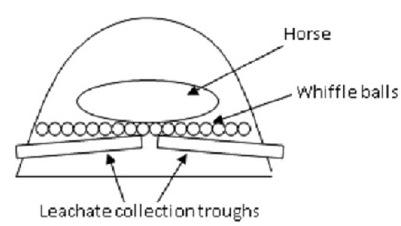
On 8/10/10 the leachate collection troughs were laid on bare soil with a 2% slope at the edge of Cornell University’s compost site in Ithaca, NY. A 0.6 m high base (3.7 x 3.7 m) of coarse carbon material (woodchips) was laid on top of the troughs. A 22 year old horse weighing approximately 590 kg, that had been dosed with 1 gram phenylbutazone at midnight on 08/10/10 and again at 7:30 am, was led onto the base and euthanized by a qualified veterinarian with 300 mg xylazine as a sedative, then with 120 ml Fatal Plus® solution (active ingredient 390 mg/ml Pentobarbital Sodium). After the horse had been euthanized and the veterinarian ensured there were no signs of life, the carcass was maneuvered on the wood chips with the head on the upward slope of the pad. The veterinarian took 4 tubes of blood from a vein in the nose and a vein in the front leg of the horse in heparinized Vacutainer® tubes for initial concentrations of pentobarbital and phenylbutazone. Twenty-six whiffle balls that had been pre-filled with wood chips (the base material of the compost pile) were placed such that they would be under the horse and liquids coming from the horse would be absorbed by the chips inside the balls, as well as in the surrounding base material, while the excess would drain down the leachate collection troughs and be captured in the 2 liter bottles at the end of the troughs (Figure 1). One Hobo U12 data logger with 4 temperature probes was set up to record hourly temperatures. The probes were placed under the horse’s neck and rump, on top of the horse’s abdomen, and one was left out to record ambient temperature. The horse was covered with woodchips so that the pile was approximately 1.8 m high. Additional woodchips were added to the pile on August 13 and the pile was covered with a breathable polyester compost cover to collect only what was leaching from the animal.

Figure 1 Cross-section of horse compost pile showing placement of leachate collection troughs and woodchip-filled whiffle balls.

On 8/10/10 a 0.6 m high base (3.5 x 3.5 m) of coarse carbon material was laid near the horse compost pile. A 455 kg 3 year, 7 month old, 2nd lactation Holstein cow was euthanized, due to a lung abscess, in the same manner as the horse (300 mg xylazine, followed by 120 ml Fatal Plus®). Four tubes of blood were withdrawn from her milk vein as described for the horse. One Hobo U12 data logger with 4 temperature probes was set up to record hourly temperatures. The probes were placed under the cow’s udder and rear leg, on top of the cow’s back, and one was left out to record ambient temperature. The cow was then covered with woodchips so that the pile was approximately 1.8 m high. Additional woodchips were added to the pile the following day before the pile was covered with a compost cover.

What did we learn?

In year one, phenylbutazone concentrations in the liver of the horse were undetectable (< 10 ppb) by 20 days of composting or burial in loose soil and were undetectable in effluent from the pile at the time of first sampling on day 6. Pentobarbital concentrations were undetectable (< 10 ppb) in liver samples retrieved from both the compost pile and loose soil by day 83. Rate of decay was faster in the soil, exponentially decreasing by 18% per day, with a half-life of 3 days, than in the compost pile where there was a 2% decrease per day and a half-life of 31 days, but occurred at the same rate of 1% and a half-life between 55 and 67 mesophilic degree days when calculated on the number of mesophilic degree days to which it was exposed. This suggests that breakdown of pentobarbital is not initiated by the heat of composting, but by the biological degradation that occurs in both soil and compost at mesophilic temperatures. Pentobarbital in the effluent decreased by 20% per day with a half-life of 3.1 days but was still detectable (0.1 ppm) at 223 days of composting.

In year 2, phenylbutazone was not detected in any of the samples analyzed (compost and leachate) other than blood taken from the jugular vein of the horse immediately after euthanasia. Pentobarbital concentrations in the compost were still detectable after 224 days of composting, but had decreased from 79.2 (initial) to 5.8 ppm. Pentobarbital in leachate was 2.2 ppm at day 56 of composting, after which no additional fluids leached into the leachate collection containers.  Rate of decay in the leachate was 35.2% per day with a half-life of 1.6 days. When managed properly, composting will deter domestic and wild animals from scavenging on treated carcasses while they contain the highest drug concentrations providing an effective means of disposal of euthanized and/or NSAID treated livestock. The resulting compost contains either no or very low concentrations of both NSAIDs and barbiturates rendering it safe for use in agriculture.

Barbiturate poisoning in domestic and wild animals has occurred from ingestion of tissue from animals euthanized with pentobarbital. Many of the reported cases have occurred from direct feeding on improperly disposed livestock in which little or no degradation or biotransformation of pentobarbital has occurred.  During the time period in which carcasses would be desirable to domestic and wild animals as a food source, composting creates sufficient heat to deter them from digging in to the pile. In addition, when covered properly, the smell of decomposition is minimized, also reducing attraction. The diverse community of microorganisms in the compost pile aids in the degradation and biotransformation of pentobarbital, especially after the thermophilic phase of composting is over. Properly implemented composting, as a means of disposal of euthanized or NSAID treated livestock, will deter domestic and wild animals from scavenging for carcasses when they contain the highest drug concentrations. The resulting compost contains either no or very low concentrations of either NSAIDs or barbiturates, rendering the compost safe for use in agriculture.

Future Plans

Education and implementation work continues in this area nationally and internationally. A 5th International Symposium on Depopulation and Disposal of Livestock is in the planning stages. A study on the Fate of anthelmintics (drugs that expel parasitic worms from the body) in livestock manure has just been completed.

Authors

Jean Bonhotal,  Mary Schwarz,  Cornell University, Cornell Waste Management Institute, Ithaca, NY

Karyn Bischoff, Joseph G Ebel, Jr. Cornell University, College of Veterinary Medicine, Ithaca, NY

Additional Information

Visit Cornell Waste Management Institute Web site: http://cwmi.css.cornell.edu/mortality.htm

Trends in Animal & Veterinary Sciences Journal article http://cwmi.css.cornell.edu/fate.pdf

The authors are solely responsible for the content of these proceedings. The technical information does not necessarily reflect the official position of the sponsoring agencies or institutions represented by planning committee members, and inclusion and distribution herein does not constitute an endorsement of views expressed by the same. Printed materials included herein are not refereed publications. Citations should appear as follows. EXAMPLE: Authors. 2013. Title of presentation. Waste to Worth: Spreading Science and Solutions. Denver, CO. April 1-5, 2013. URL of this page. Accessed on: today’s date.

Why Is It Important To Manage Animal Mortalities Properly?

Improperly disposed livestock or poultry carcasses represent a threat to water and air quality.

Proper management of on-farm animal mortalities is vital to every farming operation. Improper disposal of dead animal carcasses can negatively impact surface water and groundwater from carcass leachate. If the animal died of an infectious disease, pathogenic bacteria and viruses may be present within the carcass. These pathogens can be spread by insects, rodents, preda­tors, and subsurface or above ground water movement, as well as through direct contact with other livestock or poultry leading to increased disease transmission risks. Furthermore, many states have rules regulating the proper disposal of livestock and poultry mortalities. Therefore, the purpose of proper mortality disposal is to prevent the spread of infectious, contagious and communicable diseases and to protect air, water and soil quality. Note that regulated AFOs must abide by their animal mortality disposal plan outlined in their nutrient management plan.

Check out the other video FAQs on carcass management

Author: Joshua Payne, Oklahoma State University

Reviewers: Shafiqur Rahman, North Dakota State University and Jean Bonhotal, Cornell University

What Are Common Animal Mortality Disposal Options

Managing dead animals is not pleasant, but is a necessary task for most livestock and poultry farms. This video discusses several options for disposing of carcasses in an environmentally responsible manner.

In most states, commonly approved disposal options include: burial, landfills, incineration, rendering and composting.

Burial

Perhaps the most common method of disposal is burial. Most states have regulatory burial guidelines outlining site location, distance from waterways, depth to groundwater, etc. When proper guidelines are followed, burial is a safe option. However, poor site selection, such as sandy soils or areas with high water tables, may pose a threat to groundwater. Furthermore, burial does not convert the carcass into a valuable by-product. Variable equipment and labor costs will influence the economic viability of this disposal option.

Landfills

Disposing of carcasses at a licensed landfill that accepts animal mortalities is another form of burial. Landfills may require notification before delivery and/or documentation from a licensed veterinarian stating the cause of death. Landfill tipping fees should be assessed and may range from $20 to $30/ton. Other considerations are transportation costs and breeches of biosecurity by moving carcasses off- farm. Similar to burial, a valuable by-product is not produced.

Incineration

Incineration is a safe and effective means of carcass disposal, especially from the standpoint of biosecurity. The carcass is completely consumed by fire and heat within a self-contained incinerator utilizing air quality and emissions controls. Some states may require air quality permits. Incineration is mainly designed for smaller carcasses and fuel costs should be considered. Due to odor and emission concerns, open air incineration (burning) is not recommended and banned in some states. Furthermore, obtaining complete consumption of the carcass in a timely manner is often difficult to achieve. Burning should only be used in emergencies for controlling infectious or contagious diseases with permission from a regulatory body.

Rendering

Another recommended carcass disposal method is rendering. This is a heat driven process that cooks the product while killing pathogens and converting it into a value-added product such as an animal feedstuff. These feedstuffs, such as meat and bone meal, are generally used as pet food ingredients. Although rendering is a very effective method, currently, there are few render­ing services available. The transportation expense of collecting small volumes creates a financial obstacle for most rendering companies. Some rendering facilities require the producer to transport carcasses to the plant and pay a fee. Biosecurity and disease transmission risks should be considered when allowing vehicles on the farm and when transporting carcasses off-farm.

Composting

Composting dead animal mortalities is an inexpen­sive, biosecure and environmentally sound approach to addressing the issue of carcass disposal. By definition, composting is a controlled biological decomposition pro­cess that converts organic matter into a stable, humus-like product. The carcass (nitrogen source) is buried in a bulking agent (carbon source), such as wood shavings, allowing for the proper carbon to nitrogen ratio (C:N) required by microorganisms to successfully decompose the carcass while absorbing excess moisture and filtering odor. The high temperatures achieved through proper composting will destroy most pathogens. Microorganisms will degrade the carcass leaving only a few small bone fragments, which are brittle and break easily. This valuable by-product can then be land-applied as a fertilizer source, adding nutrients and organic matter to the soil or recycled for new compost piles. As with burial, site selection is important. The site should be located in an area that does not pose a risk to surface or groundwater contamination.

Alternative methods:

Alternative methods are not specifically defined. They may include homogenization, digestion or chemical processes and technologies to recover products from mortalities.


Check out the other video FAQs on carcass management

Author: Joshua Payne, Oklahoma State University

Reviewers: Shafiqur Rahman, North Dakota State University and Jean Bonhotal, Cornell University

How Can I Manage Multiple Animal Mortalities?

Sometimes, a disease outbreak or natural disaster results in many livestock or poultry carcasses that must be managed. Disposal of these requires additional planning to ensure this is done in an environmentally responsible manner.

During catastrophic events when multiple livestock losses occur, a producer’s routine mortality disposal plan may be inadequate. In these instances, multiple disposal options may need to be considered. Burial, rendering, landfills, composting and incineration or a combination thereof are recommended options. All catastrophic events should be reported to the appropriate state agency. If a catastrophic mortality event is the result of disease outbreak, bio-security considerations may dictate the method of transportation and disposal.

Check out the other video FAQs on carcass management

Author: Joshua Payne, Oklahoma State University

Reviewers: Shafiqur Rahman, North Dakota State University and Jean Bonhotal, Cornell University