
Purpose
Land application of swine manure (SM) offers a practical approach to supplying nutrients to crop fields while enhancing soil organic carbon and micronutrient contents. This study is a part of a multi-state project evaluating the effects of SM land application on soil properties and corn yield in comparison to inorganic fertilizer (IF).
What Did We Do?
The experiment is conducted on a five-acre plot using randomized complete block design, consisting of three treatments [IF, SM, and SM+ Starter Fertilizer (SF)], over five years. The study aims to measure various soil properties (organic carbon, nitrogen content, bulk density, porosity, water holding capacity, soil respiration, pH, electrical conductivity, and soil macro- and micronutrient contents). Soil samples are collected from each plot at various depths (0-3, 3-6, 6-12,12-18, 18-24, 24-36 inches) to evaluate treatment effects over time.
What Have We Learned?
Although the study is still in its early stages, preliminary data show promising results for corn yield in the first year, with 144.96, 174.09, and 168.39 bushels per acre for the IF, SM and SM+SF treatments, respectively. While the differences were statistically non-significant (p = 0.32), the SM treatment achieved the highest yield. Soil compaction (measured using SHT-003 Soil Load Penetrometer) of the field was non-significant (p = 0.56) for the treatments. However, the highest soil compaction was observed with the inorganic fertilizer (11.86 Newton) treatment, followed by SM (11.07 Newton), and the lowest soil compaction with the SM + SF (10.99 Newton) treatment. These findings suggest that swine manure may have a positive impact on the corn yield and soil compaction.
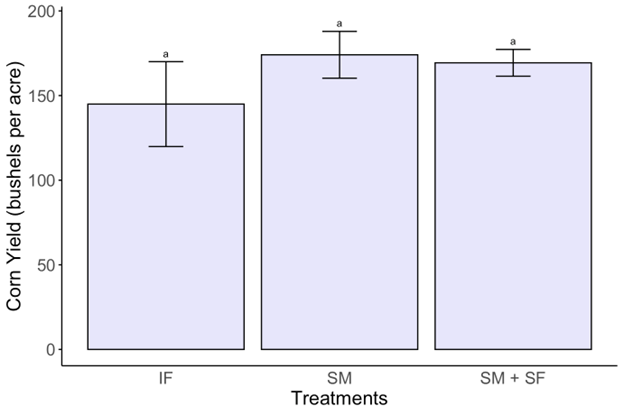
(SM- Swine Manure, IF- Inorganic fertilizer, SM+SF: Swine manure + Starter Fertilizer)
(Data are presented as mean with standard error, bars with different letters denote significantly different at p<0.05)
Furthermore, we observed significant differences (p < 0.05) in Soil Plant Analysis Development (SPAD, chlorophyll and nitrogen contents in leaves measured using Minolta Chlorophyll Meter) values among the treatments, with IF showing the highest value (52.37), followed by SM (48.15) and then the SM+SF (45.56).

(SM- Swine Manure, IF- Inorganic fertilizer, SM+SF: Swine manure + Starter Fertilizer, SPAD- Soil Plant Analysis Development)
(Data are presented as mean with standard error, bars with different letters denote significantly different at p<0.05)
The electrical conductivity (measured using Hanna GroLine Soil EC Tester) of the soil was significantly influenced (p < 0.05) by the treatments. The highest electrical conductivity was observed with the application of SM (0.36) which is statistically similar to SM+SF (0.32) treatment, but significantly higher than the IF (0.22) treatment.

(SM- Swine Manure, IF- Inorganic fertilizer, SM+SF: Swine manure + Starter Fertilizer, EC- Electrical Conductivity)
(Data are presented as mean with standard error, bars with different letters denote significantly different at p<0.05)
Future Plans
We plan to take the growth parameters including plant height and chlorophyll content (SPAD) at regular intervals. Additionally, we intend to sample soil microbiome composition in the field. This year we harvested 6 rows per plot but starting next year, we will harvest 18 center rows per plot (out of 31) for yield measurement. We will also exclude 15 feet from both the northern and southern ends of each plot.
Authors
Presenting author
Ravi Raj Mishra, Graduate student, University of Missouri, Columbia
Corresponding author
Teng-Teeh Lim, Extension Professor, University of Missouri, Columbia, limt@missouri.edu
Additional author(s) (name, title, and affiliation for each)
Manobendro Sarker, Graduate student, University of Missouri, Columbia
Keywords
Swine Manure, Soil Health, Soil Properties, Starter Fertilizers
Acknowledgements
We acknowledge the National Pork Board for the funding and collaboration with South Dakota State University. Our sincere thanks also go to Manobendro Sarker, Moh Moh Thant Zin, and Rana Das from our research group, and the research farm team for their support in field operations.
The authors are solely responsible for the content of these proceedings. The technical information does not necessarily reflect the official position of the sponsoring agencies or institutions represented by planning committee members, and inclusion and distribution herein does not constitute an endorsement of views expressed by the same. Printed materials included herein are not refereed publications. Citations should appear as follows. EXAMPLE: Authors. 2025. Title of presentation. Waste to Worth. Boise, ID. April 7–11, 2025. URL of this page. Accessed on: today’s date.