
Purpose
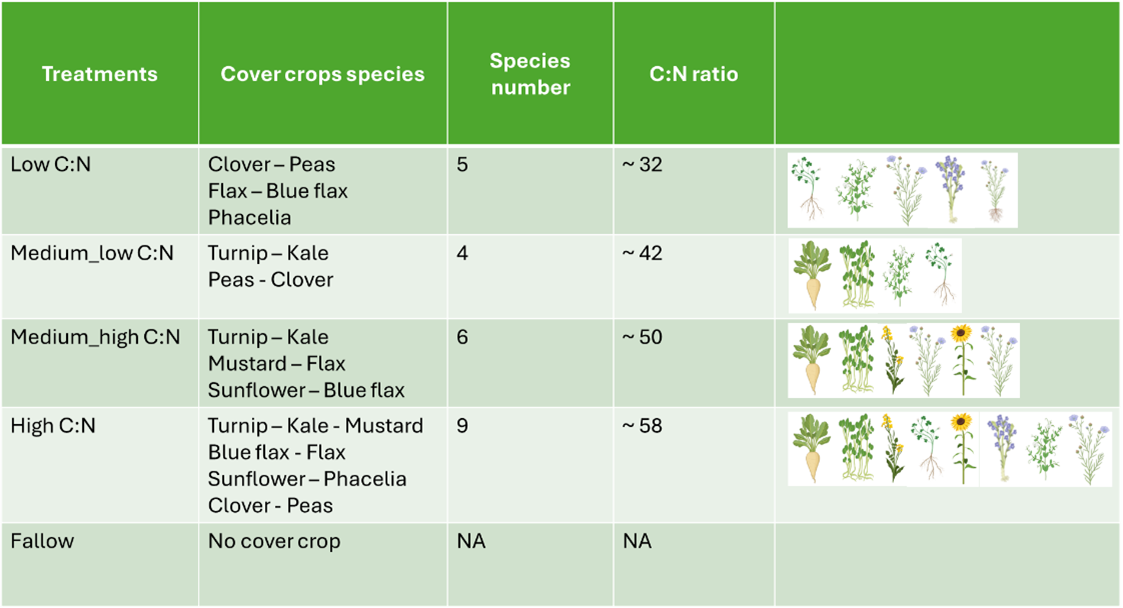
Increasing the quantity of carbon (C) inputs is a pathway to build soil C stores. One way to achieve this is using cover crop mixtures which can increase the amount and types of root exudates, supporting greater microbial activity and biomass. However, few studies use stoichiometry i.e., C:Nitrogen (N) ratios (the amount of C in relation to the amount of N present) to select cover crop mixes. Our major objective is to understand plant-soil feedback in the context of the legacy effects of cover crop stoichiometry on soil health, C-sequestration, and crop yields. We hypothesized that cover crops with a lower C:N ratio will increase nitrogen availability for the next crop cycle and increase C-sequestration.
What Did We Do?
We are conducting a multi-year, random-block field experiment comparing cover crop mixtures with low, medium-low, medium-high, and high C:N ratios (Table 1), and a fallow control (n=5). We are also interested in the effect of cover crop termination (herbicide vs. roller-crimper) on subsequent barley cash crop. The experiment was established in Southern Idaho, at the Kimberly Research and Extension Center. Soil samples were taken at the start of the experiment in fall 2023, spring, and fall 2024 to compare cover crop effects on soil health.
“Soil health is the continued capacity of soil to function as a vital living ecosystem that sustains plants, animals and humans, and connects agricultural and soil science to policy, stakeholder needs and sustainable supply-chain management” (Lehmann, et al. 2020). Moreover, natural or anthropogenic actions can change soil properties rapidly. It makes these properties be considered as good soil health indicators, that can be physical, chemical and biological. The first two have a slow response compared to the microbiological and biochemical properties.
The soil health properties evaluated in this research are:
*Physical properties: water holding capacity (the amount of water that a soil can retain).
*Chemical properties: pH, soil organic matter (decayed material that originated from a living organism), nutrient analysis (NH4-N, NO3-N, PO4, major ways that nutrients can be taken by plants).
*Biological properties: enzyme activities involved in the main biogeochemical cycles mineralizing organic matter (α- and β- glucosidase, cellobiosidase, acid and alkaline phosphatase, leucine aminopeptidase, N-acetyl-glycosaminidase), substrate induce respiration (response of microbial respiration to the addition of a nutrient as glucose), carbon mineralization (process for capturing, storing, and utilizing CO2 to synthesize other products). Also, we included agronomic parameters such as yield, crop biomass, full and empty grain.
Statistical analysis was conducted using R software version 4.4.0. Evaluating these attributes allow to verify the soil status and apply better management to get a desire outcome, e.g. increase organic matter in soil.
What Have We Learned?
Overall, the results in the first year of the study showed that medium-high C:N ratio treatment has the potential to improve soil health (Fig. 1), while herbicide termination performed better in comparison to roller crimper termination treatment.
The preliminary results show among all treatments an increase in moisture and pH with a decrease in water holding capacity during the spring compared with the fall seasons compared to fallow treatment. Active microbial biomass (i.e., substrate-induced respiration) did not differ between treatments for fall 2023 and spring 2024; however, carbon and nitrogen mineralization was higher before the treatments were established. Additionally, phosphorous did not vary across time.

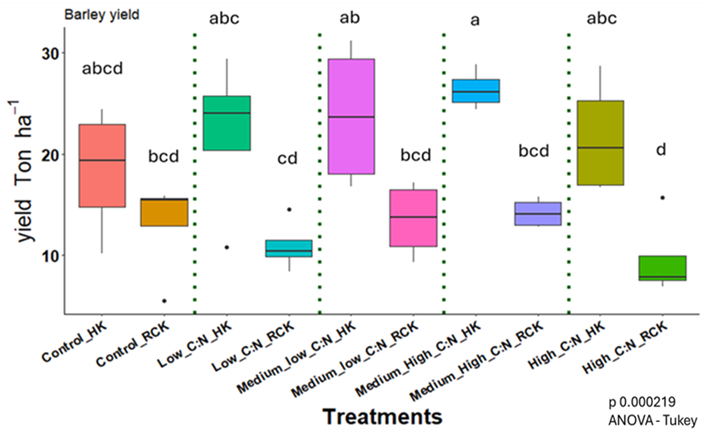
Agronomic parameters showed that herbicide termination method gave more barley height, dry aboveground biomass, seed counts, grain weight, total full grain, and barley yield (Fig. 2). On the other hand, the roller crimper termination method increased the amount of empty grain and the presence of weeds in the field.
Future Plans
To understand if the environmental condition has a positive or negative influence in soil health parameters, we replicate it at the Plant Materials Center (NRCS, USDA, Pullman, WA) where the environmental conditions are distinct from those in Southern Idaho. Also, we plan to conduct two more years of the experiment. We expect that the information obtained at the end of the study can provide fundamental information to the research community and guide farmers in the selection of cover crops and the termination methods for them in different environmental conditions.
Authors
Presenting authors
Vanessa Otero Jiménez, Postdoctoral Fellow, University of Idaho
Linda Schott, Assistant Professor and Extension Specialist, University of Idaho
Michael Strickland, Research Associated Professor, University of Idaho
Corresponding author
Vanessa Otero Jiménez, Postdoctoral Fellow, Soil and Water System Department, University of Idaho, Vanessao@uidaho.edu
Additional author
Steven Lee, Plant Materials Center, Natural Resources Conservation Service, United States Department of Agriculture
Acknowledgements
This work is supported by grant no. 2021-09118-1027664 from the USDA National Institute of Food and Agriculture. Any opinions, findings, conclusions, or recommendations expressed in this publication are those of the author(s) and do not necessarily reflect the view of the U.S. Department of Agriculture.
The authors are solely responsible for the content of these proceedings. The technical information does not necessarily reflect the official position of the sponsoring agencies or institutions represented by planning committee members, and inclusion and distribution herein does not constitute an endorsement of views expressed by the same. Printed materials included herein are not refereed publications. Citations should appear as follows. EXAMPLE: Authors. 2025. Title of presentation. Waste to Worth. Boise, ID. April 7–11, 2025. URL of this page. Accessed on: today’s date.