In a multimedia-based world, short videos are an effective visual means to provide information. A series of short (5-minute) climate change videos focusing on water conservation and efficiency were developed to connect innovative farming practices to other farmers, their advisers, consultants and the agricultural community.
What did we do?
Profiled stories include: water-efficient measures, featuring ‘low irrigation spray application’ (LISA) irrigation and ‘low elevation precision application’ (LEPA) irrigation in Eastern Washington; a video focused on dry-land farming of vegetables and fruit in Oregon using regionally adapted long taproot varieties from California; and a video featuring an Eastern Washington dairy farm’s reactive adaptation management after 2015, preparing for future growing seasons with less water. In each of the short videos, farmers, their advisers, and university experts are interviewed to provide their perspectives, knowledge and economic information.
What have we learned?
These videos are shared to highlight successful practices of conserving water while remaining profitable. Each video suggests evaluating a climate compatible management practice or crop variety on a part of a field, or when replacing outdated irrigation sprinklers and pumps.
Future Plans
Future plans include regional promotion of these successful practices.
Corresponding author, title, and affiliation
Elizabeth Whitefield, Research Associate, Washington State University
This effort was fully supported by Western Region Sustainable Agriculture and Research Education Program (EW15-012, Implications of Water Impacts from Climate Change: Preparing Agricultural Educators and Advisors in the Pacific Northwest)
Climate change is a slow and continual process that has been gradually changing our weather, and it will continue to occur. In order to adapt to such gradual changes, much foresight and planning is needed. The input-gathering process undertaken for this exercise was intended to compile information from stakeholders that was used to determine various scenarios of what future dairy production will look like, under specific climate change scenarios.
A survey of producers’ perspectives performed in 2014 yielded useful information regarding the beliefs of many New York State (NYS) dairy farmers. The survey showed that the majority of these farmers believe that they and their peers must adapt to climate changes they are currently facing, in the coming decades, in order to continue to grow and expand the industry in a sustainable manner. The scenario planning process will aid producers and their advisors in determining which adaptation strategies will be most effective to become more resilient to the climate changes that are projected in the near-term future for New York.
What did we do?
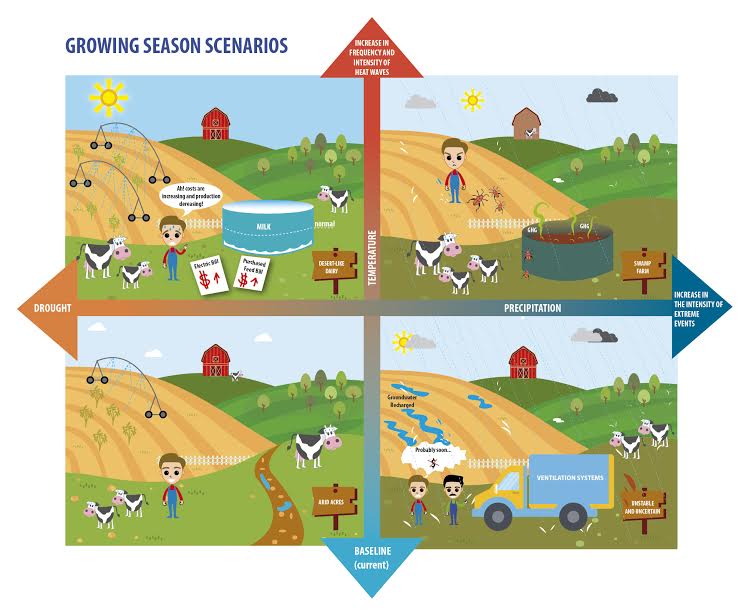
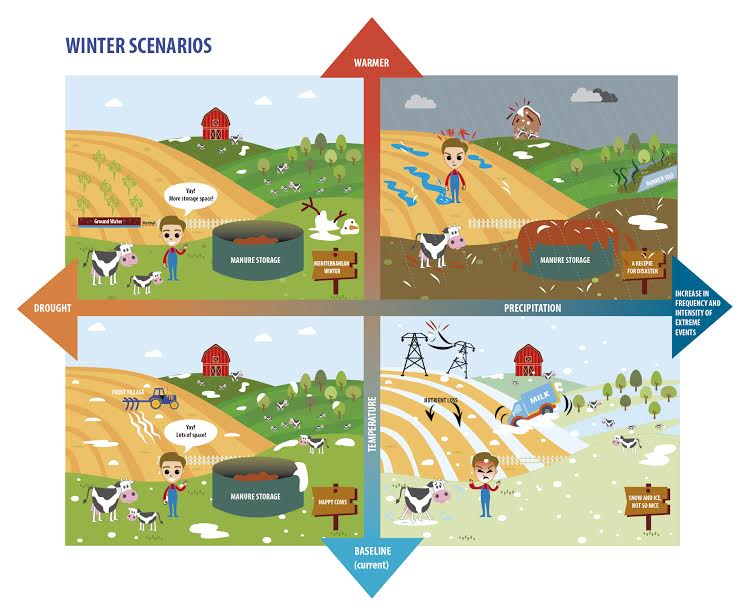
A Scenario Planning exercise was conducted throughout 2016 in preparation to help NYS producers imagine a future that involves the changes in climate that are projected over roughly the next 50 years. Scenario planning is a process that involves stakeholder input to develop multiple future scenarios based on a few key variables that will affect and change the way a system functions currently. It is a unique process in that it is not probability-based rather, it is based on the views of stakeholders and experts who choose the variables to be presented in a divergent fashion.
A workshop was held in July 2016 which gathered input from 12 stakeholders, and this input was then combined with current climate projections and other resources, to develop 8 comprehensive scenarios, 4 for the winter season and 4 for the growing season. The final scenarios are visual representations and are paired with qualitative narratives to explore the impacts of the divergent situations that are created. The final narratives provide a useful communications tool to share with farmers and other stakeholders, to explore the impacts of the climate variables involved.
What have we learned?
The exercise focused on temperature and precipitation changes for New York State, and the impacts to various aspects of the farmstead on a typical New York dairy farm. Scenarios were created for both winter and growing seasons, since the range of impacts is highly season dependent. The divergent scenarios created are presented in Figure 1 (growing season scenarios) and Figure 2 (winter season scenarios). Qualitative narratives were developed to describe in-depth the interactions that occur in each situation, for example, impacts to: the herd, the farmstead, manure management, farm economics, and finally with the farmer and personnel. Furthermore, once each situation is described fully, the next level of impact explores outside variables, for example, regional economic or political changes, population growth or social changes, or nation-wide or world-wide events that could have a significant impact on the specific farm situation presented.!
Future Plans
Next steps include identifying the best management strategies to handle the challenges presented in each resulting scenario. The final scenarios are presented in such a fashion that they will be useful tools to inform farm management, planning and decision making. The final scenarios can be used to examine how a certain set of management actions would perform under various future climatic conditions. “Robust” management actions need to be identified that would be the most highly effective under all scenarios considered, in other words, best management practices need to be identified that make the most sense to invest in, to be prepared for as many of the scenarios created as possible. In the same effort, it is important to identify management actions that are ineffective or that have little impact for a majority of the future scenarios developed. Pursuing actions that only work under a few of the projected scenarios is not in! line wit h smart planning to make the farm as resilient as possible. This preparation is a significant step towards helping farms be resilient in the face of unexpected future changes.
Corresponding author, title, and affiliation
Jennifer Pronto, Co-founder, BioProcess Analytics, LLC
The authors are solely responsible for the content of these proceedings. The technical information does not necessarily reflect the official position of the sponsoring agencies or institutions represented by planning committee members, and inclusion and distribution herein does not constitute an endorsement of views expressed by the same. Printed materials included herein are not refereed publications. Citations should appear as follows. EXAMPLE: Authors. 2017. Title of presentation. Waste to Worth: Spreading Science and Solutions. Cary, NC. April 18-21, 2017. URL of this page. Accessed on: today’s date.
This analysis of methane emissions used a “bottom-up” approach based on animal inventories, feed dry matter intake, and emission factors to estimate county-level enteric (cattle) and manure (cattle, swine, and poultry) methane emissions for the contiguous United States.
What did we do?
Methane emissions from enteric and manure sources were estimated on a county-level and placed on a map for the lower 48 states of the US. Enteric emissions were estimated as the product of animal population, feed dry matter intake (DMI), and emissions per unit of DMI. Manure emission estimates were calculated using published US EPA protocols and factors. National Agricultural Statistic Services (NASS) data was utilized to provide animal populations. Cattle values were estimated for every county in the 48 contiguous states of the United States. Swine and poultry estimates were conducted on a county basis for states with the highest populations of each species and on a state-level for less populated states. Estimates were placed on county-level maps to help visual identification of methane emission ‘hot spots’. Estimates from this project were compared with those published by the EPA, and to the European Environmental Agency’s Emission Database for Global Atmospheric Research (EDGAR).
What have we learned?
Overall, the bottom-up approach used in this analysis yielded total livestock methane emissions (8,888 Gg/yr) that are comparable to current USEPA estimates (9,117 Gg/yr) and to estimates from the global gridded EDGAR inventory (8,657 Gg/yr), used previously in a number of top-down studies. However, the spatial distribution of emissions developed in this analysis differed significantly from that of EDGAR.
Methane emissions from manure sources vary widely and research on this subject is needed. US EPA maximum methane generation potential estimation values are based on research published from 1976 to 1984, and may not accurately reflect modern rations and management standards. While some current research provides methane emission data, a literature review was unable to provide emission generation estimators that could replace EPA values across species, animal categories within species, and variations in manure handling practices.
Future Plans
This work provides tabular data as well as a visual distribution map of methane emission estimates from enteric (cattle) and manure (cattle, swine, poultry) sources. Future improvement of products from this project is possible with improved manure methane emission data and refinements of factors used within the calculations of the project.
Corresponding author, title, and affiliation
Robert Meinen, Senior Extension Associate, Penn State University Department of Animal Science
Alexander Hristov (Principal Investigator), Professor of Dairy Nutrition, Penn State University Department of Animal Science Michael Harper, Graduate Assistant, Penn State University Department of Animal Science Richard Day, Associate Professor of Soil
Additional information
None.
Acknowledgements
Funding for this project was provided by ExxonMobil Research and Engineering.
The authors are solely responsible for the content of these proceedings. The technical information does not necessarily reflect the official position of the sponsoring agencies or institutions represented by planning committee members, and inclusion and distribution herein does not constitute an endorsement of views expressed by the same. Printed materials included herein are not refereed publications. Citations should appear as follows. EXAMPLE: Authors. 2017. Title of presentation. Waste to Worth: Spreading Science and Solutions. Cary, NC. April 18-21, 2017. URL of this page. Accessed on: today’s date.
Assessing and improving the sustainability of dairy production is essential to secure future food production. Implementation of Beneficial Management Practices (BMPs) can reduce carbon and reactive nitrogen footprints of dairy farms. BMPs can and have been developed for different farm components, including feed, manure management and field cultivation practices. It is practically and economically infeasible to empirically test all combinations of BMPs at a whole farm scale. We therefore use whole-farm process-based models to assess the impact of several Beneficial Management Practices (BMPs) on carbon and reactive nitrogen footprints of dairy farms in the Great Lakes region. Specifically the aim of this study is to evaluate the influence of Beneficial Management Practices (BMPs) on carbon, reactive nitrogen and phosphorus footprints of dairy farms in the Great Lakes region.
What did we do?
1. Baseline farms
We developed two baseline model farms, a small 150 cow herd farm and a large 1500 cow herd farm, that are thought to be representative for current dairy farming practices in the Great Lakes region, particularly Wisconsin and New York State (Table 1). The two baseline dairy farms were developed based on individual team members’ expertise and a consultation with external experts (Dane County Conservationists, Madison, Wisconsin). For the 1500 cow farm, the baseline scenario was partly based on a previously-studied commercial dairy farm in NY state. Since this commercial dairy farm already employs some BMPs (e.g. anaerobic digestion as BMP in manure management), the farm was ‘downgraded’ to derive the baseline.
2. Beneficial Management Practices
Farm-specific BMPs were developed for three farm components, i.e. “Feed”, “Manure Management & Storage” and “Field management”. These BMPS were developed based on expert judgement and are expected or known to reduce whole-farm GWPs.
To ensure a meaningful integration of BMPs and a consistent comparison of whole-farm BMPs to the baseline and to each other, we used the following set of rules (per farm type): i) Total cultivated area was fixed (areas of individual crops can vary per scenario); ii) Herd size was fixed; iii) Milk production was allowed to float, however, only if the production increased (no decreases in milk production); iv) Purchases of crops and protein mixes were minimized as far as possible.
3. Process model simulation
The Integrated Farm System Model (IFSM4.3) was used to simulate the two baseline farms (i.e. 1500 cow farm in NY and 150 cow farm in WI) and all the individual BMPs. IFSM was used as a baseline model. The other process-based models, that is DNDC, APEX and CNCPS, were used to check IFSM predictions.
4.Whole-farm mitigation strategy
The individual BMPs were analyzed in terms of potential reduction in carbon and reactive nitrogen footprint. The best performing individual BMPs were combined into a whole-farm mitigation strategy and this whole-farm mitigation strategy was subsequently modeled in IFSM.
What have we learned?
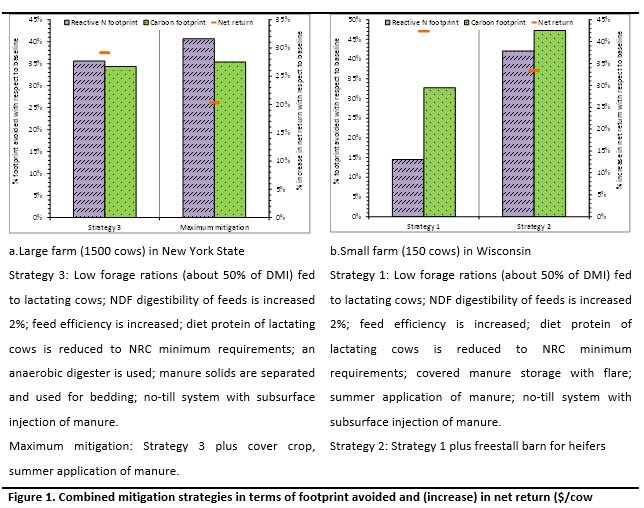
A comparison of model simulations of feed BMPs to the baseline shows that an integrated feed BMP (low forage, corn silage:alfalfa 3:1, ~2% NDF digestibility, reduced protein 14%, added fat, increased feed efficiency) can potentially reduce carbon and reactive nitrogen footprints with ~20% and ~24%, respectively, while remaining cost effective (18% increase in net return in $/cow), for both farm sizes.
For the small farm, replacing the bedded-pack barn with a free stall barn for the heifers, substantially reduces the carbon and the reactive nitrogen footprint with 12% and 11%, respectively. The manure management BMP ‘sealed with flare’ provides the largest potential reduction in carbon footprint for both farms (11% – 20%), primarily through a mitigation of CH4 emissions from manure storage.
Field management BMPs only provide a minimal reduction in carbon footprint (~3%), however, the field BMP ‘no-till with injection’ substantially reduces the reactive N footprint (~16%) for both farm sizes. This reduction is primarily achieved by a reduction in ammonia volatilization.
Based on the results for the individual BMPs, two combined whole-farm mitigation strategies were developed per farm and simulated in IFSM (Figure 1). For both the large farm and the small farm, the integrated whole-farm BMPs show an overall potential to reduce carbon and reactive nitrogen footprints with 33% to 37% and 15% to 42% respectively, simultaneously increasing milk production and the net return per cow with 10% to 12% and 20% to 42%, respectively.
This analysis suggests that BMPs can be applied to reduce greenhouse gas emissions and reactive nitrogen losses without sacrificing productivity or profit to the farmer.
Future Plans
Future research plans include a further comparison and analysis of IFSM predictions with predictions from other process models, including CNCPS, APEX, and ManureDNDC. In addition, we will assess the impact of climate change on the reactive nitrogen and carbon footprint of the baseline farms and the developed whole-farm mitigation strategies.
Corresponding author, title, and affiliation
Karin Veltman, PhD, University of Michigan, Ann Arbor
Alan Rotz, Joyce Cooper, Larry Chase, Richard Gaillard, Pete Ingraham, R. César Izaurralde, Curtis D. Jones, William Salas, Nick Stoddart, Greg Thoma, Peter Vadas, Olivier Jolliet
Additional information
Veltman et al. (2017) Comparison of process-based models to quantify nutrient flows and greenhouse gas emissions associated with milk production. Agricultural Ecosystems and Environment, 237, 31–44
DairyCAP project, www.sustainabledairy.org, aims to reduce the life cycle environmental impact of dairy production systems in the US.
Acknowledgements
This material is based upon work that is supported by the National Institute of Food and Agriculture, U.S. Department of Agriculture, under award number 2013-68002-20525. Any opinions, findings, conclusions, or recommendations expressed in this publication are those of the author(s) and do not necessarily reflect the view of the U.S. Department of Agriculture.
The authors are solely responsible for the content of these proceedings. The technical information does not necessarily reflect the official position of the sponsoring agencies or institutions represented by planning committee members, and inclusion and distribution herein does not constitute an endorsement of views expressed by the same. Printed materials included herein are not refereed publications. Citations should appear as follows. EXAMPLE: Authors. 2017. Title of presentation. Waste to Worth: Spreading Science and Solutions. Cary, NC. April 18-21, 2017. URL of this page. Accessed on: today’s date.
The purpose of this presentation is to outline the components and products of a USDA coordinated agricultural project focusing on dairy production systems in the Great Lakes region.
What did we do?
We have conducted research that includes measurement, modeling, and life cycle assessment for dairy production systems to improve sustainability at the farm level. The largest component of this grant was an assessment of best management practices to reduce greenhouse gas emissions. This project also included developing outreach materials and programs for extension and educational purposes.
What have we learned?
There are a number of strategies throughout the dairy production system that can reduce greenhouse gas emissions. There is significant variability in climate, location, dairy system design among other aspects that require different management strategies in order to reduce the net impact of dairy systems to climate change.
Future Plans
The project will be completed in the near future which includes finalizing modeling and life cycle assessments as well as extension and education materials. Beyond the project lifetime, future plans are to expand access to the models developed for expansion and use by other researchers. In addition, there are ongoing initiatives to educate stakeholders with the information produced from the project.
Corresponding author, title, and affiliation
Matt Ruark, Associate Professor, University of Wisconsin-Madison
This material is based upon work that is supported by the National Institute of Food and Agriculture, U.S. Department of Agriculture, under award number 2013-68002-20525. Any opinions, findings, conclusions or recommendations expressed in this publication are those of the author(s) and do not necessarily reflect the view of the U.S. Department of Agriculture.
A large agricultural lender reported in August 2016 that the current 20-month milk price low is not part of the typical three-year milk price cycle (which is marked by a year where the milk price is below the cost of production, followed by a year of recovering prices, and ending with a year where prices are well above the cost of production) that has been taking place since the late 1990’s, but rather is a correction of the dairy industry. That same report stated, that at the conclusion of the correction, milk prices will be more in-line with those of the early 2000’s, when the cost of production, on average, was close to the milk price, albeit with some variation. Overall, it is predicted to be a deviation from the recent three-year cycle pattern. To survive, dairy farms of the future will be compelled to even more carefully evaluate capital investments, including advanced manure treatment technologies, to assess their returns, both tangible and non-tangible, as they address regulatory and society-based environmental concerns.
Estimating the value of greenhouse gas reductions will be important to farms anticipating efforts to regulate carbon emissions in the future or to take advantage of carbon credits. Recognizing the value of water quality can also inform manure management system decisions. An economic value may help when comparing alternatives that have off-setting impacts across air and water environments.
What did we do?
This effort attempted to look at the economic values of the environmental benefits that a manure management system can provide, focusing specifically on greenhouse gas (GHG) reductions (both direct and indirect), air quality improvements, and water quality improvements. The resulting values can then be used as additional inputs in manure management system decisions on the farm. The U.S. EPA has put an economic value on the “Social Cost of Carbon”, which was incorporated into the process of putting a value on a manure treatment system. Careful nutrient recycling impacts GHG emissions and also yields societal benefits from water quality improvements downstream. Reductions of both phosphorous and nitrogen concentrations in water bodies can be valued for the impact on drinking water treatment, habitat changes, and recreational use.
What have we learned?
Through a rigorous process, we have been able to show the positive impact that anaerobic digestion systems (ADS) in New York State (NYS) can have on GHG reductions; the relevant work is presented in the accompanying paper. We learned that a focused outreach effort is needed to show multiple target audiences the possible GHG reduction values for NYS farms and to explain policy ideas that would help achieve reductions on-farm, therefore contributing to the State’s ambitious renewable energy and GHG reduction goals.
Future Plans
Future plans in this area include continued work in quantifying the environmental benefits of anaerobic digestion (AD) and in collaborating with our industry and State partners to find ways to monetize those benefits. Immediate plans include 1) a day-long program to expose and educate key NYS legislators and government officials on the benefits of farm-based ADS and the need to find ways to pay for these benefits, and 2) collecting data from additional farm-based ADS for use in further validating or changing the assumptions needed to develop reduction values.
Corresponding author, title, and affiliation
Curt Gooch, Dairy Environmental Systems and Sustainability Engineer, Cornell University
Dairy manure systems produce greenhouse gas and ammonia emissions that contribute to climate change. There are many potential practices and management strategies that can reduce these emissions which can conserve nutrients and reduce environmental impacts. This work assesses different processing strategies, additives, and manure storage covers to reduce emissions from dairy manure systems.
What did we do?
We completed three laboratory/field trials to assess emissions from manure systems. The first trial was to assess the greenhouse gas and ammonia emissions during storage and land application of manure that was processed with solid separation and digestion in combination with solid separation. A second trial assessed emissions and manure characteristics from storage with various commercial additives. The third study assessed ammonia emissions from digested manure storages with various biomass covers including raw wood, steam treated wood, and biochar produced from wood and corn cobs.
What have we learned?
The results from the study indicate that separation and digestion result in significant reductions in greenhouse gas emissions. However, as expected, ammonia emissions following digestion are increased due to increased nitrogen mineralization. Results also indicate that separation alone had a similar impact to greenhouse gas emissions, but did not further reduce emissions following digestion. Commercially available products that are designed to be added to manure storages had little to no impact on emissions or manure characteristics for the conditions present in this study. Lastly, biochar was capable of reducing ammonia emissions significantly when applied as a cover. Although the biochar was capable of sorbing ammonical nitrogen, the results indicate that the physical barrier on the manure surface was the primary driver for the reduction in ammonia emissions.
Future Plans
Following the outcomes of this work, information is being added to a dairy manure life cycle assessment to determine larger system wide impacts from changes in management practices or the inclusion of a processing system. In addition, work is being conducted to look at potential benefits that may be gained over a number of impact factors when manure management systems are optimized with other waste management systems from the municipal sector.
Corresponding author, title, and affiliation
Rebecca Larson, Assistant Professor, University of Wisconsin-Madison
M.A. Holly, Agricutural Engineer at USDA ARS, J.M. Powell, Soil Scientist at USDA ARS, H. Aguirre-Villegas, Assistant Scientist at University of Wisconsin-Madison
Additional information
Holly, M.A., R.A. Larson, M. Powell, M. Ruark, and H. Aguirre-Villegas. 2017. Evaluating greenhouse gas and ammonia emissions from digested and separated manure through storage and land application. Agriculture, Ecosystems & Environment, 239:410-419. http://www.sciencedirect.com/science/article/pii/S0959652616321953
Holly, M.A. and R.A. Larson. 2017. Effects of Manure Storage Additives on Manure Composition and Greenhouse Gas and Ammonia Emissions. Transactions of the ASABE, Accepted in Print.
Holly, M.A. and R.A. Larson. 2017. Evaluation of Biochar, Activated Biochar, and Steam Treated Wood as Dairy Manure Storage Covers for Ammonia Mitigation. In Review.
Acknowledgements
This material is based upon work that is supported by the National Institute of Food and Agriculture, U.S. Department of Agriculture, under award number 2013-68002-20525. Any opinions, findings, conclusions or recommendations expressed in this publication are those of the author(s) and do not necessarily reflect the view of the U.S. Department of Agriculture.
The authors are solely responsible for the content of these proceedings. The technical information does not necessarily reflect the official position of the sponsoring agencies or institutions represented by planning committee members, and inclusion and distribution herein does not constitute an endorsement of views expressed by the same. Printed materials included herein are not refereed publications. Citations should appear as follows. EXAMPLE: Authors. 2017. Title of presentation. Waste to Worth: Spreading Science and Solutions. Cary, NC. April 18-21, 2017. URL of this page. Accessed on: today’s date.
The purpose of this paper is to demonstrate the feasibility of using the Continuous Response Measurement (CRM) tool together with focus group discussion among CRM users to evaluate the effectiveness of Extension education videos that feature controversial subject matter. In this case, CRM was employed to measure live audience perception and response while viewing a video titled “Mitigation of Greenhouse Gases in Animal Agriculture” produced by the USDA NIFA sponsored Animal Agriculture in a Climate Change project.
What did we do?
The CRM technique (or dial testing) was employed to assess response from 32 Cooperative Extension agents and NRCS technical service providers at the October 2016 ‘Cattle & Climate Conversations Workshop’ held in Denver, Colorado. Participants represented multiple states in the U.S. Southwest with expertise and clientele involved in cattle production. Each participant used a small hand-held dial to continuously evaluate the mitigation video (shown in two 15-minute segments) and rate their agreement with the statement “This is effective at encouraging adoption of mitigation techniques.” Following the CRM activity, participants took part in a focus group discussion to provide qualitative feedback on the video. A sample of “critical moments” in the video were replayed and participants provided explanation and feedback into why these moments elicited strong positive or negative responses. Texas A&M AgriLife Extension, with funding by USDA NIFA Competitive Grant 2011-67003-30206, contracted with the Texas Tech University College of Media and Communication to conduct the CRM activity, forum discussion, and to prepare the final report.
What have we learned?
In many ways, cooperative extension agents and NRCS technical service providers serve as information gatekeepers to ensure that local agriculture producers and clientele within their service area receive scientifically-valid, researched-based, objective information on a range of relevant issues. They are also keenly sensitive to how educational content (and particularly those that involve controversial topics) will be perceived by clientele. The CRM technique with focus group discussion is an effective tool for generating both quantitative and qualitative data that can be used to improve audience perception and increase receptivity.
The CRM activity elicited several interesting ‘positive’ and ‘negative’ responses as participants viewed the mitigation video. For example, participants indicated positive responses as the video featured actual agricultural producers, when economic benefits were mentioned along with mitigation strategies, and during footage of working field technology. Conversely, interview footage of academic experts “offering redundant or unnecessary information”, dense charts and illustration with no succinct benefits, and explicit references to “climate change” coincided with the most negative responses.
During focus group discussions, participants offered several constructive suggestions to improve the overall message and perception. Recommendations included shortening the video to shorter segments, eliminating repetitive information (particularly among academic experts), tailoring content to specific types of production (e.g., pasture-based cattle production, feedlot cattle production) and region, and featuring agricultural producers using a technology with a relevant success story including economic benefits.
Future Plans
While the CRM technique provides important and useful insight into audience perception of existing educational content, this tool offers great benefit to Extension educators during product development. Future projects should consider CRM and focus group testing as a means to evaluate the effectiveness of educational content for intended audiences, thereby improving the overall perception and usefulness of the final product. A Journal of Extension article with more information on this CRM activity is currently being drafted.
Corresponding author, title, and affiliation
David W. Smith, Extension Program Specialist, Texas A&M AgriLife Extension Service
Saqib Mukhtar, University of Florida IFAS/Extension; Glenn Cummings, Texas Tech University; Coy Callison, Texas Tech University
Additional information
Full paper to be submitted to Journal of Extension April 2016.
Acknowledgements
Funding for this effort provided by USDA-NIFA Competitive Grant 2011-67003-30206. Special thanks to the Texas Tech University College of Media and Communication.
The authors are solely responsible for the content of these proceedings. The technical information does not necessarily reflect the official position of the sponsoring agencies or institutions represented by planning committee members, and inclusion and distribution herein does not constitute an endorsement of views expressed by the same. Printed materials included herein are not refereed publications. Citations should appear as follows. EXAMPLE: Authors. 2017. Title of presentation. Waste to Worth: Spreading Science and Solutions. Cary, NC. April 18-21, 2017. URL of this page. Accessed on: today’s date.
The goal of the Sustainable Dairy “Virtual Farm” website is to disseminate research-based information to diverse audiences from one platform. This is done with layers of information starting with the most basic then drilling down to peer-reviewed publications, data from life-cycle assessment studies and models related to the topics. The Virtual Farm focuses on decision makers and stakeholders including consumers, producers, policymakers, scientists and students who are interested in milk production on modern dairy farms. The top entry level of the site navigates through agricultural topics of interest to the general public. Producers can navigate to a middle level to learn about practices and how they might help them continue to produce milk for consumers responsibly in a changing climate while maintaining profitability. Featured beneficial (best) management practices (BMPs) reflect options related to dairy sustainability, climate change, greenhouse gas emissions, and milk production. Researchers can navigate directly to deeper levels to publications, tools, models, and scientific data. The website is designed to encourage users to dig deeper and discover more detailed information as their interest develops related to sustainable dairies and the environment.
What did we do?
As part of a USDA Dairy Coordinated Agricultural Project addressing climate change issues in the Great Lakes region, this online platform was developed to house various products of the transdisciplinary project in an accessible learning site. The Virtual Farm provides information about issues surrounding milk production, sustainability, and farm-related greenhouse gases. The web interface features a user-friendly, visually-appealing interactive “virtual farm” that explains these issues starting at a less-technical level, while also leading to much deeper research into each area. The idea behind this was to engage a general audience, then encourage them to dig deeper into the website for more technical information via Extension offerings.
The main landing page shows two sizes of dairy farms: 150 and 1,500-cows. The primary concept was to replace an all-day tour of multiple real dairy farms by combining their features into one ‘virtual farm’. For example, the virtual farm can describe and demonstrate the impact of various manure processing technologies. Users can explore the layout image, hover over labeled features for a brief description, and click to learn more about five main categories: crops and soils, manure management, milk production, herd management, and feed management. Each category page contains a narrative overview with illustrations and links to more detailed information.
What have we learned?
The primary benefit is that participants can learn about different practices, at their level of interest, all in one place. The virtual farm incorporates a broad theme of sustainability targeted at farming operations in the northeastern Great Lakes region of the USA.
The project has included regional differences in dairy farming practices and some important reasons for this such as environmental concerns (focus on N and/or P management in different watersheds) and long-term climate projections. Dairy industry supporters find value in having a one-stop repository of information on overall sustainability topics rather than having to visit various organizations’ sites.
Future Plans
We plan to continue to develop the website by adding relevant information, keeping information up to date, developing the platform for related topic areas and adding curriculums for school students.
Corresponding author, title, and affiliation
Daniel Hofstetter, Extension-Research Assistant, Penn State University (PSU)
Eileen Fabian-Wheeler, Professor, PSU; Rebecca Larson, Assistant Professor, University of Wisconsin (UW); Horacio Aguirre-Villegas, Assistant Scientist, UW; Carolyn Betz, Project Manager, UW; Matt Ruark, Associate Professor, UW
Additional information
Visit the following link for more information about the Sustainable Dairy CAP Project:
This material is based upon work that is supported by the National Institute of Food and Agriculture, U.S. Department of Agriculture, under award number 2013-68002-20525. Any opinions, findings, conclusions or recommendations expressed in this publication are those of the author(s) and do not necessarily reflect the view of the U.S. Department of Agriculture.
The authors are solely responsible for the content of these proceedings. The technical information does not necessarily reflect the official position of the sponsoring agencies or institutions represented by planning committee members, and inclusion and distribution herein does not constitute an endorsement of views expressed by the same. Printed materials included herein are not refereed publications. Citations should appear as follows. EXAMPLE: Authors. 2017. Title of presentation. Waste to Worth: Spreading Science and Solutions. Cary, NC. April 18-21, 2017. URL of this page. Accessed on: today’s date.
Climate change is an economic, environmental and social threat, and worthy of scientific study. Immediate action must be taken to reduce greenhouse gas emissions and mitigate negative impacts of future climate change. Proposed action can start at the farm level and has the potential of making a contribution to mitigation of climate change. Dairy farmers are able to significantly reduce their emissions by implementing better management practices, primarily through feed production, enteric fermentation, and manure management. We model the corresponding changes in emissions from proposed mitigation efforts to understand their impact on global climate change.
What did we do?
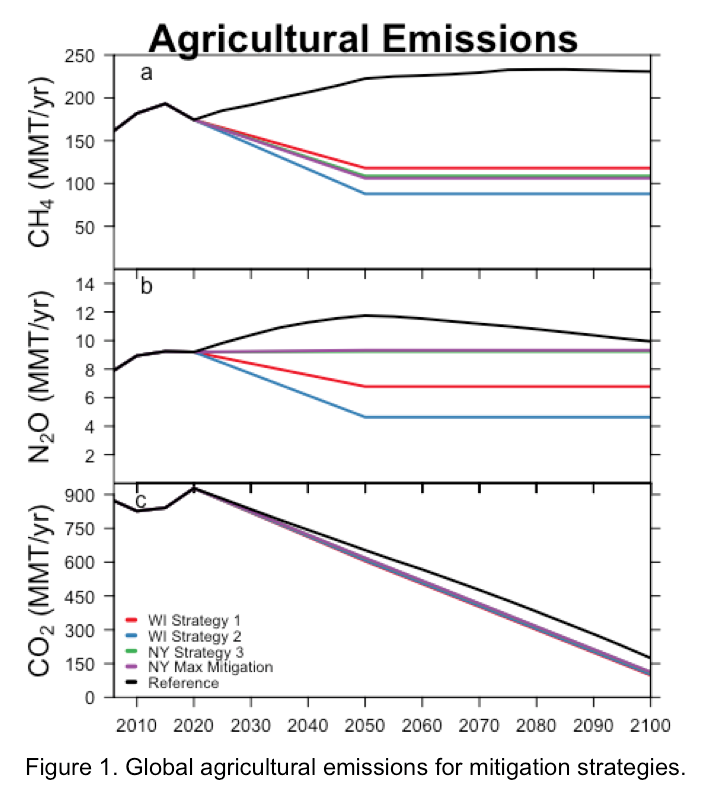
Best Management Practices (BMPs) for dairy systems have been identified and simulated using the Integrated Farm System Model (IFSM). Simulations representative of a large New York farm (1500 cows) and a small Wisconsin farm (150 cows) estimated the emission of greenhouse gases for a whole farm system. Percent reductions were calculated by comparing a baseline scenario without any implemented mitigation, to scenarios that included the identified BMPs. Refer to Table 1 for emission and percent reduction estimates for the simulated BMPs.
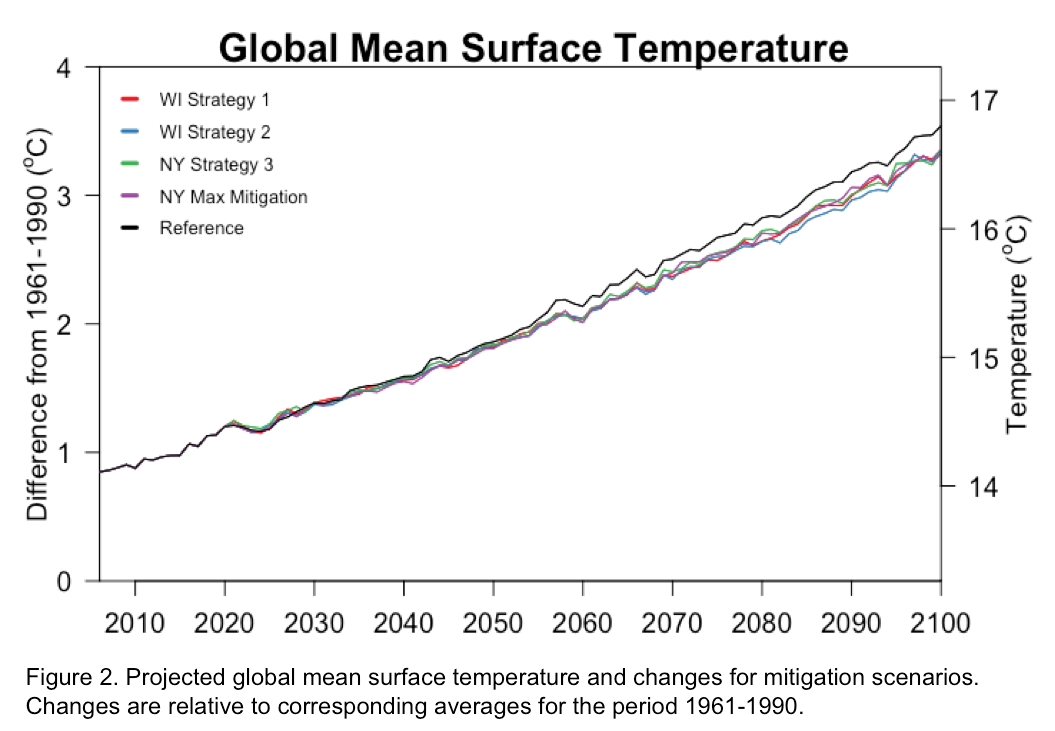
Percent reduction estimates were then applied to a projected “business as usual” emission scenario. This scenario prescribes anthropogenic emissions through 2100 and excludes any climate action or policy after 2015. Taking 2020 as a reference year and 2050 as a target year, we applied the estimated percent reductions to the projected global agricultural emissions. Emission reductions were decreased linearly from 2020 to 2050, and held constant between 2050 and 2100 (Figure 1). This assumes that all farms globally can reduce emissions despite increases in production. To compare the performance of the mitigation measures under future climate change, we employed a fully coupled earth system model of intermediate complexity – the Integrated Global System Model (IGSM). The model includes an interactive carbon-cycle capable of addressing important feedbacks between the climate and terrestrial biosphere.
What have we learned?
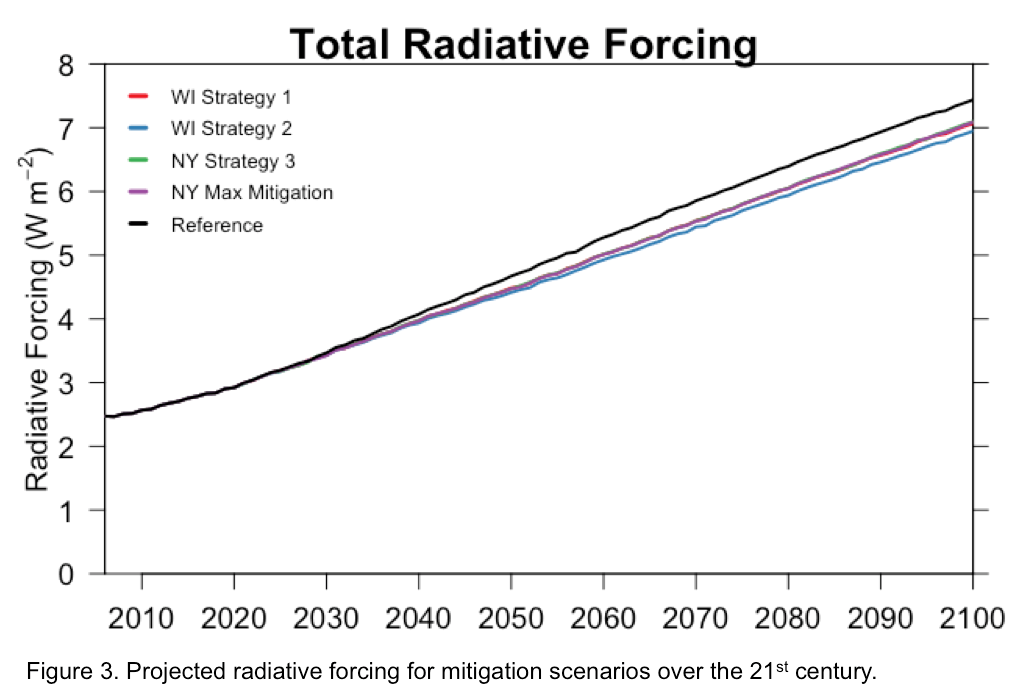
Action taken globally in the agricultural sector to reduce greenhouse gas emissions over the first half of the 21st century is likely to have an impact in mitigating global warming. Following a “business as usual” emission scenario without any climate policy or action beyond 2015, an increase in global mean surface temperature by the end of the 21st century (2081-2100) relative to pre-industrial (1961-1990) levels is projected to be 2.8 C to 3.5 C (Figure 2). This exceeds the 2 C temperature target described as the maximum warming allowed to avoid dangerous and irreversible climate change. An associated net radiative
forcing for the “business as usual” scenario is projected to be 7.4 W/m^2 by 2100 (Figure 3). Adopting the identified BMPs in the dairy sector and decreasing global agricultural emissions by 2050 is projected to decrease global mean surface temperatures for 2100 by 0.2 C and net radiative forcing by 0.4 W/! m^2 on av erage. In summary, this modeled experiment demonstrates that ongoing efforts to decrease greenhouse gas emissions in the dairy and agricultural sector are effective at reducing the overall warming of climate change.
Future Plans
Future work will look further into the evolution of regional temperature and rainfall profiles for the mitigation scenarios. Then, ecological risk assessment methodologies will be applied to determine the probable impacts of climate change by each scenario on agricultural production.
Corresponding author, title, and affiliation
Kristina Rolph – Graduate Student, The Pennsylvania State University.
This material is based upon work that is supported by the National Institute of Food and Agriculture, U.S. Department of Agriculture, under award number 2013-68002-20525. Any opinions, findings, conclusions, or recommendations expressed in this publication are those of the author(s) and do not necessarily reflect the view of the U.S. Department of Agriculture.
Manage Cookie Consent
To provide the best experiences, we use technologies like cookies to store and/or access device information. Consenting to these technologies will allow us to process data such as browsing behavior or unique IDs on this site. Not consenting or withdrawing consent, may adversely affect certain features and functions.
Functional
Always active
The technical storage or access is strictly necessary for the legitimate purpose of enabling the use of a specific service explicitly requested by the subscriber or user, or for the sole purpose of carrying out the transmission of a communication over an electronic communications network.
Preferences
The technical storage or access is necessary for the legitimate purpose of storing preferences that are not requested by the subscriber or user.
Statistics
The technical storage or access that is used exclusively for statistical purposes.The technical storage or access that is used exclusively for anonymous statistical purposes. Without a subpoena, voluntary compliance on the part of your Internet Service Provider, or additional records from a third party, information stored or retrieved for this purpose alone cannot usually be used to identify you.
Marketing
The technical storage or access is required to create user profiles to send advertising, or to track the user on a website or across several websites for similar marketing purposes.


 Proceedings Home

 ost basic then drilling down to peer-reviewed publications, data from life-cycle assessment studies and models related to the topics. The Virtual Farm focuses on decision makers and stakeholders including consumers, producers, policymakers, scientists and students who are interested in milk production on modern dairy farms. The top entry level of the site navigates through agricultural topics of interest to the general public. Producers can navigate to a middle level to learn about practices and how they might help them continue to produce milk for consumers responsibly in a changing climate while maintaining profitability. Featured beneficial (best) management practices (BMPs) reflect options related to dairy sustainability, climate change, greenhouse gas emissions, and milk production. Researchers can navigate directly to deeper levels to publications, tools, models, and scientific data. The website is designed to encourage users to dig deeper and discover more detailed information as their interest develops related to sustainable dairies and the environment.
 What have we learned?