Five Steps to the Development and Implementation of a Feed Management Plan

Printer friendly version

Introduction

This fact sheet has been developed to support the implementation of the Natural Resources Conservation Service Feed Management 592 Practice Standard. The Feed Management 592 Practice Standard was adopted by NRCS in 2003 as another tool to assist with addressing resource concerns on livestock and poultry operations. Feed management can assist with reducing the import of nutrients to the farm and reduce the excretion of nutrients in manure.

The Natural Resources Conservation Service has adopted a practice standard called Feed Management (592) and is defined as “managing the quantity of available nutrients fed to livestock and poultry for their intended purpose”. The national version of the practice standard can be found in a companion fact sheet entitled “An Introduction to Natural Resources Feed Management Practice Standard 592”. Please check in your own state for a state-specific version of the standard.

The national Feed Management Education team has developed a systematic 5-step development and implementation process for the Feed Management Practice Standard as shown in figures 1 and 2. The steps of the flow diagram were chosen to coincide with the sections of the Feed Management Practice Standard. The first step focuses on defining the purpose(s) for considering the Feed Management Standard on a particular farm, either to: 1) feed to minimize excess nutrients in manure while maintaining production, performance, and reproduction, or 2) feed to improve net farm income by feeding more efficiently.

Please check this link first if you are interested in organic or specialty dairy production

Why Consider Feed Management?

The first step focuses on defining the purpose(s) for considering the Feed Management Standard on a particular farm, either to: 1) feed to minimize excess nutrients in manure while maintaining production, performance, and reproduction, or 2) feed to improve net farm income by feeding more efficiently.

Key participants at step 1 would be the producer, the nutrient management planner, and NRCS staff.

Where Does the Practice Apply?

The second step of the flow diagram focuses on identifying the conditions where the practice applies and making an initial assessment of the opportunity for the full development of a Feed Management Plan. The conditions where the practice applies as noted the in 592 standard include:

  1. Whole farm imbalance
  2. Soil nutrient build-up
  3. Land base not large enough, or
  4. Seeking to enhance nutrient efficiencies.

After defining the condition(s) for use of the 592 standard, an opportunity checklist is then used make an initial assessment of developing a complete feed management plan. The opportunity checklist can be found in a companion fact sheet entitled “Use of the Opportunity Checklist in Feed Management Plan Development”. The Opportunity Checklist can be found in species specific versions for beef, dairy, poultry and swine.

Key participants at step 2 would be the producer, the nutrient management planner, and NRCS staff.

How Do We Reduce Manure Nutrients?

The third step of the flow diagram focuses on the question of “how to reduce nutrients on manure used on the farm”. This step will not be considered by all farms. Two major ways that a reduction in on-farm manure nutrients can be achieved is through feed ingredient and exporting manure off-farm. Making the decision to make a ration change vs. moving manure off-farm has major economic implications.

An electronic decision aid tool has been developed to assist with this decision. The tool is called FNMP$ and a description and set of instructions can be found in a companion fact sheet entitled “Feed Nutrient Management Planning Economics (FNMP$)…Connecting Feed Decisions with Crop Nutrient Management Plans”. This spreadsheet tool estimates the quantity of manure nitrogen, phosphorus, and solids excreted based upon user inputs of feed program and animal performance (based upon procedures contained within ASABE Standard D384.2). In addition, using procedures defined in USDA Natural Resources Conservation Service publication “Agricultural Waste Management Field Handbook”, an estimate of harvested and crop available nutrients are estimated. This information is then used to develop an estimate of:

  1. land requirements for agronomic utilization of the manure
  2. time requirements for land application
  3. costs associated with land application and potential nutrient value (N and P only) of manure.

Key participants at step 3 would be the producer, the nutrient management planner, and the nutritionist.

Develop the Feed Management Plan

The fourth step of the flow diagram focuses on the development of the feed management plan. The key tool to assist with the writing of the plan is the Feed Management Plan (FMP) Checklist. The FMP checklist can be found in a companion fact sheet entitled “Use of the Feed Management Plan Checklist in Feed Management Plan Development”. The Feed Management Plan Checklist can be found in species specific versions for beef, dairy, poultry and swine.

A national Feed Management Plan template has been developed and can be found in the companion fact sheet entitled “National Feed Management Plan Template”.

Key participants at step 4 would be the producer and the nutritionist.

Implement and Monitor the Plan

The fifth and final step of the flow diagram focuses on Feed Management Plan implementation and monitoring. This step focuses on implementing those practices that will help achieve the purpose(s) that were selected at step 1. In addition, review dates are established so that the FMP will be utilized as an active management tool.

It is important that the outcomes of the feed management plan as it relates to manure volume and nutrient composition are communicated to the nutrient management planner as this may affect cropping recommendations.

Key participants at step 5 would be the producer and the nutritionist.

Summary

Following the five steps to the development and implementation of a feed management plan, can provide the basis for thoroughly evaluating the merits of feed management in relation to nutrient management at the whole farm level. Clear and frequent communication with everyone managing nutrients on the farm will be a key factor to the success of the feed management plan.

“Extension programs and policies are consistent with federal and state laws and regulations on nondiscrimination regarding race, sex, religion, age, color, creed, national or ethnic origin; physical, mental or sensory disability; marital status, sexual orientation, or status as a Vietnam-era or disabled veteran. Evidence of noncompliance may be reported through your local Extension office.”

Feed Management Plan Implementation and Development Flow Charts


Disclaimer

This fact sheet reflects the best available information on the topic as of the publication date. Date 5-25-2007

This Feed Management Education Project was funded by the USDA NRCS CIG program. Additional information can be found at Feed Management Publications.
Image:Feed mgt logo4.JPG This project is affiliated with the Livestock and Poultry Environmental Learning Center.

Image:usda,nrcs,feed_mgt_logo.JPG

Project Information

Detailed information about training and certification in Feed Management can be obtained from Joe Harrison, Project Leader, jhharrison@wsu.edu, or Becca White, Project Manager, rawhite@wsu.edu.

Author Information

J. H. Harrison jhharrison@wsu.edu, and R. A. White, Washington State University
A Sutton and Todd Applegate, Purdue University
Galen Erickson and Rick Koelsch, University of Nebraska
R. Burns, Iowa State University

Partners

Logos2.JPG


Becoming A Certified Nutritionist to Develop a Feed Management Plan – Natural Resources Conservation Service (NRCS) Feed Management Practice Standard 592

Printer friendly version

Introduction

This factsheet has been developed to support the implementation of the Natural Resources Conservation Service Feed Management 592 Practice Standard. The Feed Management 592 Practice Standard was adopted in 2003 as another tool to assist with addressing resource concerns on livestock and poultry operations. Feed management can assist with reducing the import of nutrients to the farm and reduce the excretion of nutrients in manure.

During the early 2000s the USDA Natural Resources Conservation Service (NRCS) and the American Registry of Professional Animal Scientists (ARPAS) developed a memorandum of understanding “that provides an opportunity for qualified ARPAS members to become Technical Service Providers for NRCS programs in the category of feed management.” Put simply, this means that consulting nutritionists are the most appropriate advisers to develop and implement a Feed Management Plan (FMP).

Please check this link first if you are interested in organic or specialty dairy production

The NRCS Feed Management 592 Practice Standard

The NRCS Feed Management Practice Standard is defined as “managing the quantity of available nutrients fed to livestock and poultry for their intended purpose.” The purposes of the 592 standard are:

  • To supply the quantity of available nutrients required by livestock and poultry for maintenance, production, performance, and reproduction, while reducing the quantity of nutrients, especially nitrogen and phosphorus, excreted in manure by minimizing the overfeeding of these and other nutrients
  • To improve net farm income by feeding nutrients more efficiently.

The ultimate goal of utilizing the Feed Management Practice Standard 592 is to develop a farm-specific FMP.

Becoming a Certified Nutritionist to Develop a Feed Management Plan

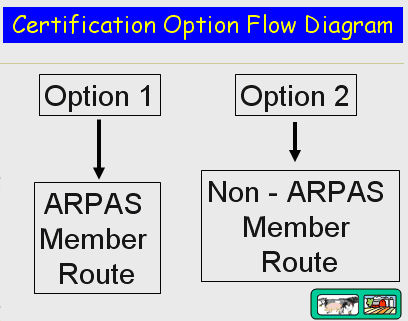
There are two options for becoming certified to write an FMP, depending on whether one chooses to be an ARPAS member and following Option 1 or choosing Option 2, which does not require membership in ARPAS (Figure 1).

Figure 1

ARPAS Member Certification Process (Option 1)

Information about becoming certified can be accessed at ARPAS. The process under Option 1 for becoming certified with NRCS as a Technical Service Provider in the area of feed management is a multistep process that should start with attending a Feed Management Workshop to gain knowledge in the process of development and implementation of an FMP. Workshops for 2008 are scheduled for June 14 in Dubuque, Iowa, and Nov. 12 near Harrisburg, Penn.

A second step is to pass the feed management exam for the species of interest. The exam will be available in the summer of 2008 (Figure 2).

The third step is to have completed an FMP at two farms (Figure 3).

Figure 2

The fourth step is to complete a NRCS Technical Service Provider Application form with ARPAS. This form can be found at NRCS Technical Service Provider Program. ARPAS will keep a record of those who have completed the NRCS Technical Service Provider Application form with ARPAS (Figure 4).

Figure 3

Figure 4

The fifth step of the process is to complete a Technical Service Agreement with NRCS. The agreement form will need to be completed in the state in which the work is done. The TechReg Step by Step Guide can be found at TechReg(Figure 5).

Non-ARPAS Member Certification Process (Option 2)

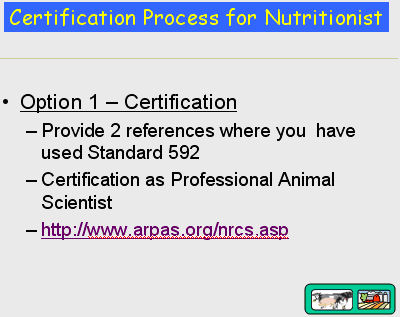
For those who choose not to be members of ARPAS, the four steps are required to become certified to write an FMP (Figure 6). These include: showing proficiency in using techniques described in Feed Management 592 Practice Standard; providing two references from where the 592 practice standard has been used; acquiring 15 hours of CEUs in feed management-related subjects every three years; and demonstrating knowledge and understanding of the NRCS National Planning Procedures Handbook – Part 600.5, Comprehensive Nutrient Management Planning Technical Guidance.

Figure 5

Figure 6

Disclaimer

This factsheet reflects the best available information on the topic as of the publication date. Date 4-12-2007

This Feed Management Education Project was funded by the USDA NRCS CIG program. Additional information can be found at Feed Management Publications.

Image:Feed mgt logo4.JPG

This project is affiliated with the Livestock and Poultry Environmental Learning Center.

Image:usda,nrcs,feed_mgt_logo.JPG

Project Information

Detailed information about training and certification in feed management can be obtained from Joe Harrison, project leader, jhharrison@wsu.edu, or Becca White, project manager, rawhite@wsu.edu.

Author Information

J. H. Harrison, Washington State University, jhharrison@wsu.edu
R. A. White, Washington State University
A. Sutton and Todd Applegate, Purdue University
Galen Erickson, University of Nebraska
R. Burns, Iowa State University
Glenn Carpenter, Natural Resources Conservation Service

Partners

Logos2.JPG

Acknowledgments

This Feed Management Education Project was funded by the USDA NRCS CIG program. Additional information can be found at Feed Management Publications.
This project is affiliated with the Livestock and Poultry Environmental Learning Center.

usda,nrcs,feed_mgt_logo.JPG

“Extension programs and policies are consistent with federal and state laws and regulations on nondiscrimination regarding race, sex, religion, age, color, creed, national or ethnic origin; physical, mental or sensory disability; marital status, sexual orientation, or status as a Vietnam-era or disabled veteran. Evidence of noncompliance may be reported through your local Extension office.”

Figures/images CC 2.5 Joe Harrison

Evaluating Corn Silage Quality for Dairy Cattle

Printer friendly version

Contents


Introduction

This fact sheet has been developed to support the implementation of the Natural Resources Conservation Service Feed Management 592 Practice Standard. The Feed Management 592 Practice Standard was adopted by NRCS in 2003 as another tool to assist with addressing resource concerns on livestock and poultry operations. Feed management can assist with reducing the import of nutrients to the farm and reduce the excretion of nutrients in manure.

The Natural Resources Conservation Service has adopted a practice standard called Feed Management (592) and is defined as “managing the quantity of available nutrients fed to livestock and poultry for their intended purpose”. The national version of the practice standard can be found in a companion fact sheet entitled “An Introduction to Natural Resources Feed Management Practice Standard 592”. Please check in your own state for a state-specific version of the standard.

An index of forage quality, milk per ton of forage DM (Undersander et al., 1993), was developed using an energy value of forage predicted from ADF content and DMI potential of forage predicted from NDF content as its basis. The milk per ton quality index was later modified for corn silage (Schwab et al., 2003) using an energy value derived from summative equations (Schwab et al., 2003; NRC, 2001) and DMI predicted from both NDF content (Mertens, 1987) and in vitro NDF digestibility (IVNDFD, % of NDF; Oba and Allen, 1999b) as its basis. This milk per ton quality index (MILK2000; Schwab et al., 2003) has become a focal point for corn silage hybrid-performance trials and hybrid-breeding programs in academia and the seed-corn industry (Lauer et al., 2005). An update, MILK2006, will be discussed herein.

Please check this link first if you are interested in organic or specialty dairy production

Model NEL-3x and DMI

We (Schwab et al., 2003) modified the NRC (2001) TDNmaintenance summative energy equation for corn silage to include starch and non-starch NF C components with a variable predicted starch digestibility coefficient, and a direct laboratory measure of the NDF digestibility coefficient rather
energy value was derived from TDNmaintenance using the NRC (1989) empirical equation in MILK2000 (Schwab et al., 2003). In MILK2006, the NEL-3x energy value is derived using an adaptation of the TDN-DE-ME-NE conversion equations provided in NRC (2001).

Neutral detergent fiber content and IVNDFD are used to predict DMI (Schwab et al., 2003) in both MILK2000 and MILK2006. However, a one %-unit change in IVNDFD (% of NDF) from lab-average IVNDFD changes DMI 0.26 lb. per day (Oba and Allen, 2005; Jung et al., 2004) in MILK2006 versus the 0.37 lb. per day value (Oba and Allen, 1999b) that was used in MILK20

In MILK2000, variation in IVNDFD impacts NEL intake through effects on both NEL-3x content and DMI (Schwab et al., 2003). However, Tine et al. (2001) and Oba and Allen (1999a) reported that at production levels of intake, IVNDFD has minimal impact on NEL-3x content but impacts NEL intake primarily through effects on DMI. In MILK2006, the IVNDFD value used for calculating NEL-3x is adjusted for differences in DMI predicted from IVNDFD using an equation adapted from Oba and Allen (1999a). Thus, IVNDFD impacts NEL intake and hence the milk per ton quality index mainly through its impact on predicted DMI in MILK2006.

Non-fiber Carbohydrates and Their Digestibility

Dairy cattle nutritionists have long used non-fiber carbohydrate (NFC) as a quasi-nutrient rather than starch specifically. However, NFC is a calculated value (100-NDF-CP+NDFCP-Fat-Ash; NRC, 2001) comprised of varying proportions of starch, sugar, soluble fiber, and organic acids, and is subject to errors associated with analyzing the five nutrients used to calculate NFC. Although the NRC 2001 summative energy equation was based on NFC, starch rather than NFC is being used in summative energy equations (Schwab et al., 2003) by many commercial feed testing laboratories especially for corn silage which they have long been analyzing for starch content and have developed NIRS calibrations for starch determination. However, determining digestion coefficients for starch to use in summative energy equations has been difficult. The NRC 2001 model uses an NFC true digestibility coefficient of 98% and arbitrary processing adjustment factors. The MILK2000 model uses a non-starch NFC (NFC minus starch) true digestibility coefficient of 98% (NRC, 2001) and varies the starch true digestibility coefficient from a minimum of 76% (Firkins et al., 2001) to a maximum of 98% (NRC, 2001) using whole-plant DM and kernel processing as regression equation variables to predict apparent total tract starch digestibility (Schwab et al., 2003). Both approaches though are limited in their ability for detecting potential variation in starch digestibility across a wide array of samples, and novel lab assays are needed.

Starch, supplied in Midwestern and Northeastern diets primarily from dry or high-moisture corn grain and whole-plant corn silage, is an important source of energy for dairy cattle. However, the digestibility of corn starch can be highly variable (Nocek and Tamminga, 1991; Orskov, 1986; Owens et al., 1986; Rooney and Pflugfelder, 1986; Theuer, 1986). Various factors, particle size (fine vs. coarse grind), grain processing (steam flaked vs. dry rolled), storage method (dry vs. high-moisture corn), moisture content of high-moisture corn, type of corn endosperm, and corn silage maturity at harvest, chop length, and kernel processing, influence starch digestibility in lactating dairy cows. Because both physical and chemical properties of starch influence starch digestion, assessment of starch digestibility in the laboratory has been challenging.

In an attempt to address variation in starch digestibility, NRC (2001) suggested empirical processing adjustment factors (PAF) to adjust NFC digestion coefficients for high-starch feeds. However, since no system to measure variation in PAF for feedstuffs is available the PAF’s are subjective book values with minimal practical utility. For corn silage, U.S. Dairy Forage Research Center workers developed a kernel processing score (KPS; Ferreira and Mertens, 2005; Mertens, 2005) to assess adequacy of kernel processing in corn silage. But, the relationship between KPS values and in vivo starch digestibility measurements is not well defined. Ruminal in-vitro or in-situ degradation, either alone or in combination with in vitro post-ruminal enzymatic digestion of the ruminal residues, have been explored by some groups (Sapienza, 2002). Some commercial laboratories are attempting to employ in situ or in vitro systems to evaluate starch digestibility, but to date methods are highly variable between laboratories. Regardless of the method it is doubtful that samples can be fine ground as fine grinding of samples may mask differences among samples (Doggett et al., 1998). Relationships between in situ/in vitro measurements and in vivo starch digestibility are often not well defined. We recently developed an enzymatic lab assay, Degree of Starch Access (DSA), which is sensitive to differences in particle size, moisture content, and vitreousness of corn-based feeds (Blasel et al., 2006).

The DSA assay was found to be quite sensitive (Blasel et al., 2006) to particle size (R2 = 0.99) and moderately sensitive to DM content (R2 = 0.76) and endosperm type (R2 = 0.59), which are three primary factors that influence starch digestibility in corn grain. However, The DSA assay is a laboratory starch recovery procedure that does not result in a direct estimate of starch digestibility and only reveals differences in starch recoveries. For example, the DSA procedure would recover 95 percent of the starch in finely ground corn but only 5 percent of the starch in whole shelled corn. Thus, the DSA values provide an index of the variation in degree of starch access among feeds. We (Shaver and Hoffman, 2006) reviewed eight trials in the scientific literature (Taylor and Allen, 2005a; Remond et al., 2004; Oba and Allen, 2003; Crocker et al., 1998; Knowlton et al., 1998; Yu et al., 1998; Joy et al., 1997; Knowlton et al., 1996) with lactating dairy cows that reported total tract starch digestibility and particle size, moisture content, and endosperm type of the corns tested. From these data, we estimated their DSA values and evaluated the relationship between DSA and their measures of total tract starch digestibility. The resultant regression equation is applied to starch recovery values generated from the DSA assay to provide an estimate of total tract starch digestibility (termed Starch DigestibilityDSA; Shaver and Hoffman, 2006) which can be used in summative energy equations (Schwab et al., 2003; NRC, 2001) directly to calculate energy values for corn-based feeds on a standardized basis.

More field and in vivo evaluations of these laboratory assays related to starch digestibility (KPS, DSA, and in situ/in vitro) are needed. Therefore, the MILK2006 model continues to use the regression approach of MILK2000 (Schwab et al., 2003) as the default method for determining starch digestibility. But, user-defined options are available within the MILK2006 spreadsheet for determining starch digestibility from available KPS, DSA, or in situ/in vitro data. For hybrid performance trials where an objective is to assess true hybrid differences for kernel endosperm properties, the harvest maturity, whole-plant DM content, and sample particle size should be kept as similar as possible since these factors all influence the starch digestibility determinations.

Fiber and Its Digestibility

The NRC (2001) summative energy equation is based on fiber digestibility calculated using lignin. Whole-plant lignin content was found to have a strong negative relationship with IVNDFD within comparisons of brown midrib (bm3) hybrids to isogenic counterparts (Oba and Allen, 1999b). However, stover NDF and lignin contents increase while NDFD decreases with progressive maturity, but whole-plant NDF and lignin contents are constant or decline as grain proportion increases (Russell et al., 1992; Hunt et al., 1989). This may partially explain why for 534 corn silage samples, NDFD calculated using lignin according to NRC (2001) accounted for only 14% (P < 0.001) of IVNDFD variation (Schwab and Shaver, unpublished). Michigan State workers (Oba and Allen, 2005; Allen and Oba, 1996; M. S. Allen, personal communication, 2003 Tri-State Nutr. Conf. Pre-Symp.) reported that lignin (% of NDF) explained only half or less of the variation for corn silage IVNDFD. These observations coupled with the NRC (2001) suggestion that IVNDFD measurements could be used directly in the NRC model led us to implement IVNDFD rather than lignin-calculated NDF digestibility in the corn silage milk per ton models (Schwab et al., 2003). Use of NDF and IVNDFD in the corn silage milk per ton models has been discussed above.

Several commercial testing laboratories offer wet chemistry IVNDFD measurements. NIRS calibrations for predicting IVNDFD on corn silage samples are available at some commercial forage testing laboratories. However, Lundberg et al. (2004) found poor prediction by NIRS of corn silage IVNDFD. It is hoped that NIRS calibration equations can be improved upon in the future. The NRC (2001) recommended a 48-h IVNDFD for use in the NRC (2001) model, and for that reason we used 48-h IVNDFD measurements in MILK2000 (Schwab et al., 2003). However, debate continues within the industry about the appropriateness of 48-h vs. 30-h IVNDFD measurements. Some argue that the 30-h incubation better reflects ruminal retention time in dairy cows (Oba and Allen, 1999a) and that most of the in vivo trials that have evaluated effects of varying IVNDFD on animal performance also performed 30-h IVNDFD measurements (Oba and Allen, 2005). Labs and their customers also like the faster sample turn around that is afforded by the 30-h incubation time point. For that reason, and also for improved lab operation efficiency, a 24-h incubation time point is being employed by some labs. However, some argue that the 48-h incubation time-point is less influenced by lag time and rate of digestion, and thus is more repeatable in the laboratory (Hoffman et al., 2003). Hoffman et al. (2003) provided data on the relationship between 30- and 48-h IVNDFD measurements that showed a strong positive relationship (r-square = 0.84). But, the lab average at a specific incubation time point and the relationship between incubation time points within a lab can be highly variable among labs making the development of a universal incubation time point adjustment equation difficult. The average lignin-calculated corn silage NDF digestibility in the NRC (2001) is 59%. This reference point is important for adjustment of IVNDFD values from different labs and varying incubation time points so that the resultant TDN and NEL values are comparable to NRC (2001) values.

User-defined flexibility is available within the MILK2006 spreadsheet for entry of 48-, 30-, or 24-h IVNDFD incubation time point measurements. But, the labs incubation time point and average results for corn silage at that time point must also be entered into the spreadsheet along with the sample data. The 48-h IVNDFD incubation time point continues to serve as the default in the milk per ton spreadsheets. The Wisconsin Corn Silage Hybrid Performance Trials (Lauer et al., 2005) will continue to use the 48-h IVNDFD incubation time point because NIRS calibrations for this time point have been developed from corn silage samples obtained in this evaluation program over several years by locations and Justen (2004) did not find the earlier incubation time points to provide any benefit over the 48-h time point for hybrid selection.

Model Comparisons

Values for TDNmaintenance, NEL-3x, and milk per ton calculated using MILK2006 and MILK2000 across a wide range of whole-plant corn IVNDFD values and extreme quality differences are presented in Tables 1 and 2, respectively. The TDNmaintenance differences between MILK2006 and MILK2000 are minimal. The NEL-3x and milk per ton values are lower and the range in these values is compressed for MILK2006 relative to MILK2000 according to the equation differences between the two models that were described above.

Analysis of correlations between corn silage NDF, IVNDFD, starch, and starch digestibility and milk per ton estimates from MILK 2006, 2000, 1995, and 1991 models (n = 3727 treatment means; Shaver and Lauer, 2006) is presented in Table 3. Results show that the MILK2000 model was revolutionary relative to the earlier models (milk per ton hybrid rank correlation between MILK2000 and MILK1991 was only 0.68), because of its recognition of IVNDFD as an important quality parameter while the earlier models were influenced mostly by whole-plant starch and grain contents. The MILK2006 model relative to MILK2000 appears to be more evolutionary reflecting the relatively minor fine-tuning of equations (milk per ton hybrid rank correlation between MILK2006 and MILK2000 was 0.95), but the spreadsheet will allow for more user-defined flexibility. Future developments in laboratory methods for determining starch digestibility may influence its relationship to milk per ton estimates relative to the other quality measures.

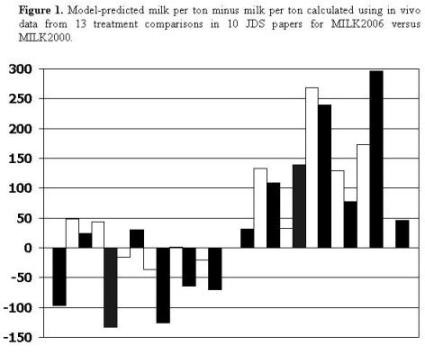
Ivan et al. (2005) evaluated “low-fiber” (26% starch, 49% NDF, 58% IVNDFD) versus “high-fiber” (22% starch, 53% NDF, 67% IVNDFD) corn silages in 30% NDF diets fed to lactating dairy cows. Reported per cow per day milk yields were converted to milk per ton of corn silage DM basis using their corn silage DMI data. Actual milk per ton was 168 lb. higher for high-fiber than low fiber corn silage. Model-predicted milk per ton estimates were 132 lb. and 297 lb. higher for high-fiber than low-fiber corn silage from MILK2006 and MILK2000 models, respectively. This suggests reasonable agreement with in vivo data for MILK2006 and better agreement with in vivo data for MILK2006 than MILK2000. Presented in Figure 1 is model-predicted milk per ton minus milk per ton calculated using in vivo data from 13 treatment comparisons in 10 JDS papers (Ballard et al., 2001; Ebling and Kung, 2004; Ivan et al., 2005; Neylon and Kung, 2003; Oba and Allen, 2000; Oba and Allen, 1999a; Qiu et al., 2003;Taylor and Allen, 2005b; Thomas et al., 2001; Weiss and Wyatt, 2002) for MILK2006 versus MILK2000. There was less model over-predictive bias for MILK2006 than MILK2000. The model-predicted milk per ton minus in vivo-calculated milk per ton difference exceeded 100 lb. (approximately 1 lb. per cow per day) for only 2 of 13 treatment comparisons with MILK2006 versus 8 of 13 treatment comparisons with MILK2000.

While these observations with MILK2006 are encouraging, more model validations relative to in vivo data are needed. The MILK2006 Excel Workbook can be downloaded at the University of Wisconsin’s Extension website.

Table 1. Impact of IVNDFD (average lab IVNDFD 58% of NDF) in whole-plant corn harvested at 35% DM content with kernel processing on TDN1x (%), NEL-3x (Mcal/lb.) and milk (lb.) per ton using MILK2006 or MILK2000 with nutrient composition adapted from NRC (2001) for “normal” corn silage (8.8% CP, 45% NDF, 27% starch, 4.3% ash, and 3.2% fat).
IVNDFD% MILK
2006
TDN1x
MILK
2006
NEL-3x
MILK
2006
Milk/ton
MILK
2000
TDN1x
MILK
2000
NEL-3x
MILK
2000
Milk/ton
46 65.3 0.66 2936 66.4 0.69 3074
50 67.0 0.67 3037 68.2 0.71 3244
54 68.8 0.68 3138 70.0 0.73 3413
58 70.5 0.69 3237 71.8 0.75 3579
62 72.3 0.70 3336 73.6 0.77 3743
66 74.0 0.72 3434 75.4 0.79 3905
70 75.8 0.73 3530 77.2 0.81 4065

Table 2. Impact of “low” (45% DM, unprocessed, 8.8% CP, 54% NDF, 46% IVNDFD, 20% starch, 4.3% ash, and 3.2% fat) versus “high” (30% DM, processed, 8.8% CP, 36% NDF, 70% IVNDFD, 34% starch, 4.3% ash, and 3.2% fat) quality extremes in whole-plant corn on TDN1x (%), NEL-3x (Mcal/lb.) and milk (lb.) per ton using MILK2006 or MILK2000.
Quality MILK
2006
TDN1x
MILK
2006
NEL-3x
MILK
2006
Milk/ton
MILK
2000
TDN1x
MILK
2000
NEL-3x
MILK
2000
Milk/ton
“Low” 56.2 0.55 2242 57.3 0.58 2418
“High” 76.3 0.74 3617 79.9 0.84 4256

Table 3. Analysis of correlations for selected corn silage nutrients and their digestibility coefficients with milk per ton estimates from MILK2006, 2000, 1995, and 1991 models (n = 3727 treatment means; Shaver and Lauer, 2006).
r-values MILK
2006
Milk/ton1
MILK
2000
Milk/ton2
MILK
1995
Milk/ton3
MILK
1991
Milk/ton4
NDF% -0.46 -0.40 -0.94 -0.99
Starch% 0.48 0.44 0.75 0.74
IVNDFD, % of NDF 0.49 0.70 0.16 -0.10
StarchD, % of Starch 0.30 0.21 -0.25 -0.27
1Calculated as per Schwab et al. (2003) except for modifications discussed herein.
2Calculated as per Schwab et al. (2003).
3Calculated as per Undersander et al. (1993) except for in vitro DM digestibility adjustment.
4Calculated as per Undersander et al. (1993) using ADF and NDF.

Corn Silage Fig 1.jpg


References

  • Allen, M., and M. Oba. 1996. Fiber digestibility of forages. Pages 151-171 in Proc. MN Nutr. Conf. Bloomington, MN.
  • Ballard, C. S., E. D. Thomas, D. S. Tsang, P. Mandebvu, C. J. Sniffen, M. I. Endres, and M. P. Carter. 2001. Effect of corn silage hybrid on dry matter yield, nutrient composition, in vitro digestion, intake by dairy heifers, and milk production by dairy cows. J. Dairy Sci. 84:442–452.
  • Blasel, H.M., P. C. Hoffman, and R. D. Shaver. 2006. Degree of starch access: An enzymatic method to determine starch degradation potential of corn grain and corn silage. J. Anim. Feed Sci. Technol. 128:96-107.
  • Crocker, L.M., E. J. DePeters, J. G. Fadel, H. Perez-Monti, S. J. Taylor, J. A. Wyckoff, and R. A. Zinn. 1998. Influence of processed corn grain in diets of dairy cows on digestion of nutrients and milk composition. J. Dairy Sci. 81: 2394-2407.
  • Doggett, C. G., Hunt, C. W., Andrae, J. G., Pritchard, G. T., Kezar, W., and J. H. Harrison. 1998. Effect of hybrid and processing on digestive characteristics of corn silage. J. Dairy Sci. 81(Suppl.1):196(Abstr.)
  • Ebling, T. L., and L. Kung, Jr. 2004. A comparison of processed conventional corn silage to unprocessed and processed brown midrib corn silage on intake, digestion, and milk production by dairy cows. J. Dairy Sci. 87:2519–2527.
  • Ferreira, G., and D. R. Mertens. 2005. Chemical and physical characteristics of corn silages and their effects on in vitro disappearance. J. Dairy Sci. 88:4414-4425.
  • Firkins, J. L., M. L. Eastridge, N. R. St-Pierre, and S. M. Noftsger. 2001. Effects of grain variability and processing on starch utilization by lactating dairy cattle. J. Anim. Sci. 79(E. Suppl.): E218-E238.
  • Hoffman, P. C., Lundberg, K. L., L. M. Bauman, and R. Shaver. 2003. In vitro NDF digestibility of forages: The 30 vs. 48 hour debate. Univ. of WI Extension Focus on Forage Series. Vol. 5, No. 16. http://www.uwex.edu/ces/crops/uwforage/30vs48-FOF.htm.
  • Hunt, C. W., W. Kezar, and R. Vinande. 1989. Yield, chemical composition and ruminal fermentability of corn whole plant, ear, and stover as affected by maturity. J. Prod. Agric. 2:357-361.
  • Ivan, S. K., R. J. Grant, D. Weakley, and J. Beck. 2005. Comparison of a Corn Silage Hybrid with High Cell-Wall Content and Digestibility with a Hybrid of Lower Cell-Wall Content on Performance of Holstein Cows. J. Dairy Sci. 2005 88:244-254.
  • Joy, M. T., E. J. DePeters, J. G. Fadel, and R. A. Zinn. 1997. Effects of corn processing on the site and extent of digestion in lactating cows. J. Dairy Sci. 80: 2087-2097.
  • Jung, H.G., M., Raeth-Knight, and J. G. Linn. 2004. Forage fiber digestibility: Measurement, variability, and impact. Pages 105-125 in Proc. 65th MN Nutr. Conf. Bloomington, MN.
  • Justen, B. A. L. 2004. Digestion kinetics and vitreousness in breeding maize (Zea Mays L.) for silage yield and nutritional quality. M. S. Thesis. Plant Breeding and Genetics. Univ. of Wisconsin – Madison.
  • Knowlton, K.F., M. S. Allen, and P. S. Erickson. 1996. Lasalocid and particle size of corn grain for dairy cows in early lactation. 1. Effect on performance, serum metabolites, and nutrient digestibility. J. Dairy Sci. 79: 557-564.
  • Knowlton, K. F., B. P. Glenn, and R. A. Erdman. 1998. Performance, ruminal fermentation, and site of starch digestion in early lactation cows fed corn grain harvested and processed differently. J. Dairy Sci. 81:1972-1984.
  • Lauer, J., K. Kohn, and P. Flannery. 2005. Wisconsin Corn Hybrid Performance Trials Grain and Silage. Univ. of WI Ext. Publ. A3653. http://corn.agronomy.wisc.edu/HT/2005/2005Text.aspx.
  • Lundberg, K. L., P. C. Hoffman, L. M. Bauman, and P. Berzaghi. 2004. Prediction of forage energy content by near infrared reflectance spectroscopy and summative equations. Prof. Anim. Sci. 20:262-269.
  • Mertens, D. R. 2005. Particle size, fragmentation index, and effective fiber: Tools for evaluating the physical attributes of corn silages. Pages 211-220 in Proc. Four-State Dairy Nutr. & Mgmt. Conf. MWPS-4SD18. Dubuque, IA.
  • Mertens, D. R. 1987. Predicting intake and digestibility using mathematical models of ruminal function. J. Anim. Sci. 64:1548-1558.
  • National Research Council. 2001. Nutrient Requirements of Dairy Cattle. 7th rev. ed. Natl. Acad. Sci., Washington, DC.
  • National Research Council. 1989. Nutrient Requirements of Dairy Cattle. 6th rev. ed. Natl. Acad, Sci., Washington, DC.
  • Neylon, J. M., and L. Kung, Jr. 2003. Effects of cutting height and maturity on the nutritive value of corn silage for lactating cows. J. Dairy Sci. 86:2163–2169.
  • Nocek, J. E., and S. Tamminga. 1991. Site of digestion of starch in the gastrointestinal tract of dairy cows and its effects on milk yield and composition. J. Dairy Sci. 74:3598-3629.
  • Oba, M. and M. Allen. 2005. In vitro digestibility of forages. Pages 81-91 in Proc. Tri-State Dairy Nutr. Conf. Ft. Wayne, IN.
  • Oba, M, and M. S. Allen. 2003. Effects of corn grain conservation method on ruminal digestion kinetics for lactating dairy cows at two dietary starch concentrations. J. Dairy Sci. 86:184-194.
  • Oba, M. and M. S. Allen. 2000. Effects of brown midrib 3 mutation in corn silage on productivity of dairy cows fed two concentrations of dietary neutral detergent fiber: 1. Feeding behavior and nutrient utilization. J. Dairy Sci. 83:1333-1341.
  • Oba, M. and M. S. Allen. 1999a. Effects of brown midrib 3 mutation in corn silage on dry matter intake and productivity of high yielding dairy cows. J. Dairy Sci. 82:135-142.
  • Oba, M. and M. S. Allen. 1999b. Evaluation of the importance of the digestibility of neutral detergent fiber from forage: effects on dry matter intake and milk yield of dairy cows. J. Dairy Sci. 82:589-596.
  • Orskov, E. R. 1986. Starch digestion and utilization in ruminants. J. Anim. Sci. 63:1624-1633.
  • Owens, F. N., R. A. Zinn, and Y. K. Kim. 1986. Limits to starch digestion in the ruminant small intestine. J. Anim. Sci. 63:1634-1648.
  • Qiu, X., M. L. Eastridge, and Z. Wang. 2003. Effects of corn silage hybrid and dietary concentration of forage NDF on digestibility and performance by dairy cows. J. Dairy Sci. 86:3667–3674.
  • Remond, D., Cabrer-Estrada, J. I., Chapion M., Chauveau B., Coudure R., Poncet C. 2004. Effect of corn particle size on site and extent of starch digestion in lactating dairy cows. J. Dairy Sci. 87:1389-1399.
  • Rooney, L. W., and R. L. Pflugfelder. 1986. Factors affecting starch digestibility with special emphasis on sorghum and corn. J. Anim. Sci. 63:1607-1623.
  • Russell, J. R., N. A. Irlbeck, A. R. Hallauer, and D. R. Buxton. 1992. Nutritive value and ensiling characteristics of maize herbage as influenced by agronomic factors. J. Anim. Feed Sci. Technol. 38:11-24.
  • Sapienza, D. 2002. Pioneer tripartite method: Linking nutrient content to availability. Pages 27-40 in Proc. 64th Cornell Nutr. Conf. East Syracuse, NY.
  • Schwab, E. C., R. D. Shaver. J. G. Lauer, and J. G. Coors. 2003. Estimating silage energy value and milk yield to rank corn hybrids. J. Anim. Feed Sci. Technol. 109:1-18.
  • Shaver, R. D., and P. C. Hoffman. 2006. Corn silage starch digestibility: What’s new? In Proc. NRAES Silage for Dairy Farms Conf. Camp Hill, PA.
  • Shaver, R. D., and J. G. Lauer. 2006. Review of Wisconsin corn silage milk per ton models. J. Dairy Sci. 89(Suppl. 1):282(Abstr.)
  • Taylor, C. C. and M. S. Allen. 2005a. Corn grain endosperm type and brown midrib 3 corn silage: Site of digestion and ruminal digestion kinetics in lactating cows. J. Dairy Sci. 2005 88: 1413-1424.
  • Taylor, C. C. and M. S. Allen. 2005b. Corn grain endosperm type and brown midrib 3 corn silage: Feeding Behavior and Milk Yield of Lactating Cows. J. Dairy Sci. 88: 1425-1433.
  • Theurer, C. B. 1986. Grain processing effects on starch utilization by ruminants. J. Anim. Sci. 63:1649-1662.
  • Thomas, E. D., P. Mandebvu, C. S. Ballard, C. J. Sniffen, M. P. Carter, and J. Beck. 2001. Comparison of corn silage hybrids for yield, nutrient composition, in vitro digestibility, and milk yield by dairy cows. J. Dairy Sci. 84:2217–2226.
  • Undersander, D.J., W.T. Howard, and R.D. Shaver. 1993. Milk per acre spreadsheet for combining yield and quality into a single term. J. Prod. Ag. 6:231 235.
  • Weiss, W. P., and D. J. Wyatt. 2002. Effects of feeding diets based on silage from corn hybrids that differed in concentration and in vitro digestibility of neutral detergent fiber to dairy cows. J. Dairy Sci. 85:3462–3469.
  • Yu, P., J. T. Huber, F.A.P. Santos, J. M. Simas, and C. B. Theurer. 1998. Effects of ground, steam-flaked, and steam-rolled corn grains on performance of lactating cows. J. Dairy Sci. 81: 777-783.

“Extension programs and policies are consistent with federal and state laws and regulations on nondiscrimination regarding race, sex, religion, age, color, creed, national or ethnic origin; physical, mental or sensory disability; marital status, sexual orientation, or status as a Vietnam-era or disabled veteran. Evidence of noncompliance may be reported through your local Extension office.”

Disclaimer

This fact sheet reflects the best available information on the topic as of the publication date. Date 5-25-2007

This Feed Management Education Project was funded by the USDA NRCS CIG program. Additional information can be found at Feed Management Publications.

Image:Feed mgt logo4.JPG
This project is affiliated with the Livestock and Poultry Environmental Learning Center.

Image:usda,nrcs,feed_mgt_logo.JPG

Project Information

Detailed information about training and certification in Feed Management can be obtained from Joe Harrison, Project Leader, jhharrison@wsu.edu, or Becca White, Project Manager, rawhite@wsu.edu.

Author Information

Randy Shaver
Professor and Extension Dairy Nutritionist
Department of Dairy Science
College of Agricultural and Life Sciences
University of Wisconsin – Madison
University of Wisconsin – Extension

Reviewer Information

Pat Hoffman – University of Wisconsin
Jim Barmore – Nutrition Consultant

Partners
Logos2.JPG


Estimating Manure Nutrient Excretion

Printer friendly version

Introduction

This fact sheet has been developed to support the implementation of the Natural Resources Conservation Service Feed Management 592 Practice Standard. The Feed Management 592 Practice Standard was adopted by NRCS in 2003 as another tool to assist with addressing resource concerns on livestock and poultry operations. Feed management can assist with reducing the import of nutrients to the farm and reduce the excretion of nutrients in manure.

The Natural Resources Conservation Service has adopted a practice standard called Feed Management (592) and is defined as “managing the quantity of available nutrients fed to livestock and poultry for their intended purpose”. The national version of the practice standard can be found in a companion fact sheet entitled “An Introduction to Natural Resources Feed Management Practice Standard 592”. Please check in your own state for a state-specific version of the standard.

Please check this link first if you are interested in organic or specialty dairy production

Estimating Manure Nutrient Excretion

The front and back end of an animal is connected. While this principle seems obvious, it has historically been ignored in nutrient planning procedures. This fact sheet describes tools that allow integration of feed management and animal performance into nutrient planning processes for animal feeding operations.

A new standard published by the American Society of Agricultural and Biological Engineers (D384.2, Manure Production and Characteristics) is a tool for developing farm specific Comprehensive Nutrient Management Plans (CNMP). This standard allows accurate estimates of nutrient and solids excretion reflective of feed programs and animal performance. Accurate estimates of manure excretion are critical to estimating land requirements and land application costs, sizing manure storage, and planning treatment technologies. This fact sheet will introduce the new manure excretion standard and its application.

Contents of the Manure Production Standard

An ASABE committee of animal scientists and agricultural engineers developed predictive equations for estimating manure excretion for five species (beef, dairy, horse, poultry, and swine) and “typical” characteristics for excreted and as-removed manure. The standard is found at ASABEfollowed by a search of “Standards” and “Title” options for “Manure Production”. The ASABE standard includes seven sections.

Section 1 lists a new “typical” characteristics tabular summary for individual species and groupings of animals. See Tables 1 and 2.(PDF file) These values should provide a reasonable estimate of excretion for animals in the year 2000. As time passes, published typical values become less accurate and should be used with caution for individual herds or flocks. Differences in genetics, feed program, and animal performance between individual farms create a potential for errors when typical values are applied. They may have value for preliminary nutrient planning estimates but should NOT be used in final farm-specific nutrient management plans.

Sections 2 through 7 define the equations for cattle, dairy cattle, horses, poultry (separate sections for meat birds and layers), and swine, respectively. Equation based estimates are provided for all species groups for dry matter, N and P excretion. Equations for estimating additional characteristics are available for some species.

Section 8 of the new standard summarizes As-Removed manure characteristics. The work group summarized a wide range of data sets for inclusion in this section. These values can be beneficial for estimating storage volumes and manure application rates when no other farm-specific information is available. However, when farm specific manure samples are available, they are preferred.

Two Approaches for Estimating Excretion

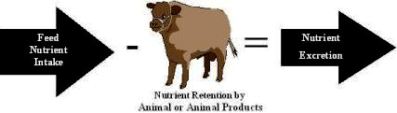
Two distinctly different approaches were used equation based estimates of excretion. The beef, swine, and poultry work groups used an animal mass balance approach (Figure 1). Excretion is estimated as a difference between feed nutrient intake and retention in body mass or animal products (eggs or milk). intake and retention in body mass or animal products (eggs or milk). The dairy and horse work groups used existing data sets as a basis for multi-variable regression analysis. The dairy work group proposed equations for lactating cows, dry cows and heifers. The horse work group chose to publish separate equations for exercised and sedentary horses. See Table 1. Estimated typical manure (urine and feces combined) characteristics as excreted by meat-producing livestock and poultry.(PDF file) Diet based numbers are in BOLD. Source ASAE D384.2 March 2005, Manure Production and Characteristics.

Figure 1. Mass balance approach was used for estimating excretion haracteristics for beef cattle, swine and poultry.

Factors Affecting Nutrient Excretion

The new standard defines the relationship between feed inputs and animal performance and manure excretion characteristics. For example, the quantity of solids excreted is directly tied to the dry matter digestibility of the diet. Since dry matter digestibility for many species is often 80 to 85% (15 to 20% of solids in feed excreted in feces), small changes in dry matter digestibility produce large differences in solids excreted. A dietary modification that changes dry matter digestibility change from 85% to 80% results in 33% more solids in the feces. Similarly, dietary intake of protein and phosphorus is directly related to excreted N and P.

Historically, manure excretion estimates have been based upon standards published by the ASABE, USDA Natural Resources Conservation Service, and Midwest Plan Service. These previous standards varied excretion estimates with species and animal weight only. A linear relationship was assumed between excretion and body weight. However, this approach provides a poor explanation of important biological factors that influence manure excretion. In addition, these standards become dated with time because they do not recognize changes in genetics, animal performance, and feeding options. Current and past excretion estimates based upon species and body weight alone often produce inaccurate estimates of manure excretion for individual farms.

The standard for manure excretion released by ASABE in 2005 was designed to provide farm-specific estimates of excretion reflective of individual farm feed programs and animal performance. In addition, this standard will better adapt to changes in excretion that occur over time due to factors such as improved animal genetics. Thus, the equation based standard for manure excretion released in 2005 should remain accurate well into the future.

Is This Important?

Tables 3, 4, and 5(PDF file) illustrate excretion estimates for beef, swine, and dairy calculated from the new equations. Some of the more dramatic differences between the current ASABE and other standards are associated with P and total solids excretion. These differences tend to become larger as emerging feed technologies reduce nutrient excretion and as feeding of by-products of corn processing and other food processing industries become increasingly popular. To illustrate the importance of the new ASABE standard for farm specific estimates, comparisons are illustrated below for three species.

Beef

A comparison of excretion characteristics estimated by the new ASABE standard with past standards (Table 3, Rows A-C) suggests that previous estimates are in reasonable agreement for N excretion but in poor agreement with P excretion. A significant effort to better match beef cattle rations with phosphorus requirements has reduced P excretion substantially.

Considerable variation exists between individual cattle feedlots relative to performance and feed program strategies. Substantial variation in N and P excretion is anticipated when comparing a corn based ration (Table 3, Row C) and a ration with 40% distillers grains (Table 3, Row D). Combining feed program variation with typical ranges in animal performance can produce a 2-fold range in N excretion and a 3-fold range in P excretion (Table 3, Rows F and G). Large errors in beef cattle excretion estimates are common unless performance and feed program are considered in estimating excretion.

Swine

Typical nitrogen excretion estimates for swine for the new standard have changed little from the past ASAE standard (Table 4, Rows A-B). However, phosphorus excretion is substantially lower than other standards. Total solids excretion is also generally lower than previously accepted values.

Table 4 illustrates the importance of a standard that responds to emerging feeding strategies (Table 4, Row C). Diets based on use of crystalline amino acids and phytase have the potential for lowering dietary CP and P levels and N and P excretion. A low CP diet would produce N excretion levels up to 40% less than new standard typical value. Low P diets would reduce P excretions levels by 33 to 40% from new typical values.

Dairy Cattle

Generally the new ASABE standard predicts greater excretion of nutrients and solids as compared to the past ASAE standard and other existing accepted values for lactating cattle (Table 5, Rows A and B. Steadily increasing milk production will create an even larger disparity between predicted excretion by the new ASABE standard and other past values.

Tools for Applying ASABE Standard

The proposed ASABE equations complicate the process of estimating nutrient and solid excretion. Software tools based upon these equations provides one option for improving the utility of equations and their application to farm specific CNMPs. Two spreadsheet tools use the ASABE estimate of excreted nutrients as a basis for estimating land requirements for managing manure nutrients. A Nutrient Inventory comes with instructions and a one-hour video discussing its application (available at University of Nebraska). A second tool nearing completion (FNMP$) will estimate land requirements, cost and time required for land applying manure, and potential economic benefits of manure nutrients (will be available at the same web site).

A simplified hand calculator of nutrient excretion was introduced in a MWPS publication, Manure Characteristics (Table 6). It uses a mass nutrient balance procedure for estimating excretion for beef, dairy, poultry and swine. It provides a simplified approach that produces similar answers to procedures used in the ASABE standard.

Information Requirements for Using New Standard

The information requirements of the new standard are greater than with past standards. Farm specific information is needed for animal performance ( e.g. weight gain or milk production) and feed program (dry matter intake and nutrient concentration). Those input requirements are summarized in [media:Table7excretion.pdf | Table 7]].

Applications of New ASABE Standard

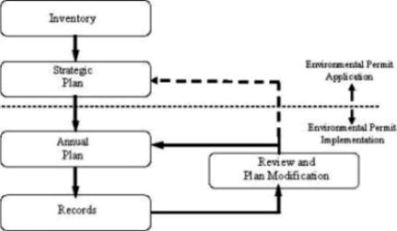
Most nutrient planning processes follow a step-wise procedure similar to that illustrated in Figure 2. At this time, the equation-based estimates of solids and nutrients will have their greatest utility in the strategic or long-term planning. These strategic plans are of greatest value to a new or expanded facility or when a regulatory permit is being assembled.

Figure 2 illustrates a second critical planning phase, the Tactical or Annual Plan. For decisions such as manure application rates, timing, and location, constantly changing conditions such as weather and residual soil nutrients must be considered. On-farm data such as manure samples will likely be of greater value to annual planning processes than the predictions made by the new ASABE equations

Figure 2. Common planning procedure used for nutrient management planning.

Improvements in nutrient excretion estimates offered by the new equations should improve the accuracy of farm-specific planning for:

  • Land requirements for managing N and P. The equations provide a more accurate estimate of nutrient driven land requirements for manure application when on-farm data on manure production is not available. Nitrogen volatilization and availability estimates remain a weak point for this planning process.
  • Cost of manure application. The ASABE equations are being used to estimate manure nutrient value as well as time, equipment, and labor requirements for handling manure (Kissinger et al., 2005).
  • Ammonia emissions. Ammonia emissions from animal facilities are of increasingly interest to the regulatory community. The equations should provide a mechanism for adjusting farm emission estimates based upon several farm-specific factors.

The equations also allow a prediction of dry matter excretion and possibly volatile solids excretion if feed digestibility values are known. This approach will allow farm specific estimates of solids excretion that will benefit planning estimates of:

  • Anaerobic and aerobic lagoon sizing,
  • Anaerobic digester sizing and gas production,
  • Storage sizing if solids estimates are combined with known moisture contents resulting from specific manure handling systems

Summary

The new ASABE standard for manure excretion provides an important tool for key strategic planning activities important to a comprehensive nutrient management plans. In addition, the new standard provides an important tool for integrating feed management decisions into CNMPs and deciding the environmental and economic benefits and costs of feed program options.

Related Files

To follow the references in this article, it is recommended that you print these four PDF files and refer to them at the appropriate places in the article.
Tables 1 and 2
Tables 3, 4 and 5
Table 6
Table 7

Disclaimer

This fact sheet reflects the best available information on the topic as of the publication date. Date 5-25-2007

Acknowledgements

This Feed Management Education Project was funded by the USDA NRCS CIG program. Additional information can be found at Feed Management Publications.

Image:Feed mgt logo4.JPG This project is affiliated with the Livestock and Poultry Environmental Learning Center.

Image:usda,nrcs,feed_mgt_logo.JPG

Project Information

Detailed information about training and certification in Feed Management can be obtained from Joe Harrison, Project Leader, jhharrison@wsu.edu, or Becca White, Project Manager, rawhite@wsu.edu.

Author Information

R.K. Koelsch, University of Nebraska-Lincoln

Images: CC 2.5 Rick Koelsch

Partners

Logos2.JPG

“Extension programs and policies are consistent with federal and state laws and regulations on nondiscrimination regarding race, sex, religion, age, color, creed, national or ethnic origin; physical, mental or sensory disability; marital status, sexual orientation, or status as a Vietnam-era or disabled veteran. Evidence of noncompliance may be reported through your local Extension office.”

Feed Management Planning as a Tool to Reduce Nutrient Excretion

Why is Feed Management Important to Nutrient Planning?

Feed represents the largest import of nutrients to the farm, followed by commercial fertilizer. Feed management practices impact the amount of nutrients that are imported to the farm and excreted in manure. The excreted nutrients are subsequently available for volatile loss (nitrogen) to the atmosphere and potentially lost via surface runoff (nitrogen and phosphorus) or leached to ground water (nitrogen and phosphorus).

Nutrient management planning addresses the proper distribution of manure nutrients, but typically only focuses on the nutrients after they have been excreted by the animal. It may seem obvious, but the amount of N and P consumed by an animal is directly related to the amount it excretes. Formulating an inexpensive ration with excess N or P, will increase the amount of these nutrients excreted in the manure. Depending on the requirements of the farm nutrient management plan, this may mean that the manure must be spread over a larger number of acres compared to manure that contains lower N or P levels.

Feed management opportunities currently exist to reduce imports of nutrients (particularly N and P) to most animal livestock and poultry operations. Since consulting nutritionists play such a key role with regard to importation of nutrients to the farm, a systematic approach to evaluate the role that Feed Management has on whole farm nutrient management is warranted.

Resources Available for Managing Feed Nutrients

The National Feed Management Education Project (NFMEP) has developed a systematic approach to feed management and whole farm nutrient management. The team has developed a series of fact sheets and resources for the four major species. In addition, the LPE Learning Center Small Farms team has developed resources for small acreage livestock and poultry owners.

graphic

CC2.5 LPELC

Authors: Joe Harrison, Washington State University and Jill Heemstra, University of Nebraska

Managing Dietary Phosphorus for Livestock and Poultry

Phytate Phosphorus

Phosphorus is required in the diet of animals, but if overfed or wasted, can contaminate the environment and water supplies. Cereal grains fed to livestock contain phytate-bound phosphorus. Phytate-bound phosphorous is digestible by ruminant animals such as cows, sheep, and goats, but it cannot be digested by single-stomached animals, such as pigs and chickens. Phytate consists of a carbon ring structure with balanced phosphate groups surrounding the ring. Since horses are a hind gut fermenter, they are able to process the phosphorus much like ruminant animals.

Since phytate-bound phosphorous is unavailable to pigs, chickens, and other single stomached animals, phosphorous from other sources is supplemented to meet the needs of the animal. The extra phytate-bound phosphorus will be unavailable and excreted in the manure.

Reducing the proportion of cereal grains in the diet will usually reduce the amount of phosphorus fed. However, for pigs and chickens, and there are few economic alternatives to cereal grains. Plant breeders are working to develop feed grains lower in phytate content and higher in available phosphorus.

Phytase in the Feed

An enzyme called phytase can be included with the diet. Phytase will break down phytate and release digestible phosphorus. Mixing phytase (commercially available) in the diet will reduce the phosphorus required in supplements.

Interactions Between Nutrients

Another factor affecting phosphorus availability is the presence of other nutrients in the diet. Overfeeding calcium can limit the availability of phosphorus. Calcium and other nutrients should be fed in balance so as not to disrupt the availability of phosphorus.

Calcium:Phosphorus Ratio for Horses

Horses are a bit unique; they require calcium and phosphorus to be in a specific ratio in the diet. Young growing horses, as well as lactating mares, should receive a Ca:P ratio of 2:1, while mature horses not reproducing can get by with a 1:1 ratio. Calcium should never be fed at a level lower than phosphorus because phosphorus will tend to interfere with calcium absorption into bone. Horses at maintenance require .17% phosphorus in the diet and .24% Ca. The highest levels of phosphorus are needed in reproducing mares (.34%). Typical horse diets approach 2 to 3 times the required level of phosphorus, which can be detrimental to the environment. This high phosphorus level is partially due to the estimated Ca:P ratio in alfalfa hay being 6:1. Many horse owners try to counteract this by adding more phosphorus to the diets. Many equine supplements already contain more phosphorus than is necessary. There are also phosphorus concerns for ruminant animals such as cows, sheep, goats, and etc.

Ruminants and Phosphorus

Ruminant animals have a phytate enzyme produced naturally within the rumen that breaks down phytate-bound phosphorus and makes it available to the animal. According to the National Research Council, a lactating dairy cow requires between .35 and .40% phosphorus in the diet. Previous dairy feeding practices included as high as .55% or .60% phosphorus in the diet. This would mean an excess of 25 to 30 pounds fed to a cow in a normal lactation. If you multiply this over a dairy herd with 100 cows, then nearly 3,000 pounds extra phosphorous would be fed over the course of a year. Some dairy farmers think that phosphorus is a mineral required for proper reproductive function. While phosphorous is indeed important for normal bodily functions and is important for reproduction just as all nutrients are important for reproduction, there is no special link between phosphorus and reproduction in a cow. Most dairy farmers have already reduced phosphorus in their diets to levels given by the National Research Council.

Feed Management Tips for Small Livestock Farms

How can small farms make the most efficient use of their feed resources and reduce potential environmental impacts? They do it by managing their feed supplies and animals carefully using some of the tips mentioned below. Farmers also need to pay special attention to nitrogen and phosphorus.

Appropriate Use of Feed Additives

Additives, supplements, hormones, antibiotics, and etc. are generally very effective ways to improve animal performance and efficiency. If used, these should be fed as prescribed on the label, or under the care of a veterinarian.

Examples of additives are:

  • Ionophores like monensin or bovatec affect fermentation in the bovine (cattle) rumen and improve performance and feed efficiency. (Monensin and bovatec should never be feed to horses!)
  • Hormones such as anabolic implants and steroids or rBST (recombinant bovine somatotropin) improve production efficiency, growth rate or milk production in cattle. Hormones are not used in pig or poultry production.
  • Antibiotics, which, when used properly in the diet, can result in improved feed efficiencies and health. Using antibiotics for the purpose of growth promotion and not disease control (called sub-therapeutic use) is under a great deal of scrutiny and is becoming more controversial as scientists look for ways to combat antibiotic-resistance in microbes and pathogens.

Products that improve nutrient efficiency will also reduce excretion relative to production.

How to Incorporate By-Product Feeds in Diets

By-product (often also called co-product) feeds are often used in animal diets. These are by-products of other industries, such as the production of distilled spirits, ethanol, or beer, wheat processing, milling, and soy oil among others. These co-products, such as brewer’s grains, distiller’s grains, soy hulls, and others can make excellent animal feedstuffs.

There are also byproducts from the wheat milling industry, such as wheat bran, middlings, reddog, shorts, etc. By-products from wet corn milling give us high fructose corn syrup and a variety of other corn products including corn gluten feeds and meals. In addition, there are products such as citrus pulp, beet pulp, and whole cottonseed. Some farms even feed expired foods that have been returned to distributors from grocery stores.

One disadvantage of by-products is that their nutrient content is often variable; these feeds should be sampled regularly so estimates of nutrient content can be used in formulating diets. Sometimes, the by-product supplier will provide a nutrient analysis when requested. Advantages of by-products are that they can often be purchased more cheaply than traditional feeds and utilize a material that might otherwise become a part of the waste stream.

Managing Feed Variability

Every load of feed that comes out of the field during harvest or is delivered by the feed company is different from the previous load. Every bale of hay in the summer is different from the previous bale. Every scoop full of grain that is given to a horse or livestock animal is different from the previous container of grain. It is essential that producers get a handle on the variability of their feed and ensure that to the best of their knowledge and ability they are able to balance diets for the nutrients that are in the feeds they are using.

There are feed and forage labs available and feed samples can be sent to these labs to determine nutrient content. In this way diets can be formulated based on the nutrient content of each individual component. It is possible to use published values when nothing else is available. However, these are only averages of many samples and may not reflect actual conditions.

Monitoring Feed and Forage Quality

Every effort should be made to use feeds of a high quality. For ruminants to reach optimum levels of production, it is essential that forages be of the best quality possible. Those too high in fiber, or rained on during production, or that spoil in the silo, will result in lower levels of production, will be more costly to the producer, and may result in greater levels of nutrient loss.

Every extra day beyond the optimum harvest date for hay in the summer will result in a reduction in forage quality and greater costs to the producer. This is an important point to remember; harvesting forage at the optimum time will improve quality, result in greater profitability for the producer, and less waste of feed and nutrients. Feed samples and laboratory analysis

Related: Forage Testing and Interpreting the Analysis…. (dairy) | Hay analysis: Its importance…. (horses)

Monitor Health and Disease

Sick animals are not productive animals, but will continue to consume feed since they have a requirement for body maintenance. They will continue to excrete nutrients in their manure. All animals should be on a regular health and herd management program. They should be vaccinated for disease regularly and monitored for special diseases. To reduce waste, temporarily reduce feed delivery to sick animals and gradually bring it back up to full levels as they recover.

All domestic livestock animals can be affected by parasites. Parasites will infest the intestines and can result in substantial decreases in performance. Whenever this happens, the efficiency of nutrient utilization is going to decline and influence nutrient excretion. All animals should be on a regular de-worming and parasite control schedule.

Toxins in the feed or water may also influence animal production. For example, during a drought year forage quality will often decline, and toxins, such as excess nitrates, may be taken up from the soil by plants and influence animal production. Plant growth stress can also result in the formation of mycotoxins in the feed; this can occur in both feed grains and forages. These toxins can result in decreased production, as well as sickness and death. Whenever toxins are believed to be a problem, it is important to test feed and water supplies to ensure the adequate consumption of uncontaminated feeds and water.

Feed Processing

Processing feed is helpful if animals are to digest and absorb nutrients. In recent years, the use of corn silage kernel processors has increased on dairy farms. Kernel processors typically use physical force to break down each kernel of grain and make the nutrients in the kernel more available to digestive processes. This has been shown to result in a significant increase in production in animals fed these diets.

Feed processing includes grinding, flaking, steam rolling, and other processes that improve the availability of nutrients. For example, sorghum grain or milo is unavailable to ruminant animals and horses without some level of processing, such as grinding or steam flaking. It can be utilized by chickens that have the advantage of the crop and gizzard in their digestive system. If there is any down side to feed processing, it would be over-processing or over-mixing. Over-processing usually means that the feed reached too high a temperature. This causes chemical changes that can offset the benefits and actually tie-up or bind nutrients.

Mixing feeds, particularly forage, for too long of a period of time can break particles down into smaller pieces. These pieces tend to move more quickly through the gastrointestinal tract and not be digested at a level required for optimum utilization and health of the animal. Processed feeds are also more expensive than unprocessed, and might not always be necessary (e.g. oats for horses).

Reducing Feed Waste

cows fed a bale of hay on pasture and wasting most of it

A hay bale fed on the ground like this one will result in as much as 40-50% waste. Hay feeders can greatly reduce the loss.

It is common for animals to spill or waste feed. For example, pigs will waste as much as 20% of their diet while eating. This wasted feed is often wet, covered with saliva, and it will spoil and rot. If this feed is left in place, animals will not consume it. Silage left in the feed bunk and not consumed quickly is especially susceptible to spoilage and will not be eaten. Wasted, spilled, and rotten feed is a breeding ground for flies and attracts vermin like mice and rats.

  • Bunks and feeders should be designed to reduce wasted feed.
  • Bunks and feeders should be cleaned on a regular basis so spoiled or rotten feed can be removed.
  • Do not feed animals on the ground. It is a common practice, but there is no greater source of waste than feeding an animal on the ground. Although this might be acceptable with beef cows or sheep on the open range, or even horses, it is not acceptable to feed animals on the ground near a stream. This sort of waste also contributes to the creation of mud in pastures and paddocks.

Use Feed Ingredients High in Nutrient Availability

The availability of individual nutrients can vary from feedstuff to feedstuff; for example phytate-bound phosphorus in cereal grains. Ruminants can utilize phytate-phosphorus but horses and pigs cannot. Pig farmers often add an enzyme, phytase, to swine diets to make the phosphorus more availalable. This reduces the amount of phosphorus supplement needed and also reduced the phosphorus excreted in manure. It is important for producers to choose feedstuffs that have nutrients high in bioavailability. This means that nutrients present in feedstuffs are readily available and utilized by the animal. Related: Managing dietary phosphorus…

Authors

Michael L. Westendorf and Carey A. Williams, Extension Specialists in Animal Sciences, Rutgers, The State University of New Jersey. This article was originally published as Rutgers Cooperative Extension Fact Sheet FS 1064. Updated November 25, 2008.

Managing Dietary Nitrogen for Livestock and Poultry

Diets should be managed to reduce nitrogen (N) losses. Protein is the chief N source in the diet, and N is the nutrient we are most concerned with. If a growing pig requires 22% protein in the diet and is fed 25% protein, then the excess (containing N) is going to be lost. Some N is going to be lost in the feces, and some that is absorbed is going to be lost as urea in the urine. Conversely, if a pig requires 22% protein, and is only fed 18% protein, then that animal’s production will be limited to the 18% level. In this case other nutrients in the diet will be in excess and cannot be utilized efficiently. Nitrogen feeding strategies are different for all livestock species.

Dietary Nitrogen Management for Ruminants

Ruminants (cow, sheep, goat, etc.) have a requirement for proteins that are quickly degraded in the rumen, called degradable intake protein (DIP). They also require proteins less quickly degraded or undegradable in the rumen, undegradble intake protein (UIP). If too much UIP protein is fed, then some of that excess will probably be excreted in the feces. On the other hand, if too much degradable protein is fed, there will be too much absorption of nitrogen into the blood supply and it will be lost in the urine as urea. Most research has shown that lactating dairy cows require about 32% to 38% undegradable protein in the diet, with the remainder being made up as degradable protein.

To learn more about protein for cattle see the following Livestock and Poultry Environmental Stewardship (LPES) Curriculum lesson sections:

Dietary Nitrogen Management for Non-ruminants

With non-ruminant animals, like chickens, horses, and pigs, individual amino acids are the basis of diet protein formulation. (Protein is composed of individual nitrogen-containing amino acids). A ruminant has a microbial population that produces essential amino acids in the rumen, so there is less focus on amino acids for them. In the case of pigs, horses, and chickens each individual amino acid is important. Lysine is usually the first limiting amino acid when feeding pigs and horses, and methionine is usually first limiting with chickens. Commonly used feeds are limiting in these amino acids and must be supplemented through balancing with other ingredients or by adding commercially-available crystalline amino acids to the diet.

To learn more about protein for non-ruminants, see the following Livestock and Poultry Environmental Stewardship (LPES) Curriculum lesson sections:

Feed Management on Small Livestock Farms

Why Is Feed Management Important?

Nitrogen and phosphorus from agriculture sources can affect water quality. These nutrients are required for plant and animal growth, but too much in agricultural runoff can result in environmental and health concerns. This fact sheet provides some guidelines to help livestock producers, especially those on small farms, reduce nitrogen and phosphorus losses by monitoring and/or changing feeding and management practices. This can result in less waste and ultimately a healthier, cleaner, and safer environment. Wasted feed and wasted nutrients also represent wasted money for the farm.

Nutrient Balance on Small Farms

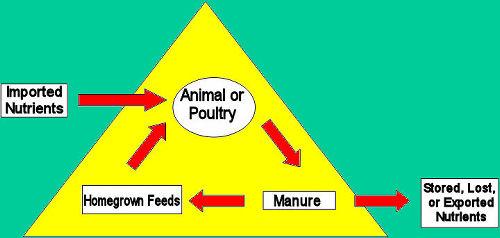
Nutrient inputs on a farm consist of feed, animals, irrigation water, fertilizer, legume nitrogen, etc. Outputs are meat, milk, animals, crops, and manure. When inputs exceed outputs, losses will be present in feed or barnyard waste, in manure, and in lot runoff, etc. These losses may result in excess nutrient storage in the soil. Nutrients may leach through the soil (nitrate) into ground water or run off the soil surface (phosphorus and nitrogen) and directly transported to surface waters.

Each farm should be seen as a complete system or cycle with inputs, outputs, storage, losses, and recycling all taking place. To illustrate, a 120-cow dairy farm will require 29.2 tons of nitrogen and 2.6 tons of phosphorus per year. Outputs (meat, milk, fiber, etc.) will be 6.9 tons of nitrogen and .8 tons of phosphorus, resulting in 22.3 tons of nitrogen and 1.8 tons of phosphorus for disposal, usually through spreading on available land. Similar calculations can be made for all livestock species. See “Whole Farm Nutrient Balance“…

If nutrients are overfed, or if feeding is mismanaged on an individual farm, this will result in more nutrients to manage in manure or as spoiled feed. While these nutrients can be applied to crop or hay ground to raise feed, it is important to try and keep this recycling loop as balanced as possible to avoid build-up of excess nutrients. Proper animal feeding and management practices can ensure that feed nutrients are not wasted, not overfed, and feed efficiency will be optimized on the farm.

Feeding Management

Feeding a balanced diet, avoiding overfeeding, and providing abundant supplies of cool, clean, and pure water will help to optimize feed and nutrient use on an animal farm. One way to understand nutrient requirements is to imagine a stave barrel. Only when all staves making up the barrel are the same length will water stay in the barrel. If all staves are 3 feet long, all the water will stay in the barrel. However, if one stave is a foot and a half long, then all the water will run out of the barrel to the level of a foot and a half. (See Figure below.)

barrel

CC2.5 LPELC

That is exactly what is happening with a balanced diet. If all nutrients are in a perfect balance, then there will be no excess and no wastage. It is impossible for all nutrients to be in a perfect balance in commercial or practical diets, but we want to come close to meeting an animal’s nutrient requirements. If the diet is balanced except for one underfed nutrient, then the entire production of the animal will be limited to the level of that “limiting nutrient” and all other nutrients will be wasted.

Overfeeding can be harmful to animals and to the environment. Animals that become overconditioned or obese may be unproductive and at greater risk of health problems. Excess feed is often wasted and may remain in the feeding area, become contaminated, and end up in the manure pile. Water is the most abundant, cheapest, and least understood of all nutrients required for livestock production. Water is of concern whenever it is in short supply or contamination is suspected. If subfreezing temperatures turn water into a frozen nutrient, it will mean trouble for domestic livestock. Distress is often brought on by cold wet winter weather requiring an animal’s digestive system and metabolic processes to function at peak efficiency to convert feedstuffs to energy so that they can remain warm, healthy, and productive.

Conversely, in hot summer weather, water is essential to the animal as well. It serves to cool the animal and works as a solvent or buffer for chemical reactions in the body. When the weather is hot in the summer, an animals’ requirement for water will increase. A lactating dairy cow requires on the average between 15 and 35 gallons of water per day; non-lactating dairy and beef cows require about 15 gallons per day; an adult horse will consume up to 15 gallons per day, which will increase 2 to 3 times when exercising; an adult sheep between 1 ½ and 3 gallons a day; adult swine from 3 to 5 gallons per day; and adult hens about a pint.

A quick rule of thumb is that for every 2 pounds of dry feed intake, an animal should receive one gallon of water. This will vary with stress, weather conditions, heat, cold, disease, productive state, work, exercise, etc., as well as the water and salt content of the feed. Often the first sign that water consumption is inadequate is when animals stop eating. Water is essential to maintain adequate feed consumption.

How does this affect nutrient management?

If we want our animals to reach maximum levels of production, then they will only have optimum feed intake if they receive adequate amounts water. Level of salt in the water or the diet can influence water requirements as can the presence of heavy metals, nitrates, microbes, and algae. Water is not related to runoff or contamination on the farm in the same way that overfeeding or imbalanced diets are, but water influences the ability of animals to use feed. If water is inadequate or contaminated, then animals will use diets less efficiently, eat less, be less productive, and may excrete more nutrients in waste.

How Do I Feed My Livestock to Avoid Waste and Maximize Efficiency?

Check out the list of helpful feed management tips for practical ways to manage feed and nutrients. Some of the topics on the page include:

Feeding animals is both an art and a science. It is a science influenced by years of research and it is an art developed by centuries of practical experience. Healthy animals fed balanced diets and provided with abundant supplies of fresh water will be the most productive. These animals will be the most profitable to the farmer and the most efficient users of nutrients.

References

  • National Research Council. 1989, 1994, 1996, 1998, 2001. Nutrient Requirements of Horses, Poultry, Beef, Swine, and Dairy. National Academy Press, Washington, DC.
  • Ralston, S. L. 1993. Analysis of Feeds and Forages for Horses. Rutgers Cooperative Extension. NJAES. Factsheet – FS714.
  • Singer, J. W. and D. L. Lee. 1999. Feed and Forage Testing Labs. Rutgers Cooperative Extension. NJAES. Factsheet – FS935.
  • Williams, C. A. 2004. The Basics of Equine Nutrition. Rutgers Cooperative Extension. NJAES. Factsheet – FS038.©2007 Rutgers, The State University of New Jersey.All rights reserved.
  • Rutgers Cooperative Extension Fact Sheet FS 1064
  • N.J. Agricultural Experiment Station
  • Rutgers, The State University of New Jersey, New Brunswick

Cooperating Agencies

  • Rutgers, The State University of New Jersey, U.S. Department of Agriculture, and County Boards of Chosen Freeholders.
  • Rutgers Cooperative Extension, a unit of Rutgers New Jersey Agricultural Experiment Station, is an equal opportunity program provider and employer. Published: June 2007

Authors: Michael L. Westendorf and Carey A. Williams, Extension Specialists in Animal Sciences, Rutgers, The State University of New Jersey. This article was originally published as Rutgers Cooperative Extension Fact Sheet FS 1064. Updated November 25, 2008.

Dairy Feed Nutrient Management Fact Sheets

Introduction to Feed Management and Developing a Feed Management Plan

It is strongly recommended that you read these introductory fact sheets before the dairy-specific ones.

Developing A Dairy-Specific Feed Management Plan

Managing Feed Nutrients on a Dairy Farm

Tools and Resources for Developing a Feed Management Plan

These fact sheets were developed as part of the National Feed Management Education Project.