
Costs of Slurry Manure Application and Transport

Livestock and Poultry Environmental Learning Center:

Home Page

All articles about:

Manure Value and Economics

Livestock such as dairy and swine often have slurry type manure. The manure is liquid but does not flow easily. It is either stored directly below the animal pens, or scraped or pumped periodically into a holding pen outside of the building.

Loading Slurry Manure

Loading slurry manure is accomplished with a pump powered by a tractor or stationary engine. The slurry can be loaded into tractor-pulled or truck-mounted tankers, or pumped through a hose attached to a tractor that applies it as it is being pumped from the pit. The cost of loading slurry is usually low because the pump can do it quickly and the volume per animal is not usually high.

Slurry Manure Transport

Transportation of slurry by tanker can be expensive because a lot of water is being transported and the same equipment that is hauling the slurry is usually land applying the slurry. When tankers are used, the number of hours spent transporting the slurry is frequently the limiting cost. The land may become unavailable to receive the slurry, due to crop planting times or soil conditions, before all of the slurry can be land applied. Often, the distance transported is limited so that the time constraints can be met.

If the slurry is pumped through a hose to the field, the transport time is negligible. As the slurry is pumped, it is simultaneously injected or surface applied to the land. The important cost becomes the cost of purchasing pipe and hose that is sufficient for this method of land application.

Land Application of Slurry Manure

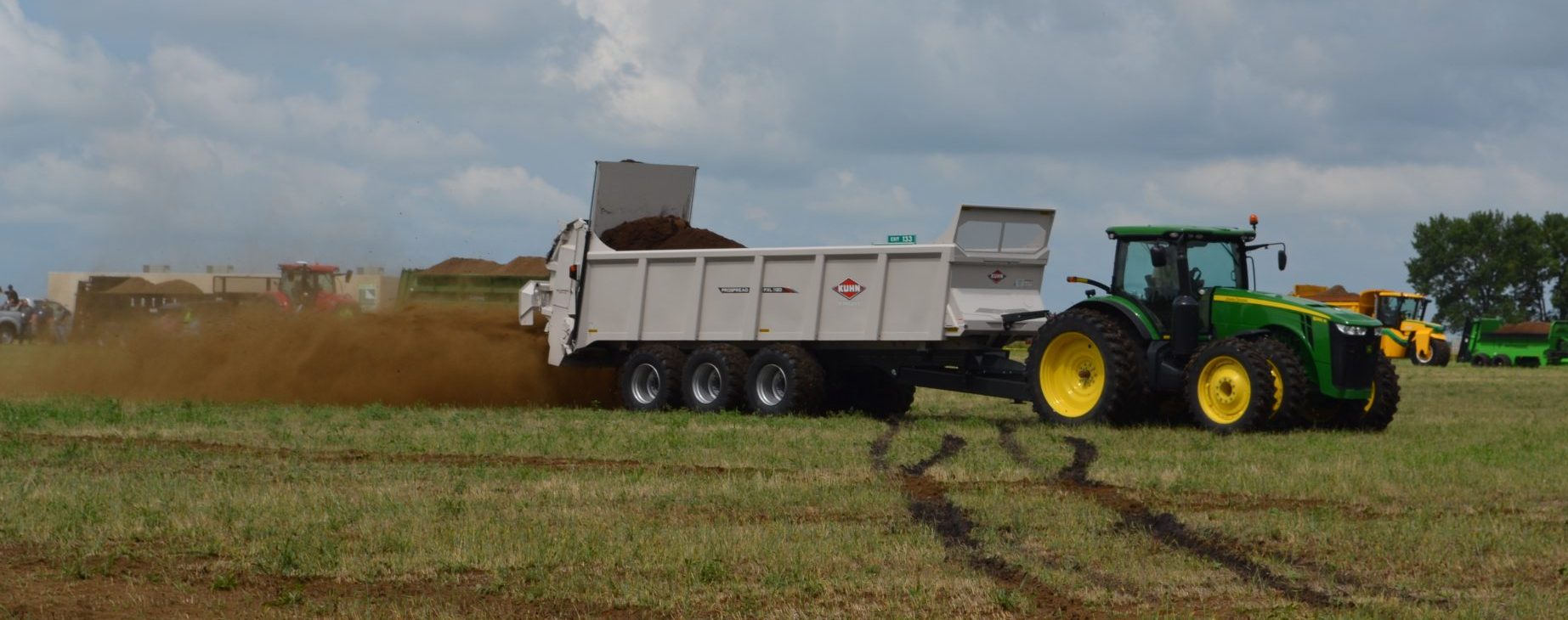
The cost of land application of slurry varies with the type of equipment used. Tankers can be expensive to own unless they are used for many animals on many acres. There is a definite economy of scale with tankers. Additionally, the tankers usually require fairly large tractors or trucks. If the livestock owner does not have a cropping enterprise that requires the large tractor, ownership of the tractor for manure distribution alone becomes expensive.

Tankers are economical for large-scale operations with slurry manure.

When slurries are applied via hoses (called dragline hoses), a tractor pulled distributor is used to move the hose around the field so that the slurry is evenly distributed. The cost of the equipment can be very expensive, but the amount of time is decreased considerably compared to using tankers because most of the time is spent in applying the slurry. Very little time is spent getting into and out of the field, as is the case when using tankers.

Authors: Ray Massey, University of Missouri and Josh Payne, Oklahoma State University

Costs of Liquid Manure Application and Transport

Livestock and Poultry Environmental Learning Center:

Home Page

All articles about:

Manure Value and Economics

What Systems Produce Liquid Manure?

Liquid manures are most common with pork production where the manure is flushed from the building and stored outside in lagoons. Liquid manures are mostly water with some organic matter and nutrients suspended in the water. Most of the organic matter decomposes in the lagoons and is not removed.

Options to Haul and Apply Liquid Manure

While some livestock producers haul liquid manure in tankers, it is usually considered cost prohibitive. The amount of water is so great that the hours spent distributing it and the resulting dollar cost exceeds the value of the manure supplied nutrients when using tankers.

Liquid manure is usually pumped through pipes and hoses to the land that will be accepting the manure. This means that loading costs and transportation costs are relatively low. Once the manure is at the field, it can be applied with a tractor that pulls the dragline hose through the field or via an irrigation system. The irrigation system can be a stationary sprinkler or a single big gun sprinkler that must be moved periodically by the operator.

Liquid manure can be land applied with a dragline hose.

Other options include, a big gun sprinkler or a center pivot irrigation system that move automatically through the field. The center pivot irrigation system is usually too expensive to own just for liquid manure distribution; it is usually part of an irrigation system that also pumps clean water. The stationary and big gun sprinklers are inexpensive and easy to use.

Authors: Ray Massey, University of Missouri and Josh Payne, Oklahoma State University

Equipment and facilities for managing manure on small farms

The number of small farms is increasing in much of the country, ensuring up to date information is available is important to protect water and environmental quality. This webinar focuses on some of the farm and manure management needs of smaller farms. This presentation was originally broadcast on April 20, 2018. More… Continue reading “Equipment and facilities for managing manure on small farms”

Thermal Manure-to-Energy Systems for Farms: Technical and Environmental Feasibility

Results of performance evaluations, including technical and environmental feasibility are presented, along with results from field trials where ash and biochars were compared side-by-side in row crop and vegetable production with commercial fertilizer and untreated poultry litter.This presentation was originally broadcast on September 18, 2015. More… Continue reading “Thermal Manure-to-Energy Systems for Farms: Technical and Environmental Feasibility”