
 Waste to Worth home | More proceedings….
Why Study Manure Land Application and Steroids?
Manure generated from concentrated animal feeding operations may serve as a source of steroids in surface water and adversely impact the development of aquatic ecosystems. The objectives of this research were to determine the amount of steroids and metabolites in manure from beef cattle production pens, and runoff from crop production fields.
 What Did We Do?
Heifers were treated with zeranol, trenbolone acetate, and 17b-estradiol implants and fed melengestrol acetate, while a second group was not treated with growth promoters. Manure was sampled in the pens during feeding, run-off was collected during rainfall events, after feeding manure was collected, and either composted or stockpiled overwinter. In the following summer both composted and stockpiled manure was spread on a field, with plots subjected three tillage practices. Following application, two rainfall simulation events were conducted: one day (1 DAT) and one month later (30 DAT) to determine the effects of rainfall timing, manure handling (treated compost, untreated compost, treated stockpile and untreated stockpile) and tillage (no-till, moldboard plow+disk and disk) on the runoff losses of steroids.
What Have We Learned?
|
Simulated rainfall apparatus. |

Results from the manure composting showed reduction in steroid concentrations over stockpiling for some compounds in manure samples such as 4-androstenedione, a-zearalenol, and progesterone, though not for all steroids. Very low concentrations of steroids were found in most runoff samples, approaching or below detection limits. Considering only detection frequency, fewer runoff samples showed traces of steroids on the 1 DAT in comparison to the 30 DAT simulations. The amount of rainfall before runoff was initiated was affected by tillage, and was different for the 1 DAT and 30 DAT events. A second year’s study with a smaller set of treatments, and use of a surrogate estrogen applied at known mass showed that disking significantly reduced runoff losses of the steroids. Runoff risk is affected by the storm event needed to initiate runoff, and also the time since manure application.
|
Soil during rain simulation and tube to take runoff to collection point. |

Future Plans
From both the steroid runoff and general manure applications risk perspectives, how the soil receives rainfall changes during the first month after tillage. Therefore, this process needs to be investigated more closely and models predicting runoff have to take these changes into account.
Authors
Charles A. Shapiro, Professor, Department of Agronomy and Horticulture, University of Nebraska-Lincoln, Haskell Agricultural Laboratory, Concord, NE cshapiro@unl.edu
Sigor Biswas, Research Assistant, William L. Kranz, Associate Professor, David P. Shelton, Professor, Simon J. van Donk, Assistant Professor, Biological Systems Engineering; Daniel D. Snow, Associate Professor, Schol of Natural Resources; Shannon L. Bartelt-Hunt, Assistant Professor, Tian C. Zhang, Professor, Civil Engineering; Terry L. Mader, Professor, Animal Science, University of Nebraska-Lincoln; David D. Tarkalson, Soil Scientist, USDA-ARS, Kimberly-ID.
Additional Information
Bartelt-Hunt, S., D. Snow, W. Kranz, T. Mader, C. Shapiro, S. van Donk, D. Shelton, D. Tarkelson, and T.C. Zhang. 2012. Effect of growth promotants on the occurrence of steroid hormones on feedlot soils and in runoff from beef cattle feeding operations. Environ. Sci. Technol. 46(3): 1352-1360.
Biswas, S., C. A. Shapiro, W. L. Kranz, T. L. Mader, D. P. Shelton, D.D. Snow, S. L. Bartell-Hunt, D. D. Tarkalson, S. J. van Donk, T. C. Zhang, S. Enslay. Current knowledge on the environmental fate, potential impact and management of growth promoting steroids used in the US beef cattle industry. J. of Soil and Water Cons. (In press, July 2013 issue).
Acknowledgements
This research was funded by US-EPA Science to Achieve Results (STAR) grant R833423.
The authors are solely responsible for the content of these proceedings. The technical information does not necessarily reflect the official position of the sponsoring agencies or institutions represented by planning committee members, and inclusion and distribution herein does not constitute an endorsement of views expressed by the same. Printed materials included herein are not refereed publications. Citations should appear as follows. EXAMPLE: Authors. 2013. Title of presentation. Waste to Worth: Spreading Science and Solutions. Denver, CO. April 1-5, 2013. URL of this page. Accessed on: today’s date.


 Algal biomass offers many advantages over traditional energy crops; algal biomass generates higher yields and requires smaller land area than other energy crops. In addition to biomass production for potential biofuel feedstock generation, algal growth systems can also act as tertiary treatment systems for wastewater. Algal growth can dramatically reduce nitrogen and phosphorus from wastewater. Unlike conventional open pond and photo-bioreactor systems, periphytic systems (e.g., algal turf scrubbers) generally involve the polyculture of micro-algae, which does not require specialized conditions. While algal turf scrubber systems are traditionally used for water treatment, they are also capable of generating high biomass yields.
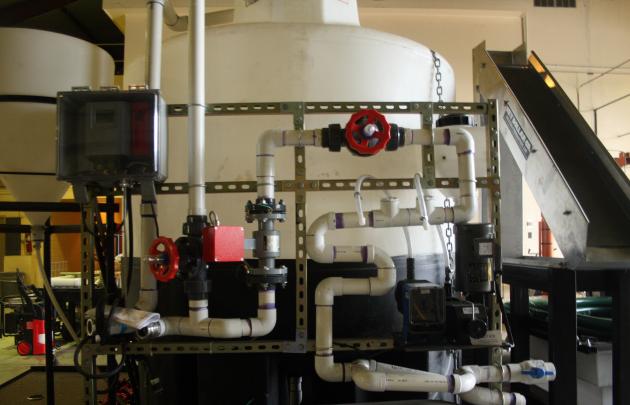
 Many technologies being considered incorporate some type of manure separation to concentrate manure solids, nutrients, and energy content. An LCA study in Denmark showed that energy recovery (incineration, gasification, and anaerobic digestion) had lower GHG emissions than traditional land application of swine manure. Other studies point to the complexities of manure management system design options in relation to GHG emissions. This portion of the project will quantify the effect of various solid separation approaches on the chemical composition of the manure generated by the feed trials at the University of Arkansas facilities during this project ,and generate the necessary manure solids for the thermo-chemical conversion portion of this project. Design and construct a pilot scale mobile solids separation system (see image below) is currently approaching completion and anticipated to be ready to begin trial calibrations soon.