South Carolina’s Confined Animal Manure Manager Program

Waste to Worth: Spreading science and solutions logoWaste to Worth home | More proceedings….

Abstract

In 1998 the South Carolina Legislature enacted regulation R.61-43, titled “Standards for the Permitting of Agricultural Animal Facilities.”  This regulation provides requirements on Confined Animal Facility location and permitting, facility management, vector control, mortality disposal, manure application and storage, and a number of other topics.  A portion of this regulation stipulates that Clemson University shall provide training in the management of confined animal facilities and the proper application and utilization of manure produced from these facilities.  The poster will detail the major points of the regulation and the development and presentation of the Confined Animal Manure Manager program in South Carolina to over 1,500 growers to date.

Authors

Bryan Smith, Clemson University Cooperative Extension Service               wsmth@clemson.edu

Jesse Adams III, M.S., Area Extension Agent – Livestock, Clemson Extension Service (ret.), Brian L. Beer, M.S., Area Extension Agent – Livestock, Clemson Extension Service, John P. Chastain, Ph.D., Professor and Extension Agricultural Engineer, Clemson University, Julie D. Helm, DVM, Livestock-Poultry Health Division, Clemson University, Stephen T. Henry, M.S., Environmental Engineer, USDA-NRCS, Tonya O’Cain, Agricultural Compliance Manager, SCDHEC, Lee van Vlake, M.S., Area Extension Agent – Livestock, Clemson Extension Service


The authors are solely responsible for the content of these proceedings. The technical information does not necessarily reflect the official position of the sponsoring agencies or institutions represented by planning committee members, and inclusion and distribution herein does not constitute an endorsement of views expressed by the same. Printed materials included herein are not refereed publications. Citations should appear as follows. EXAMPLE: Authors. 2013. Title of presentation. Waste to Worth: Spreading Science and Solutions. Denver, CO. April 1-5, 2013. URL of this page. Accessed on: today’s date.

Iowa Manure Management Action Group (IMMAG)

Waste to Worth: Spreading science and solutions logoWaste to Worth home | More proceedings….

Abstract

The Iowa Manure Management Action Group (IMMAG) was a concept born in 1997 to provide a comprehensive vehicle to deliver manure management information.  It is hard to imagine, but at that time web pages were just beginning to be used as vehicles to share information, and even harder to imagine is the fact that while information on manure management existed, it was difficult to access, and it was just not a topic that garnered much positive attention.

IMMAG began as state-level technical committee comprised of public and private-sector entities with the objectives to 1) provide access to comprehensive information on manure management issues; 2) develop relevant educational materials and 3) provide them in a format that could be easily accessible.

Now, 15 years later, what was supposed to be short-term, one-year effort, has turned into a major outreach and education effort for Iowa State University Extension and Outreach and their partners.  In addition to the web page, IMMAG has hosted many field days and training workshops over the years as well as coordinated the development of countless fact sheets, newsletters and other educational pieces. 

Why Was the IMMAG formed?

As the livestock sector in Iowa changed in the 1990’s it became apparent that a mechanism for information delivery was needed that could quickly evolve to keep livestock producers in tune with changing regulations, up-to-date with current research and understand best management practices to help assure manure’s value as a crop nutrient resource and help protect Iowa’s natural resources.

IMMAG was a concept born in 1997 to provide a comprehensive vehicle to deliver manure management information, develop and deliver educational programs, and design tools and resources that could be used by producers, technical agencies, educational institutions, researchers, consultants and the general public.  IMMAG originated as a state-level technical committee under the leadership of the Iowa NRCS that brought together the state agencies, land-grant institution, commodity groups, environmental groups and private sector interests who proceeded to identify challenges and needs for manure management information. 

What Did We Do?

After an initial needs assessment was completed, members of IMMAG agreed the highest priority was the development of an integrated Web site for all manure management information.  A Web page would allow the most flexibility in keeping materials up-to-date.  The members also agreed that producers and others not having internet access would be able to request printed materials from the site made available through the commodity organization.   Once all existing materials were organized and included on the IMMAG Web page, a needs assessment was conducted by ISU Extension and the commodity group to determine information gaps and the kinds of new material that needed to be developed.  Materials were not limited to print resources, but also included development and delivery of nutrient planning workshops, field days and tools.  Along with a needs assessment, the Web site was thoroughly evaluated by members of the environmental groups and the general public to determine how accessible the information was and how easy it was to use and comprehend. 

During the past 15 years, the Iowa Manure Management Action Group has distributed monthly newsletters (originally printed, now e-newletters); created 40 fact sheets;  hosted over 50 field days and workshops, coordinated 3 multi-day manure clinics for producers and professionals; written over 200 popular press articles,  supported and developed material for nearly 600 Extension meetings;  and developed 9 video presentations. 

What Have We Learned?

The biggest lesson learned from this educational outreach program was and is the success  of integrating the state agency, land-grant university and livestock commodity group message to assist livestock producers.  This partnership allowed the development of  a consistent message among all involved when it came to manure management so producers and their technical staff were using the same recommendations and planning processes across all programs.  Other important things learned include  1) longevity of programs are crucial to producer awareness and success; 2) a defined mechanism for intergrating research into extension programming is crucial for producers to make informed choices related to best management practices; 3) leveraging financial support to serve all clients helps level the playing field in terms of client access to educational materials, events and access to technical assistance and 4) when provided with appropriate training and resource materials, it is possible to develop an entire service industry to assist producers with manure nutrient management planning.

Future Plans

Many internal discussions have identified the need to continue to support this effort even with the availability of other national programs that serve as clearinghouses for manure management information.  Future needs for program implementation  include coordinating long-term financial support for continued programming and a needs assessment that is relevant to current production practices.  Future needs for program delivery include more field days and hands-on type experiences for producers and their service providers. 

Authors

Angela Rieck-Hinz, Extension Program Specialist, Iowa State University, amrieck@iastate.edu

Additional Information

IMMAG Home Page


The authors are solely responsible for the content of these proceedings. The technical information does not necessarily reflect the official position of the sponsoring agencies or institutions represented by planning committee members, and inclusion and distribution herein does not constitute an endorsement of views expressed by the same. Printed materials included herein are not refereed publications. Citations should appear as follows. EXAMPLE: Authors. 2013. Title of presentation. Waste to Worth: Spreading Science and Solutions. Denver, CO. April 1-5, 2013. URL of this page. Accessed on: today’s date.

Water Quality Initiatives for Small Iowa Beef and Dairy Feedlot Operations (Small Feedlot Project)

Waste to Worth: Spreading science and solutions logoWaste to Worth home | More proceedings….

Abstract

Traditionally, small feedlots and dairies have not been engaged in environmental regulations and awareness in Iowa due to the environmental focus being directed at large feedlots and confinement feeding operations.  Many small feedlot and dairy managers do not even recognize or admit that regulations do apply to their livestock operation. This effort primarily uses traditional extension outreach methods, field days and publications, to raise awareness.  Unique to this outreach effort are the goal to provide a producer network to share information and ideas to learn more about manure runoff control structures and best management practices to reduce impacts on water quality, and the focus on controls beyond minimum rule requirements, but tailored to small operations.

This talk will discuss some of the challenges faced by small feedlot producers, identification of parameters to help producers overcome some of these challenges, and methods and educational materials aimed at helping raise environmental awareness and foster action among these producers.

Purpose

The Small Feedlot Project is a cooperative effort between state and federal regulatory agencies, public research and extension, technical agencies and the private sector in Iowa.  The primary objectives are to 1) educate producers to better understand the pollution potential of open feedlot runoff, 2) train producers to accurately assess the water pollution potential of their own feedlots, 3) assist producers to identify and evaluate appropriate runoff control alternatives, and 4) provide technical assistance to producers to implement solutions that improve the environmental performance of their feedlots.  

What Did We Do?

The first focus in regards to raising awareness about potential impacts of runoff from open feedlots was the development of two producers guides that specifically talk about open lot runoff and impacts on water quality,  applicable regulations,  the importance and how to assess risk, structural solutions, management solutions and a list of appropriate resources.  The guides, PM 3018, Small Open Beef Feedlots in Iowa- a producer guide and PM 3019, Small Open Lot Dairies in Iowa- a producer guide, were both written and printed in 2012.  These publications were peered reviewed by internal and external partners to the Small Feedlot Plan.  Two-thousand copies of each publication were printed and have been widely distributed via field days, workshops and meetings.  The publications have been in such demand that as of February 2013, only 26 copies of the beef publication and 630 copies of the dairy pub remain in stock. 

The second focus to raising awareness was to offer multiple field days that showcased structural or management practices put in place by feedlot owners to address runoff from their farms.  It is well-known that livestock producers respond well to field days where they can observe physical site conditions that impact runoff, see structural (i.e. settling basins, pumping demonstration, clean-water diversions) or management practices (i.e.  pen scraping, manure removal) put in place by other producers; can ask management and cost of implementation questions to other producers; and can discuss regulations and other management decisions with Extension and agency staff. 

Three field days were held in 2012 to provide options to look at different sizes of feedlots, dirt versus concrete lots and structural and management practices on farms.  The first field day was a three-stop tour held on August 7 near Larchwood, IA with 26 people in attendance; the second field day was held on October 29 near Wall Lake, IA, with 22 people in attendance; and the third field day was held on October 31 near Andover, IA with 26 people in attendance.


What Have We Learned?

A post-field day evaluation was offered to attendees at the Wall Lake and Andover Field Days.  A summary of the evaluations completed follows:

  • 29% reported their understanding of impact of feedlot runoff on stream water quality “increased a lot”; while 56% reported their understanding “increased a little”.
  • 38% reported their understanding of lost-cost methods to better control and manage feedlot runoff “increased a lot”; while 52% reported their understanding “increased a little”.
  • 29% reported their understanding of the value of feedlot manure for crop production “increased a lot”; while 60% reported their understanding “increased a little”.
  • 31% reported their understanding of available technical and financial assistance for feedlot runoff control improvement “increased a lot”; while 58% reported their understanding “increased a little”. 
  • 35% reported they are more likely to plan and install additional improvements to feedlot runoff controls on their farms as a result of attending a field day. 

Future Plans

Future plans include the development of fact sheets that address specific practices small open lot dairy and beef operations can use to protect water quality and additional field days throughout 2013.  New materials will be posted to a Web page specifically created to host resources for small open lots. 

Authors

Angela Rieck-Hinz, Extension Program Specialist, Iowa State University, amrieck@iastate.edu

Shawn Shouse, Extension Field Ag Engineer, Iowa State University

Additional Information

Small Feedlots and Dairy Operations Web Page

Acknowledgements

Partners in the Water Quality Initiatives for Small Iowa Beef and Dairy Feedlot Operations

The authors are solely responsible for the content of these proceedings. The technical information does not necessarily reflect the official position of the sponsoring agencies or institutions represented by planning committee members, and inclusion and distribution herein does not constitute an endorsement of views expressed by the same. Printed materials included herein are not refereed publications. Citations should appear as follows. EXAMPLE: Authors. 2013. Title of presentation. Waste to Worth: Spreading Science and Solutions. Denver, CO. April 1-5, 2013. URL of this page. Accessed on: today’s date.

Using Soil Moisture to Predict the Risk of Runoff on Non-Frozen Ground

Waste to Worth: Spreading science and solutions logoWaste to Worth home | More proceedings….

Why Study Risk and Runoff Potential?

Identifying time periods when land application of manure is likely to contribute to surface runoff contamination is important for making proper management decisions and reducing the risk of surface water contamination.  Recently, a great deal of attention has been focused on reducing nutrient and sediment losses from the winter period.  However, sediment and nutrient losses during the late spring period can be significant and it is important to understand landscape and weather conditions that lead to elevated runoff risk during this time period. 

What Did We Do?

Surface runoff and weather data were gathered at multiple edge-of-field Discovery Farm monitoring stations in Wisconsin.  Soil moisture data were also collected.  Data were analyzed by each storm event during the non-frozen ground period to determine the impact of antecedent soil moisture on surface runoff generation.

What Have We Learned?

Data from the Wisconsin Discovery Farms Program has identified two key time periods with an elevated risk of surface runoff from agricultural fields: the late winter period (February – March) and the late spring period (May – June).  Eighty-one percent of the average annual surface runoff was observed during these two time periods with the late winter period accounting for 50% and the late spring period accounting for 31%.  Data collected over the past 12 years of the Wisconsin Discovery Farm Program indicate that the vast majority (86%) of non-frozen ground runoff occurs when soil moisture is in excess of 35%.   High antecedent soil moisture can indicate risk for surface runoff in agricultural watersheds and can also influence the quantity of surface runoff generated during rainfall events. Avoiding manure applications during time periods with a high probability of rainfall and when soil moisture is at or near threshold levels decreases the risk of surface water contamination. Agricultural producers can utilize soil moisture measurement to guide the timing and rate of manure application to further reduce environmental risk.

Future Plans

Producer education and outreach

Authors

Tim Radatz, Research Specialist , Discovery Farms MN & WI, radatz@mawrc.org

Anita Thompson, Associate Professor, University of Wisconsin – Madison

Fred Madison, Professor, University of Wisconsin – Madison

Additional Information

Radatz, T. F., Thompson, A. M. and Madison, F. W. (2012), Soil moisture and rainfall intensity thresholds for runoff generation in southwestern Wisconsin agricultural watersheds. Hydrol. Process.. doi: 10.1002/hyp.9460

Acknowledgements

UW Discovery Farms Program and Staff

UW-Platteville Pioneer Farm Program and Staff


The authors are solely responsible for the content of these proceedings. The technical information does not necessarily reflect the official position of the sponsoring agencies or institutions represented by planning committee members, and inclusion and distribution herein does not constitute an endorsement of views expressed by the same. Printed materials included herein are not refereed publications. Citations should appear as follows. EXAMPLE: Authors. 2013. Title of presentation. Waste to Worth: Spreading Science and Solutions. Denver, CO. April 1-5, 2013. URL of this page. Accessed on: today’s date.

Will Spreading Bans Reduce Manure Runoff Events?

Waste to Worth: Spreading science and solutions logoWaste to Worth home | More proceedings….

Abstract

The Wisconsin Discovery Farms Program was one of the first on-farm evaluation projects to identify the risk of manure applications in the late winter period.  Data from several of our farms have shown that manure applied during February and March has an increased risk of running off and contributing to high nutrient losses in surface water.  This data has been used to justify the establishment of recommendations, rules and regulations on winter manure spreading.  But, do bans on winter manure spreading (spreading on frozen or snow covered ground) actually reduce the risk of manure runoff?  A close evaluation of the data indicates that spreading during early winter (November – January) is much different than during late winter when frost can extend deeper and be more solid in the soil profile. Total winter application bans also increase the volume of manure that needs to be stored and increase the risk of runoff during the spring spreading season.

Based on the data from the Wisconsin Discovery Farms Program, manure spreading bans should be established based on field conditions, and not a calendar.  There are times when applying manure early in the winter is optimal because lack of snow and/or frost affords the opportunity for manure to come into contact with the soil.  There are also times when manure can be safely applied in late March, when the soils have thawed, snowmelt is finished and the fields are fit.  Not allowing farmers to begin fieldwork based on calendar dates can greatly increase the potential for runoff because the window for manure applications is smaller and the potential for runoff from saturated soils and spring rains is greater.

Why Did the Discovery Farms Project Study Nutrient Runoff?

The Wisconsin Discovery Farms Program was established in 2001 with leadership from farmers, their advisors and their industry groups to gather water quality data from working farms around Wisconsin and to use that data to educate farmers, industry personnel, consumers and policymakers. At the time, there was little reliable year-round information on actual phosphorus, nitrogen or sediment loss from fields with different management practices, physical settings or weather related events.

What Did We Do?


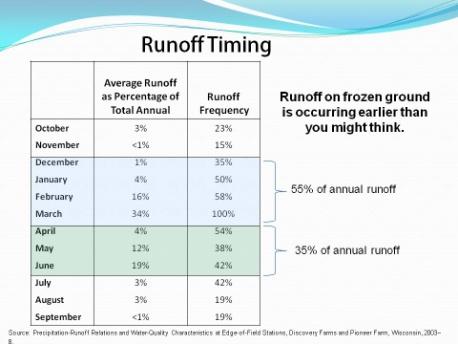
Average runoff timing and frequency from Wisconsin Discovery Farms, 2003-2008

The US Geological Survey partners with the Discovery Farms Program to provide high quality year-round data collected from agricultural fields, in streams, and within tile drainage. Monitoring has been conducted on more than 10 farms all around the state, totaling over 150 site years of data.

What Have We Learned?

The Discovery Farms data shows losses from the edge of field are, on average, 667 pounds of sediment, 2 pounds of phosphorus and 7 pounds of nitrogen.  While these numbers are important, the real value is in the variation, factors, and the management decisions that can influence nutrient and sediment losses. One of the most important lessons learned is the impact of the timing of manure application on nutrient loss. The key to reducing loss of nutrients from manure applications is to maximize the time between a manure application and a runoff event. As a producer, you need to understand the factors that cause runoff and options you have when manure spreading is not feasible.

Approximately 90% of the annual runoff in Wisconsin occurs from December through June. From December through March, most of the runoff is caused by snowmelt or rain on frozen/snow covered ground. During every year and on every site monitored, there has been runoff in March. Avoiding manure application during February and March can reduce nutrient loss, as 50% of the annual runoff happens during these two months. From April through June, runoff is driven by intense storm events or saturated soil conditions. In any given year, there can be times when fields are fit for manure application during this same time period based on little to no snow cover, early spring conditions, or droughty periods.

Future Plans

Prohibiting spreading based on calendar dates does not allow producers to assess the conditions in their immediate location. Management by calendar dates can force producers to spread during conditions when the risk for runoff is high because storage facilities are full. The conditions vary each year, and waiting for a specific calendar date can make producers miss opportune times for manure application so that field activities can be completed in a timely manner.

To prepare producers for assessing their own situations, Discovery Farms has provided intensive education and outreach on the factors that cause runoff in Wisconsin. By understanding the factors that cause runoff and management strategies that reduce nutrient loss, Wisconsin agriculture producers can maintain and improve water quality resources and farm productivity.

Authors

Amber Radatz, Outreach Specialist, UW Discovery Farms, aradatz@wisc.edu

Eric Cooley, Outreach Specialist, UW Discovery Farms

Dennis Frame, Director, UW Discovery Farms

Additional Information

www.uwdiscoveryfarms.org

UW Discovery Farms on Facebook

The authors are solely responsible for the content of these proceedings. The technical information does not necessarily reflect the official position of the sponsoring agencies or institutions represented by planning committee members, and inclusion and distribution herein does not constitute an endorsement of views expressed by the same. Printed materials included herein are not refereed publications. Citations should appear as follows. EXAMPLE: Authors. 2013. Title of presentation. Waste to Worth: Spreading Science and Solutions. Denver, CO. April 1-5, 2013. URL of this page. Accessed on: today’s date.

Photometric measurement of ground-level fugitive dust emissions from open-lot animal feeding operations.

Waste to Worth: Spreading science and solutions logoWaste to Worth home | More proceedings….

Abstract

Fugitive dust from confined livestock operations is a primary air quality issue associated with impaired visibility, nuisance odor, and other quality-of-life factors.  Particulate matter has conventionally been measured using costly scientific instruments such as transmissometers, nephelometers, or tapered-element, oscillating microbalances (TEOMs).  The use of digital imaging and automated data-acquisition systems has become a standard practice in some locations to track visibility conditions on roadways; however, the concept of using photometry to measure fugitive dust concentrations near confined livestock operations is relatively new.  We have developed a photometric method to estimate path-averaged particulate matter (PM10) concentrations using digital SLR cameras and high-contrast visibility targets.  Digital imaging, followed by automated image processing and interpretation, would be a plausible, cost-effective alternative for operators of confined livestock facilities to monitor on-site dust concentrations.  We report on the development and ongoing evaluation of such a method for use by cattle feeders and open-lot dairy producers.

Purpose

To develop a low-cost practical alternative for measurement of path-averaged particulate matter (PM10) concentrations downwind of open-lot animal feeding operations.

What Did We Do?

Working downwind of a cattle feedyard under a variety of dust conditions, we photographed an array of high contrast visibility targets with dSLR cameras and compared contrast data extracted from the photographs with path-averaged particulate matter (PM10) concentration data collected from several TEOMs codeployed alonside the visibility targets.

What Have We Learned?

We have developed a photometric method to estimate path-averaged particulate matter (PM10) concentrations using digital SLR cameras and high-contrast visibility targets.  Using contrast data from digital images we expect to predict PM10 concentrations within 20% of TEOM values under the dustiest conditions.  Digital imaging, followed by automated image processing and interpretation, may be a plausible, cost-effective alternative for operators of open-lot livestock facilities to monitor on-site dust concentrations and evaluate the abatement measures and management practices they put in place.

Future Plans

We intend to improve the prediction accuracy of the photometric method and automate it such that it can be easily adapted for use as a cost-effective alternative for measuring path-averaged particulate matter (PM10) concentrations at cattle feedyards and open-lot dairies.

Authors

Brent Auvermann, Professor of Biological and Agricultural Engineering, Texas A&M AgriLife Research.  b-auvermann@tamu.edu

Sharon Preece, Senior Research Associate, Texas A&M AgriLife Research; Brent W. Auvermann, Professor of Biological and Agricultural Engineering, Texas A&M AgriLife Research; Taek M. Kwon, Professor of Electrical and Computer Engineering, University of Minnesota-Duluth; Gary W. Marek, Postdoctoral Research Associate, Texas A&M AgriLife Research; Kevin Heflin, Extension Associate, Texas A&M AgriLife Research; K. Jack Bush, Research Associate, Texas A&M AgriLife Research.

Additional Information

Please contact Brent W. Auvermann, Professor of Biological and Agricultural Engineering, Texas A&M AgriLife Research, 6500 Amarillo Boulevard West, Amarillo TX, 79106, Phone: 806-677-5600, Email: b-auvermann@tamu.edu.

Acknowledgements

This research was underwritten by grants from the USDA National Institute on Food and Agriculture (contract nos. 2010-34466-20739 and 2009-55112-05235).

The authors are solely responsible for the content of these proceedings. The technical information does not necessarily reflect the official position of the sponsoring agencies or institutions represented by planning committee members, and inclusion and distribution herein does not constitute an endorsement of views expressed by the same. Printed materials included herein are not refereed publications. Citations should appear as follows. EXAMPLE: Authors. 2013. Title of presentation. Waste to Worth: Spreading Science and Solutions. Denver, CO. April 1-5, 2013. URL of this page. Accessed on: today’s date.

Impacts of the Michigan Agriculture Environmental Assurance Program

Waste to Worth: Spreading science and solutions logoWaste to Worth home | More proceedings….

Abstract

The Michigan Agriculture Environmental Assurance Program (MAEAP) is a holistic approach to environmental protection. It helps farmers evaluate their entire operation, regardless of size or commodity, and make sustainable management decisions balancing society’s needs, the environment, and economics. MAEAP is a partnership effort that aims to protect natural resources and build positive communities by working with farmers on environmentally responsible agricultural production practices.

To become MAEAP verified, farmers must complete three comprehensive steps: educational seminars, an on-farm risk assessment, and development and implementation of an action plan addressing potential environmental risks. The Michigan Department of Agriculture and Rural Development (MDARD) conducts an on-farm inspection to verify program requirements related to applicable state and federal environmental regulations, including the Generally Accepted Agricultural and Management Practices (GAAMPs). MAEAP benefits Michigan by helping to protect the Great Lakes by using proven scientific standards to improve air, water, and soil quality. Annual phosphorus reduction through MAEAP is over 340,451 pounds per year which is enough to grow almost 85,104 tons of algae in lakes and streams.  Farming is an environmentally intense practice and the MAEAP-verification process ensures farmers are making choices that balance production and environmental demands. The measures aimed at protecting air, soil, water, and other environmental factors mean that MAEAP-verified farmers are committed to utilizing farming practices that protect Michigan’s natural resources.

Purpose

The Michigan Agriculture Environmental Assurance Program (MAEAP) is an innovative, proactive program that assists farms of all sizes and all commodities voluntarily prevent or minimize agricultural pollution risks. MAEAP is a collaborative effort of farmers, Michigan Department of Agriculture and Rural Development, Michigan Farm Bureau, commodity organizations, universities, conservation districts, conservation groups and state and federal agencies. MAEAP teaches farmers how to identify and prevent environmental risks and work to comply with state and federal environmental regulations. Farmers who successfully complete the three phases of a MAEAP system (Farmstead, Cropping or Livestock) are rewarded by becoming verified in that system.

What Did We Do?

To become MAEAP-verified, farmers must complete three comprehensive steps: educational seminars, a thorough on-farm risk assessment, and development and implementation of an action plan addressing potential environmental risks. The Michigan Department of Agriculture and Rural Development (MDARD) conducts an on-farm inspection to verify program requirements related to applicable state and federal environmental regulations, including the Generally Accepted Agricultural Management Practices. To retain MAEAP verification, a farm must repeat all three steps including MDARD inspection every three years.

Local MAEAP farm verified in the Cropping System

What Have We Learned?

The MAEAP program is positively influencing Michigan producers and the agriculture industry. Annually, an average of 5,000 Michigan farmers attend an educational session geared toward environmental stewardship and MAEAP verification. To date, over 10,000 farms are participating with over 1,500 MAEAP verifications. On a yearly basis, over $1.2 million is spent for practice implementation by producers working towards MAEAP verification. In 2012; the sediment reduced on MAEAP-verified farms could have filled 28,642 dump trucks (10 yards each), the phosphorus reduced on MAEAP farms could have grown 138,056 tons of algae in surface waters, and the nitrogen reduced on MAEAP farms could have grown 45,515 tons of algae in surface waters.

An example of the partnership between MAEAP and Michigan Farm Bureau

Future Plans

Michigan Governor Rick Snyder has taken a vested interest in the value of the MAEAP program. In March of 2011, Governor Snyder signed Public Acts 1 and 2 which codify MAEAP into law. This provides incentives and structure for the MAEAP program. It is a goal of Governor Snyder’s to have 5,000 farms MAEAP-verified by 2015. Most importantly, through forward thinking MAEAP strives to connect farms and communities, ensure emergency preparedness and protect natural resources.

Authors

Jan Wilford, Program Manager, Michigan Department of Agriculture & Rural Development – Environmental Stewardship Division,    wilfordj9@michigan.gov

Shelby Bollwahn, MAEAP Technician – Hillsdale Conservation District

shelby.bollwahn@mi.nacdnet.net

Additional Information

www.maeap.org – MAEAP Website

http://michigan.gov/mdard/0,4610,7-125-1567_1599_25432—,00.html – MDARD MAEAP Website

http://www.facebook.com/mimaeap – MAEAP Facebook Page

Acknowledgements

MDARD MAEAP Program Office Communications Department

Michigan Farm Bureau

Michigan Association of Conservation Districts

Hillsdale County Farm Bureau

Hillsdale Conservation District

Handout version of the poster (8.5 x 11; pdf format)

The authors are solely responsible for the content of these proceedings. The technical information does not necessarily reflect the official position of the sponsoring agencies or institutions represented by planning committee members, and inclusion and distribution herein does not constitute an endorsement of views expressed by the same. Printed materials included herein are not refereed publications. Citations should appear as follows. EXAMPLE: Authors. 2013. Title of presentation. Waste to Worth: Spreading Science and Solutions. Denver, CO. April 1-5, 2013. URL of this page. Accessed on: today’s date.
Livestock GRACEnet

Waste to Worth: Spreading science and solutions logoWaste to Worth home | More proceedings….

Abstract

Livestock GRACEnet is a United States Department of Agriculture, Agricultural Research Service working group focused on atmospheric emissions from livestock production in the USA. The working group presently has 24 scientists from 13 locations covering the major animal production systems in the USA (dairy, beef, swine, and poultry). The mission of Livestock GRACEnet is to lead the development of management practices that reduce greenhouse gas, ammonia, and other emissions and provide a sound scientific basis for accurate measurement and modeling of emissions from livestock agriculture. The working group fosters collaboration among fellow scientists and stakeholders to identify and develop appropriate management practices; supports the needs of policy makers and regulators for consistent, accurate data and information; fosters scientific transparency and rigor and transfers new knowledge efficiently to stakeholders and the scientific community.  Success in the group’s mission will help ensure the economic viability of the livestock industry, improve vitality and quality of life in rural areas, and provide beneficial environmental services. Some of the research highlights of the group are provided as examples of current work within Livestock GRACEnet. These include efforts aimed at improving emissions inventories, developing mitigation strategies, improving process-based models for estimating emissions, and producing fact sheets to inform producers about successful management practices that can be put to use now.

Why Was GRACEnet Created?

The mission of Livestock GRACEnet is to lead the development of livestock management practices to reduce greenhouse gas, ammonia, and other emissions and to provide a sound scientific basis for accurate measurement and modeling of emissions.

What Did We Do?

The Livestock GRACEnet group is comprised of 24 scientists from 13 USDA-ARS locations researching the effects of livestock production on emissions and air quality.

Our goals are to:

  • Collaborate with fellow scientists and stakeholders to identify and develop appropriate management practices
  • Support the needs of policy makers and regulators for consistent, accurate data and information
  • Foster scientific transparency and rigor
  • Transfer new knowledge efficiently to stakeholders and the scientific community

Success in our mission will help to ensure the economic viability of the livestock industry, vitality and quality of life in rural areas, and provide environmental services benefits.

Authors

April Leytem, Research Soil Scientist, USDA-ARS april.leytem@ars.usda.gov

Additional Information

https://www.ars.usda.gov/anrds/gracenet/livestock-gracenet/


The authors are solely responsible for the content of these proceedings. The technical information does not necessarily reflect the official position of the sponsoring agencies or institutions represented by planning committee members, and inclusion and distribution herein does not constitute an endorsement of views expressed by the same. Printed materials included herein are not refereed publications. Citations should appear as follows. EXAMPLE: Authors. 2013. Title of presentation. Waste to Worth: Spreading Science and Solutions. Denver, CO. April 1-5, 2013. URL of this page. Accessed on: today’s date.
Feed Management Planners Certification Program to Reduce Nutrient Loads in Impaired Watersheds

Waste to Worth: Spreading science and solutions logoWaste to Worth home | More proceedings….

Why Develop a Feed Management Certification Program?

To develop a program to train ARPAS-certified (American Registry of Professional Animal Scientists) dairy and beef nutritionists on how to prepare and evaluate Feed Management plans as it relates to the NRCS Feed Management (592) practice in Pennsylvania. The objective is to compare how formulated diets match to the consumed diets. Phosphorus is monitored through manure testing and nitrogen by milk urea nitrogen and calculating milk nitrogen efficiency. Dry matter intake efficiency is also monitored as this can affect the total manure volume excreted.

What Did We Do?

In 2007, Mid-Atlantic Water Program (MAWP) scientists applied the national feed management program to meet the needs of dairy consultants to implement feed management in the Chesapeake Basin. This program certifies consultants in precision feed management, a practice that reduces nutrient loads in animal wastes by minimizing the phosphorus and nitrogen content in the feed. 

With the recent release of the US Environmental Protection Agency’s Total Maximum Daily Load for the Chesapeake Bay, the agricultural community is looking for the best practices to control nutrient pollution while minimizing impacts to profit. Over the years, the work of this project team has established precision feed management as both an economically and environmentally viable best management practice.  As such, state watershed implementation plans include precision feed management as a method to meet load allocations.

Pennsylvania currently has twenty-four NRCS qualified nutritionists to write feed management plans. In 2011, fifty-one operations received EQIP or CBWI funding through USDA-NRCS for feed management, with the majority consisting of dairy farms.  An additional 10 farms entered into contracts with NRCS in 2012.  Farms are currently in the process of being assessed on how well they implemented recommendations from the first year of quarterly reports and are working through their second year of implementation.

Additional efforts have been implemented to educate consultants about the regulations and issues affecting dairy producers. Currently, the Pennsylvania team is working with producers to monitor income over feed costs and to develop cash flow plans, which provides the opportunity to implement precision feeding practices while monitoring the economic benefits to the herd.  A study of six component fed dairy herds in Pennsylvania is also being completed to evaluate the effects of the feed, forage, and manure sampling protocols along with feeding order on fecal phosphorus levels and to update current sampling recommendations.

Funding from the MAWP was critical to providing these trainings and projects and establishing precision feed management as a best management practice that farmers can realistically utilize.  The infrastructure is in place to address the demand for more feed management plans and the MAWP will continue to meet the educational needs of this audience.

What Have We Learned?

There are a lot of opportunities on farms to improve feed management and nutrient balance. Challenges have been observed pertaining to nutrient reduction strategies that could impact overall nutrient balances in dairy and beef rations. Many of these challenges are greatly influenced by the volatility in today’s commodity pricing. Producers need to become more engaged in what they are feeding and how it affects their profitability.  It has been observed that inorganic phosphorus is still being used in grain mixtures when rations contain high phosphorus forages or inclusion of byproduct feeds. We have also observed some challenges in obtaining test analyses for complete grain and mineral mixes on a regular basis.  More education is needed for both industry professionals as well as producers.

Future Plans

As the feed management program in Pennsylvania progresses, pounds of phosphorus excreted can be tracked to monitor the effects of reducing phosphorus in dairy and beef rations. This can be used to evaluate its effect on water quality and potential phosphorus accumulations in the soil when manure is applied to crops at nitrogen-based rates. Crop rotations, inclusion of alternative forages and whole farm nutrient balance will be included in future trainings and feed management plans. The Penn State Extension Dairy team is also working on the development of a Feed Management mobile app for producers and nutritionist to be able to track and monitor their progress on nutrient reductions in their rations.

Authors

Daniel Ludwig, Natural Resources Specialist, USDA – NRCS, dan.ludwig@pa.usda.gov

Virginia Ishler, Dairy Complex Manager/Nutrient Specialist, Penn State University

Rebecca White, Program Manager-Penn State Extension Dairy Team

Additional Information

Feed Management for Producers

Pennsylvania NRCS on Feed Management


The authors are solely responsible for the content of these proceedings. The technical information does not necessarily reflect the official position of the sponsoring agencies or institutions represented by planning committee members, and inclusion and distribution herein does not constitute an endorsement of views expressed by the same. Printed materials included herein are not refereed publications. Citations should appear as follows. EXAMPLE: Authors. 2013. Title of presentation. Waste to Worth: Spreading Science and Solutions. Denver, CO. April 1-5, 2013. URL of this page. Accessed on: today’s date.

Integrating Probable Fieldwork Days into Nutrient Management Plans

Waste to Worth: Spreading science and solutions logoWaste to Worth home | More proceedings….

Abstract

Weather conditions impact land application of manure.  Wet soils hinder equipment from accessing fields.  Regulations prohibit application on frozen or snow cover soils.  Uncertain soil and atmospheric conditions can cause the best plans to fail.  Nutrient management plans that are expected to succeed might fail given any particular year’s weather. Incorporating fieldwork days information into nutrient management plans can make them more robust to uncertain weather conditions.

The USDA publishes the number of fieldwork days for different crop reporting districts within states. These data are from field reporters who provide their opinion on the number of days that were available for farmers to conduct fieldwork such as disking, planting and harvesting.  USDA Fieldwork Days data cover the growing season (approximately April to December). Estimates of fieldwork days do not exist for the non-growing season (approximately December to April).  However, certain states have agricultural weather station networks that collect soil temperature and other critical information that can be used to estimate the number of fieldwork days that exist for manure application within regulatory limits.

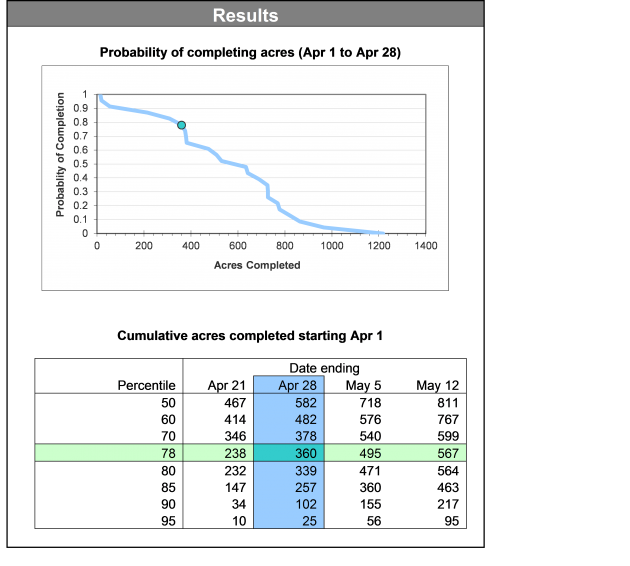
This project integrates fieldwork days from the USDA Fieldwork Days data with the Missouri Agricultural Weather Station Network winter soil temperature and precipitation data for the corresponding crop reporting district.  This compiled database gives a complete year of fieldwork day estimates.  The data are used in a model that allows nutrient management planners to incorporate climatological impacts into their land application plans.  Users specify their equipment complement and size, quantity of manure, and desired beginning and ending dates.  The model reports output in a cumulative distribution function that estimates the probability of completing fieldwork within the specified parameters and a sensitivity table of ending dates.

Why Consider Fieldwork Days for Nutrient Planning?

We currently have no mechanism to evaluate the feasibility of implementing nutrient management plans.  A plan that successfully finds sufficient fields for using nutrients in manure may fail because there is insufficient time to apply manure with the designated equipment.  Incorporating fieldwork day information into the nutrient management planning process could make plans more robust, informing the planner and farmer how likely the plan will succeed.

What Did We Do?

This project developed two spreadsheets that help nutrient management planners incorporate USDA and climatic data into their plans to estimate the likelihood of successfully completing the plan objectives.

The first spreadsheet incorporates fieldwork day data from the USDA with machinery management decisions to estimate the probability of completing manure application within a planned window.  This spreadsheet and data report the number of days in a week when fieldwork can be done in various regions of the state during the period April through November.  The second spreadsheet integrates soil temperature and precipitation data from the Missouri Agricultural Weather Station Network to estimate the probability of completing manure application within a planned window during the months of December through March period.

Users specify their equipment complement and size, quantity of acres receiving manure, desired beginning and ending dates for manure application, and hours per day and days per week they can apply manure.  The model reports output in a cumulative distribution function that estimates the probability of completing fieldwork within the specified parameters and a sensitivity table of ending dates.

Sample output of the probability of completing necessary fieldwork.

What Have We Learned?

Plans do not normally consider the feasibility of accomplishing manure application within an appropriate time frame.  Missouri fieldwork day data indicate that time available for field work varies significantly over the year and within the state at any given time.    For example, a nutrient management plan that requires 100 hours of application time in northwest MO during the month of April would be successful 78% of the time.  The same nutrient management plan needing 100 hours of fieldwork during February would be successful 40% of the time.  In April the median number of fieldwork days 11.5 days compared to 8.3 days in February.

Sample imput screen for describing the manure application parameters.

Future Plans

We will expand the tool beyond Missouri.  We are looking for funding opportunities to integrate it into our nutrient management plan document generators.

Authors

John Lory, Associate Professor of Extension, Plant Science Divsion, University of Missouri loryj@missouri.edu

Dr. Ray Massey, Professor of Extension, Agricultural Economics, University of Missouri

Pat Guinan, Assistant Professor of Extension, Soil and Environmental Systems, University of Missouri

Additional Information

The spreadsheets that incorporates fieldwork days into manure management decisions can be obtained at swine.missouri.edu/manure/ under the link names of Probable Fieldwork Days and Probable Winter Fieldwork Days.

Acknowledgements

Scott Gerlt and Brent Carpenter of the Food and Agriculture Policy Institute created the initial spreadsheet tool.


The authors are solely responsible for the content of these proceedings. The technical information does not necessarily reflect the official position of the sponsoring agencies or institutions represented by planning committee members, and inclusion and distribution herein does not constitute an endorsement of views expressed by the same. Printed materials included herein are not refereed publications. Citations should appear as follows. EXAMPLE: Authors. 2013. Title of presentation. Waste to Worth: Spreading Science and Solutions. Denver, CO. April 1-5, 2013. URL of this page. Accessed on: today’s date.