The North American Partnership for Phosphorus Sustainability: Creating a Circular P Economy as Part of a Sustainable Food System


Purpose           

To promote and foster the implementation of sustainable P solutions in both the private and public sectors

People standing in the formation of a 'P'What did we do? 

Recently, a team of Phosphorus researchers initiated the North American Partnership for Phosphorus Sustainability (NAPPS) with seed funding from Arizona State University. The goal of North American Partnership for Phosphorus Sustainability (NAPPS) is to actively engage stakeholders (e.g. corporations, national and local policy makers, planners and officials, representatives of agriculture, industry) to promote and foster the implementation of sustainable P solutions in both the private and public sectors. NAPPS seeks to engage partners in identifying key bottlenecks and strategies for decision-making, policy, and implementation of P efficiency and recycling technologies.

What have we learned? 

Phosphorus is necessary for life, and is essential for agricultural production, and so for food security. The growing world population, changing diets of humans to more meat and dairy and growing use of phosphate additives, and biomass production for energy or industrial uses result in an increasing need for phosphorus input, and the world is today heavily dependent on non-renewable, finite phosphate rock reserves that which are concentrated in a small number of countries, posing geopolitical vulnerability. These trends lead to the depletion of phosphate rock resources, pressure on and instability in phosphate prices, decreasing quality and increasing contaminant loads of remaining reserves, and unstable, insecure P supply for regions without local rock resources, especially in the developing world. At the same time, excess P is lost from the food system at multiple points. The result is eutrophication of freshwater and coastal ecosystems – lo ss of the amenity value of lakes and rivers as well as toxic algal blooms and impacts on fisheries.

Phosphorus stewardship is therefore essential, and we must use P more efficiently in the agri-food system, and actively develop phosphorus reuse and recycling technologies and practices. At the same time, the issue of contaminants, both in phosphate rock and in recycled phosphates must be addressed, as well as the need to reduce phosphate inputs to surface waters where these are problematic. We can reduce the use of mined P by producing and applying fertilizer from recycled sources. By using improved practices and smarter crops, we can reduce the demand for P fertilizer and reduce the runoff to surface water bodies. By reducing and re-using food waste and eating food with lower P footprints we can lower our phosphorus consumption and demand. Collectively, these will also lessen the impacts of P runoff on precious water resources.

Future Plans 

NAPPS activities and stakeholder recruitment will be organized around four main sectors: P Recycling; P Efficiency in Food Production; BioEnergy and Food Choice; and Water Quality. Projects and activities will be decided by the Board of Directors, but may include:

1. Develop a common vision for creating a sustainable P cycle in North America

2. Identifying and helping businesses and other organizations respond to opportunities offered by challenges in P management and emerging research in P sustainability

3. Building networks between different interest groups and sectors related to phosphorus management and recycling

4. Evaluating new P efficiency and recycling technologies, including feasibility, availability of suppliers, inventory of existing technologies and companies, cost/benefit analysis, and life cycle analyses

5. Fostering implementation of new technologies by improving the efficiency of business value chains

6. Assessing and facilitating regulatory development pertaining to phosphorus management, including waste, environmental, discharge, and agriculture to improve P sustainability

7. Representing North American phosphorus managers and innovators in international meetings and initiatives

8. Preparing funding RFPs for demonstration projects and integration and dissemination of new technologies and concepts

Authors

Helen Ivy Rowe, Assistant Research Professor, School of LIfe Sciences, Arizona State University hirowe@asu.edu

James J. Elser, Regents Professor, School of LIfe Sciences, Arizona State University

Additional information                

http://sustainablep.asu.edu

Acknowledgements      

We thank Arizona State University for providing funds to launch this initiative.
 

Logo for Sustainable Phosphorus Initiative

The Sustainable Phosphorus Initiative - farm, food, fertilizer

The authors are solely responsible for the content of these proceedings. The technical information does not necessarily reflect the official position of the sponsoring agencies or institutions represented by planning committee members, and inclusion and distribution herein does not constitute an endorsement of views expressed by the same. Printed materials included herein are not refereed publications. Citations should appear as follows. EXAMPLE: Authors. 2015. Title of presentation. Waste to Worth: Spreading Science and Solutions. Seattle, WA. March 31-April 3, 2015. URL of this page. Accessed on: today’s date.
Thermal-Chemical Conversion of Animal Manures – Another Tool for the Toolbox


How Can Thermo-Chemical Technologies Assist in Nutrient Management?

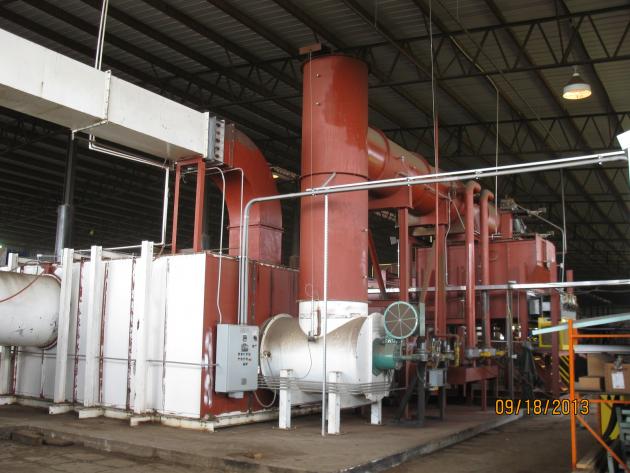
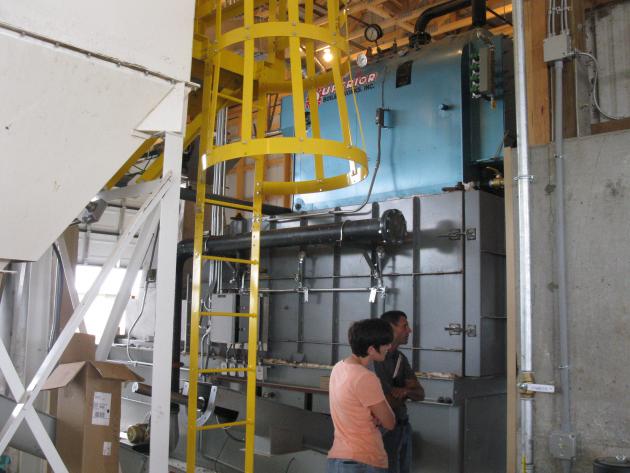
Livestock operations continue to expand and concentrate in certain parts of the country. This has created regional “hot spot” areas in which excess nutrients, particularly phosphorus, are produced. This nutrient issue has resulted in water quality concerns across the country and even lead to the necessity of a “watershed diet” for the Chesapeake Bay Watershed. To help address this nutrient concern some livestock producers are looking to manure gasification and other thermo-chemical processes. There are several thermo-chemical conversion configurations, and the one chosen for a particular livestock operation is dependent on the desired application and final by-products. Through these thermo-chemical processes manure Factory processingvolumes are significantly reduced. With the nutrients being concentrated, they are more easily handled and can be transported from areas of high nutrient loads to regions of low nutrient loads at a lower cost. This practice can also help to reduce the on-farm energy costs by providing supplemental energy and/or heat. Additional benefits include pathogen destruction and odor reduction. This presentation will provide an overview of several Conservation Innovation Grants (CIG) and other manure thermo-chemical conversion projects that are being demonstrated and/or in commercial operation. Information will cover nutrient fate, emission studies, by-product applications along with some of the positives and negatives related to thermo-chemical conversion systems.

Exterior of factory processingWhat did we do? 

Several farm-scale manure-to-energy demonstration projects are underway within the Chesapeake Bay Watershed. Many of these receive funding through the USDA-NRCS Conservation Innovation Grant program. These projects, located on poultry farms, are being evaluated for the performance of on-farm thermal conversion technologies. Monitoring data is being collected for each project which includes: technical performance, operation and maintenance, air emissions, and by-product uses and potential markets. Performance of manure gasification systems for non-poultry operations have also been reviewed and evaluated. A clearinghouse website for thermal manure-to-energy processes has been developed.

What have we learned? 

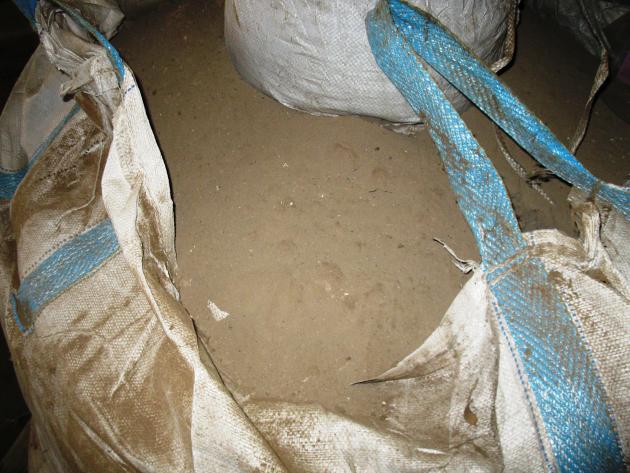
The projects have shown that poultry litter can be used as a fuel source, but operation and maintenance issues can impact the performance and longevity of a thermal conversion system. These systems are still in the early stages of commercialization and modifications are likely as lessons are learned. Preliminary air emission data shows that most of the nitrogen in the poultry litter is converted to a non-reactive form. The other primary nutrients, phosphorus and potassium, are preserved in the ash or biochar co-products. Plant availability of nutrients in the ash or biochar varies between the different thermal conversion processes and ranges from 80 to 100 percent. The significant volume reduction and nutrient concentration show that thermal conversion processes can be effective in reducing water quality issues by lowering transportation and land application costs of excess manure phosphorus.

Future Plans    

Monitoring will continue for the existing demonstration projects. Based on the lessons learned, additional demonstration sites will be pursued. As more manure-to-energy systems come on-line the clearinghouse will be updated. Based on data collected, NRCS conservation practice standards will be generated or updated as necessary.

Author       

Jeffrey P. Porter, PE, Manure Management Team Leader, USDA-Natural Resources Conservation Service jeffrey.porter@gnb.usda.gov

Additional information                

Thermal manure-to-energy clearinghouse website: http://lpelc.org/thermal-manure-to-energy-systems-for-farms/

Environmental Finance Center review of financing options for on-farm manure-to-energy including cost share funding contact information in the Chesapeake Bay region: http://efc.umd.edu/assets/m2e_ft_9-11-12_edited.pdf

Sustainable Chesapeake: http://www.susches.org

Farm Pilot Project Coordination: http://www.fppcinc.org

National Fish and Wildlife Foundation, Chesapeake Bay Stewardship Fund: http://www.nfwf.org/chesapeake/Pages/home.aspx

Acknowledgements

National Fish and Wildlife Foundation, Chesapeake Bay Funders Network, Farm Pilot Project Coordination, Inc., Sustainable Chesapeake, Flintrock Farm, Mark Weaver Farm, Mark Rohrer Farm, Riverview Farm, Wayne Combustion, Enginuity Energy, Coaltec Energy, Agricultural Waste Solutions, University of Maryland Center for Environmental Science, Environmental Finance Center, Virginia Cooperative Extension, Lancaster County Conservation District, Virginia Tech Eastern Shore Agricultural Research and Extension Center, Eastern Shore Resource Conservation and Development Council, with funding from the USDA Conservation Innovation Grant Program and the U.S. EPA Innovative Nutrient and Sediment Reduction Program.

The authors are solely responsible for the content of these proceedings. The technical information does not necessarily reflect the official position of the sponsoring agencies or institutions represented by planning committee members, and inclusion and distribution herein does not constitute an endorsement of views expressed by the same. Printed materials included herein are not refereed publications. Citations should appear as follows. EXAMPLE: Authors. 2015. Title of presentation. Waste to Worth: Spreading Science and Solutions. Seattle, WA. March 31-April 3, 2015. URL of this page. Accessed on: today’s date.

Co-Digestion: A Primer on Substrate Utilization and Project Considerations

Why Study Co-Digestion?

An overwhelming percentage of farm-based, anaerobic digestion projects practice co-digestion for improved business models that result from revenues enhanced by tipping fees and extra biogas production. This presentation utilizes over a decade of research and practical experience available within the Pacific Northwest regarding co-digestion, highlighting its benefits, potential pitfalls, and project considerations. Throughout, specific industry examples, made available through a scientific survey of experts, are used to relay information.

What did we do?

To provide an insider’s look at design and management considerations, five individuals with extensive experience in co-digestion at dairy digesters were interviewed. Interviewees included a project developer who has successfully implemented co-digestion at a number of dairy digesters, a dairy farmer who owns and operates a co-digestion project, a scientist with in-depth knowledge of AD and co-digestion, and two system engineers who have designed numerous digesters. The sample size was relatively small, but few individuals have technical expertise in co-digestion in the US, and not all individuals with expertise were willing to be interviewed. Several of these individuals work primarily in the Pacific Northwest where authors are located; however, to the extent possible, individuals with broader experience throughout the US were included.

costs and revenue streams for codigestion compared to baseline manure only digestion

Figure 1. Costs and revenue streams for codigestion compared to baseline manure only digestion

What have we learned?

Co-digestion can provide a significant economic boost to AD operations at dairies. However, after talking with numerous experts in the field of co-digestion, it is clear that careful consideration and planning is required to successfully incorporate substrates. Substrates should be chosen to complement existing waste streams, and should be carefully screened to avoid inhibition. In most cases, the selection of a substrate will be limited by location and volume attainable, and project developers may need to invest considerable time and effort into developing and maintaining the necessary relationships for acquiring substrates. Regulatory restrictions and nutrient management implications are also important. A solid understanding of these issues can contribute to successful implementation of co-digestion.

Successful co-digestion depends on multiple factors including but not limited to type of substrate, hauling costs, location of digester compared to substrate, local substrate competition, tipping fees, and nutrients. Before beginning co-digestion, developers need to first determine whether co-digestion makes economic sense at a particular dairy operation. Otherwise, co-digestion may turn into an economic burden for project developers that are already economically strained by high AD capital costs and low received electrical rates. If a sound business plan is developed and implemented, co-digestion can provide additional profit to project owners.

Future Plans

In the US, most post-consumer food scrap recycling is currently achieved via composting. For example, in western Washington State, many residents of Seattle and King County have their food scraps recycled along with yard waste into saleable compost. While this effectively diverts food scraps from landfilling, AD could capture the energy within food scraps and use it to replace fossil-derived energy, providing additional benefits. When linked with nutrient recovery, the process could also produce saleable fertilizers. If dairy farmers are located near post-consumer food scrap sources, they may be able to position themselves well as an environmentally conscious (lower odor production) and less expensive (shorter hauling distances and lower tipping fees) recycling option.

Existing barriers to co-digestion of post-consumer food wastes include current regulations excluding these wastes from AD, and the extensive pretreatment required so that these wastes could be viably fed to digesters. However, if solutions to these issues could be found, it could be a win-win scenario for food waste diversion and AD projects looking to remain viable.

Authors

Jingwei Ma, Research Associate at Washington State University mjw@wsu.edu

Nick Kennedy, Associate in Research at Washington State University, Georgine Yorgey, Research Associate at Washington State University, Chad Kruger, Director of CSANR, Craig Frear, Assistant Professor at Washington State University

Additional information

https://pubs.extension.wsu.edu/considerations-for-incorporating-codigestion-on-dairy-farms

Acknowledgements

This research was supported by funding from USDA National Institute of Food and Agriculture, Contract #2012-6800219814; National Resources Conservation Service, Conservation Innovation Grants #69-3A75-10-152; Biomass Research Funds from the WSU Agricultural Research Center; and the Washington State Department of Ecology, Waste 2 Resources Program.

The authors are solely responsible for the content of these proceedings. The technical information does not necessarily reflect the official position of the sponsoring agencies or institutions represented by planning committee members, and inclusion and distribution herein does not constitute an endorsement of views expressed by the same. Printed materials included herein are not refereed publications. Citations should appear as follows. EXAMPLE: Authors. 2015. Title of presentation. Waste to Worth: Spreading Science and Solutions. Seattle, WA. March 31-April 3, 2015. URL of this page. Accessed on: today’s date.

Anaerobic Digestion Projects: Environmental Credits 101

Several renewable natural gas (RNG) projects are either recently completed or on the books as potential new projects. With such a new business model, Washington State University, in concert with State officials embarked on a feasibility study to investigate costs/revenues as well as project consideration, hurdles and options for production of RNG as compared to an industry standard combined heat and power (CHP) model. The feasibility study was for an existing dairy anaerobic digestion project located near the Yakima Valley of Washington State.  

What Are Some of the Benefits of Anaerobic Digestion?

One of the major advantages of anaerobic digestion (AD) is the environmental benefits that accompany the technology. AD systems mitigate greenhouse gas (GHG) emissions, can contribute to reducing nutrient export from dairies to surface and ground water, can reduce the risk of pathogen spread, and can improve air quality. In the field of economics, many of these types of environmental benefits and harms fall into the realm of market externalities. Externalities are outputs of a production process that are “external” to the producers’ decision-making process, such as methane emitted from a manure lagoon. A common way governments have attempted to reduce harmful environmental externalities is through emissions regulations. An alternative way to mitigate negative externalities that we have seen in recent years has been the formation of markets for environmental attributes. This induces producers to internalize the environmental costs and benefits of production. Existing environmental markets contribute revenue gains to AD adopters, and with further development have the potential to result in even larger revenue gains for AD projects.

What did we do?

We explored available and potential environmental credits that could be available to AD projects and classified them by environmental attribute. These include carbon credits, renewable energy / fuel credits, tax and utility credits, and nutrient credits. We present examples of types of these environmental credits and their impacts on AD project profitability under various scenarios. We further discuss questions of eligibility and considerations for project developers and managers in the context of positioning for future environmental credit opportunities.

Table 1: Available sources of environmental revenues for anaerobic digester owners based on combined heat and power (CHP) or compressed natural gas (CNG) generation.

AD Methane Use Environmental Credit Market Price Yearly Revenue $/Head Market Price Yearly Revenue $/Head Market Price Yearly Revenue $/Head
    Low Scenario Medium Scenario High Scenario
Combined Heat & Power Carbon Credit $10/tCO2e $42.13 $15/tCO2e $63.19 $20/tCO2e $84.25
REC $2.00/MWh $3.08 $4/MWh $6.16 $8/MWh $12.32
Compressed Natural Gas Carbon Credit $10/tCO2e $42.13 $15/tCO2e $63.19 $20/tCO2e $84.25
RIN $0.005/Mbtu $158.34 $0.01/Mbtu $316.68 $0.02/Mbtu $633.36
LCFS $12/tCO2e $380.02 $24/tCO2e $760.04 $48/tCO2e $1,520.07

What have we learned?

Environmental crediting options are highly variable both in terms of the types and mechanisms for the credit and their availability across space (jurisdiction) and time. History indicates there is likely to be continued variability and limited predictability for environmental crediting. Economic analyses show that AD projects can be profitable under many different scenarios, but is most sustainable when it allows for multiple revenues from electricity or renewable fuel, fiber products, nutrients, and carbon credits for avoided methane emissions. Environmental incentives like carbon credits and RFS credits (i.e., RIN) have a significant contribution to the profitability of an AD project, particularly when the project produces renewable natural gas.

Products AD-Combined heat and power (CHP) AD-Boiler AD-Renewable natural gas

Table 2: Net present values of alternative anaerobic digester (AD) systems given different revenue streams.

Energy1 -$2.1 million NA -$4.8 million
Energy, and fiber and nutrients $4.8 million $1.3 million $1.5 million
Energy, fiber and nutrients and environmental incentives2 $8.0 million $3.6 million $4.1 million
Note: NA – means not applicable for AD-Boiler Project because it does not produce electricity.
1Energy refers to electricity produced by the AD-CHP and AD-Boiler Projects, and electricity and renewable natural gas produced by the AD-RNG Project.
2Environmental incentives include the: Washington Energy Initiative, Renewable Energy Certificates, and carbon credits.

Future Plans

We will be publishing a Fact Sheet through WSU Extension providing more detailed discussion of environmental credits for AD projects. This fact sheet is part of an Anaerobic Digestion Systems Manual under development with support from USDA NIFA.

Authors

Chad Kruger, Director, WSU CSANR cekruger@wsu.edu

Greg Astill, Graduate Student WSU Econ; Suzette Galinato, Research Associate, WSU IMPACT Center; Craig Frear, Assistant Professor, WSU Biological Systems Engineering; Georgine Yorgey, Associate in Research, WSU CSANR; Jim Jensen

Additional information

Coppedge, B., G. Coppedge, D. Evans, J. Jensen, E. Kanoa, K. Scanlan, B. Scanlan, P. Weisberg and C. Frear. 2012. Renewable Natural Gas and Nutrient Recovery Feasibility for DeRuyter Dairy: An Anaerobic Digester Case Study for Alternative Off-take Markets and Remediation of Nutrient Loading Concerns within the Region. A Report to Washington State Department of Commerce. <http://csanr.wsu.edu/publications/deRuyterFeasibilityStudy.pdf>.

Galinatto, S.P., C.E. Kruger, and C.S. Frear (2015). Anaerobic Digester Project and System Modifications: An Economic Analysis. WSU Extension Publications EM090

Acknowledgements

The preparation of this fact sheet was funded by the WSU ARC Biomass Research Program, and USDA National Institute of Food and Agriculture Award #2012-6800219814.

The authors are solely responsible for the content of these proceedings. The technical information does not necessarily reflect the official position of the sponsoring agencies or institutions represented by planning committee members, and inclusion and distribution herein does not constitute an endorsement of views expressed by the same. Printed materials included herein are not refereed publications. Citations should appear as follows. EXAMPLE: Authors. 2015. Title of presentation. Waste to Worth: Spreading Science and Solutions. Seattle, WA. March 31-April 3, 2015. URL of this page. Accessed on: today’s date.

Renewable Natural Gas – Economics


Can We Approach Anaerobic Digestion Differently?

Anaerobic digestion (AD) system installations are costly and projects vary significantly depending on local circumstance. One possible business model proposed to improve the economic performance of AD systems is to use the biogas as renewable natural gas (RNG) rather than heat and electricity. Washington State University partnered with state agencies and a private project developer to study the feasibility of adding RNG to an existing commercial AD project in the Yakima Valley of Washington State.

What did we do?

We examined three alternative AD system modifications: (a) combined heat and power, which is the baseline system; (b) boiler as a substitute for combined heat and power; and (c) renewable natural gas infrastructure. Our primary objective was to highlight the findings of a case study (Coppedge et al., 2012), particularly the identification of various factors that may affect the feasibility of an AD project. We answered the following questions:

  1. What is the importance of the relative difference of an AD project’s operating cost with respect to its capital cost?
  2. How do different end-uses for biogas (e.g., heat, electricity, renewable natural gas for pipeline or transportation fuel) affect the profitability of a digester project?
  3. How important is revenue from fiber and nutrient co-products to digester profitability?
  4. How important are environmental payments (Renewable Energy Certificates, Renewable Fuel Standards credit, carbon credits) to digester profitability?

This presentation focuses on questions 2 and 4 – end-uses for biogas and environmental payments tied to the alternative renewable energy options.

What have we learned?          

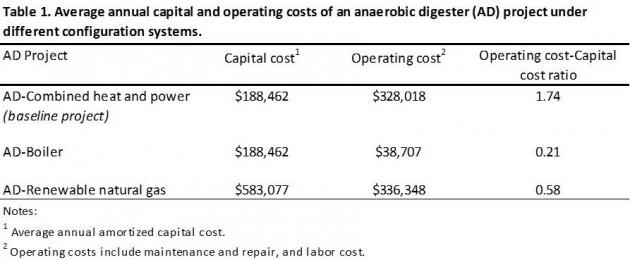
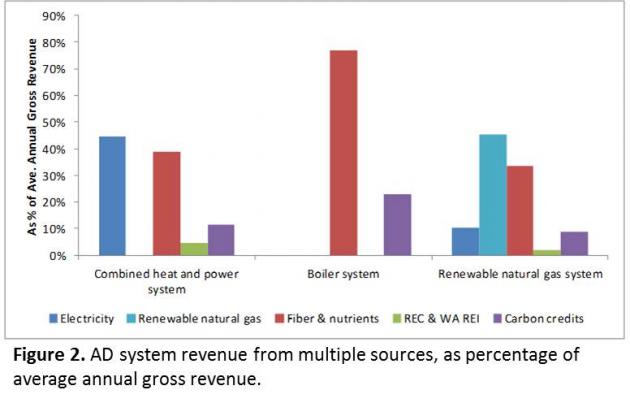
RNG offers promising opportunities. When available and potential renewable fuel credits are added to the commodity price of RNG, the AD project with this system can generate more net returns than with a combined heat and power system (baseline). Furthermore, if renewable fuel is sold as transportation fuel in the retail compressed natural gas market, the renewable natural gas system is more profitable than the baseline system with or without the addition of environmental incentives.Table 1. Average annual operating and capital costs of an anaerobic digester project under different configuration systems


Figure 2. AD system revenue from multiple sources, as percentage of average annual gross revenue.

Future Plans  

We have published a fact sheet (forthcoming) through WSU Extension providing a synthesis of the economic evaluation from the main feasibility study. This fact sheet (EM090E) is part of an Anaerobic Digestion Systems Manual under development with support from USDA NIFA.

Authors      

Chad Kruger, Director, WSU CSANR cekruger@wsu.edu

Suzette Galinatto, Research Associate @ WSU IMPACT Center; Craig Frear, Assistant Professor @ WSU Biological Systems Engineering

Additional information

Coppedge, B., G. Coppedge, D. Evans, J. Jensen, E. Kanoa, K. Scanlan, B. Scanlan, P. Weisberg and C. Frear. 2012. Renewable Natural Gas and Nutrient Recovery Feasibility for DeRuyter Dairy: An Anaerobic Digester Case Study for Alternative Off-take Markets and Remediation of Nutrient Loading Concerns within the Region. A Report to Washington State Department of Commerce. <http://csanr.wsu.edu/publications/deRuyterFeasibilityStudy.pdf>.

Galinatto, S.P., C.E. Kruger, and C.S. Frear (2015). Anaerobic Digester Project and System Modifications: An Economic Analysis. WSU Extension Publications EM090E.

Acknowledgements      

This project was supported by the WSU ARC Biomass Research Program, and USDA National Institute of Food and Agriculture Award #2012-6800219814.

The authors are solely responsible for the content of these proceedings. The technical information does not necessarily reflect the official position of the sponsoring agencies or institutions represented by planning committee members, and inclusion and distribution herein does not constitute an endorsement of views expressed by the same. Printed materials included herein are not refereed publications. Citations should appear as follows. EXAMPLE: Authors. 2015. Title of presentation. Waste to Worth: Spreading Science and Solutions. Seattle, WA. March 31-April 3, 2015. URL of this page. Accessed on: today’s date.

Hydrogen Sulfide Release from Dairy Manure Storages Containing Gypsum Bedding


Why Look at Potential Connections Between Gypsum and Hydrogen Sulfide?

Gypsum, a recycled product from the waste streams of the manufacturing and construction industries, provides ideal bedding for livestock because it absorbs moisture keeping the animals dry, is non-abrasive, and discourages bacterial growth as it is inert and non-organic. Gypsum is calcium sulfate (CaSO4•2H2O) and provides a sulfur source material that potentially increases H2S production from the manure storage due to the high generation of H2S levels. The goal of this research project is to compare H2S concentrations among Pennsylvania dairy farms that use traditional bedding, gypsum bedding and gypsum bedding with an amendment. Related: Manure Storage Safety | 2013 Waste to Worth conference proceedings by these authors “Gypsum Bedding – Risks & Recommendations for Manure Handling“

Information from this gypsum bedding project was recently featured on a pre-conference webcast More…


What did we do?

Ten farms were observed during 19 fall and spring agitation events. Portable multi-gas meters (models MX6, M40 and Tango, Industrial Scientific, Pittsburgh, PA) were place around the perimeter of each manure storage, 10 meters downwind of the storage perimeter and attached to the operator for the duration of the event to monitor exposure. Each meter recorded gas measurements every minute during the first hour of manure agitation. Wind speed, wind direction and air temperature were recorded every minute during these events using a weather station (Kestral Communicator model 4500, Nielsen-Kellerman, Birmingham, MI). Manure storage design and manure handling practices were characterized. Manure was characterized according to general chemistry (temperature, pH and oxidation-reduction potential) as well as submitted for a full nutrient analysis content including total nitrogen, sulfur, calcium, percent solids and phosphorus source coefficient.

What have we learned?

Figure 1 shows cumulative H2S concentrations versus gypsum application rate. Gypsum and non-gypsum farms represented by the diamonds show a significant increase in cumulative H2S concentrations with increasing gypsum application rate. The observations depicted by the squares represent farms that use Vital™ Breakdown (manufactured for Homestead Nutrition, New Holland, PA), a treatment reported to reduce H2S emissions. One of the farms observed, also pointed out in Figure 1 by the triangles, uses OK-1000 (manufactured by Pro-soil Ag Solutions, Hawkins, TX) as a manure additive. Though it appears that these manure additives reduce cumulative H2S concentrations, the reduction was not statistically significant because not enough observations were recorded to provide statistical power.

Movement of manure prior to the storage location appears to allow H2S to escape before entering long term storage (shown in Figure 1 as prior agitation), lowering H2S concentrations released during agitation of the manure storage. Wind flowing into proximate buildings inhibited the dissipation of H2S thereby increasing cumulative H2S concentrations as shown by the observation pointed out by the image of wind direction in Figure 1. Four observations of operator exposure (out of 19 observations including non-gypsum, gypsum and gypsum with additive) yielded H2S concentrations above 20 ppm (above the Occupational Health and Safety Administration’s (OSHA) recommended exposure limit. Of the four operators above 20 ppm H2S, three were working over the rim of the storage, which increased risk of exposure. Downwind H2S concentrations above 20 ppm ten meters from storage occurred for eight out of the fourteen observations from farms that use gypsum, showing that children and animals within ten meters of the storage are at risk.

Figure 1. cumulative hydrogen sulfide concentrations for first 60 minutes of agitations versus gypsum application rate

Future Plans  

Bench scale work will be performed in hopes of finding a manure additive that reduces H2S production from farms that use gypsum. A new product (Dri Mat) formulated from its precursor, VitalTM Breakdown, will be mixed with manure and analyzed to determine the efficacy to reduced H2S emissions. Iron oxide, a by-product of acid mine drainage passive treatment lagoons will be one of the treatments for this work as well.

Authors  

Hile, Michael, Ph. D. Candidate in Agricultural and Biological Engineering (ABE) at Penn State (PSU) mlh144@psu.edu

Dr. Eileen E. Fabian, Professor in ABE at PSU, Dr. Herschel A. Elliott, professor in ABE at PSU, Dr. Robin Brandt, Senior Lecturer in ABE at PSU, Dr. C. Alan Rotz, Agricultural Engineer at USDA-ARS and Dr. Ray Bryant, Soil Scientist at USDA-ARS.

Acknowledgements      

This project would not have been possible without the support from Natural Resources Conservation Service’ (NRCS) Conservation Innovation Grant (CIG) program, USA Gypsum and Industrial Scientific.

The authors are solely responsible for the content of these proceedings. The technical information does not necessarily reflect the official position of the sponsoring agencies or institutions represented by planning committee members, and inclusion and distribution herein does not constitute an endorsement of views expressed by the same. Printed materials included herein are not refereed publications. Citations should appear as follows. EXAMPLE: Authors. 2015. Title of presentation. Waste to Worth: Spreading Science and Solutions. Seattle, WA. March 31-April 3, 2015. URL of this page. Accessed on: today’s date.

Manure Separation: Bedding and Nutrient Recovery

Why Study Manure Solid-Liquid Separation?

We wished to evaluate a two staged manure separation system for bedding and solids removal. Manure separation can accomplish several purposes on a dairy farm. The two most common goals are to produce a fiber bedding for the animals and the second is to remove as many solids as economically feasible prior to long term storage.

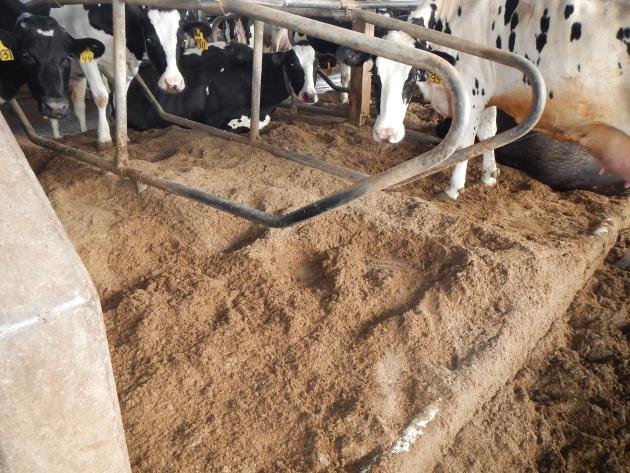
bedding in dairy barn made from separated manure solidsWhat did we do?

We looked at existing and new systems that use manure fiber bedding. Manure fiber bedding or “green bedding” is separated solids from manure collected daily on the dairy that has not been through digestion or other heat process. Manure samples were collected and analyzed for total solids and nutrient content through commercial labs. Questions were asked to dairy personnel regarding stall management practices.

What have we learned?

Separating manure for fiber bedding production is very different than separation for clean liquid. A dry solids cake from the separator does not directly correlate to a good bedding product for the cows. Dairy bedding must provide cushioning for the animal while laying and stable footing during the process of lying down and getting up. A healthy, productive cow will spend 12-14 hours per day lying down. A good bedding must be able to absorb liquid and maintain a clean, dry and comfortable stall for the cow. Typical dry solids cakes contain many small particles that prohibits the solids ability to absorb liquid on the cows lying surface.

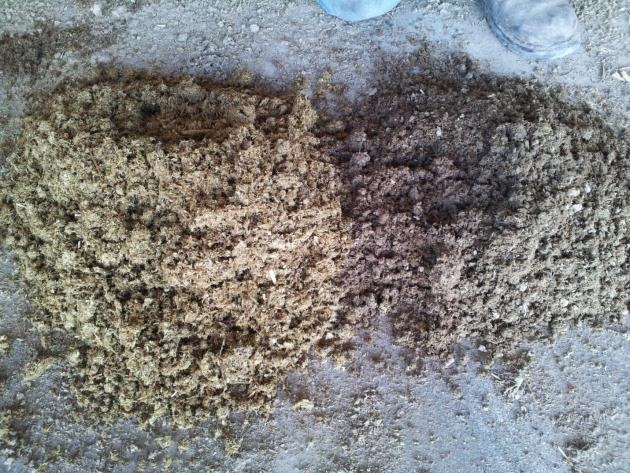
Separation equipment does have an effect on overall perceived bedding quality. Longer fibers are preferred to shorter fibers. Longer fibers appear to provide better cushioning and are less prone to sticking to the cow’s legs, flanks and teat ends.

comparison of fibers from two different manure separation systems

Figure 1. Roller press fibers on the left; screw press fibers on the right.

Fiber bedding can be used directly from the separator (often referred to as “green bedding), composted in windrows or aerobically digested in a vessel. Regardless of treatment method, the success of a manure fiber bedding system is dependent on many factors besides the equipment operation. Management of the free stalls including stall grooming, ventilation, re-bedding and frequency of manual manure removal are examples of other critical factors.

In looking at staged separation systems, the owner is willing to sacrifice capture rate efficiency on first stage separation to achieve high quality bedding. By allowing smaller solids to pass through the primary separation system, the quality of bedding often improves. Eventually, as the larger fibers are broken down while in the free stall or by pumping and processing equipment they become small enough to pass through first stage separation.

Having staged separation is extremely beneficial for advanced manure processing. Primary separation systems do more than produce a fiber bedding material, they also act as a foreign material screen for downstream equipment as well as slightly reduce the total volume to subsequent stages. Foreign material such as; plastic bottles, wooden hoof blocks, rocks, pieces of plastic etc. can cause significant damage to more sensitive (and often expensive) downstream equipment, such as a centrifuge, finer separation screen, belt filter press or other mechanical solid liquid separator. A primary separator is often better suited to handle foreign materials without disrupting operations. Furthermore, by removing the larger solids for bedding there is a slight reduction in volume going to secondary separation steps. This can lead to savings by reducing the required capacity of downstream equipment or reducing the total volume chemistry costs when using coagulants or polymers.

Primary separation for bedding has shown some nutrient removal. On farms using primary separated solids for animal bedding, the nutrient content is irrelevant since the nutrients are recycled back into to the housing system, until the fibers are broken down enough to pass. The specific capture rate of total solids and individual nutrients are show in the table below.

Primary Capture Rates Dairy TR Dairy GM Dairy CVT
Total Solids   20 43 55
Total Nitrogen   4.2 15 20
Phosphorus 3.5 5 37
Potassium   2.6 10 15

Total solids capture rates are directly correlated to incoming total solids content. Higher incoming solids results in higher capture rates (Burns and Moody, 2001). The total solids in the incoming material was lowest for Dairy TR and highest for Dairy CVT. It is a general understanding that a majority of the nutrients are contained in relatively small particles which pass through primary separation stream.

Future Plans

Staged separation systems are one example of how to incrementally add equipment and separation capacity as farms expand or field application of nutrients becomes more precise. Farms may initially install a basic separator to re-use liquid for alley flushing or flush fluming. A secondary stage separator can then be added for excess liquid prior to going to the lagoon for additional solids and nutrient removal.

Future investigation steps will be to continue evaluating secondary separation equipment for ease of operation, operational costs and nutrient removal efficiencies. Additionally further uses for the primary solids as a separation aid may prove beneficial as more systems are installed and used.

Author

Andy Lenkaitis, P.E. Environmental Systems Engineer, GEA Farm Technologies  andy.lenkaitis@gea.com

Additional information

Contact GEA Farm Technologies for additional information regarding specific information on equipment or systems for manure separation systems.

Flyer

Acknowledgements      

The author would like to acknowledge for dairy producers for sharing their insight and information to further the adaption of manure equipment. Additionally, support from key field personnel and local equipment dealers for identifying customers and servicing equipment in a less than pleasant location.

The authors are solely responsible for the content of these proceedings. The technical information does not necessarily reflect the official position of the sponsoring agencies or institutions represented by planning committee members, and inclusion and distribution herein does not constitute an endorsement of views expressed by the same. Printed materials included herein are not refereed publications. Citations should appear as follows. EXAMPLE: Authors. 2015. Title of presentation. Waste to Worth: Spreading Science and Solutions. Seattle, WA. March 31-April 3, 2015. URL of this page. Accessed on: today’s date.

Swine Manure Odor Reduction Using a Humic Amendment: On-Farm Demonstration


Why Study Odors from Pig Farms?

Odor-related nuisance complaints associated with animal production facilities are on the rise as residential sprawl encroaches on once rural areas. The efficacy of odor control additives is highly variable and most have limited success. This project demonstrated the efficacy of a commercial humic-material product (ManureMaxTM, Manufactured by JDMV Holding, LLC; Huston, TX) for limited control of liquid swine manure odors.

What did we do?

Two similarly-operated, 2,250-pig, tunnel-ventilated finishing barns on one farm were used for the demonstration. Barns were widely-separated by 1,800 feet of woodland and fields and were occupied by pigs of similar age. The underfloor manure storage pit (5-ft deep) of one barn received monthly additions with the additive while the other barn received no additive. After 20 weeks when hogs were finished for market and barns cleaned for restocking, treatments were switched so the previously untreated barn received the amendment. Odors at the barn ventilation exhaust were evaluated monthly by direct sensory methods (olfactometry) using human subjects. Field-applied manure was evaluated at the end of each 20-week grow-out period. Nasal Ranger Field Olfactometer (NRO) units were used to evaluate barn exhaust odor dilutions-to-threshold (D/T) and odors during field application, employing the Multiple-Assessor Repeat Observation (MARO) method (B randt et at., 2011a and 2011b). Barn ventilation exhaust was normalized against fan velocity and compared as odor flux (odor units min-1) among treatments. Whole air samples were collected in 10-liter TedlarTM® bags during each field visit and brought back to the Penn State Odor Assessmnt Laboratory (PSOAL) for evaluation. A team of five qualified odor panelists quantified odor detection threshold (DT) using Dynamic Triangular Forced-Choice Olfactometry (DTFCO) on an Ac’ScentTM International Dynamic Olfactometer (St. Croix Sensory, Lake Elmo, MN) within 10 hours of sample collection.

What have we learned?

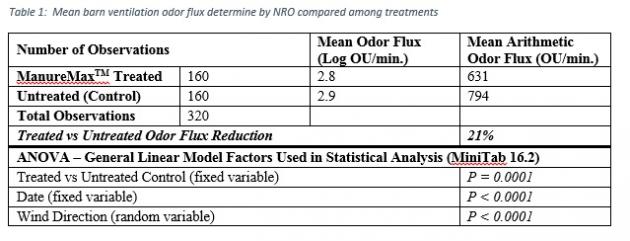
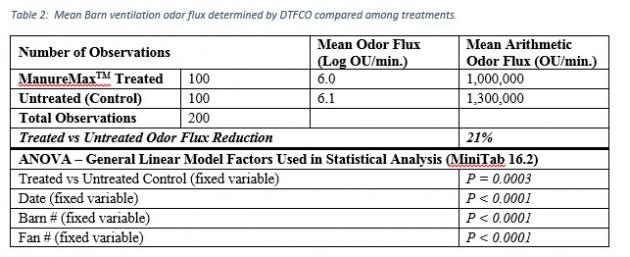
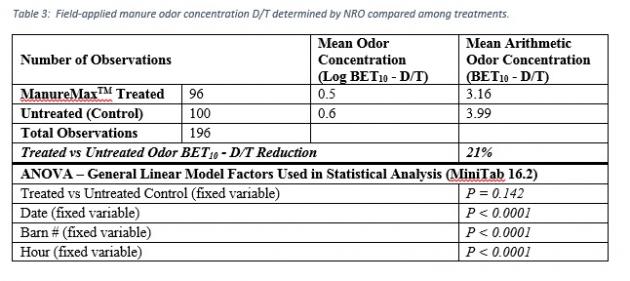
Results show a 21% reduction in mean barn odor exhaust as shown in Table 1 and Table 2. The humic amendment significantly decreased barn ventilation odor flux by 21% in both field NRO and laboratory DTFCO evaluations. Evaluation of field applied manure yield a 21% and 60% decrease in odor concentrations for NRO and DTFCO, respectively.mean barn ventilation odor flux

mean barn ventilation odor flux

field-applied manure odor concentration

field-applied manure odor concentration DT

Authors

Hile, Michael, Ph. D. Candidate in Agricultural and Biological Engineering (ABE) at Penn State (PSU) mlh144@psu.edu

Brandt, Robin, Senior Lecturer in ABE at PSU, Eileen E. Fabian, Professor in ABE at PSU and Herschel A. Elliott, professor in ABE at PSU. Robert E. Mikesell, Program Coordinator and Senior Lecturer, Department of Animal Science at PSU.

Additional information

Brandt, R.C., H.A. Elliott, M.A.A. Adviento-Borbe, E.F. Wheeler, P.J.A. Kleinman, and D.B. Beegle. 2011a. Field Olfactometry Assessment of Dairy Manure Land Application Methods. J. Environ. Qual. 40: 431-437.

Brandt, R.C., M.A.A. Adviento-Borbe, H.A. Elliott, E.F. Wheeler. 2011. Protocols for Reliable Field Olfactometry Odor Evaluations. J. Appl. Engr Agr. Vol. 27(3): 457-466.

Brandt, R. C., H. A. Elliott, E. E. Fabian, M. L. Hile, R. E. Mikesell, Jr., 2014. Manure Additive Shows Swine Odor Reduction. Fact Sheet. Penn State University, Department of Agricultural and Biological Engineering.

Acknowledgements

Thanks to JDMV Holding, LLC Houston, TX) for providing funding and product for this project. This project would not have been possible without the support from Natural Resources Conservation Service’ (NRCS) Conservation Innovation Grant (CIG) program.

The authors are solely responsible for the content of these proceedings. The technical information does not necessarily reflect the official position of the sponsoring agencies or institutions represented by planning committee members, and inclusion and distribution herein does not constitute an endorsement of views expressed by the same. Printed materials included herein are not refereed publications. Citations should appear as follows. EXAMPLE: Authors. 2015. Title of presentation. Waste to Worth: Spreading Science and Solutions. Seattle, WA. March 31-April 3, 2015. URL of this page. Accessed on: today’s date.

Anaerobic Digestion – Highlights of Successful Project Feasibility Studies


Purpose  

Feasibility studies are a form of decision-making tool that require research, data collection and analysis to evaluate investments in new technology or projects. They answer key questions about a project’s technical and financial viability, including project structure and organization and the costs, benefits, and risks involved. The analyses completed are so important that many grant programs require feasibility studies before making project grant awards. Financial investors and banks commonly may require the most rigorous form of feasibility study prior to making any investment.

What did we do?             

To develop a catalog of steps needed to perform a successful feasibility study, we reviewed the literature on feasibility studies, as well as dozens of studies done on the subject of anaerobic digestion. We also talked with a range of experts in project development.

What have we learned?

General Assessment Study or Screening—Most basic feasibility studies assess the viability of different opportunities within a defined industry or geographic area. On a project level, a general assessment determines if a potential project meets basic criteria thresholds to support more in-depth analysis?

Project-Based, Techno-Economic Study—A higher level of research and analysis is used to establish project viability. These studies consider the costs, benefits, and risks of building a specific type of project, with specific technology, on a specific site. For this purpose the study might incorporate readily available data about technology choices and make assumed adjustments about how it would perform under site-specific conditions. This level of analysis forces project advocates to put their ideas and assumptions on paper and test whether the conclusion is sound and realistic.

Investment-Grade Study—The most rigorous feasibility study is used to validate the marketability of a specific project from an investment perspective. It would look beyond basic techno-economic viability to establish the actual planned inputs and outputs of a project. It can include detailed equipment specifications and estimates, as well as detailed mass, energy, and water balance calculations. It may also identify key providers of feedstocks as well as potential end users. Detailed scheduling may be required to complete financial analyses accurately. With a detailed proforma showing financial analyses of cash flow and return on investment, this high level of feasibility study is sometimes termed “investment-grade.” These types of studies often include sensitivity analyses to explore the impact on a project’s viability from changes to one or more key assumptions. Sensitivity analyses can clarify which of the many assumptions made are most critical to project success.

Getting the best, most reliable and accurate data is perhaps the most critical element of a successful feasibility study. Typical steps observed in many feasibility studies:

  •  Define project goals and scope
  •  Establish the project criteria necessary for success
  •  Inputs: potential feedstocks from measured results, existing data, or surveys of sources
  •  Outputs, calculated from inputs: biogas, liquid and solid effluents and nutrients, and environmental attributes
  •  Financial costs: capital expenses, including cost of money, and ongoing operation and maintenance expenses
  •  Revenues (10 or more): methane energy power or fuel, surplus thermal energy, tip fees, value of solids, liquids-water, liquids-nutrients, environmental attributes, ecosystem services (e.g., GHG offsets, water quality/quantity benefits), carbon dioxide, and/or bioplastics.
  •  Cost offsets as revenues: e.g., rainwater diversion, reduction in manure handling/spreading, odor reduction, avoided disposal, etc.
  •  Financial analyses: cash flow, simple payback, EBITA (earnings before interest, taxes and amortization), net present value, return on investment, sensitivity analyses, life-cycle analyses
  •  Project finance: grants and loan guarantees, debt, and equity
  •  Project ownership and liabilities: including design, build, own, operate, maintain

Future Plans      

We will continue to evaluate methods to add value and publish the full results in a Anaerobic Digestion technology brief on this topic.

Authors    

Jim Jensen, Sr Bioenergy & Alt Fuel Specialist, Washington State University Energy Program jensenj@energy.wsu.edu

Craig Frear, Chad Kruger, and Georgine Yorgey, Center for Sustaining Agriculture and Natural Resources, Washington State University

Additional information                 

http://www.energy.wsu.edu/

http://csanr.wsu.edu/

Acknowledgements      

This research was supported by Biomass Research Funds from the WSU Agricultural Research Center; and by the Washington State Department of Commerce.

The authors are solely responsible for the content of these proceedings. The technical information does not necessarily reflect the official position of the sponsoring agencies or institutions represented by planning committee members, and inclusion and distribution herein does not constitute an endorsement of views expressed by the same. Printed materials included herein are not refereed publications. Citations should appear as follows. EXAMPLE: Authors. 2015. Title of presentation. Waste to Worth: Spreading Science and Solutions. Seattle, WA. March 31-April 3, 2015. URL of this page. Accessed on: today’s date.

Digested Solids – Forms, Markets and Trends


Are Digested Solids a Viable Product?

Anaerobic digesters for U.S. livestock operations are becoming more complex. A study of livestock-based digesters in 2003 found they were built largely to meet on-farm needs for power or gas. Digester residuals were mostly land applied as nutrients for crop production. A few used fibrous solids as animal bedding (King, 2003). In recent years, more livestock-based digester projects have been built by third-party developer/managers. Projects increasingly employ a systems approach, where individual product streams are managed in concert for greatest profit by the project manager. This approach holds the promise that digestate residuals, especially fiber solids, will no longer be neglected, but instead play a larger role in offsetting weak performance in energy revenues.

What did we do?

Looking closely at dairy-based digesters, the solids recovered after separation from the digester eflluent have unique characteristics. Most notably, these solids tend to be fibrous with high cellulose, hemicellulose, and lignin content. Digestion also reduces pathogenic contaminants, volatile solids, odor, and viable weed seeds (MacConnell, 2010). These qualities can be influenced by the makeup of an animal’s feed and the use of co-digestion feedstocks, such as municipal or industrial wastes or other agricultural manures or byproducts

Table 1 shows the characteristics of dairy AD solids compared to raw manure and raw separated solids (MacConnell, 2010).

Table 1. Fiber Characteristics

Table 1.

As is. In bulk. Sold to a wholesale buyer—this is the easiest way to sell digested dairy fiber. Through a combination of literature search and expert interviews, this presentation looks at the methods project managers might use to add more value to their digested fiber.

What have we learned?

Composting. Perhaps the most basic way to add value to digested dairy fiber is simply to apply basic compost processing methods—aerating the material under controlled conditions for sufficient time to reduce odor and stabilize the organic matter. While already low in pathogens, hot composting practices can give additional assurance of pathogen reduction. In co-digestion situations, screening the material to remove contaminants and assure consistency and uniformity is desired. Even wholesale buyers will pay more for material that is already composted (King 2003)

Processing to compete – replacing peat. Because of its physical similarity, researchers have explored using digested dairy fiber as a direct replacement for peat moss in nursery and horticulture mixes. WSU was an early source of research and growth trials on such uses. Their research showed that with minimal post-digestion treatment, amended digested dairy fiber performed as well or better than peat in soilless mixes. (MacConnell, 2007, and Kruger, 2008) In 2007, Organix, a Washington company, announced the first shipments of RePeat, using their patent-pending FibreRite production system. Since then several new varieties of these peat replacements have hit the market nationwide, under such brands as Magic Dirt, EnerGro, and MooFiber.

Organic certification. Organic gardening and food production is growing rapidly in Washington state and around the nation. Getting an organic certification for organic matter and nutrients that have been digested and composted will add significant value to the final product (King, 2003).

Branding and marketing for retail. Moving away from bulk and wholesale are the next steps in moving material up the value chain. However, putting product in bags and selling into retail markets requires significant investments in packaging, branding, marketing and sales. This is like adding an additional business onto the back end of a digester project and demands its own feasibility analysis.

Vermicomposting. Using earthworms, especially redworms, to further process fiber solids and excrete earthworm castings, produces another specialty soil product. Vermicomposts and earthworm castings are well-known and appreciated in some growers in some markets. They are often used as a small additive in specialty soil mixes to allow the use of “earthworm castings” on the list of ingredients. Two commercial examples of vermicompost production lie on opposite coasts—Sonoma Valley Worm Farm in California and Worm Power in New York. Sonoma Valley Worm Farm direct markets high-quality vermicompost to a variety of growers throughout their region, with special emphasis on vineyards. Worm Power topped 2 million pounds of production in 2012 and signed an agreement with Rochester, NY-based Harris Seeds to market its vermicompost products regionally.

Specialty products produced from the separated fiber materials are another area of interest. Perhaps the best known of such products are the biodegradable planting nursery pots sold as Cow Pots by the Fruend Dairy Farm in Connecticut.

Biochar. This is another specialty product from a fledgling industry that fits in niche markets. It could be used to process digested fiber. It has received a strong research focus in the Pacific Northwest. The value of biochar in landscape or agricultural uses is still being studied, though at present it appears to have less to do with agronomic benefit, than on measured benefits for carbon sequestration and the value given to these benefits through carbon credits or other mechanisms (Galinato, 2011). On the other hand, replacing biochar for conventional forms of activated carbon for filtering stormwater or wastewaters shows some promising results and is getting a lot of attention.

Future Plans      

We will continue to evaluate methods to add value and publish the full results in a Anaerobic Digestion technology brief on this topic.

Authors        

Jim Jensen, Sr. Bioenergy & Alt Fuel Specialist, Washington State University Energy Program jensenj@energy.wsu.edu

Craig Frear, Chad Kruger, and Georgine Yorgey, Center for Sustaining Agriculture and Natural Resources, Washington State University

Additional information  

References:

Galinato, S., Yoder, J., Granatstein, D., 2011. The economic value of biochar in crop production. Energy Policy.

King, 2003. Study to Evaluate the Price and Markets for Residual Solids from a Dairy Cow Manure Anaerobic Digester—Final Report, King County Solid Waste, Seattle, WA.

Kruger, Chad, et.al., 2008. High-quality fiber and fertilizer as co-products from anaerobic digestion. Journal of Soil and Water Conservation.

MacConnell, C.B., Collins, H.P., 2007. Utilization of re-processed anaerobically digested fiber from dairy manure as a container media substrate. Proceedings of the International Symposium on Growing Media, Nottingham, UK.

MacConnell, C., Frear, C., Liao W., 2010. Pretreatment of AD-treated fibrous solids for value-added container media market, Center for Sustaining Agriculture and Natural Resources, Pullman, WA.

Acknowledgements      

This research was supported by funding from USDA National Institute of Food and Agriculture, Contract #2012-6800219814; Biomass Research Funds from the Washington State University Agricultural Research Center; and the Washington State Department of Ecology, Waste 2 Resources Program.

The authors are solely responsible for the content of these proceedings. The technical information does not necessarily reflect the official position of the sponsoring agencies or institutions represented by planning committee members, and inclusion and distribution herein does not constitute an endorsement of views expressed by the same. Printed materials included herein are not refereed publications. Citations should appear as follows. EXAMPLE: Authors. 2015. Title of presentation. Waste to Worth: Spreading Science and Solutions. Seattle, WA. March 31-April 3, 2015. URL of this page. Accessed on: today’s date.