
The Arkansas Discovery Farm Program: Connecting Science to the Farm

Waste to Worth: Spreading science and solutions logoWaste to Worth home | More proceedings….

Why Create the Arkansas Discovery Farm Program?

Agriculture in Arkansas is under increasing pressure to manage nutrients and sediment in an environmentally sustainable manner.  In many sectors of the farming community, this has created severe constraints to remaining economically viable and competitive in today’s global market place.  In northwest Arkansas, home to the nation’s second largest broiler poultry production, farmers have been under intense scrutiny and litigation over the last decade, due to downstream water users (i.e., Oklahoma) questioning the role of agriculture in water quality impairment.  Also, increasing national attention is being focused on reducing nutrients to the Gulf of Mexico, which will further increase the need of agricultural producers to increase nutrient efficiency while declining groundwater levels in crop producing areas of eastern Arkansas will increase the need for greater water efficiency.  The Arkansas Discovery Farm Program was initiated in 2009 to document the effectiveness of conservation practices on “real-world” private farms across the diverse forage, livestock, and row crop agricultural setting across the State.

What Did We Do?

We are monitoring runoff quality from seven farms as we are quantify sediment and nutrient losses from all major row crop and livestock commodities including rice, soybean, corn, cotton, poultry and beef cattle.  We are currently monitoring the quality of runoff from 19 fields using automated water quality samplers that are now equipped modems that contact us via cell phone when sampling is initiated.    On our row crop fields, we have increased our efforts to monitor irrigation water use and needs.  All fields are equipped with turbine-type irrigation flow meters that utilize dataloggers to automatically records flow data.  On two farms, we split fields in half and monitored evapotranspiration with atmometers (ET gages) and compared to our computer irrigation scheduler to calibrate the ET gages as an easier field method for irrigation scheduling.

What Have We Learned?

Due to the fact that we have been monitoring runoff since mid-2011 at the longest, we have limited reliable information to present.  As our first year, 2011 produced several severe flood-stage storms and 2012 provided a record breaking drought, it is difficult to quantify impact at this point.  While the water quality monitoring is a cornerstone, empowering agricultural producers to take ownership in finding solutions to minimize environmental impact is paramount to protecting voluntary efforts for the industry.  Our major findings to date have been the willingness of Arkansas farmers in general to embrace the Program, to be environmentally accountable for their actions, and to be proactive rather than reactionary.   

Future Plans

We have plans to develop another Discovery Farm in the litigated Illinois River Watershed, Northwest Arkanas.   While there is a great deal of interest in developing a commerical forestry Discovery Farm, a lack of potneital funding has limited those plans to date.  As we continue to collect data, we hope we can provide timely information on both economic and natural resource sustainability on behalf of Arkansas Agriculture to regulators, lawmakers and other decision makers. 

Authors

Andrew Sharpley, Professor, Division of Agriculture, University of Arkansas System, sharpley@uark.edu

Mike Daniels, Professor, Cooperative Extension, Division of Agriculture, University of Arkansas System

Neal Mays, Program Technician, Division of Agriculture, University of Arkansas System

Cory Hallmark, Program Technician, Cooperative Extension, Division of Agriculture, University of Arkansas System

Additional Information

http://discoveryfarms.uark.edu/

Acknowledgements

Arkansas Association of Conservation Districts, Arkansas Conservation Commission, Arkansas Natural Resource Conservation Service, Arkansas Farm Bureau


The authors are solely responsible for the content of these proceedings. The technical information does not necessarily reflect the official position of the sponsoring agencies or institutions represented by planning committee members, and inclusion and distribution herein does not constitute an endorsement of views expressed by the same. Printed materials included herein are not refereed publications. Citations should appear as follows. EXAMPLE: Authors. 2013. Title of presentation. Waste to Worth: Spreading Science and Solutions. Denver, CO. April 1-5, 2013. URL of this page. Accessed on: today’s date.
What We Feed Dairy Cows Impacts Manure Chemistry and the Environment

Waste to Worth: Spreading science and solutions logoWaste to Worth home | More proceedings….

Why Be Concerned with Feed Rations and Their Environmental Implications?

During the last part of the 20th century, animal manure management became an environmental concern. In response to these concerns, legislation was enacted to control manure management and the emission of undesirable gasses (e.g., methane, ammonia, nitrous oxide) from animal production systems. The purpose of this paper is to illustrate how mineral phosphorus (P) supplements, forage types and amounts, and the crude protein (CP) fed to lactating cows impact manure chemistry and the fate of manure nutrients in the environment.

What Did We Do?

Source-sink relationships have been used to illustrate relationships between feed nutrient sources (e.g., forms and concentrations of P and CP in lactating cows rations) and nutrient sinks (milk and manure), and relationships between manure nutrient sources (e.g., soluble P, urea N) and sinks [soil test P, runoff P, atmospheric ammonia, soil inorganic nitrogen (N), crop N] and the impact of these relationships on the environment.

What Have We Learned?

As mineral P concentrations in dairy rations increase, the excretion of total P and soluble P in manure also increases. The amount of cropland needed to recycle manure P and runoff of soluble P from cropland after manure application can be related back to the P excreted in manure, which in turn can be linked to the amount of mineral P in cow rations.  Likewise, the type and amount of CP and forage fed to dairy cows impact manure chemistry and manure N losses as ammonia, N cycling in soil, including plant N uptake. Ammonia emissions from dairy barns and soil after manure application can be related back to the urea N excreted by dairy cows in urine, which is linked to the types and concentrations of CP and forages in cow rations, and the concentrations of urea in milk (milk urea N, or MUN).  Our results demonstrate that profitable rations can be fed to satisfy the nutritional demands of healthy, high producing dairy cows, reduce manure excretion and therefore the environmental impacts of milk production.

Future Plans

We continue investigations on how the feeding of tannins to lactating dairy cows, and the use of MUN as a management tool  may enhance feed CP use efficiency (more feed CP transformed into milk, less excreted in manure) and reduce losses of ammonia, nitrates and nitrous oxide from dairy farms.

Authors

J. Mark Powell, Soil Scientist. USDA-ARS U.S. Dairy Forage Research Center, Madison, Wisconsin,  mark.powell@ars.usda.gov

Glen A. Broderick,  Dairy Scientist,  USDA-ARS U.S. Dairy Forage Research Center, Madison, Wisconsin

Additional Information

Powell, J.M. and Broderick, G.A. Transdisciplinary soil science research: Impacts of dairy nutrition on manure chemistry and the environment. Soil. Sci. Soc. Am. J. 75:2071–2078.

Powell, J.M. Alteration of Dairy Cattle Diets for Beneficial On-Farm Recycling of Manure Nutrients. pp 21-42  In: Applied Research in Animal Manure Management. Zhongqi H. (Ed.) Nova Science Publ. Inc.

Powell, J.M., Wattiaux, M.A., and Broderick, G.A. Evaluation of milk urea nitrogen as a management tool to reduce ammonia emissions from dairy farms. J. Dairy Sci. 94:4690–4694.


The authors are solely responsible for the content of these proceedings. The technical information does not necessarily reflect the official position of the sponsoring agencies or institutions represented by planning committee members, and inclusion and distribution herein does not constitute an endorsement of views expressed by the same. Printed materials included herein are not refereed publications. Citations should appear as follows. EXAMPLE: Authors. 2013. Title of presentation. Waste to Worth: Spreading Science and Solutions. Denver, CO. April 1-5, 2013. URL of this page. Accessed on: today’s date.
BFNMP$: A Tool for Estimating Feedlot Manure Economics

Waste to Worth: Spreading science and solutions logoWaste to Worth home | More proceedings….

Why Consider the Costs of Manure Transport in Nutrient Planning?

* Presentation slides are available at the bottom of the page.

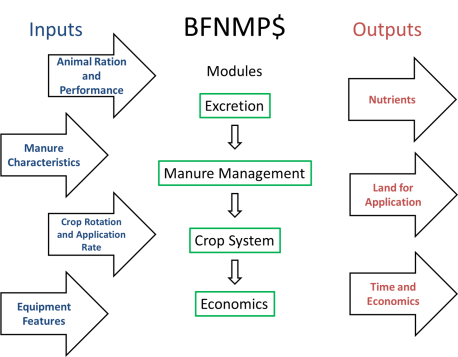
The Beef Feed Nutrient Management Planning Economics (BFNMP$) computer program can assist producers in understanding the impacts manure handling changes could have on their operation.  It calculates manure management economics based on animal nutrient intake, manure nutrient availability, land requirements for spreading, operating costs, and fertilizer value.  These values can be altered to fit individual operations.  The objective of this analysis was to use the BFNMP$ software tool to evaluate the effect of distillers grains inclusion, nitrogen (N) volatilization, and manure application rate on feedlot nutrient management plans.

The BFNMP$ software tool is organized into 4 modules with producers entering information about their operation and then viewing the results.  Outputs include nutrients produced, land needed for manure application, time the plan will take to implement, and economic implications.

What Did We Do?

This program was used to determine 1) impact of dietary N and P from traditional grain based diets compared to diets including 40% distillers grains (DG); 2) effect of different N volatilization (VOL) rates; 3) impact of changing manure application rates from N to P based and from 1 to 4 yr rates.  While comparing scenarios, all other factors in the model were constant.  These scenarios fed out 5,000 cattle per year in 100 hd pens from 341 to 591 kg with 144 d on feed.

What Have We Learned?

Increasing dietary N and P, with a 40% DG diet, increases excretion of these nutrients.  Capturing these nutrients in manure increases costs, but increases value at a greater rate.  Manure from cattle fed a traditional feedlot diet with 50% N VOL has a value of $21.53/animal ($14.45/Mg) based on inorganic fertilizer values.  Feeding a 40% DG ration results in manure worth $29.70/animal ($19.94/Mg).  Decreasing N VOL to 20% increases value of the manure to $26.55/animal ($17.83/Mg) and $37.11/animal ($24.93/Mg) for the grain based and DG diet, respectively.  Phosphorus based applications require about 3 times the acres of N based applications, but spreading on a N basis results in excess P buildup.  Spreading enough manure in 1 yr to meet crop P requirements for 4 yrs costs approximately the same as spreading manure every yr to meet N requirements.

Future Plans

The BFNMP$ program has been designed to aid feedlots in implementing a nutrient management plan.  This tool allows them to see the potential effects of changes before implementing them and promotes better utilization of valuable manure nutrients.

Authors

Andrea Watson, graduate student, University of Nebraska awatson3@unl.edu

Galen Erickson, professor, University of Nebraska

Terry Klopfenstein, professor, University of Nebraska

Rick Koelsch, assistant dean, extension and former professor, University of Nebraska

Ray Massey, professor, University of Missouri

Joseph Harrison, professor, Washington State University

Matt Luebbe, assistant professor, University of Nebraska

Additional Information

http://beef.unl.edu/reports 2006 Beef Report pg. 98; 2008 Beef Report pg. 59; 2012 Beef Report pg. 104

http://water.unl.edu/web/manure/software       website to download the software tool and user guide

Acknowledgements

Funding provided by USDA NRCS CIG Program – Decision Aid Tool to Enhance Adoption of Feed Management 592 (FMPS 592) – Contract No. 69-3A75-10-121.

The authors are solely responsible for the content of these proceedings. The technical information does not necessarily reflect the official position of the sponsoring agencies or institutions represented by planning committee members, and inclusion and distribution herein does not constitute an endorsement of views expressed by the same. Printed materials included herein are not refereed publications. Citations should appear as follows. EXAMPLE: Authors. 2013. Title of presentation. Waste to Worth: Spreading Science and Solutions. Denver, CO. April 1-5, 2013. URL of this page. Accessed on: today’s date.

Combination of Borax and Quebracho Condensed Tannins Treatment to Reduce Hydrogen Sulfide, Ammonia and Greenhouse Gas Emissions from Stored Swine Manure

Waste to Worth: Spreading science and solutions logoWaste to Worth home | More proceedings….

Abstract

Livestock producers are acutely aware for the need to reduce gaseous emissions from stored livestock waste and have been trying to identify new technologies to address the chronic problem.  Besides the malodor issue, toxic gases emitted from stored livestock manure, especially hydrogen sulfide (H2S) and ammonia (NH3) are environmental and health hazards for humans and animals and under scrutiny by the Environmental Protection Agency for regulatory control of concentrated animal farm operations (CAFOs). 

These odorous and toxic gases are produced by bacteria during the fermentation of the stored manure.  Sulfate reducing bacteria convert sulfate (SO4) to sulfide (H2S) during the fermentation.  During storage of swine manure, about 60% of NH3 nitrogen is also loss.  If NH3 loss can be prevented, the fertilizer value of swine manure would improve and reduce the need for additional commercial nitrogen fertilizer.

There are very few technologies available to reduce H2S, NH3 and greenhouse gas emissions from stored livestock manure, which meet the criteria of being: inexpensive, safe for farmers and animals, and environmentally sustainable. Previous research has shown that borax and quebracho condensed tannin are effective in inhibiting H2S production in stored swine manure. The present research demonstrates that a combination of borax and quebracho condensed tannin is highly effective in reducing all gaseous emissions (H2S, NH3, CO2, CO, N2O and CH4) and in retaining more nitrogen in swine manure. Lesser amounts of borax and quebracho condensed tannin are needed when combined to achieve a similar reduction in H2S production to using much larger amounts of either product alone. 

Phytotoxicity studies show that the level of tolerance of crops to borax-tannin combination treated swine manure is:  alfalfa > corn > wheat > soybean >> dry beans.  Quebracho condensed tannin does not appear to be toxic to crops.

Why Study Tannins?

Develop methods for reducing emissions from stored swine manure.

What Did We Do?

Tested the effects of addition of combinantions of borax and quebracho condensed tannins to swine manure slurries on  production of gaseous emissions and more retaining nitrogen in the manure.

What Have We Learned?

Addition of various combinations of borax and quebracho condensed tannins to swine manure slurries was highly effective in reducing all gaseous emissions (H2S, NH3, CO2, CO, N2O, and CH4) and in retaining more nitrogen in swine manure.  Lesser amounts of borax and tannin are needed when combined to achieve  a similar reduction in H2S production to using much larger amounts of either product alone.   Phytotoxicity studies show that the level of tolerance of crops to borax-tannin combination treated swine manure is:  alfalfa > corn > wheat > soybean >> dry beans. 

Future Plans

We are interested in transferring this research to on-farm sites.

Authors

Melvin Yokoyama, Professor, Dept. of Animal Science, Michigan State University, E. Lansing, MI 48824, yokoyama@msu.edu

Terence R. Whitehead, Research Microbiologist, USDA-ARS-National Center for Agricultural Utilization Research, Peoria, IL 61604

Cheryl Spence, USDA-ARS-National Center for Agricultural Utilization Research, Peoria, IL 61604

Michael A. Cotta, USDA-ARS-National Center for Agricultural Utilization Research, Peoria, IL 61604

Donald Penner, Dept. of Crops and Soil Sciences, Michigan State University, E. Lansing, MI 48824

Susan Hengemuehle, Dept. of Animal Science, Michigan State University, E. Lansing, MI 48824

Janis  Michael, Dept. of Crops and Soil Sciences, Michigan State University, E. Lansing, MI 48824

Additional Information

Whitehead, T.R., Spence, C., and Cotta, M.A.  Inhibition of Hydrogen Sulfide, Methane and Total Gas Production and Sulfate-Reducing Bacteria in In Vitro Swine Manure Slurries by Tannins, with Focus on Condensed Quebracho Tannins. (2012) Appl. Microbiol. Biotech. http://link.springer.com/article/10.1007/s00253-012-4562-6/fulltext.html

Development and Comparison of SYBR Green Quantitative Real-Time PCR Assays for Detection and Enumeration of Sulfate-Reducing Bacteria in Stored Swine Manure.  (2008) J. Appl. Microbiol. 105: 2143-2152.  http://onlinelibrary.wiley.com/doi/10.1111/j.1365-2672.2008.03900.x/pdf

USDA-ARS-NCAUR Bioenergy Research Unit Home Page: http://ars.usda.gov/main/site_main.htm?modecode=36-20-61-00


The authors are solely responsible for the content of these proceedings. The technical information does not necessarily reflect the official position of the sponsoring agencies or institutions represented by planning committee members, and inclusion and distribution herein does not constitute an endorsement of views expressed by the same. Printed materials included herein are not refereed publications. Citations should appear as follows. EXAMPLE: Authors. 2013. Title of presentation. Waste to Worth: Spreading Science and Solutions. Denver, CO. April 1-5, 2013. URL of this page. Accessed on: today’s date.

Influence of Swine Manure Application Method on Concentrations of Methanogens and Denitrifiers in Agricultural Soils

Waste to Worth: Spreading science and solutions logoWaste to Worth home | More proceedings….

Abstract

Soil microbial communities have been proposed as indicators of soil quality due to their importance as drivers of global biogeochemical cycles and their sensitivity to management and climatic conditions. Despite the importance of the soil microbiota to nutrient transformation and chemical cycling, physio-chemical properties rather than biological properties of soils are traditionally used as measures of environmental status. In general, much is unknown regarding the effect of management fluctuations on important functional groups in soils systems (i.e., methanogens, nitrifiers and denitrifiers). It is only recently that it has been possible, through application of sophisticated molecular microbiological methods, to sensitively and specifically target important microbial populations that contribute to nutrient cycling and plant health present at the field-scale and in differentially managed soil systems.

Fig. 1. Swine slurry surface application.

In this study, quantitative, real-time PCR (qPCR) was used to quantify changes in denitrifiers (narG) and methanogens (mcrA) in agricultural soils with three different swine effluent application methods including surface application, direct injection, and application in combination with soil aeration. Results show that concentrations of bacteria were high in all treatments (2.9 ± 1.4 X 10⁹ cells per gram of soil); about 25% higher than in controls with no slurry added. Concentrations of methanogens and denitrifiers were slightly higher (around 50%) when slurry was applied by injection or aeration (5.3 ± 2.4 X 10⁷ cells and 2.8 ± 1.8 X 10⁷ cells per gram of soil, respectively) as compared to no till  (2.4 ± 1.6 X 10⁷ cells and 1.6 ± 1.0 X 10⁷ cells per gram of soil, respectively).

These results suggest that application method has little influence on concentrations of functional groups of microorganisms. These results will be discussed in light of results of GHG sampling conducted during the same study.

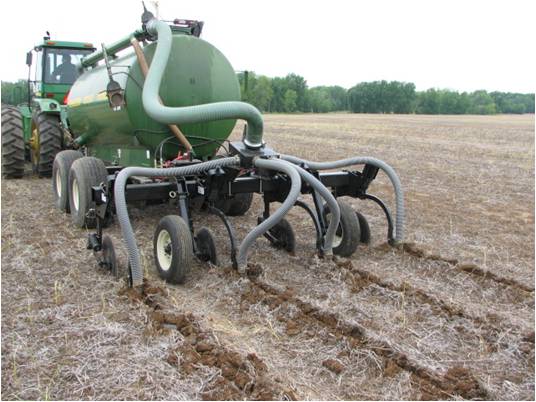
Fig. 2. Swine slurry application by direct injection.

Why Study Greenhouse Gases and the Manure-Soil Interaction?

Although agricultural production has been identified as a significant source of green house gas (GHG) emissions, relatively little scientific research has been conducted to determine how manure management strategies effect GHG production upon land application. Even fewer studies have taken into consideration the microorganisms associated with applied manures. Microbial communities are responsible for nutrient transformation and chemical cycling in soil systems and many important functional groups (i.e., methanogens, nitrifiers and denitrifiers) are extremely sensitive to environmental management and climate conditions. The goal of this study was to evaluate how swine slurry land application methods effect microbial communities associated with nitrogen cycling and GHG production.

Fig. 3. Swine slurry application in combination with soil aeration.

What Did We Do?

We used molecular microbial methods to quantify changes in nitrifiers (amoA), denitrifiers (nirK, nosZ and narG) and methanogens (mcrA) in agricultural soils receiving swine slurry applied by (A) surface application (Fig. 1) (B) direct injection (Fig. 2) or (C) application in combination with soil aeration (Fig. 3). Soil samples were taken from triplicate plots 13 days after effluent application.

Above – Fig. 4. Concentration of methanogens (mcrA) and nitrate reducing bacteria (narG) as measured by quantitative, real-time PCR analysis of targeted genes (in parentheses). Swine slurry was applied by three methods surface, direct injection (Inj) or in combination with aeration (Aer). Chemical fertilizer (Fert) and plots with no fertilizer (Control) were also included. Initial slurry was removed before application. Cells in soils from plots with surface applied slurry were sampled at two depths (1.3 cm and 5.1 cm). Error bars represent the standard deviation of triplicate plot samples.
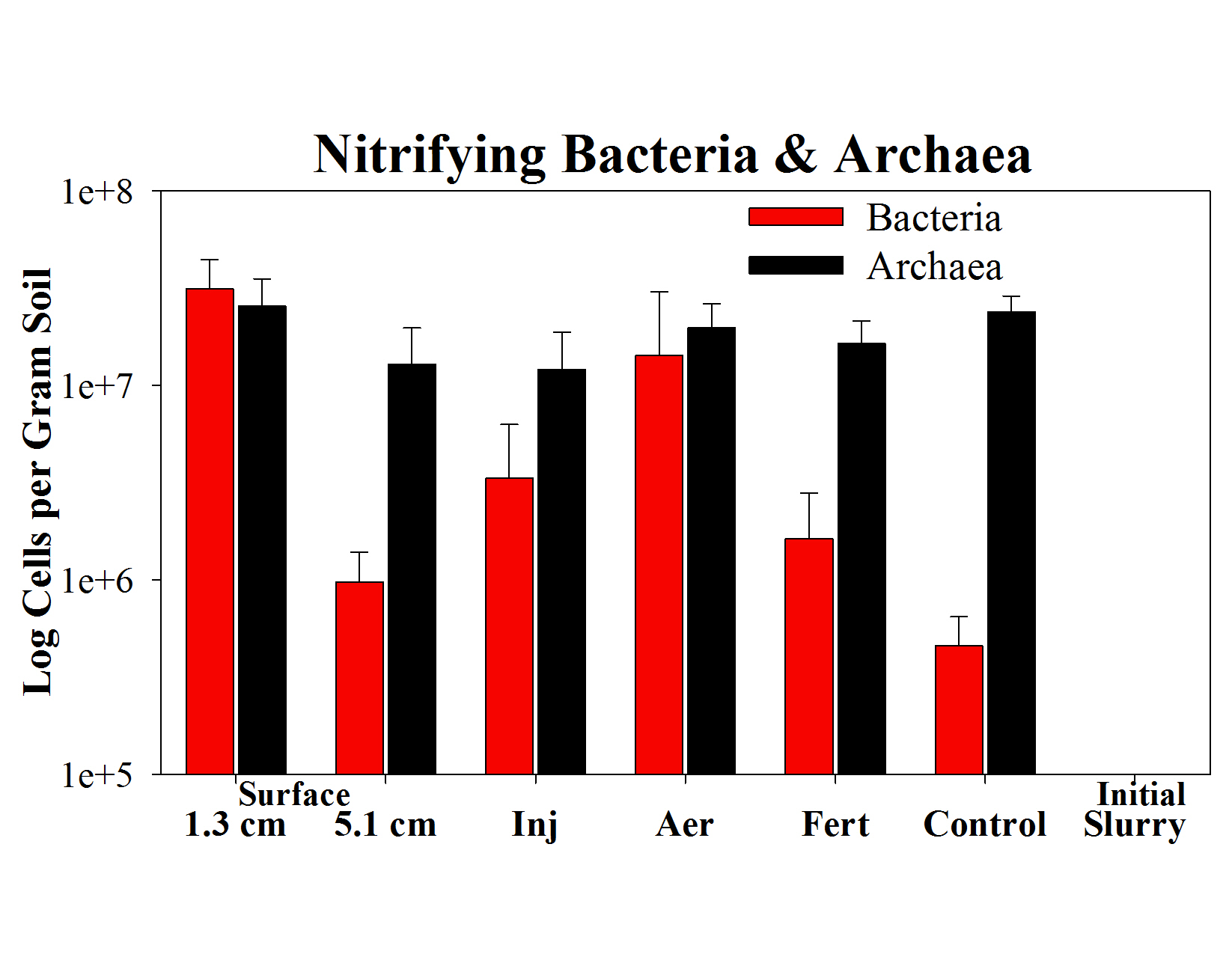
Below – Fig. 5. Concentration of nitrifying bacteria or archaea as measured by quantitative, real-time PCR analysis of the amoA specific for each group. Swine slurry was applied by three methods surface, direct injection (Inj) or in combination with aeration (Aer). Chemical fertilizer (Fert) and plots with no fertilizer (Control) were also included. Initial slurry was removed before application. Cells in soils from plots with surface applied slurry were sampled at two depths (1.3 cm and 5.1 cm). Error bars represent the standard deviation of triplicate plot samples.

What Have We Learned?

  1. Sampling cell concentrations at different soil depths (1.3 cm or 5 cm) from plots with surface applied slurry significantly influenced results (Fig. 4, Fig. 5 and Fig 6).
  2. Slurry applied by any method significantly increased (7 logs) concentrations of nitrate reducing bacteria and methanogens (Fig 4). Methanogens were present in the slurry while nitrate reducers were not measurable in slurry or control plots.
  3. Nitrifying bacteria significantly increased in concentration after slurry addition (i.e. 7, 31, 2 and 68 times higher than control plots for slurry applied by injection, aeration or surface application (1.3 cm and 5 cm), respectively); concentrations of nitrifying archaea did not change from initial levels after slurry addition (Fig. 5).
  4. Concentrations of bacteria, fungi and denitrifiers on plots with slurry applied were two to nine times higher than concentrations in controls with no slurry (Fig. 6).

Future Plans

Findings from this study underscore the importance of measuring both microbial populations and gas production when evaluating the impact of manure application on emissions. Emission data provided important information about the kind and rate of GHG emissions (see reference below for details; Sistani et al (2011) Soil Sci. America J. 74(2): 429-435). However, microbial analyses showed that select groups of nitrifiers and denitrifiers (but not all groups) were affected by manure application. Findings from microbial analyses will be the basis for development of future studies to target and manipulate specific microbial populations in ways that inhibit their ability to produce GHG.

Fig. 6. Change in concentration of targeted population in each treatment relative to that in the control with no slurry or fertilizer added. Concentrations of bacteria (16S RNA gene), fungi (18S RNA gene), nitrite reducing bacteria (nirK) or nitrous oxide reducing bacteria (nosZ) were measured by quantitative, real-time PCR analysis of targeted genes (in parentheses). Swine slurry was applied by three methods surface, direct injection (Inj) or in combination with aeration (Aer). Chemical fertilizer (Fert) and plots with no fertilizer (Control) were also included. Initial slurry was removed before application. Cells in soils from plots with surface applied slurry were sampled at two depths (1.3 cm and 5.1 cm). Error bars represent the standard deviation of triplicate plot samples.

Authors

Dr. Kimberly Cook, Research Microbiologist, USDA Agricultural Research Service, kim.cook@ars.usda.gov

Dr. Karamat Sistani, Research Soil Scientist, USDA Agricultural Research Service

Additional Information

USDA-ARS Bowling Green, KY Location Webpage: http://www.ars.usda.gov/main/site_main.htm?modecode=64-45-00-00


Relevant Publications:

Sistani, K.R., Warren, J.G., Lovanh, N.C., Higgins, S., Shearer, S. 2010. Green House Gas Emissions from Swine Effluent Applied to Soil by Different Methods. Soil Sci. America J. 74(2): 429-435.

Acknowledgements

We would like to thank Jason Simmons and Rohan Parekh for valuable technical assistance. This research is part of USDA-ARS National Program 214: Agricultural and Industrial By-products

The authors are solely responsible for the content of these proceedings. The technical information does not necessarily reflect the official position of the sponsoring agencies or institutions represented by planning committee members, and inclusion and distribution herein does not constitute an endorsement of views expressed by the same. Printed materials included herein are not refereed publications. Citations should appear as follows. EXAMPLE: Authors. 2013. Title of presentation. Waste to Worth: Spreading Science and Solutions. Denver, CO. April 1-5, 2013. URL of this page. Accessed on: today’s date.
Minnesota Watershed Nitrogen Reduction Planning Tool

Abstract

Using the nitrogen reduction planning model involves three steps.  The first step is to select a watershed, enter hypothetical adoption rates for each BMP, and compare the effectiveness and cost of the individual BMPs.  The second step is to compare suites of the BMPs that would attain any given reduction in the N load at minimum cost.  The third step is to “drill down” to the details and assumptions behind the models of effectiveness and costs of any particular BMP and make any adjustments to reflect your particular situation.

Why Develop a Nitrogen Reduction Planning Tool?

A watershed-level nitrogen reduction planning tool (Excel spreadsheet) compares the effectiveness and cost of nine different “best management practices” (BMPs), alone and in combination, for reducing N loads leaving a Minnesota watershed.  The Minnesota Pollution Control Agency is developing a new set of standards for nitrate nitrogen in surface waters based on aquatic life toxicity.  The tool was developed to assist the agency and local resource managers to better understand the feasibility and cost of various “best management practices” to reduce N loading from Minnesota cropland.

What Did We Do?

The BMPs are:  reducing corn N fertilizer rates to extension recommended rates, changing fertilizer application timing, seeding cover crops, installing tile line bioreactors or controlled drainage, planting riparian buffers, or converting some corn and soybean acres to a perennial crop. The spreadsheet does its analysis for a watershed that the user selects.  However, the N loadings and crop economic calculations are done first by agroecoregion before aggregating the results into the watershed of interest.  Agroecoregions are units having relatively homogeneous climate, soil and landscapes, and land use/land cover.  The spreadsheet includes area data for the fifteen high-N HUC8 watersheds that make up roughly the southern half of the state, along with the state as a whole.  When the user selects a watershed for analysis, formulas retrieve results as an area-weighted average of the agroecoregions making up that watershed.  Each of the fifteen HUC8 watersheds includes between four and nine agroecoregions.

The N loadings from each agroecoregion are calculated in three categories:  drainage tile discharges, leaching from cropland, and runoff.  Nitrogen loading amounts modeled are “edge-of-field” measures that do not account for denitrification losses that occur beyond the edge of field as groundwater travels towards and is discharged to streams.  The BMPs consider only loading from cropland, but loading from forests and impervious urban and suburban land is also included in the totals.

What Have We Learned?

The EPA’s Science Advisory Board has said that a 45% reduction in both N and P is needed in the Mississippi River to reduce the size of the Gulf of Mexico hypoxic zone.  This tool suggests that the BMPs considered are not likely to achieve much more than half that reduction even at high adoption rates.  Reducing N fertilizer rates on corn down to extension-recommended levels and shifting from fall to spring or sidedressed applications tend to be among the cheaper BMPs to adopt, but the results vary across watersheds and weather scenarios.  Various other factors such as crop and fertilizer prices also affect the results, hence the need for a computer tool.

Future Plans

The tool and results of a larger project will be reviewed during the first half of 2013.  The tool may then play a role in implementation of the new N state standards in the state.

Authors

William F. Lazarus, Professor and Extension Economist, University of Minnesota wlazarus@umn.edu

Geoff Kramer, Research Fellow, Department of Biosystems and Bioproducts Engineering, University of Minnesota

David J. Mulla, Professor, Department of Soil, Water, and Climate, University of Minnesota

David Wall, Senior Hydrologist, Watershed Division, Minnesota Pollution Control Agency

Additional Information

The latest version of the tool and an overview paper are available at the author’s project page.

Davenport, M. A., and B. Olson. “Nitrogen Use and Determinants of Best Management Practices:  A Study of Rush River and Elm Creek Agricultural Producers Final Report, submitted to the Minnesota Pollution Control Agency  as part of a comprehensive report on nitrogen in Minnesota Surface Waters.” Department of Forest Resources, University of Minnesota, St. Paul, Minnesota, September 2012.

Fabrizzi, K., and D. Mulla. “Effectiveness of Best Management Practices for Reductions in Nitrate Losses to Surface Waters In Midwestern U.S. Agriculture.  Report submitted to the Minnesota Pollution Control Agency  as part of a comprehensive report on nitrogen in Minnesota Surface Waters.” September 2012.

Lazarus, W. F., et al. “Watershed Nitrogen Reduction Planning Tool (NBMP.xlsm) for Comparing the Economics of Practices to Reduce Watershed Nitrogen Loads.” December 11, 2012, http://wlazarus.cfans.umn.edu/.

Mulla, D. J., et al. “Nonpoint Source Nitrogen Loading, Sources and Pathways for Minnesota Surface Waters.  Report submitted to the Minnesota Pollution Control Agency  as part of a comprehensive report on nitrogen in Minnesota Surface Waters.” Department of Soil, Water & Climate, University of Minnesota, September 2012.

Acknowledgements

Partial support for this project was provided by the Minnesota Legislature.

The authors are solely responsible for the content of these proceedings. The technical information does not necessarily reflect the official position of the sponsoring agencies or institutions represented by planning committee members, and inclusion and distribution herein does not constitute an endorsement of views expressed by the same. Printed materials included herein are not refereed publications. Citations should appear as follows. EXAMPLE: Authors. 2013. Title of presentation. Waste to Worth: Spreading Science and Solutions. Denver, CO. April 1-5, 2013. URL of this page. Accessed on: today’s date.