
Farm-System Modeling to Evaluate Environmental Losses, Profitability, and Best Management Practice Cost-Effectiveness

Waste to Worth: Spreading science and solutions logoWaste to Worth home | More proceedings….

Abstract

To meet Chesapeake Bay Total Maximum Daily Load requirements for agricultural pollution, conservation districts and farmers are tasked with implementing best management practices (BMPs) that reduce farm losses of nutrients and sediment. The importance of the agricultural industry to the regional economy highlights the need for determining cost-effective BMP solutions given the geographical and operational characteristics of these farms. This study evaluated both the environmental risk and farm profitability of common farm-level management practices for three major farm types in the region: crop, tractor-based (“English”) dairy, and horse-drawn (“Amish”) dairy.

Whole-farm simulations were conducted with the Integrated Farm System Model, a multi-year, process-based simulation model, to facilitate a broader understanding of the challenges for the farmers in finding financially feasible and environmentally sustainable solutions. Strip cropping, conservation tillage, cover cropping, and nutrient management BMPs generally reduced nutrient and sediments losses from all three farm types. However, scenarios that reduced phosphorus and sediment losses generally promoted more leaching of nitrogen. Double cropping corn with winter wheat combined with improved nutrient management was the most profitable practice for the crop farm, increasing average farm profitability by 92% over the baseline condition, while reducing combined nitrogen and total phosphorus losses by 13% and 23%, respectively.

Net profitability of the dairy farm was increased only by decreasing manure storage or using improved nutrient management. For the horse-drawn dairy, cover-cropping and harvest of rye silage combined with increased nutrient management provided the greatest increase in farm profit (+8%) and also reduced phosphorus and nitrogen losses.

Horse-drawn machinery through puts and increased human labor hours were required to simulate a typical Lancaster Old Order Amish dairy operation in Southeastern Pennsylvania.

Why Study Farms As a System?

Because southeastern Pennsylvania is a significant environmental contributor of the Chesapeake Bay, agricultural land management is under intense scrutiny by restoration groups. It is imperative to improving water quality that economically and culturally acceptable nonpoint source control practices be explored, developed, and evaluated. This is true for “contemporary” crop and dairy farms in the region as well as those that are more conservative in their use of electrical- or gas-powered farming equipment, described in this study as “Lancaster Old Order Amish”. Evaluation from a whole-farm perspective enables practical assessments of tradeoffs among management practice combinations and is particularly relevant when effectiveness relies on the willingness and dedication of the farm operators.

What Did We Do?

The expertise of regional conservationists and pooled results from farmer surveys were used to determine three major farm types in southeastern Pennsylvania and design potentially acceptable management combinations for each type. Three baseline farms were described: 400 ha corn-soy-wheat crop farm; 100 cow, 120 ha contemporary dairy; and 24 ha Lancaster Old Order Amish dairy. Whole-farm impacts were assessed with the Integrated Farm System Model (IFSM), a multi-year, process-based simulation model. Environmental tradeoffs between nitrogen, phosphorus, and sediment losses were evaluated and financial cost-benefits through change in annual net return for the farmer were analyzed.

What Have We Learned?

Strip cropping, conservation tillage, cover cropping, and improved nutrient management generally reduced nutrient and sediment losses from all three farm types. However, scenarios that reduced phosphorus and sediment runoff losses generally increased nitrogen leaching to groundwater. Double cropping corn and winter wheat under improved nutrient management was the most profitable combination for the crop farm, increasing average farm profitability by 92% over the baseline while reducing combined nitrogen and total phosphorus losses by 13% and 23%, respectively. Net profitability of the contemporary dairy farm was increased only by decreasing manure storage or using improved nutrient management. For the Lancaster Old Order Amish dairy, cover-cropping and harvest of rye silage combined with increased nutrient management provided the greatest increase in farm profit (+8%) and also reduced phosphorus and nitrogen losses.

Future Plans

Cost-effective recommendations from a whole farm perspective that account for unique characteristics of particular farm types can aid officials in determining locally agreeable methods for efficiently addressing regional priority pollutants. As farms adopt and implement suggested management changes, additional management practices of interest can be evaluated. Also, IFSM is being expanded to consider air emissions and carbon sequestration effects of the management practices.

Authors

Tamie L. Veith, Agricultural Engineer, USDA-ARS, tamie.veith@ars.usda.gov

Andrew D. McLean, Water Resources Designer, McCormick Taylor, Inc.

C. Alan Rotz, Agricultural Engineer, USDA-ARS

James M. Hamlett, Professor of Agricultural and Biological Engineering, The Pennsylvania State University

James S. Shortle, Distinguished Professor of Agricultural and Environmental Economics, The Pennsylvania State University

Additional Information

Integrated Farm System Model: http://www.ars.usda.gov/Main/docs.htm?docid=8519

McLean, A. D., 2012. Modeling best management practices on representative farms in Southeastern Pennsylvania. Master’s thesis, PA State University, University Park, PA. https://etda.libraries.psu.edu/paper/14093/, available Dec. 05, 2012.

Acknowledgements

This work contributes to the Conservation Effects Assessment Project (CEAP), jointly funded, coordinated, and administered by United States Department of Agriculture’s Natural Resources Conservation Service, Agricultural Research Service, and National Institute for Food and Agriculture. We would like to thank Mike Hubler and Larry Baum from Dauphin County Conservation District and officials at Lancaster and Lebanon County Conservation Districts for their advice and guidance categorizing and characterizing farms of Dauphin County and southeastern Pennsylvania. Thanks also to Kristen Saacke-Blunk and Matt Royer from Conewago Creek Collaborative Conservation Initiative for their time and input.  Mention of trade names or commercial products in this publication is solely for the purpose of providing specific information and does not imply recommendation or endorsement by the U.S. Department of Agriculture. USDA is an equal opportunity provider and employer.

The authors are solely responsible for the content of these proceedings. The technical information does not necessarily reflect the official position of the sponsoring agencies or institutions represented by planning committee members, and inclusion and distribution herein does not constitute an endorsement of views expressed by the same. Printed materials included herein are not refereed publications. Citations should appear as follows. EXAMPLE: Authors. 2013. Title of presentation. Waste to Worth: Spreading Science and Solutions. Denver, CO. April 1-5, 2013. URL of this page. Accessed on: today’s date.
The Farm Manure to Energy Initiative: Using Excess Manure to Generate Farm Income in the Chesapeake’s Phosphorus Hotspots

Waste to Worth: Spreading science and solutions logoWaste to Worth home | More proceedings….

Abstract

Currently, all the Bay states are working to achieve nutrient reduction goals from various pollution sources.  Significant reductions in phosphorus pollution from agriculture, particularly with respect to phosphorus losses from land application of manure are needed to support a healthy aquatic ecosystem.  Producers in high-density animal agricultural production areas such as Lancaster County region of Pennsylvania, the Delmarva Peninsula, and the Shenandoah Valley region of Virginia, need viable alternatives to local land application in order to meet nutrient reduction goals.

Field demonstrations will be monitored to determine whether the technologies are environmental beneficial, and economically and technically feasible. Specific measures of performance include: reliability and heat distribution, in-house air quality, avoided propane or electricity use, costs to install and maintain, fertilizer and economic value of ash or biochar produced, air emissions, and fate of poultry litter nutrients. Technology evaluation results will be shared on a clearinghouse website developed in partnership with eXtension.

The Farm Manure to Energy Initiative is also supporting efforts to develop markets for nutrient rich ash and biochar co-products. Field trials using nutrient rich ash and biochar from poultry litter thermochemical processes for fresh market vegetable production are currently underway at Virginia Tech’s Eastern Shore Agricultural Research and Experiment Station.

Purpose

The Farm Manure to Energy Initiative is a collaborative effort to evaluate the technical, environmental, and economic feasibility of farm-scale manure to energy technologies in an effort to expand management and revenue-generating opportunities for excess manure nutrients in concentrated animal production regions of the Chesapeake Bay watershed.

What Did We Do?

The project team went through a comprehensive review process and identified three farm-scale, manure to energy technologies that we think have the potential to generate new revenue streams and provide alternatives to local land application of excess manure nutrients.  Installation and performance evaluation of two of these technologies on four host farms in the Chesapeake Bay region are underway. Partners have also completed a survey of financing options for farm-scale technology deployment and published a comprehensive financing resources guide for farmers in the Chesapeake Bay region.

What Have We Learned?

To date, we have not identified any manure to energy technologies that also provide alternatives to local land application of excess manure nutrients for liquid manures.  Thermochemical manure to energy technologies using poultry litter as a fuel source seem to show the most promise for offering opportunities to export excess nutrients from phosphorus hotspots in the Chesapeake Bay region. Producing heat for poultry houses is the most readily available energy capture option.  We did not identify any vendors with a proven approach to producing electricity via farm-scale, thermochemical manure to energy technologies. With respect to the fate of poultry litter nutrients, preliminary air emissions data indicates that most poultry litter nitrogen (greater than 98%) is converted to non-reactive nitrogen in the thermochemical process. Phosphorus and potash are preserved in the ash or biochar coproducts. Preliminary field trial results indicate that phosphorus in ash and biochar is bioavailable and can be used as a replacement for commercial phosphorus fertilizer, but bioavailability varied according to the thermochemical process.

Future Plans

We are currenty in the process of installing and measuring the performance of farm-scale demonstrations in the Chesapeake Bay region.  We are collaborating with the Livestock and Poultry Environmental Learning Center to develop a clearinghouse website for thermochemical farm-scale manure to energy technologies that will be hosted on the eXtension website.  Performance data from our projects will be shared on this website, which can also be used as a platform to share information about the performance of other farm-scale, thermochemical technology installations around the U.S. Technical training events using farm demonstrations as an educational platform will be hosted during the later half of the project. Additional field and row crop trials to demonstrate the fertilizer value of the concentrated nutrient coproducts are also planned using ash from farm demonstrations.

Authors

Jane Corson-Lassiter, USDA NRCS, Jane.Lassiter@va.usda.gov; Kristen Hughes Evans, Executive Director, Sustainable Chesapeake

Additional partners in the Farm Manure to Energy Initiative include: Farm Pilot Project Coordination, Inc., University of Maryland Center for Environmental Studies, University of Maryland Environmental Finance Center, Virginia Cooperative Extension, Lancaster County Conservation District, the Virginia Tech Eastern Shore Agricultural Research and Extension Center, National Fish and Wildlife Foundation, Chesapeake Bay Funders Network, Chesapeake Bay Commission, and International Biochar Institute.

Additional Information

www.sustainablechesapeake.org

www.fppcinc.org

Acknowledgements

Funding for this project is provided by a grant from the USDA Conservation Innovation Grant program, the National Fish and Wildlife Foundation via the U.S. EPA Innovative Nutrient and Sediment Reduction Program, the Chesapeake Bay Funders Network, as well as technology vendors and host farmers participating in the technology demonstrations.


The authors are solely responsible for the content of these proceedings. The technical information does not necessarily reflect the official position of the sponsoring agencies or institutions represented by planning committee members, and inclusion and distribution herein does not constitute an endorsement of views expressed by the same. Printed materials included herein are not refereed publications. Citations should appear as follows. EXAMPLE: Authors. 2013. Title of presentation. Waste to Worth: Spreading Science and Solutions. Denver, CO. April 1-5, 2013. URL of this page. Accessed on: today’s date.

Swine Manure & Aqua-ammonia Nitrogen Application Timing on Subsurface Drainage Water

Waste to Worth: Spreading science and solutions logoWaste to Worth home | More proceedings….

Abstract

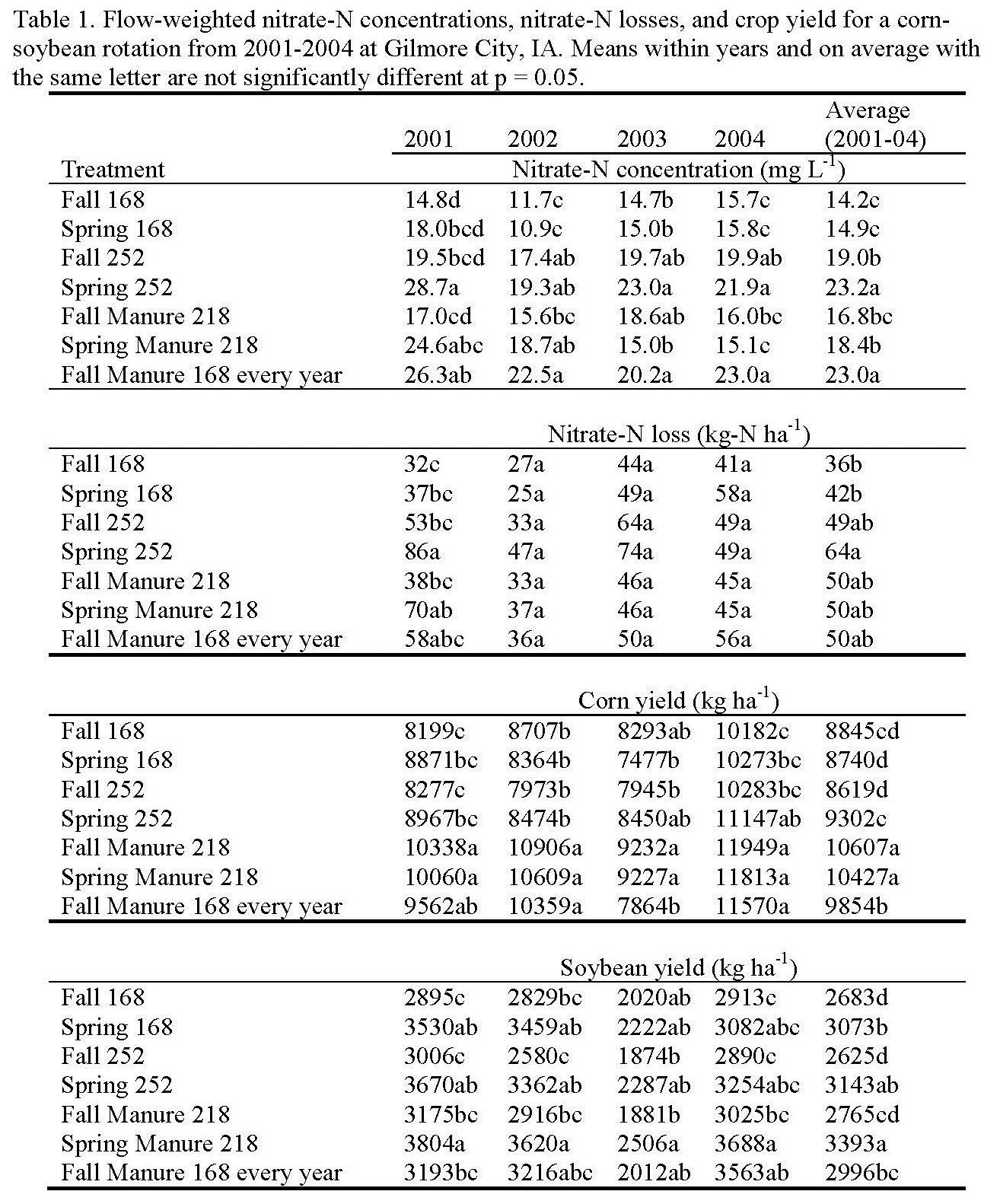
In Iowa and many other Midwestern states, excess water is removed artificially through subsurface drainage systems.  While these drainage systems are vital for crop production, nitrogen (N) added as manure or commercial fertilizer, or derived from soil organic matter, can be carried as nitrate-nitrogen (NO3-N) to downstream water bodies.  A five-year, five-replication, field study was conducted in north-central Iowa with the objective to determine the influence of seasonal N application as ammonia or liquid swine manure on flow-weighted NO3-N concentrations and losses in subsurface drainage water and crop yields in a corn-soybean rotation.  Four aqua-ammonia N treatments (150 or 225 lb-N/acre applied for corn in late fall or as an early season side-dress) and three manure treatments (200 lb-N/acre for corn in late fall or spring or 150 lb-N/acre  in the fall for both corn and soybean) were imposed on subsurface drained, continuous-flow-monitored plots. Four-year average flow-weighted NO3-N concentrations measured in drainage water were ranked: spring aqua-ammonia 225 (23 ppm) = fall manure 150 every year (23 ppm) > fall aqua-ammonia 225 (19ppm) = spring manure 200 (18 ppm) = fall manure 200 (17 ppm) > spring aqua-ammonia 150 (15 ppm) = fall aqua-ammonia 150 (14 ppm).  Corn yields were significantly greater (p=0.05) for the spring and fall manure-200 rates than for non-manure treatments. Soybean yields were significantly greater (p=0.05) for the treatments with a spring nitrogen application to the previous corn crop. Related: LPELC Manure Nutrient Management resources

Check Out These Other Presentations About Tile Drainage

Tile Drainage Field Day

Use of Filters in Drainage Control Structures

New Technologies for Drainage Water Management

Role of Drainage Depth and Intensity on Nutrient Loss

Why Study Sub-Surface Drainage and Manure Application?

Subsurface agricultural drainage has allowed for enhanced crop production in many areas of the world including the upper Midwest, United States. However, the presence of nitrate-nitrogen (nitrate-N) in subsurface tile drainage water is a topic of intense scrutiny due to several water quality issues. With the growing concern for the health of the Gulf of Mexico and local water quality concerns, there is a need to understand how recommended nitrogen management practices, such as through nitrogen rate and timing, impact nitrate-N concentrations from subsurface drainage systems.  The objective of this presentation is to summarize results of studies from Iowa that have documented the impact of nitrogen application rate and timing on tile drainage nitrate loss. 

What Did We Do?

The field experimental site was located near Gilmore City in Pocahontas County, IA. In the fall of 1999, seven treatments were initiated on 35 plots at the site to determine the effect of N source, rate, and application timing on crop yield and subsurface drainage water quality in a corn and soybean (CS) rotation. Two fertilizer N rates (168 or 252 kg ha-1) applied in the spring or fall and liquid swine manure (LSM) applied in spring or fall (218 kg ha-1) for corn production, and fall applied LSM for both crops in a CS rotation (168 kg ha-1) were randomly distributed in five blocks. Flow-weighted drainage samples were collected and volume measurements recorded for each plot through sampling/monitoring systems during drainage seasons in 2001-2004.

What Have We Learned?

This multi-year experiment demonstrated that rate and to a lesser extent timing affect concentration and losses and even at constant rates, these can be highly variable depending on precipitation patterns, N mineralization/denitrification processes and crop utilization in a given season. As expected, as nitrogen application rate to corn increases, the nitrate-N concentrations in subsurface tile drainage water increase.  This highlights the need for appropriate nitrogen application to corn and to avoid over application.  However, it is important to note that even when recommended nitrogen application rates are used, nitrate-N concentrations in subsurface drainage are still elevated and may exceed the EPA drinking water standard for nitrate-N of 10 mg L-1.  Relative to timing of nitrogen application, i.e. moving from fall to spring application, our studies showed little to moderate potential to decrease nitrate-N concentrations. Likely the largest factor when looking at the effect from fertilizer application timing is when precipitation and associated nitrate-N loss occurs.  Although timing of nitrogen application is important, perhaps the most important factor is to apply the correct amount of N. Manure treatments out yielded commercial N in all years. No significant differences in corn yield for any year were noted between application timing. Soybean yields were affected by N timing and less so by application rate.

click on image to enlarge

Future Plans

Other management practices need to be explored for their potentials in reducing nitrate loads from tile drained systems. Promising practices include drainage management, alternative cropping systems and edge-of-field practices.

Authors

Matthew Helmers, Associate Professor, Department of Agricultural & Biosystems Engineering, Iowa State University, mhelmers@iastate.edu

Xiaobo Zhou, Assistant Scientist, Department of Agricultural & Biosystems Engineering, Iowa State Univeristy

Carl Pederson, Agricultural Specialist, Department of Agricultural & Biosystems Engineering, Iowa State University

Additional Information

Lawlor, P.A., A.J. Helmers, J.L. Baker, S.W. Melvin, and D.W. Lemke. 2011. Comparison of liquid swine manure and ammonia nitrogen dynamics for a corn-soybean crop system. Trans. ASABE 54(5): 1575-1588.

LPELC Manure Nutrient Management home

Acknowledgements

Funding for this project was provided by the Iowa Department of Agriculture and Land Stewardship through the Agricultural Water Management fund.


The authors are solely responsible for the content of these proceedings. The technical information does not necessarily reflect the official position of the sponsoring agencies or institutions represented by planning committee members, and inclusion and distribution herein does not constitute an endorsement of views expressed by the same. Printed materials included herein are not refereed publications. Citations should appear as follows. EXAMPLE: Authors. 2013. Title of presentation. Waste to Worth: Spreading Science and Solutions. Denver, CO. April 1-5, 2013. URL of this page. Accessed on: today’s date.
Liquid Manure Sampling Procedures

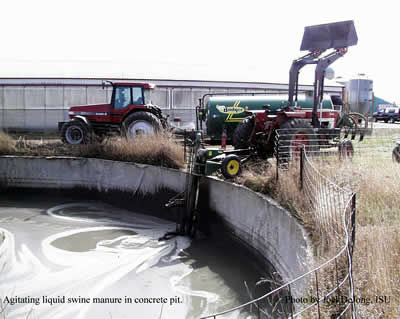
When testing manure, your nutrient management plan is only as good as your ability to obtain a representative sample. In liquid manure storage, agitation is critical to spreading uniform manure and to getting a representative sample. Agitating for 2-4 hours is the minimum. Depending on the type of storage longer agitation times may be required. The agitation for sampling should be similar to the agitation done when the storage is emptied. For this reason the most practical time to sample is when the storage is being emptied for field application.

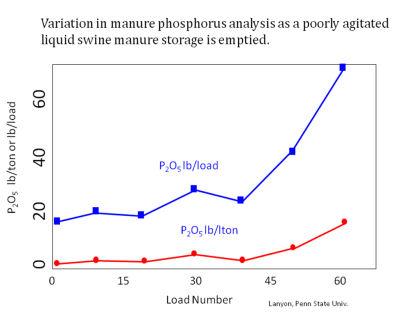
If the storage is not adequately agitated there will likely be stratification. The figure below illustrates how manure analysis can vary within a storage without adequate agitation. In this example manure in the last 15 loads spread from this storage has 2 to 3 times more phosphorus than in the first 45 loads spread. If the storage is known to be stratified, separate samples should be taken as the manure consistency changes during emptying.

diagram

cc2.5 Les Lanyon

Sampling As Manure Storage Is Emptied

Agitate the storage thoroughly before sampling. Use a bucket to collect at least 5 samples during the process of loading several spreader loads and save them in the bucket. When all of the samples are collected, thoroughly mix the samples and take a subsample from this to fill the lab manure test container. When filling containers with liquid manure never fill the container more than ¾ full. If samples are collected over a several hour period, the bucket with manure sample should be stored on ice to limit ammonia losses.

Sample Manure When Pumping From Storage. Photo courtesy of Ontario Ministry of Agriculture, Food and Rural Affairs. Photo Source: http://www.thecattlesite.com/articles/1307/sampling-liquid-manure-for-analysis


Sampling From the Manure Storage

Picture Source: http://www.extension.iastate.edu/pages/communications/epc/Winter02/manure.html

Sampling a storage directly is much more difficult and likely to result in more variable results than sampling as the manure is loaded into the spreader. Agitate the storage thoroughly before sampling. Use a small bucket or tube to collect at least 5 samples from different locations in the storage. Combine these samples in a bucket and thoroughly mix the samples and take a subsample from this to fill the lab manure test container. When filling containers with liquid manure never fill the container more than ¾ full.

Liquid Manure Sampling Video

This video from the Iowa Learning Farms Project shows two sampling techniques for liquid manure storage prior to agitation. As indicated above, samples of agitated liquid manure should be obtained when possible, but in cases where the information from the lab analysis (which can take several days) is needed before manure can be applied to crop land.

Part 2: Sampling Liquid Manure

Sampling Manure During Application

This method is good for irrigated manure. Place buckets around the field to catch manure from the spreader or irrigation equipment. Place these to collect manure from more than one spreader load. Combine and mix the manure collected from different locations, and take a subsample from this to fill the lab manure test container. This method may give you “crop available ammonia nitrogen” as any ammonia losses may have already occurred prior to reaching bucket. What reaches the bucket is likely to soak into the soil and be available to the crop.

Related Web Pages

Overview of Manure Testing

Page Authors: Douglas Beegle, Penn State University and John Peters, University of Wisconsin

On-Farm Nutrient Management Research: Replacing Commercial Sidedress Nitrogen with Liquid Livestock Manure on Emerged Corn

This webinar highlights the on-farm research that has been done and is being planned in the state of Ohio to capitalize on the opportunity to apply in-season nutrients with manure application. This presentation was originally broadcast on May 19, 2017. More… Continue reading “On-Farm Nutrient Management Research: Replacing Commercial Sidedress Nitrogen with Liquid Livestock Manure on Emerged Corn”